REVIEW 3 major objections 6 minor 36 references
Photoinduced inclusive cross sections in hadronic collisions at the LHC
T0 review · 3 major / 6 minor · reviewed 2026-08-06 · deepseek-v4-flash
Pith's one-line read The paper derives inclusive electromagnetic dissociation in pp and pA collisions at the LHC from deep inelastic structure functions, with simultaneous Delta(1232) excitation dominating the pp rate.
desk verdict A competent and honest application of a 1974 formula to LHC kinematics, with useful new numbers for Coulomb dissociation, though the TeV gamma-p extraction idea depends on an unvalidated extrapolation. read the letter →
The pith
A machine-rendered reading of the paper's core claim, the machinery that carries it, and where it could break.
The reading
What carries the argument
The load-bearing object is the master formula Eq. (2.10), a compact expression for $d\sigma/dQ^2\,dM_X^2\,dM_Y^2$ as a sum of products of transverse and longitudinal virtual photoabsorption cross sections of the two hadrons, weighted by kinematic coefficients $C_{TT}$, $C_{LT}$, $C_{LL}$. This factorisation into two single-hadron tensors is what turns measured deep inelastic structure functions into predictions for hadron-hadron dissociation. The paper feeds into it a merged parametrization of the proton: the resonance-region fit of Ref. [14], the ALLM description beyond the resonance region, and a LUX-like fit at large $Q^2$, while $\sigma_L$ is included but numerically negligible.
What would settle it
Measure the proton-nucleus dissociation cross section $pA\to XA$ with a detector that captures the full hadronic final state of the dissociated proton and determines the invariant mass $M_X$ calorimetrically; if the observed $M_X$ distribution at photon-proton energies above roughly 200 GeV deviates from the resonance-plus-ALLM and LUX-like predictions by more than their mutual spread, the extrapolation that carries the paper's claims is wrong.
Extended reading notes
Core claim
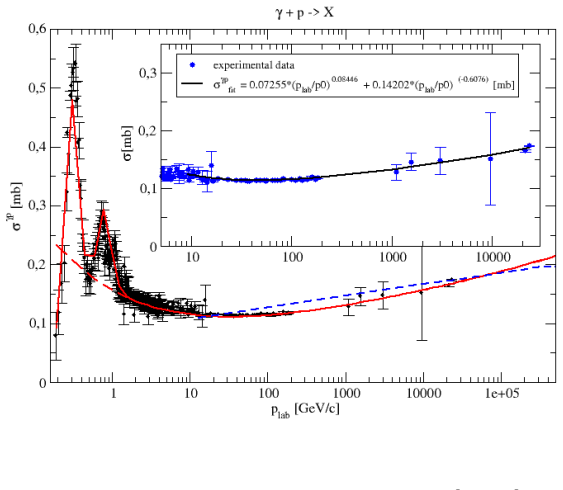
On its own terms, the paper establishes that the inclusive reactions $AB\to XY$ mediated by one-photon exchange are fully determined by the virtual photoabsorption cross sections $\sigma_T(\gamma^* A; M_X^2, Q^2)$ and $\sigma_L(\gamma^* A; M_X^2, Q^2)$ of the two colliding hadrons. The threefold differential cross section of Eq. (2.10) assembles these from the hadronic tensors, with the coefficient functions $C_{TT}, C_{LT}, C_{LL}$ carrying all kinematic dependence on $s$, $Q^2$, $M_X^2$, and $M_Y^2$. Using a resonance-region fit joined to the ALLM parametrization, plus a LUX-like structure-function fit, the paper predicts for $pp\to XY$ at $\sqrt{s}=13\,\mathrm{TeV}$ a cross section dominated by the simultaneous excitation of $\Delta(1232)$ resonances, dropping steeply with invariant mass. For $p\,^{208}\mathrm{Pb}\to X\,^{208}\mathrm{Pb}$ at $\sqrt{s_{NN}}=8.79\,\mathrm{TeV}$, it predicts substantial rates up to photon-proton centre-of-mass energies in the TeV range, and it argues that measuring the full dissociative final state there could determine the total photoabsorption cross section of the proton.
Load-bearing premise
The calculation rests on assuming the parametrized curves for how a proton absorbs a virtual photon remain correct when the photon is nearly real and when the photon-proton energy reaches the TeV region, ranges in which the fits are not directly tested by data.
Editorial extensions
If this is right
- The $pp\to XY$ cross section at $\sqrt{s}=13\,\mathrm{TeV}$ is dominated by simultaneous $\Delta(1232)$ excitation, with a steep falloff in $M_X$, $M_Y$ and a strong correlation between large mass on one side and small mass on the other.
- For $pA\to XA$ at $\sqrt{s_{NN}}=8.79\,\mathrm{TeV}$, sizeable cross sections extend to photon-proton energies in the TeV region, so the channel can in principle measure the total photoabsorption cross section of the proton at energies beyond any direct measurement.
- The longitudinal contribution $\sigma_L$ is numerically negligible, so the predictions are effectively controlled by the transverse structure function $F_2$ at low $Q^2$.
- The same final-state topology as single and double diffractive dissociation is distinguished by a strong dominance of very small $Q^2$, near the kinematic limit, which can serve as an experimental tag.
Reading between the lines
- (Editorial inference) The same master formula could be applied to ion-ion collisions, where measured electromagnetic-dissociation cross sections would provide a direct cross-check of the $Q^2$ flux and structure-function inputs at lower photon energies.
- (Editorial inference) The predicted double-$\Delta(1232)$ peak in $pp\to XY$ is a distinctive two-resonance signal that could be searched for in existing large-rapidity-gap LHC data, separating the photon-exchange contribution from diffractive dissociation by its tiny $Q^2$.
- (Editorial inference) A dedicated calorimetric measurement of the dissociated proton in $pA\to XA$ would not only test the paper's curves but also discriminate between the ALLM and LUX-like extrapolations of $\sigma_{\gamma p}(W)$ at high $W$, a discrimination the paper does not itself quantify.
Editorial analysis
A structured set of objections, weighed in public.
Referee Report
Summary. The manuscript derives and applies a one-photon-exchange formula for inclusive electromagnetic dissociation in pp and pA collisions. Starting from the hadronic tensor and virtual photoabsorption cross sections, it presents the Carimalo et al. master formula, Eq. (2.10), for dsigma/dQ^2 dM_X^2 dM_Y^2, including TT, LT, and LL terms, and applies it to pp -> XY at sqrt(s)=13 TeV and pA -> XA at sqrt(s_NN)=8.79 TeV. The inputs are merged parametrizations of the resonance region (Bosted-Christy), ALLM, and a LUX-like F2+FL parametrization. The results show a dominance of simultaneous Delta(1232) excitation, a rapid fall-off with invariant mass, and sizable cross sections extending to photon-proton energies of order TeV. The authors propose pA -> XA as a possible way to measure the total photoabsorption cross section of the proton at very high energies, while explicitly stating that further studies are necessary to assess that potential.
Significance. If the numerical predictions hold, the paper provides useful estimates for a class of LHC processes that share a final-state topology with single and double diffractive dissociation, and the pA proposal offers an interesting route toward extending measurements of the total photoabsorption cross section beyond HERA energies. The formalism itself is not new, following the 1974 Carimalo et al. convolution, but applying it with modern structure-function inputs and highlighting Coulomb dissociation of protons on nuclei is a useful contribution. The paper is commendably explicit that no quantity is fitted to new data and that the high-energy extraction idea requires further assessment. The main value depends on the reliability of the input sigma_T and sigma_L in unmeasured kinematics, which is currently not quantified.
major comments (3)
- [Sec. III.A, Figs. 4 and 6] The central numerical predictions depend on sigma_{T,L}(gamma* p; M_X^2, Q^2) extrapolated to low Q^2 and to photon-proton center-of-mass energies W up to the TeV region, where the input is unconstrained by data and where the ALLM and color-dipole curves in Fig. 5 visibly differ in energy dependence. The authors themselves describe the dipole-model agreement as "somewhat fortuituous," but no uncertainty band or alternative-input calculation is provided. Since the high-M_X tails in Figs. 4 and 6, and the proposed pA measurement, are controlled by exactly this region, the quantitative predictions are not yet robust. Please repeat the calculation with at least one alternative high-energy input, such as the dipole model shown in Fig. 5, and state which features of the distributions are stable under that change.
- [Sec. III.A and Eqs. (2.6)-(2.7)] The exact merging of the resonance-region fit [14], ALLM [15,16], and the LUX-like parametrization [11] is not specified: there is no transition point in W or Q^2, no interpolation procedure, and no statement of which flux-factor convention phi_A from Eq. (2.6) is used when converting F_2 and F_L into sigma_{T,L} via Eq. (2.7). The master formula Eq. (2.10) and the coefficient functions C_{ij} depend on that convention, so as written the numerical results are not reproducible. The authors should specify the matching conditions and the convention explicitly, or provide the code or interface used for the numerical evaluation.
- [Sec. III.B, Fig. 6] The suggestion that pA -> XA could measure the total photoabsorption cross section assumes both that the full dissociative proton final state can be measured calorimetrically and that the photon-exchange contribution can be isolated from the same final-state topology generated by strong single-diffractive dissociation. The paper does not quantify these backgrounds or compare the photon-exchange rate with the QCD-induced single-diffraction rate in the same phase space. If the extraction idea is to remain a central motivation, an estimate of this background ratio should be included; otherwise, the abstract-level claim should be softened further.
minor comments (6)
- [Eq. (2.8)] The definition of Bjorken x uses m_p in the denominator for a generic hadron A; it should use m_A (or be restricted to the proton case) for consistency with the other formulas in Section II.
- [Figs. 2 and 3 captions] The captions of Figs. 2 and 3 are identical, although the text describes them as showing different content; one caption should describe the two-dimensional maps in M_X and log Q^2.
- [Fig. 5 and Sec. III.B] The text says the solid red curve is the LUX-like fit of Ref. [11], while the caption says the red curve merges the fit of Ref. [14] with ALLM; the relationship between ALLM and the LUX-like fit should be clarified, and the caption should match the text.
- [Sec. III.A and Sec. III.B] There are several typographical errors: "in tems of QCD partons," "decribes," and "texbook-like" should be corrected.
- [Eq. (2.12)] The expression for cosh eta is typeset in a way that is hard to parse, with a large brace containing several terms; it should be checked against Ref. [13] and reformatted for clarity.
- [Fig. 6 caption] The caption says the right panels show the high-mass contribution, but the relevant distinction is between the upper and lower panels; the caption should say "lower panels."
Circularity Check
No circularity: Eq. (2.10) is a standard 1974 convolution of external DIS-based inputs; nothing is fitted to the predicted cross sections.
full rationale
The derivation chain is not circular. The master formula Eq. (2.10) is attributed to Carimalo et al. [13], an independent 1974 derivation, and is simply the contraction of two hadronic tensors; no quantity in this paper is fitted to the predicted pp->XY or pA->XA cross sections. The numerical inputs are prior parametrizations of sigma_{T,L}(gamma* p): the resonance-region fit of Bosted and Christy [14], the ALLM parametrization [15,16], and the LUX-like fit of Ref. [11]. Refs. [11] and [35] are self-citations by overlapping authors, but they are anchored to HERA and fixed-target DIS measurements and are not defined in terms of the cross sections calculated here. The color-dipole model [35] is used only to illustrate the energy dependence of the input, with the authors explicitly noting that its agreement with HERA data 'may be somewhat fortuituous'. The real-photon curves shown in Fig. 5 are displays of the adopted input parametrizations, not independent predictions derived in this paper. The proposed pA->XA measurement of the total photoabsorption cross section is explicitly qualified: 'Further studies are necessary to assess the potential...'. The genuine scientific risk is that the input sigma_{gamma p} is extrapolated to Q^2 near zero and W up to the TeV region, where ALLM and the dipole model disagree; this is a model-uncertainty and correctness concern, not a circularity of the derivation.
Assumptions & free parameters
free parameters (5)
- Quark masses in color-dipole model =
m_u=m_d=m_s=140 MeV, m_c=1.5 GeV
- Dipole cross-section fit parameters =
fit to DIS data with Q^2 > 3.5 GeV^2 (Ref. [35])
- ALLM parametrization parameters =
from Refs. [15,16]
- LUX-like structure function parameters =
from Ref. [11]
- Resonance-region fit parameters =
from Bosted and Christy (Ref. [14])
assumptions (5)
- domain assumption Master formula Eq. (2.10) from Carimalo et al. (1974) is correct for inclusive dissociation via one-photon exchange
- domain assumption Factorization of the cross section into two independent photoabsorption vertices
- domain assumption The virtual photoabsorption cross sections sigma_{T,L} for the proton can be continued from the fitted DIS region to the low-Q^2, large-W region relevant at the LHC
- standard math Elastic vertex is described by Sachs form factors (Eq. 2.15)
- domain assumption Color-dipole representation (Eqs. 3.1-3.4) with a gluon-driven dipole cross section describes the energy dependence of sigma_{gamma-p}
Cite this review
Pith. "Pith review of Photoinduced inclusive cross sections in hadronic collisions at the LHC." pith.science (2026). https://pith.science/paper/27XXXIDT
@misc{pith2026250700682,
  author       = {Pith},
  title        = {Pith review of: Photoinduced inclusive cross sections in hadronic collisions at the LHC},
  year         = {2026},
  howpublished = {\url{https://pith.science/paper/27XXXIDT}},
  note         = {Machine review of arXiv:2507.00682}
}
abstract
We discuss inclusive electromagnetic dissociation processes in proton--proton ($pp$) and proton--nucleus ($pA$) scattering at the LHC where one or both of the protons dissociate. These processes which involve the exchange of a virtual photon in the $t$--channel are calculable in terms of deep inelastic structure functions (virtual photoabsorption cross sections). For the $pA \to XA$ reaction there emerges the possibility of measuring the total photoabsorption cross section on the proton at very high energies.
Figures


Figures from the paper (3 more)


Reference graph
Works this paper leans on
-
[13]
F. E. Low and S. B. Treiman, Phys. Rev. D5, 756 (1972)
work page 1972
-
[14]
C. Carimalo, G. Cochard, P. Kessler, J. Parisi, and B. Roehner, Phys. Rev. D10, 1561 (1974)
work page 1974
-
[11]
inspired by the procedure proposed in [10]. In Fig.2 we show the two–dimensional distributions inMX, MY both for the low–mass res- onance region as well as a larger mass range. We see that the cross section is dominated by the simultaneous excitation of ∆+(1232)–resonances. The cross section quickly drops with invariant masses of the excited system. We se...
work page 2025
-
[1]
G. Baur, K. Hencken, D. Trautmann, S. Sadovsky, and Y. Kharlov, Phys. Rept.364, 359 (2002), hep-ph/0112211
arXiv 2002
-
[2]
C. A. Bertulani, S. R. Klein, and J. Nystrand, Ann. Rev. Nucl. Part. Sci.55, 271 (2005), nucl-ex/0502005
arXiv 2005
-
[3]
S. Klein and P. Steinberg, Ann. Rev. Nucl. Part. Sci.70, 323 (2020), 2005.01872
arXiv 2020
- [4]
-
[5]
C. A. Bertulani, J. Phys. Conf. Ser.2619, 012003 (2023), 2304.12475
work page Pith review arXiv 2023
Show all 36 references
- [6]
-
[7]
Maj (ATLAS), Phys
K. Maj (ATLAS), Phys. Proc. UPC1, 25 (2024)
2024
- [8]
-
[9]
Łuszczak, W
M. Łuszczak, W. Schäfer, and A. Szczurek, Phys. Rev. D93, 074018 (2016), 1510.00294
2016 arXiv
-
[10]
Manohar, P
A. Manohar, P. Nason, G. P. Salam, and G. Zanderighi, Phys. Rev. Lett.117, 242002 (2016), 1607.04266
2016 arXiv
- [12]
-
[15]
P. E. Bosted and M. E. Christy, Phys. Rev. C77, 065206 (2008), 0711.0159
2008 arXiv
-
[16]
Abramowicz, E
H. Abramowicz, E. M. Levin, A. Levy, and U. Maor, Phys. Lett. B269, 465 (1991)
1991
- [17]
-
[18]
T. A. Armstrong et al., Phys. Rev. D5, 1640 (1972)
1972
-
[19]
Symposium on Electron and Photon Interactions at High Energies (1969)
E.D.Bloometal., in 4th Int. Symposium on Electron and Photon Interactions at High Energies (1969)
1969
-
[20]
Michalowski, D
S. Michalowski, D. Andrews, J. Eickmeyer, T. Gentile, N. B. Mistry, R. Talman, and K. Ueno, Phys. Rev. Lett.39, 737 (1977)
1977
-
[21]
Meyer, B
H. Meyer, B. Naroska, J. H. Weber, M. Wong, V. Heynen, E. Mandelkow, and D. Notz, Phys. Lett. B33, 189 (1970)
1970
-
[22]
H. G. Hilpert et al., Phys. Lett. B27, 474 (1968)
1968
-
[23]
M. L. Perl, T. Braunstein, J. Cox, F. Martin, W. T. Toner, B. Dieterle, T. F. Zipf, W. L. Lakin, and H. C. Bryant, Phys. Rev. Lett.23, 1191 (1969)
1969
-
[24]
Ballam et al., Phys
J. Ballam et al., Phys. Rev. D5, 545 (1972)
1972
-
[25]
D. O. Caldwell et al., Phys. Rev. Lett.40, 1222 (1978)
1978
-
[26]
G. M. Vereshkov, O. D. Lalakulich, Y. F. Novoseltsev, and R. V. Novoseltseva, Phys. Atom. Nucl. 66, 565 (2003)
2003
- [27]
- [28]
-
[29]
Thiel, F
A. Thiel, F. Afzal, and Y. Wunderlich, Prog. Part. Nucl. Phys.125, 103949 (2022), 2202.05055
2022 arXiv
-
[30]
N. N. Nikolaev, J. Speth, and V. R. Zoller, Phys. Lett. B473, 157 (2000), hep-ph/9911433
2000 arXiv
- [31]
-
[32]
M. M. Block, L. Durand, and P. Ha, Phys. Rev. D89, 094027 (2014), 1404.4530
2014 arXiv
-
[33]
Britzger, C
D. Britzger, C. Ewerz, S. Glazov, O. Nachtmann, and S. Schmitt, Phys. Rev. D100, 114007 (2019), 1901.08524
2019 arXiv
-
[34]
Chwastowski and J
J. Chwastowski and J. Figiel, Phys. Part. Nucl.35, 619 (2004), hep-ex/0311044. 10
2004 arXiv
-
[35]
N. N. Nikolaev and B. G. Zakharov, Z. Phys. C49, 607 (1991)
1991
-
[36]
Łuszczak and H
A. Łuszczak and H. Kowalski, Phys. Rev. D95, 014030 (2017), 1611.10100. 11
2017 arXiv
Reviewed August 6, 2026 · model on record in the stance chip above.
Discussion (0). Sign in to comment.