REVIEW 3 major objections 3 minor 66 references
Persuasion Gains and Losses from Peer Communication
T0 review · 3 major / 3 minor · reviewed 2026-08-04 · deepseek-v4-flash
Pith's one-line read In critical-mass Bayesian persuasion on networks, adding communication links among receivers can strictly increase a sender's payoff, and in several natural network families it reaches the maximum value achievable with private signaling.
desk verdict Novel and mostly convincing non-monotonicity results, but Proposition 4 (clusters) is false as stated and needs a real repair before the paper is publishable. read the letter →
The pith
A machine-rendered reading of the paper's core claim, the machinery that carries it, and where it could break.
The reading
What carries the argument
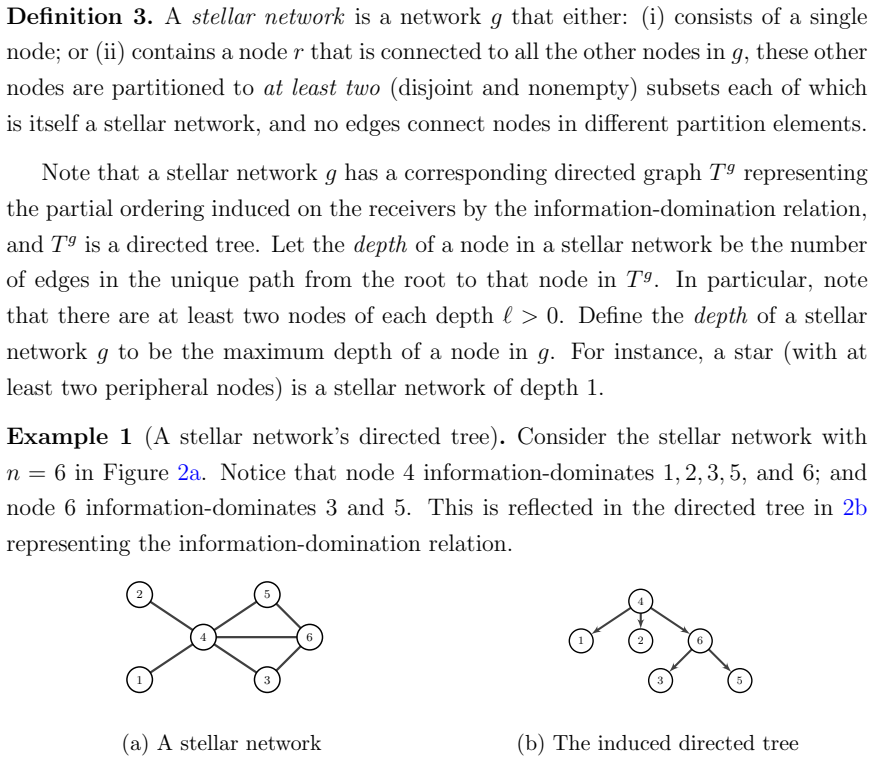
The central tool is the notion of information domination: receiver i information-dominates j if j's neighborhood is a subset of i's. The paper relies on Lemma 3, a cited sufficient condition, which says that if a network has no information-dominating pairs, the sender can achieve the empty-network upper bound V_n^k. The constructive half of the paper builds link additions that break every information-dominating pair, then invokes Lemma 3 to conclude the upper bound is reached.
What would settle it
For a small instance of Theorem 1 (e.g., n=8, k=4, lambda0(X)=0.3, with a stellar component of six nodes of depth 2 and two external nodes), explicitly build the extension described in the proof and numerically optimize the sender's experiment over finite message sets; if the optimum is strictly below V_8^4 = 0.9, the central claim fails. More directly, any network with no information-dominating pairs whose optimal value is below V_n^k would refute the imported Lemma 3 and with it the paper's upper-bound constructions.
Extended reading notes
Core claim
The paper's central claim is that in a Bayesian persuasion problem where a sender needs a critical mass of receivers to choose a desired action, and where each receiver observes the messages sent to himself and to his direct neighbors, extending the communication network can strictly increase the sender's expected utility. For several natural families—stellar networks with a hierarchical center, constellations with multiple centers, galaxies built from disconnected star components, and cluster networks of equal-sized cliques—the paper constructs an explicit extension on which the sender achieves the upper bound V_n^k, the payoff of optimal private signaling on an empty network. The mechanism
Load-bearing premise
The upper-bound results depend on Lemma 3, a theorem imported from a cited paper: if a network has no information-dominating pairs, the sender can achieve the private-signaling value V_n^k; if that theorem is false or carries unstated conditions, the main constructions in Theorem 1, Theorem 2, Proposition 3, and Proposition 4 collapse.
Editorial extensions
If this is right
- The sender's value is not monotone in network density: adding links can strictly increase the probability of reaching critical mass, even when starting from a network where the sender is constrained.
- In stellar, constellation, galaxy, and cluster networks satisfying the stated conditions, an optimal experiment on the extension reaches V_n^k, the same value as in the empty network—so the sender loses nothing from communication if links are chosen well.
- Such beneficial extensions come at the receivers' expense: the probability that the collective outcome matches the true state decreases.
- Platform designers and policymakers should not equate more communication with greater consumer or voter protection; link recommendations can actually increase manipulability.
- For marketing and voting, the results imply semi-connected sets of consumers or voters are not necessarily harder to persuade; the structure of the added links determines whether persuasion power rises or falls.
Reading between the lines
- The information-domination condition suggests a general design principle: any network extension that makes all neighborhoods incomparable should restore private-signaling power; this may apply to random graph models or community detection beyond the specific families studied.
- A testable behavioral prediction: in a lab experiment with a threshold voting task, adding a small number of cross-hierarchy links (e.g., connecting a peripheral member of one clique to an outsider) should increase the sender's success rate relative to the base network, while adding all links should lower it back to public-signaling levels.
- For social media policy, this implies that recommender systems that create 'boundary spanner' connections—links between users of different hierarchical depths—may inadvertently amplify the platform's or advertisers' persuasive power; density alone will not reveal the risk.
- The paper's non-monotonicity could also inform design of deliberation procedures: if an institution controls the communication graph (e.g., committee meetings, town halls), choosing which participants can talk to whom is itself a design instrument that can be used for manipulation.
Signed reviews
Editorial analysis
A structured set of objections, weighed in public.
Referee Report
Summary. The paper studies a multi-receiver Bayesian persuasion problem with network spillovers: each receiver observes the sender's private message to himself and to his neighbors, and the sender wants a critical mass k of receivers to choose the sender-favorable action. The main claim is that, contrary to the intuition that more communication helps receivers, extending the network can strictly increase the sender's value, and in several families (stellar, halo, constellation, galaxy, cluster) the sender can reach the empty-network upper bound V_n^k. The analysis uses a symmetry lemma, a circle construction, and a sufficient condition for attaining V_n^k based on the absence of information-dominating pairs. Section 4 also gives examples where no beneficial extension exists.
Significance. If correct, the paper would make a valuable and counterintuitive contribution: it would show that the sender's persuasion value is non-monotone in network density, with concrete structural families where denser communication helps the sender and hurts receivers. The constructive experiments, especially the two-message circle construction, are a useful strength, and the transparent reliance on the information-domination lemma makes the proof strategy easy to follow. However, the cluster-family result (Proposition 4) is false as stated, which materially weakens the paper's claim to cover 'general families' of networks. The stellar and galaxy results may still be salvageable, but the current manuscript overstates the scope of its conclusions.
major comments (3)
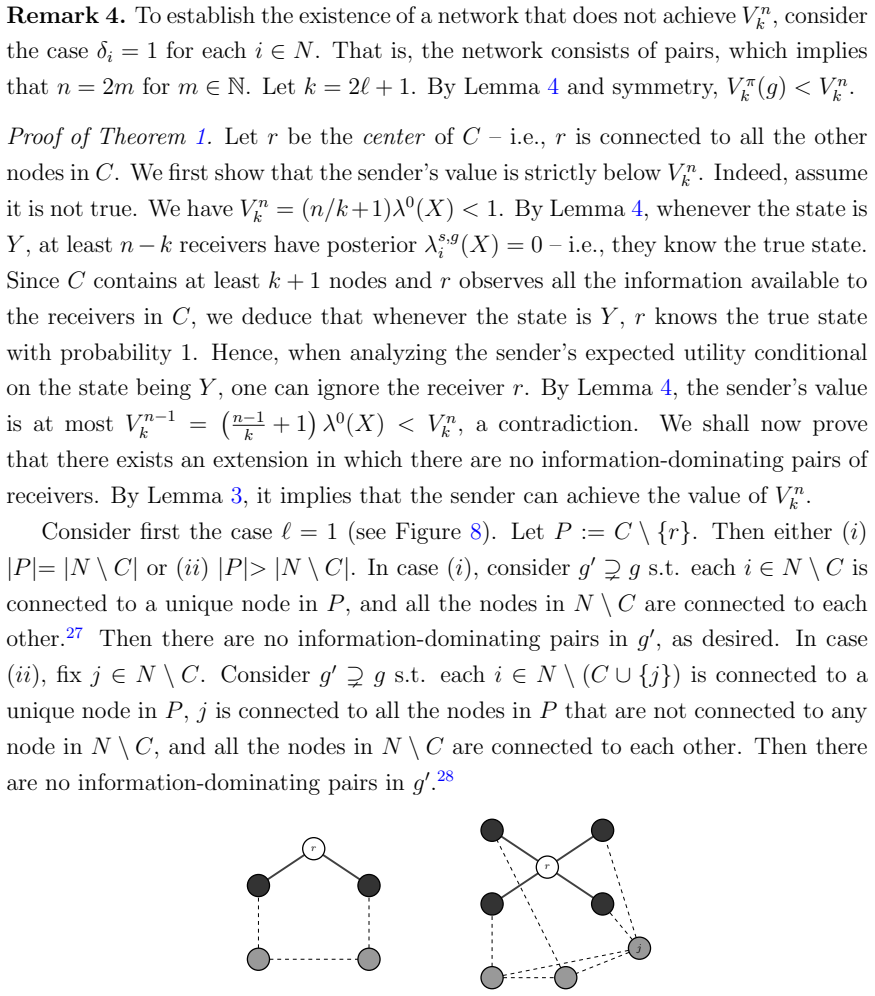
- [Appendix B, Proof of Proposition 4; Proposition 4] Proposition 4 is false as stated. The proof derives p|n and p|n-k, hence p|k, and then asserts that n/2<k<n forces gcd(n,k)=1. This is wrong: n=6, k=4, p=2 satisfies the hypotheses and gcd(6,4)=2. In that case, the network is three disjoint 2-cliques, and the sender can already achieve V_6^4. Send x to all receivers in state X; in state Y, with probability r = 6λ0/(4(1-λ0)), choose two of the three clusters uniformly and send x to those four receivers and y to the third cluster, and with probability 1-r send y to all. Each receiver in a targeted cluster has posterior 1/2, exactly four receivers choose x, and the value is (6/4+1)λ0 = V_6^4. Since V_n^k is the upper bound, no extension can strictly benefit. The proposition needs a divisibility condition such as p∤k, and the divisible case must be handled separately.
- [Lemma 3 and its uses in Theorem 1, Theorem 2, Proposition 3, Proposition 4] The paper's central positive results all conclude by invoking Lemma 3, imported from Babichenko et al. (2021), which asserts that a network with no information-dominating pairs attains V_n^k. Lemma 3 is therefore load-bearing. The manuscript should either prove it or provide a precise reference with all hypotheses verified. The Proposition 4 counterexample shows the importance of checking the lemma's precondition: if the original network already attains V_n^k, the lemma cannot be used to establish strict improvement. The current proofs do not independently verify this precondition in a way that rules out the counterexample.
- [Corollary 2 (Halo)] Corollary 2 is stated without proof. It is not an immediate corollary of the displayed results, and it is used to extend the paper's nonmonotonicity claim to halo networks. The authors should provide a proof or a precise reduction to Theorem 1; otherwise the claim should be labeled as a conjecture or removed.
minor comments (3)
- [Lemma 2 proof] The set T_i is defined as {i, i+1, ..., i+n-1-k} (mod n), which has n-k elements, not k. To obtain the claimed experiment, T_i should have exactly k elements, e.g., {i, ..., i+k-1}. As written, the construction does not reach the critical mass in state Y.
- [Proposition 4 proof, line 'p|pq=n'] The notation 'p|pq=n' is awkward; since n=pq, the authors mean p divides n. More importantly, the subsequent claim about relative primality is false, as noted above.
- [Example 2] The example sets λ0(X)=1/3, which equals k/(n+k) rather than satisfying the strict inequality assumed at the end of Section 2. The text acknowledges this, but it would be cleaner to choose a generic prior and adjust the probabilities.
Circularity Check
No significant circularity: the paper's results are supported by independent constructions and externally cited lemmas, not by self-referential definitions or fitted predictions.
full rationale
The derivation chain is not circular. The upper bound V_n^k = (n/k+1)λ0(X) is cited as the known empty-network value from Kerman et al. (2024) / Arieli and Babichenko (2019), and the paper proves via a replication argument (Proposition 1 proof) that every network value lies between V_p and V_n^k. That bound is an independent mathematical fact, not an input that already contains the paper's main conclusions. The load-bearing no-information-domination sufficiency condition (Lemma 3) is imported from Babichenko et al. (2021) as a black-box theorem; it is parameter-free, its assumptions do not include any of the paper's target statements, and the paper supplies explicit link-addition constructions (circle experiment, stellar/halo/constellation/galaxy/cluster extensions) to satisfy it. Even though some citations overlap with the present authors (Zabarnyi in Babichenko et al. 2021; Kerman in Kerman et al. 2024), the cited results have independent proofs and are not derived from the current paper's claims. No parameter is fitted to data, and no predictive quantity is defined in terms of the quantity it is supposed to predict. The skeptic's concern about Proposition 4—that the gcd argument 'since n/2<k<n, we must have that n,k are relatively prime' is invalid (e.g., n=6,k=4,p=2) and that the cluster network may already attain V_n^k—is a mathematical-correctness issue, not a circularity: if correct, it would falsify a theorem, but it would not make the derivation equivalent to its inputs. Therefore the circularity score is 0.
Assumptions & free parameters
assumptions (4)
- domain assumption V_n^k = ((n+k)/k) * lambda_0(X) is the value of the empty network (Kerman et al., 2024).
- domain assumption Babichenko et al. (2021) Theorem 3.5: a network with no information-dominating pairs admits an experiment achieving the private signaling upper bound.
- standard math Receivers use Bayes updates and choose the action with posterior at least 1/2, with ties broken in the sender's favor.
- domain assumption Prior lambda_0(X) < k/(n+k) and k >= floor((n+1)/2).
Cite this review
Pith. "Pith review of Persuasion Gains and Losses from Peer Communication." pith.science (2026). https://pith.science/paper/2AHUCP2Y
@misc{pith2026250909099,
  author       = {Pith},
  title        = {Pith review of: Persuasion Gains and Losses from Peer Communication},
  year         = {2026},
  howpublished = {\url{https://pith.science/paper/2AHUCP2Y}},
  note         = {Machine review of arXiv:2509.09099}
}
read the original abstract
We study a Bayesian persuasion setting in which a sender wants to persuade a critical mass of receivers by revealing partial information about the state to them. The homogeneous binary-action receivers are located on a communication network, and each observes the private messages sent to them and their immediate neighbors. We examine how the sender's expected utility varies with increased communication among receivers. We show that for general families of networks, extending the network can strictly benefit the sender. Thus, the sender's gain from persuasion is not monotonic in network density. Moreover, many network extensions can achieve the upper bound on the sender's expected utility among all networks, which corresponds to the payoff in an empty network. This is the case in networks reflecting a clear informational hierarchy (e.g., in global corporations), as well as in decentralized networks in which information originates from multiple sources (e.g., influencers in social media). Finally, we show that a slight modification to the structure of some of these networks precludes the possibility of such beneficial extensions. Overall, our results caution against presuming that more communication necessarily leads to better collective outcomes.
Figures


Figures from the paper (6 more)



Reference graph
Works this paper leans on
-
[1]
Ali, S. N. and D. A. Miller (2016). Ostracism and forgiveness. American Economic Review\/ 106\/ (8), 2329--2348
2016
-
[2]
Alonso, R. and O. C \^a mara (2016). Persuading voters. American Economic Review\/ 106\/ (11), 3590--3605
2016
-
[3]
Anderson, L. R. and C. A. Holt (1997). Information cascades in the laboratory. The American economic review\/ , 847--862
1997
-
[4]
Angeletos, G.-M. and A. Pavan (2004). Transparency of information and coordination in economies with investment complementarities. American Economic Review\/ 94\/ (2), 91--98
2004
-
[5]
Anunrojwong, J. and N. Sothanaphan (2018). Naive Bayesian learning in social networks . In Proceedings of the 2018 ACM Conference on Economics and Computation , pp.\ 619--636
2018
-
[6]
Arieli, I. and Y. Babichenko (2019). Private Bayesian persuasion . Journal of Economic Theory\/ 182 , 185--217
2019
-
[7]
Athanassopoulos, A. D. (2000). Customer satisfaction cues to support market segmentation and explain switching behavior. Journal of business research\/ 47\/ (3), 191--207
2000
-
[8]
Babichenko, Y., I. Talgam-Cohen, H. Xu, and K. Zabarnyi (2021). Multi-Channel Bayesian Persuasion . arXiv preprint arXiv:2111.09789\/
arXiv 2021
Show all 66 references
-
[9]
Backstrom, L. and J. Leskovec (2011). Supervised random walks: predicting and recommending links in social networks. In Proceedings of the fourth ACM international conference on Web search and data mining , pp.\ 635--644
2011
-
[10]
Bala, V. and S. Goyal (2000). A noncooperative model of network formation. Econometrica\/ 68\/ (5), 1181--1229
2000
-
[11]
Bardhi, A. and Y. Guo (2018). Modes of persuasion toward unanimous consent. Theoretical Economics\/ 13\/ (3), 1111--1149
2018
-
[12]
Aloini, P
Benevento, E., D. Aloini, P. Roma, and D. Bellino (2025). The impact of influencers on brand social network growth: Insights from new product launch events on Twitter . Journal of Business Research\/ 189 , 115123
2025
-
[13]
Hirshleifer, and I
Bikhchandani, S., D. Hirshleifer, and I. Welch (1992). A theory of fads, fashion, custom, and cultural change as informational cascades. Journal of political Economy\/ 100\/ (5), 992--1026
1992
-
[14]
Birkinshaw, and R
Bresman, H., J. Birkinshaw, and R. Nobel (1999). Knowledge transfer in international acquisitions. Journal of international business studies\/ 30\/ (3), 439--462
1999
-
[15]
Broderick, A. J., G. E. Greenley, and R. D. Mueller (2007). The behavioural homogeneity evaluation framework: Multi-level evaluations of consumer involvement in international segmentation. Journal of International Business Studies\/ 38\/ (5), 746--763
2007
-
[16]
Burt, R. S. (1992). Structural holes . Harvard University Press
1992
-
[17]
Burt, R. S. (2004). Structural holes and good ideas. American Journal of Sociology\/ 110\/ (2), 349 – 399
2004
-
[18]
Candogan, O. (2019). Persuasion in networks: Public signals and k-cores. New York, NY, USA. Association for Computing Machinery
2019
-
[19]
Guo, and H
Candogan, O., Y. Guo, and H. Xu (2020). On information design with spillovers. Available at SSRN 3537289\/
2020
-
[20]
Gupta, F
Chan, J., S. Gupta, F. Li, and Y. Wang (2019). Pivotal persuasion. Journal of Economic Theory\/ 180 , 178--202
2019
-
[21]
Church, J. and N. Gandal (1992). Network effects, software provision, and standardization. The journal of industrial economics\/ , 85--103
1992
-
[22]
Colla, P. and A. Mele (2010). Information linkages and correlated trading. The Review of Financial Studies\/ 23\/ (1), 203--246
2010
-
[23]
Colman, H. L. and A. Rouzies (2019). Postacquisition boundary spanning: A relational perspective on integration. Journal of Management\/ 45\/ (5), 2225--2253
2019
-
[24]
Cooperman, A. D. (2024). Bloc voting for electoral accountability. American Political Science Review\/ 118\/ (3), 1222--1239
2024
-
[25]
Corten, R. and V. Buskens (2010). Co-evolution of conventions and networks: An experimental study . Social Networks\/ 32\/ (1), 4--15
2010
-
[26]
Ursino, and A
Currarini, S., G. Ursino, and A. Chand (2020). Strategic transmission of correlated information. The Economic Journal\/ 130\/ (631), 2175--2206
2020
-
[27]
de Fine Licht, J. (2014). Transparency actually: how transparency affects public perceptions of political decision-making. European Political Science Review\/ 6\/ (2), 309--330
2014
-
[28]
Dong, Y., J. Tang, N. V. Chawla, T. Lou, Y. Yang, and B. Wang (2015). Inferring social status and rich club effects in enterprise communication networks. PloS one\/ 10\/ (3), e0119446
2015
-
[29]
Mengel, and C
Drago, F., F. Mengel, and C. Traxler (2020). Compliance behavior in networks: Evidence from a field experiment. American Economic Journal: Applied Economics\/ 12\/ (2), 96–133
2020
-
[30]
Egorov, G. and K. Sonin (2020). Persuasion on networks. Technical report, National Bureau of Economic Research
2020
-
[31]
Eguia, J. X. (2011). Voting blocs, party discipline and party formation. Games and economic behavior\/ 73\/ (1), 111--135
2011
-
[32]
Galeotti, A. and S. Goyal (2010). The law of the few. American Economic Review\/ 100\/ (4), 1468--92
2010
-
[33]
Galperti, S. and J. Perego (2025). Games with information constraints: seeds and spillovers. Theoretical Economics\/ 20 , 667–711
2025
-
[34]
Gatewood, J. B. (1984). Cooperation, competition, and synergy: information-sharing groups among Southeast Alaskan Salmon seiners . American Ethnologist\/ 11\/ (2), 350--370
1984
-
[35]
Gavazza, A. and A. Lizzeri (2009). Transparency and economic policy. The Review of Economic Studies\/ 76\/ (3), 1023--1048
2009
-
[36]
Goeree, J. K., A. Riedl, and A. Ule (2009). In search of stars: Network formation among heterogeneous agents. Games and Economic Behavior\/ 67\/ (2), 445--466
2009
-
[37]
Gormley, I. C. and T. B. Murphy (2008). Exploring voting blocs within the irish electorate: A mixture modeling approach. Journal of the American Statistical Association\/ 103\/ (483), 1014--1027
2008
-
[38]
Marble, and C
Grimmer, J., W. Marble, and C. Tanigawa-Lau (2025). Measuring the contribution of voting blocs to election outcomes. The Journal of Politics\/ 87\/ (3), 905--921
2025
-
[39]
Gupta, P., A. Goel, J. Lin, A. Sharma, D. Wang, and R. Zadeh (2013). Wtf: The who to follow service at twitter. In Proceedings of the 22nd international conference on World Wide Web , pp.\ 505--514
2013
-
[40]
Hansen, M. T. (1999). The search-transfer problem: The role of weak ties in sharing knowledge across organization subunits. Administrative science quarterly\/ 44\/ (1), 82--111
1999
-
[41]
Jackson, M. O. and B. W. Rogers (2007). Meeting strangers and friends of friends: How random are social networks? The American Economic Review\/ 97\/ (3), 890--915
2007
-
[42]
Br \'o dka, and J
Jankowski, J., P. Br \'o dka, and J. Hamari (2016). A picture is worth a thousand words: an empirical study on the influence of content visibility on diffusion processes within a virtual world. Behaviour & Information Technology\/ 35\/ (11), 926--945
2016
-
[43]
Kamenica, E. and M. Gentzkow (2011). Bayesian persuasion. American Economic Review\/ 101\/ (6), 2590--2615
2011
-
[44]
Stolarczyk, Z
Karamched, B., S. Stolarczyk, Z. P. Kilpatrick, and K. Josic (2020). Bayesian evidence accumulation on social networks. SIAM journal on applied dynamical systems\/ 19\/ (3), 1884--1919
2020
-
[45]
Katona, Z., P. P. Zubcsek, and M. Sarvary (2011). Network effects and personal influences: The diffusion of an online social network. Journal of marketing research\/ 48\/ (3), 425--443
2011
-
[46]
Katz, M. L. and C. Shapiro (1994). Systems competition and network effects. Journal of economic perspectives\/ 8\/ (2), 93--115
1994
-
[47]
Kerman, T. and A. P. Tenev (2021). Persuading communicating voters. Available at SSRN 3765527\/
2021
-
[48]
Kerman, T. T., P. J.-J. Herings, and D. Karos (2024). Persuading sincere and strategic voters. Journal of Public Economic Theory\/ 26\/ (1), e12671
2024
-
[49]
Kerman, T. T. and A. P. Tenev (2025). Information design for weighted voting. Economic Theory\/ 79 , 809--852
2025
-
[50]
Kerman, T. T., A. P. Tenev, and Y. Tsodikovich (2025). Bayesian persuasion in networks: Divisibility and network irrelevance. Available at SSRN 5131130\/
2025
-
[51]
Levy, G. (2007). Decision making in committees: Transparency, reputation, and voting rules. American economic review\/ 97\/ (1), 150--168
2007
-
[52]
Liporace, M. (2021). Persuasion in networks. Working Paper\/
2021
-
[53]
Marmaros, D. and B. Sacerdote (2006, 02). How Do Friendships Form? The Quarterly Journal of Economics\/ 121\/ (1), 79--119
2006
-
[54]
Perego, and I
Mathevet, L., J. Perego, and I. Taneva (2020). On information design in games. Journal of Political Economy\/ 128\/ (4), 1370--1404
2020
-
[55]
Jamtveit, and K
Mathiesen, J., B. Jamtveit, and K. Sneppen (2010). Organizational structure and communication networks in a university environment. Physical Review E—Statistical, Nonlinear, and Soft Matter Physics\/ 82\/ (1), 016104
2010
-
[56]
Friedman, and J
Mengel, F., D. Friedman, and J. Kov \'a r \' k (2024). Influence in social networks. Available at SSRN 5059047\/
2024
-
[57]
Molavi, P. and A. Jadbabaie (2011). Aggregate observational distinguishability is necessary and sufficient for social learning. In 2011 50th IEEE Conference on Decision and Control and European Control Conference , pp.\ 2335--2340. IEEE
2011
-
[58]
Noam, E. M. (2016). Who Owns the World's Media? Media Concentration and Ownership around the World . Oxford University Press
2016
-
[59]
Noble, G. and R. Jones (2006). The role of boundary-spanning managers in the establishment of public-private partnerships. Public administration\/ 84\/ (4), 891--917
2006
-
[60]
Nora, V. and E. Winter (2024). Exploiting social influence in networks. Theoretical Economics\/ 19\/ (1), 1--27
2024
-
[61]
Sun, J., A. J. Schram, and R. Sloof (2023). Public persuasion in elections: Single-crossing property and the optimality of censorship. Available at SSRN 4028840\/
2023
-
[62]
Taneva, I. (2019). Information design. American Economic Journal: Microeconomics\/ 11\/ (4), 151--85
2019
-
[63]
Titova, M. (2022). Persuasion with verifiable information. Technical report, Working Paper
2022
-
[64]
Vizcarrondo, T. (2013). Measuring concentration of media ownership: 1976--2009. International Journal on Media Management\/ 15\/ (3), 177--195
2013
-
[65]
Wang, Y. (2013). Bayesian persuasion with multiple receivers. Available at SSRN: https://ssrn.com/abstract=2625399\/
2013
-
[66]
Williams, P. (2012). We are all boundary spanners now? In Collaboration in Public Policy and Practice , pp.\ 95--118. Policy Press
2012
Reviewed August 4, 2026 · model on record in the stance chip above.
Discussion (0). Continue with ORCID to comment.