REVIEW 4 major objections 5 minor 46 references
URWKV: Unified RWKV Model with Multi-state Perspective for Low-light Image Restoration
T0 review · 4 major / 5 minor · reviewed 2026-08-07 · deepseek-v4-flash
Pith's one-line read The paper claims that a single RWKV-based encoder-decoder with multiple internal states outperforms task-specific low-light enhancers and larger unified transformers on eight benchmarks while using only 2.25M parameters.
desk verdict Solid incremental architecture paper with a real ablation misreport and an overbroad parameter claim; the central SOTA margins are plausible but not yet protocol-robust. read the letter →
The pith
A machine-rendered reading of the paper's core claim, the machinery that carries it, and where it could break.
The reading
What carries the argument
The load-bearing mechanism is the URWKV block, a modified RWKV block with three custom components. Luminance-adaptive Normalization (LAN) pools 1D luminance statistics from the current input and all previous stage outputs, applies multi-kernel 1D convolutions and an MLP with tanh to predict a per-channel scaling offset, and then normalizes adaptively, mimicking pupil adjustment. A multi-state quad-directional token shift (SQ-Shift) aggregates the current state with earlier intra-stage states through an exponential moving average before the original four-direction token shift, so degradation context persists across blocks. State-aware Selective Fusion (SSF) replaces naive skip connections: it channel-averages encoder features, aligns their spatial sizes, stacks them, runs them through an inception-style multi-receptive-field block, and predicts a sigmoid spatial weight that gates which encoder context should reach the decoder.
What would settle it
Re-run URWKV and the leading baselines (e.g., Retinexformer on LOL-v2-real and PDHAT on LOL-blur) under identical splits and training budgets across at least five random seeds; if their confidence intervals overlap with URWKV's by more than the claimed margins, the central performance claim fails to be confirmed.
Extended reading notes
Core claim
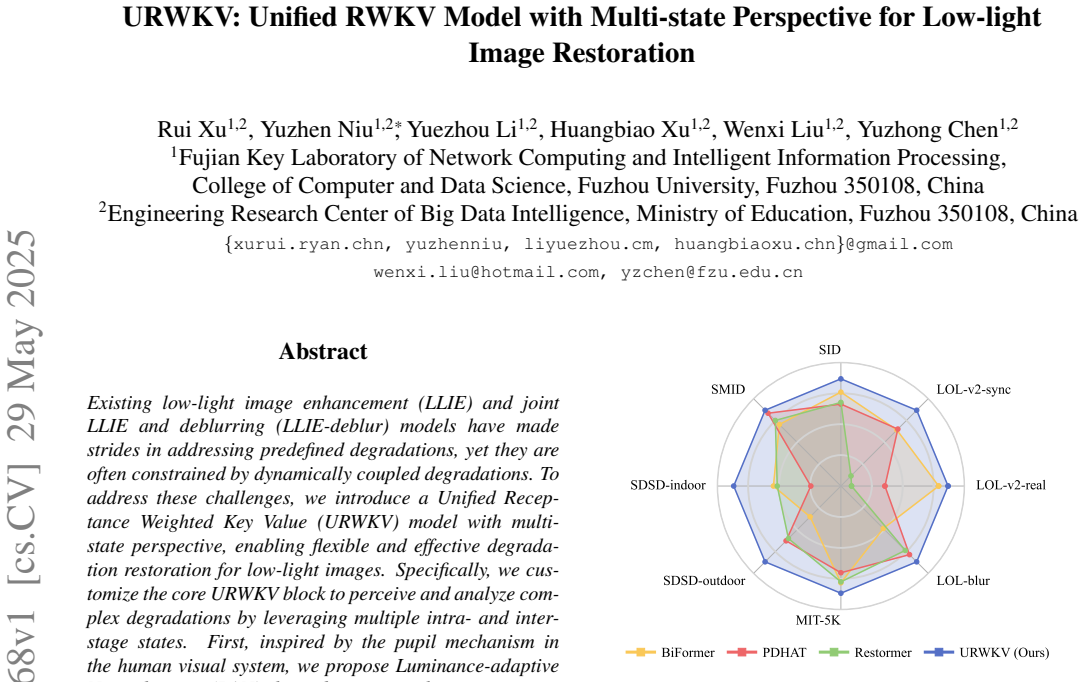
The central claim is that the "multi-state perspective" -- using both inter-stage states from earlier encoder/decoder stages and intra-stage states from preceding blocks -- lets an RWKV-style model perceive and restore dynamically coupled degradations. Concretely, URWKV reports 23.11 dB PSNR on LOL-v2-real, surpassing Retinexformer by 0.32 dB, and 27.27 dB on LOL-blur, surpassing PDHAT by 0.56 dB, while using fewer parameters and FLOPs than almost all compared models. The paper also demonstrates in ablations that the luminance-adaptive normalization contributes the largest single gain, and that the selective fusion module avoids the noise propagation and semantic gap of naive skip connections when multi-state encoder features are transferred.
Load-bearing premise
The superiority claim rests on the assumption that the baseline numbers quoted from earlier papers are directly comparable to URWKV's results -- same data splits, evaluation protocol, and training budget -- and that PSNR differences of 0.1 to 0.5 dB are meaningful; no error bars or significance tests are reported.
Editorial extensions
If this is right
- A single URWKV model can cover both low-light enhancement and joint low-light deblurring, so practitioners would not need separate pipelines for those coupled degradations.
- At 2.25M parameters and 18.34G FLOPs, the reported performance suggests the multi-state design is efficient enough for deployment on resource-constrained devices, if the benchmark margins hold.
- The SSF module's gating of skip connections implies that state-aware fusion could replace naive concatenation in other encoder-decoder restoration networks without adding parameters.
- Since the model is benchmarked as a unified model across LLIE, LLIE-deblur, and restoration datasets, its success would imply that the same architecture can adapt to varying degradation types rather than being predefined per task.
Reading between the lines
- A direct testable extension would be varying the decay factor alpha in the EMA aggregation per stage; the paper fixes it at 0.5, and adaptive alpha may yield further gains if the multi-state hypothesis is right.
- If LAN's inter-stage luminance modulation is what drives its 1.38 dB ablation gain, a similar modulator could be added to the LayerNorm of other Retinex-style backbones as a low-cost upgrade.
- The pupil-inspired mechanism suggests a natural extension to low-light video: inter-frame states could play the same role as inter-stage states for temporally coupled degradations.
Editorial analysis
A structured set of objections, weighed in public.
Referee Report
Summary. The manuscript proposes URWKV, a unified RWKV-based encoder-decoder architecture for low-light image enhancement and joint enhancement-deblurring. Three components are introduced: Luminance-adaptive Normalization (LAN) that modulates normalization parameters from inter-stage states, a multi-state quad-directional token shift (SQ-Shift) using exponential moving average over intra-stage states, and a State-aware Selective Fusion (SSF) module that replaces naive skip connections. The model is evaluated on eight benchmarks (LOL, SID, SMID, SDSD, FiveK, LOL-blur) against LLIE, LLIE-deblur, and unified baselines, reporting PSNR/SSIM and claiming state-of-the-art results with 2.25M parameters and 18.34G FLOPs. Code is provided.
Significance. If the performance claims withstand scrutiny, the paper would provide a meaningful extension of RWKV-style recurrent architectures to low-level vision, with a lightweight unified model for coupled low-light and blur degradations. The multi-state perspective (inter-stage LAN, intra-stage EMA, and selective fusion) is a plausible design direction, and the release of code supports reproducibility. However, the current evidence base has a load-bearing ablation misattribution, a parameter-efficiency claim that is contradicted by the paper's own table on two baselines, and a lack of statistical robustness for the small reported margins. These issues must be resolved before the claims can be accepted.
major comments (4)
- [Section 4.3, Table 4] The text states that 'the model with LAN alone achieves a more pronounced gain, with PSNR increasing by 1.38 dB over the baseline,' but Table 4 shows the baseline PSNR is 21.33, LAN-only is 21.40 (a gain of 0.07 dB), SSF-only is 22.71 (a gain of 1.38 dB), and the full model is 23.11. The 1.38 dB improvement is therefore attributable to SSF alone, not LAN alone. This misattribution overstates LAN's contribution and undermines the ablation evidence for the claimed central role of LAN; the text must be corrected or the ablations rerun.
- [Abstract, Section 4.2, Table 1] The abstract and conclusion claim that URWKV requires 'significantly fewer parameters' than state-of-the-art models, but Table 1 lists URWKV at 2.25M parameters while Retinexformer has 1.61M and BiFormer has 0.83M. The parameter-efficiency claim is therefore not valid as a general statement; it holds only relative to heavier baselines such as Restormer (26.11M) or MIRNet (31.76M). The authors should qualify the claim to name the specific baselines to which it applies.
- [Section 4.2, Tables 1-3] The reported superiority margins over the previous best methods are small (0.29 dB on SMID, 0.32 dB on LOL-v2-real, 0.56 dB on LOL-blur), yet no error bars, multiple seeds, or significance tests are reported. Baseline numbers are quoted from prior papers, so differences in data splits, cropping strategies, metric computation, and training budgets could easily account for these margins. To support the central superiority claim, the authors should report mean and standard deviation over multiple training runs and, where feasible, re-evaluate the closest baselines under identical protocols.
- [Section 4.2, SID results] The text says that URWKV 'delivers superior performance, closely trailing Retinexformer on SID,' but Table 1 shows URWKV at 23.11 dB versus Retinexformer at 24.44 dB on SID, a gap of 1.33 dB. A 1.33 dB gap is not 'closely trailing,' and the sentence also contradicts the surrounding claim of superiority. This should be rephrased to accurately describe the relative performance on SID.
minor comments (5)
- [Throughout] There are several typographical errors: 'anothor' in the Introduction, 'navie' and 'Exisiting' in Section 3.3, 'liminance' in the caption of Figure 2, and 'Proceddings' in references [13], [16], [31], and [46]. A careful proofreading pass is needed.
- [Section 3.2, Eq. (4)] In Eq. (4), the exponential moving average is written as MSA(X_t^LAN) = α ⊙ X_t^LAN + (1-α) ⊙ MSA(H_{t-1}), but MSA is used both as the aggregation function and as its output. Clarify the notation, for instance by defining S_t = α ⊙ X_t^LAN + (1-α) ⊙ S_{t-1}.
- [Section 3.2, Eq. (3)] In Eq. (3), the shift parameter β is introduced but it is not stated whether β is learnable, fixed, or also adapted using inter-stage states. Please specify.
- [Figure 1] The caption says the maximum PSNR values across all datasets are normalized, but the exact normalization procedure is not described. Provide the formula used for the normalized values.
- [Section 3.2, LAN description] The text says LAN leverages inter-stage states from 'six stages,' but the encoder-decoder framework in Figure 2 has three encoder stages and three decoder stages. Clarify whether the six stages include the input/output projections or another interpretation.
Circularity Check
No significant circularity: architectural claims are empirical, self-citations are baselines or design choices, and no prediction reduces to a fitted input.
full rationale
URWKV is an empirical architecture paper. The claimed derivation chain is: propose LAN (Eqs. 1-3), SQ-Shift (Eq. 4), multi-state mixing (Eqs. 5-6), and SSF (Eqs. 7-8), then train with a combined L1/SSIM/perceptual loss and report PSNR/SSIM on standard benchmarks. None of these formulas are derived from the target benchmark numbers; they are design choices with learned parameters. The only self-references are to the authors' prior BiFormer [1] and PDHAT [2], used as related work, as baselines in Tables 1-3, and as the source of the loss function ('we use a unified loss function for all datasets, as in [1]'). Adopting a loss from one's own earlier paper is not circular because the loss is an input component, not a predicted quantity, and it does not force the reported gains. The reported improvements are comparisons against published baseline numbers on external datasets; while single-run comparisons without error bars weaken the empirical claim, that is a statistical robustness issue, not a circularity issue. No fitted parameter is renamed as a prediction, no uniqueness theorem is imported from the authors, and no ansatz is smuggled in via citation. The central contribution, whether the multi-state RWKV architecture actually improves restoration, is an empirical claim supported by held-out test numbers that are not used to define the architecture. Therefore no significant circularity is present; the minor self-citations are not load-bearing.
Assumptions & free parameters
free parameters (3)
- EMA decay factor alpha =
0.5
- Loss weights for L1, SSIM, perceptual terms =
not specified
- Number of URWKV blocks and channels (N1, N2, C) =
3, 2, 32
assumptions (3)
- domain assumption RWKV architecture serves as a strong base for image restoration
- domain assumption Global average pooling of stage outputs captures luminance information
- ad hoc to paper EMA with a fixed alpha=0.5 effectively aggregates multi-state features
Cite this review
Pith. "Pith review of URWKV: Unified RWKV Model with Multi-state Perspective for Low-light Image Restoration." pith.science (2026). https://pith.science/paper/2AJPFAQN
@misc{pith2026250523068,
  author       = {Pith},
  title        = {Pith review of: URWKV: Unified RWKV Model with Multi-state Perspective for Low-light Image Restoration},
  year         = {2026},
  howpublished = {\url{https://pith.science/paper/2AJPFAQN}},
  note         = {Machine review of arXiv:2505.23068}
}
read the original abstract
Existing low-light image enhancement (LLIE) and joint LLIE and deblurring (LLIE-deblur) models have made strides in addressing predefined degradations, yet they are often constrained by dynamically coupled degradations. To address these challenges, we introduce a Unified Receptance Weighted Key Value (URWKV) model with multi-state perspective, enabling flexible and effective degradation restoration for low-light images. Specifically, we customize the core URWKV block to perceive and analyze complex degradations by leveraging multiple intra- and inter-stage states. First, inspired by the pupil mechanism in the human visual system, we propose Luminance-adaptive Normalization (LAN) that adjusts normalization parameters based on rich inter-stage states, allowing for adaptive, scene-aware luminance modulation. Second, we aggregate multiple intra-stage states through exponential moving average approach, effectively capturing subtle variations while mitigating information loss inherent in the single-state mechanism. To reduce the degradation effects commonly associated with conventional skip connections, we propose the State-aware Selective Fusion (SSF) module, which dynamically aligns and integrates multi-state features across encoder stages, selectively fusing contextual information. In comparison to state-of-the-art models, our URWKV model achieves superior performance on various benchmarks, while requiring significantly fewer parameters and computational resources.
Figures


Figures from the paper (5 more)



Reference graph
Works this paper leans on
-
[1]
Rui Xu, Yuezhou Li, Yuzhen Niu, Huangbiao Xu, Yuzhong Chen, and Tiesong Zhao. Bilateral interaction for local- global collaborative perception in low-light image enhance- ment.IEEE Transactions on Multimedia, 2024. 1, 2, 5, 6, 7
work page 2024
-
[2]
Yuezhou Li, Rui Xu, Yuzhen Niu, Wenzhong Guo, and Tiesong Zhao. Perceptual decoupling with heterogeneous auxiliary tasks for joint low-light image enhancement and deblurring.IEEE Transactions on Multimedia, pages 6663– 6675, 2024. 1, 2, 3, 6, 7
work page 2024
-
[3]
Restormer: Efficient transformer for high-resolution image restoration
Syed Waqas Zamir, Aditya Arora, Salman Khan, Mu- nawar Hayat, Fahad Shahbaz Khan, and Ming-Hsuan Yang. Restormer: Efficient transformer for high-resolution image restoration. InProceedings of the IEEE Conference on Com- puter Vision and Pattern Recognition, pages 5728–5739,
-
[4]
Andong Lu, Zhang Zhang, Yan Huang, Yifan Zhang, Cheng- long Li, Jin Tang, and Liang Wang. Illumination distillation framework for nighttime person re-identification and a new benchmark.IEEE Transactions on Multimedia, pages 1–14,
-
[5]
Xiaopeng Li and Xiaojie Guo. SPN2D-GAN: Semantic prior based night-to-day image-to-image translation.IEEE Trans- actions on Multimedia, pages 1–15, 2022. 1
work page 2022
-
[6]
Xuechen Bai, Xinghua Li, Jianhao Miao, and Huanfeng Shen. Making the rarth clear at night: A high-resolution nighttime light image deblooming network.IEEE Transac- tions on Geoscience and Remote Sensing, 61:1–13, 2023. 1
work page 2023
-
[7]
Kindling the darkness: A practical low-light image enhancer
Yonghua Zhang, Jiawan Zhang, and Xiaojie Guo. Kindling the darkness: A practical low-light image enhancer. InPro- ceedings of the ACM International Conference on Multime- dia, pages 1632–1640, 2019. 1, 2, 6
work page 2019
-
[8]
Deep retinex decomposition for low-light enhancement
Chen Wei, Wenjing Wang, Wenhan Yang, and Jiaying Liu. Deep retinex decomposition for low-light enhancement. In Proceedings of the British Machine Vision Conference, 2018. 1, 2, 7
work page 2018
Show all 46 references
-
[9]
Retinexformer: One-stage retinex- based transformer for low-light image enhancement
Yuanhao Cai, Hao Bian, Jing Lin, Haoqian Wang, Radu Tim- ofte, and Yulun Zhang. Retinexformer: One-stage retinex- based transformer for low-light image enhancement. InPro- ceedings of the IEEE International Conference on Computer Vision, pages 12504–12513, 2023. 1, 2, 6, 7
2023
-
[10]
Ultra-high-definition low-light image enhancement: A benchmark and transformer-based method
Tao Wang, Kaihao Zhang, Tianrun Shen, Wenhan Luo, Bjorn Stenger, and Tong Lu. Ultra-high-definition low-light image enhancement: A benchmark and transformer-based method. InProceedings of the AAAI Conference on Artificial Intelli- gence, volume 37, pages 2654–2662, 2023. 1, 2, 6, 7
2023
-
[11]
Retinexmamba: Retinex-based mamba for low-light image enhancement
Jiesong Bai, Yuhao Yin, and Qiyuan He. Retinexmamba: Retinex-based mamba for low-light image enhancement. arXiv preprint arXiv:2405.03349, 2024. 1, 2, 6
2024 arXiv
-
[12]
SNR-aware low-light image enhancement
Xiaogang Xu, Ruixing Wang, Chi-Wing Fu, and Jiaya Jia. SNR-aware low-light image enhancement. InProceedings of the IEEE Conference on Computer Vision and Pattern Recognition, pages 17714–17724, 2022. 2, 6, 7
2022
-
[13]
LED- Net: Joint low-light enhancement and deblurring in the dark
Shangchen Zhou, Chongyi Li, and Chen Change Loy. LED- Net: Joint low-light enhancement and deblurring in the dark. InProceddings of the European Conference on Computer Vi- sion, pages 573–589, 2022. 2, 3, 6, 7
2022
-
[14]
Learning enriched features for real image restoration and enhancement
Syed Waqas Zamir, Aditya Arora, Salman Khan, Munawar Hayat, Fahad Shahbaz Khan, Ming-Hsuan Yang, and Ling Shao. Learning enriched features for real image restoration and enhancement. InProceedings of the European Confer- ence on Computer Vision, pages 492–511, 2020. 2, 3, 6, 7
2020
-
[15]
Pre-trained image processing transformer
Hanting Chen, Yunhe Wang, Tianyu Guo, Chang Xu, Yiping Deng, Zhenhua Liu, Siwei Ma, Chunjing Xu, Chao Xu, and Wen Gao. Pre-trained image processing transformer. InPro- ceedings of the IEEE Conference on Computer Vision and Pattern Recognition, pages 12299–12310, 2021. 2, 3
2021
-
[16]
MambaIR: A simple baseline for im- age restoration with state-space model
Hang Guo, Jinmin Li, Tao Dai, Zhihao Ouyang, Xudong Ren, and Shu-Tao Xia. MambaIR: A simple baseline for im- age restoration with state-space model. InProceedings of the European Conference on Computer Vision, pages 222–241,
-
[17]
Uformer: A gen- eral u-shaped transformer for image restoration
Zhendong Wang, Xiaodong Cun, Jianmin Bao, Wengang Zhou, Jianzhuang Liu, and Houqiang Li. Uformer: A gen- eral u-shaped transformer for image restoration. InProceed- ings of the IEEE Conference on Computer Vision and Pattern Recognition, pages 17683–17693, 2022. 2, 4, 5, 6
2022
-
[18]
RWKV: Reinventing rnns for the transformer era.arXiv preprint arXiv:2305.13048, 2023
Bo Peng, Eric Alcaide, Quentin Anthony, Alon Albalak, Samuel Arcadinho, Stella Biderman, Huanqi Cao, Xin Cheng, Michael Chung, Matteo Grella, et al. RWKV: Reinventing rnns for the transformer era.arXiv preprint arXiv:2305.13048, 2023. 2, 4
2023 arXiv
-
[19]
Vision-RWKV: Efficient and scalable visual perception with RWKV-like architectures.arXiv preprint arXiv:2403.02308, 2024
Yuchen Duan, Weiyun Wang, Zhe Chen, Xizhou Zhu, Lewei Lu, Tong Lu, Yu Qiao, Hongsheng Li, Jifeng Dai, and Wen- hai Wang. Vision-RWKV: Efficient and scalable visual perception with RWKV-like architectures.arXiv preprint arXiv:2403.02308, 2024. 2, 4, 5
2024 arXiv
-
[20]
Adaptive image contrast enhancement using generalizations of histogram equalization.IEEE Transac- tions on Image Processing, 9:889–896, 2000
J Alex Stark. Adaptive image contrast enhancement using generalizations of histogram equalization.IEEE Transac- tions on Image Processing, 9:889–896, 2000. 2
2000
-
[21]
A dynamic his- togram equalization for image contrast enhancement.IEEE Transactions on Consumer Electronics, 53:593–600, 2007
Mohammad Abdullah-Al-Wadud, Md Hasanul Kabir, M Ali Akber Dewan, and Oksam Chae. A dynamic his- togram equalization for image contrast enhancement.IEEE Transactions on Consumer Electronics, 53:593–600, 2007
2007
-
[22]
Contextual and variational contrast enhancement.IEEE Transactions on Image Process- ing, 20:3431–3441, 2011
Turgay Celik and Tardi Tjahjadi. Contextual and variational contrast enhancement.IEEE Transactions on Image Process- ing, 20:3431–3441, 2011. 2
2011
-
[23]
A probabilistic method for image enhancement with simultaneous illumination and re- flectance estimation.IEEE Transactions on Image Process- ing, 24:4965–4977, 2015
Xueyang Fu, Yinghao Liao, Delu Zeng, Yue Huang, Xiao- Ping Zhang, and Xinghao Ding. A probabilistic method for image enhancement with simultaneous illumination and re- flectance estimation.IEEE Transactions on Image Process- ing, 24:4965–4977, 2015. 2
2015
-
[24]
Structure-revealing low-light image en- hancement via robust retinex model.IEEE Transactions on Image Processing, 27:2828–2841, 2018
Mading Li, Jiaying Liu, Wenhan Yang, Xiaoyan Sun, and Zongming Guo. Structure-revealing low-light image en- hancement via robust retinex model.IEEE Transactions on Image Processing, 27:2828–2841, 2018
2018
-
[25]
A multiscale retinex for bridging the gap between color images and the human observation of scenes.IEEE Transactions on Image processing, 6:965–976, 1997
Daniel J Jobson, Zia-ur Rahman, and Glenn A Woodell. A multiscale retinex for bridging the gap between color images and the human observation of scenes.IEEE Transactions on Image processing, 6:965–976, 1997. 2
1997
-
[26]
FourLLIE: Boost- ing low-light image enhancement by fourier frequency infor- mation
Chenxi Wang, Hongjun Wu, and Zhi Jin. FourLLIE: Boost- ing low-light image enhancement by fourier frequency infor- mation. InProceedings of the ACM International Conference on Multimedia, pages 7459–7469, 2023. 3, 6, 7
2023
-
[27]
Embedding fourier for ultra-high-definition low-light image enhancement.Proceedings of the International Conference on Learning Representations, 2023
Chongyi Li, Chun-Le Guo, Man Zhou, Zhexin Liang, Shangchen Zhou, Ruicheng Feng, and Chen Change Loy. Embedding fourier for ultra-high-definition low-light image enhancement.Proceedings of the International Conference on Learning Representations, 2023. 3, 6, 7
2023
-
[28]
Revitalizing convolutional network for image restoration
Yuning Cui, Wenqi Ren, Xiaochun Cao, and Alois Knoll. Revitalizing convolutional network for image restoration. IEEE Transactions on Pattern Analysis and Machine Intel- ligence, pages 9423–9438, 2024. 3
2024
-
[29]
SwinIR: Image restoration using swin transformer
Jingyun Liang, Jiezhang Cao, Guolei Sun, Kai Zhang, Luc Van Gool, and Radu Timofte. SwinIR: Image restoration using swin transformer. InProceedings of the IEEE Inter- national Conference on Computer Vision, pages 1833–1844,
-
[30]
Burstormer: Burst image restoration and enhancement transformer
Akshay Dudhane, Syed Waqas Zamir, Salman Khan, Fa- had Shahbaz Khan, and Ming-Hsuan Yang. Burstormer: Burst image restoration and enhancement transformer. In Proceedings of the IEEE Conference on Computer Vision and Pattern Recognition, pages 5703–5712, 2023. 3
2023
-
[31]
Fourmer: An efficient global modeling paradigm for image restoration
Man Zhou, Jie Huang, Chun-Le Guo, and Chongyi Li. Fourmer: An efficient global modeling paradigm for image restoration. InProceddings of the International Conference on Machine Learning, pages 42589–42601, 2023. 3
2023
-
[32]
Image restoration via frequency selection.IEEE Trans- actions on Pattern Analysis and Machine Intelligence, 46(2):1093–1108, 2024
Yuning Cui, Wenqi Ren, Xiaochun Cao, and Alois Knoll. Image restoration via frequency selection.IEEE Trans- actions on Pattern Analysis and Machine Intelligence, 46(2):1093–1108, 2024. 3
2024
-
[33]
Changes in the objective amplitude of accommodation with pupil size.Optometry and Vision Science, 91(10):1215–1220, 2014
Francisco Lara, Paula Bernal-Molina, Vicente Fern ´andez- S´anchez, and Norberto L ´opez-Gil. Changes in the objective amplitude of accommodation with pupil size.Optometry and Vision Science, 91(10):1215–1220, 2014. 4
2014
-
[34]
Photoreceptor contributions to the human pupil light reflex.Journal of Photochemistry and Photobiology, 15:100178, 2023
Pablo A Barrionuevo, Luis A Issolio, and Constanza Tripolone. Photoreceptor contributions to the human pupil light reflex.Journal of Photochemistry and Photobiology, 15:100178, 2023. 4
2023
-
[35]
EnlightenGAN: Deep light enhancement without paired supervision.IEEE Transactions on Image Process- ing, 30:2340–2349, 2021
Yifan Jiang, Xinyu Gong, Ding Liu, Yu Cheng, Chen Fang, Xiaohui Shen, Jianchao Yang, Pan Zhou, and Zhangyang Wang. EnlightenGAN: Deep light enhancement without paired supervision.IEEE Transactions on Image Process- ing, 30:2340–2349, 2021. 6, 7
2021
-
[36]
UCTransNet: Rethinking the skip connections in U-Net from a channel-wise perspective with transformer
Haonan Wang, Peng Cao, Jiaqi Wang, and Osmar R Zaiane. UCTransNet: Rethinking the skip connections in U-Net from a channel-wise perspective with transformer. InProceedings of the AAAI conference on artificial intelligence, volume 36, pages 2441–2449, 2022. 5
2022
-
[37]
Going deeper with convolutions
Christian Szegedy, Wei Liu, Yangqing Jia, Pierre Sermanet, Scott Reed, Dragomir Anguelov, Dumitru Erhan, Vincent Vanhoucke, and Andrew Rabinovich. Going deeper with convolutions. InProceedings of the IEEE Conference on Computer Vision and Pattern Recognition, pages 1–9, 2015. 6
2015
-
[38]
Adam: A method for stochastic optimization.arXiv preprint arXiv:1412.6980,
Diederik P Kingma and Jimmy Ba. Adam: A method for stochastic optimization.arXiv preprint arXiv:1412.6980,
-
[39]
Scope of valid- ity of PSNR in image/video quality assessment.Electronics Letters, 44:800–801, 2008
Quan Huynh-Thu and Mohammed Ghanbari. Scope of valid- ity of PSNR in image/video quality assessment.Electronics Letters, 44:800–801, 2008. 6
2008
-
[40]
Image quality assessment: From error visibility to structural similarity.IEEE Transactions on Image Process- ing, 13(4):600–612, 2004
Zhou Wang, Alan C Bovik, Hamid R Sheikh, and Eero P Si- moncelli. Image quality assessment: From error visibility to structural similarity.IEEE Transactions on Image Process- ing, 13(4):600–612, 2004. 6
2004
-
[41]
Sparse gradient regularized deep retinex network for robust low-light image enhancement.IEEE Transactions on Image Processing, 30:2072–2086, 2021
Wenhan Yang, Wenjing Wang, Haofeng Huang, Shiqi Wang, and Jiaying Liu. Sparse gradient regularized deep retinex network for robust low-light image enhancement.IEEE Transactions on Image Processing, 30:2072–2086, 2021. 6
2021
-
[42]
Learning to see in the dark
Chen Chen, Qifeng Chen, Jia Xu, and Vladlen Koltun. Learning to see in the dark. InProceedings of the IEEE Con- ference on Computer Vision and Pattern Recognition, pages 3291–3300, 2018. 6
2018
-
[43]
Seeing dynamic scene in the dark: A high- quality video dataset with mechatronic alignment
Ruixing Wang, Xiaogang Xu, Chi-Wing Fu, Jiangbo Lu, Bei Yu, and Jiaya Jia. Seeing dynamic scene in the dark: A high- quality video dataset with mechatronic alignment. InPro- ceedings of the IEEE International Conference on Computer Vision, pages 9700–9709, 2021. 7
2021
-
[44]
Learning photographic global tonal adjustment with a database of input/output image pairs
Vladimir Bychkovsky, Sylvain Paris, Eric Chan, and Fr ´edo Durand. Learning photographic global tonal adjustment with a database of input/output image pairs. InProceedings of the IEEE Conference on Computer Vision and Pattern Recogni- tion, pages 97–104, 2011. 7
2011
-
[45]
Learning with nested scene modeling and co- operative architecture search for low-light vision.IEEE Transactions on Pattern Analysis and Machine Intelligence, 45:5953–5969, 2022
Risheng Liu, Long Ma, Tengyu Ma, Xin Fan, and Zhongx- uan Luo. Learning with nested scene modeling and co- operative architecture search for low-light vision.IEEE Transactions on Pattern Analysis and Machine Intelligence, 45:5953–5969, 2022. 7
2022
-
[46]
GLARE: Low light image enhancement via generative latent feature based codebook retrieval
Han Zhou, Wei Dong, Xiaohong Liu, Shuaicheng Liu, Xiongkuo Min, Guangtao Zhai, and Jun Chen. GLARE: Low light image enhancement via generative latent feature based codebook retrieval. InProceddings of the European Conference on Computer Vision, pages 36–54, 2024. 7
2024
Reviewed August 7, 2026 · model on record in the stance chip above.
Discussion (0). Sign in to comment.