REVIEW 5 major objections 5 minor 2 cited by
TensorTouch: Calibration of Tactile Sensors for High Resolution Stress Tensor and Deformation for Dexterous Manipulation
T0 review · 5 major / 5 minor · reviewed 2026-08-07 · deepseek-v4-flash
Pith's one-line read TensorTouch claims that a soft optical tactile gel can be calibrated with finite-element simulation and a hierarchical vision transformer to output pixel-level stress tensors, deformation fields, and contact forces from a single image.
desk verdict A serious, well-built tactile-calibration pipeline with a real robot demo, but the central pixel-level stress-tensor claim rests on unvalidated FE targets and the abstract oversells the results; deserves revision, not rejection. read the letter →
The pith
A machine-rendered reading of the paper's core claim, the machinery that carries it, and where it could break.
The reading
What carries the argument
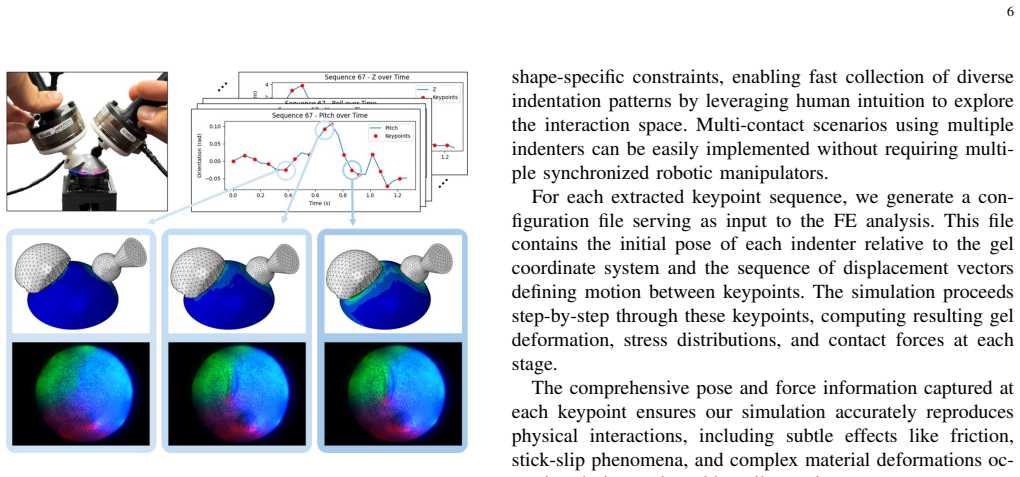
The load-bearing mechanism is a nonlinear finite-element model of the gel: a single homogeneous hyperelastic material described by a strain-energy function of the first strain invariant, a literature friction coefficient of 2.2 against the indenter, and a fully fixed bottom surface, solved with a general-purpose finite-element solver. To make the simulation match the real sensor, the authors collect synchronized motion-capture poses and force/torque readings during human-guided indentations with 12 diverse 3D-printed contact geometries, extract keypoints from each trajectory, simulate those keypoints in the finite-element model, and convert the 3D nodal stress and displacement results into 2D image channels through a Gaussian-process-based 2D-to-3D correspondence map. Simulated forces are then corrected component-wise using offset ratios and a random forest fitted to real force/torque measurements, and a dynamic baseline-update mechanism re-anchors the undeformed reference image to handle gel hysteresis. The network is a hierarchical vision transformer pretrained with masked autoencoding and paired with a Q-Upsampling decoder that fuses multi-resolution features before separate convolutional heads emit the five output modalities: displacement, normal stress, shear stress, contact normal force, and contact shear force.
What would settle it
Run the same network and clustering on indentations with indenter shapes never seen in training, while measuring ground-truth force with a high-accuracy sensor, and check the per-contact integrated force error after removing the random-forest correction; if errors grow well beyond the reported 0.24 N, the finite-element stress ground truth is not generalizing. A second check is to compare the finite-element-predicted gel surface deformation against an independent 3D scan of the gel during a 5 mm indentation; a mismatch of more than a fraction of a millimeter would mean the dense stress maps are not trustworthy even where forces are corrected.
Extended reading notes
Core claim
On the paper's own terms, the central claim is that the TensorTouch pipeline yields accurate pixel-level estimates of the contact stress tensor, deformation field, and contact forces from a single optical tactile image while accommodating the large deformations that soft gels undergo. Evaluated on a custom modular hemispherical sensor with two gel softness levels, the framework reports mean contact-position errors of 0.684 mm, 0.376 mm, and 1.292 mm along x, y, z and mean force errors of 0.106 N, 0.113 N, and 0.139 N per axis, with an overall force-magnitude error of 0.239 N, compared against motion capture and a commercial force/torque sensor. The authors further claim that these calibrated fields let a two-finger hand track multiple simultaneous contacts and selectively maintain grasp on a moving target object, with success rates from 67.7% for two identical cables up to 90% for two rigid objects.
Load-bearing premise
The whole calibration rests on the assumption that the finite-element model of the gel—one homogeneous hyperelastic material, a single literature friction coefficient, and a rigidly fixed bottom—predicts the real gel's internal stress fields well enough that a network trained on those simulations can estimate true forces and stresses from images, with the force-correction step able to fix only systematic magnitude errors, not fundamentally wrong stress distributions.
Editorial extensions
If this is right
- Very soft gels become usable for tactile manipulation without giving up accurate measurement, because the finite-element pipeline supplies the large-deformation ground truth that small-deformation methods lacked.
- Policies can consume calibrated force and stress fields instead of raw tactile images, which is the route the paper identifies toward sensor-agnostic manipulation.
- Multiple simultaneous contacts can be separated, tracked, and attributed to individual objects, enabling tasks such as selective string grasping.
- Recalibration after sensor aging or replacement is cheap, since the random-forest correction needs only about 5 to 7 measurement points.
- The modular sensor design and parametric finite-element setup mean the same calibration framework can be applied to other flat or curved optical tactile sensors.
Reading between the lines
- Beyond the paper, the pipeline should transfer to other optical sensor geometries, since the finite-element model and the correspondence mapping are parametric in sensor shape; the cost is recollecting calibration data and re-fitting the map, not redesigning the network.
- The reported force errors sit close to the reference sensor's resolution (about 0.06 N), so part of the quoted error could be measurement noise; a higher-resolution reference would reveal the true floor of the model.
- If the predicted stress fields are physically consistent, continuum equilibrium could be imposed as a self-supervised training signal, allowing the network to improve on unlabeled real images.
- Selective grasping of identical cables succeeded at a lower rate than mixed object pairs, suggesting the practical limit for telling two similar objects apart is force-field resolution; finer discrimination should improve with a more accurate reference.
Editorial analysis
A structured set of objections, weighed in public.
Referee Report
Summary. The paper presents TensorTouch, a calibration framework for optical tactile sensors that combines Abaqus finite-element simulation of hyperelastic gels with a hierarchical vision transformer (Hiera with a Q-upsampling decoder) to predict pixel-level displacement fields, normal/shear stress tensors, and contact force distributions from raw tactile images. A motion-capture and ATI-based data collection system with diverse YCB-derived indenter shapes is used to collect real images and poses, and a sim-to-real correction step (component-wise offset ratios plus a random-forest regressor) is applied to the FE forces. The authors evaluate cluster-level position and force estimates against motion-capture and ATI measurements, and demonstrate a two-finger selective string-grasping task with success rates between 67.7% and 90% across object combinations.
Significance. If the dense stress-tensor and deformation outputs were validated against independent measurements, TensorTouch could be an important step toward standardized, physics-based tactile sensing for dexterous manipulation. Strengths of the paper include the large-scale paired dataset, the use of multiple indenter geometries from YCB objects to improve generalization, a systematic FE pipeline adaptable to different sensor shapes, and a careful network ablation showing the benefit of the proposed lightweight Hiera+Q-upsampling architecture. The reported sub-Newton force errors and the successful multi-object manipulation demo are encouraging, provided the evaluation protocol is made rigorous.
major comments (5)
- [V-A, III-I, III-J] The 60 evaluation points used for the force and position comparison are not described as held out from either the network training set or the ATI-based calibration data (offset ratios and random forest). Because the calibration and evaluation use the same ATI sensor, the reported force errors of 0.106 to 0.239 N could simply reflect fitted values rather than generalization. The paper must state how the 60 points were selected relative to training and calibration, and ideally evaluate on a strictly disjoint set.
- [V-A, III-I] The central claim of accurate pixel-level normal and shear stress distributions is not directly validated against any independent ground truth. The only quantitative checks are cluster-level force and position comparisons; the stress tensors are trained on FE targets whose fidelity is uncertain because the gel is modeled as a single homogeneous Yeoh material, the friction coefficient of 2.2 is taken from the literature [54], and the bottom boundary is fully encastre. The offset ratios in Eq. (14)-(15) are scalar multipliers applied to integrated forces and cannot correct spatial stress-distribution errors. The authors should either provide independent validation of the stress and displacement fields (for example, using stereo or structured-light measurement of the physical gel surface under the same indentations) or substantially weaken the stress-accuracy claim.
- [Abstract, Table II] The abstract states that experimental validation demonstrates 90% success in selectively grasping one of two strings, but Table II reports 90% only for the two-rigid-object control condition; the string-related conditions achieve 67.7%, 75%, and 85%. The headline claim should be corrected to match the data, or the abstract should clarify which condition the 90% figure refers to.
- [V-A, Abstract] The position errors are reported as 0.684, 0.376, and 1.292 mm in x, y, and z, so the z-axis error exceeds 1 mm and the abstract's 'sub-millimeter position accuracy' is not fully supported. The paper also notes that the cluster centroid does not coincide with the indenter origin due to geometry, so part of this error is a systematic offset rather than sensor localization error. Please separate the sensor localization component from the geometric offset and restate the accuracy claim accordingly.
- [III-I] The random-forest correction is described only briefly, as 'as few as 5-7 measurement points,' without specifying the input features, the training and validation split, or how the zero-constraint is enforced. Given that this correction is load-bearing for the force estimates, the lack of detail prevents reproducibility and makes the reported accuracies difficult to interpret. Please provide the full calibration protocol or clarify whether the random-forest correction is used in the final evaluation.
minor comments (5)
- [III-I (Eq. 14-15)] The ratio r_i is defined component-wise in the text but appears as a single scalar in Equations (14) and (15); please clarify whether r_i is a vector and how its index aligns with the normal and shear force components.
- [IV-B] The sentence 'Each dataset includes four sensors with the same gel softness' is ambiguous; please specify the number of physical sensors and gels per softness setting.
- [III-H, Table I] Because outputs are normalized using both global and local statistics, the PSNR/MSE/SSIM values in Table I depend on the normalization procedure; please state whether the metrics are computed on the denormalized physical values.
- [III-C] The baseline-update threshold is given as 'MSE threshold = 8' without units; please specify the metric (for example, per-pixel squared difference over the full image) so the threshold is interpretable.
- [Throughout] There are several typographical and formatting issues, including 'preseves' in Section III-J and corrupted equation formatting in Eq. (10) ('withWandHas'); the manuscript should be proofread.
Circularity Check
No load-bearing circularity: the FE-to-image supervised pipeline is self-contained; the ATI-based force correction is declared calibration rather than a hidden prediction, and the self-citations are not load-bearing.
full rationale
The derivation chain is: Abaqus FE simulation of the gel (Section III-E) -> projection of stress, displacement, and contact fields onto 2D images (Section III-H) -> supervised training of a Hiera-based network to map tactile images to those fields (Section III-J) -> contact clustering (Section III-K) -> external comparison with mocap and ATI measurements (Section V-A). The stress-tensor and displacement outputs are learned targets taken directly from the FE simulation, so Table I is a regression-accuracy report against those training labels; it is not an independent physical validation of stress, but it is also not a circular reduction because the network learns a genuine image-to-field map that is not algebraically identical to its input. The force correction in Section III-I, Eqs. (14)-(15), is explicitly a calibration: r_i is fit from ATI readings and multiplies the Abaqus force, so at the calibration points the corrected force equals the ATI measurement by construction. However, the paper presents this as calibration rather than as a first-principles force prediction, and it does not state that the 60 evaluation points in Section V-A were the same points used to fit r_i or the random-forest correction. Without that stated overlap, no forced reduction can be exhibited. The genuine weaknesses are validation gaps: pixel-level stress tensors are never compared with an independent ground truth, and the held-out status of the force-evaluation split is not documented. These are limitations on evidence quality, not circularity. Self-citations to the authors' earlier DenseTact work ([21], [25], [36]) appear in related work and sensor-design context and are not used to justify the FE calibration, the network outputs, or any uniqueness claim, so they are not load-bearing. Overall the central derivation is self-contained, warranting a low circularity score.
Assumptions & free parameters
free parameters (5)
- Yeoh material parameters C1, C2, C3, D1 for each gel formulation =
Not reported numerically; fit to uniaxial and biaxial test data
- Friction coefficient between indenter and gel =
2.2
- Component-wise contact offset ratios r_i =
Not reported numerically
- Random forest force correction model =
Trained on 5-7 paired measurements
- Data selection thresholds =
F_contact=1.5N, F_detach=1.1N, MSE_threshold=8
assumptions (6)
- domain assumption The Yeoh hyperelastic constitutive model adequately represents the silicone gel's response over the deformation range.
- domain assumption The gel is modeled as a single homogeneous material; the thin reflective surface layer is mechanically negligible.
- domain assumption The bottom gel surface is fully constrained (encastre), mimicking full attachment to the camera and LED module.
- domain assumption The friction coefficient from reference [54] applies to this indenter-gel interface.
- domain assumption Abaqus FE with hybrid elements and penalty contact accurately simulates the multi-contact large-deformation scenarios.
- domain assumption The GPR-based 2D-to-3D mapping trained on pokes generalizes across the whole gel surface.
Cite this review
Pith. "Pith review of TensorTouch: Calibration of Tactile Sensors for High Resolution Stress Tensor and Deformation for Dexterous Manipulation." pith.science (2026). https://pith.science/paper/2AQ7HJLG
@misc{pith2026250608291,
  author       = {Pith},
  title        = {Pith review of: TensorTouch: Calibration of Tactile Sensors for High Resolution Stress Tensor and Deformation for Dexterous Manipulation},
  year         = {2026},
  howpublished = {\url{https://pith.science/paper/2AQ7HJLG}},
  note         = {Machine review of arXiv:2506.08291}
}
read the original abstract
Advanced dexterous manipulation involving multiple simultaneous contacts across different surfaces, like pinching coins from ground or manipulating intertwined objects, remains challenging for robotic systems. Such tasks exceed the capabilities of vision and proprioception alone, requiring high-resolution tactile sensing with calibrated physical metrics. Raw optical tactile sensor images, while information-rich, lack interpretability and cross-sensor transferability, limiting their real-world utility. TensorTouch addresses this challenge by integrating finite element analysis with deep learning to extract comprehensive contact information from optical tactile sensors, including stress tensors, deformation fields, and force distributions at pixel-level resolution. The TensorTouch framework achieves sub-millimeter position accuracy and precise force estimation while supporting large sensor deformations crucial for manipulating soft objects. Experimental validation demonstrates 90% success in selectively grasping one of two strings based on detected motion, enabling new contact-rich manipulation capabilities previously inaccessible to robotic systems.
Figures


Figures from the paper (14 more)





Forward citations
Cited by 2 Pith papers
-
3D Cal: An Open-Source Software Library for Depth Reconstruction on Vision-Based Tactile Sensors
3D Cal repurposes a 3D printer as an automated calibration rig and trains a lightweight CNN, TouchNet, to reconstruct depth maps for DIGIT and GelSight Mini.
-
Pose-Aware Modeling to Mitigate Pose-Related Artifacts in Tactile Gloves
Feeding index-finger joint angles into a tactile glove as a learned residual correction reduces pose-induced artifacts and lowers the minimum detectable force by 10-18%.
Reference graph
Works this paper leans on
-
[54]
S.-J. Lee and C.-L. Kim, “Influence of surface structure on friction and wear characteristics of silicone rubber for hydraulic rod seals,”RSC advances, vol. 13, no. 48, pp. 33 595–33 602, 2023
work page 2023
-
[1]
π 0: A vision–language–action flow model for general robot control,
K. Black, N. Brown, D. Driess, A. Esmail, M. Equi, C. Finn, N. Fusai, L. Groom, K. Hausman, B. Ichteret al., “π 0: A vision–language–action flow model for general robot control,”arXiv preprint, 2024. [Online]. Available: https://arxiv.org/abs/2410.24164
arXiv 2024
-
[2]
π 0.5: A vision–language–action model with open-world generalization,
Physical Intelligence, K. Black, N. Brown, J. Darpinian, K. Dhabalia, D. Driess, A. Esmail, M. Equi, C. Finn, N. Fusaiet al., “π 0.5: A vision–language–action model with open-world generalization,”arXiv preprint, 2025. [Online]. Available: https://arxiv.org/abs/2504.16054
arXiv 2025
-
[3]
Dexterous contact-rich ma- nipulation via the contact trust region,
H. Suh, T. Pang, T. Zhao, and R. Tedrake, “Dexterous contact-rich ma- nipulation via the contact trust region,”arXiv preprint arXiv:2505.02291, 2025
arXiv 2025
-
[4]
Pp-tac: Paper picking using tactile feedback in dexterous robotic hands,
P. Lin, Y . Huang, W. Li, J. Ma, C. Xiao, and Z. Jiao, “Pp-tac: Paper picking using tactile feedback in dexterous robotic hands,”arXiv preprint arXiv:2504.16649, 2025
arXiv 2025
-
[5]
Lessons from learning to spin “pens
J. Wang, Y . Yuan, H. Che, H. Qi, Y . Ma, J. Malik, and X. Wang, “Lessons from learning to spin “pens”,” inCoRL, 2024
2024
-
[6]
TacSL: A Library for Visuotactile Sensor Simulation and Learning,
I. Akinola, J. Xu, J. Carius, D. Fox, and Y . Narang, “TacSL: A Library for Visuotactile Sensor Simulation and Learning,”IEEE Transactions on Robotics, pp. 1–17, 2025. [Online]. Available: https://ieeexplore.ieee.org/abstract/document/10912733
-
[7]
PoCo: Policy Composition from and for Heterogeneous Robot Learning,
L. Wang, J. Zhao, Y . Du, E. Adelson, and R. Tedrake, “PoCo: Policy Composition from and for Heterogeneous Robot Learning,” inRobotics: Science and Systems XX. Robotics: Science and Systems Foundation, Jul. 2024. [Online]. Available: http://www.roboticsproceedings.org/ rss20/p127.pdf
work page 2024
Show all 67 references
-
[8]
General In-hand Object Rotation with Vision and Touch,
H. Qi, B. Yi, S. Suresh, M. Lambeta, Y . Ma, R. Calandra, and J. Malik, “General In-hand Object Rotation with Vision and Touch,” inProceedings of The 7th Conference on Robot Learning. PMLR, Dec. 2023, pp. 2549–2564, iSSN: 2640-3498. [Online]. Available: https://proceedings.mlr...
2023
-
[9]
Fine Manipulation Using a Tactile Skin: Learning in Simulation and Sim-to-Real Transfer,
U. Kasolowsky and B. B ¨auml, “Fine Manipulation Using a Tactile Skin: Learning in Simulation and Sim-to-Real Transfer,” Sep. 2024, arXiv:2409.12735. [Online]. Available: http://arxiv.org/abs/2409.12735
2024 arXiv
-
[10]
A Learning-based Controller for Multi-Contact Grasps on Unknown Objects with a Dexterous Hand,
D. Winkelbauer, R. Triebel, and B. B ¨auml, “A Learning-based Controller for Multi-Contact Grasps on Unknown Objects with a Dexterous Hand,” Sep. 2024, arXiv:2409.12339. [Online]. Available: http://arxiv.org/abs/2409.12339
2024 arXiv
-
[11]
Biomimetic tactile sensor array,
N. Wettels, V . J. Santos, R. S. Johansson, and G. E. Loeb, “Biomimetic tactile sensor array,”Advanced robotics, vol. 22, no. 8, pp. 829–849, 2008
2008
-
[12]
Active touch sensing,
W. D. Hillis, “Active touch sensing,” Ph.D. dissertation, Massachusetts Institute of Technology, 1981
1981
-
[13]
Location and Orientation Super- Resolution Sensing With a Cost-Efficient and Repairable Barometric Tactile Sensor,
J. Hou, X. Zhou, and A. Spiers, “Location and Orientation Super- Resolution Sensing With a Cost-Efficient and Repairable Barometric Tactile Sensor,”IEEE Transactions on Robotics, vol. 41, pp. 729–741,
-
[14]
PX-6AX GEN2 Hall Effect Tactile Sen- sor,
Paxini Technology Co., Ltd., “PX-6AX GEN2 Hall Effect Tactile Sen- sor,” https://paxini.com/ax/gen2, 2024, multi-dimensional tactile sensor based on hall effect technology capable of 15 types of tactile perceptions with 0.01N high-precision measurement
2024
-
[15]
GelSight: High-Resolution Robot Tactile Sensors for Estimating Geometry and Force
“GelSight: High-Resolution Robot Tactile Sensors for Estimating Geometry and Force.” [Online]. Available: https://www.mdpi.com/ 1424-8220/17/12/2762
-
[16]
GelSlim 3.0: High- Resolution Measurement of Shape, Force and Slip in a Compact Tactile-Sensing Finger,
I. H. Taylor, S. Dong, and A. Rodriguez, “GelSlim 3.0: High- Resolution Measurement of Shape, Force and Slip in a Compact Tactile-Sensing Finger,” in2022 International Conference on Robotics and Automation (ICRA), May 2022, pp. 10 781–10 787. [Online]. Available: https://ieeex...
2022
-
[17]
DIGIT: A Novel Design for a Low-Cost Compact High-Resolution Tactile Sensor With Application to In-Hand Manipulation,
M. Lambeta, P.-W. Chou, S. Tian, B. Yang, B. Maloon, V . R. Most, D. Stroud, R. Santos, A. Byagowi, G. Kammerer, D. Jayaraman, and R. Calandra, “DIGIT: A Novel Design for a Low-Cost Compact High-Resolution Tactile Sensor With Application to In-Hand Manipulation,”IEEE Robotics ...
2020
-
[18]
MagicTac: A Novel High-Resolution 3D Multi-layer Grid-Based Tactile Sensor,
W. Fan, H. Li, and D. Zhang, “MagicTac: A Novel High-Resolution 3D Multi-layer Grid-Based Tactile Sensor,” in2024 IEEE International Conference on Robotics and Automation (ICRA), May 2024, pp. 388–
2024
-
[19]
DelTact: A Vision-Based Tactile Sensor Using a Dense Color Pattern,
G. Zhang, Y . Du, H. Yu, and M. Y . Wang, “DelTact: A Vision-Based Tactile Sensor Using a Dense Color Pattern,”IEEE Robotics and Automation Letters, vol. 7, no. 4, pp. 10 778–10 785, Oct. 2022. [Online]. Available: https://ieeexplore.ieee.org/document/9849124
2022
-
[20]
Digitizing Touch with an Artificial Multimodal Fingertip,
M. Lambeta, T. Wu, A. Sengul, V . R. Most, N. Black, K. Sawyer, R. Mercado, H. Qi, A. Sohn, B. Taylor, N. Tydingco, G. Kammerer, D. Stroud, J. Khatha, K. Jenkins, K. Most, N. Stein, R. Chavira, T. Craven-Bartle, E. Sanchez, Y . Ding, J. Malik, and R. Calandra, “Digitizing Touc...
2024 arXiv
-
[21]
Densetact: Optical tactile sensor for dense shape reconstruction,
W. K. Do and M. Kennedy, “Densetact: Optical tactile sensor for dense shape reconstruction,” in2022 International Conference on Robotics and Automation (ICRA). IEEE, 2022, pp. 6188–6194
2022
-
[22]
The TacTip Family: Soft Optical Tactile Sensors with 3D-Printed Biomimetic Morphologies,
B. Ward-Cherrier, N. Pestell, L. Cramphorn, B. Winstone, M. E. Giannaccini, J. Rossiter, and N. F. Lepora, “The TacTip Family: Soft Optical Tactile Sensors with 3D-Printed Biomimetic Morphologies,” Soft Robotics, vol. 5, no. 2, pp. 216–227, Apr. 2018, publisher: Mary Ann Liebe...
2018
-
[23]
Omnitact: A multi-directional high-resolution touch sensor,
A. Padmanabha, F. Ebert, S. Tian, R. Calandra, C. Finn, and S. Levine, “Omnitact: A multi-directional high-resolution touch sensor,” in2020 IEEE International Conference on Robotics and Automation (ICRA). IEEE, 2020, pp. 618–624
2020
-
[24]
GelSight Svelte: A Human Finger-Shaped Single-Camera Tactile Robot Finger with Large Sensing Coverage and Proprioceptive Sensing,
J. Zhao and E. H. Adelson, “GelSight Svelte: A Human Finger-Shaped Single-Camera Tactile Robot Finger with Large Sensing Coverage and Proprioceptive Sensing,” in2023 IEEE/RSJ International Conference on Intelligent Robots and Systems (IROS), Oct. 2023, pp. 8979– 8984, iSSN: 21...
2023
-
[25]
Densetact-mini: An optical tactile sensor for grasping multi-scale objects from flat surfaces,
W. K. Do, A. K. Dhawan, M. Kitzmann, and M. Kennedy III, “Densetact-mini: An optical tactile sensor for grasping multi-scale objects from flat surfaces,”arXiv preprint arXiv:2309.08860, 2023
2023 arXiv
-
[26]
A soft thumb- sized vision-based sensor with accurate all-round force perception,
H. Sun, K. J. Kuchenbecker, and G. Martius, “A soft thumb- sized vision-based sensor with accurate all-round force perception,” Nature Machine Intelligence, vol. 4, no. 2, pp. 135–145, Feb. 2022, publisher: Nature Publishing Group. [Online]. Available: https://www.nature.com/a...
2022
-
[27]
Soft-bubble grippers for robust and perceptive manipulation,
N. Kuppuswamy, A. Alspach, A. Uttamchandani, S. Creasey, T. Ikeda, and R. Tedrake, “Soft-bubble grippers for robust and perceptive manipulation,” in2020 IEEE/RSJ International Conference on Intelligent Robots and Systems (IROS), Oct. 2020, pp. 9917– 9924, iSSN: 2153-0866. [Onl...
2020
-
[28]
Texterity: Tactile extrinsic dexterity,
A. Bronars, S. Kim, P. Patre, and A. Rodriguez, “Texterity: Tactile extrinsic dexterity,” in2024 IEEE International Conference on Robotics and Automation (ICRA). IEEE, 2024, pp. 7976–7983
2024
-
[29]
UniT: Data efficient tactile representation with generalization to unseen objects,
Z. Xu, R. Uppuluri, X. Zhang, C. Fitch, P. G. Crandall, W. Shou, D. Wang, and Y . She, “UniT: Data efficient tactile representation with generalization to unseen objects,” 2025. [Online]. Available: https://arxiv.org/abs/2408.06481
2025 arXiv
-
[30]
Self-supervised perception for tactile skin covered dexterous hands,
A. Sharma, C. Higuera, C. K. Bodduluri, Z. Liu, T. Fan, T. Hellebrekers, M. Lambeta, B. Boots, M. Kaess, T. Wuet al., “Self-supervised perception for tactile skin covered dexterous hands,”arXiv preprint arXiv:2505.11420, 2025
2025 arXiv
-
[31]
Diffusion policy: Visuomotor policy learning via ac- tion diffusion,
C. Chi, Z. Xu, S. Feng, E. Cousineau, Y . Du, B. Burchfiel, R. Tedrake, and S. Song, “Diffusion policy: Visuomotor policy learning via ac- tion diffusion,”The International Journal of Robotics Research, p. 02783649241273668, 2023
2023
-
[32]
Reactive diffusion policy: Slow-fast visual-tactile policy learning for contact-rich manipulation,
H. Xue, J. Ren, W. Chen, G. Zhang, Y . Fang, G. Gu, H. Xu, and C. Lu, “Reactive diffusion policy: Slow-fast visual-tactile policy learning for contact-rich manipulation,”arXiv preprint arXiv:2503.02881, 2025
2025 arXiv
-
[33]
Robot Tactile Sensing: Vision Based Tactile Sensor for Force Perception,
T. Zhang, Y . Cong, X. Li, and Y . Peng, “Robot Tactile Sensing: Vision Based Tactile Sensor for Force Perception,” in2018 IEEE 8th Annual International Conference on CYBER Technology in Automation, Control, and Intelligent Systems (CYBER), Jul. 2018, pp. 1360– 1365, iSSN: 237...
2018
-
[34]
In-Hand Object Localization Using a Novel High-Resolution Visuotactile Sensor,
S. Cui, R. Wang, J. Hu, J. Wei, S. Wang, and Z. Lou, “In-Hand Object Localization Using a Novel High-Resolution Visuotactile Sensor,”IEEE Transactions on Industrial Electronics, vol. 69, no. 6, pp. 6015–6025, Jun. 2022. [Online]. Available: https: //ieeexplore.ieee.org/abstrac...
2022
-
[35]
DTact: A Vision-Based Tactile Sensor that Measures High-Resolution 3D Geometry Directly from Darkness,
C. Lin, Z. Lin, S. Wang, and H. Xu, “DTact: A Vision-Based Tactile Sensor that Measures High-Resolution 3D Geometry Directly from Darkness,” in2023 IEEE International Conference on Robotics and Automation (ICRA), May 2023, pp. 10 359–10 366. [Online]. Available: https://ieeexp...
2023
-
[36]
Densetact 2.0: Optical tactile sensor for shape and force reconstruction,
W. K. Do, B. Jurewicz, and M. Kennedy, “Densetact 2.0: Optical tactile sensor for shape and force reconstruction,” in2023 IEEE International Conference on Robotics and Automation (ICRA), 2023, pp. 12 549– 12 555
2023
-
[37]
Dense Tactile Force Estimation using GelSlim and inverse FEM,
D. Ma, E. Donlon, S. Dong, and A. Rodriguez, “Dense Tactile Force Estimation using GelSlim and inverse FEM,” in2019 International Conference on Robotics and Automation (ICRA), May 2019, pp. 5418–5424, iSSN: 2577-087X. [Online]. Available: https://ieeexplore.ieee.org/abstract/d...
2019
-
[38]
Sparsh: Self-supervised touch representations for vision- based tactile sensing,
C. Higuera, A. Sharma, C. K. Bodduluri, T. Fan, P. Lancaster, M. Kalakrishnan, M. Kaess, B. Boots, M. Lambeta, T. Wu, and M. Mukadam, “Sparsh: Self-supervised touch representations for vision- based tactile sensing,” Oct. 2024, arXiv:2410.24090 [cs]. [Online]. Available: http:...
2024 arXiv
-
[39]
Sim-to-real for robotic tactile sensing via physics-based simulation and learned latent projections,
Y . Narang, B. Sundaralingam, M. Macklin, A. Mousavian, and D. Fox, “Sim-to-real for robotic tactile sensing via physics-based simulation and learned latent projections,” in2021 IEEE International Conference on Robotics and Automation (ICRA). IEEE, 2021, pp. 6444–6451
2021
-
[40]
3D Force and Contact Estimation for a Soft-Bubble Visuotactile Sensor Using FEM,
J.-C. Peng, S. Yao, and K. Hauser, “3D Force and Contact Estimation for a Soft-Bubble Visuotactile Sensor Using FEM,” in 2024 IEEE International Conference on Robotics and Automation (ICRA), May 2024, pp. 5666–5672. [Online]. Available: https: //ieeexplore.ieee.org/abstract/do...
2024
-
[41]
BiTac: A Soft Vision-Based Tactile Sensor With Bidirectional Force Perception for Robots,
L. V . Duong, “BiTac: A Soft Vision-Based Tactile Sensor With Bidirectional Force Perception for Robots,”IEEE Sensors Journal, vol. 23, no. 9, pp. 9158–9167, May 2023. [Online]. Available: https://ieeexplore.ieee.org/document/10077553
2023
-
[42]
iFEM2.0: Dense 3-D Contact Force Field Reconstruction and Assessment for Vision-Based Tactile Sensors,
C. Zhao, J. Liu, and D. Ma, “iFEM2.0: Dense 3-D Contact Force Field Reconstruction and Assessment for Vision-Based Tactile Sensors,” IEEE Transactions on Robotics, vol. 41, pp. 289–305, 2025. [Online]. Available: https://ieeexplore.ieee.org/abstract/document/10758225
2025
-
[43]
Hiera: A hierarchical vision transformer without the bells-and-whistles,
C. Ryali, Y . Hu, D. Bolya, C. Wei, H. Fan, P. Huang, V . Aggarwal, A. Chowdhury, O. Poursaeed, J. Hoffman, J. Malik, Y . Li, and C. Feichtenhofer, “Hiera: A hierarchical vision transformer without the bells-and-whistles,” inInternational Conference on Machine Learning, ICML 2...
2023
-
[44]
The effective- ness of mae pre-pretraining for billion-scale pretraining,
M. Singh, Q. Duval, K. V . Alwala, H. Fan, V . Aggarwal, A. Adcock, A. Joulin, P. Doll´ar, C. Feichtenhofer, R. Girshicket al., “The effective- ness of mae pre-pretraining for billion-scale pretraining,” inProceedings of the IEEE/CVF international conference on computer vision...
2023
-
[45]
Yale-cmu-berkeley dataset for robotic manipulation research,
B. Calli, A. Singh, J. Bruce, A. Walsman, K. Konolige, S. Srinivasa, P. Abbeel, and A. M. Dollar, “Yale-cmu-berkeley dataset for robotic manipulation research,”The International Journal of Robotics Research, vol. 36, no. 3, pp. 261–268, 2017
2017
-
[46]
On the theory of filter amplifiers,
S. Butterworthet al., “On the theory of filter amplifiers,”Wireless Engineer, vol. 7, no. 6, pp. 536–541, 1930
1930
-
[47]
The physics of rubber elasticity,
L. Treload, “The physics of rubber elasticity,” 1975
1975
-
[48]
Large elastic deformations of isotropic materials iv. further developments of the general theory,
R. S. Rivlin, “Large elastic deformations of isotropic materials iv. further developments of the general theory,”Philosophical transactions of the royal society of London. Series A, Mathematical and physical sciences, vol. 241, no. 835, pp. 379–397, 1948
1948
-
[49]
R. W. Ogden,Non-linear elastic deformations. Courier Corporation, 1997
1997
-
[50]
Some forms of the strain energy function for rubber,
O. H. Yeoh, “Some forms of the strain energy function for rubber,” Rubber Chemistry and technology, vol. 66, no. 5, pp. 754–771, 1993
1993
-
[51]
Dense tactile force esti- mation using gelslim and inverse fem,
D. Ma, E. Donlon, S. Dong, and A. Rodriguez, “Dense tactile force esti- mation using gelslim and inverse fem,” in2019 International Conference on Robotics and Automation (ICRA). IEEE, 2019, pp. 5418–5424
2019
-
[52]
Measurement of the hyperelastic properties of ex vivo brain tissue slices,
T. Kaster, I. Sack, and A. Samani, “Measurement of the hyperelastic properties of ex vivo brain tissue slices,”Journal of biomechanics, vol. 44, no. 6, pp. 1158–1163, 2011
2011
-
[53]
[Online]
Dassault Syst `emes Simulia Corp.,Abaqus/CAE User’s Manual, Version 2024, Dassault Syst `emes, Providence, RI, USA, 2024, software manual. [Online]. Available: https://www.3ds.com/products/simulia/abaqus/
2024
-
[55]
Analysis of approximate nearest neighbor searching with clustered point sets,
S. Maneewongvatana and D. M. Mount, “Analysis of approximate nearest neighbor searching with clustered point sets,”arXiv preprint cs/9901013, 1999
1999 arXiv
-
[56]
Vision transformers for dense prediction,
R. Ranftl, A. Bochkovskiy, and V . Koltun, “Vision transformers for dense prediction,” in2021 IEEE/CVF International Conference on Computer Vision, ICCV 2021, Montreal, QC, Canada, October 10-17, 2021. IEEE, 2021, pp. 12 159–12 168. [Online]. Available: https://doi.org/10.1109...
2021
-
[57]
U-net: Convolutional networks for biomedical image segmentation,
O. Ronneberger, P. Fischer, and T. Brox, “U-net: Convolutional networks for biomedical image segmentation,” inMedical image computing and computer-assisted intervention–MICCAI 2015: 18th international con- ference, Munich, Germany, October 5-9, 2015, proceedings, part III 18. ...
2015
-
[58]
Manipulability of robotic mechanisms,
T. Yoshikawa, “Manipulability of robotic mechanisms,”The interna- tional journal of Robotics Research, vol. 4, no. 2, pp. 3–9, 1985
1985
-
[59]
Coal: an extension of the flexible collision library,
J. Pan, S. Chitta, D. Manocha, F. Lamiraux, J. Mirabel, J. Carpentier, L. Montautet al., “Coal: an extension of the flexible collision library,” https://github.com/coal-library/coal, 2015–2024
2015
-
[60]
Densely connected convolutional networks,
G. Huang, Z. Liu, L. Van Der Maaten, and K. Q. Weinberger, “Densely connected convolutional networks,” inProceedings of the IEEE confer- ence on computer vision and pattern recognition, 2017, pp. 4700–4708
2017
-
[61]
Deep residual learning for image recognition,
K. He, X. Zhang, S. Ren, and J. Sun, “Deep residual learning for image recognition,” inProceedings of the IEEE conference on computer vision and pattern recognition, 2016, pp. 770–778
2016
-
[62]
An image is worth 16x16 words: Transformers for image recognition at scale,
A. Dosovitskiy, L. Beyer, A. Kolesnikov, D. Weissenborn, X. Zhai, T. Unterthiner, M. Dehghani, M. Minderer, G. Heigold, S. Gelly, J. Uszkoreit, and N. Houlsby, “An image is worth 16x16 words: Transformers for image recognition at scale,”ICLR, 2021
2021
-
[63]
Vision transformers for dense prediction,
R. Ranftl, A. Bochkovskiy, and V . Koltun, “Vision transformers for dense prediction,” inProceedings of the IEEE/CVF international conference on computer vision, 2021, pp. 12 179–12 188
2021
-
[64]
Masked autoencoders are scalable vision learners,
K. He, X. Chen, S. Xie, Y . Li, P. Doll ´ar, and R. B. Girshick, “Masked autoencoders are scalable vision learners,” inIEEE/CVF Conference on Computer Vision and Pattern Recognition, CVPR 2022, New Orleans, LA, USA, June 18-24, 2022. IEEE, 2022, pp. 15 979–15 988. [Online]. Av...
2022
-
[65]
Transferable tactile transformers for representation learning across diverse sensors and tasks,
J. Zhao, Y . Ma, L. Wang, and E. H. Adelson, “Transferable tactile transformers for representation learning across diverse sensors and tasks,”arXiv preprint arXiv:2406.13640, 2024
2024 arXiv
-
[394]
Available: https://ieeexplore.ieee.org/abstract/document/ 10610615
[Online]. Available: https://ieeexplore.ieee.org/abstract/document/ 10610615
-
[2025]
Available: https://ieeexplore.ieee.org/abstract/document/ 10770605
[Online]. Available: https://ieeexplore.ieee.org/abstract/document/ 10770605
Reviewed August 7, 2026 · model on record in the stance chip above.
Discussion (0). Sign in to comment.