Patched Flow Matching: Generative Wall-Pressure Reconstruction Beyond Training-Domain Scales from Sparse Sensors
Pith reviewed 2026-06-26 11:29 UTC · model grok-4.3
The pith
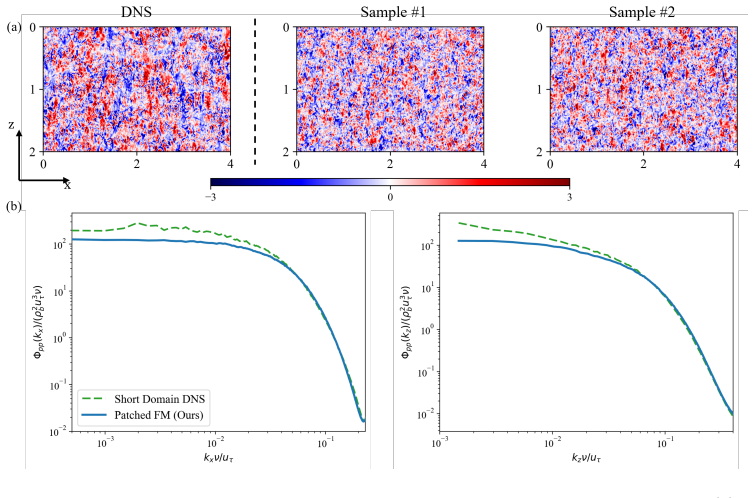
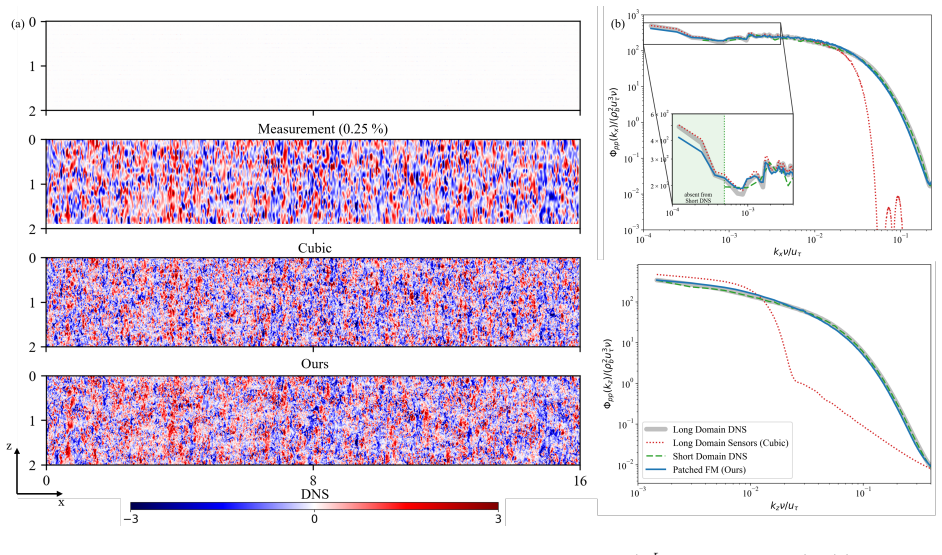
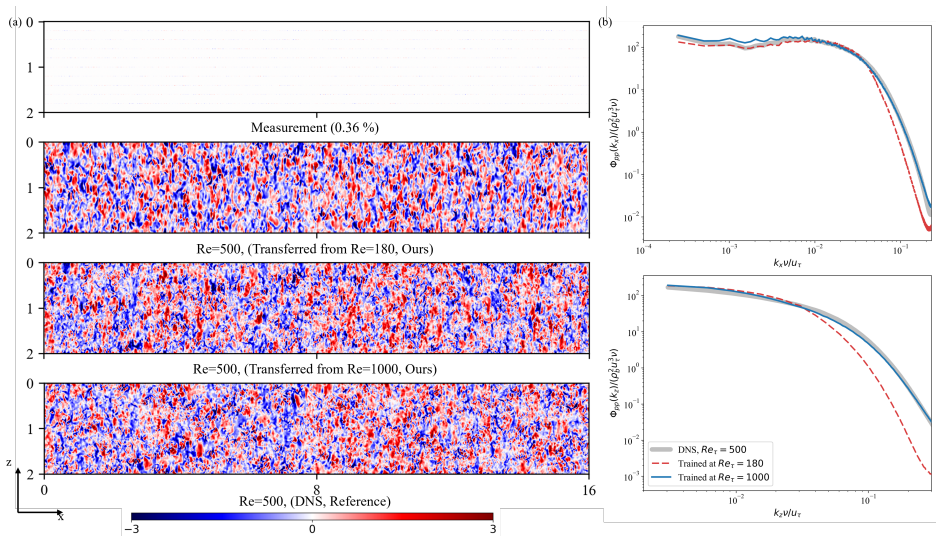
Patched Flow Matching reconstructs full-resolution wall-pressure fields on domains four times larger than the training domain from sensor coverage as low as 0.25%.
A machine-rendered reading of the paper's core claim, the machinery that carries it, and where it could break.
Core claim
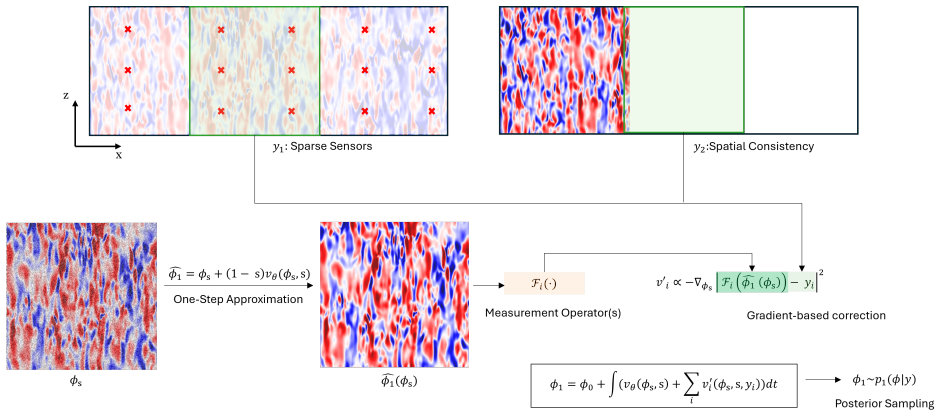
Patched Flow Matching learns a patch-local prior over inner-scaled wall-pressure statistics from short-domain DNS and assimilates sparse sensor measurements at inference time through training-free posterior sampling. The patch-additive decomposition of the flow matching vector field decouples the generative prior from the global domain size, enabling reconstruction on domains four times larger than the training configuration from sensor coverage as low as 0.25%. By expressing the patch prior in inner-scaled coordinates, where high-wavenumber statistics are approximately Reynolds-number invariant, the framework extends to higher Reynolds numbers through hierarchical transfer learning with as
What carries the argument
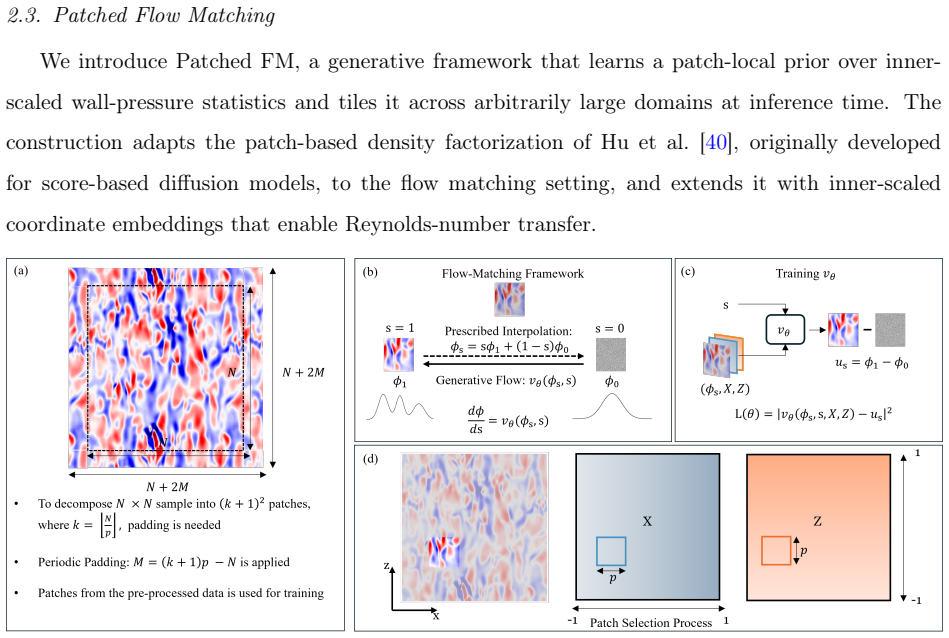
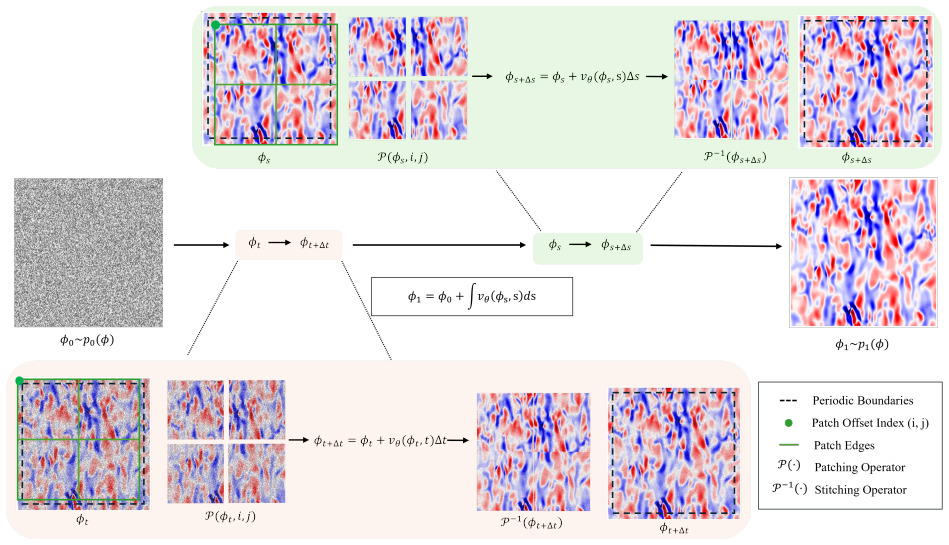
The patch-additive decomposition of the flow matching vector field, which decouples the generative prior from the global domain size.
If this is right
- Reconstruction of full-resolution wall-pressure fields on domains arbitrarily larger than the training configuration.
- Recovery of low-wavenumber spectral content with high fidelity in both streamwise and spanwise directions.
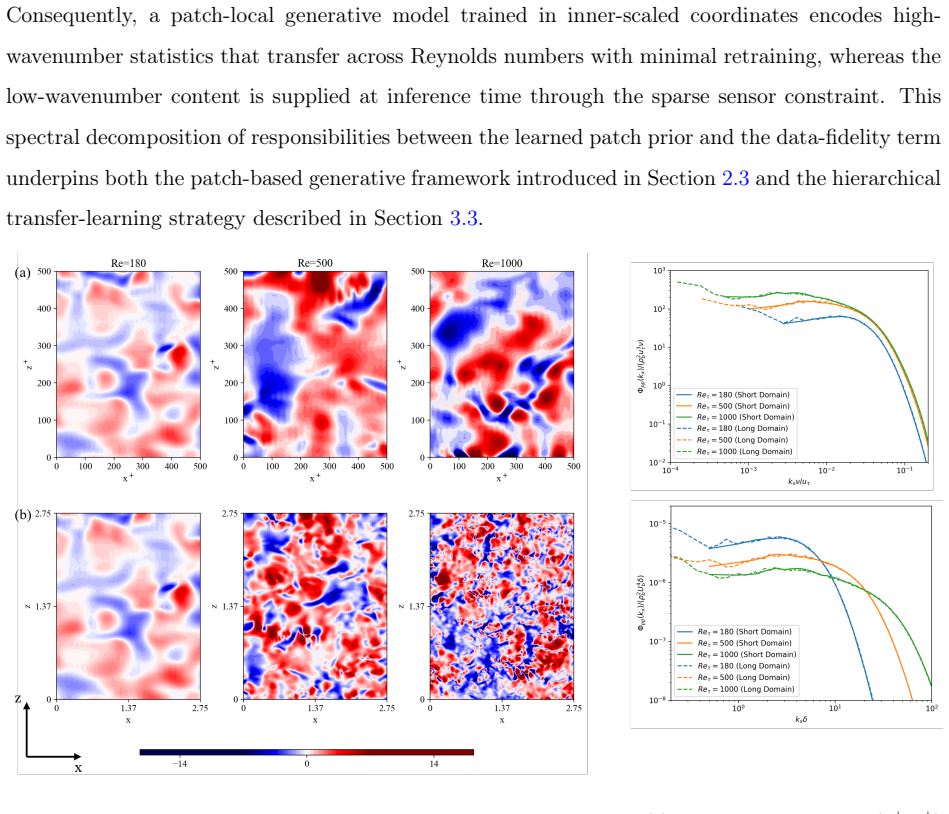
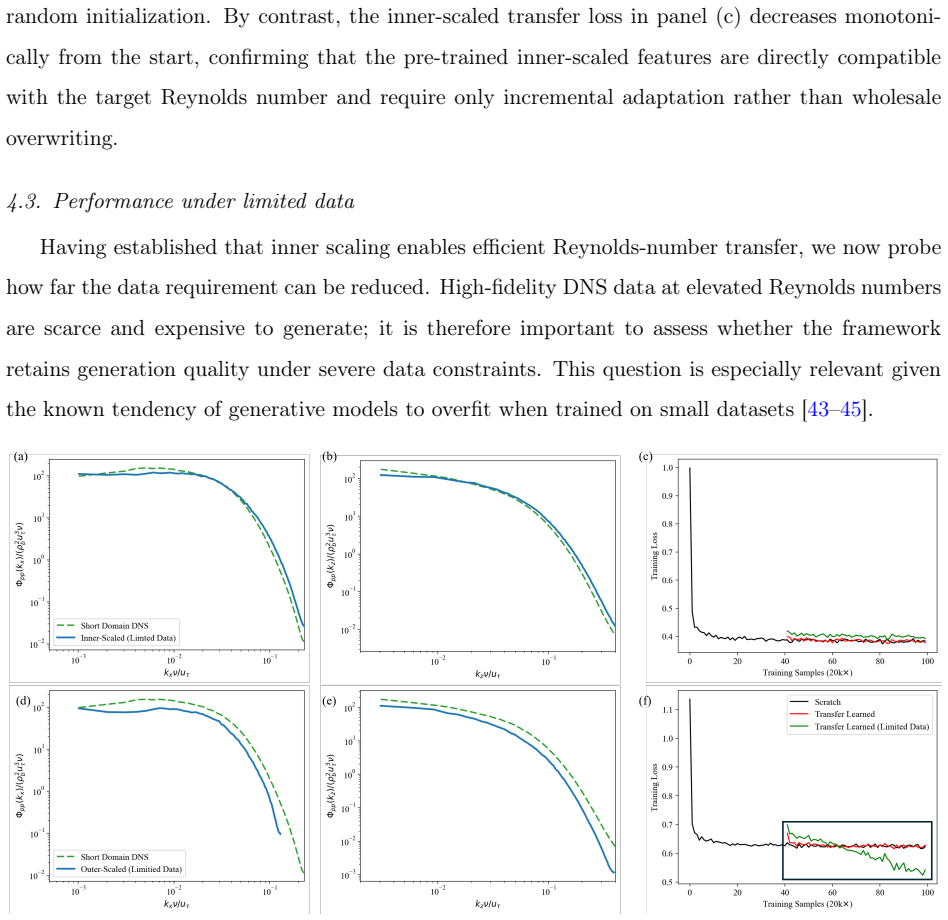
- Data-efficient extension to higher Reynolds numbers using only 500 short-domain snapshots, or 2.5% of the base training data.
- Zero-shot generalization to unseen Reynolds numbers without retraining the patch prior.
Where Pith is reading between the lines
- The same patch-decoupling strategy could be tested on other surface quantities such as shear stress if inner scaling continues to hold.
- Integration with real experimental sensor arrays would allow reconstruction on facility-scale domains where long-domain DNS remains impossible.
- The approach suggests that similar patch-based generative priors might reduce the cost of generating statistically stationary fields for even larger domain multiples.
Load-bearing premise
High-wavenumber wall-pressure statistics are approximately Reynolds-number invariant when expressed in inner-scaled coordinates.
What would settle it
A direct comparison in which the low-wavenumber portion of the reconstructed wall-pressure spectrum deviates substantially from independent long-domain DNS or high-resolution experiments at the same Reynolds number.
Figures
read the original abstract
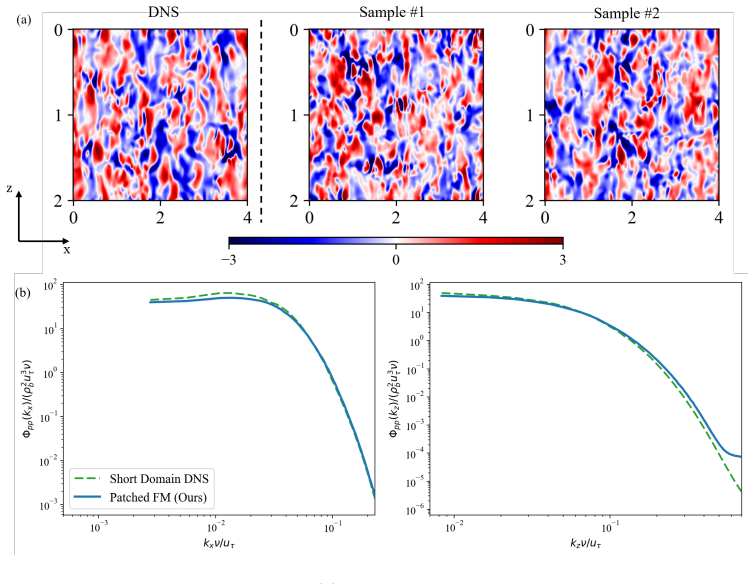
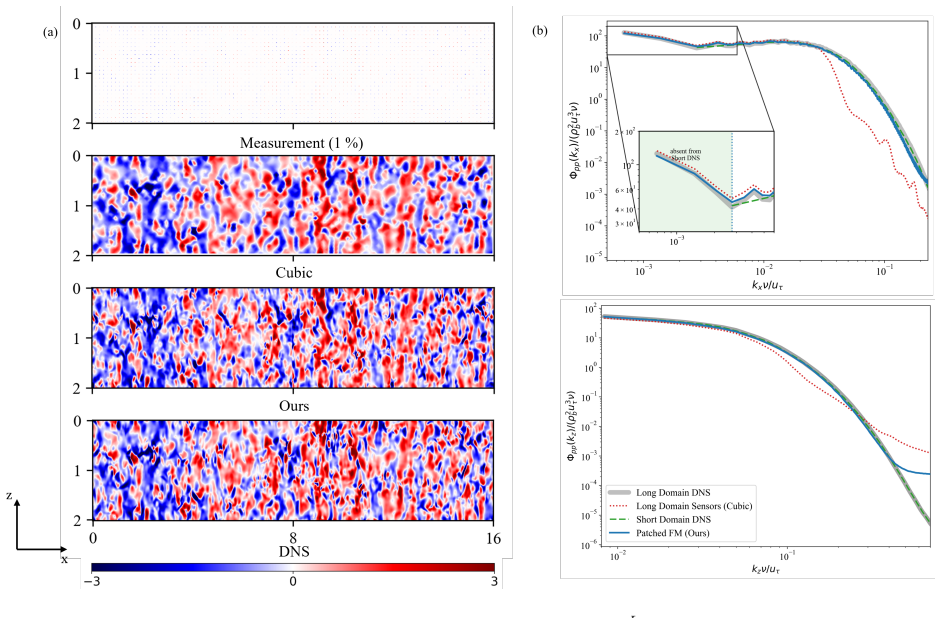
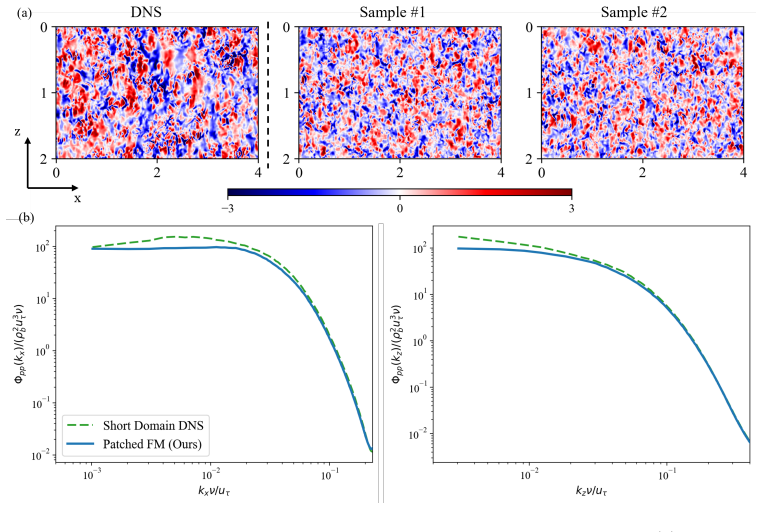
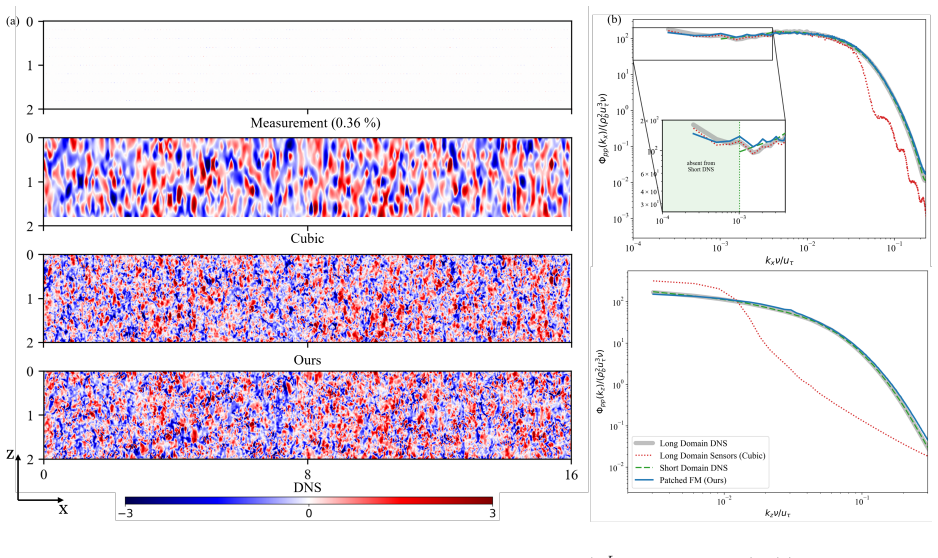
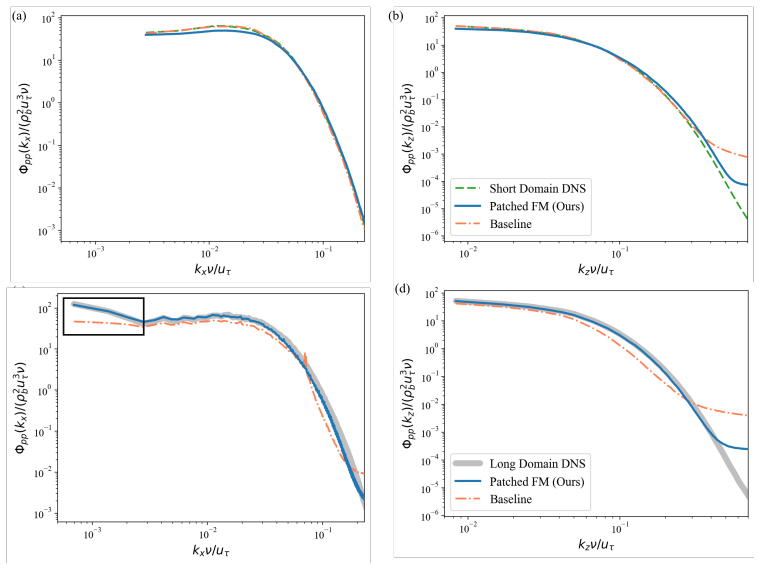
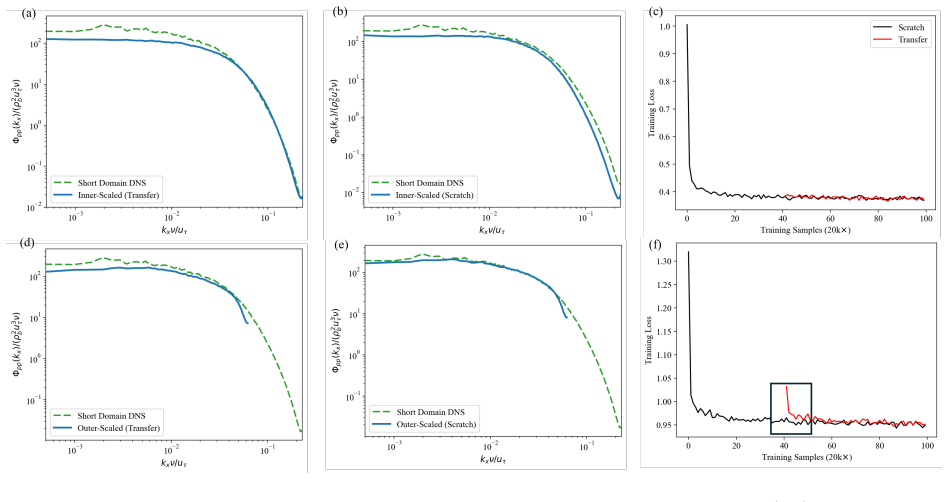
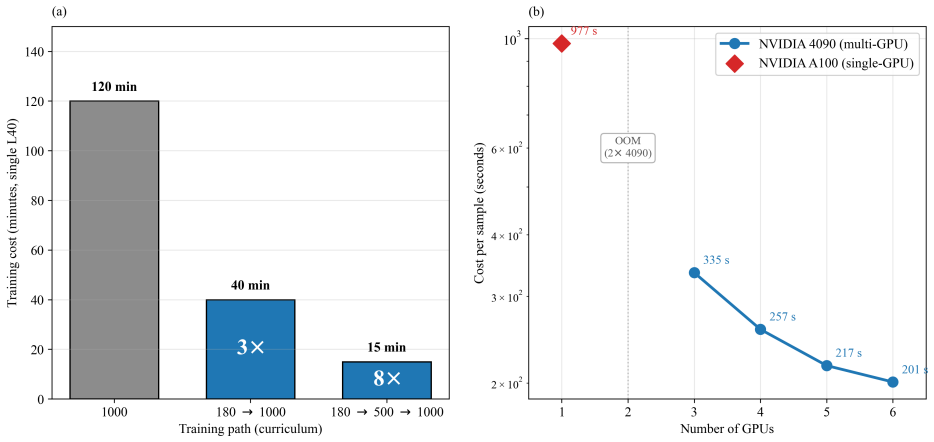
Characterizing the complete wall-pressure spectrum in turbulent wall-bounded flows requires simultaneous access to the viscous-scale high-wavenumber content and the outer-layer low-wavenumber content -- a requirement that neither short-domain direct numerical simulation (DNS) nor sparse experimental measurements alone can satisfy. We propose Patched Flow Matching (Patched FM), a generative framework that fuses these two complementary sources by learning a patch-local prior over inner-scaled wall-pressure statistics from short-domain DNS and assimilating sparse sensor measurements at inference time through training-free posterior sampling. The patch-additive decomposition of the flow matching vector field decouples the generative prior from the global domain size, enabling reconstruction on domains arbitrarily larger than the training configuration. By expressing the patch prior in inner-scaled coordinates, where high-wavenumber wall-pressure statistics are approximately Reynolds-number invariant, the framework extends to higher Reynolds numbers through hierarchical transfer learning with as few as $500$ short-domain snapshots ($2.5\%$ of the base training data) at a fraction of the scratch-training cost. Applied to compressible channel-flow DNS at $Re_\tau = 180$, $500$, and $1000$, Patched FM reconstructs full-resolution wall-pressure fields on a domain four times larger than the training configuration ($L_x^L = 16\pi\delta$ versus $L_x^S = 4\pi\delta$) from sensor coverage as low as $0.25\%$, recovering the low-wavenumber spectral content inaccessible to short-domain DNS with high fidelity in both streamwise and spanwise directions. Zero-shot generalization to unseen Reynolds numbers and ablation studies further confirm the role of inner scaling as a physical prerequisite for data-efficient Reynolds-number transfer.
Editorial analysis
A structured set of objections, weighed in public.
Referee Report
Summary. The manuscript introduces Patched Flow Matching (Patched FM), a generative framework for reconstructing full-resolution wall-pressure fields in turbulent wall-bounded flows. It learns a patch-local prior over inner-scaled high-wavenumber statistics from short-domain DNS (Lx^S = 4πδ) and assimilates sparse sensor measurements at inference via training-free posterior sampling. The patch-additive decomposition of the flow-matching vector field decouples the prior from global domain size, enabling zero-shot reconstruction on domains four times larger (Lx^L = 16πδ) from sensor coverages as low as 0.25%. By exploiting approximate Reynolds-number invariance of high-wavenumber wall-pressure statistics in inner units, the method performs hierarchical transfer learning to higher Re_τ with only 500 snapshots (2.5% of base data). Results are demonstrated on compressible channel-flow DNS at Re_τ = 180, 500, and 1000, with claims of high-fidelity recovery of low-wavenumber spectral content inaccessible to short-domain DNS and zero-shot generalization to unseen Reynolds numbers.
Significance. If the quantitative claims hold, the work would provide a practical route to obtaining complete wall-pressure spectra by fusing limited DNS priors with sparse measurements, addressing a long-standing limitation in turbulence research. The patch-additive decomposition is a clear technical strength that enables domain-size-independent generation. The use of inner scaling to justify data-efficient Re transfer is conceptually appealing and, if validated with explicit bounds, could reduce the cost of high-Re studies. No machine-checked proofs or open reproducible code are mentioned, but the framework's emphasis on physical invariance as a prerequisite for transfer is a positive feature.
major comments (2)
- [Abstract] Abstract: The central claims of 'high-fidelity' reconstruction and recovery of low-wavenumber content rest on quantitative performance, yet the abstract supplies no error metrics, spectral comparisons, error bars, or benchmark validations. This absence prevents evaluation of whether the reported reconstructions actually achieve the stated fidelity on the Lx^L = 16πδ domain.
- [Abstract] Abstract (hierarchical transfer learning paragraph): The data-efficiency claim (500 snapshots, 2.5% of base data) for Re_τ extension depends on the approximate invariance of high-wavenumber wall-pressure statistics in inner-scaled coordinates. No quantitative bound (e.g., integrated spectral difference for k^+ > 0.05 or Kolmogorov-Smirnov distance) or ablation isolating the effect of violating this assumption is provided; without it the transfer step and associated cost reduction cannot be assessed.
minor comments (1)
- [Abstract] Abstract: The phrase 'patch-additive decomposition of the flow matching vector field' is introduced without an accompanying equation or brief definition, which obscures the precise mechanism decoupling the prior from domain size.
Simulated Author's Rebuttal
We thank the referee for the constructive feedback focused on the abstract. We agree that quantitative support is needed to substantiate the central claims and will revise the abstract accordingly while preserving its length constraints.
read point-by-point responses
-
Referee: [Abstract] Abstract: The central claims of 'high-fidelity' reconstruction and recovery of low-wavenumber content rest on quantitative performance, yet the abstract supplies no error metrics, spectral comparisons, error bars, or benchmark validations. This absence prevents evaluation of whether the reported reconstructions actually achieve the stated fidelity on the Lx^L = 16πδ domain.
Authors: We agree that the abstract would be strengthened by explicit quantitative indicators. In the revised manuscript we will insert concise statements reporting the relative L2 reconstruction error, streamwise/spanwise spectral correlation coefficients, and associated variability for the Lx^L = 16πδ cases, drawn directly from the quantitative results already presented in Section 4. This change will allow readers to assess the claimed fidelity without leaving the abstract. revision: yes
-
Referee: [Abstract] Abstract (hierarchical transfer learning paragraph): The data-efficiency claim (500 snapshots, 2.5% of base data) for Re_τ extension depends on the approximate invariance of high-wavenumber wall-pressure statistics in inner-scaled coordinates. No quantitative bound (e.g., integrated spectral difference for k^+ > 0.05 or Kolmogorov-Smirnov distance) or ablation isolating the effect of violating this assumption is provided; without it the transfer step and associated cost reduction cannot be assessed.
Authors: The manuscript contains ablation studies on Reynolds-number transfer (Section 5) that demonstrate successful zero-shot generalization, but we acknowledge the abstract itself does not supply an explicit quantitative bound on the inner-scaled invariance. We will revise the abstract to include a brief statement of the observed spectral similarity (e.g., integrated difference for k^+ > 0.05) together with a reference to the ablation that isolates the assumption's role. This addresses the concern while remaining within abstract length limits. revision: yes
Circularity Check
No significant circularity; derivation relies on external DNS inputs and stated physical assumptions.
full rationale
The paper learns a patch-local prior from short-domain DNS snapshots and assimilates sparse sensor data at inference via training-free sampling. The inner-scaling invariance is invoked as an external physical property to justify hierarchical transfer with 500 snapshots, not derived from or defined by the model's own equations. No self-citations, fitted parameters renamed as predictions, or self-definitional reductions appear in the provided text. The central claims (domain extension, low-wavenumber recovery) are presented as outputs of the generative process conditioned on independent data, with ablations referenced to support the scaling choice. This satisfies the default expectation of a non-circular framework.
Axiom & Free-Parameter Ledger
axioms (1)
- domain assumption High-wavenumber wall-pressure statistics are approximately Reynolds-number invariant in inner-scaled coordinates.
Reference graph
Works this paper leans on
-
[1]
W. K. Blake, Mechanics of Flow-Induced Sound and Vibration: Complex Flow–Structure In- teractions, 2nd Edition, Vol. 2, Academic Press, 2017
2017
-
[2]
Bull, Wall-pressure fluctuations beneath turbulent boundary layers: some reflections on forty years of research, Journal of Sound and Vibration 190 (3) (1996) 299–315
M. Bull, Wall-pressure fluctuations beneath turbulent boundary layers: some reflections on forty years of research, Journal of Sound and Vibration 190 (3) (1996) 299–315
1996
-
[3]
Devenport, N
W. Devenport, N. Alexander, S. Glegg, M. Wang, The sound of flow over rigid walls, Annual Review of Fluid Mechanics 50 (2018) 435–458. 35
2018
-
[4]
K. C. Kim, R. J. Adrian, Very large-scale motion in the outer layer, Physics of Fluids 11 (2) (1999) 417–422
1999
-
[5]
Hutchins, I
N. Hutchins, I. Marusic, Evidence of very long meandering features in the logarithmic region of turbulent boundary layers, Journal of Fluid Mechanics 579 (2007) 1–28
2007
-
[6]
Marusic, R
I. Marusic, R. Mathis, N. Hutchins, Predictive model for wall-bounded turbulent flow, Science 329 (5988) (2010) 193–196
2010
-
[7]
Mathis, N
R. Mathis, N. Hutchins, I. Marusic, Large-scale amplitude modulation of the small-scale struc- tures in turbulent boundary layers, Journal of Fluid Mechanics 628 (2009) 311–337
2009
-
[8]
Y. Liu, K. Wang, M. Wang, Subconvective wall-pressure fluctuations in low-Mach-number turbulent channel flow, Journal of Fluid Mechanics 984 (2024) R2
2024
-
[9]
Y. Liu, M. Wang, Reynolds number effect on wall-pressure fluctuations in low-Mach-number turbulent channel flow, AIAA Paper 2025–3492 (2025)
2025
-
[10]
Lozano-Durán, J
A. Lozano-Durán, J. Jiménez, Effect of the computational domain on direct simulations of turbulent channels up toReτ = 4200, Physics of Fluids 26 (1) (2014)
2014
-
[11]
Jiménez, P
J. Jiménez, P. Moin, The minimal flow unit in near-wall turbulence, Journal of Fluid Mechanics 225 (1991) 213–240
1991
-
[12]
T.M.Farabee, M.J.Casarella, Spectralfeaturesofwallpressurefluctuationsbeneathturbulent boundary layers, Physics of Fluids A: Fluid Dynamics 3 (10) (1991) 2410–2420
1991
-
[13]
Klewicki, P
J. Klewicki, P. Priyadarshana, M. Metzger, Statistical structure of the fluctuating wall pressure and its in-plane gradients at high Reynolds number, Journal of Fluid Mechanics 609 (2008) 195–220
2008
-
[14]
Gravante, A
S. Gravante, A. Naguib, C. Wark, H. Nagib, Characterization of the pressure fluctuations under a fully developed turbulent boundary layer, AIAA journal 36 (10) (1998) 1808–1816
1998
-
[15]
Hu, Sensor-size-related attenuation correction of wall pressure spectra measurements, Physics of Fluids 34 (6) (2022)
N. Hu, Sensor-size-related attenuation correction of wall pressure spectra measurements, Physics of Fluids 34 (6) (2022). 36
2022
-
[16]
S. L. Prigent, É. Salze, C. Bailly, Deconvolution of wave-number-frequency spectra of wall pressure fluctuations, AIAA Journal 58 (1) (2020) 164–173
2020
-
[17]
Fukami, K
K. Fukami, K. Fukagata, K. Taira, Super-resolution reconstruction of turbulent flows with machine learning, Journal of Fluid Mechanics 870 (2019) 106–120
2019
-
[18]
Fukami, K
K. Fukami, K. Fukagata, K. Taira, Machine-learning-based spatio-temporal super resolution reconstruction of turbulent flows, Journal of Fluid Mechanics 909 (2021) A9
2021
-
[19]
N. K. Chaurasia, S. Chakraborty, Reconstruction of the turbulent flow field with sparse mea- surements using physics-informed neural network, Physics of Fluids 36 (8) (2024)
2024
-
[20]
Guastoni, A
L. Guastoni, A. Güemes, A. Ianiro, S. Discetti, P. Schlatter, H. Azizpour, R. Vinuesa, Convolutional-networkmodelstopredictwall-boundedturbulencefromwallquantities, Journal of Fluid Mechanics 928 (2021) A27
2021
-
[21]
A. Balasubramanian, L. Guastoni, A. Güemes, A. Ianiro, S. Discetti, P. Schlatter, H. Az- izpour, R. Vinuesa, Predicting the near-wall region of turbulence through convolutional neural networks, arXiv preprint arXiv:2107.07340 (2021)
arXiv 2021
-
[22]
Y. Song, J. Sohl-Dickstein, D. P. Kingma, A. Kumar, S. Ermon, B. Poole, Score-based gen- erative modeling through stochastic differential equations, arXiv preprint arXiv:2011.13456 (2020)
Pith/arXiv arXiv 2011
-
[23]
Y. Lipman, R. T. Chen, H. Ben-Hamu, M. Nickel, M. Le, Flow matching for generative mod- eling, arXiv preprint arXiv:2210.02747 (2022)
Pith/arXiv arXiv 2022
-
[24]
Albergo, N
M. Albergo, N. M. Boffi, E. Vanden-Eijnden, Stochastic interpolants: A unifying framework for flows and diffusions, Journal of Machine Learning Research 26 (209) (2025) 1–80
2025
-
[25]
H. Chung, J. Kim, M. T. Mccann, M. L. Klasky, J. C. Ye, Diffusion posterior sampling for general noisy inverse problems, arXiv preprint arXiv:2209.14687 (2022)
Pith/arXiv arXiv 2022
-
[26]
J. Song, A. Vahdat, M. Mardani, J. Kautz, Pseudoinverse-guided diffusion models for inverse problems, in: International conference on learning representations, 2023. 37
2023
-
[27]
M. H. Parikh, Y. Chen, J.-X. Wang, D-flow sgld: Source-space posterior sampling for scientific inverse problems with flow matching, arXiv preprint arXiv:2602.21469 (2026)
arXiv 2026
-
[28]
H. Gao, X. Han, X. Fan, L. Sun, L.-P. Liu, L. Duan, J.-X. Wang, Bayesian conditional diffu- sion models for versatile spatiotemporal turbulence generation, Computer Methods in Applied Mechanics and Engineering 427 (2024) 117023
2024
-
[29]
P. Du, M. H. Parikh, X. Fan, X.-Y. Liu, J.-X. Wang, Conditional neural field latent diffusion model for generating spatiotemporal turbulence, Nature Communications 15 (1) (2024) 10416
2024
-
[30]
X. Fan, D. Akhare, J.-X. Wang, Neural differentiable modeling with diffusion-based super- resolution for two-dimensional spatiotemporal turbulence, Computer Methods in Applied Me- chanics and Engineering 433 (2025) 117478
2025
-
[31]
D. Chakraborty, H. Kim, R. Maulik, Adaptive diffusion posterior sampling for data and model fusion of complex nonlinear dynamical systems, arXiv preprint arXiv:2603.12635 (2026)
arXiv 2026
-
[32]
A. Vishwasrao, S. B. C. Gutha, A. Cremades, K. Wijk, A. Patil, C. Gorle, B. J. McKeon, H. Azizpour, R. Vinuesa, Diff-SPORT: Diffusion-based sensor placement optimization and re- construction of turbulent flows in urban environments, arXiv preprint arXiv:2506.00214 (2025)
arXiv 2025
-
[33]
X.-Y. Liu, M. H. Parikh, X. Fan, P. Du, Q. Wang, Y.-F. Chen, J.-X. Wang, CoNFiLD-inlet: Synthetic turbulence inflow using generative latent diffusion models with neural fields, Physical Review Fluids 10 (5) (2025) 054901
2025
-
[34]
M. H. Parikh, X. Fan, J.-X. Wang, Conditional flow matching for generative modelling of near-wall turbulence with quantified uncertainty, Journal of Fluid Mechanics 1029 (2026) A32
2026
-
[35]
X. Fan, M. H. Parikh, Y. Liu, X.-Y. Liu, J. Guo, M. Wang, J.-X. Wang, Generative reconstruc- tion of spatiotemporal wall-pressure in turbulent boundary layers via patchwise latent diffusion, arXiv preprint arXiv:2511.12455 (2025)
arXiv 2025
-
[36]
B. E. McGrath, R. L. Simpson, Some features of surface pressure fluctuations in turbulent boundary layers with zero and favorable pressure gradients, Tech. Rep. NASA Contractor Report 4051, NASA (1987). 38
1987
-
[37]
H. Choi, P. Moin, On the space-time characteristics of wall-pressure fluctuations, Physics of Fluids A: Fluid Dynamics 2 (8) (1990) 1450–1460
1990
-
[38]
B. Yang, Z. Yang, On the wavenumber–frequency spectrum of the wall pressure fluctuations in turbulent channel flow, Journal of Fluid Mechanics 937 (2022) A39
2022
-
[39]
Gloerfelt, Aerodynamic noise from turbulent channel flow using compressible simulations, AIAA Paper 2024–3074 (2024)
X. Gloerfelt, Aerodynamic noise from turbulent channel flow using compressible simulations, AIAA Paper 2024–3074 (2024)
2024
-
[40]
J. Hu, B. Song, X. Xu, L. Shen, J. A. Fessler, Learning image priors through patch-based diffu- sion models for solving inverse problems, Advances in Neural Information Processing Systems 37 (2024) 1625–1660
2024
-
[41]
A. J. Smits, B. J. McKeon, I. Marusic, High–Reynolds number wall turbulence, Annual Review of Fluid Mechanics 43 (1) (2011) 353–375
2011
-
[42]
A. Tong, K. Fatras, N. Malkin, G. Huguet, Y. Zhang, J. Rector-Brooks, G. Wolf, Y. Bengio, Improving and generalizing flow-based generative models with minibatch optimal transport, arXiv preprint arXiv:2302.00482 (2023)
Pith/arXiv arXiv 2023
-
[43]
Y. Xu, S. Luo, L. Wang, D. He, C. Liu, Diagnosing and improving diffusion models by esti- mating the optimal loss value, arXiv preprint arXiv:2506.13763 (2025)
Pith/arXiv arXiv 2025
-
[44]
Bonnaire, R
T. Bonnaire, R. Urfin, G. Biroli, M. Mézard, Why diffusion models don’t memorize: The role of implicit dynamical regularization in training, Advances in Neural Information Processing Systems 38 (2026) 141266–141286
2026
-
[45]
Buchanan, D
S. Buchanan, D. Pai, Y. Ma, V. De Bortoli, On the edge of memorization in diffusion models, Advances in Neural Information Processing Systems 38 (2026) 96113–96157. Appendix A. Supplementary Studies Appendix A.1. Effect of number of sensors on generation performance The conditional generation framework relies on sparse sensor observations to guide the rec...
2026
discussion (0)
Sign in with ORCID, Apple, or X to comment. Anyone can read and Pith papers without signing in.