2D Topological Edge States in Periodic Space-Time Interfaces
Pith reviewed 2026-05-22 00:33 UTC · model grok-4.3
The pith
Photonic space-time crystals support two-dimensional topological edge states that propagate and can grow exponentially along moving interfaces.
A machine-rendered reading of the paper's core claim, the machinery that carries it, and where it could break.
Core claim
In photonic space-time crystals the refractive index is modulated periodically in both space and time, opening simultaneous gaps in frequency and wavevector. Topological invariants determine the phase relation between waves reflected and refracted at the spatial and temporal interfaces. Because the system is two-dimensional, these invariants produce propagating edge states; one of them follows the space-time edge while its power grows exponentially by extracting energy from the modulation.
What carries the argument
The space-time periodic refractive-index modulation that simultaneously opens frequency and momentum bandgaps and enforces topological invariants at the combined interfaces.
If this is right
- Scattering-free transport becomes possible along edges that move in both space and time.
- Amplification occurs without resonance because energy is drawn directly from the space-time modulation.
- Robustness to spatial and temporal disorder follows from the topological protection.
- New interfaces can be engineered where light is both guided and amplified at once.
Where Pith is reading between the lines
- The same mechanism could be used to design topologically protected optical amplifiers whose gain is set by the modulation strength rather than by material resonances.
- Similar space-time periodicity might be explored in other wave systems such as acoustics or matter waves to produce moving, amplifying waveguides.
- If fabrication tolerances allow the required modulation, the exponential edge state offers a route to compact, disorder-resistant light sources.
Load-bearing premise
Ideal periodic modulation of refractive index in both space and time can be realized in a physical system without prohibitive losses, dispersion mismatches, or violation of the assumed topological invariants.
What would settle it
An experiment that launches light at a moving space-time interface and measures whether the power of the guided edge state increases exponentially with distance along the interface or remains constant.
Figures


read the original abstract
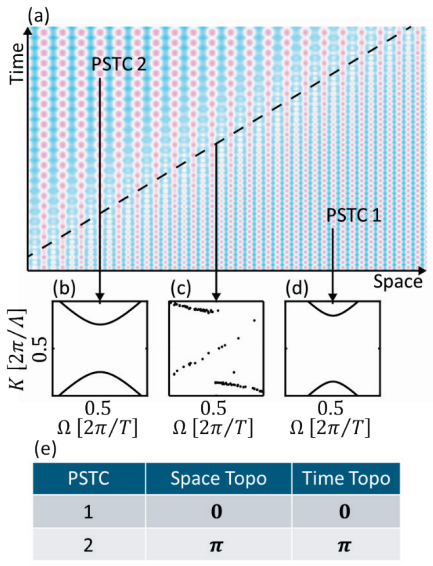
Topological edge states in systems of two (or more) dimensions offer scattering-free transport, exhibiting robustness to inhomogeneities and disorder. In a different domain, time-modulated systems, such as photonic time crystals (PTCs), offer non-resonant amplification drawing energy from the modulation. Combining these concepts, we explore topological systems that vary periodically in both time and space, manifesting the best of both worlds. We present topological phases and topological edge states in photonic space-time crystals - materials in which the refractive index varies periodically in both space and time, displaying bandgaps in both frequency and momentum. The topological nature of this system leads to topological invariants that govern the phase between refracted and reflected waves generated from both the spatial and the temporal interfaces. The 2D nature of this system leads to propagating edge states, and a unique edge state that grows exponentially in power whilst following the space-time edge.
Editorial analysis
A structured set of objections, weighed in public.
Referee Report
Summary. The manuscript develops a theoretical model for photonic space-time crystals in which the refractive index is modulated periodically in both space and time, n(x,t) = n0 + δn cos(kx x + ωt). It claims that the resulting 2D periodicity in (x,t) produces bandgaps in both frequency and wavevector, with topological invariants (analogous to Chern numbers in the extended Brillouin zone) that control the phase between reflected and refracted waves at spatial and temporal interfaces. The 2D character is asserted to yield propagating topological edge states along space-time boundaries together with a unique edge mode whose power grows exponentially while remaining localized to the interface.
Significance. If the central claims are rigorously established, the work would usefully combine the scattering immunity of topological edge states with the parametric energy input available from temporal modulation. This could open routes to robust, self-amplifying waveguides in non-Hermitian photonic platforms. The conceptual step of treating space-time periodicity as a genuine 2D topological problem in the (k,ω) plane is interesting and, if supported by explicit invariant calculations and controlled comparisons, would merit attention in the optics community.
major comments (3)
- [§3] §3 (Topological invariants): The manuscript invokes a Chern-like topological invariant in the (k,ω) Brillouin zone to govern interface phases and edge-state existence, yet provides no explicit integral evaluation or numerical computation of this invariant as a function of modulation parameters. Without this calculation it is impossible to verify quantization or to confirm that the claimed edge states are topologically protected rather than conventional.
- [§4.2] §4.2 (Exponentially growing edge state): The central claim that the observed exponential power growth is a consequence of the 2D space-time topology (rather than generic parametric gain from the temporal component of the modulation) is load-bearing. No direct comparison is shown to the purely temporal case (kx = 0) or to a topologically trivial parameter regime; the growth rate is therefore not isolated from non-Hermitian amplification that exists even in 1D photonic time crystals.
- [§4.1, Eq. (15)] §4.1, Eq. (15): The dispersion relation for the space-time edge mode is presented, but the boundary conditions at the space-time interface are not derived from first principles or matched to the bulk modes; it is therefore unclear whether the exponential growth is an intrinsic topological feature or an artifact of the assumed ideal modulation profile.
minor comments (3)
- [Figure 3] Figure 3: The labeling of the space-time edge in the simulation snapshot is ambiguous; an arrow or dashed line indicating the interface trajectory would improve clarity.
- [Throughout] Notation: The symbol δn is used both for the modulation amplitude and, later, for a detuning parameter; a distinct symbol for the latter would avoid confusion.
- [Introduction] References: Several foundational works on photonic time crystals (e.g., the original PTC papers) are cited only in passing; a brief comparison paragraph in the introduction would help situate the novelty.
Simulated Author's Rebuttal
We thank the referee for the careful and constructive review. The comments have helped us strengthen the presentation of the topological invariants, the isolation of the 2D topological contribution to the edge-state growth, and the derivation of the interface conditions. We address each major comment below and have revised the manuscript accordingly.
read point-by-point responses
-
Referee: §3 (Topological invariants): The manuscript invokes a Chern-like topological invariant in the (k,ω) Brillouin zone to govern interface phases and edge-state existence, yet provides no explicit integral evaluation or numerical computation of this invariant as a function of modulation parameters. Without this calculation it is impossible to verify quantization or to confirm that the claimed edge states are topologically protected rather than conventional.
Authors: We agree that an explicit evaluation is required for rigor. In the revised manuscript we now compute the Chern number by direct numerical integration of the Berry curvature over the two-dimensional (k,ω) Brillouin zone for representative modulation amplitudes. The results, shown in a new figure in §3, confirm integer quantization in the topological regime and vanishing values in the trivial regime. This establishes the topological protection of the reported edge states. revision: yes
-
Referee: §4.2 (Exponentially growing edge state): The central claim that the observed exponential power growth is a consequence of the 2D space-time topology (rather than generic parametric gain from the temporal component of the modulation) is load-bearing. No direct comparison is shown to the purely temporal case (kx = 0) or to a topologically trivial parameter regime; the growth rate is therefore not isolated from non-Hermitian amplification that exists even in 1D photonic time crystals.
Authors: We accept that a controlled comparison is necessary. The revised §4.2 now includes (i) the purely temporal case (kx = 0) and (ii) a topologically trivial parameter set with vanishing Chern number. In the kx = 0 case amplification occurs but the mode is delocalized in space; in the trivial regime no exponentially growing interface-localized state appears. These comparisons isolate the contribution of the 2D topology to the unique growth and localization properties. revision: yes
-
Referee: §4.1, Eq. (15): The dispersion relation for the space-time edge mode is presented, but the boundary conditions at the space-time interface are not derived from first principles or matched to the bulk modes; it is therefore unclear whether the exponential growth is an intrinsic topological feature or an artifact of the assumed ideal modulation profile.
Authors: We have expanded the derivation in the revised §4.1. Starting from Maxwell’s equations with the piecewise space-time periodic index, we enforce continuity of the tangential E and H fields across the interface and match the resulting coefficients to the bulk Floquet modes on either side. The resulting secular equation reproduces Eq. (15) and confirms that the exponential growth is tied to the topological mismatch of the bulk invariants rather than to the specific form of the modulation envelope. revision: yes
Circularity Check
No significant circularity; derivation remains self-contained
full rationale
The abstract and outline present a model of space-time periodic refractive index modulation leading to bandgaps and topological invariants that control interface phases, with 2D periodicity producing propagating and exponentially growing edge states. No equations, fitted parameters, or self-citations are shown that reduce any prediction or invariant to the input data or ansatz by construction. Topological invariants are invoked as standard governing quantities for the combined spatial-temporal system rather than being redefined from the target results. The exponential growth is attributed to the 2D space-time topology without visible reduction to purely temporal parametric gain via self-referential steps. The chain is independent and externally benchmarkable against existing topological photonics and photonic time crystal literature.
Axiom & Free-Parameter Ledger
axioms (2)
- domain assumption Existence of well-defined topological invariants for space-time periodic media that govern reflection/refraction phases at interfaces
- domain assumption Ideal lossless periodic modulation of refractive index in both space and time is physically realizable
Lean theorems connected to this paper
-
IndisputableMonolith/Foundation/AbsoluteFloorClosure.leanreality_from_one_distinction unclear?
unclearRelation between the paper passage and the cited Recognition theorem.
The topological nature of this system leads to topological invariants that govern the phase between refracted and reflected waves... The 2D nature of this system leads to propagating edge states, and a unique edge state that grows exponentially in power whilst following the space-time edge.
-
IndisputableMonolith/Foundation/AlexanderDuality.leanalexander_duality_circle_linking unclear?
unclearRelation between the paper passage and the cited Recognition theorem.
PSTCs band structures may include momentum bandgaps, energy bandgaps and hybrid bandgaps... the main features of the modes in the hybrid gaps are dictated by the 1D modes
What do these tags mean?
- matches
- The paper's claim is directly supported by a theorem in the formal canon.
- supports
- The theorem supports part of the paper's argument, but the paper may add assumptions or extra steps.
- extends
- The paper goes beyond the formal theorem; the theorem is a base layer rather than the whole result.
- uses
- The paper appears to rely on the theorem as machinery.
- contradicts
- The paper's claim conflicts with a theorem or certificate in the canon.
- unclear
- Pith found a possible connection, but the passage is too broad, indirect, or ambiguous to say the theorem truly supports the claim.
Reference graph
Works this paper leans on
-
[1]
Quantized Hall Conductance in a Two-Dimensional Periodic Potential,
D. J. Thouless, M. Kohmoto, M. P. Nightingale, and M. Den Nijs, “Quantized Hall Conductance in a Two-Dimensional Periodic Potential,” Phys. Rev. Lett., vol. 49, no. 6, pp. 405–408, Aug. 1982, doi: 10.1103/PhysRevLett.49.405
-
[2]
Observation of unidirectional backscattering-immune topological electromagnetic states,
Z. Wang, Y. Chong, J. D. Joannopoulos, and M. Soljačić, “Observation of unidirectional backscattering-immune topological electromagnetic states,” Nature, vol. 461, no. 7265, Art. no. 7265, Oct. 2009, doi: 10.1038/nature08293
-
[3]
F. D. M. Haldane and S. Raghu, “Possible Realization of Directional Optical Waveguides in Photonic Crystals with Broken Time-Reversal Symmetry,” Phys. Rev. Lett., vol. 100, no. 1, p. 013904, Jan. 2008, doi: 10.1103/PhysRevLett.100.013904
-
[4]
Direct measurement of the Zak phase in topological Bloch bands,
M. Atala et al., “Direct measurement of the Zak phase in topological Bloch bands,” Nature Phys, vol. 9, no. 12, Art. no. 12, Dec. 2013, doi: 10.1038/nphys2790
-
[5]
Experimental realization of the topological Haldane model with ultracold fermions,
G. Jotzu et al., “Experimental realization of the topological Haldane model with ultracold fermions,” Nature, vol. 515, no. 7526, Art. no. 7526, Nov. 2014, doi: 10.1038/nature13915
-
[6]
A. B. Khanikaev, R. Fleury, S. H. Mousavi, and A. Alù, “Topologically robust sound propagation in an angular-momentum-biased graphene-like resonator lattice,” Nat Commun, vol. 6, no. 1, Art. no. 1, Oct. 2015, doi: 10.1038/ncomms9260
-
[7]
Acoustic topological insulator and robust one-way sound transport,
C. He et al., “Acoustic topological insulator and robust one-way sound transport,” Nature Phys, vol. 12, no. 12, Art. no. 12, Dec. 2016, doi: 10.1038/nphys3867
-
[8]
Lasing in topological edge states of a one-dimensional lattice,
P. St-Jean et al., “Lasing in topological edge states of a one-dimensional lattice,” Nature Photon, vol. 11, no. 10, Art. no. 10, Oct. 2017, doi: 10.1038/s41566-017- 0006-2
-
[9]
Exciton-polariton topological insulator,
S. Klembt et al., “Exciton-polariton topological insulator,” Nature, vol. 562, no. 7728, Art. no. 7728, Oct. 2018, doi: 10.1038/s41586-018-0601-5
-
[10]
K. V. Klitzing, G. Dorda, and M. Pepper, “New Method for High-Accuracy Determination of the Fine-Structure Constant Based on Quantized Hall Resistance,” Phys. Rev. Lett., vol. 45, no. 6, pp. 494–497, Aug. 1980, doi: 10.1103/PhysRevLett.45.494
-
[11]
Z 2 Topological Order and the Quantum Spin Hall Effect,
C. L. Kane and E. J. Mele, “Z 2 Topological Order and the Quantum Spin Hall Effect,” Phys. Rev. Lett., vol. 95, no. 14, p. 146802, Sep. 2005, doi: 10.1103/PhysRevLett.95.146802
-
[12]
Z. Yang et al., “Topological Acoustics,” Phys. Rev. Lett., vol. 114, no. 11, p. 114301, Mar. 2015, doi: 10.1103/PhysRevLett.114.114301
-
[13]
Topological mechanics of gyroscopic metamaterials,
L. M. Nash, D. Kleckner, A. Read, V. Vitelli, A. M. Turner, and W. T. M. Irvine, “Topological mechanics of gyroscopic metamaterials,” Proceedings of the National Academy of Sciences, vol. 112, no. 47, pp. 14495–14500, Nov. 2015, doi: 10.1073/pnas.1507413112
-
[14]
Topological Phononic Crystals with One-Way Elastic Edge Waves,
P. Wang, L. Lu, and K. Bertoldi, “Topological Phononic Crystals with One-Way Elastic Edge Waves,” Phys. Rev. Lett., vol. 115, no. 10, p. 104302, Sep. 2015, doi: 10.1103/PhysRevLett.115.104302
-
[15]
Topological boundary modes in isostatic lattices,
C. L. Kane and T. C. Lubensky, “Topological boundary modes in isostatic lattices,” Nature Phys, vol. 10, no. 1, pp. 39–45, Jan. 2014, doi: 10.1038/nphys2835
-
[16]
Photonic Floquet topological insulators,
M. C. Rechtsman et al., “Photonic Floquet topological insulators,” Nature, vol. 496, no. 7444, Art. no. 7444, Apr. 2013, doi: 10.1038/nature12066
-
[17]
Imaging topological edge states in silicon photonics,
M. Hafezi, S. Mittal, J. Fan, A. Migdall, and J. M. Taylor, “Imaging topological edge states in silicon photonics,” Nature Photon, vol. 7, no. 12, Art. no. 12, Dec. 2013, doi: 10.1038/nphoton.2013.274
-
[18]
Topological insulator laser: Theory,
G. Harari et al., “Topological insulator laser: Theory,” 2018
work page 2018
-
[19]
Topological insulator laser: Experiments,
M. A. Bandres et al., “Topological insulator laser: Experiments,” 2018
work page 2018
-
[20]
Topological insulator vertical-cavity laser array,
A. Dikopoltsev et al., “Topological insulator vertical-cavity laser array,” Science, vol. 373, no. 6562, pp. 1514–1517, Sep. 2021, doi: 10.1126/science.abj2232
-
[21]
A topological source of quantum light,
S. Mittal, E. A. Goldschmidt, and M. Hafezi, “A topological source of quantum light,” Nature, vol. 561, no. 7724, pp. 502–506, Sep. 2018, doi: 10.1038/s41586-018- 0478-3
-
[22]
Topological protection of photonic path entanglement,
M. C. Rechtsman, Y. Lumer, Y. Plotnik, A. Perez-Leija, A. Szameit, and M. Segev, “Topological protection of photonic path entanglement,” Optica, OPTICA, vol. 3, no. 9, pp. 925–930, Sep. 2016, doi: 10.1364/OPTICA.3.000925
-
[23]
Topological protection of biphoton states,
A. Blanco-Redondo, B. Bell, D. Oren, B. J. Eggleton, and M. Segev, “Topological protection of biphoton states,” Science, vol. 362, no. 6414, pp. 568– 571, Nov. 2018, doi: 10.1126/science.aau4296
-
[24]
Topological aspects of photonic time crystals,
E. Lustig, Y. Sharabi, and M. Segev, “Topological aspects of photonic time crystals,” Optica, OPTICA, vol. 5, no. 11, pp. 1390–1395, Nov. 2018, doi: 10.1364/OPTICA.5.001390
-
[25]
Dynamics of light propagation in spatiotemporal dielectric structures,
F. Biancalana, A. Amann, A. V. Uskov, and E. P. O’Reilly, “Dynamics of light propagation in spatiotemporal dielectric structures,” Phys. Rev. E, vol. 75, no. 4, p. 046607, Apr. 2007, doi: 10.1103/PhysRevE.75.046607
-
[26]
J. R. Reyes-Ayona and P. Halevi, “Observation of genuine wave vector (k or β) gap in a dynamic transmission line and temporal photonic crystals,” Applied Physics Letters, vol. 107, no. 7, p. 074101, Aug. 2015, doi: 10.1063/1.4928659
-
[27]
Time reversal and holography with spacetime transformations,
V. Bacot, M. Labousse, A. Eddi, M. Fink, and E. Fort, “Time reversal and holography with spacetime transformations,” Nature Phys, vol. 12, no. 10, Art. no. 10, Oct. 2016, doi: 10.1038/nphys3810
-
[28]
Observation of temporal reflection and broadband frequency translation at photonic time interfaces,
H. Moussa, G. Xu, S. Yin, E. Galiffi, Y. Ra’di, and A. Alù, “Observation of temporal reflection and broadband frequency translation at photonic time interfaces,” Nat. Phys., vol. 19, no. 6, pp. 863–868, Jun. 2023, doi: 10.1038/s41567-023-01975-y
-
[29]
Time-reflection of microwaves by a fast optically-controlled time-boundary,
T. R. Jones, A. V. Kildishev, M. Segev, and D. Peroulis, “Time-reflection of microwaves by a fast optically-controlled time-boundary,” Nat Commun, vol. 15, no. 1, p. 6786, Aug. 2024, doi: 10.1038/s41467-024-51171-6
-
[30]
Doppler-shift emulation using highly time-refracting TCO layer,
A. M. Shaltout et al., “Doppler-shift emulation using highly time-refracting TCO layer,” in 2016 Conference on Lasers and Electro-Optics (CLEO), Jun. 2016, pp. 1–
work page 2016
- [31]
-
[32]
Broadband frequency translation through time refraction in an epsilon-near-zero material,
Y. Zhou et al., “Broadband frequency translation through time refraction in an epsilon-near-zero material,” Nat Commun, vol. 11, no. 1, Art. no. 1, May 2020, doi: 10.1038/s41467-020-15682-2
-
[33]
Ultraviolet second harmonic generation from Mie-resonant lithium niobate nanospheres
E. Lustig et al., “Time-refraction optics with single cycle modulation,” Nanophotonics, vol. 12, no. 12, pp. 2221–2230, Jun. 2023, doi: 10.1515/nanoph- 2023-0126
-
[34]
Place holder: Observation of Photonic Time-Crystals at microwave frequencies
T. R. Jones, L. Propkopyeva, A. V. Kildishev, M. Segev, and D. Peroulis, “Place holder: Observation of Photonic Time-Crystals at microwave frequencies”
-
[35]
Light emission by free electrons in photonic time- crystals,
A. Dikopoltsev et al., “Light emission by free electrons in photonic time- crystals,” Proceedings of the National Academy of Sciences, vol. 119, no. 6, p. e2119705119, Feb. 2022, doi: 10.1073/pnas.2119705119
-
[36]
Amplified emission and lasing in photonic time crystals,
M. Lyubarov, Y. Lumer, A. Dikopoltsev, E. Lustig, Y. Sharabi, and M. Segev, “Amplified emission and lasing in photonic time crystals,” Science, vol. 377, no. 6604, pp. 425–428, Jul. 2022, doi: 10.1126/science.abo3324
-
[37]
Observation of momentum-gap topology of light at temporal interfaces in a time-synthetic lattice,
Y. Ren et al., “Observation of momentum-gap topology of light at temporal interfaces in a time-synthetic lattice,” Nat Commun, vol. 16, no. 1, p. 707, Jan. 2025, doi: 10.1038/s41467-025-56021-7
-
[38]
Spatiotemporal photonic crystals,
Y. Sharabi, A. Dikopoltsev, E. Lustig, Y. Lumer, and M. Segev, “Spatiotemporal photonic crystals,” Optica, OPTICA, vol. 9, no. 6, pp. 585–592, Jun. 2022, doi: 10.1364/OPTICA.455672
-
[39]
Spatiotemporal plane wave expansion method for arbitrary space–time periodic photonic media,
J. Park and B. Min, “Spatiotemporal plane wave expansion method for arbitrary space–time periodic photonic media,” Opt. Lett., vol. 46, no. 3, p. 484, Feb. 2021, doi: 10.1364/OL.411622
-
[40]
Berry’s phase for energy bands in solids,
J. Zak, “Berry’s phase for energy bands in solids,” Phys. Rev. Lett., vol. 62, no. 23, pp. 2747–2750, Jun. 1989, doi: 10.1103/PhysRevLett.62.2747
-
[41]
Surface Impedance and Bulk Band Geometric Phases in One-Dimensional Systems,
M. Xiao, Z. Q. Zhang, and C. T. Chan, “Surface Impedance and Bulk Band Geometric Phases in One-Dimensional Systems,” Phys. Rev. X, vol. 4, no. 2, p. 021017, Apr. 2014, doi: 10.1103/PhysRevX.4.021017
-
[42]
Topology in Photonic Space-Time Crystals,
O. Segal et al., “Topology in Photonic Space-Time Crystals,” in Conference on Lasers and Electro-Optics (2022), paper JW4A.4, Optica Publishing Group, May 2022, p. JW4A.4. doi: 10.1364/CLEO_AT.2022.JW4A.4
-
[43]
Space-time- topological events in photonic quantum walks,
J. Feis, S. Weidemann, T. Sheppard, H. M. Price, and A. Szameit, “Space-time- topological events in photonic quantum walks,” Nat. Photon., vol. 19, no. 5, pp. 518– 525, May 2025, doi: 10.1038/s41566-025-01653-w
-
[44]
Supplementary Information - 2D Topological Edge States in Periodic Space- Time Interfaces
“Supplementary Information - 2D Topological Edge States in Periodic Space- Time Interfaces”
-
[45]
Double-slit time diffraction at optical frequencies,
R. Tirole et al., “Double-slit time diffraction at optical frequencies,” Nat. Phys., vol. 19, no. 7, pp. 999–1002, Jul. 2023, doi: 10.1038/s41567-023-01993-w
-
[46]
Time-Refraction with Moving Time-Interfaces,
O. Segal et al., “Time-Refraction with Moving Time-Interfaces,” in CLEO 2023 (2023), paper FTu3D.2, Optica Publishing Group, May 2023, p. FTu3D.2. doi: 10.1364/CLEO_FS.2023.FTu3D.2
-
[47]
Ultrafast Non-Hermitian Skin Effect,
B. Schneider et al., “Ultrafast Non-Hermitian Skin Effect,” May 06, 2025, arXiv: arXiv:2505.03658. doi: 10.48550/arXiv.2505.03658
-
[48]
Non-Hermitian topology and skin modes in the continuum via parametric processes,
M. Bestler, A. Dikopoltsev, and O. Zilberberg, “Non-Hermitian topology and skin modes in the continuum via parametric processes,” May 05, 2025, arXiv: arXiv:2505.02776. doi: 10.48550/arXiv.2505.02776
-
[49]
Metasurface-based realization of photonic time crystals,
X. Wang, M. S. Mirmoosa, V. S. Asadchy, C. Rockstuhl, S. Fan, and S. A. Tretyakov, “Metasurface-based realization of photonic time crystals,” Science Advances, vol. 9, no. 14, p. eadg7541, Apr. 2023, doi: 10.1126/sciadv.adg7541
discussion (0)
Sign in with ORCID, Apple, or X to comment. Anyone can read and Pith papers without signing in.