REVIEW 4 major objections 6 minor 1 cited by
Function Space Diversity for Uncertainty Prediction via Repulsive Last-Layer Ensembles
T0 review · 4 major / 6 minor · reviewed 2026-08-11 · deepseek-v4-flash
Pith's one-line read A frozen pretrained network plus a repulsive multi-head last layer yields deep-ensemble-grade uncertainty at a fraction of the cost.
desk verdict Useful empirical paper on cheap last-layer ensembles; main claims are plausible but the missing kernel bandwidth and partial OOD overlap need fixing before it is independently reproducible. read the letter →
The pith
A machine-rendered reading of the paper's core claim, the machinery that carries it, and where it could break.
The reading
What carries the argument
The central object is the function-space repulsive last-layer ensemble (fs-RLL-E): one pretrained base network whose last layer is replaced by $n$ linear heads, each head a particle, with a Gaussian kernel repulsion term on the heads' prediction functions evaluated at a chosen batch of repulsion samples. The repulsion term is what drives the heads to disagree outside the training distribution, turning prediction spread into an epistemic uncertainty estimate via mutual information. The choice of repulsion samples is the second load-bearing mechanism: training data diversity underfits, so the paper uses unlabeled out-of-distribution data or patch-shuffled augmentations that destroy class labels, which suppresses spurious features and makes OOD disagreement generalize.
What would settle it
Train fs-RLL-E on a base network known to collapse features, such as LeNet or VGG-16 without residual connections on DirtyMNIST with eMNIST as repulsion samples, and measure whether epistemic uncertainty separates ambiguous MNIST from OOD data; the paper's own Appendix B.2 predicts degraded separation, so an AUROC near chance on that separation would falsify the claim that frozen feature extractors suffice.
Extended reading notes
Core claim
The central claim is that a shared frozen feature extractor with a repulsive last-layer ensemble, multiple linear heads trained as particles in function space, can produce uncertainty estimates competitive with deep ensembles while adding only $(d \times K + K) \times n$ trainable parameters for feature dimension $d$, $K$ classes, and $n$ particles. The paper shows that function-space repulsion evaluated on unlabeled out-of-distribution data or on label-destroyed augmented samples separates aleatoric from epistemic uncertainty, detects near and far out-of-domain inputs, and calibrates predictions under covariate shift. It also claims that this works retrospectively on pretrained residual networks, provided the base representation is distance-aware enough to avoid feature collapse, so that diversity can be enforced on the last layer alone.
Load-bearing premise
The method assumes the frozen pretrained feature extractor keeps distant inputs distant in feature space, so that a linear head can actually produce diverse predictions on out-of-distribution or augmented points; if the base network collapses such points together, last-layer repulsion cannot separate them.
Editorial extensions
If this is right
- Deep-ensemble-level uncertainty becomes available on pretrained models for roughly the cost of retraining a single linear layer.
- Active learning can use mutual information from the last-layer heads to pick informative points while ignoring ambiguous ones, matching deep ensembles.
- OOD detection improves for both near and far shifts, particularly when repulsion samples are drawn from a related but different dataset like TinyImageNet for CIFAR models.
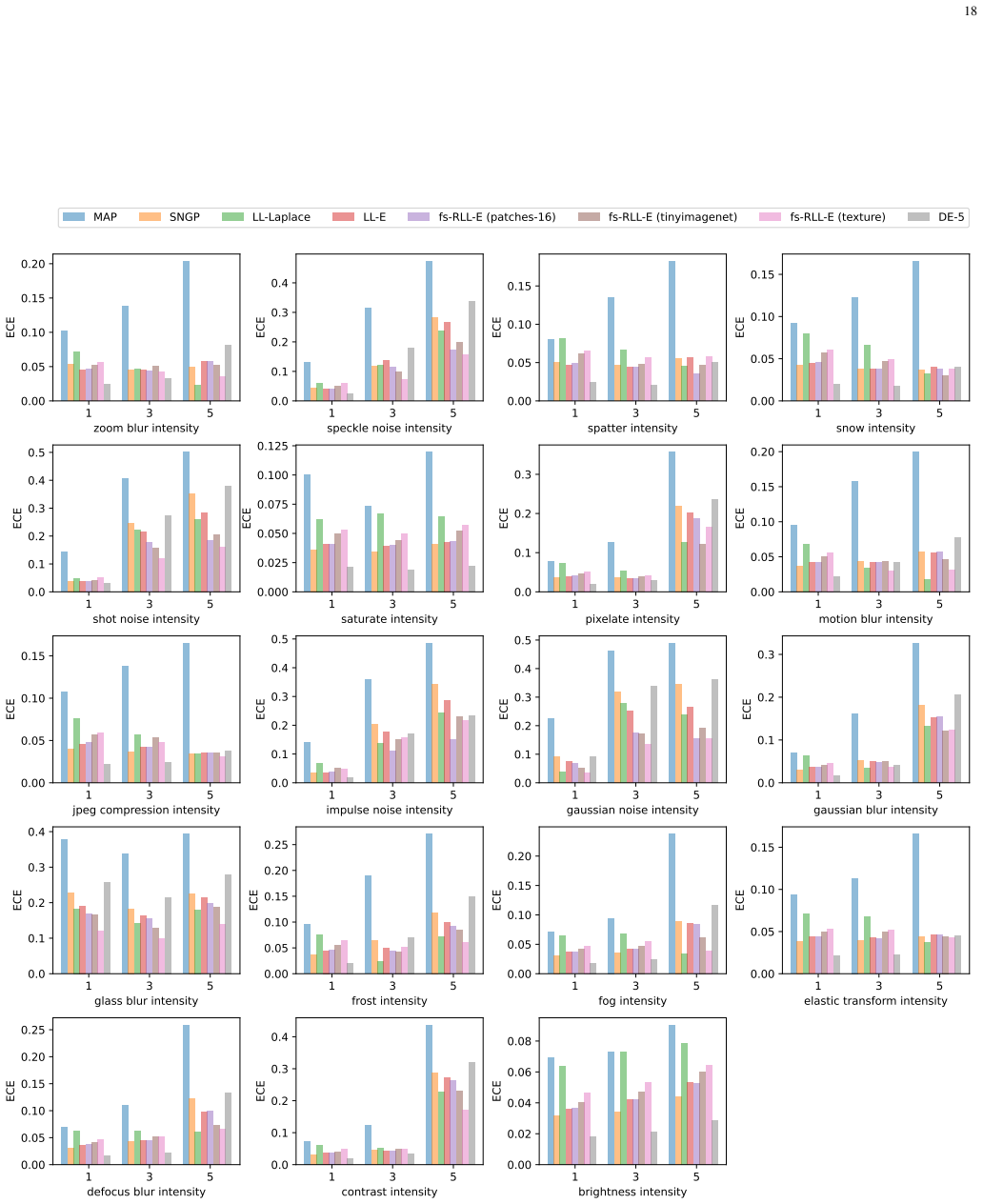
- Calibration under corruption improves over the base network and often matches full deep ensembles.
- Diversity on training data itself is counterproductive; label-destroying augmentation is a viable substitute when no OOD data is available.
Reading between the lines
- If the feature extractor preserves distances, fs-RLL-E could serve as a drop-in uncertainty retrofit for any pretrained residual network, including models fine-tuned for downstream tasks; the paper tests several ResNet sizes but not large language or vision-language backbones.
- The choice of repulsion samples is effectively a prior over where the model should express ignorance, suggesting a design rule: point repulsion at the specific failure modes you want to catch, and expect trade-offs when one repulsion set must cover many OOD directions.
- A testable extension is to make repulsion samples adaptive during training, for example by mining near-boundary or confusing OOD samples; the paper keeps the repulsion set fixed.
- Since parameter-space repulsion gives no benefit over the unregularized last-layer ensemble in the paper's tables, the result implies that diversity must be measured on outputs rather than weights, a lesson that extends to ensemble distillation.
Editorial analysis
A structured set of objections, weighed in public.
Referee Report
Summary. This paper proposes function-space repulsive last-layer ensembles (fs-RLL-E): a single network with a shared frozen base and n linear output heads, trained jointly with a function-space repulsion term evaluated on auxiliary repulsion samples (unlabeled OOD data or label-destroying augmented training data). The authors argue that (i) enforcing diversity on training-data samples is detrimental, (ii) parameter-space repulsion is insufficient and function-space diversity should be enforced instead (desideratum D1), and (iii) the multi-headed last-layer parameterization is flexible enough to serve as the particle representation, enabling retrospective uncertainty estimates for pretrained networks (D2). The method is evaluated on DirtyMNIST uncertainty decomposition, an active learning benchmark, OOD detection for CIFAR10/CIFAR100, and covariate-shift calibration on CIFAR10-C/CIFAR100-C, against MAP, DDU, SNGP, last-layer Laplace, and deep ensembles. The appendices add ablations over repulsion-sample choices, base-network architectures, spectral normalization, and feature-space dimensionality.
Significance. If the central claims are correct, the paper's contribution is a practically important one: a cheap post-hoc uncertainty method that achieves OOD detection and calibration competitive with deep ensembles at a fraction of the training and memory cost, plus a transferable design rule (enforce diversity on OOD or augmented samples, not on training data). The empirical work is broad and largely well-controlled: repulsion-sample ablations (Tables II and III), base-architecture sensitivity (Appendix B.2), spectral-normalization sensitivity (Table VIII), and feature-dimension scaling (Appendix B.5). The negative result for training-data repulsion (Table II, fs-RLL-E + Cifar10 with ECE 5.73 and AUROC below 50 on several OOD sets) is a clear, falsifiable finding that future work will have to engage with. However, three issues currently block full confidence: the core kernel hyperparameters are unreported, the parameter-space repulsion ablation appears to run in a dead-kernel regime, and the 'pretrained network' claim has not been tested on off-the-shelf checkpoints. These are fixable revisions rather than fundamental flaws.
major comments (4)
- [§IV-B; Appendix A, Table IV] The function-space repulsion kernel k(f_i, f_j) = exp(−||f_i − f_j||^p/ν) from Section IV-B is the mechanism that the paper credits for the improvements of fs-RLL-E over LL-E, but neither the bandwidth ν nor the exponent p nor any repulsion-loss weighting is reported, and Table IV (the hyperparameter summary) omits them. Since the experiments show that the repulsion term is strongly active — e.g., Table II, where replacing the repulsion-sample set changes NLL from 14.01 (Patches-32) to 19.08 (Cifar10) — the missing ν is a reproducibility blocker and not a cosmetic omission. I ask the authors to report the exact values used in every experiment and to add a sensitivity study of the main OOD AUROC and ECE numbers to ν (and, if applicable, to the repulsion weight) over at least two orders of magnitude.
- [§VIII-B; Tables I–III] In Section VIII-B the authors conclude that 'imposing diversity on the parameters of the last layer particles (RLL-E)... does not provide any additional benefit,' but the supporting rows in Tables I–III are not informative as reported. In Table I the RLL-E row is numerically identical to the LL-E row in every metric and every standard deviation across 10 runs (83.53±0.16, 48.32±0.24, 1.00±0.14, 96.82±0.34, 99.41±0.22, 96.16±1.53), and in Tables II–III the two rows are nearly identical, with most differences well within one standard deviation. Identical statistics over ten runs are consistent with an effectively inactive parameter-space kernel (e.g., ν so large that the repulsion gradient vanishes) rather than with a meaningful test of parameter-space repulsion. The comparison should report ν and the repulsion weight and should demonstrate at least one regime where RLL-E visibly differs from LL-E; otherwise the argument for desideratum D1 (parameter-space diversity is insufficient) rests on a degenerate experiment.
- [§V-C; Appendix A; Appendix B.2] The advertised use case — uncertainty-aware fine-tuning of pretrained networks — is only exercised on base networks trained by the authors under a single protocol (300 epochs, SGD, spectral normalization; Appendix A and Table IV). Appendix B.2 shows that this matters: on LeNet and VGG-16, which lack residual connections, the advantages of fs-RLL-E shrink (e.g., Table VI, LeNet ambig-vs-OOD AUROC of 92.68 vs 99.55 for ResNet-18), and Section V-C itself concedes the feature-collapse risk. Because the method inherits distance-awareness entirely from the frozen backbone, the paper should either add one experiment with a genuine off-the-shelf checkpoint (e.g., an ImageNet-pretrained ResNet without spectral normalization and without the authors' training protocol) or restrict the 'seamless integration to pretrained networks' claim to models trained with distance-preserving regularization. As it stands, the central practical claim is under-tested precisely in the setting it is meant to serve.
- [§VIII-D; Tables II–III; Table X] In the CIFAR10/100 OOD experiments, the repulsion-sample set and the OOD test set coincide for several configurations (fs-RLL-E + TinyImagenet evaluated on TinyImagenet, fs-RLL-E + Texture evaluated on Texture, and likewise for Cifar100 and SVHN in Table X). Table X is helpful evidence that repulsion diversity transfers across OOD datasets, but the main tables report same-source settings without any caveat, so the reader cannot separate genuine OOD detection from detection of the repulsion training signal. Please state explicitly in Section VIII-D which OOD test sets overlap with Drep, and provide the AUROC values with those same-source columns excluded; the conclusions should rest on the cross-generalization numbers.
minor comments (6)
- [§IV-A] The text says 'Euclidean (ℓ2 norm) or Manhattan (ℓ2 norm)', but the Manhattan distance is the ℓ1 norm; the second ℓ2 is a typo.
- [Table VI] The ResNet-18 LL-Laplace AUROC entries are printed as 'nan' with no explanation; either report the values or add a footnote, since missing values in a comparison table block a fair reading of that row.
- [§VIII-E] The phrase 'enhance improve uncertainty estimates' contains a duplicated verb, and 'Section A PPENDIX B.3' has a spacing artifact; both need copy-editing.
- [Fig. 5] The legend mixes method names with 'pool (PE)' and 'pool (MI)' variants in a way that is hard to parse; clarify that the parentheticals denote the acquisition score (predictive entropy vs mutual information) and to which curve 'pool' refers.
- [Abstract] The sentence 'the input samples, where particle predictions are enforced to be diverse, are detrimental to the model performance' is misleading as written, since the paper's headline is that OOD and augmented repulsion samples are beneficial; rephrase to say that enforcing diversity on training-data samples is detrimental.
- [Appendix A] No link to the authors' own implementation is given; Appendix A links only third-party repositories for [5], [6], and [52]. Since the method's performance hinges on ν and the repulsion-sample protocol, releasing the fs-RLL-E code (or a complete configuration file) is needed for reproducibility.
Circularity Check
OOD-detection scores on repulsion-sample distributions are partly self-confirming, but unseen-OOD generalization keeps the core claim independent.
-
fitted input called prediction
[Appendix B.3 (Table VII caption) and Section VIII-D (Tables II-III)]
"We test the influence of repulsion samples from the OOD training set for different base network architectures. ... Using informative repulsion samples for the function space loss results in better performance than unregularized LL-E retraining."
The training objective for fs-RLL-E includes a repulsion term evaluated on a chosen set Drep; when Drep equals the evaluation OOD test set (e.g., Cifar100 for +Cifar100, TinyImagenet for +TinyImagenet), the AUROC on that column measures whether the model learned to satisfy the training loss on the repulsion-sample distribution, not whether the uncertainty estimator detects a genuinely unseen shift. The paper frames these columns as OOD-detection evidence, but for the same-distribution cells this is a self-confirming evaluation: the desired behavior (diverse predictions on those inputs) is the optimization target. Unlike the unseen-OOD columns, these numbers do not provide independent evidence for the method's generalization claim.
full rationale
The derivation chain is mostly empirical. The particle update rule (Eq. 2) and the function-space kernel are imported from prior external work (D'Angelo and Fortuin; Wang et al.), not derived from the paper's own conclusions; no load-bearing self-citation appears in the reference list. The main architectural claim, that a shared frozen base with linear heads is flexible enough, is tested directly (Tables I-III) and supported by comparisons against DDU, SNGP, LL-Laplace, and DE-5, which are external methods. The one genuine circular element is evaluative: in Tables II/III and Appendix B.3/B.5, several OOD-detection AUROC columns use as the OOD test set the very distribution that was used as repulsion samples in training (e.g., fs-RLL-E +Cifar100 evaluated on Cifar100; fs-RLL-E +TinyImagenet evaluated on TinyImagenet). Since the training loss explicitly enforces diverse predictions on those repulsion samples, a high AUROC on those columns is partly the optimization objective, not an independent prediction. The paper also reports generalization to unseen OOD (e.g., fs-RLL-E +TinyImagenet on SVHN/FakeData; DirtyMNIST eMNIST-repulsion on kMNIST/fashionMNIST/Omniglot), so the central claim has independent content. Score 3 reflects this partial, non-central circularity; no self-citation or definitional identity was found.
Assumptions & free parameters
free parameters (3)
- Kernel bandwidth nu in function-space RBF repulsion kernel =
not reported in the paper
- Number of heads/particles n =
10 for image classification, 30 for toy experiments
- Repulsion sample dataset Drep =
eMNIST or Patches for MNIST; TinyImagenet, CIFAR100, Texture, or Patches for CIFAR10/100
assumptions (4)
- standard math Particle-optimization variational inference with the update in Eq. (2) converges to the posterior in the infinite-particle limit.
- standard math Evaluating the function-space kernel on a finite set of repulsion samples with support on the input domain suffices for inference (the B-dimensional marginal condition).
- domain assumption A single shared base network with multiple linear heads is flexible enough to represent diverse prediction functions for uncertainty estimation.
- domain assumption Pretrained networks with residual connections and/or spectral normalization avoid feature collapse, so the frozen feature space remains distance-aware.
Cite this review
Pith. "Pith review of Function Space Diversity for Uncertainty Prediction via Repulsive Last-Layer Ensembles." pith.science (2026). https://pith.science/paper/2B5KCP3P
@misc{pith2026241215758,
  author       = {Pith},
  title        = {Pith review of: Function Space Diversity for Uncertainty Prediction via Repulsive Last-Layer Ensembles},
  year         = {2026},
  howpublished = {\url{https://pith.science/paper/2B5KCP3P}},
  note         = {Machine review of arXiv:2412.15758}
}
read the original abstract
Bayesian inference in function space has gained attention due to its robustness against overparameterization in neural networks. However, approximating the infinite-dimensional function space introduces several challenges. In this work, we discuss function space inference via particle optimization and present practical modifications that improve uncertainty estimation and, most importantly, make it applicable for large and pretrained networks. First, we demonstrate that the input samples, where particle predictions are enforced to be diverse, are detrimental to the model performance. While diversity on training data itself can lead to underfitting, the use of label-destroying data augmentation, or unlabeled out-of-distribution data can improve prediction diversity and uncertainty estimates. Furthermore, we take advantage of the function space formulation, which imposes no restrictions on network parameterization other than sufficient flexibility. Instead of using full deep ensembles to represent particles, we propose a single multi-headed network that introduces a minimal increase in parameters and computation. This allows seamless integration to pretrained networks, where this repulsive last-layer ensemble can be used for uncertainty aware fine-tuning at minimal additional cost. We achieve competitive results in disentangling aleatoric and epistemic uncertainty for active learning, detecting out-of-domain data, and providing calibrated uncertainty estimates under distribution shifts with minimal compute and memory.
Figures


Figures from the paper (7 more)


Forward citations
Cited by 1 Pith paper
-
Controllable Diversity in Normalization-Based Implicit Ensembles via Softmax-Temperature Modulation
Softmax-temperature regularisation of sigmoid-bounded normalisation scales controls member diversity in implicit ensembles, matching deep ensembles cheaply across CNNs and transformers.
Reference graph
Works this paper leans on
-
[1]
Simple and scalable predictive uncertainty estimation using deep ensembles,
B. Lakshminarayanan, A. Pritzel, and C. Blundell, “Simple and scalable predictive uncertainty estimation using deep ensembles,” Advances in Neural Information Processing Systems , vol. 30, 2017
2017
-
[2]
Stein variational gradient descent: A general purpose Bayesian inference algorithm,
Q. Liu and D. Wang, “Stein variational gradient descent: A general purpose Bayesian inference algorithm,” Advances in Neural Information Processing Systems, vol. 29, 2016
work page 2016
-
[3]
Stein variational gradient descent as gradient flow,
Q. Liu, “Stein variational gradient descent as gradient flow,” Advances in Neural Information Processing Systems , vol. 30, 2017
work page 2017
-
[4]
Understanding and accelerating particle-based variational inference
C. Liu, J. Zhuo, P. Cheng, R. Zhang, and J. Zhu, “Understanding and accelerating particle-based variational inference.” PMLR, 2019, pp. 4082–4092
work page 2019
-
[5]
Function Space Particle Optimization for Bayesian Neural Networks
Z. Wang, T. Ren, J. Zhu, and B. Zhang, “Function space par- ticle optimization for Bayesian neural networks,” arXiv preprint arXiv:1902.09754, 2019
work page Pith review arXiv 1902
-
[6]
Repulsive deep ensembles are Bayesian,
F. D’Angelo and V . Fortuin, “Repulsive deep ensembles are Bayesian,” Advances in Neural Information Processing Systems , vol. 34, pp. 3451– 3465, 2021
work page 2021
-
[7]
Input gradient diversity for neural network ensembles,
T. Trinh, M. Heinonen, L. Acerbi, and S. Kaski, “Input gradient diversity for neural network ensembles,” arXiv preprint arXiv:2306.02775, 2023
arXiv 2023
-
[8]
Feature space particle inference for neural network ensembles
S. Yashima, T. Suzuki, K. Ishikawa, I. Sato, and R. Kawakami, “Feature space particle inference for neural network ensembles.” PMLR, 2022, pp. 25 452–25 468
work page 2022
Show all 70 references
-
[9]
Hydra: Preserving ensemble diversity for model distillation,
L. Tran, B. S. Veeling, K. Roth, J. Swiatkowski, J. V . Dillon, J. Snoek, S. Mandt, T. Salimans, S. Nowozin, and R. Jenatton, “Hydra: Preserving ensemble diversity for model distillation,” arXiv preprint arXiv:2001.04694, 2020. 12
2001 arXiv
-
[10]
Quantification of uncertainty with adversarial models,
K. Schweighofer, L. Aichberger, M. Ielanskyi, G. Klambauer, and S. Hochreiter, “Quantification of uncertainty with adversarial models,” Advances in Neural Information Processing Systems , vol. 36, pp. 19 446–19 484, 2023
2023
-
[11]
A unified particle- optimization framework for scalable bayesian sampling,
C. Chen, R. Zhang, W. Wang, B. Li, and L. Chen, “A unified particle- optimization framework for scalable bayesian sampling,” arXiv preprint arXiv:1805.11659, 2018
2018 arXiv
-
[12]
Decomposition of uncertainty in Bayesian deep learning for efficient and risk-sensitive learning
S. Depeweg, J.-M. Hernandez-Lobato, F. Doshi-Velez, and S. Udluft, “Decomposition of uncertainty in Bayesian deep learning for efficient and risk-sensitive learning.” PMLR, 2018, pp. 1184–1193
2018
-
[13]
Quan- tifying aleatoric and epistemic uncertainty in machine learning: Are conditional entropy and mutual information appropriate measures?
L. Wimmer, Y . Sale, P. Hofman, B. Bischl, and E. H ¨ullermeier, “Quan- tifying aleatoric and epistemic uncertainty in machine learning: Are conditional entropy and mutual information appropriate measures?” in Uncertainty in Artificial Intelligence . PMLR, 2023, pp. 2282–2292
2023
-
[14]
On the usefulness of deep ensemble diver- sity for out-of-distribution detection,
G. Xia and C.-S. Bouganis, “On the usefulness of deep ensemble diver- sity for out-of-distribution detection,” arXiv preprint arXiv:2207.07517, 2022
2022 arXiv
-
[15]
A rigorous link between deep ensembles and (variational) bayesian methods,
V . D. Wild, S. Ghalebikesabi, D. Sejdinovic, and J. Knoblauch, “A rigorous link between deep ensembles and (variational) bayesian methods,” in Advances in Neural Information Processing Systems, 2023. [Online]. Available: https://openreview.net/forum?id=eTHawKFT4h
2023
-
[16]
Improving the identifiability of neural networks for bayesian inference,
A. A. Pourzanjani, R. M. Jiang, and L. R. Petzold, “Improving the identifiability of neural networks for bayesian inference,” in NIPS workshop on bayesian deep learning , vol. 4, 2017, p. 31
2017
-
[17]
On the surprising behavior of distance metrics in high dimensional space,
C. C. Aggarwal, A. Hinneburg, and D. A. Keim, “On the surprising behavior of distance metrics in high dimensional space,” in Database Theory—ICDT 2001: 8th International Conference London, UK, Jan- uary 4–6, 2001 Proceedings 8 . Springer, 2001, pp. 420–434
2001
-
[18]
Bridging the data processing inequality and function-space variational inference,
A. Kirsch, “Bridging the data processing inequality and function-space variational inference,” in The Third Blogpost Track at ICLR 2024 ,
2024
-
[19]
Distilling the knowledge in a neural network,
G. Hinton, O. Vinyals, and J. Dean, “Distilling the knowledge in a neural network,” arXiv preprint arXiv:1503.02531 , 2015
2015 arXiv
-
[20]
Do Bayesian neural networks need to be fully stochastic?
M. Sharma, S. Farquhar, E. Nalisnick, and T. Rainforth, “Do Bayesian neural networks need to be fully stochastic?” PMLR, 2023, pp. 7694– 7722
2023
-
[21]
The best deep ensembles sacrifice predictive diversity,
T. Abe, E. K. Buchanan, G. Pleiss, and J. P. Cunningham, “The best deep ensembles sacrifice predictive diversity,” 2022
2022
-
[22]
Joint training of deep ensembles fails due to learner collusion,
A. Jeffares, T. Liu, J. Crabb ´e, and M. van der Schaar, “Joint training of deep ensembles fails due to learner collusion,” Advances in Neural Information Processing Systems , vol. 36, 2024
2024
-
[23]
Uncertainty estimation using a single deep deterministic neural network
J. van Amersfoort, L. Smith, Y . W. Teh, and Y . Gal, “Uncertainty estimation using a single deep deterministic neural network.” PMLR, 2020, pp. 9690–9700
2020
-
[24]
Spectral normalization for generative adversarial networks,
T. Miyato, T. Kataoka, M. Koyama, and Y . Yoshida, “Spectral normalization for generative adversarial networks,” arXiv preprint arXiv:1802.05957, 2018
2018 arXiv
-
[25]
mixup: Beyond empirical risk minimization,
H. Zhang, M. Cisse, Y . N. Dauphin, and D. Lopez-Paz, “mixup: Beyond empirical risk minimization,” arXiv preprint arXiv:1710.09412 , 2017
2017 arXiv
-
[26]
Cutmix: Reg- ularization strategy to train strong classifiers with localizable features,
S. Yun, D. Han, S. J. Oh, S. Chun, J. Choe, and Y . Yoo, “Cutmix: Reg- ularization strategy to train strong classifiers with localizable features,” in Proceedings of the IEEE/CVF international conference on computer vision, 2019, pp. 6023–6032
2019
-
[27]
Bayesian learning for neural networks,
R. M. Neal, “Bayesian learning for neural networks,” Ph.D. dissertation, University of Toronto, 1995
1995
-
[28]
Weight uncertainty in neural network
C. Blundell, J. Cornebise, K. Kavukcuoglu, and D. Wierstra, “Weight uncertainty in neural network.” PMLR, 2015, pp. 1613–1622
2015
-
[29]
Dropout as a Bayesian approximation: Representing model uncertainty in deep learning
Y . Gal and Z. Ghahramani, “Dropout as a Bayesian approximation: Representing model uncertainty in deep learning.” PMLR, 2016, pp. 1050–1059
2016
-
[30]
Laplace redux-effortless Bayesian deep learning,
E. Daxberger, A. Kristiadi, A. Immer, R. Eschenhagen, M. Bauer, and P. Hennig, “Laplace redux-effortless Bayesian deep learning,” Advances in Neural Information Processing Systems , vol. 34, pp. 20 089–20 103, 2021
2021
-
[31]
Efficient and scalable Bayesian neural nets with rank-1 factors
M. Dusenberry, G. Jerfel, Y . Wen, Y . Ma, J. Snoek, K. Heller, B. Laksh- minarayanan, and D. Tran, “Efficient and scalable Bayesian neural nets with rank-1 factors.” PMLR, 2020, pp. 2782–2792
2020
-
[32]
Being Bayesian, even just a bit, fixes overconfidence in relu networks
A. Kristiadi, M. Hein, and P. Hennig, “Being Bayesian, even just a bit, fixes overconfidence in relu networks.” PMLR, 2020, pp. 5436–5446
2020
-
[33]
Variational bayesian last layers,
J. Harrison, J. Willes, and J. Snoek, “Variational bayesian last layers,” arXiv preprint arXiv:2404.11599 , 2024
2024 arXiv
-
[34]
Evaluating scalable bayesian deep learning methods for robust computer vision,
F. K. Gustafsson, M. Danelljan, and T. B. Schon, “Evaluating scalable bayesian deep learning methods for robust computer vision,” in Pro- ceedings of the IEEE/CVF conference on computer vision and pattern recognition workshops, 2020, pp. 318–319
2020
-
[35]
Can you trust your model’s uncer- tainty? evaluating predictive uncertainty under dataset shift,
Y . Ovadia, E. Fertig, J. Ren, Z. Nado, D. Sculley, S. Nowozin, J. Dillon, B. Lakshminarayanan, and J. Snoek, “Can you trust your model’s uncer- tainty? evaluating predictive uncertainty under dataset shift,” Advances in Neural Information Processing Systems , vol. 32, 2019
2019
-
[36]
The case for bayesian deep learning,
A. G. Wilson, “The case for bayesian deep learning,” arXiv preprint arXiv:2001.10995, 2020
2001 arXiv
-
[37]
Functional variational Bayesian neural networks,
S. Sun, G. Zhang, J. Shi, and R. Grosse, “Functional variational Bayesian neural networks,” arXiv preprint arXiv:1903.05779 , 2019
1903 arXiv
-
[38]
Variational implicit pro- cesses,
C. Ma, Y . Li, and J. M. Hern ´andez-Lobato, “Variational implicit pro- cesses,” in International Conference on Machine Learning . PMLR, 2019, pp. 4222–4233
2019
-
[39]
Un- derstanding variational inference in function-space,
D. R. Burt, S. W. Ober, A. Garriga-Alonso, and M. van der Wilk, “Un- derstanding variational inference in function-space,” in Third Symposium on Advances in Approximate Bayesian Inference , 2020
2020
-
[40]
Functional variational inference based on stochastic process generators,
C. Ma and J. M. Hern ´andez-Lobato, “Functional variational inference based on stochastic process generators,” Advances in Neural Information Processing Systems, vol. 34, pp. 21 795–21 807, 2021
2021
-
[41]
Tractable function-space variational inference in Bayesian neural networks,
T. G. Rudner, Z. Chen, Y . W. Teh, and Y . Gal, “Tractable function-space variational inference in Bayesian neural networks,” Advances in Neural Information Processing Systems , vol. 35, pp. 22 686–22 698, 2022
2022
-
[42]
Function- space regularization in neural networks: A probabilistic perspective,
T. G. Rudner, S. Kapoor, S. Qiu, and A. G. Wilson, “Function- space regularization in neural networks: A probabilistic perspective,” International Conference on Machine Learning , 2023
2023
-
[43]
Deep anomaly detection with outlier exposure,
D. Hendrycks, M. Mazeika, and T. Dietterich, “Deep anomaly detection with outlier exposure,” in International Conference on Learning Representations, 2019. [Online]. Available: https://openreview.net/ forum?id=HyxCxhRcY7
2019
-
[44]
Collaborative learning for deep neural networks,
G. Song and W. Chai, “Collaborative learning for deep neural networks,” Advances in Neural Information Processing Systems , vol. 31, 2018
2018
-
[45]
Very deep mul- tilingual convolutional neural networks for lvcsr
T. Sercu, C. Puhrsch, B. Kingsbury, and Y . LeCun, “Very deep mul- tilingual convolutional neural networks for lvcsr.” IEEE, 2016, pp. 4955–4959
2016
-
[46]
Why m heads are better than one: Training a diverse ensemble of deep networks,
S. Lee, S. Purushwalkam, M. Cogswell, D. Crandall, and D. Batra, “Why m heads are better than one: Training a diverse ensemble of deep networks,” arXiv preprint arXiv:1511.06314 , 2015
2015 arXiv
-
[47]
Deep exploration via bootstrapped dqn,
I. Osband, C. Blundell, A. Pritzel, and B. Van Roy, “Deep exploration via bootstrapped dqn,” Advances in Neural Information Processing Systems, vol. 29, 2016
2016
-
[48]
Knowledge distillation by on-the-fly native ensemble,
X. Zhu, S. Gong et al. , “Knowledge distillation by on-the-fly native ensemble,” Advances in Neural Information Processing Systems, vol. 31, 2018
2018
-
[49]
Sub-ensembles for fast uncertainty estimation in neural networks,
M. Valdenegro-Toro, “Sub-ensembles for fast uncertainty estimation in neural networks,” in Proceedings of the IEEE/CVF International Conference on Computer Vision , 2023, pp. 4119–4127
2023
-
[50]
Posterior network: Uncertainty estimation without ood samples via density-based pseudo- counts,
B. Charpentier, D. Z ¨ugner, and S. G ¨unnemann, “Posterior network: Uncertainty estimation without ood samples via density-based pseudo- counts,” Advances in Neural Information Processing Systems , vol. 33, pp. 1356–1367, 2020
2020
-
[51]
Quantifying aleatoric and epistemic uncertainty using density estimation in latent space,
J. Postels, H. Blum, C. Cadena, R. Siegwart, L. Van Gool, and F. Tombari, “Quantifying aleatoric and epistemic uncertainty using density estimation in latent space,” arXiv preprint arXiv:2012.03082 , vol. 1, 2020
2012 arXiv
-
[52]
Deep deterministic uncertainty: A new simple baseline,
J. Mukhoti, A. Kirsch, J. van Amersfoort, P. H. Torr, and Y . Gal, “Deep deterministic uncertainty: A new simple baseline,” 2023, pp. 24 384– 24 394
2023
-
[53]
Contrastive training for improved out-of-distribution detection,
J. Winkens, R. Bunel, A. G. Roy, R. Stanforth, V . Natarajan, J. R. Ledsam, P. MacWilliams, P. Kohli, A. Karthikesalingam, S. Kohl et al., “Contrastive training for improved out-of-distribution detection,” arXiv preprint arXiv:2007.05566, 2020
2007 arXiv
-
[54]
Simple and principled uncertainty estimation with deterministic deep learning via distance awareness,
J. Liu, Z. Lin, S. Padhy, D. Tran, T. Bedrax Weiss, and B. Lak- shminarayanan, “Simple and principled uncertainty estimation with deterministic deep learning via distance awareness,” Advances in Neural Information Processing Systems , vol. 33, pp. 7498–7512, 2020
2020
-
[55]
Single-model uncertainties for deep learning,
N. Tagasovska and D. Lopez-Paz, “Single-model uncertainties for deep learning,” Advances in Neural Information Processing Systems , vol. 32, 2019
2019
-
[56]
On feature collapse and deep kernel learning for single forward pass uncertainty,
J. van Amersfoort, L. Smith, A. Jesson, O. Key, and Y . Gal, “On feature collapse and deep kernel learning for single forward pass uncertainty,” arXiv preprint arXiv:2102.11409 , 2021
2021 arXiv
-
[57]
Improved training of wasserstein GANs,
I. Gulrajani, F. Ahmed, M. Arjovsky, V . Dumoulin, and A. C. Courville, “Improved training of wasserstein GANs,” Advances in Neural Informa- tion Processing Systems , vol. 30, 2017
2017
-
[58]
On the practicality of deterministic epistemic uncertainty,
J. Postels, M. Segu, T. Sun, L. Sieber, L. Van Gool, F. Yu, and F. Tombari, “On the practicality of deterministic epistemic uncertainty,” arXiv preprint arXiv:2107.00649 , 2021
2021 arXiv
-
[59]
Learning multiple layers of features from tiny images,
A. Krizhevsky, “Learning multiple layers of features from tiny images,” Tech. Rep., 2009. 13
2009
-
[60]
Places: A 10 million image database for scene recognition,
B. Zhou, A. Lapedriza, A. Khosla, A. Oliva, and A. Torralba, “Places: A 10 million image database for scene recognition,” IEEE Transactions on Pattern Analysis and Machine Intelligence , 2017
2017
-
[61]
Reading digits in natural images with unsupervised feature learning,
Y . Netzer, T. Wang, A. Coates, A. Bissacco, B. Wu, and A. Y . Ng, “Reading digits in natural images with unsupervised feature learning,” Advances in Neural Information Processing Systems , 2011
2011
-
[62]
Describing textures in the wild,
M. Cimpoi, S. Maji, I. Kokkinos, S. Mohamed, , and A. Vedaldi, “Describing textures in the wild,” in Proceedings of the IEEE Conf. on Computer Vision and Pattern Recognition (CVPR) , 2014
2014
-
[63]
Tiny imagenet visual recognition challenge,
Y . Le and X. Yang, “Tiny imagenet visual recognition challenge,” CS 231N, vol. 7, no. 7, p. 3, 2015
2015
-
[64]
Benchmarking neural network robust- ness to common corruptions and perturbations,
D. Hendrycks and T. Dietterich, “Benchmarking neural network robust- ness to common corruptions and perturbations,” International Confer- ence on Learning Representations , 2019
2019
-
[65]
A simple approach to improve single-model deep uncertainty via distance-awareness
J. Z. Liu, S. Padhy, J. Ren, Z. Lin, Y . Wen, G. Jerfel, Z. Nado, J. Snoek, D. Tran, and B. Lakshminarayanan, “A simple approach to improve single-model deep uncertainty via distance-awareness.” J. Mach. Learn. Res., vol. 24, pp. 42–1, 2023
2023
-
[66]
Obtaining well calibrated probabilities using Bayesian binning,
M. P. Naeini, G. Cooper, and M. Hauskrecht, “Obtaining well calibrated probabilities using Bayesian binning,” vol. 29, no. 1, 2015
2015
-
[67]
Clanuwat, M
T. Clanuwat, M. Bober-Irizar, A. Kitamoto, A. Lamb, K. Yamamoto, and D. Ha. (2018) Deep learning for classical japanese literature
2018
-
[68]
Fashion-mnist: a novel image dataset for benchmarking machine learning algorithms,
H. Xiao, K. Rasul, and R. V ollgraf, “Fashion-mnist: a novel image dataset for benchmarking machine learning algorithms,” arXiv preprint arXiv:1708.07747, 2017
2017 arXiv
-
[69]
Human-level concept learning through probabilistic program induction,
B. M. Lake, R. Salakhutdinov, and J. B. Tenenbaum, “Human-level concept learning through probabilistic program induction,” Science, vol. 350, no. 6266, pp. 1332–1338, 2015. Sophie Steger received her BSc and MSc (Dipl. Ing.) degree in Electrical Engineering at Graz Uni- versit...
2015
-
[2024]
Available: https://openreview.net/forum?id=CAt2LeiiSc
[Online]. Available: https://openreview.net/forum?id=CAt2LeiiSc
Reviewed August 11, 2026 · model on record in the stance chip above.
Discussion (0). Continue with ORCID to comment.