REVIEW 3 major objections 5 minor 3 cited by
Lyman Continuum Leakers at $z>3$ in the GOODS-S Field: Mergers Dominated
T0 review · 3 major / 5 minor · reviewed 2026-08-11 · deepseek-v4-flash
Pith's one-line read Twenty of 23 distant galaxies that leak ionizing light show merger signatures, pointing to mergers and starbursts as the two escape routes.
desk verdict First systematic morphology census of z>3 LyC leakers finds ~87% visually classified as mergers, but the count rests on subjective classification without a control sample or inter-rater check, so the headline fraction is plausible but not yet secure. read the letter →
The pith
A machine-rendered reading of the paper's core claim, the machinery that carries it, and where it could break.
The reading
What carries the argument
The load-bearing classification is visual merger identification in stacked HST and JWST images using two criteria adopted from a published merger taxonomy: (1) two or more cores and/or close companions, and (2) extended elongated structures or long tails. These morphological signatures are taken to trace ongoing or recent tidal interaction, which is the physical mechanism proposed to disturb the interstellar medium and create channels of low optical depth through which Lyman-continuum photons escape. The paper combines this with PSF-corrected half-light radii $r_{50}$ from HST ACS/F814W and star-formation-rate surface densities constructed from SED-fitted SFRs and $r_{50}$ to connect morphology, size, and star formation activity.
What would settle it
Re-run the merger classification on the same HST/JWST cutouts with a validated automated classifier or with multiple blinded human readers, alongside a matched sample of non-leaking galaxies. If the leaker merger fraction falls to the roughly 35% level of the quantitative test, or matches the non-leaker control fraction, the central claim is refuted.
Extended reading notes
Core claim
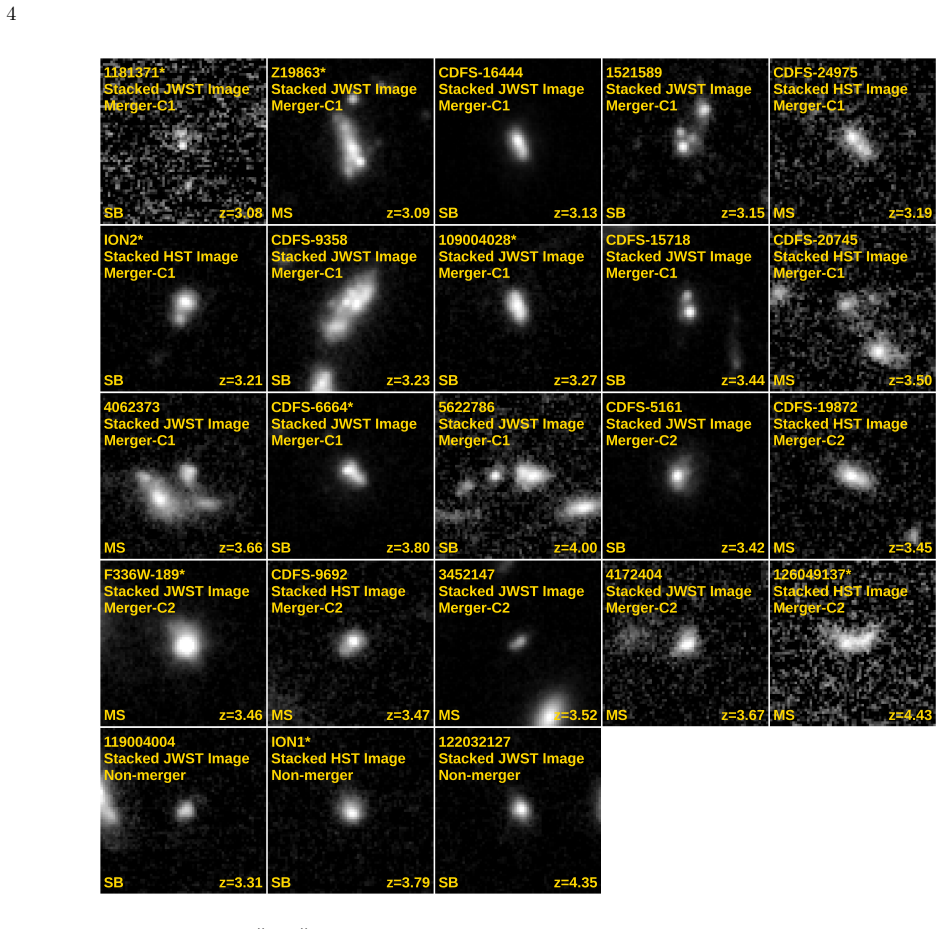
The central discovery is that mergers dominate the observed population of Lyman-continuum leakers at $3<z<4.5$: 20 of 23 GOODS-S leakers are classified as mergers, 13 by showing two or more cores or close companions and 7 by showing extended elongated structures or tails. All ten leakers on the star-forming main sequence are in the merger class, while the three non-mergers have more intense star formation, with mean $\log(\mathrm{sSFR/yr})\simeq -6.95$ versus $-7.65$ for mergers. The paper interprets this as a dichotomy: when merging does not drive escape, vigorous starburst feedback must. It further reports a mean PSF-corrected size $r_{50}=0.74$ kpc, larger than the low-redshift comparison sample's 0.51 kpc and larger than $z>5$ star-forming galaxies, and reads this as an observational bias in favor of extended, merging systems.
Load-bearing premise
The result stands on visual inspection of compact, high-redshift galaxy images, with no independent second reader or matched control sample; a quantitative CAS/Gini test in the paper itself identifies only 8 of the 23 as mergers.
Editorial extensions
If this is right
- If mergers are the dominant escape route at $3<z<4.5$, merger-driven channel clearing should be included in reionization models alongside starburst feedback.
- Main-sequence galaxies that leak ionizing photons are predicted to show merger or interaction signatures; a clean main-sequence leaker with undisturbed morphology would break the proposed dichotomy.
- Current LyC surveys at these redshifts are biased toward extended, bright leakers, so the true leaker population likely contains more compact, high-$\Sigma_{\rm SFR}$ starbursts than we now see.
- The low-redshift comparison, in which half of 50 leakers show merger signatures, implies the merger route operates at $z\sim0.3$ as well, but with starbursts playing a larger relative role.
- Deep, high-resolution UV imaging should reveal additional compact leakers and thereby raise the estimated contribution of galaxies to cosmic reionization.
Reading between the lines
- If the merger-driven channel picture is right, cold-gas kinematics of these 23 systems (e.g., with ALMA or JWST IFU) should show low-column-density sightlines aligned with the tidal features used for classification.
- The size-bias argument predicts that a deeper UV survey at similar resolution will find a population of compact high-redshift leakers with higher mean $\Sigma_{\rm SFR}$ than the current GOODS-S sample.
- A direct check of the main-sequence claim would be to compare the merger fraction of confirmed leakers with a luminosity-matched sample of non-leaking star-forming galaxies at the same redshifts; the gap, not the absolute fraction, is the cleaner test of whether mergers cause escape.
Signed reviews
Editorial analysis
A structured set of objections, weighed in public.
Referee Report
Summary. The paper examines the morphologies of 23 Lyman Continuum (LyC) leakers at 3<z<4.5 in GOODS-S using HST and JWST imaging. The authors report that 20/23 (about 87%) show merging signatures based on visual inspection following Jiang et al. (2013), that all star-forming main-sequence leakers are mergers, and that the three non-mergers are intense starbursts. They also measure PSF-corrected half-light radii, compare sizes and star formation surface densities with low-redshift LyC leakers and z>5 galaxies, and argue that the over-representation of extended sources at high redshift is an observational bias. The paper concludes that LyC photon escape is facilitated either by mergers or by intense starburst activity.
Significance. If the central morphological result is secure, the paper provides a systematic, observationally grounded answer to an open question in reionization studies: what physical conditions allow Lyman continuum photons to escape from high-redshift galaxies. The study is timely because it combines HST and JWST data for a literature-compiled sample of direct LyC detections, and the size comparison with low-redshift leakers and z>5 star-forming galaxies is a useful addition. The paper is transparent about several limitations, including the discrepancy with quantitative morphology (Section 3.1), and it makes explicit PSF corrections and reports Monte-Carlo-style size uncertainties. However, the headline claim—that mergers dominate LyC escape—rests on a visual classification that is not validated against a control sample or independent raters, and the quantitative CAS/Gini test supports only 8 of 23 mergers. Because that claim is the paper's main result, the current version is not yet fully convincing.
major comments (3)
- [Section 3.1]
- [Section 4.1]
- [Section 4.1 and 4.4]
minor comments (5)
- [Section 4.1]
- [Section 3.2, Eq. (1)]
- [Section 5 vs. Section 3.1]
- [Figure 2 caption]
- [Section 3.1]
Circularity Check
No significant circularity: the 87% merger fraction is a direct morphological measurement; self-cited prior classifications are independent observational inputs, not constructions of the result.
full rationale
The central claim that 20 of 23 LyC leakers show merging signatures is derived from visual inspection of stacked HST/JWST images using external criteria from Jiang et al. (2013), not from the paper's own SED fits or escape-fraction measurements. The merger fraction is a direct morphological count, and the quantitative CAS/Gini check (8/23) is presented as a robustness caveat rather than as the basis of the result. The secondary statement that all main-sequence leakers are mergers cross-tabulates the visually classified merger morphology with the SED-based starburst/main-sequence classification from Zhu et al. (2024); the latter is an independent observational quantity (SFR and stellar mass) and does not by construction imply merger morphology. Similarly, the size and Sigma_SFR comparisons use SExtractor half-light radii and literature values, with no parameter fitted to force the stated conclusions. The acknowledged limitations about resolution, projection effects, and the absence of a control sample are empirical validity concerns, not circularity. Self-citations to Zhu et al. (2024) and Yuan et al. (2024) supply sample membership and physical properties, but the new morphological claim is not obtained by restating those inputs. Therefore no derivation step reduces to its own inputs by construction.
Assumptions & free parameters
assumptions (6)
- domain assumption Visual morphology criteria from Jiang et al. (2013) identify mergers as galaxies with two or more cores or companions, or with extended elongated structures and tidal tails.
- standard math The PSF-corrected half-light radius follows r50 = sqrt(r50_app^2 - r50_PSF^2).
- domain assumption SFRs and the starburst versus main-sequence classification inherited from Zhu et al. (2024) are accurate.
- domain assumption The compiled sample of 23 LyC leakers is representative of LyC leakers at 3 < z < 4.5 in GOODS-S despite being assembled from several literature surveys with different selection functions.
- domain assumption The IGM transmission T_IGM = 0.557 and intrinsic UV-to-LyC ratio of 1.37 are used for the detectability estimate.
- ad hoc to paper Comparison samples at z > 5 and z about 0.3 are restricted to the size and M_UV range of the high-z leakers, 0.37 to 1.64 kpc and -21.5 to -18.
Cite this review
Pith. "Pith review of Lyman Continuum Leakers at $z>3$ in the GOODS-S Field: Mergers Dominated." pith.science (2026). https://pith.science/paper/2BH7XBJH
@misc{pith2026241208395,
  author       = {Pith},
  title        = {Pith review of: Lyman Continuum Leakers at $z>3$ in the GOODS-S Field: Mergers Dominated},
  year         = {2026},
  howpublished = {\url{https://pith.science/paper/2BH7XBJH}},
  note         = {Machine review of arXiv:2412.08395}
}
abstract
Understanding the ionizing photon escape from galaxies is essential for studying Cosmic Reionization. With a sample of 23 Lyman Continuum (LyC) leakers at $3<z<4.5$ in the GOODS-S field, we investigate their morphologies using high-resolution data from the Hubble Space Telescope (HST) and the James Webb Space Telescope (JWST). We find that 20 of the 23 LyC leakers show merging signatures, while the remaining 3 are starbursts. Based on our previous finding that LyC leakers are not necessarily starbursts while some are in the star formation main sequence, we further find that those in the main sequence show merger signatures. Our results suggest that LyC leakers are either starbursts or mergers, both of which can facilitate the LyC photon escape, in addition to generating more LyC photons. Furthermore, we show that high-$z$ LyC leakers are statistically more extended than those selected at low redshift, which exhibits a higher merger fraction as size increases. This is likely due to the observational bias that the spatial resolution limits the detection of high-$z$ compact galaxies, while low redshift LyC leakers are more selected as compact starbursts.
Figures


Forward citations
Cited by 3 Pith papers
-
Subaru meets JWST: A Direct Measurement of Ly$\boldsymbol{\alpha}$ Escape Fraction at $\boldsymbol{z\simeq6.2}$ with Dual Narrow-Band Imaging
Completeness-weighted stacking of 56 HAEs at z≃6.2 gives median f_esc^Lyα = 0.106^{+0.066}_{-0.044} with no strong Hα-luminosity dependence and UV-linked galaxy-to-galaxy trends.
-
The JWST Unveils the Bimodal Nature of Lyman Alpha Emitters at 3 <z<7: Pristine versus Merger-Driven Populations
JWST imaging of 817 Lyman-alpha emitters at z=3-7 shows a bimodal population: low-mass isolated 'pristine' galaxies and massive 'merger-driven' galaxies, with a 39% late-stage merger fraction.
-
Little impact of mergers and galaxy morphology on the production and escape of ionizing photons in the early Universe
Using 436 JWST galaxies at z=5 to 7, the authors find no significant correlation between merger morphology and predicted Lyman continuum escape or ionizing photon production efficiency.
Reference graph
Works this paper leans on
-
[1]
O., Rodr ´ ıguez-Henr ´ ıquez, M., Fern´ andez, V., et al
Amor ´ ın, R. O., Rodr ´ ıguez-Henr ´ ıquez, M., Fern´ andez, V., et al. 2024, A&A, 682, L25, doi: 10.1051/0004-6361/202449175 Astropy Collaboration, Robitaille, T. P., Tollerud, E. J., et al. 2013, A&A, 558, A33, doi: 10.1051/0004-6361/201322068 9 Astropy Collaboration, Price-Whelan, A. M., Sip˝ ocz, B. M., et al. 2018, AJ, 156, 123, doi: 10.3847/1538-38...
-
[2]
2013, A&A, 554, A38, doi: 10.1051/0004-6361/201118433
Bergvall, N., Leitet, E., Zackrisson, E., & Marquart, T. 2013, A&A, 554, A38, doi: 10.1051/0004-6361/201118433
-
[3]
1996, A&AS, 117, 393, doi: 10.1051/aas:1996164
Bertin, E., & Arnouts, S. 1996, A&AS, 117, 393, doi: 10.1051/aas:1996164
-
[4]
Bridge, C. R., Teplitz, H. I., Siana, B., et al. 2010, ApJ, 720, 465, doi: 10.1088/0004-637X/720/1/465
-
[5]
Conselice, C. J. 2003, ApJS, 147, 1, doi: 10.1086/375001
doi:10.1086/375001 2003
-
[6]
Dayal, P., Volonteri, M., Greene, J. E., et al. 2024, arXiv e-prints, arXiv:2401.11242, doi: 10.48550/arXiv.2401.11242 de Barros, S., Vanzella, E., Amor ´ ın, R., et al. 2016, A&A, 585, A51, doi: 10.1051/0004-6361/201527046
-
[7]
2024, ApJL, 963, L23, doi: 10.3847/2041-8213/ad2344
Dhiwar, S., Saha, K., Maulick, S., et al. 2024, ApJL, 963, L23, doi: 10.3847/2041-8213/ad2344
-
[8]
Eisenstein, D. J., Johnson, B. D., Robertson, B., et al. 2023a, arXiv e-prints, arXiv:2310.12340, doi: 10.48550/arXiv.2310.12340
Show all 75 references
- [9]
-
[10]
A., Becker, R
Fan, X., Strauss, M. A., Becker, R. H., et al. 2006, AJ, 132, 117, doi: 10.1086/504836
2006 doi
-
[11]
L., & Bagley, M
Finkelstein, S. L., & Bagley, M. B. 2022, ApJ, 938, 25, doi: 10.3847/1538-4357/ac89eb
2022 doi
-
[12]
J., Tang, M., Robertson, B
Fletcher, T. J., Tang, M., Robertson, B. E., et al. 2019, ApJ, 878, 87, doi: 10.3847/1538-4357/ab2045
2019 doi
-
[13]
R., Jaskot, A
Flury, S. R., Jaskot, A. E., Ferguson, H. C., et al. 2022, ApJS, 260, 1, doi: 10.3847/1538-4365/ac5331
2022 doi
- [14]
-
[15]
R., Millman, K
Harris, C. R., Millman, K. J., van der Walt, S. J., et al. 2020, Nature, 585, 357, doi: 10.1038/s41586-020-2649-2
2020 doi
-
[16]
Hunter, J. D. 2007, Computing in Science & Engineering, 9, 90, doi: 10.1109/MCSE.2007.55
2007 doi
- [17]
-
[18]
K., Shimizu, I., Iwata, I., & Tanaka, M
Inoue, A. K., Shimizu, I., Iwata, I., & Tanaka, M. 2014, MNRAS, 442, 1805, doi: 10.1093/mnras/stu936
2014 doi
-
[19]
I., Orlitov´ a, I., Schaerer, D., et al
Izotov, Y. I., Orlitov´ a, I., Schaerer, D., et al. 2016a, Nature, 529, 178, doi: 10.1038/nature16456
-
[20]
I., Schaerer, D., Thuan, T
Izotov, Y. I., Schaerer, D., Thuan, T. X., et al. 2016b, MNRAS, 461, 3683, doi: 10.1093/mnras/stw1205
-
[21]
I., Schaerer, D., Worseck, G., et al
Izotov, Y. I., Schaerer, D., Worseck, G., et al. 2018a, MNRAS, 474, 4514, doi: 10.1093/mnras/stx3115
-
[22]
I., Worseck, G., Schaerer, D., et al
Izotov, Y. I., Worseck, G., Schaerer, D., et al. 2021, MNRAS, 503, 1734, doi: 10.1093/mnras/stab612 —. 2018b, MNRAS, 478, 4851, doi: 10.1093/mnras/sty1378
2021 doi
-
[23]
E., & Oey, M
Jaskot, A. E., & Oey, M. S. 2013, ApJ, 766, 91, doi: 10.1088/0004-637X/766/2/91
2013 doi
-
[24]
2020, ApJ, 888, 109, doi: 10.3847/1538-4357/ab5fdc
Ji, Z., Giavalisco, M., Vanzella, E., et al. 2020, ApJ, 888, 109, doi: 10.3847/1538-4357/ab5fdc
2020 doi
-
[25]
2013, ApJ, 773, 153, doi: 10.1088/0004-637X/773/2/153
Jiang, L., Egami, E., Fan, X., et al. 2013, ApJ, 773, 153, doi: 10.1088/0004-637X/773/2/153
2013 doi
-
[26]
2022, Nature Astronomy, 6, 850, doi: 10.1038/s41550-022-01708-w
Jiang, L., Ning, Y., Fan, X., et al. 2022, Nature Astronomy, 6, 850, doi: 10.1038/s41550-022-01708-w
2022 doi
-
[27]
S., Sanders, D
Kartaltepe, J. S., Sanders, D. B., Le Floc’h, E., et al. 2010, ApJ, 721, 98, doi: 10.1088/0004-637X/721/1/98
2010 doi
-
[28]
2018, ApJ, 855, 4, doi: 10.3847/1538-4357/aaa6cf
Kawamata, R., Ishigaki, M., Shimasaku, K., et al. 2018, ApJ, 855, 4, doi: 10.3847/1538-4357/aaa6cf
2018 doi
-
[29]
A., Wisotzki, L., et al
Kerutt, J., Oesch, P. A., Wisotzki, L., et al. 2024, A&A, 684, A42, doi: 10.1051/0004-6361/202346656 Le Reste, A., Cannon, J. M., Hayes, M. J., et al. 2023, MNRAS, doi: 10.1093/mnras/stad3910
2024 doi
- [30]
-
[31]
M., Jonsson, P., Cox, T
Lotz, J. M., Jonsson, P., Cox, T. J., & Primack, J. R. 2008, MNRAS, 391, 1137, doi: 10.1111/j.1365-2966.2008.14004.x
2008
-
[32]
M., Primack, J., & Madau, P
Lotz, J. M., Primack, J., & Madau, P. 2004, AJ, 128, 163, doi: 10.1086/421849
2004 doi
-
[33]
2015, ApJL, 813, L8, doi: 10.1088/2041-8205/813/1/L8
Madau, P., & Haardt, F. 2015, ApJL, 813, L8, doi: 10.1088/2041-8205/813/1/L8
2015 doi
-
[34]
E., Finkelstein, S
Malhotra, S., Rhoads, J. E., Finkelstein, S. L., et al. 2012, ApJL, 750, L36, doi: 10.1088/2041-8205/750/2/L36
2012 doi
-
[35]
2021, MNRAS, 507, 524, doi: 10.1093/mnras/stab2187 —
Marques-Chaves, R., Schaerer, D., ´Alvarez-M´ arquez, J., et al. 2021, MNRAS, 507, 524, doi: 10.1093/mnras/stab2187 —. 2022, MNRAS, 517, 2972, doi: 10.1093/mnras/stac2893
2021 doi
- [36]
-
[37]
2023, ApJL, 949, L42, doi: 10.3847/2041-8213/acd69f
Matsuoka, Y., Onoue, M., Iwasawa, K., et al. 2023, ApJL, 949, L42, doi: 10.3847/2041-8213/acd69f
2023 doi
-
[38]
P., Brammer, G., et al
Matthee, J., Naidu, R. P., Brammer, G., et al. 2024, ApJ, 963, 129, doi: 10.3847/1538-4357/ad2345
2024 doi
-
[39]
Maulick, S., Saha, K., Kataria, M., & Herenz, E. C. 2024a, ApJ, 972, 138, doi: 10.3847/1538-4357/ad6155
- [40]
-
[41]
2017, 3D-HST, STScI/MAST, doi: 10.17909/T9JW9Z 10
Momcheva, I. 2017, 3D-HST, STScI/MAST, doi: 10.17909/T9JW9Z 10
2017 doi
-
[42]
2024, ApJ, 963, 9, doi: 10.3847/1538-4357/ad1404
Morishita, T., Stiavelli, M., Chary, R.-R., et al. 2024, ApJ, 963, 9, doi: 10.3847/1538-4357/ad1404
2024 doi
-
[43]
P., Tacchella, S., Mason, C
Naidu, R. P., Tacchella, S., Mason, C. A., et al. 2020, ApJ, 892, 109, doi: 10.3847/1538-4357/ab7cc9
2020 doi
-
[44]
2014, MNRAS, 442, 900, doi: 10.1093/mnras/stu902
Nakajima, K., & Ouchi, M. 2014, MNRAS, 442, 900, doi: 10.1093/mnras/stu902
2014 doi
-
[45]
A., Montes, M., Reddy, N., et al
Oesch, P. A., Montes, M., Reddy, N., et al. 2018, ApJS, 237, 12, doi: 10.3847/1538-4365/aacb30
2018 doi
-
[46]
A., Brammer, G., Naidu, R
Oesch, P. A., Brammer, G., Naidu, R. P., et al. 2023, MNRAS, 525, 2864, doi: 10.1093/mnras/stad2411
2023 doi
-
[47]
Y., Ho, L
Peng, C. Y., Ho, L. C., Impey, C. D., & Rix, H.-W. 2010, AJ, 139, 2097, doi: 10.1088/0004-6256/139/6/2097 Planck Collaboration, Aghanim, N., Akrami, Y., et al. 2020, A&A, 641, A1, doi: 10.1051/0004-6361/201833880
2010 doi
-
[48]
D., Haehnelt, M
Rauch, M., Becker, G. D., Haehnelt, M. G., et al. 2011, MNRAS, 418, 1115, doi: 10.1111/j.1365-2966.2011.19556.x
2011
-
[49]
2023, Data from the JWST Advanced Deep Extragalactic Survey (JADES), STScI/MAST, doi: 10.17909/8TDJ-8N28
Rieke, Marcia, Robertson, Brant, Tacchella, Sandro, et al. 2023, Data from the JWST Advanced Deep Extragalactic Survey (JADES), STScI/MAST, doi: 10.17909/8TDJ-8N28
2023 doi
-
[50]
E., Hayes, M., & Melinder, J
Rivera-Thorsen, T. E., Hayes, M., & Melinder, J. 2022, arXiv e-prints, arXiv:2206.10799. https://arxiv.org/abs/2206.10799
2022 arXiv
-
[51]
Robertson, B. E. 2022, ARA&A, 60, 121, doi: 10.1146/annurev-astro-120221-044656
2022 doi
-
[52]
E., Ellis, R
Robertson, B. E., Ellis, R. S., Furlanetto, S. R., & Dunlop, J. S. 2015, ApJL, 802, L19, doi: 10.1088/2041-8205/802/2/L19
2015 doi
-
[53]
F., Lotz, J
Rodriguez-Gomez, V., Snyder, G. F., Lotz, J. M., et al. 2019, MNRAS, 483, 4140, doi: 10.1093/mnras/sty3345
2019 doi
-
[54]
S., Snyder, G
Rose, C., Kartaltepe, J. S., Snyder, G. F., et al. 2023, ApJ, 942, 54, doi: 10.3847/1538-4357/ac9f10
2023 doi
- [55]
-
[56]
N., Simmonds, C., et al
Saha, K., Tandon, S. N., Simmonds, C., et al. 2020, Nature Astronomy, 4, 1185, doi: 10.1038/s41550-020-1173-5
2020 doi
-
[57]
S., et al
Saxena, A., Pentericci, L., Ellis, R. S., et al. 2022, MNRAS, 511, 120, doi: 10.1093/mnras/stab3728
2022 doi
-
[58]
E., Steidel, C
Shapley, A. E., Steidel, C. C., Strom, A. L., et al. 2016, ApJL, 826, L24, doi: 10.3847/2041-8205/826/2/L24
2016 doi
-
[59]
2015, ApJS, 219, 15, doi: 10.1088/0067-0049/219/2/15
Shibuya, T., Ouchi, M., & Harikane, Y. 2015, ApJS, 219, 15, doi: 10.1088/0067-0049/219/2/15
2015 doi
-
[60]
F., Rodriguez-Gomez, V., Lotz, J
Snyder, G. F., Rodriguez-Gomez, V., Lotz, J. M., et al. 2019, MNRAS, 486, 3702, doi: 10.1093/mnras/stz1059
2019 doi
-
[61]
C., Bogosavljevi´ c, M., Shapley, A
Steidel, C. C., Bogosavljevi´ c, M., Shapley, A. E., et al. 2018, ApJ, 869, 123, doi: 10.3847/1538-4357/aaed28
2018 doi
-
[62]
2012, ApJ, 751, 70, doi: 10.1088/0004-637X/751/1/70
Vanzella, E., Guo, Y., Giavalisco, M., et al. 2012, ApJ, 751, 70, doi: 10.1088/0004-637X/751/1/70
2012 doi
-
[63]
2016, ApJ, 825, 41, doi: 10.3847/0004-637X/825/1/41
Vanzella, E., de Barros, S., Vasei, K., et al. 2016, ApJ, 825, 41, doi: 10.3847/0004-637X/825/1/41
2016 doi
-
[64]
2018, MNRAS, 476, L15, doi: 10.1093/mnrasl/sly023
Vanzella, E., Nonino, M., Cupani, G., et al. 2018, MNRAS, 476, L15, doi: 10.1093/mnrasl/sly023
2018 doi
-
[65]
2015, A&A, 578, A7, doi: 10.1051/0004-6361/201423978
Verhamme, A., Orlitov´ a, I., Schaerer, D., & Hayes, M. 2015, A&A, 578, A7, doi: 10.1051/0004-6361/201423978
2015 doi
-
[66]
2017, A&A, 597, A13, doi: 10.1051/0004-6361/201629264
Verhamme, A., Orlitov´ a, I., Schaerer, D., et al. 2017, A&A, 597, A13, doi: 10.1051/0004-6361/201629264
2017 doi
-
[67]
M., Leitherer, C., et al
Wang, B., Heckman, T. M., Leitherer, C., et al. 2019, ApJ, 885, 57, doi: 10.3847/1538-4357/ab418f
2019 doi
-
[68]
E., Ashas, M., Illingworth, G., et al
Whitaker, K. E., Ashas, M., Illingworth, G., et al. 2019, ApJS, 244, 16, doi: 10.3847/1538-4365/ab3853
2019 doi
-
[69]
C., Tacchella, S., Maseda, M
Williams, C. C., Tacchella, S., Maseda, M. V., et al. 2023, ApJS, 268, 64, doi: 10.3847/1538-4365/acf130
2023 doi
-
[70]
2023, Data from the JWST Extragalactic Medium-band Survey (JEMS), STScI/MAST, doi: 10.17909/FSC4-DT61
Williams, Christina, Tacchella, Sandro, & Maseda, Michael. 2023, Data from the JWST Extragalactic Medium-band Survey (JEMS), STScI/MAST, doi: 10.17909/FSC4-DT61
2023 doi
-
[71]
2024, Nature Astronomy, 8, 384, doi: 10.1038/s41550-023-02179-3
Witten, C., Laporte, N., Martin-Alvarez, S., et al. 2024, Nature Astronomy, 8, 384, doi: 10.1038/s41550-023-02179-3
2024 doi
-
[72]
2024, arXiv e-prints, arXiv:2409.20352, doi: 10.48550/arXiv.2409.20352
Yuan, F.-T., Zheng, Z.-Y., Jiang, C., et al. 2024, arXiv e-prints, arXiv:2409.20352, doi: 10.48550/arXiv.2409.20352
2024 doi
-
[73]
Yuan, F.-T., Zheng, Z.-Y., Lin, R., Zhu, S., & Rahna, P. T. 2021, ApJL, 923, L28, doi: 10.3847/2041-8213/ac4170
2021 doi
-
[74]
2018, in 42nd COSPAR Scientific Assembly, Vol
Zhan, H. 2018, in 42nd COSPAR Scientific Assembly, Vol. 42, E1.16–4–18
2018
- [75]
Reviewed August 11, 2026 · model on record in the stance chip above.
Discussion (0). Continue with ORCID to comment.