REVIEW 2 major objections 5 minor 300 references
Reviewed by Pith at T0; open to challenge.
T0 means a machine referee read the full paper against a public rubric. The mark states how deep the mechanical check went, never who wrote it. the ladder, T0–T4 →
T0 review · grok-4.5
At redshift 6.2, H-alpha emitters leak a median 11 percent of their Ly-alpha light, with no clear drop among the more luminous systems.
2026-07-10 10:23 UTC pith:FSDJMRKQ
load-bearing objection Solid first dual-NB f_esc^Lyα at z≃6.2; the stacked number is usable, the luminosity-independence claim is under-powered and the LyC budget step is conditional. the 2 major comments →
Subaru meets JWST: A Direct Measurement of Lyboldsymbol{α} Escape Fraction at boldsymbol{zsimeq6.2} with Dual Narrow-Band Imaging
The pith
A machine-rendered reading of the paper's core claim, the machinery that carries it, and where it could break.
Core claim
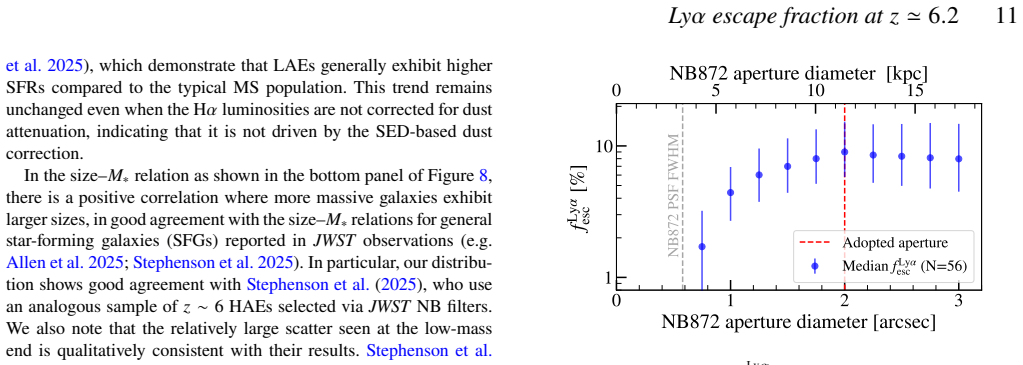
A completeness-weighted stack of H-alpha emitters at z≃6.2 yields a median Ly-alpha escape fraction of 0.106^{+0.066}_{-0.044}, with no significant dependence on the lower H-alpha luminosity limit over the range sampled. The authors therefore argue that relatively luminous H-alpha emitters, not only the faintest galaxies, can contribute importantly to the ionizing photon budget if Ly-alpha escape traces Lyman-continuum leakage.
What carries the argument
Dual narrow-band imaging: the JWST/NIRCam F470N and Subaru/HSC NB872 filters simultaneously capture H-alpha and Ly-alpha from the same galaxies at z≃6.2, converting the observed line ratio (after continuum subtraction, dust correction, and filter-transmission correction) into an effective Ly-alpha escape fraction under Case B recombination.
Load-bearing premise
The claim that luminous H-alpha emitters can dominate the ionizing budget rests on the premise that Ly-alpha leakage reliably traces Lyman-continuum leakage through the same low-density channels; the paper itself notes that Ly-alpha can escape after kinematic redshifting while ionizing photons require truly optically thin paths.
What would settle it
A deeper dual-narrow-band or spectroscopic campaign that measures stacked Ly-alpha escape separately in luminosity bins spanning well below and above 0.4 L* H-alpha, or direct Lyman-continuum detections of the same H-alpha emitters, would show whether the escape fraction remains flat or rises toward the faint end.
If this is right
- If the flat luminosity dependence holds, models of reionization must assign a larger share of the ionizing photon budget to galaxies near current observational limits rather than only to the ultra-faint population.
- The positive correlation of escape with Ly-alpha equivalent width and the negative correlations with UV slope and UV size give observers practical photometric predictors of which systems are leaking.
- Galaxy-to-galaxy variation is driven more by compact, low-attenuation UV-emitting clumps than by SED-averaged dust or overall optical size, guiding which morphological and continuum diagnostics to prioritize.
- The dual-narrow-band method itself becomes a low-model-dependence route to cosmic-averaged escape fractions at still higher redshift once matching filter pairs exist.
Where Pith is reading between the lines
- Because the H-alpha luminosity function slope is shallower than the UV luminosity function, a luminosity-independent escape fraction would shift the peak contribution to reionization toward systems already reachable by JWST narrow-band surveys.
- The same compact UV clumps that regulate Ly-alpha escape are natural candidates for the low-column channels that also allow Lyman-continuum leakage, offering a morphological target for future direct ionizing-photon searches.
- Larger samples with rest-frame UV size measurements could turn the tentative surface-density trends into a quantitative ranking of which feedback or geometry parameters most control escape.
Editorial analysis
A structured set of objections, weighed in public.
Referee Report
Summary. The paper presents the first dual narrow-band measurement of the Lyα escape fraction for Hα emitters at z≃6.2, combining JWST/NIRCam F470N (Hα) with Subaru/HSC NB872 (Lyα) in the CEERS field. After continuum-slope correction, photo-z selection, AGN/LRD removal and SED quality cuts, the authors assemble 84 HAEs, of which 56 have reliable NB872 photometry (19 Lyα detections at >2σ). Completeness-weighted median stacking yields f_esc^Lyα = 0.106^{+0.066}_{-0.044}, consistent with recent spectroscopic and LF-based results at similar redshift and substantially higher than the dual-NB value at z~2.2. No significant dependence of the stacked value on the lower Hα luminosity limit is found over the range probed. Individual f_esc values (including upper limits) correlate positively with EW0(Lyα) and negatively with UV slope β and rest-frame UV size, while showing no significant correlation with SED-derived E(B-V) or optical size. The authors interpret the null luminosity trend, under the assumption that Lyα traces LyC leakage, as suggesting that relatively luminous HAEs can contribute importantly to the ionizing photon budget.
Significance. If the stacked median and its lack of strong luminosity dependence hold, the work supplies a low-model-dependence, imaging-based benchmark for the cosmic-averaged Lyα escape fraction at the end of reionization, complementary to slitless spectroscopy and LF comparisons. The dual-NB design recovers total line fluxes without slit losses and is the only currently available filter pair that simultaneously captures both lines at z>6. The individual-galaxy correlations with compact, low-attenuation UV components are physically interesting and align with recent spatially resolved JWST results. The ionizing-budget implication is more provisional: it rests on a null result whose statistical power the authors themselves note is limited, and on the imperfect correspondence between Lyα and angle-averaged LyC escape. Even so, the measurement itself is a valuable addition to the EoR toolkit and will motivate deeper/wider dual-NB programmes.
major comments (2)
- Section 4.2.3 and Figure 11: the claim of “no significant dependence” of stacked f_esc^Lyα on the lower Hα luminosity limit is under-powered for the ionizing-budget inference drawn in Section 4.2.4. The paper itself states that an LF-based estimate predicts a ~0.2 dex drop when L_limit rises from 0.04 L* to 0.25 L*, and that “the uncertainty of our f_esc measurements is comparable to this expected difference.” With only 56 objects (19 detections) and bootstrap errors of order +0.066/-0.044, non-detection of a trend is expected even if a real luminosity dependence of the size reported by Goovaerts et al. (2024) is present. The subsequent suggestion that relatively luminous HAEs can dominate ń_ion therefore rests on a null result whose statistical power is acknowledged to be marginal. The text should either (i) quantify the statistical power more explicitly (e.g., the minimum detectable sl
- Section 4.2.4: the step from a flat f_esc^Lyα–L_Hα relation to a flat angle-averaged f_esc^LyC (and therefore luminous-HAE dominance of the ionizing budget) is load-bearing for the abstract and summary claims, yet the paper correctly notes that Lyα can escape after kinematic redshifting while LyC requires truly optically thin sightlines. Radiation-hydrodynamic simulations further show that LyC escape is highly anisotropic and stochastic. The manuscript should either provide a quantitative estimate of how large a residual luminosity dependence in f_esc^LyC could remain consistent with the present Lyα data, or relegate the ionizing-budget discussion more clearly to the status of a qualitative possibility pending larger samples and direct LyC constraints.
minor comments (5)
- Equation (8) and surrounding text: the adoption of the Case-B ratio 8.7 is standard, but a short quantitative note on how a Case-A-like ratio (~12) would shift the reported median would help readers assess systematic uncertainty.
- Section 3.3 / Figure 5: the global mean transmission-ratio correction (0.723±0.256) is applied to the majority of the sample; a brief test of how the stacked median changes if the correction is varied within its 1σ scatter would strengthen robustness claims.
- Table 5 and Section 4.3: several individual correlations (especially those involving R_e,UV and ΣsSFR,UV) rest on N=12 sources. The text already flags the limited sample, but the abstract phrasing could more explicitly note that the size-related trends are tentative.
- Figure 9: the curve-of-growth justification for the 2″ NB872 aperture is clear; adding the corresponding growth curve for the continuum-subtracted Lyα stack (if available) would further reassure readers that halo flux is not being truncated.
- Minor typographical consistency: “completeness-weighted stack of the HAE sample yields a median f_esc… of 0.106” appears both in the abstract and Section 4.2.1; ensure the unweighted value is always quoted with the same precision and error format.
Circularity Check
No circularity: f_esc is a direct flux ratio under standard Case B; the stack and luminosity-cut tests are empirical medians, not forced by construction or self-citation.
full rationale
The central quantity is defined by the standard observational formula f_Lyα_esc = F_Lyα,obs / (8.7 F_Hα,int) (Eq. 8), where the Case-B factor 8.7 is the conventional literature value (Hummer & Storey 1987) adopted for consistency, not fitted to the present data. Continuum subtraction uses independent SED models; the transmission-ratio correction is a Monte-Carlo average over the filter curves and an external velocity-offset prior (0–800 km s⁻¹); completeness weights come from mock recovery simulations on the F470N image. The reported median (0.106^{+0.066}_{-0.044}) is simply the completeness-weighted median stack of the 56 HAEs with reliable NB872 photometry; varying the lower Hα luminosity cut and re-stacking is an empirical sensitivity test, not a prediction forced by a prior fit. Comparisons to Lin et al. (2024), Sun et al. (2023) and Matthee et al. (2016) are external benchmarks. Mild self-citations (e.g., Shimizu et al. 2025 for photometry methods or LAE interpretation) supply procedural context but do not enter the numerical value of f_esc or the null luminosity dependence. The ionizing-budget implication is explicitly conditional (“If Lyα escape traces Lyman continuum leakage…”) and the paper itself flags the statistical power limitation and the Lyα–LyC channel caveat. Nothing reduces by construction to its own inputs.
Axiom & Free-Parameter Ledger
free parameters (5)
- Case B Lyα/Hα intrinsic ratio =
8.7
- Global mean transmission-ratio correction =
0.723
- Median E(B-V) for stack dust correction =
0.075
- Completeness-function parameters (f_max, f_min, α, m50) =
0.998, 0.040, 1.808, 26.255
- Lyα velocity-offset range for mocks =
0–800 km/s
axioms (5)
- domain assumption Case B recombination holds for the intrinsic Lyα/Hα ratio under typical nebular conditions.
- domain assumption Calzetti attenuation law with equal stellar and nebular E(B-V) correctly recovers intrinsic Hα.
- domain assumption F470N excess after continuum-slope correction and photo-z cuts isolates HAEs at z≃6.2 with negligible [N II] and continuum contamination.
- domain assumption Lyα escape fraction is a useful (if imperfect) tracer of Lyman-continuum leakage for photon-budget arguments.
- ad hoc to paper Median stacking of continuum-subtracted NB images yields a representative cosmic-averaged escape fraction for the sampled luminosity range.
read the original abstract
We present a direct measurement of the Ly$\alpha$ escape fraction, $f^{\rm Ly\alpha}_{\rm esc}$, for H$\alpha$ emitters (HAEs) at $z\simeq6.2$ in the JWST CEERS field by combining JWST/NIRCam F470N imaging with Subaru/HSC NB872 imaging. This unique pair of narrow-band filters enables the simultaneous measurement of Ly$\alpha$ and H$\alpha$ fluxes from galaxies during the epoch of reionization (EoR). We select 84 HAEs from F470N excesses, among which 56 have reliable NB872 photometry and 19 are detected in Ly$\alpha$ at $>2\sigma$ significance. The completeness-weighted stack of the HAE sample yields a median $f^{\rm Ly\alpha}_{\rm esc}$ at $z\simeq6.2$ of $0.106^{+0.066}_{-0.044}$, which is in good agreement with recent measurements at similar redshifts. We further find no significant dependence of the stacked $f_{\rm esc}^{\rm Ly\alpha}$ on the lower limit of H$\alpha$ luminosity over the luminosity range probed by our sample. If Ly$\alpha$ escape traces Lyman continuum leakage, this may suggest that relatively luminous HAEs, rather than only the faintest galaxies, can provide an important contribution to the ionizing photon budget during the EoR. For individual galaxies, $f^{\rm Ly\alpha}_{\rm esc}$ positively correlates with Ly$\alpha$ equivalent width and negatively correlates with the UV continuum slope $\beta$ and the rest-frame UV size, while no significant correlation is found with SED-derived $E(B-V)$, or rest-frame optical size, although these trends are based on a limited sample. These results suggest that the galaxy-to-galaxy variation in $f_{\rm esc}^{\rm Ly\alpha}$ is more closely linked to compact, low-attenuation star-forming components traced by the UV continuum than to global dust attenuation or the overall stellar structure.
Figures




Reference graph
Works this paper leans on
-
[1]
Quantifying the Escape of Ly at z 5 6: A Census of Ly Escape Fraction with H -emitting Galaxies Spectroscopically Confirmed by JWST and VLT/MUSE. , keywords =. doi:10.3847/1538-4365/ad3e7d , archivePrefix =. 2401.09532 , primaryClass =
work page internal anchor Pith review Pith/arXiv arXiv doi:10.3847/1538-4365/ad3e7d
-
[2]
The Star-forming Main Sequence in JADES and CEERS at z > 1.4: Investigating the Burstiness of Star Formation. , keywords =. doi:10.3847/1538-4357/ad8ba4 , archivePrefix =. 2406.05178 , primaryClass =
work page internal anchor Pith review Pith/arXiv arXiv doi:10.3847/1538-4357/ad8ba4
-
[3]
UV & Ly$\alpha$ halos of Ly$\alpha$ emitters across environments at z=2.84
UV and Ly Halos of Ly Emitters across Environments at z = 2.84. , keywords =. doi:10.3847/1538-4357/acbf30 , archivePrefix =. 2302.12848 , primaryClass =
work page internal anchor Pith review Pith/arXiv arXiv doi:10.3847/1538-4357/acbf30
-
[4]
The emergence of the Star Formation Main Sequence with redshift unfolded by JWST
The Emergence of the Star Formation Main Sequence with Redshift Unfolded by JWST. , keywords =. doi:10.3847/1538-4357/adb309 , archivePrefix =. 2406.13554 , primaryClass =
work page internal anchor Pith review Pith/arXiv arXiv doi:10.3847/1538-4357/adb309
-
[5]
MIDIS: JWST NIRCam and MIRI Unveil the Stellar Population Properties of Ly Emitters and Lyman-break Galaxies at z ≃ 3 7. , keywords =. doi:10.3847/1538-4357/ad15f6 , archivePrefix =. 2309.08515 , primaryClass =
work page internal anchor Pith review Pith/arXiv arXiv doi:10.3847/1538-4357/ad15f6
-
[6]
Galaxy main sequence and properties of low-mass Lyman- emitters towards reionisation as viewed by VLT/MUSE and JWST/NIRCam. , keywords =. doi:10.1051/0004-6361/202348011 , archivePrefix =. 2401.12289 , primaryClass =
work page internal anchor Pith review Pith/arXiv arXiv doi:10.1051/0004-6361/202348011
-
[7]
SILVERRUSH. XIII. A Catalog of 20,567 Ly Emitters at z = 2-7 Identified in the Full-depth Data of the Subaru/HSC-SSP and CHORUS Surveys. , keywords =. doi:10.3847/1538-4365/ace4cb , archivePrefix =. 2305.08921 , primaryClass =
work page internal anchor Pith review Pith/arXiv arXiv doi:10.3847/1538-4365/ace4cb
-
[8]
CEERS Key Paper. I. An Early Look into the First 500 Myr of Galaxy Formation with JWST. , keywords =. doi:10.3847/2041-8213/acade4 , archivePrefix =. 2211.05792 , primaryClass =
work page internal anchor Pith review Pith/arXiv arXiv doi:10.3847/2041-8213/acade4 2041
-
[9]
Stellar Populations of Ly -emitting Galaxies in the HETDEX Survey. I. An Analysis of LAEs in the GOODS-N Field. , keywords =. doi:10.3847/1538-4357/ac8546 , archivePrefix =. 2208.01660 , primaryClass =
-
[10]
PRIMER: Public Release IMaging for Extragalactic Research
-
[11]
CHORUS. I. Cosmic HydrOgen Reionization Unveiled with Subaru: Overview. , keywords =. doi:10.1093/pasj/psaa100 , archivePrefix =. 2011.07211 , primaryClass =
work page internal anchor Pith review Pith/arXiv arXiv doi:10.1093/pasj/psaa100 2011
-
[12]
Observations of the Lyman-$\alpha$ Universe
Observations of the Lyman- Universe. , keywords =. doi:10.1146/annurev-astro-032620-021859 , archivePrefix =. 2012.07960 , primaryClass =
work page internal anchor Pith review Pith/arXiv arXiv doi:10.1146/annurev-astro-032620-021859 2012
-
[13]
Differences and similarities of stellar populations in LAEs and LBGs at z 3.4-6.8. , keywords =. doi:10.1093/mnras/staa1196 , archivePrefix =. 2004.11175 , primaryClass =
-
[14]
CIGALE: a python Code Investigating GALaxy Emission
CIGALE: a python Code Investigating GALaxy Emission. , keywords =. doi:10.1051/0004-6361/201834156 , archivePrefix =. 1811.03094 , primaryClass =
work page internal anchor Pith review Pith/arXiv arXiv doi:10.1051/0004-6361/201834156
-
[15]
Slicing COSMOS with SC4K: the evolution of typical Ly emitters and the Ly escape fraction from z 2 to 6. , keywords =. doi:10.1093/mnras/sty378 , archivePrefix =. 1712.04451 , primaryClass =
work page internal anchor Pith review Pith/arXiv arXiv doi:10.1093/mnras/sty378
-
[16]
The nature of luminous Ly emitters at z 2-3: maximal dust-poor starbursts and highly ionizing AGN. , keywords =. doi:10.1093/mnras/sty782 , archivePrefix =. 1802.10102 , primaryClass =
work page internal anchor Pith review Pith/arXiv arXiv doi:10.1093/mnras/sty782
-
[17]
SILVERRUSH. II. First catalogs and properties of 2000 Ly emitters and blobs at z 6-7 identified over the 14-21 deg ^ 2 sky ^ *. , keywords =. doi:10.1093/pasj/psx122 , archivePrefix =. 1704.08140 , primaryClass =
work page internal anchor Pith review Pith/arXiv arXiv doi:10.1093/pasj/psx122 2000
-
[18]
The CALYMHA survey: Ly$\alpha$ escape fraction and its dependence on galaxy properties at $z=2.23$
The CALYMHA survey: Ly escape fraction and its dependence on galaxy properties at z = 2.23. , keywords =. doi:10.1093/mnras/stw322 , archivePrefix =. 1602.02756 , primaryClass =
work page internal anchor Pith review Pith/arXiv arXiv doi:10.1093/mnras/stw322
-
[19]
Detection of dark galaxies and circum-galactic filaments fluorescently illuminated by a quasar at z = 2.4. , keywords =. doi:10.1111/j.1365-2966.2012.21529.x , archivePrefix =. 1204.5753 , primaryClass =
-
[20]
Two types of Lyman emitters envisaged from hierarchical galaxy formation. , keywords =. doi:10.1111/j.1365-2966.2010.16758.x , archivePrefix =. 1004.0781 , primaryClass =
-
[21]
Stellar population synthesis at the resolution of 2003. , keywords =. doi:10.1046/j.1365-8711.2003.06897.x , archivePrefix =. astro-ph/0309134 , primaryClass =
-
[22]
Galactic Stellar and Substellar Initial Mass Function
Galactic Stellar and Substellar Initial Mass Function. , keywords =. doi:10.1086/376392 , archivePrefix =. astro-ph/0304382 , primaryClass =
work page internal anchor Pith review Pith/arXiv arXiv doi:10.1086/376392
-
[23]
Secondary standard stars for absolute spectrophotometry. , keywords =. doi:10.1086/160817 , adsurl =
-
[24]
An Atlas of Color-selected Quiescent Galaxies at $z>3$ in Public $JWST$ Fields
An Atlas of Color-selected Quiescent Galaxies at z > 3 in Public JWST Fields. , keywords =. doi:10.3847/1538-4357/acbefa , archivePrefix =. 2302.10936 , primaryClass =
work page internal anchor Pith review Pith/arXiv arXiv doi:10.3847/1538-4357/acbefa
-
[25]
doi:10.5281/zenodo.8370018 , version =
grizli. doi:10.5281/zenodo.8370018 , version =
-
[26]
Drizzle: A Method for the Linear Reconstruction of Undersampled Images
Drizzle: A Method for the Linear Reconstruction of Undersampled Images. , keywords =. doi:10.1086/338393 , archivePrefix =. astro-ph/9808087 , primaryClass =
work page internal anchor Pith review Pith/arXiv arXiv doi:10.1086/338393
-
[27]
The Hyper Suprime-Cam SSP Survey: Overview and Survey Design
The Hyper Suprime-Cam SSP Survey: Overview and survey design. , keywords =. doi:10.1093/pasj/psx066 , archivePrefix =. 1704.05858 , primaryClass =
work page internal anchor Pith review Pith/arXiv arXiv doi:10.1093/pasj/psx066
-
[28]
First Data Release of the Hyper Suprime-Cam Subaru Strategic Program
First data release of the Hyper Suprime-Cam Subaru Strategic Program. , keywords =. doi:10.1093/pasj/psx081 , archivePrefix =. 1702.08449 , primaryClass =
work page internal anchor Pith review Pith/arXiv arXiv doi:10.1093/pasj/psx081
-
[29]
Second Data Release of the Hyper Suprime-Cam Subaru Strategic Program
Second data release of the Hyper Suprime-Cam Subaru Strategic Program. , keywords =. doi:10.1093/pasj/psz103 , archivePrefix =. 1905.12221 , primaryClass =
work page internal anchor Pith review Pith/arXiv arXiv doi:10.1093/pasj/psz103 1905
-
[30]
Third Data Release of the Hyper Suprime-Cam Subaru Strategic Program
Third data release of the Hyper Suprime-Cam Subaru Strategic Program. , keywords =. doi:10.1093/pasj/psab122 , archivePrefix =. 2108.13045 , primaryClass =
work page internal anchor Pith review Pith/arXiv arXiv doi:10.1093/pasj/psab122
-
[31]
The MUSE Hubble Ultra Deep Field Survey. X. Ly equivalent widths at 2.9 < z < 6.6. , keywords =. doi:10.1051/0004-6361/201731579 , archivePrefix =. 1711.01747 , primaryClass =
work page internal anchor Pith review Pith/arXiv arXiv doi:10.1051/0004-6361/201731579
-
[32]
The X-SHOOTER Lyman-$\alpha$ survey at z=2 (XLS-z2) I: What makes a galaxy a Lyman-$\alpha$ emitter?
The X-SHOOTER Lyman survey at z = 2 (XLS-z2) I: what makes a galaxy a Lyman emitter?. , keywords =. doi:10.1093/mnras/stab1304 , archivePrefix =. 2102.07779 , primaryClass =
work page internal anchor Pith review Pith/arXiv arXiv doi:10.1093/mnras/stab1304
-
[33]
Dark Galaxy Candidates at Redshift ~3.5 Detected with MUSE
Dark Galaxy Candidates at Redshift 3.5 Detected with MUSE. , keywords =. doi:10.3847/1538-4357/aab6aa , archivePrefix =. 1709.03522 , primaryClass =
work page internal anchor Pith review Pith/arXiv arXiv doi:10.3847/1538-4357/aab6aa
-
[34]
The XMM-Newton wide-field survey in the COSMOS field. The point-like X-ray source catalogue
The XMM-Newton wide-field survey in the COSMOS field. The point-like X-ray source catalogue. , keywords =. doi:10.1051/0004-6361/200810794 , archivePrefix =. 0901.2347 , primaryClass =
work page internal anchor Pith review Pith/arXiv arXiv doi:10.1051/0004-6361/200810794
-
[35]
The Chandra COSMOS Legacy survey: overview and point source catalog
The Chandra Cosmos Legacy Survey: Overview and Point Source Catalog. , keywords =. doi:10.3847/0004-637X/819/1/62 , archivePrefix =. 1601.00941 , primaryClass =
work page internal anchor Pith review Pith/arXiv arXiv doi:10.3847/0004-637x/819/1/62
-
[36]
The VLA-COSMOS 3~GHz Large Project: AGN and host-galaxy properties out to z$\lesssim$6
The VLA-COSMOS 3 GHz Large Project: AGN and host-galaxy properties out to z 6. , keywords =. doi:10.1051/0004-6361/201629367 , archivePrefix =. 1703.09720 , primaryClass =
work page internal anchor Pith review Pith/arXiv arXiv doi:10.1051/0004-6361/201629367
-
[37]
The Subaru/XMM-Newton Deep Survey (SXDS). III. X-Ray Data. , keywords =. doi:10.1086/591083 , archivePrefix =. 0806.2846 , primaryClass =
work page internal anchor Pith review Pith/arXiv arXiv doi:10.1086/591083
-
[38]
X-UDS: The Chandra Legacy Survey of the UKIDSS Ultra Deep Survey Field
X-UDS: The Chandra Legacy Survey of the UKIDSS Ultra Deep Survey Field. , keywords =. doi:10.3847/1538-4365/aab9b4 , archivePrefix =. 1809.08240 , primaryClass =
work page internal anchor Pith review Pith/arXiv arXiv doi:10.3847/1538-4365/aab9b4
-
[39]
Radio imaging of the Subaru/XMM-Newton Deep Field - I. The 100- Jy catalogue, optical identifications, and the nature of the faint radio source population. , keywords =. doi:10.1111/j.1365-2966.2006.10907.x , archivePrefix =. astro-ph/0609529 , primaryClass =
-
[40]
SExtractor: Software for source extraction. , keywords =. doi:10.1051/aas:1996164 , adsurl =
-
[41]
The Dust Content and Opacity of Actively Star-Forming Galaxies
The Dust Content and Opacity of Actively Star-forming Galaxies. , keywords =. doi:10.1086/308692 , archivePrefix =. astro-ph/9911459 , primaryClass =
work page internal anchor Pith review Pith/arXiv arXiv doi:10.1086/308692
-
[42]
EAZY: A Fast, Public Photometric Redshift Code
EAZY: A Fast, Public Photometric Redshift Code. , keywords =. doi:10.1086/591786 , archivePrefix =. 0807.1533 , primaryClass =
work page internal anchor Pith review Pith/arXiv arXiv doi:10.1086/591786
-
[43]
The MUSE Hubble Ultra Deep Field Survey. XIV. Evolution of the Ly emitter fraction from z = 3 to z = 6. , keywords =. doi:10.1051/0004-6361/201937340 , archivePrefix =. 2003.12083 , primaryClass =
work page internal anchor Pith review Pith/arXiv arXiv doi:10.1051/0004-6361/201937340 2003
-
[44]
Evolution of the Lyman- -emitting fraction and UV properties of lensed star-forming galaxies in the range 2.9 < z < 6.7. , keywords =. doi:10.1051/0004-6361/202347110 , archivePrefix =. 2307.15559 , primaryClass =
work page internal anchor Pith review Pith/arXiv arXiv doi:10.1051/0004-6361/202347110
-
[45]
SILVERRUSH X: Machine Learning-aided Selection of 9318 LAEs at z = 2.2, 3.3, 4.9, 5.7, 6.6, and 7.0 from the HSC SSP and CHORUS Survey Data. , keywords =. doi:10.3847/1538-4357/abea15 , archivePrefix =. 2104.02177 , primaryClass =
work page internal anchor Pith review Pith/arXiv arXiv doi:10.3847/1538-4357/abea15
-
[46]
The Global Schmidt Law in Star Forming Galaxies
The Global Schmidt Law in Star-forming Galaxies. , keywords =. doi:10.1086/305588 , archivePrefix =. astro-ph/9712213 , primaryClass =
work page internal anchor Pith review Pith/arXiv arXiv doi:10.1086/305588
-
[47]
, year = 1955, month = jan, volume =
The Luminosity Function and Stellar Evolution. , year = 1955, month = jan, volume =. doi:10.1086/145971 , adsurl =
-
[48]
Cosmic Star-Formation History. , keywords =. doi:10.1146/annurev-astro-081811-125615 , archivePrefix =. 1403.0007 , primaryClass =
work page internal anchor Pith review Pith/arXiv arXiv doi:10.1146/annurev-astro-081811-125615
-
[49]
Case B calculations for H I and He II
Recombination-line intensities for hydrogenic ions - I. Case B calculations for H I and He II. , keywords =. doi:10.1093/mnras/224.3.801 , adsurl =
-
[50]
Radiative Transfer in a Clumpy Universe: The Colors of High-Redshift Galaxies. , keywords =. doi:10.1086/175332 , adsurl =
-
[51]
Bright Lyman $\rm \alpha$ emitters among Spitzer SMUVS galaxies in the MUSE/COSMOS field
Bright Lyman- emitters among Spitzer SMUVS galaxies in the MUSE/COSMOS field. , keywords =. doi:10.1051/0004-6361/201935782 , archivePrefix =. 1910.04771 , primaryClass =
work page internal anchor Pith review Pith/arXiv arXiv doi:10.1051/0004-6361/201935782 1910
-
[52]
Ly-alpha emitters: blue dwarfs or supermassive ULIRGs? Evidence for a transition with redshift
Ly emitters: blue dwarfs or supermassive ULIRGs? Evidence for a transition with redshift. , keywords =. doi:10.1051/0004-6361/200913407 , archivePrefix =. 0911.0419 , primaryClass =
work page internal anchor Pith review Pith/arXiv arXiv doi:10.1051/0004-6361/200913407
-
[53]
The physical properties of Lyalpha emitting galaxies: not just primeval galaxies?
The physical properties of Ly emitting galaxies: not just primeval galaxies?. , keywords =. doi:10.1051/0004-6361:200810722 , archivePrefix =. 0811.1861 , primaryClass =
work page internal anchor Pith review Pith/arXiv arXiv doi:10.1051/0004-6361:200810722
-
[54]
Lyman Alpha Galaxies: Primitive, Dusty or Evolved Galaxies?
Lyman Alpha Galaxies: Primitive, Dusty, or Evolved?. , keywords =. doi:10.1088/0004-637X/691/1/465 , archivePrefix =. 0806.3269 , primaryClass =
work page internal anchor Pith review Pith/arXiv arXiv doi:10.1088/0004-637x/691/1/465
-
[55]
Direct evidence for Ly$\alpha$ depletion in the protocluster core
Direct evidence for Lyboldsymbol\ alpha \ depletion in the protocluster core. , keywords =. doi:10.1093/mnrasl/slx019 , archivePrefix =. 1702.00100 , primaryClass =
work page internal anchor Pith review Pith/arXiv arXiv doi:10.1093/mnrasl/slx019
-
[56]
The Physical Nature of Lyman Alpha Emitting Galaxies at z=3.1
The Physical Nature of Ly -emitting Galaxies at z=3.1. , keywords =. doi:10.1086/504467 , archivePrefix =. astro-ph/0603244 , primaryClass =
work page internal anchor Pith review Pith/arXiv arXiv doi:10.1086/504467
-
[57]
Connecting the escape fraction of Lyman-alpha and Lyman-continuum photons in star-forming galaxies at z ≃ 4-5. , keywords =. doi:10.1093/mnras/stad3417 , archivePrefix =. 2306.03916 , primaryClass =
work page internal anchor Pith review Pith/arXiv arXiv doi:10.1093/mnras/stad3417
-
[58]
Galactic Winds and the Role Played by Massive Stars
Galactic Winds and the Role Played by Massive Stars. arXiv e-prints , keywords =. doi:10.48550/arXiv.1701.09062 , archivePrefix =. 1701.09062 , primaryClass =
work page internal anchor Pith review Pith/arXiv arXiv doi:10.48550/arxiv.1701.09062
-
[59]
Between the Extremes: A JWST Spectroscopic Benchmark for High-redshift Galaxies Using 500 Confirmed Sources at z 5. , keywords =. doi:10.3847/1538-4357/ad85d3 , archivePrefix =. 2403.07103 , primaryClass =
work page internal anchor Pith review Pith/arXiv arXiv doi:10.3847/1538-4357/ad85d3
-
[60]
Size Stellar Mass Relation and Morphology of Quiescent Galaxies at z 3 in Public JWST Fields. , keywords =. doi:10.3847/1538-4357/ad2512 , archivePrefix =. 2307.06994 , primaryClass =
work page internal anchor Pith review Pith/arXiv arXiv doi:10.3847/1538-4357/ad2512
-
[61]
Lyman Continuum Leakers at $z>3$ in the GOODS-S Field: Mergers Dominated
Lyman Continuum Leakers at z > 3 in the GOODS-S Field: Mergers Dominated. , keywords =. doi:10.3847/2041-8213/adc125 , archivePrefix =. 2412.08395 , primaryClass =
work page internal anchor Pith review Pith/arXiv arXiv doi:10.3847/2041-8213/adc125 2041
-
[62]
On the redshift-evolution of the Lyman-alpha escape fraction and the dust content of galaxies
On the Redshift Evolution of the Ly Escape Fraction and the Dust Content of Galaxies. , keywords =. doi:10.1088/0004-637X/730/1/8 , archivePrefix =. 1010.4796 , primaryClass =
work page internal anchor Pith review Pith/arXiv arXiv doi:10.1088/0004-637x/730/1/8
-
[63]
Bright and Faint Ends of Ly Luminosity Functions at z = 2 Determined by the Subaru Survey: Implications for AGNs, Magnification Bias, and ISM H I Evolution. , keywords =. doi:10.3847/0004-637X/823/1/20 , archivePrefix =. 1512.01854 , primaryClass =
work page internal anchor Pith review Pith/arXiv arXiv doi:10.3847/0004-637x/823/1/20
-
[64]
The ALMA Spectroscopic Survey Large Program: The Infrared Excess of z = 1.5-10 UV-selected Galaxies and the Implied High-redshift Star Formation History. , keywords =. doi:10.3847/1538-4357/abb830 , archivePrefix =. 2009.10727 , primaryClass =
work page internal anchor Pith review Pith/arXiv arXiv doi:10.3847/1538-4357/abb830 2009
-
[65]
A deep ALMA image of the Hubble Ultra Deep Field
A deep ALMA image of the Hubble Ultra Deep Field. , keywords =. doi:10.1093/mnras/stw3088 , archivePrefix =. 1606.00227 , primaryClass =
work page internal anchor Pith review Pith/arXiv arXiv doi:10.1093/mnras/stw3088
-
[66]
SILVERRUSH. XIV. Ly Luminosity Functions and Angular Correlation Functions from 20,000 Ly Emitters at z 2.2 7.3 from up to 24 deg ^ 2 HSC-SSP and CHORUS Surveys: Linking the Postreionization Epoch to the Heart of Reionization. , keywords =. doi:10.3847/1538-4365/adb1c0 , archivePrefix =. 2411.15495 , primaryClass =
work page internal anchor Pith review Pith/arXiv arXiv doi:10.3847/1538-4365/adb1c0
-
[67]
Diffuse Ly haloes around galaxies at z = 2.2-6.6: implications for galaxy formation and cosmic reionization. , keywords =. doi:10.1093/mnras/stu825 , archivePrefix =. 1403.0732 , primaryClass =
work page internal anchor Pith review Pith/arXiv arXiv doi:10.1093/mnras/stu825
-
[68]
MAMMOTH-Subaru. II. Diverse Populations of Circumgalactic Ly Nebulae at Cosmic Noon. , keywords =. doi:10.3847/1538-4365/ad812c , archivePrefix =. 2405.13113 , primaryClass =
work page internal anchor Pith review Pith/arXiv arXiv doi:10.3847/1538-4365/ad812c
-
[69]
An H{\alpha} Impression of Ly{\alpha} Galaxies at $z\simeq6$ with Deep JWST/NIRCam Imaging
An H Impression of Ly Galaxies at z ≃ 6 with Deep JWST/NIRCam Imaging. , keywords =. doi:10.3847/2041-8213/acb26b , archivePrefix =. 2211.13620 , primaryClass =
work page internal anchor Pith review Pith/arXiv arXiv doi:10.3847/2041-8213/acb26b 2041
-
[70]
The ionizing photon production efficiency of star-forming galaxies at $z\sim 4-10$
The ionizing photon production efficiency of star-forming galaxies at z 4 10. , keywords =. doi:10.1051/0004-6361/202453251 , archivePrefix =. 2412.01358 , primaryClass =
work page internal anchor Pith review Pith/arXiv arXiv doi:10.1051/0004-6361/202453251
-
[71]
Little impact of mergers and galaxy morphology on the production and escape of ionizing photons in the early Universe. , keywords =. doi:10.1051/0004-6361/202553760 , archivePrefix =. 2501.08268 , primaryClass =
work page internal anchor Pith review Pith/arXiv arXiv doi:10.1051/0004-6361/202553760
-
[72]
The ionising photon production efficiency at z~6 for Lyman-alpha emitters using JEMS and MUSE
The ionizing photon production efficiency at z 6 for Lyman-alpha emitters using JEMS and MUSE. , keywords =. doi:10.1093/mnras/stad1749 , archivePrefix =. 2303.07931 , primaryClass =
work page internal anchor Pith review Pith/arXiv arXiv doi:10.1093/mnras/stad1749
-
[73]
The Physics of Indirect Estimators of Lyman Continuum Escape and their Application to High-Redshift JWST Galaxies. , keywords =. doi:10.1093/mnras/stae776 , archivePrefix =. 2304.08526 , primaryClass =
work page internal anchor Pith review Pith/arXiv arXiv doi:10.1093/mnras/stae776
-
[74]
Ly${\alpha}$-Lyman Continuum connection in 3.5 < z < 4.3 star-forming galaxies from the VUDS survey
Ly -Lyman continuum connection in 3.5 z 4.3 star-forming galaxies from the VUDS survey. , keywords =. doi:10.1051/0004-6361/201732133 , archivePrefix =. 1710.10184 , primaryClass =
work page internal anchor Pith review Pith/arXiv arXiv doi:10.1051/0004-6361/201732133
-
[75]
Predicting LyC emission of galaxies using their physical and Ly$\alpha$ emission properties
Predicting Lyman-continuum emission of galaxies using their physical and Lyman-alpha emission properties. , keywords =. doi:10.1051/0004-6361/202142740 , archivePrefix =. 2204.02440 , primaryClass =
work page internal anchor Pith review Pith/arXiv arXiv doi:10.1051/0004-6361/202142740
-
[76]
Low-mass bursty galaxies in JADES efficiently produce ionizing photons and could represent the main drivers of reionization. , keywords =. doi:10.1093/mnras/stad3605 , archivePrefix =. 2310.01112 , primaryClass =
work page internal anchor Pith review Pith/arXiv arXiv doi:10.1093/mnras/stad3605
-
[77]
Probing the faint-end luminosity function of Lyman-alpha emitters at 3 < z < 7 behind 17 MUSE lensing clusters. , keywords =. doi:10.1051/0004-6361/202346716 , archivePrefix =. 2308.08685 , primaryClass =
-
[78]
The great escape: understanding the connection between Ly emission and LyC escape in simulated JWST analogues. , keywords =. doi:10.1093/mnras/stae1586 , archivePrefix =. 2401.09557 , primaryClass =
work page internal anchor Pith review Pith/arXiv arXiv doi:10.1093/mnras/stae1586
-
[79]
The evolution of rest-frame UV properties, Ly EWs, and the SFR-stellar mass relation at z 2-6 for SC4K LAEs. , keywords =. doi:10.1093/mnras/staa093 , archivePrefix =. 1910.02959 , primaryClass =
work page internal anchor Pith review Pith/arXiv arXiv doi:10.1093/mnras/staa093 1910
-
[80]
JADES: The production and escape of ionizing photons from faint Lyman-alpha emitters in the epoch of reionization. , keywords =. doi:10.1051/0004-6361/202347132 , archivePrefix =. 2306.04536 , primaryClass =
work page internal anchor Pith review Pith/arXiv arXiv doi:10.1051/0004-6361/202347132
discussion (0)
Sign in with ORCID, Apple, or X to comment. Anyone can read and Pith papers without signing in.