REVIEW 3 major objections 4 minor 65 references
LISA test-mass charging. Particle flux modeling, Monte Carlo simulations and induced effects on the sensitivity of the observatory
T0 review · 3 major / 4 minor · reviewed 2026-08-12 · deepseek-v4-flash
Pith's one-line read The paper claims that a Monte Carlo simulation toolkit can predict LISA test-mass charging, and that a moderate solar particle event would appear in the observatory's band with signal-to-noise ratio about 20 while galactic cosmic-ray…
desk verdict Honest methods paper with a useful toolkit and LISA-specific predictions, but the toolkit's own charging-noise numbers are a factor of two low and the authors say so themselves. read the letter →
The pith
A machine-rendered reading of the paper's core claim, the machinery that carries it, and where it could break.
The reading
What carries the argument
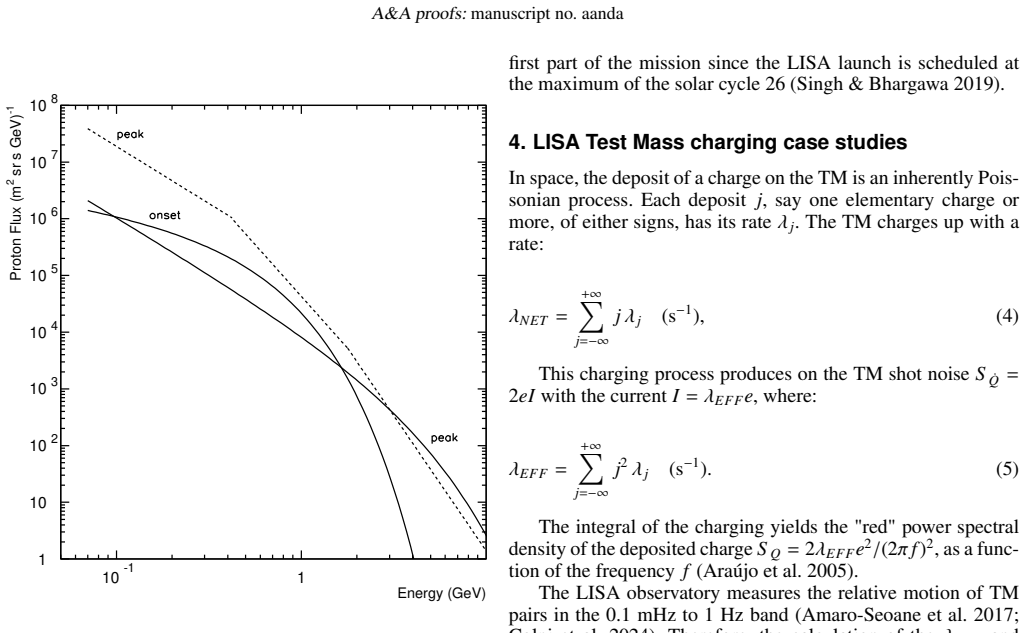
The machine that carries the argument is a Poissonian charging model with two summary rates: $\lambda_{\mathrm{NET}} = \sum_j j\,\lambda_j$ for the mean charge accumulation and $\lambda_{\mathrm{EFF}} = \sum_j j^2\,\lambda_j$ for the shot-noise variance, with the charge noise entering the spectrum as $S_Q \propto \lambda_{\mathrm{EFF}}/f^2$. A Monte Carlo particle-transport simulation feeds these rates by tracking protons, nuclei, and electrons through the simplified spacecraft geometry, and it adds custom processes for low-energy electron emission and quantum diffraction at the gold surfaces. The induced force along the sensitive axis is $F_x = Q_{\mathrm{TM}}E_x$, where the stray field is parameterized by a small DC bias $\Delta x$, and the forecast signal-to-noise ratio is computed against LISA's acceleration-noise floor.
What would settle it
A measurement of the secondary-electron spectrum transmitted through a 100-nm gold slab under 10 keV electron bombardment, from a few eV up to 1 keV, would settle the discrepancy: the toolkit's prediction currently sits about an order of magnitude below the alternative model below 1 keV. Once LISA flies, comparing the predicted and measured net and effective charging rates would provide the same test at mission scale.
Extended reading notes
Core claim
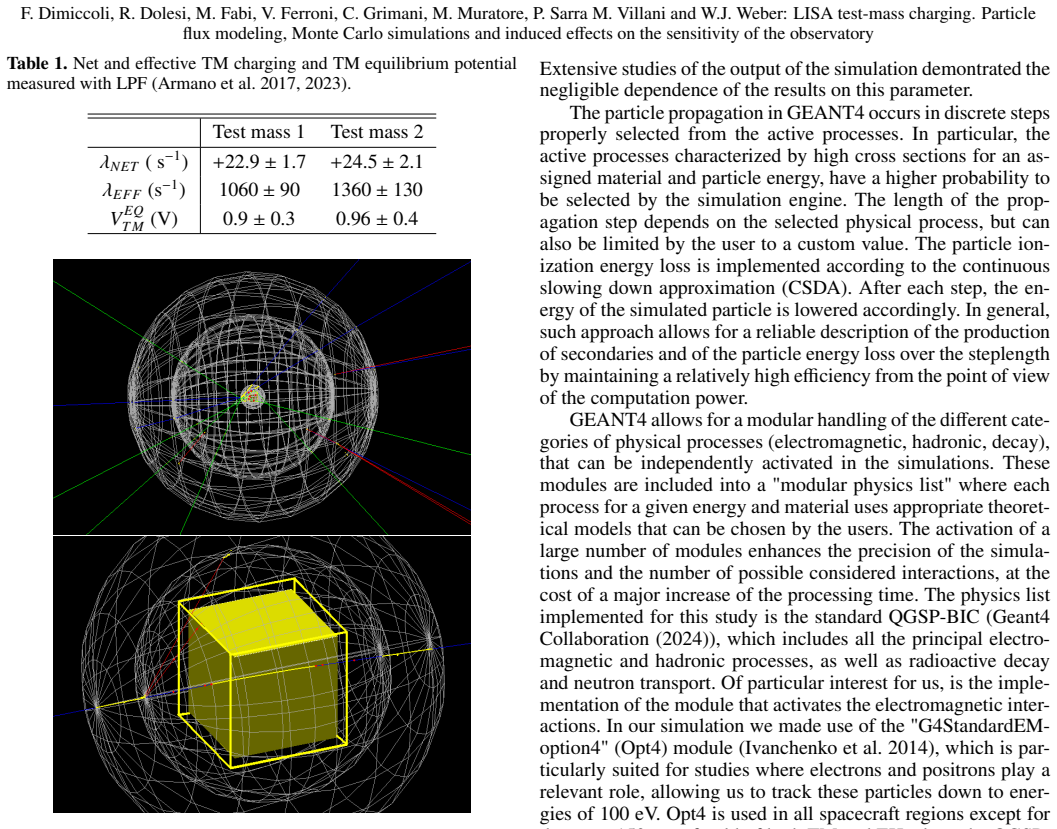
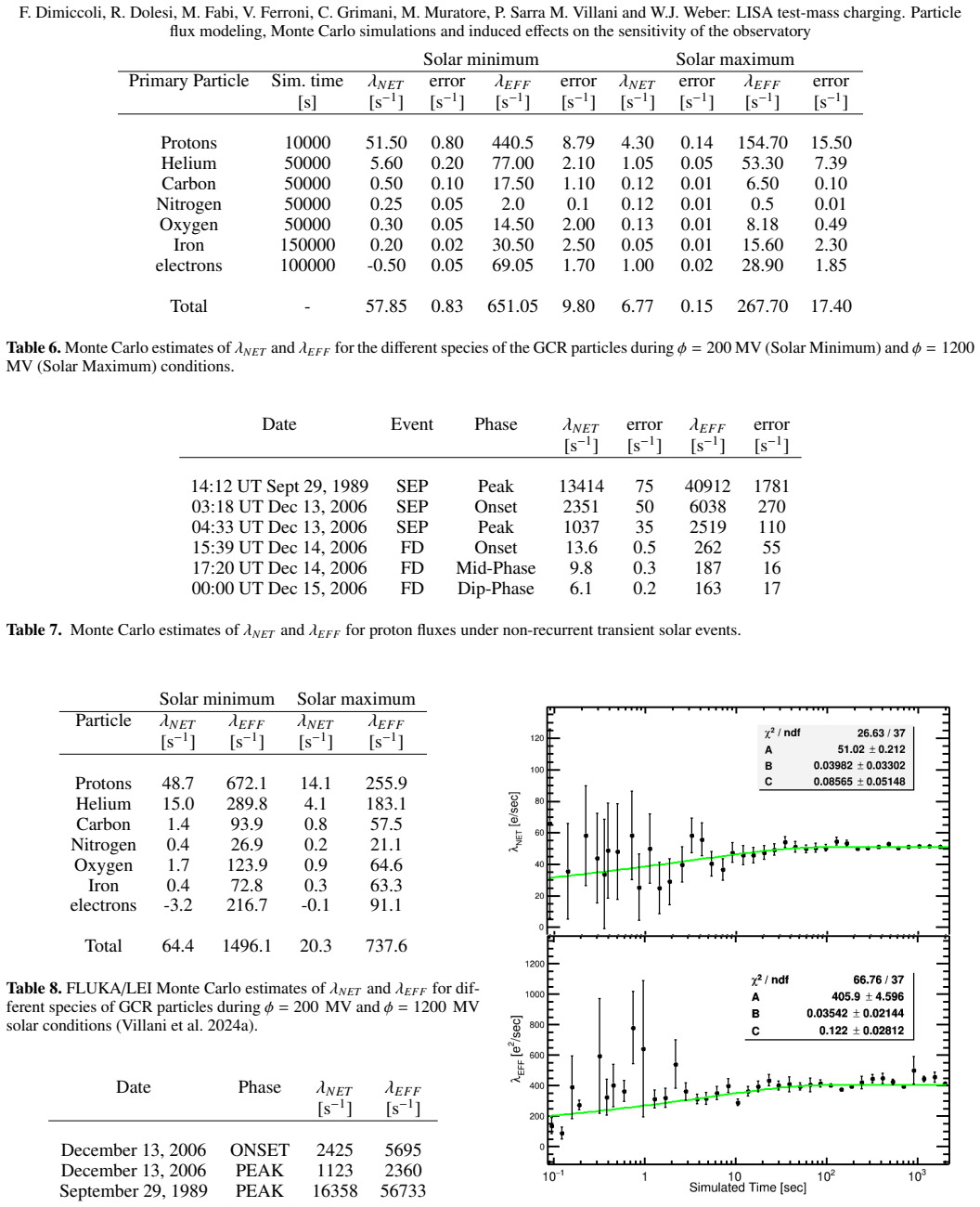
The central claim, stated on the paper's own terms, is that TMCTK gives reliable predictions of LISA test-mass charging and of the forces the charging induces. Simulating a simplified spherical spacecraft with $16\,\mathrm{g\,cm^{-2}}$ of shielding and a cubic gold test mass, the toolkit finds total net charging rates $\lambda_{\mathrm{NET}} = 57.85 \pm 0.83\,\mathrm{s^{-1}}$ and effective charging rates $\lambda_{\mathrm{EFF}} = 651.05 \pm 9.80\,\mathrm{s^{-1}}$ for galactic cosmic rays at solar minimum, and correspondingly smaller values at solar maximum. For the December 13, 2006 solar energetic particle event the predicted force signal has signal-to-noise ratio about 20, while the accompanying Forbush decrease gives about 0.1; a stronger September 29, 1989 event pushes the net charging rate above $10^4\,\mathrm{s^{-1}}$. The paper's key comparison claim is that net charging agrees with LISA Pathfinder measurements and with previous simulations, but effective charging is underestimated by about a factor of two relative to LISA Pathfinder, a discrepancy the authors attribute to low-energy secondary-electron production and transport in gold.
Load-bearing premise
The load-bearing premise is that the toolkit's low-energy electron model faithfully describes how many and how energetic secondary electrons are produced and transported in the gold surfaces of the test mass and electrode housing; the paper's own comparison with LISA Pathfinder indicates this premise may be off by about a factor of two in the effective charging rate.
Editorial extensions
If this is right
- Galactic-cosmic-ray charging noise will not by itself limit LISA's baseline sensitivity: the predicted acceleration noise from charging stays near $0.3\,\mathrm{fm\,s^{-2}\,Hz^{-1/2}}$ at $0.1$ mHz if the higher-yield low-energy electron results are used, comfortably below the $3\,\mathrm{fm\,s^{-2}\,Hz^{-1/2}}$ requirement.
- A moderate solar energetic particle event of the December 2006 type would be clearly visible in LISA data as a signal-to-noise ratio of about 20, so such events will need to be vetoed or subtracted rather than ignored.
- A much stronger event of the September 1989 type would raise the net charging rate above $10^4\,\mathrm{s^{-1}}$ and could charge the test mass toward potentials near $1$ volt, making the response of the charge-management system a relevant part of mission operations.
- Forbush decreases alone would sit at signal-to-noise ratio about 0.1 under the nominal $5$ mV DC bias, but with un-compensated biases of order $50$ mV they could become spurious signals in the LISA band.
- The acknowledged factor-of-two underestimate in effective charging means the absolute charge-induced force noise from the toolkit should be treated with that uncertainty, even though the main budget conclusion is unaffected.
Reading between the lines
- Beyond the paper itself, a direct laboratory measurement of the secondary-electron transmission spectrum through a thin gold slab (about 100 nm) at 10 keV incident energy would discriminate the two low-energy electron models; if the higher-yield result is correct, LISA's absolute charging force noise would be about twice the TMCTK numbers, while the SEP signal-to-noise conclusion, driven by primar
- An implication the authors leave implicit is that the same toolkit and flux parameterizations can be reused for any future mission with free-falling test masses, so the method transfers to other drag-free gravitational-wave or geodesy concepts before their designs are final.
- The paper's simplified spherical shielding assumption, which the authors find has negligible effect on their results, could be tested against the final LISA spacecraft geometry; the interesting stress test is whether non-uniform shielding changes the balance between low-energy electrons emitted near the electrode housing and those produced deeper in the spacecraft.
- Because the signal-to-noise estimate assumes charge-control response times much longer than the event duration, a natural extension is to simulate a multi-day SEP event with the actual discharge algorithm; the paper leaves this for a dedicated study.
Editorial analysis
A structured set of objections, weighed in public.
Referee Report
Summary. This manuscript presents the Test Mass Charging Toolkit (TMCTK), a GEANT4-based Monte Carlo package for simulating LISA test-mass charging. It combines a simplified spherical shielding geometry with GEANT4-DNA low-energy electromagnetic physics, custom yield-based kinetic emission processes for protons and alpha particles, and a quantum diffraction model for electrons below 100 eV. The authors model galactic cosmic-ray long-term and short-term variations and two solar energetic particle events, computing net charging rate λNET and effective charging rate λEFF, and translate these into force noise and signal-to-noise ratios for LISA sensitivity. The key quantitative results are that TMCTK reproduces λNET within about 10% of FLUKA/LEI and LPF observations, while λEFF is underestimated by roughly a factor of two relative to LPF and FLUKA/LEI, and that the transmitted secondary-electron spectrum from a gold slab is about an order of magnitude lower than FLUKA/LEI below 1 keV. Using FLUKA/LEI values, the authors conclude that GCR charging noise is within the 3 fm s^-2 Hz^-1/2 budget and that the 13 December 2006 SEP event would yield SNR ≈ 20.
Significance. The paper addresses a mission-critical issue for LISA and provides a useful public benchmark of GEANT4-DNA against LPF data and FLUKA/LEI. Its strengths are the transparent comparison with LPF observations, the explicit documentation of the TMCTK physics list and flux parameterizations, and the honest admission of the λEFF discrepancy in Section 5. If the λNET agreement holds, the SEP signal-to-noise prediction and the overall conclusion that GCR charging noise is not a limiting noise source remain robust. The λEFF factor-of-two underestimate, however, means the paper's central promise of 'precise knowledge' of charging is not yet delivered for the noise channel, and the quantitative noise-budget argument currently rests on FLUKA/LEI rather than on TMCTK.
major comments (3)
- [Section 5, Tables 6 and 8, Fig. 14] The paper's own results show that TMCTK underestimates λEFF by about a factor of two relative to LPF measurements (Table 1) and FLUKA/LEI (Table 8), and that the GEANT4-DNA transmitted secondary-electron spectrum is about an order of magnitude below LEI below 1 keV (Fig. 14). Because the charge-noise force scales with sqrt(λEFF), TMCTK-based noise predictions are systematically low. The abstract's claim of 'precise knowledge' of the charging process is therefore not supported for the noise channel. The authors should either provide a corrected or rescaled prediction, or explicitly reframe the paper as a development milestone with validated λNET and a known λEFF limitation.
- [Section 6, Eq. 6] The noise-budget calculation that yields 0.3 fm s^-2 Hz^-1/2 uses FLUKA/LEI values (Table 8), not the TMCTK values from Table 6. The text should state this explicitly and justify the choice, since otherwise a reader may attribute the noise-budget conclusion to TMCTK. This is not a physics error, but it is a mismatch between the paper's presentation of TMCTK as the comprehensive toolkit and the source of the headline numbers.
- [Section 4, Table 7 and Section 6] For SEP events, the Monte Carlo simulations were run for a fixed physical time of 6 s per phase (Section 4), yet the force time series in Figs. 15-16 and the SNR in Eq. (7) are computed over a much longer event window. The paper should explain how the 6 s simulations are extrapolated to the full event duration and how statistical and systematic uncertainties in that extrapolation affect the reported SNR of 20.
minor comments (4)
- [Section 2] The typo 'sourrounding' appears in the first paragraph; also the toolkit name is written both 'TMCTK' and 'TMTCK' in the text and in Section 3, and should be made uniform.
- [Section 5, Fig. 14] The caption of Fig. 14 states a '150 nm thick gold target' while the body text in Section 5 says '100 nm thick gold slab'; please reconcile the thickness description.
- [Section 2.1] The notation 'E min' and 'Eth' is used inconsistently; use consistent subscript notation for the propagation cutoff and the cross-section validity threshold.
- [Table 3] The solar maximum electron parameterization '4 .5(E− 0.04)0.84' appears to be missing a multiplication sign and has a spurious space; please format the equation consistently with Table 2.
Circularity Check
No significant circularity: the toolkit predictions are forward simulations openly benchmarked against LISA Pathfinder data, and the paper explicitly flags its own underprediction of the effective charging rate.
full rationale
The paper's derivation chain is not circular. TMCTK computes lambda_NET and lambda_EFF by forward GEANT4/GEANT4-DNA simulation from environmental flux parameterizations, spacecraft geometry, and physics models; none of these inputs include the LPF charge measurements that are used only as external benchmarks. The paper openly reports that TMCTK underpredicts lambda_EFF by about a factor of two relative to LPF data and FLUKA/LEI (Tables 1, 6 and 8), which is the opposite of fitting the target result. The helium flux normalization to AMS-02 data in Section 3.1 is a calibration of an environmental input, not a fit to the charging output. In Section 6 the noise-budget conclusion deliberately switches to FLUKA/LEI values, with the paper stating 'Although our simulation have shown some limit in reproducing LPF measurements, we can use FLUKA/LEI results...', so the main engineering claim does not rest on the underperforming TMCTK lambda_EFF. The SNR=20 SEP result follows from simulated lambda_NET and an assumed 5 mV stray field; lambda_NET agrees with FLUKA/LEI to about 10%, so that result is not forced by construction. The extensive self-citations to FLUKA/LEI and to the quantum-diffraction/kinetic-emission models are backed by LPF observations and by the explicit cross-code comparison in Figure 14, so under the rule that externally falsifiable, code-reproduced results count as real evidence, these citations do not create circularity. The genuine weakness is physical accuracy of the GEANT4-DNA low-energy electron model in gold, which is a correctness risk acknowledged by the paper, not a circular-logic defect.
Assumptions & free parameters
free parameters (5)
- Solar modulation parameter φ =
200 MV (solar minimum), 1200 MV (solar maximum)
- Helium flux normalization factor =
Adjusted by 25% downward vs Shikaze et al. interstellar spectrum to match AMS-02 2016 data above 450 MeV/n
- Kinetic emission yield parameters (protons) =
Y0=2.18, E0=180 keV, s=1.54
- Kinetic emission yield parameters (alphas) =
Y0=6, E0=200 keV, s=1.64; angular dependence constant
- Emitted LEE energy distribution =
Gaussian, σ=2 eV, centered at 8.4 eV; isotropic emission
assumptions (6)
- standard math Gleeson-Axford force-field approximation with a single modulation parameter φ describes GCR transport at LISA orbit.
- domain assumption The simplified spherical 16 g/cm2 aluminum shell geometry is representative of the LISA spacecraft for charging purposes.
- domain assumption GEANT4-DNA electron cross-section models for gold are valid from 10 eV to 1 GeV, and custom processes cover kinetic emission and quantum diffraction.
- ad hoc to paper Furman-Pivi yield formula with literature parameters describes proton and alpha kinetic emission from gold surfaces.
- domain assumption Only particles above approximately 100 MeV/n (hadrons), 20 MeV (electrons) and 100 keV (photons) contribute to TM charging.
- domain assumption The LISA discharge control system response time is about 10^5 s and will not filter SEP charge dynamics above 10^-4 Hz.
Cite this review
Pith. "Pith review of LISA test-mass charging. Particle flux modeling, Monte Carlo simulations and induced effects on the sensitivity of the observatory." pith.science (2026). https://pith.science/paper/2BIYMMDC
@misc{pith2026241118030,
  author       = {Pith},
  title        = {Pith review of: LISA test-mass charging. Particle flux modeling, Monte Carlo simulations and induced effects on the sensitivity of the observatory},
  year         = {2026},
  howpublished = {\url{https://pith.science/paper/2BIYMMDC}},
  note         = {Machine review of arXiv:2411.18030}
}
read the original abstract
Context. The LISA space observatory will explore the sub-Hz spectrum of gravitational wave emission from the Universe. The space environment, where will be immersed in, is responsible for charge accumulation on its free falling test masses (TMs) due to the galactic cosmic rays (GCRs) and solar energetic particles (SEP) impinging on the spacecraft. Primary and secondary particles produced in the spacecraft material eventually reach the TMs by depositing a net positive charge fluctuating in time. This work is relevant for any present and future space missions that, like LISA, host free-falling TMs as inertial reference. Aims. The coupling of the TM charge with native stray electrostatic field produces noise forces on the TMs, which can limit the performance of the LISA mission. A precise knowledge of the charging process allows us to predict the intensity of these charge-induced disturbances and to design specific counter-measures. Methods. We present a comprehensive toolkit that allows us to calculate the TM charging time-series in a geometry representative of LISA mission, and the associated induced forces under different conditions of the space environment by considering the effects of short, long GCR flux modulations and SEPs. Results. We study, for each of the previously mentioned conditions, the impact of spurious forces associated with the TM charging process on the mission sensitivity for gravitational wave detection.
Figures


Figures from the paper (12 more)




Reference graph
Works this paper leans on
-
[1]
P., Abbott, R., Abbott, T
Abbott, B. P., Abbott, R., Abbott, T. D., et al. 2016, Phys. Rev. Lett., 116, 061102
2016
-
[2]
Adriani, O., Barbarino, G. C., Bazilevskaya, G. A., et al. 2011, ApJ, 742, 102
work page 2011
-
[3]
Agostinelli, S. et al. 2003, Nucl. Instrum. Meth. A, 506, 250
2003
-
[4]
Aguilar, M., Cavasonza, L. A., Ambrosi, G., et al. 2021, Phys. Rev. Lett., 127, 271102
work page 2021
-
[5]
2006, IEEE Transactions on Nu- clear Science, 53, 270
Allison, J., Amako, K., Apostolakis, J., et al. 2006, IEEE Transactions on Nu- clear Science, 53, 270
work page 2006
-
[6]
Allison, J. et al. 2016, Nucl. Instrum. Meth. A, 835, 186
work page 2016
-
[7]
2017, arXiv e-prints, arXiv:1702.00786
Amaro-Seoane, P., Audley, H., Babak, S., et al. 2017, arXiv e-prints, arXiv:1702.00786
arXiv 2017
-
[8]
Antonucci, F., Armano, M., Audley, H., et al. 2012, CQG, 29, 124014
work page 2012
Show all 65 references
-
[9]
2012, Phys
Antonucci, F., Cavalleri, A., Dolesi, R., et al. 2012, Phys. Rev. Lett., 108, 181101 Araújo, H., Wass, P., Shaul, D., Rochester, G., & Sumner, T. 2005, Astroparticle Physics, 22, 451
2012
-
[10]
2016, Phys
Armano, M., Audley, H., Auger, G., et al. 2016, Phys. Rev. Lett., 116, 231101
2016
-
[12]
2017, Phys
Armano, M., Audley, H., Auger, G., et al. 2017, Phys. Rev. Lett., 118, 171101
2017
-
[13]
2019, Astrophys
Armano, M., Audley, H., Baird, J., et al. 2019, Astrophys. J., 874, 167
2019
-
[14]
2023, Phys
Armano, M., Audley, H., Baird, J., et al. 2023, Phys. Rev. D, 107, 062007
2023
-
[15]
2014, in Joint International Confer- ence on Supercomputing in Nuclear Applications + Monte Carlo, 06005
Battistoni, G., Boehlen, T., Cerutti, F., et al. 2014, in Joint International Confer- ence on Supercomputing in Nuclear Applications + Monte Carlo, 06005
2014
-
[16]
A., Bordage, M
Bernal, M. A., Bordage, M. C., Brown, J. M. C., et al. 2015, Physica Medica, 31, 861 Böhlen, T. T., Cerutti, F., Chin, M. P. W., et al. 2014, Nuclear Data Sheets, 120, 211
2015
-
[17]
A., Potgieter, M
Burger, R. A., Potgieter, M. S., & Heber, B. 2000, Journal of Geophysical Re- search: Space Physics, 105, 27447
2000
-
[18]
2024, arXiv e-prints, arXiv:2402.07571
Colpi, M., Danzmann, K., Hewitson, M., et al. 2024, arXiv e-prints, arXiv:2402.07571
2024 arXiv
-
[19]
A., Katz, R., Wilson, J
Cucinotta, F. A., Katz, R., Wilson, J. W., & Dubey, R. R. 1996, in American Institute of Physics Conference Series, V ol. 362, Two-center e ffects in ion- atom Collisions: A Symposium in honor of M. Eugene Rudd, 245–265
1996
-
[20]
1916, Sitzungsberichte der Koumlniglich Preussischen Akademie der Wissenschaften, 688
Einstein, A. 1916, Sitzungsberichte der Koumlniglich Preussischen Akademie der Wissenschaften, 688
1916
-
[21]
Forbush, S. E. 1937, Physical Review, 51, 1108
1937
-
[22]
Forbush, S. E. 1954, Journal of Geophysical Research, 59, 525
1954
-
[23]
Forbush, S. E. 1958, Journal of Geophysical Research, 63, 651
1958
-
[24]
Furman, M. A. & Pivi, M. T. F. 2002, Phys. Rev. ST Accel. Beams, 5, 124404 García Marirrodriga, C., Pacros, A., Strandmoe, S., et al. 2021, A&A, 646, A121 Geant4 Collaboration. 2024, Geant4 Physics Reference Manual, accessed: 2024- 09-12
2002
-
[25]
Gleeson, L. J. & Axford, W. I. 1968, ApJ, 154, 1011
1968
-
[26]
2004, A&A, 418, 649
Grimani, C. 2004, A&A, 418, 649
2004
-
[27]
2007, A&A, 474, 339
Grimani, C. 2007, A&A, 474, 339
2007
-
[28]
2021, A&A, 656, A15
Grimani, C., Andretta, V ., Chioetto, P., et al. 2021, A&A, 656, A15
2021
-
[29]
2013, in Journal of Physics Conference Series, V ol
Grimani, C., Fabi, M., Finetti, N., Laurenza, M., & Storini, M. 2013, in Journal of Physics Conference Series, V ol. 409, Journal of Physics Conference Series, 012159
2013
-
[30]
2008, International Cosmic Ray Conference, 1, 485
Grimani, C., Fabi, M., Finetti, N., & Tombolato, D. 2008, International Cosmic Ray Conference, 1, 485
2008
-
[31]
2009, Class
Grimani, C., Fabi, M., Finetti, N., & Tombolato, D. 2009, Class. Quant. Grav., 26, 215004
2009
-
[32]
2015, CQG, 32, 035001
Grimani, C., Fabi, M., Lobo, A., Mateos, I., & Telloni, D. 2015, CQG, 32, 035001
2015
-
[33]
2025, in preparation
Grimani, C., Fabi, M., Sabbatini, F., & Villani, M. 2025, in preparation
2025
-
[34]
2022, A&A, 666, A38
Grimani, C., Villani, M., Fabi, M., Cesarini, A., & Sabbatini, F. 2022, A&A, 666, A38
2022
-
[35]
2024, Journal of High Energy Astrophysics, 42, 38
Grimani, C., Villani, M., Fabi, M., & Sabbatini, F. 2024, Journal of High Energy Astrophysics, 42, 38
2024
-
[36]
A., et al
Incerti, S., Kyriakou, I., Bernal, M. A., et al. 2018, Medical Physics, 45, e722
2018
-
[37]
2014, in Geant4 electromagnetic physics: improving simulation performance and accuracy, 03101
Ivanchenko, V ., Incerti, S., Allison, J., et al. 2014, in Geant4 electromagnetic physics: improving simulation performance and accuracy, 03101
2014
-
[38]
2023, PoS, ICRC2023, 1494
Mazzanti, D., Guberman, D., Aran, A., et al. 2023, PoS, ICRC2023, 1494
2023
-
[39]
I., De Koning, C
Miroshnichenko, L. I., De Koning, C. A., & Perez-Enriquez, R. 2000, Space Sci. Rev., 91, 615
2000
-
[40]
Moskalenko, I. V . & Strong, A. W. 1998, Ap. J., 493, 694 Müller, D., St. Cyr, O. C., Zouganelis, I., et al. 2020, A&A, 642, A1
1998
-
[41]
2023, PRD, 108, 082004
Muratore, M. 2023, PRD, 108, 082004
2023
-
[42]
Muratore, M., Hartwig, O., Vetrugno, D., Vitale, S., & Weber, W. J. 2023, Phys. Rev. D, 107, 082004
2023
-
[43]
1996, Nuovo Cim., C19, 367 Quang Nam, D., Martino, J., Lemière, Y ., et al
Papini, P., Grimani, C., & Stephens, S. 1996, Nuovo Cim., C19, 367 Quang Nam, D., Martino, J., Lemière, Y ., et al. 2023, Phys. Rev. D, 108, 082004
1996
-
[44]
Reames, D. V . 2021, Solar Energetic Particles. A Modern Primer on Understand- ing Sources, Acceleration and Propagation, V ol. 978
2021
-
[45]
Reames, D. V . 2022, Frontiers in Astronomy and Space Sciences, 9 Rodríguez-Pacheco, J., Wimmer-Schweingruber, R. F., Mason, G. M., et al. 2020, A&A, 642, A7
2022
-
[46]
C., et al
Sakata, D., Incerti, S., Bordage, M. C., et al. 2016, Journal of Applied Physics, 120, 244901
2016
-
[47]
2018, Medical Physics, 45, 2230, epub 2018 Mar 23
Sakata, D., Kyriakou, I., Okada, S., et al. 2018, Medical Physics, 45, 2230, epub 2018 Mar 23
2018
-
[48]
1980, Phys
Schou, J. 1980, Phys. Rev. B, 22, 2141
1980
-
[49]
2016, Phys
Sesana, A. 2016, Phys. Rev. Lett., 116, 231102
2016
-
[50]
Shaul, D. N. A., Aplin, K. L., Araújo, H., et al. 2006, in American Institute of Physics Conference Series, V ol. 873, Laser Interferometer Space Antenna: 6th International LISA Symposium, ed. S. M. Merkovitz & J. C. Livas (AIP), 172–178
2006
-
[51]
2007, Astroparticle Physics, 28, 154
Shikaze, Y ., Haino, S., Abe, K., et al. 2007, Astroparticle Physics, 28, 154
2007
-
[52]
Simpson, J. A. 1983, Annual Review of Nuclear and Particle Science, 33, 323
1983
-
[53]
Singh, A. K. & Bhargawa, A. 2019, Ap&SS, 364, 12
2019
-
[54]
& Murase, K
Suwa, Y . & Murase, K. 2009, Phys. Rev. D, 80, 123008
2009
-
[55]
2023, Classical and Quantum Gravity, 40, 075001
Taioli, S., Dapor, M., Dimiccoli, F., et al. 2023, Classical and Quantum Gravity, 40, 075001
2023
-
[56]
& Armstrong, J
Tinto, M. & Armstrong, J. W. 1999, Phys. Rev. D, 59, 102003
1999
-
[57]
N., Archer, J., Baldacchino, G., et al
Tran, H. N., Archer, J., Baldacchino, G., et al. 2024, Medical Physics, n /a [https://aapm.onlinelibrary.wiley.com/doi/pdf/10.1002/mp.17256]
2024 doi
-
[58]
G., Bazilevskaya, G
Usoskin, I. G., Bazilevskaya, G. A., & Kovaltsov, G. A. 2011, Journal of Geo- physical Research: Space Physics, 116
2011
-
[59]
G., Gil, A., Kovaltsov, G
Usoskin, I. G., Gil, A., Kovaltsov, G. A., Mishev, A. L., & Mikhailov, V . V . 2017, Journal of Geophysical Research: Space Physics, 122, 3875 Van Hove, M., Weinberg, W., & Chan, C. 1986, Low-Energy Electron Di ffrac- tion: Experiment, Theory and Surface Structure Determinatio...
2017
-
[60]
2022, Acta Astronautica, 193, 731 Article number, page 15 of 16 A&A proofs: manuscript no
Vidano, S., Novara, C., Pagone, M., & Grzymisch, J. 2022, Acta Astronautica, 193, 731 Article number, page 15 of 16 A&A proofs: manuscript no. aanda
2022
-
[61]
2020, Applied Surface Science, 512, 145734
Villani, M., Benella, S., Fabi, M., & Grimani, C. 2020, Applied Surface Science, 512, 145734
2020
-
[62]
2021, CQG, 38, 145005
Villani, M., Cesarini, A., Fabi, M., & Grimani, C. 2021, CQG, 38, 145005
2021
-
[63]
2023, Experi- mental Astronomy, 56, 1
Villani, M., Sabbatini, F., Grimani, C., Fabi, M., & Cesarini, A. 2023, Experi- mental Astronomy, 56, 1
2023
-
[64]
Vlachoudis, V . 2009, in International Conference on Mathematics, Computa- tional Methods & Reactor Physics (M&C 2009), Saratoga Springs, New York, 790–800 V occa, H., Grimani, C., Amico, P., et al. 2004, Classical and Quantum Gravity, 21, S665
2009
-
[65]
J., Araújo, H
Wass, P. J., Araújo, H. M., Shaul, D. N. A., & Sumner, T. J. 2005, Classical and Quantum Gravity, 22, S311
2005
-
[66]
J., Sumner, T
Wass, P. J., Sumner, T. J., Araújo, H. M., & Hollington, D. 2023, Phys. Rev. D, 107, 022010 Article number, page 16 of 16
2023
Reviewed August 12, 2026 · model on record in the stance chip above.
Discussion (0). Continue with ORCID to comment.