REVIEW 3 major objections 4 minor 86 references
Quantum Compilation Toolkit for Rydberg Atom Arrays with Implications for Problem Hardness and Quantum Speedups
T0 review · 3 major / 4 minor · reviewed 2026-08-11 · deepseek-v4-flash
Pith's one-line read The paper claims that a three-module pipeline—deterministic graph reduction, a hardware compatibility check, and hardware-efficient embedding—can map generic maximum independent set problems onto unit-disk Rydberg atom arrays in sizes…
desk verdict Solid compilation pipeline with a strong reduction module; the optimized top-down embedder's exactness is asserted, not proven, and that needs fixing before the central claim stands. read the letter →
The pith
A machine-rendered reading of the paper's core claim, the machinery that carries it, and where it could break.
The reading
What carries the argument
Two mechanisms carry the argument. The first is isolated clique removal, a kernelization rule that recursively finds simplicial (corner) vertices and removes them with their neighborhood; because a corner vertex can always replace any other selected vertex of its clique without changing the independent set size, the reduction is provably optimal and can shrink graphs by orders of magnitude. The second is the Rydberg gadget construction of Ref. [41], where each logical variable is spread over an odd-length chain of atoms and chain crossings are decorated with interacting or non-interacting gadgets; ground states of the resulting unit-disk graph correspond one-to-one with ground states of the logical MIS problem. The top-down embedder's four overhead-reducing moves—reordering chain endpoints, shortening chains, replacing end gadgets with direct terminal interactions, and rewiring via biased breadth-first search—all work within this gadget language, and the paper's overhead reduction from about $4n^2$ to about $1.45n^2$ qubits is the quantitative payoff of preserving that correspondence with fewer gadgets.
What would settle it
Run the top-down embedder with each of the four modifications in isolation on every graph with up to six nodes, then compare the independence number and the set of logical assignments induced by the ground states of the embedded physical Hamiltonian with the logical MIS ground states by exhaustive enumeration. Any mismatch—for example, an embedded graph whose optimal independent sets contain an atom-chain pattern that decodes to a non-maximal logical set—would falsify exactness. A faster targeted test is to check, on a few hundred random annealing moves of the rewiring stage, that every accepted move preserves chain parity and minimum spacing between interacting qubits.
Extended reading notes
Core claim
The central claim is that generic, potentially large-scale MIS instances on arbitrary graphs can be mapped to smaller MIS instances on unit-disk graphs that Rydberg arrays implement natively, while preserving optimality. The reducer's isolated-clique-removal rule selects exposed corner nodes—vertices whose neighbors form a clique—adds them to the independent set, and deletes them together with their neighborhood; a cut-and-paste argument shows each such node is in some maximum independent set, so kernel solutions lift exactly to original solutions. The compatibility checker gives a necessary condition for native embeddability based on maximum degree and triangle counts under Union-Jack connectivity. The bottom-up embedder learns atom placements by minimizing graph edit distance with a random-key optimizer and refines them with ancilla quantum wires placed by constrained shortest-path search, while the top-down embedder builds on the generic exact embedding scheme of Ref. [41], reordering, shortening, terminating, and rewiring atom chains to reduce qubit count while keeping the ground-state correspondence. The paper reports a hardware run on a 256-qubit Rydberg device for the largest component of the reduced Cora graph, where an eight-atom quantum wire enforces the one missing edge and the MIS solution found on hardware matches noise-free simulation.
Load-bearing premise
The load-bearing premise is that the top-down embedder's four shortcut moves—reordering chain endpoints, shortening chains, terminal interactions without gadgets, and biased-BFS rewiring—always preserve the exact match between ground states of the logical graph and ground states of the embedded unit-disk graph, with correctness inherited rather than re-proved for each move.
Editorial extensions
If this is right
- Real-world MIS instances such as citation networks can be solved after reduction in sub-second laptop time, with some instances (Florentine, Les Miserables) reduced completely to the null graph, meaning the reducer alone acts as an exact solver.
- For the tested sparse residual graphs, the optimized top-down embedding reduces the qubit overhead prefactor from about $3.99n^2$ to about $1.45n^2$, so a hypothetical 1000-qubit device can embed logical instances up to roughly $n=27$ nodes rather than $n=15$.
- Rydberg-native random instances near filling fraction $\sim 0.8$ show a large spread in reduction with a critical average degree near six, giving a tunable knob for generating hard kernels where quantum speedups would be sought.
- Combining the reducer with downstream solvers changes exponential run time from roughly $2^{\alpha n}$ to $2^{\tilde{\alpha} n}$ with $\tilde{\alpha}=(1-\xi)\alpha$, so a 50 percent reduction yields about a quadratic speedup for exact solvers.
- The pipeline is modular: the reducer can be paired with the generic embedding of Ref. [41], and the checker's local node-level flags can guide where ancilla roll-outs are needed.
Reading between the lines
- Editorial inference: the easy-hard-easy crossover at average degree near six suggests a practical recipe for benchmark construction—sample hard instances just above the critical density and keep only those that survive reduction—so future speedup claims can be reported against the kernel size rather than the original instance size.
- Editorial inference: because the top-down embedder's four modifications are asserted rather than individually proved to preserve the logical-to-physical ground-state correspondence, a certified version would verify parity and spacing after every accepted annealing move, which is straightforward to automate for graphs up to a few dozen nodes.
- Editorial inference: the reported reduction factors transfer directly to other NP-hard graph problems with similar local structure, such as MaxCut or graph coloring on power-law networks, where dangling bonds can be removed and labeled in post-processing using the same corner-node logic.
Editorial analysis
A structured set of objections, weighed in public.
Referee Report
Summary. The paper proposes and implements an end-to-end compilation pipeline for solving maximum independent set (MIS) problems on Rydberg atom arrays with unit-disk connectivity. The pipeline has three modules: a deterministic clique-based graph reducer that removes exposed corner nodes while preserving the optimal MIS value; a hardware compatibility checker that flags, with a necessary-but-not-sufficient condition, whether a graph can be natively embedded in a Union-Jack-type Rydberg layout; and two embedders, a bottom-up approximate embedder based on random-key optimization and a top-down embedder based on the gadget construction of Ref. [41] with additional overhead-reducing optimizations. The authors demonstrate the reducer on random and real-world graphs, observe an easy-hard-easy crossover in the reduction factor, quantify embedding overhead as roughly 1.45n^2 for a family of reduced Erdős–Rényi graphs, and run a small end-to-end demonstration on the Cora citation graph using QuEra Aquila hardware.
Significance. If the central claims hold, the paper provides a practically useful toolkit that substantially widens the class of MIS instances that can be approached with near-term Rydberg devices. The reducer is a clean, provably optimality-preserving implementation of isolated clique removal, and the paper correctly labels the compatibility checker as necessary-but-not-sufficient. The easy-hard-easy observations are interesting heuristics for selecting instances for future quantum experiments. The most significant quantitative claim, however, is the near-threefold reduction in embedding overhead (from about 4n^2 to about 1.45n^2) while retaining exactness of the logical-to-physical ground-state correspondence. That claim is currently supported more by informal assertion than by proof or automated verification, and it is load-bearing for the stated goal of mapping generic MIS instances to native Rydberg MIS problems.
major comments (3)
- [Sec. IV.C.2, "Overhead reduction" and "Embedding algorithm"] The paper repeatedly states that the optimized top-down embedding provides an "exact one-to-one correspondence between the ground states of the logical and embedded graphs" and that the top-down scheme gives "exact embeddings with MIS optimality guarantees." However, the four overhead-reducing modifications are justified only informally, with the final modification invoking "provided that parity and spacing requirements are observed." No invariant or proof is given that the simulated-annealing/BFS rewiring maintains the copy-gadget encoding from Ref. [41] for every accepted move. In particular, Modification 3 places a chain's terminal qubit next to an odd-numbered qubit of another chain; if that terminal also falls within the blockade radius of a third chain, a spurious edge is created and the ground-state correspondence is lost. Because this exactness is the load-bearing component of the paper's central claim, the authors should provide a correctness lemma (or a formal reduction to the gadget theorem of Ref. [41]) for the optimized placement, or clearly relabel the optimized top-down embedder as heuristic and revise the corresponding claims.
- [Sec. VI.C, Fig. 16] The overhead scaling N_qubits ≈ 1.45(2)n^2 is reported for 250 reduced Erdős–Rényi graphs, but the paper does not describe any verification that the optimized embeddings counted in this experiment are actually valid, i.e., that they contain no spurious Rydberg edges, satisfy the required parity conditions, and preserve the logical-to-physical ground-state correspondence. If some of the counted embeddings are invalid, the fitted prefactor does not represent the qubit cost of correct embeddings and the comparison with the generic 3.99(1)n^2 scheme is not meaningful. Please report a validation procedure, the fraction of instances for which correctness can be certified, and, if necessary, exclude or flag failures.
- [Sec. V, Figs. 13 and 15] The "easy-hard-easy" transition and the "critical average degree" are extracted from the reduction factor ξ alone. The paper does hedge this as a "signature" and notes that the existence of a phase transition was not determined, which is commendable. Nevertheless, the surrounding text draws stronger conclusions, such as "allows to tune problem hardness" and the claim that instances with large kernel are the ones where quantum speedups are more likely. The reduction factor measures susceptibility to this particular clique-removal rule, not an independent measure of MIS computational hardness. The conclusions about problem hardness and quantum speedups should be correspondingly qualified, unless an independent hardness metric is supplied.
minor comments (4)
- [Sec. VI.C and Fig. 16 caption] There are a few typographical errors: "hyptothetical" in the Fig. 16 caption and "top-dowm" in Sec. VI.C. These should be corrected.
- [Sec. IV.C.2, Eq. (7)] Equation (7) uses an approximate equality and an expression involving binomial coefficients, but the text describes it as the resulting qubit count. Please clarify the exact boundary and corner terms, since the later fits (3.99n^2 versus 1.45n^2) are central quantitative outputs.
- [General] The paper does not include a code or data availability statement. For a toolkit paper with many algorithmic claims and empirical fits, providing the implementation (or at least detailed pseudocode for the top-down embedder's BFS/rewiring step) would substantially improve reproducibility.
- [Table I and Appendix A] The power-law fit for run times on real-world networks is based on only ten data points; the stated exponent alpha ≈ 1.02(6) should be described as indicative rather than as a demonstrated asymptotic scaling.
Circularity Check
No circular derivation found; the pipeline's components are self-contained, with a minor same-group benchmark citation and one non-circular omitted proof in the top-down embedder.
full rationale
The claimed pipeline maps generic MIS instances to Rydberg-native UD MIS instances through three independent modules, and I could not exhibit an equation-level reduction of any output to its inputs. The reducer's optimality is justified by a cut-and-paste argument and standard external literature; the reduction factors, run-time scalings, and overhead prefactors (3.99 versus 1.45) are empirical descriptors fitted to data, not parameters that are then relabeled as predictions. The same-group citation that appears in the hardness discussion is Ref. [28] (Andrist et al., overlapping authors), used to import the conductance-like hardness parameter H and reported PMIS values for the benchmark instances in Sec. V; H is not an input to the reduction or embedding derivations, so this is a minor, non-load-bearing self-citation. I also explicitly flag an omitted proof rather than a circularity: Sec. IV.C.2's optimized top-down embedding asserts that chain reordering, shortening, terminal interactions, and rewiring preserve exactness 'provided that parity and spacing requirements are observed,' but the paper gives no invariant or automated verification that the simulated-annealing/biased-BFS search maintains those conditions. This is a load-bearing correctness risk for the strongest claim, but it is not a self-definitional or fitted-input circularity because the exact gadget construction is inherited from external Ref. [41] and the paper does not define the output in terms of the input. Score 2 reflects the minor self-citation; the central derivation retains independent content.
Assumptions & free parameters
free parameters (3)
- Generic embedding overhead prefactor =
3.99(1)
- Optimized embedding overhead prefactor =
1.45(2)
- Critical average degree =
~6 (edges per node)
assumptions (6)
- standard math An exposed (corner) vertex with no neighbors outside its clique belongs to some maximum independent set.
- domain assumption Atoms on a square lattice with sqrt(2) <= Rb/a < 2 generate exactly the Union-Jack unit-disk connectivity used throughout.
- domain assumption The classical Hamiltonian H = -sum n_i + U sum n_i n_j with U>1 has ground states equal to the maximum independent sets.
- ad hoc to paper The optimized top-down embedding preserves the exact logical-to-physical ground-state correspondence from Ref. [41].
- domain assumption Reduction factor xi, or kernel size, is a meaningful hardness proxy for quantum algorithms.
- domain assumption The conductance-like hardness parameter H from Refs. [22,23,28] characterizes difficulty for Rydberg quantum algorithms.
Cite this review
Pith. "Pith review of Quantum Compilation Toolkit for Rydberg Atom Arrays with Implications for Problem Hardness and Quantum Speedups." pith.science (2026). https://pith.science/paper/2BKWEJK2
@misc{pith2026241214976,
  author       = {Pith},
  title        = {Pith review of: Quantum Compilation Toolkit for Rydberg Atom Arrays with Implications for Problem Hardness and Quantum Speedups},
  year         = {2026},
  howpublished = {\url{https://pith.science/paper/2BKWEJK2}},
  note         = {Machine review of arXiv:2412.14976}
}
read the original abstract
We propose and implement a comprehensive quantum compilation toolkit for solving the maximum independent set (MIS) problem on quantum hardware based on Rydberg atom arrays. Our end-to-end pipeline involves three core components to efficiently map generic MIS instances onto Rydberg arrays with unit-disk connectivity, with modules for graph reduction, hardware compatibility checks, and graph embedding. The first module (reducer) provides hardware-agnostic and deterministic reduction logic that iteratively reduces the problem size via lazy clique removals. We find that real-world networks can typically be reduced by orders of magnitude on sub-second time scales, thus significantly cutting down the eventual load for quantum devices. Moreover, we show that reduction techniques may be an important tool in the ongoing search for potential quantum speedups, given their ability to identify hard problem instances. In particular, for Rydberg-native MIS instances, we observe signatures of an easy-hard-easy transition and quantify a critical degree indicating the onset of a hard problem regime. The second module (compatibility checker) implements a hardware compatibility checker that quickly determines whether or not a given input graph may be compatible with the restrictions imposed by Rydberg quantum hardware. The third module (embedder) describes hardware-efficient graph embedding routines to generate (approximate) encodings with controllable overhead and optimized ancilla placements. We exemplify our pipeline with experiments run on the QuEra Aquila device available on Amazon Braket. In aggregate, our work provides a set of tools that extends the class of problems that can be tackled with near-term Rydberg atom arrays.
Figures


Figures from the paper (15 more)



Reference graph
Works this paper leans on
-
[41]
to effectively support the required connectivity with the help of ancilla qubits. C. Graph Embedding We now outline two complementary embedding strate- gies for Rydberg atom arrays. Our first (bottom-up) ap- proach targetsapproximate embeddings with minimal re- sourcerequirements, whileoursecond(top-down)scheme provides exact embeddings with optimality gu...
-
[1]
Bottom-Up Embedding Scheme We first describe an approximate, hardware-efficient (bottom-up) embedding heuristic we refer to asGAGE (Generative Approximate Graph Embedder), in which optimized atomic (vertex) positions and the correspond- ing physical graph are learned via iterative training. Our scheme makes use of the random-key formalism to ef- ficiently...
-
[2]
interacting
Top-Down Embedding Scheme Our second embedding approach builds on the generic embedding scheme outlined in Ref. [41]. This scheme is designed to provide a (physical, hardware-native) embed- ding for any potential (logical) input graph, regardless of its size, edge density or specific interactions, with an ex- act one-to-one correspondence between the grou...
1921
- [3]
-
[4]
W. K. Hale,Frequency assignment: Theory and applica- tions, Proceedings of the IEEE68, 1497 (1980)
work page 1980
-
[5]
Our results are displayed in Figs
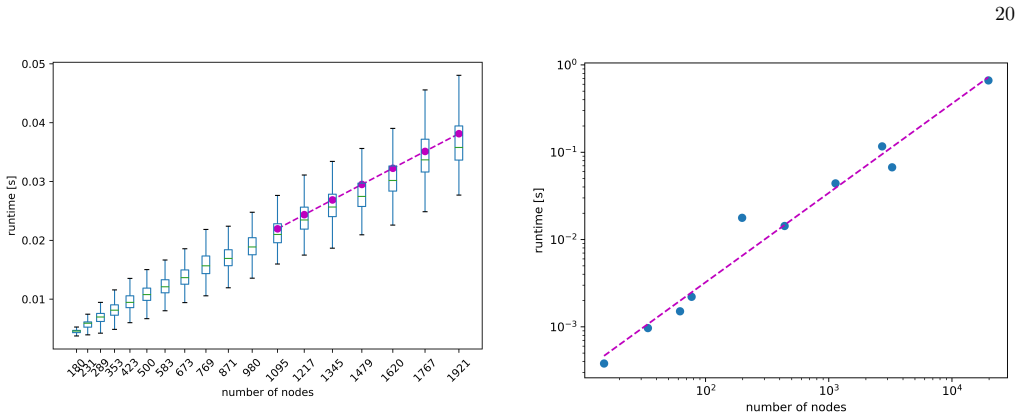
Reduction run times In this section, we provide results for the algorithmic run times of our clique-based reduction algorithm when applied to both random UJ instances and real-world net- works. Our results are displayed in Figs. 17 and 18, re- spectively. For random UJ instances, we find that all re- duction runs finish on sub-second time scales per insta...
2000
-
[6]
Our results for random BA and ER graphs are shown in Fig
Reduction of synthetic (random) graphs In this section, we provide additional results on the clique-based reduction of synthetic (random) graphs, similar to the results shown for RG graphs in the main text. Our results for random BA and ER graphs are shown in Fig. 19
-
[7]
C. H. Papadimitriou and K. Steiglitz,Combinatorial Op- timization: Algorithms and Complexity(Courier Corpo- ration, North Chelmsford, 1998)
work page 1998
Show all 86 references
-
[8]
Korte and J
B. Korte and J. Vygen, Combinatorial Optimization, vol. 2 (Springer, New York, 2012)
2012
-
[9]
Abbas, A
A. Abbas, A. Ambainis, B. Augustino, A. Bärtschi, H. Buhrman, C. Coffrin, G. Cortiana, V. Dunjko, D. J. Egger, B. G. Elmegreen, et al., Challenges and op- portunities in quantum optimization , Nature Reviews Physics 6, 718 (2024), URLhttps://doi.org/10.1038/ s42254-024-00770-9
2024
-
[10]
Kadowaki and H
T. Kadowaki and H. Nishimori, Quantum anneal- ing in the transverse ising model , Phys. Rev. E 58, 5355 (1998), URL https://link.aps.org/doi/10. 1103/PhysRevE.58.5355
1998
-
[11]
Y. Dong, A. V. Goldberg, A. Noe, N. Parot- sidis, M. G. C. Resende, and Q. Spaen, A meta- heuristic algorithm for large maximum weight in- dependent set problems , Networks 85, 91 (2025), https://onlinelibrary.wiley.com/doi/pdf/10.1002/net.22247, URL https://onlinelibrary.wile...
2025 doi
-
[12]
Boginski, S
V. Boginski, S. Butenko, and P. M. Pardalos,Statistical analysis of financial networks, Computational Statistics and Data Analysis48, 431 (2005)
2005
-
[13]
Kalra, F
A. Kalra, F. Qureshi, and M. Tisi, Portfolio as- set identification using graph algorithms on a Quan- tum Annealer, SSRN (2018), URL https://ssrn.com/ abstract=3333537
2018
-
[14]
Pistoia, and Y
D.Herman, C.Googin, X.Liu, Y.Sun, A.Galda, I.Safro, M. Pistoia, and Y. Alexeev, Quantum computing for finance, Nature Reviews Physics 5, 450 (2023), URL https://doi.org/10.1038/s42254-023-00603-1
2023 doi
-
[15]
Farhi, J
E. Farhi, J. Goldstone, and S. Gutmann, A quan- 22 tum approximate optimization algorithm (2014), arXiv:1411.4028
2014 arXiv
-
[16]
Zhou, S.-T
L. Zhou, S.-T. Wang, S. Choi, H. Pichler, and M. D. Lukin, Quantum Approximate Optimization Al- gorithm: Performance, mechanism, and implemen- tation on near-term devices , Phys. Rev. X 10, 021067 (2020), URL https://link.aps.org/doi/10. 1103/PhysRevX.10.021067
2020
-
[17]
Farhi, J
E. Farhi, J. Goldstone, S. Gutmann, and M. Sipser, Quantum computation by adiabatic evolution (2000), arXiv:quant-ph/0001106
2000 arXiv
-
[18]
Farhi, J
E. Farhi, J. Goldstone, S. Gutmann, J. Lapan, A. Lund- gren, and D. Preda, A quantum adiabatic evolution al- gorithm applied to random instances of an np-complete problem, Science 292, 472 (2001), URL https://www. science.org/doi/abs/10.1126/science.1057726
2001 doi
-
[19]
Das and B
A. Das and B. K. Chakrabarti,Colloquium: Quantum annealing and analog quantum computation, Rev. Mod. Phys. 80, 1061 (2008), URL https://link.aps.org/ doi/10.1103/RevModPhys.80.1061
2008 doi
-
[20]
Hauke, H
P. Hauke, H. G. Katzgraber, W. Lechner, H. Nishimori, and W. Oliver,Perspectives of quantum annealing: meth- ods and implementations, Rep. Prog. Phys. 83, 054401 (2020)
2020
-
[21]
M. F. Serret, B. Marchand, and T. Ayral,Solving opti- mization problems with Rydberg analog quantum comput- ers: Realistic requirements for quantum advantage using noisy simulation and classical benchmarks, Phys. Rev. A 102, 052617 (2020), URL https://link.aps.org/doi/ 10.1103...
2020 doi
-
[22]
Ebadi, A
S. Ebadi, A. Keesling, M. Cain, T. T. Wang, H. Levine, D. Bluvstein, G. Semeghini, A. Omran, J.-G. Liu, R. Samajdar, et al.,Quantum optimization of Maximum Independent Set using Rydberg atom arrays, Science376, 1209 (2022), URL https://doi.org/10.1126/science. abo6587
2022 doi
-
[23]
Lucas, Ising formulations of many NP problems , Front
A. Lucas, Ising formulations of many NP problems , Front. Physics2, 5 (2014)
2014
-
[24]
Glover, G
F. Glover, G. Kochenberger, and Y. Du,Quantum Bridge Analytics I: A Tutorial on Formulating and Using QUBO Models, 4OR 17, 335 (2019)
2019
-
[25]
Pichler, S.-T
H. Pichler, S.-T. Wang, L. Zhou, S. Choi, and M. D. Lukin, Quantum optimization for Maximum Independent Set using Rydberg atom arrays(2018), arXiv:1808.10816
2018 arXiv
-
[26]
Pichler, S.-T
H. Pichler, S.-T. Wang, L. Zhou, S. Choi, and M. D. Lukin, Computational complexity of the Rydberg Block- ade in two dimensions(2018), arXiv:1809.04954
2018 arXiv
-
[27]
K.Kim, M.Kim, J.Park, A.Byun, andJ.Ahn, Quantum computing dataset of maximum independent set problem on king lattice of over hundred rydberg atoms, Scientific Data 11, 111 (2024), URL https://doi.org/10.1038/ s41597-024-02926-9
2024
-
[28]
R. S. Andrist, M. J. A. Schuetz, P. Minssen, R. Yalovet- zky, S. Chakrabarti, D. Herman, N. Kumar, G. Salton, R. Shaydulin, Y. Sun, et al., Hardness of the maximum-independent-set problem on unit-disk graphs and prospects for quantum speedups, Phys. Rev. Res. 5, 043277 (2023),...
2023
-
[29]
M. Cain, S. Chattopadhyay, J.-G. Liu, R. Samajdar, H.Pichler, andM.D.Lukin, Quantum speedup for combi- natorial optimization with flat energy landscapes(2023), arXiv:2306.13123
2023 arXiv
-
[30]
B. F. Schiffer, D. S. Wild, N. Maskara, M. Cain, M. D. Lukin, and R. Samajdar, Circumventing su- perexponential runtimes for hard instances of quan- tum adiabatic optimization , Phys. Rev. Res. 6, 013271 (2024), URL https://link.aps.org/doi/10. 1103/PhysRevResearch.6.013271
2024
-
[31]
J. R. Finžgar, M. J. A. Schuetz, J. K. Brubaker, H. Nishi- mori, and H. G. Katzgraber,Designing quantum anneal- ing schedules using bayesian optimization, Phys. Rev. Res. 6, 023063 (2024), URL https://link.aps.org/ doi/10.1103/PhysRevResearch.6.023063
2024 doi
-
[32]
J. R. Finžgar, A. Kerschbaumer, M. J. Schuetz, C. B. Mendl, and H. G. Katzgraber, Quantum-informed re- cursive optimization algorithms , PRX Quantum 5, 020327 (2024), URL https://link.aps.org/doi/10. 1103/PRXQuantum.5.020327
2024
-
[33]
M. S. Könz, W. Lechner, H. G. Katzgraber, and M. Troyer, Embedding overhead scaling of optimiza- tion problems in quantum annealing , PRX Quantum 2, 040322 (2021), URLhttps://link.aps.org/doi/10. 1103/PRXQuantum.2.040322
2021
-
[34]
P. I. Bunyk, E. M. Hoskinson, M. W. Johnson, E. Tolka- cheva, F. Altomare, A. J. Berkley, R. Harris, J. P. Hilton, T. Lanting, A. J. Przybysz, et al.,Architectural consid- erations in the design of a superconducting quantum an- nealing processor, IEEE Transactions on Applied S...
2014
-
[35]
M. D. Lukin, M. Fleischhauer, R. Cote, L. M. Duan, D. Jaksch, J. I. Cirac, and P. Zoller, Dipole Blockade and quantum information processing in mesoscopic atomic ensembles, Phys. Rev. Lett. 87, 037901 (2001), URL https://link.aps.org/doi/10. 1103/PhysRevLett.87.037901
2001
-
[36]
Levine, A
H. Levine, A. Keesling, G. Semeghini, A. Omran, T. T. Wang, S. Ebadi, H. Bernien, M. Greiner, V. Vuletić, H. Pichler, et al.,Parallel implementation of high-fidelity multiqubit gates with neutral atoms, Phys. Rev. Lett. 123, 170503 (2019), URL https://link.aps.org/doi/ 10.1103...
2019 doi
-
[37]
Saffman, T
M. Saffman, T. G. Walker, and K. Mølmer, Quan- tum information with Rydberg atoms, Rev. Mod. Phys. 82, 2313 (2010), URL https://link.aps.org/doi/10. 1103/RevModPhys.82.2313
2010
-
[38]
B. N. Clark, C. J. Colbourn, and D. S. Johnson,Unit disk graphs, Discrete Mathematics86, 165 (1990), ISSN 0012- 365X, URLhttps://www.sciencedirect.com/science/ article/pii/0012365X9090358O
1990
-
[39]
M. Kim, K. Kim, J. Hwang, E.-G. Moon, and J. Ahn, Rydberg quantum wires for Maximum Independent Set problems, Nature Physics 18, 755 (2022), URL https: //doi.org/10.1038/s41567-022-01629-5
2022 doi
-
[40]
Dlaska, K
C. Dlaska, K. Ender, G. B. Mbeng, A. Kruckenhauser, W. Lechner, and R. van Bijnen, Quantum optimiza- tion via four-body rydberg gates, Phys. Rev. Lett. 128, 120503 (2022), URL https://link.aps.org/doi/10. 1103/PhysRevLett.128.120503
2022
-
[42]
Vinci, T
W. Vinci, T. Albash, G. Paz-Silva, I. Hen, and D. A. Lidar, Quantum annealing correction with minor em- bedding, Phys. Rev. A 92, 042310 (2015), URL https: //link.aps.org/doi/10.1103/PhysRevA.92.042310
2015 doi
-
[43]
Sugie, Y
Y. Sugie, Y. Yoshida, N. Mertig, T. Takemoto, H. Ter- amoto, A. Nakamura, I. Takigawa, S.-i. Minato, M. Ya- maoka, and T. Komatsuzaki, Minor-embedding heuris- tics for large-scale annealing processors with sparse hard- ware graphs of up to 102,400 nodes , Soft Comput- ing 25, ...
2021
-
[44]
A. Byun, M. Kim, and J. Ahn,Finding the maximum independent sets of platonic graphs using rydberg atoms, PRX Quantum 3, 030305 (2022), URL https://link. aps.org/doi/10.1103/PRXQuantum.3.030305
2022 doi
-
[45]
A. Byun, J. Jung, K. Kim, M. Kim, S. Jeong, H. Jeong, and J. Ahn, Rydberg-atom graphs for quadratic unconstrained binary optimization problems (2023), arXiv:2309.14847
2023 arXiv
-
[46]
Butenko and S
S. Butenko and S. Trukhanov, Using critical sets to solve the maximum independent set problem , Opera- tions Research Letters 35, 519 (2007), ISSN 0167- 6377, URL https://www.sciencedirect.com/science/ article/pii/S0167637706000952
2007
-
[47]
Nguyen, J.-G
M.-T. Nguyen, J.-G. Liu, J. Wurtz, M. D. Lukin, S.- T. Wang, and H. Pichler, Quantum optimization with arbitrary connectivity using Rydberg atom arrays, PRX Quantum 4, 010316 (2023), URL https://link.aps. org/doi/10.1103/PRXQuantum.4.010316
2023 doi
-
[48]
A. G. de Oliveira, E. Diamond-Hitchcock, D. M. 23 Walker, M. T. Wells-Pestell, G. PelegrÃ, C. J. Picken, G. P. A. Malcolm, A. J. Daley, J. Bass, and J. D. Pritchard, Demonstration of weighted graph optimization on a rydberg atom array using local light-shifts(2024), arXiv:2404.02658
2024 arXiv
-
[49]
Bluvstein, H
D. Bluvstein, H. Levine, G. Semeghini, T. T. Wang, S. Ebadi, M. Kalinowski, A. Keesling, N. Maskara, H. Pichler, M. Greiner, et al., A quantum processor based on coherent transport of entangled atom arrays, Na- ture 604, 451 (2022), URLhttps://doi.org/10.1038/ s41586-022-04592-6
2022
-
[50]
Bluvstein, S
D. Bluvstein, S. J. Evered, A. A. Geim, S. H. Li, H. Zhou, T. Manovitz, S. Ebadi, M. Cain, M. Kalinowski, D. Hangleiter, et al.,Logical quantum processor based on reconfigurable atom arrays, Nature 626, 58 (2024), URL https://doi.org/10.1038/s41586-023-06927-3
2024 doi
-
[51]
Butenko, P
S. Butenko, P. Pardalos, I. Sergienko, V. Shylo, and P. Stetsyuk, in Proceedings of the 2002 ACM Sympo- sium on Applied Computing(Association for Computing Machinery, New York, NY, USA, 2002), SAC ’02, pp. 542–546, ISBN 1581134452, URLhttps://doi.org/10. 1145/508791.508897
2002
-
[52]
Wurtz, A
J. Wurtz, A. Bylinskii, B. Braverman, J. Amato-Grill, S. H. Cantu, F. Huber, A. Lukin, F. Liu, P. Weinberg, J. Long, et al.,Aquila: Quera’s 256-qubit neutral-atom quantum computer(2023), arXiv:2306.11727
2023 arXiv
-
[53]
Strash, inComputing and Combinatorics, edited by T
D. Strash, inComputing and Combinatorics, edited by T. N. Dinh and M. T. Thai (Springer International Publishing, Cham, 2016), pp. 345–356, ISBN 978-3-319- 42634-1
2016
-
[54]
Hespe, C
D. Hespe, C. Schulz, and D. Strash, Scalable kernel- ization for maximum independent sets, ACM J. Exp. Algorithmics 24 (2019), ISSN 1084-6654, URL https: //doi.org/10.1145/3355502
2019 doi
-
[55]
S. Lamm, C. Schulz, D. Strash, R. Williger, and H. Zhang, Exactly Solving the Maxi- mum Weight Independent Set Problem on Large Real-World Graphs (2019), pp. 144–158, https://epubs.siam.org/doi/pdf/10.1137/1.9781611975499.12, URL https://epubs.siam.org/doi/abs/10.1137/1. 97816...
2019 doi
-
[56]
A. K. McCallum, K. Nigam, J. Rennie, and K. Seymore, Automating the construction of internet portals with ma- chine learning, Information Retrieval3, 127 (2000)
2000
-
[57]
Namata, B
G. Namata, B. London, L. Getoor, and B. Huang, in 10th International Workshop on Mining and Learning with Graphs(2012), vol. 8, p. 249
2012
-
[58]
Chang, W
L. Chang, W. Li, and W. Zhang, in Proceedings of the 2017 ACM International Conference on Management of Data (Association for Computing Machinery, New York, NY, USA, 2017), SIGMOD ’17, pp. 1181–1196, ISBN 9781450341974, URL https://doi.org/10.1145/ 3035918.3035939
2017
-
[59]
Gyger, M
F. Gyger, M. Ammenwerth, R. Tao, H. Timme, S. Sni- girev, I. Bloch, and J. Zeiher,Continuous operation of large-scale atom arrays in optical lattices, Phys.Rev.Res. 6, 033104 (2024), URLhttps://link.aps.org/doi/10. 1103/PhysRevResearch.6.033104
2024
-
[60]
H. J. Manetsch, G. Nomura, E. Bataille, K. H. Leung, X. Lv, and M. Endres,A tweezer array with 6100 highly coherent atomic qubits(2024), arXiv:2403.12021
2024 arXiv
-
[61]
C. S. Adams, J. D. Pritchard, and J. P. Shaffer, Ry- dberg atom quantum technologies, Journal of Physics B: Atomic, Molecular and Optical Physics 53, 012002 (2019), URLhttps://dx.doi.org/10.1088/1361-6455/ ab52ef
2019 doi
-
[62]
Henriet, L
L. Henriet, L. Beguin, A. Signoles, T. Lahaye, A. Browaeys, G.-O. Reymond, and C. Jurczak, Quan- tum computing with neutral atoms , Quantum 4, 327 (2020), ISSN 2521-327X, URL https://doi.org/10. 22331/q-2020-09-21-327
2020
-
[63]
Butenko, P
S. Butenko, P. Pardalos, I. Sergienko, V. Shylo, and P. Stetsyuk,Estimating the size of correcting codes using extremal graph problems(Springer New York, New York, NY, 2009), pp. 227–243, ISBN 978-0-387-98096-6, URL https://doi.org/10.1007/978-0-387-98096-6_12
2009 doi
-
[64]
Glover, M
F. Glover, M. Lewis, and G. Kochenberger, Log- ical and inequality implications for reducing the size and difficulty of quadratic unconstrained bi- nary optimization problems, European Journal of Op- erational Research 265, 829 (2018), ISSN 0377- 2217, URL https://www.scienced...
2018
-
[65]
S. Lamm, P. Sanders, C. Schulz, D. Strash, and R. F. Werneck,Finding near-optimal independent sets at scale, Journal of Heuristics23, 207 (2017), URLhttps://doi. org/10.1007/s10732-017-9337-x
2017 doi
-
[66]
Großmann, S
E. Großmann, S. Lamm, C. Schulz, and D. Strash, in Proceedings of the Genetic and Evolutionary Computa- tion Conference(Association for Computing Machinery, New York, NY, USA, 2023), GECCO ’23, pp. 293–302, ISBN 9798400701191, URL https://doi.org/10.1145/ 3583131.3590353
2023
-
[67]
Y. Liu, T. Safavi, A. Dighe, and D. Koutra,Graph sum- marization methods and applications: A survey, ACM Comput. Surv. 51 (2018), ISSN 0360-0300, URLhttps: //doi.org/10.1145/3186727
2018 doi
-
[68]
Hashemi, S
M. Hashemi, S. Gong, J. Ni, W. Fan, B. A. Prakash, and W. Jin, A comprehensive survey on graph re- duction: Sparsification, coarsening, and condensation (2024), arXiv:2402.03358
2024 arXiv
-
[69]
Lewis and F
M. Lewis and F. Glover,Quadratic unconstrained binary optimization problem preprocessing: Theory and empiri- cal analysis, Netw. 70, 79 (2017), ISSN 0028-3045, URL https://doi.org/10.1002/net.21751
2017 doi
-
[70]
M. A. Londe, L. S. Pessoa, C. E. Andrade, and M. G. C. Resende, Early years of biased random-key genetic algo- rithms: A systematic review (2024), 2405.01765, URL https://arxiv.org/abs/2405.01765
2024 arXiv
-
[71]
updates. Upon completion, after a series of training steps, RKO outputs an approximate graphG of low cost that is as similar as possible to the input graphG, given the hardware connectivity constraints. Let us illustrate the GAGE embedding scheme as de- scribed above with a si...
-
[72]
Narimani, S
A. Narimani, S. S. C. Rezaei, and A. Zaribafiyan,Com- binatorial optimization by decomposition on hybrid cpu– non-cpu solver architectures(2017), arXiv:1708.03439
2017 arXiv
-
[73]
H. N. Djidjev, E. A. R. Pelofske, and G. Hahn,Decompo- sition algorithms for solving np-hard problems on a quan- tum annealer, Journal of Signal Processing Systems93 (2020), ISSN 1939-8018, URL https://www.osti.gov/ biblio/1822729
2020
-
[74]
M. E. J. Newman, Networks: an introduction (Oxford University Press, Oxford; New York, 2010), ISBN 9780199206650 0199206651, URL http://www.amazon. com/Networks-An-Introduction-Mark-Newman/dp/ 0199206651/ref=sr_1_5?ie=UTF8&qid=1352896678&sr= 8-5&keywords=complex+networks
2010
-
[75]
A. A. Chaves, M. G. C. Resende, M. J. A. Schuetz, J. K. Brubaker, H. G. Katzgraber, E. F. de Arruda, and R. M. A. Silva, A random-key optimizer for com- binatorial optimization (2024), 2411.04293, URLhttps: 24 //arxiv.org/abs/2411.04293
2024
-
[76]
M. A. Londe, L. S. Pessoa, C. E. Andrade, and M. G. Resende, Biased random-key genetic algorithms: A re- view, European Journal of Operational Research (2024), ISSN 0377-2217, URL https://www.sciencedirect. com/science/article/pii/S0377221724002303
2024
-
[77]
M. J. Schuetz, J. K. Brubaker, H. Montagu, Y. van Dijk, J. Klepsch, P. Ross, A. Luckow, M. G. Resende, and H. G. Katzgraber, Optimization of robot-trajectory planning with nature-inspired and hy- brid quantum algorithms , Phys. Rev. Appl. 18, 054045 (2022), URL https://link.ap...
2022
-
[78]
A. A. Chaves, M. G. C. Resende, and R. M. A. Silva, in Metaheuristics: 15th International Conference, MIC 2024, Lorient, France, June 4-7, 2024, Proceedings, Part I (Springer-Verlag, Berlin, Heidelberg, 2024), pp. 15– 20, ISBN 978-3-031-62911-2, URLhttps://doi.org/10. 1007/978...
2024
-
[79]
Kirkpatrick, C
S. Kirkpatrick, C. D. Gelatt, and M. P. Vecchi, Op- timization by Simulated Annealing, Science 220, 671 (1983), URL https://www.science.org/doi/abs/10. 1126/science.220.4598.671
1983
-
[80]
Perseguers, Hardness-dependent adiabatic schedules for analog quantum computing(2024), 2410.08995, URL https://arxiv.org/abs/2410.08995
S. Perseguers, Hardness-dependent adiabatic schedules for analog quantum computing(2024), 2410.08995, URL https://arxiv.org/abs/2410.08995
2024 arXiv
-
[81]
Leyton-Brown, H
K. Leyton-Brown, H. H. Hoos, F. Hutter, and L. Xu,Un- derstanding the empirical hardness of np-complete prob- lems, Commun. ACM 57, 98 (2014), ISSN 0001-0782, URL https://doi.org/10.1145/2594413.2594424
2014
-
[82]
Y. Song, M. Kim, H. Hwang, W. Lee, and J. Ahn, Quantum simulation of cayley-tree ising hamiltonians with three-dimensional rydberg atoms, Phys. Rev. Res. 3, 013286 (2021), URLhttps://link.aps.org/doi/10. 1103/PhysRevResearch.3.013286
2021
-
[83]
R. A. Rossi and N. K. Ahmed, inAAAI (2015), URL http://networkrepository.com
2015
-
[84]
Barthelemy, Spatial networks , Physics Re- ports 499, 1 (2011), ISSN 0370-1573, URL https://www.sciencedirect.com/science/article/ pii/S037015731000308X
M. Barthelemy, Spatial networks , Physics Re- ports 499, 1 (2011), ISSN 0370-1573, URL https://www.sciencedirect.com/science/article/ pii/S037015731000308X
2011
-
[85]
Barabási and R
A.-L. Barabási and R. Albert, Emergence of scal- ing in random networks , Science 286, 509 (1999), https://www.science.org/doi/pdf/10.1126/science.286.5439.509, URL https://www.science.org/doi/abs/10.1126/ science.286.5439.509
1999 doi
-
[86]
Wurtz, S
J. Wurtz, S. H. Sack, and S.-T. Wang, Solving non- native combinatorial optimization problems using hy- brid quantum-classical algorithms, IEEE Transactions on Quantum Engineering pp. 1–15 (2024)
2024
Reviewed August 11, 2026 · model on record in the stance chip above.
Discussion (0). Continue with ORCID to comment.