REVIEW 3 major objections 3 minor 36 references
The Jackknife method as a new approach to validate strong lens mass models
T0 review · 3 major / 3 minor · reviewed 2026-08-16 · deepseek-v4-flash
Pith's one-line read A leave-one-source-out Jackknife test separates correct from overfitted strong-lens mass models even when both have reduced chi-square near unity.
desk verdict A promising but uncalibrated jackknife validation test for cluster lens models; the core simulation works, but the N(0,1) null is setup-dependent and no error bars are quoted. read the letter →
The pith
A machine-rendered reading of the paper's core claim, the machinery that carries it, and where it could break.
The reading
What carries the argument
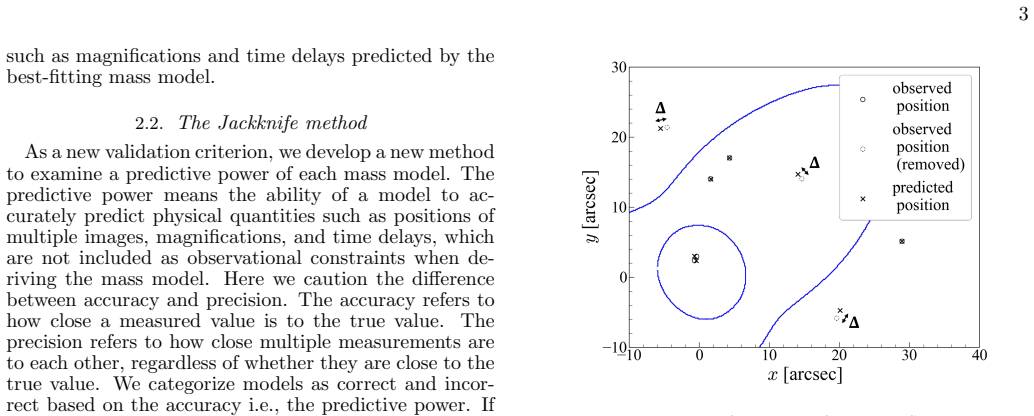
The central object is the leave-one-source-out Jackknife residual distribution. For each source, the procedure removes all of that source's multiple images, refits the mass model using the remaining sources, predicts the removed source's image positions, and records the positional differences ($\Delta$ x, $\Delta$ y); these are divided by the assumed positional error $\sigma$ to form standardized residuals. The diagnostic is the standard deviation of the pooled standardized residuals, compared with the reference value 1 from a Gaussian N(0, 1) distribution. The method works by exploiting the difference between precision and accuracy: an overfitted model reproduces its training images well but predicts held-out images poorly, so its Jackknife residuals are wider than the assumed error, while a genuinely predictive model produces residuals that track the assumed error.
What would settle it
Run the same leave-one-source-out analysis on simulated clusters with a known true model but deliberately fewer constraints or strong parameter degeneracies, keeping chi-square per degree of freedom near 1; if the correct model's Jackknife standard deviation rises well above 1, the fixed N(0, 1) reference would mislabel correct models as overfitted. Equivalently, an analytic calculation of the expected leave-one-out residual variance for a linearized lens model with 2P constraints and Q parameters would settle whether the reference value should depend on the degrees of freedom.
Extended reading notes
Core claim
The paper's central claim is that the Jackknife method can reveal whether a strong-lens mass model is overfitted, even when the usual reduced chi-square diagnostic cannot. In the 5-source simulation, the incorrect model is deliberately given extra multipole perturbations and is fit with an inflated positional error so that its reduced chi-square is also about 1; nevertheless, the standard deviation of the standardized Jackknife residuals is 2.28 for the incorrect model versus 1.24 for the correct model. The paper interprets this as the incorrect model failing to predict held-out image positions by roughly twice the assumed positional error, while the correct model predicts them at about the assumed error. In the MACS0647 demonstration, the HST-based model gives a Jackknife standard deviation of 4.03, suggesting overfitting, whereas the JWST-based model gives 1.72, suggesting a more reliable model. The paper further argues that the ratio sigma_Jackknife/sigma correlates with the ratio of true to MCMC-estimated errors on physical quantities like magnifications and time delays, so the method might eventually correct underestimated statistical errors.
Load-bearing premise
The load-bearing premise is that a correct model's Jackknife residuals should scatter with standard deviation 1, but the paper states this expectation without deriving it; its own correct-model simulation gives 1.24, so the threshold cannot cleanly separate correct-but-sparsely-constrained models from incorrect ones without calibration.
Editorial extensions
If this is right
- A model with reduced chi-square near 1 can still be overfitted, so the Jackknife test provides a complementary diagnostic that does not require knowing the true substructure error.
- The 5-source mock result quantifies the separation: a Jackknife standard deviation of 1.24 for the correct model versus 2.28 for the incorrect model suggests that values well above 1 indicate low predictive power.
- In the MACS0647 demonstration, the larger JWST image sample (86 images) yields a Jackknife width much closer to 1 than the smaller HST sample (31 images), supporting the idea that more constraints curb overfitting.
- If the sigma_Jackknife/sigma versus sigma_realization/sigma_MCMC trend is established, one could correct underestimated MCMC errors for magnifications and time delays using observed data alone.
- In the 20-source simulation, the incorrect model is no longer overfitted, so the Jackknife distributions agree; the method detects overfitting rather than model misspecification in general.
Reading between the lines
- An implication the paper leaves implicit is that the expected Jackknife width for a correct model is probably not exactly 1 for all designs; it should depend on the number of constraints and parameter degeneracies, so a calibration grid covering correct models with varying source counts would allow model-specific thresholds rather than a fixed Gaussian reference.
- The same leave-one-source-out logic could be applied directly to predicted magnifications or time delays, not just image positions, turning the method into a per-quantity predictive check that would speak more directly to the science outputs that matter.
- A natural next test is to apply the Jackknife to mock clusters with simulated dark-matter substructure; if substructure inflates the Jackknife width of a true model, the method may need to distinguish genuine complexity from a wrong model.
- Because the 20-source case shows no separation, the method's power is highest in the low-constraint regime where overfitting is most dangerous, which is also the regime where the reduced chi-square is least informative.
Signed reviews
Editorial analysis
A structured set of objections, weighed in public.
Referee Report
Summary. The paper proposes a jackknife validation method for cluster-scale strong lens mass models. The procedure removes all multiple images of one source, refits the model to the remaining sources, predicts the removed images, and compares observed and predicted positions through standardized residuals Delta_x/sigma, Delta_y/sigma. The central claim, stated in Section 3.2, is that this jackknife distribution separates a correct model (standard deviation 1.24) from an incorrect, overfitted model (2.28) in a 5-source mock experiment, even though both models have reduced chi-square near 1. The paper also applies the method to MACS0647 using HST and JWST data and explores whether the jackknife width can calibrate MCMC error estimates for physical quantities.
Significance. If the central claim holds, the jackknife method would provide a quantitative, hold-out-based diagnostic for overfitting in strong lens mass modeling, addressing a real problem: the reduced chi-square is often made acceptable by inflating positional errors. The controlled mock experiment is a genuine strength: it uses a known input model, genuine hold-out predictions, and a fair construction in which the incorrect model is rescaled to chi-square/DoF ~ 1. The demonstration with real observations and the discussion of MCMC error validation are useful first steps. However, the interpretation depends on an uncalibrated and setup-dependent null distribution, and the quoted widths lack uncertainty estimates, so the method as currently stated cannot cleanly classify models in practice.
major comments (3)
- [Section 2.2 (with Figs. 2 and 3)] The assertion that for a correct model the jackknife residuals Delta_x/sigma, Delta_y/sigma follow a Gaussian distribution with standard deviation 1 is not derived, and it is contradicted by the paper's own simulations: the correct model gives a jackknife width of 1.24 with 5 sources and 1.02 with 20 sources. Leave-one-out predictive residuals for models with estimated parameters have variance sigma^2 times (1 + leverage), where the leverage depends on the number of constraints, the number of images per held-out source, and parameter degeneracies. Without a derivation or a calibration table, the reference value 1 cannot serve as a universal null threshold, and the 'much larger than 1' criterion for overfitting is not quantitatively grounded. This is the main load-bearing issue for the paper's central claim.
- [Section 3.2 (Figs. 2 and 3)] The quoted jackknife widths (1.24 vs 2.28 for 5 sources; 1.02 vs 1.14 for 20 sources) are presented without uncertainties or effective sample sizes. Residuals from multiple images of the same removed source are correlated, so the number of independent jackknife residuals is closer to the number of sources R (5 or 20) than to the number of images (15 or 60). The sampling uncertainty on these widths is therefore non-negligible, and the separation between 1.24 and 2.28 may be less significant than it appears. The paper should report confidence intervals, bootstrap errors, or the distribution of widths over the 100 mock realizations to support the claimed discrimination.
- [Section 4 (Fig. 4)] The MACS0647 demonstration interprets the JWST jackknife width of 1.72 as indicating a relatively accurate model and the HST width of 4.03 as indicating overfitting. Given the uncalibrated null distribution, a width of 1.72 is also consistent with the 1.24 width of the correct 5-source mock model, so the observation alone cannot distinguish 'correct but limited constraints' from 'overfitted'. The application should be framed strictly as a feasibility demonstration, or it must be accompanied by a calibrated threshold and confidence intervals on the widths.
minor comments (3)
- [Section 5.1 (Figs. 6 and 7)] The calibration relation between sigma_Jackknife/sigma and sigma_realization/sigma_MCMC is described as positive only at about the 2-sigma level with large scatter, and the text states more analysis is needed. This section should be explicitly labeled as exploratory; the wording 'we can validate the statistical error' overstates what is currently established.
- [Figure 2 caption] The caption notes that source-plane fitting can produce a different number of predicted images and that the incorrect model predicts extra images near halo centers. The paper should clarify how observed and predicted images are matched when the predicted multiplicity differs from the observed multiplicity, since this affects the computed Delta_x, Delta_y residuals.
- [Table 2] The table uses 'DoF' as both a column name and a concept; for readability, consider defining 'DoF = Constraint - Parameter' explicitly in the table caption, as is done in the text.
Circularity Check
No significant circularity: the Jackknife test is a genuine hold-out procedure evaluated on controlled simulations and external data; the un-derived N(0,1) null is a calibration concern, not a circular reduction.
full rationale
The paper's derivation chain is self-contained. Section 3.1 constructs mock data from a specified input lens model, fits a correct model with identical components and an incorrect model with extra multipoles, and rescales sigma' via Eq. (8) so that the incorrect model also has reduced chi-square near 1; this is a fair test construction, not a fit to the held-out Jackknife predictions. The Jackknife residuals in Figs. 2 and 3 are genuine leave-one-source-out predictions: no held-out image position enters the fit used to predict it, so the reported widths (1.24 vs 2.28 for 5 sources; 1.02 vs 1.14 for 20 sources) are not equal to inputs by construction. The Sect. 2.2 statement that a correct model gives N(0,1) standardized residuals is asserted rather than derived, and the paper's own correct-model widths (1.24 at 5 sources vs 1.02 at 20 sources) show the null value is setup-dependent; this is an uncalibrated-threshold and validity concern, not a circular one. The paper itself flags in Sect. 5.1 that the MCMC-error calibration trend is only positive at about 2 sigma with large scatter and states 'More analysis is needed to fully establish the trend.' Citations to glafic (Oguri 2010, 2021) and to Okabe et al. (2020) are software and data references rather than load-bearing evidence; the central Jackknife comparison is recomputed in this paper, so no load-bearing claim reduces to a self-citation or to a fitted parameter renamed as a prediction.
Assumptions & free parameters
free parameters (3)
- sigma_eff (simulated positional error) =
0.4 arcsec
- sigma_prime (rescaled error for incorrect models) =
Derived per setup via Eq. (8) so that reduced chi-square equals 1
- Multipole perturbation amplitudes (m=3,4,5) =
Not stated in text
assumptions (5)
- standard math Gravitational lens equation and deflection potentials (NFW, shear, multipoles) map source positions to image positions.
- domain assumption Minimized chi-square follows a chi-square distribution with nu = 2P - Q degrees of freedom.
- ad hoc to paper For a correct mass model, Jackknife standardized residuals Delta x/sigma, Delta y/sigma follow N(0,1).
- domain assumption Positional errors are homoscedastic and sigma_eff is the same for all images.
- domain assumption The adopted parametric model family (NFW halo, external shear, multipoles, member galaxies) is sufficient to describe the true mass distribution.
Cite this review
Pith. "Pith review of The Jackknife method as a new approach to validate strong lens mass models." pith.science (2026). https://pith.science/paper/2BNASAXO
@misc{pith2026250500553,
  author       = {Pith},
  title        = {Pith review of: The Jackknife method as a new approach to validate strong lens mass models},
  year         = {2026},
  howpublished = {\url{https://pith.science/paper/2BNASAXO}},
  note         = {Machine review of arXiv:2505.00553}
}
read the original abstract
The accuracy of a mass model in the strong lensing analysis is crucial for unbiased predictions of physical quantities such as magnifications and time delays. While the mass model is optimized by changing parameters of the mass model to match predicted positions of multiple images with observations, positional uncertainties of multiple images often need to be boosted to take account of the complex structure of dark matter in lens objects, making the interpretation of the chi-square value difficult. We introduce the Jackknife method as a new method to validate strong lens mass models, specifically focusing on cluster-scale mass modeling. In this approach, we remove multiple images of a source from the fitting and optimize the mass model using multiple images of the remaining sources. We then calculate the multiple images of the removed source and quantitatively evaluate how well they match the observed positions. We find that the Jackknife method performs effectively in simulations using a simple model. We also demonstrate our method with mass modeling of the galaxy cluster MACS J0647.7+7015. We discuss the potential of using the Jackknife method to validate the error estimation of the physical quantities by the Markov Chain Monte Carlo.
Figures


Figures from the paper (6 more)


Reference graph
Works this paper leans on
-
[1]
author author W. Zheng , author M. Postman , author A. Zitrin , author J. Moustakas , author X. Shu , author S. Jouvel , author O. H st , author A. Molino , author L. Bradley , author D. Coe , author L. A. \ Moustakas , author M. Carrasco , author H. Ford , author N. Ben \' tez , author T. R. \ Lauer , author S. Seitz , author R. Bouwens , author A. Koeke...
-
[2]
author author D. Coe , author A. Zitrin , author M. Carrasco , author X. Shu , author W. Zheng , author M. Postman , author L. Bradley , author A. Koekemoer , author R. Bouwens , author T. Broadhurst , author A. Monna , author O. Host , author L. A. \ Moustakas , author H. Ford , author J. Moustakas , author A. van der Wel , author M. Donahue , author S. ...
-
[3]
author author H. Williams , author P. L. \ Kelly , author W. Chen , author G. Brammer , author A. Zitrin , author T. Treu , author C. Scarlata , author A. M. \ Koekemoer , author M. Oguri , author Y.-H. \ Lin , author J. M. \ Diego , author M. Nonino , author J. Hjorth , author D. Langeroodi , author T. Broadhurst , author N. Rogers , author I. Perez-Four...
-
[4]
author author A. Adamo , author L. D. \ Bradley , author E. Vanzella , author A. Claeyssens , author B. Welch , author J. M. \ Diego , author G. Mahler , author M. Oguri , author K. Sharon , author Abdurro'uf , author T. Y.-Y. \ Hsiao , author X. Xu , author M. Messa , author A. E. \ Lassen , author E. Zackrisson , author G. Brammer , author D. Coe , auth...
-
[5]
author author P. L. \ Kelly , author S. A. \ Rodney , author T. Treu , author L. G. \ Strolger , author R. J. \ Foley , author S. W. \ Jha , author J. Selsing , author G. Brammer , author M. Brada c , author S. B. \ Cenko , author O. Graur , author A. V. \ Filippenko , author J. Hjorth , author C. McCully , author A. Molino , author M. Nonino , author A. ...
-
[6]
author author S. A. \ Rodney , author G. B. \ Brammer , author J. D. R. \ Pierel , author J. Richard , author S. Toft , author K. F. \ O'Connor , author M. Akhshik , \ and\ author K. E. \ Whitaker ,\ 10.1038/s41550-021-01450-9 journal journal Nature Astronomy \ volume 5 ,\ pages 1118 ( year 2021 ) ,\ http://arxiv.org/abs/2106.08935 arXiv:2106.08935 [astro...
-
[7]
Shock cooling of a red-supergiant supernova at redshift 3 in lensed images
author author W. Chen , author P. L. \ Kelly , author M. Oguri , author T. J. \ Broadhurst , author J. M. \ Diego , author N. Emami , author A. V. \ Filippenko , author T. L. \ Treu , \ and\ author A. Zitrin ,\ 10.1038/s41586-022-05252-5 journal journal \ volume 611 ,\ pages 256 ( year 2022 ) ,\ http://arxiv.org/abs/2306.12985 arXiv:2306.12985 [astro-ph.G...
-
[8]
author author K. Napier , author K. Sharon , author H. Dahle , author M. Bayliss , author M. D. \ Gladders , author G. Mahler , author J. R. \ Rigby , \ and\ author M. Florian ,\ 10.3847/1538-4357/ad045a journal journal \ volume 959 ,\ eid 134 ( year 2023 ) ,\ http://arxiv.org/abs/2301.11240 arXiv:2301.11240 [astro-ph.CO] NoStop
Show all 36 references
-
[9]
author author P. L. \ Kelly , author S. Rodney , author T. Treu , author M. Oguri , author W. Chen , author A. Zitrin , author S. Birrer , author V. Bonvin , author L. Dessart , author J. M. \ Diego , author A. V. \ Filippenko , author R. J. \ Foley , author D. Gilman , author...
-
[10]
Pascale , author B
author author M. Pascale , author B. L. \ Frye , author J. D. R. \ Pierel , author W. Chen , author P. L. \ Kelly , author S. H. \ Cohen , author R. A. \ Windhorst , author A. G. \ Riess , author P. S. \ Kamieneski , author J. M. \ Diego , author A. K. \ Meena , author S. Cha ...
-
[11]
Priewe , author L
author author J. Priewe , author L. L. R. \ Williams , author J. Liesenborgs , author D. Coe , \ and\ author S. A. \ Rodney ,\ 10.1093/mnras/stw2785 journal journal \ volume 465 ,\ pages 1030 ( year 2017 ) ,\ http://arxiv.org/abs/1605.07621 arXiv:1605.07621 [astro-ph.CO] NoStop
2017 arXiv
-
[12]
author author C. A. \ Raney , author C. R. \ Keeton , author S. Brennan , \ and\ author H. Fan ,\ 10.1093/mnras/staa921 journal journal \ volume 494 ,\ pages 4771 ( year 2020 ) ,\ http://arxiv.org/abs/2004.05952 arXiv:2004.05952 [astro-ph.CO] NoStop
2020 arXiv
-
[13]
Meneghetti , author P
author author M. Meneghetti , author P. Natarajan , author D. Coe , author E. Contini , author G. De Lucia , author C. Giocoli , author A. Acebron , author S. Borgani , author M. Bradac , author J. M. \ Diego , author A. Hoag , author M. Ishigaki , author T. L. \ Johnson , aut...
-
[14]
Acebron , author E
author author A. Acebron , author E. Jullo , author M. Limousin , author A. Tilquin , author C. Giocoli , author M. Jauzac , author G. Mahler , \ and\ author J. Richard ,\ 10.1093/mnras/stx1330 journal journal \ volume 470 ,\ pages 1809 ( year 2017 ) ,\ http://arxiv.org/abs/17...
-
[15]
Sebesta , author L
author author K. Sebesta , author L. L. R. \ Williams , author J. Liesenborgs , author E. Medezinski , \ and\ author N. Okabe ,\ 10.1093/mnras/stz1950 journal journal \ volume 488 ,\ pages 3251 ( year 2019 ) ,\ http://arxiv.org/abs/1907.09492 arXiv:1907.09492 [astro-ph.CO] NoStop
2019 arXiv
-
[16]
author author J. D. \ Remolina Gonz \'a lez , author K. Sharon , \ and\ author G. Mahler ,\ 10.3847/1538-4357/aacf8e journal journal \ volume 863 ,\ eid 60 ( year 2018 ) ,\ http://arxiv.org/abs/1807.03291 arXiv:1807.03291 [astro-ph.CO] NoStop
2018 arXiv
-
[17]
author author C. A. \ Raney , author C. R. \ Keeton , \ and\ author D. T. \ Zimmerman ,\ 10.1093/mnras/stab2857 journal journal \ volume 508 ,\ pages 5587 ( year 2021 ) NoStop
2021 doi
-
[18]
Perera , author J
author author D. Perera , author J. H. M. \ Jr , author L. L. R. \ Williams , author J. Liesenborgs , author A. Keen , author S. K. \ Li , \ and\ author M. Limousin ,\ 10.33232/001c.136341 journal journal The Open Journal of Astrophysics \ volume 8 ,\ eid 37 ( year 2025 ) ,\ h...
-
[19]
author author S. A. \ Rodney , author B. Patel , author D. Scolnic , author R. J. \ Foley , author A. Molino , author G. Brammer , author M. Jauzac , author M. Brada c , author T. Broadhurst , author D. Coe , author J. M. \ Diego , author O. Graur , author J. Hjorth , author A...
-
[20]
author author G. B. \ Caminha , author P. Rosati , author C. Grillo , author G. Rosani , author K. I. \ Caputi , author M. Meneghetti , author A. Mercurio , author I. Balestra , author P. Bergamini , author A. Biviano , author M. Nonino , author K. Umetsu , author E. Vanzella ...
-
[21]
Bergamini , author P
author author P. Bergamini , author P. Rosati , author E. Vanzella , author G. B. \ Caminha , author C. Grillo , author A. Mercurio , author M. Meneghetti , author G. Angora , author F. Calura , author M. Nonino , \ and\ author P. Tozzi ,\ 10.1051/0004-6361/202039564 journal j...
-
[22]
Coe , author E
author author D. Coe , author E. Fuselier , author N. Ben \' tez , author T. Broadhurst , author B. Frye , \ and\ author H. Ford ,\ 10.1086/588250 journal journal \ volume 681 ,\ pages 814 ( year 2008 ) ,\ http://arxiv.org/abs/0803.1199 arXiv:0803.1199 [astro-ph] NoStop
2008 arXiv
-
[23]
Cha \ and\ author M
author author S. Cha \ and\ author M. J. \ Jee ,\ 10.3847/1538-4357/acd111 journal journal \ volume 951 ,\ eid 140 ( year 2023 ) ,\ http://arxiv.org/abs/2301.08765 arXiv:2301.08765 [astro-ph.GA] NoStop
2023 arXiv
-
[24]
Ishiyama , author M
author author T. Ishiyama , author M. Enoki , author M. A. R. \ Kobayashi , author R. Makiya , author M. Nagashima , \ and\ author T. Oogi ,\ 10.1093/pasj/psv021 journal journal \ volume 67 ,\ eid 61 ( year 2015 ) ,\ http://arxiv.org/abs/1412.2860 arXiv:1412.2860 [astro-ph.CO] NoStop
2015 arXiv
-
[25]
Oguri ,\ 10.1093/pasj/62.4.1017 journal journal \ volume 62 ,\ pages 1017 ( year 2010 ) ,\ http://arxiv.org/abs/1005.3103 arXiv:1005.3103 [astro-ph.CO] NoStop
author author M. Oguri ,\ 10.1093/pasj/62.4.1017 journal journal \ volume 62 ,\ pages 1017 ( year 2010 ) ,\ http://arxiv.org/abs/1005.3103 arXiv:1005.3103 [astro-ph.CO] NoStop
2010 arXiv
-
[26]
Oguri ,\ 10.1088/1538-3873/ac12db journal journal \ volume 133 ,\ eid 074504 ( year 2021 ) ,\ http://arxiv.org/abs/2106.11464 arXiv:2106.11464 [astro-ph.IM] NoStop
author author M. Oguri ,\ 10.1088/1538-3873/ac12db journal journal \ volume 133 ,\ eid 074504 ( year 2021 ) ,\ http://arxiv.org/abs/2106.11464 arXiv:2106.11464 [astro-ph.IM] NoStop
2021 arXiv
-
[27]
author author J. F. \ Navarro , author C. S. \ Frenk , \ and\ author S. D. M. \ White ,\ 10.1086/304888 journal journal \ volume 490 ,\ pages 493 ( year 1997 ) ,\ http://arxiv.org/abs/astro-ph/9611107 arXiv:astro-ph/9611107 [astro-ph] NoStop
1997 arXiv
-
[28]
author author T. Y.-Y. \ Hsiao , author D. Coe , author Abdurro'uf , author L. Whitler , author I. Jung , author G. Khullar , author A. K. \ Meena , author P. Dayal , author K. S. S. \ Barrow , author L. Santos-Olmsted , author A. Casselman , author E. Vanzella , author M. Non...
-
[29]
Kawamata , author M
author author R. Kawamata , author M. Oguri , author M. Ishigaki , author K. Shimasaku , \ and\ author M. Ouchi ,\ 10.3847/0004-637X/819/2/114 journal journal \ volume 819 ,\ eid 114 ( year 2016 ) ,\ http://arxiv.org/abs/1510.06400 arXiv:1510.06400 [astro-ph.GA] NoStop
2016 arXiv
-
[30]
Ebeling , author E
author author H. Ebeling , author E. Barrett , author D. Donovan , author C. J. \ Ma , author A. C. \ Edge , \ and\ author L. van Speybroeck ,\ 10.1086/518603 journal journal \ volume 661 ,\ pages L33 ( year 2007 ) ,\ http://arxiv.org/abs/astro-ph/0703394 arXiv:astro-ph/070339...
2007 arXiv
-
[31]
Postman , author D
author author M. Postman , author D. Coe , author N. Ben \' tez , author L. Bradley , author T. Broadhurst , author M. Donahue , author H. Ford , author O. Graur , author G. Graves , author S. Jouvel , author A. Koekemoer , author D. Lemze , author E. Medezinski , author A. Mo...
-
[32]
Zitrin , author A
author author A. Zitrin , author A. Fabris , author J. Merten , author P. Melchior , author M. Meneghetti , author A. Koekemoer , author D. Coe , author M. Maturi , author M. Bartelmann , author M. Postman , author K. Umetsu , author G. Seidel , author I. Sendra , author T. Br...
-
[33]
Okabe , author M
author author T. Okabe , author M. Oguri , author S. Peirani , author Y. Suto , author Y. Dubois , author C. Pichon , author T. Kitayama , author S. Sasaki , \ and\ author T. Nishimichi ,\ 10.1093/mnras/staa1479 journal journal \ volume 496 ,\ pages 2591 ( year 2020 ) ,\ http:...
-
[34]
author author A. K. \ Meena , author A. Zitrin , author Y. Jim \'e nez-Teja , author E. Zackrisson , author W. Chen , author D. Coe , author J. M. \ Diego , author P. Dimauro , author L. J. \ Furtak , author P. L. \ Kelly , author M. Oguri , author B. Welch , author Abdurro'uf...
-
[35]
author author T. Y.-Y. \ Hsiao , author Abdurro'uf , author D. Coe , author R. L. \ Larson , author I. Jung , author M. Mingozzi , author P. Dayal , author N. Kumari , author V. Kokorev , author A. Vikaeus , author G. Brammer , author L. J. \ Furtak , author A. Adamo , author ...
-
[36]
author author L. J. \ Furtak , author A. K. \ Meena , author E. Zackrisson , author A. Zitrin , author G. B. \ Brammer , author D. Coe , author J. M. \ Diego , author J. J. \ Eldridge , author Y. Jim \'e nez-Teja , author V. Kokorev , author M. Ricotti , author B. Welch , auth...
Reviewed August 16, 2026 · model on record in the stance chip above.
Discussion (0). Continue with ORCID to comment.