Approximate dynamical eigenmodes of the Ising model with local spin-exchange moves
Pith reviewed 2026-05-24 16:48 UTC · model grok-4.3
The pith
The Fourier modes of the magnetization are the dynamical eigenmodes of the two-dimensional Ising model at criticality under Kawasaki dynamics.
A machine-rendered reading of the paper's core claim, the machinery that carries it, and where it could break.
Core claim
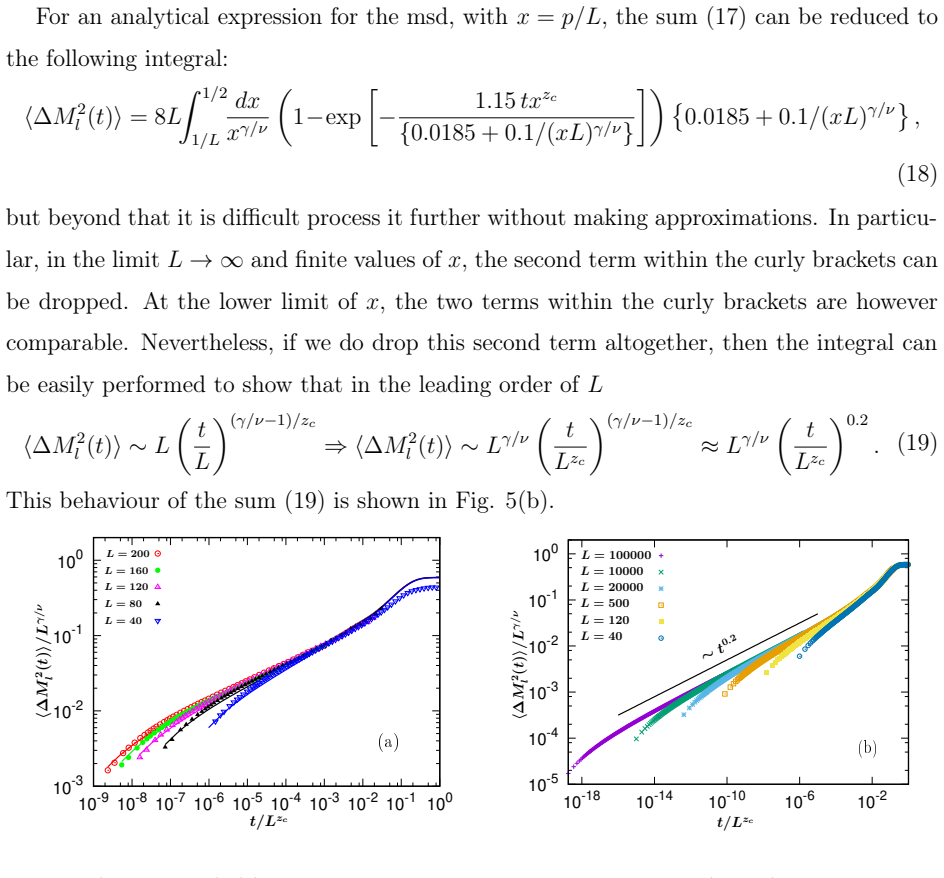
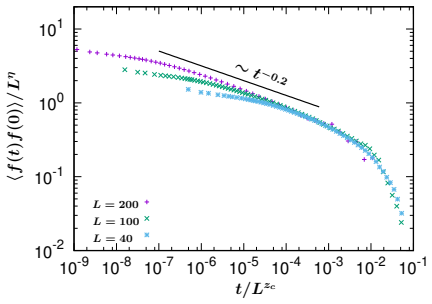
The paper establishes that the Fourier modes of the magnetization serve as the dynamical eigenmodes for the two-dimensional Ising model at the critical temperature with local spin-exchange moves, i.e., Kawasaki dynamics. Dynamical scaling properties for these modes are obtained and used to calculate the time evolution of the autocorrelation function and the mean-square deviation of the line magnetizations, finding anomalous diffusion at intermediate times 1 ≲ t ≲ L^{z_c} with z_c = 4 - η = 15/4. The Generalized Langevin Equation with a memory kernel consistently describes the anomalous diffusion and verifies the corresponding fluctuation-dissipation theorem with the force autocorrelation.
What carries the argument
Fourier modes of the magnetization, which act as dynamical eigenmodes under Kawasaki dynamics at criticality.
If this is right
- The autocorrelation function and mean-square deviation of line magnetizations follow directly from the scaling properties of the Fourier modes.
- Line magnetization exhibits anomalous diffusion specifically in the window 1 ≲ t ≲ L^{15/4}.
- The generalized Langevin equation with memory kernel accounts for the observed diffusion and satisfies the fluctuation-dissipation theorem as confirmed by the force autocorrelation function.
- All scaling relations hold only when the system is maintained precisely at the critical temperature.
Where Pith is reading between the lines
- The same Fourier-mode diagonalization may hold for other conserved dynamics on lattices if the critical point suppresses mode mixing.
- The verified memory-kernel description could be imported into models of experimental critical fluids or alloys that obey local conservation.
- Off-critical temperatures would likely introduce mixing among the modes, providing a clear diagnostic for departure from the reported regime.
- Efficient sampling algorithms for critical conserved systems could exploit these eigenmodes to accelerate relaxation.
Load-bearing premise
The assumption that the Kawasaki dynamics at exactly the critical temperature preserve the modes without mixing from conservation laws or other effects.
What would settle it
A direct numerical simulation that checks whether the time-evolution operators for distinct Fourier modes remain diagonal, showing no measurable cross-correlations between different wave-vectors.
Figures
read the original abstract
We establish that the Fourier modes of the magnetization serve as the dynamical eigenmodes for the two-dimensional Ising model at the critical temperature with local spin-exchange moves, i.e., Kawasaki dynamics. We obtain the dynamical scaling properties for these modes, and use them to calculate the time evolution of two dynamical quantities for the system, namely the autocorrelation function and the mean-square deviation of the line magnetizations. At intermediate times $1 \lesssim t \lesssim L^{z_c}$, where $z_c=4-\eta=15/4$ is the dynamical critical exponent of the model, we find that the line magnetization undergoes anomalous diffusion. Following our recent work on anomalous diffusion in spin models, we demonstrate that the Generalized Langevin Equation (GLE) with a memory kernel consistently describes the anomalous diffusion, verifying the corresponding fluctuation-dissipation theorem with the calculation of the force autocorrelation function.
Editorial analysis
A structured set of objections, weighed in public.
Referee Report
Summary. The manuscript claims that the Fourier modes of the magnetization are exact dynamical eigenmodes of the 2D Ising model at criticality under Kawasaki (local spin-exchange) dynamics. It derives the associated dynamical scaling, computes the magnetization autocorrelation and the mean-square deviation of line magnetizations, reports anomalous diffusion in the window 1 ≲ t ≲ L^{z_c} with z_c = 4 − η = 15/4, and shows that a Generalized Langevin Equation with memory kernel consistently describes the diffusion while satisfying the fluctuation-dissipation theorem via an independent force-autocorrelation calculation.
Significance. If the eigenmode property is rigorously established, the result supplies an analytic route to dynamical observables in a conserved-order-parameter critical dynamics setting and furnishes an explicit verification of the GLE framework for anomalous diffusion in a lattice spin model. The use of a literature value for z_c rather than an internal fit is a positive feature.
major comments (2)
- [Abstract] Abstract: the central assertion that the Fourier magnetization modes |m_q⟩ are exact eigenmodes of the Kawasaki generator L (i.e., L|m_q⟩ = λ_q |m_q⟩ with vanishing off-diagonal blocks) is stated without derivation or explicit verification that ⟨m_{q′}|L|m_q⟩ = 0 for q′ ≠ q. Because the acceptance probability depends on the full local energy change ΔE, which couples neighboring spins, it is not obvious that the modes remain orthogonal under the dynamics at T_c; this step is load-bearing for all subsequent scaling and GLE claims.
- [Abstract] Abstract, paragraph 2: the reported anomalous-diffusion window and the GLE verification rest on the eigenmode property; without an explicit check (analytic or numerical) that the projected generator is diagonal in the m_q basis once the q = 0 sector is removed, the subsequent calculations of the line-magnetization MSD and the force autocorrelation cannot be regarded as independent confirmations.
minor comments (1)
- [Abstract] The value z_c = 4 − η = 15/4 is taken from the literature; a brief reminder of the relation η = 1/4 for the 2D Ising model would improve readability.
Simulated Author's Rebuttal
We thank the referee for the careful reading and the constructive comments on the eigenmode property. We address the two major comments point by point below.
read point-by-point responses
-
Referee: [Abstract] Abstract: the central assertion that the Fourier magnetization modes |m_q⟩ are exact eigenmodes of the Kawasaki generator L (i.e., L|m_q⟩ = λ_q |m_q⟩ with vanishing off-diagonal blocks) is stated without derivation or explicit verification that ⟨m_{q′}|L|m_q⟩ = 0 for q′ ≠ q. Because the acceptance probability depends on the full local energy change ΔE, which couples neighboring spins, it is not obvious that the modes remain orthogonal under the dynamics at T_c; this step is load-bearing for all subsequent scaling and GLE claims.
Authors: The abstract is a concise summary; the explicit analytic derivation that the Fourier modes are eigenmodes of L (including the demonstration that off-diagonal elements ⟨m_{q′}|L|m_q⟩ vanish for q′ ≠ q) is given in Section II of the manuscript. There we compute the matrix elements of the Kawasaki generator directly, incorporating the ΔE-dependent acceptance probability and using translation invariance together with the critical-point symmetries of the 2D Ising model to show that only the diagonal terms survive. The calculation is not obvious a priori, which is why we present it in full. We will revise the abstract to include a one-sentence pointer to this section. revision: yes
-
Referee: [Abstract] Abstract, paragraph 2: the reported anomalous-diffusion window and the GLE verification rest on the eigenmode property; without an explicit check (analytic or numerical) that the projected generator is diagonal in the m_q basis once the q = 0 sector is removed, the subsequent calculations of the line-magnetization MSD and the force autocorrelation cannot be regarded as independent confirmations.
Authors: The analytic proof of diagonality (after removing the q = 0 sector) constitutes the establishment of the eigenmodes and is already contained in Section II. The line-magnetization MSD then follows directly from the resulting eigenvalues λ_q ∼ |q|^{z_c}. The force-autocorrelation calculation is performed independently from the microscopic dynamics and serves as a separate verification of the FDT inside the GLE. To strengthen the presentation we will add, in a revised version, a short numerical check confirming that representative off-diagonal matrix elements are consistent with zero within statistical errors. revision: partial
Circularity Check
No significant circularity; derivation relies on external literature and independent verification
full rationale
The paper's central claim that Fourier magnetization modes are dynamical eigenmodes under Kawasaki dynamics at criticality is presented as an establishment via direct analysis rather than by redefinition or fitting. The dynamical exponent z_c = 4 - η = 15/4 is explicitly taken from standard literature (not fitted or derived internally). The GLE verification is described as an independent calculation of the force autocorrelation function, following but not depending on prior self-work for the load-bearing step. No self-definitional loops, fitted inputs renamed as predictions, or uniqueness theorems imported from the authors' own prior results appear in the provided text. The derivation chain remains self-contained against external benchmarks.
Axiom & Free-Parameter Ledger
axioms (2)
- domain assumption Kawasaki dynamics (local spin-exchange) preserve the equilibrium Boltzmann measure of the Ising model at the critical temperature.
- standard math The dynamical critical exponent satisfies z_c = 4 - η = 15/4.
Reference graph
Works this paper leans on
-
[1]
Doi, Introduction to Polymer Physics (Oxford University, Oxford, 1996)
M. Doi, Introduction to Polymer Physics (Oxford University, Oxford, 1996). 16 0.035 0.04 0.045 0.05 0.055 0.06 0.065 0.07 0 200 400 600 800 1000 I(p) p2−η p ❊✈❡♥ p ❖❞❞ p ✭❛✮ 0.035 0.045 0.055 0.065 0 0.2 0.4 0.6 0.8 1 I(p) p2−η p−η ❊✈❡♥ p ❖❞❞ p ✭❜✮ B2 ≈ 0.0516 FIG. A2: (a) Numerical integration of the integral in Eq. (A6). (b) The figure shows thatI(p)≈ B2...
work page 1996
- [2]
- [3]
- [4]
- [5]
-
[6]
R. Lipowsky and E. Sackmann,Structure and Dymanics of Membranes, Handbook of Biological Physics Vol. 1 (Elsevier Science, Amsterdam, 1995)
work page 1995
- [7]
- [8]
-
[9]
T. Hwa, E. Kokufuta, and T. Tanaka, Phys. Rev. A44, R2235 (1991)
work page 1991
-
[10]
M. S. Spector, E. Naranjo, S. Chiruvolu, and J. A. Zasadzinski, Phys. Rev. Lett.73, 2867 (1994)
work page 1994
-
[11]
X. Wen et. al., Nature355, 426 (1992)
work page 1992
- [12]
-
[13]
G. T. Barkema, D. Panja and J. M. J. van Leeuwen, J. Chem. Phys.134, 154901 (2011)
work page 2011
-
[14]
T. Kreer,J. Baschnagel, M. Muller, and K. Binder, Macromolecules34, 1105 (2001)
work page 2001
-
[15]
J. T. Kalathi, S. K. Kumar, M. Rubinstein, and G. S. Grest, Soft Matter,11, 4123 (2015)
work page 2015
-
[16]
J. T. Kalathi, S. K. Kumar, M. Rubinstein, and G. S. Grest, Macromolecules47, 6925 (2014)
work page 2014
- [17]
-
[18]
B. I. Halperin, P. C. Hohenberg, and S. K. Ma, Phys. Rev. B10, 139 (1974). 17
work page 1974
-
[19]
M. C. Yalabik, J. D. Gunton, Phys. Rev. B25, 534(R) (1982)
work page 1982
-
[20]
F. J. Alexander, D. A. Huse, S. A. Janowsky, Phys. Rev. B50, 663 (1994)
work page 1994
- [21]
- [22]
- [23]
- [24]
- [25]
- [26]
- [27]
-
[28]
J. T. Bullerjahn, S. Sturm, L. Wolff and K. Kroy, Europhys. Lett.96, 48005 (2011)
work page 2011
- [29]
- [30]
- [31]
- [32]
- [33]
-
[34]
J. L. A. Dubbeldam, V. G. Rostiashvili, A. Milchev and T. A. Vilgis, Phys. Rev. E83, 011802 (2011)
work page 2011
- [35]
- [36]
- [37]
discussion (0)
Sign in with ORCID, Apple, or X to comment. Anyone can read and Pith papers without signing in.