REVIEW 6 major objections 5 minor 102 references
FashionPose: Text to Pose to Relight Image Generation for Personalized Fashion Visualization
T0 review · 6 major / 5 minor · reviewed 2026-08-06 · deepseek-v4-flash
Pith's one-line read FashionPose claims that one natural-language caption can control pose, garment rendering, and lighting in generated fashion images, with reported pose accuracy exceeding text-only baselines on the DF-PASS benchmark.
desk verdict A useful text-to-pose-to-relight pipeline with a real dataset, but the headline pose numbers contradict each other across tables and the central quantitative claim is not yet reproducible. read the letter →
The pith
A machine-rendered reading of the paper's core claim, the machinery that carries it, and where it could break.
The reading
What carries the argument
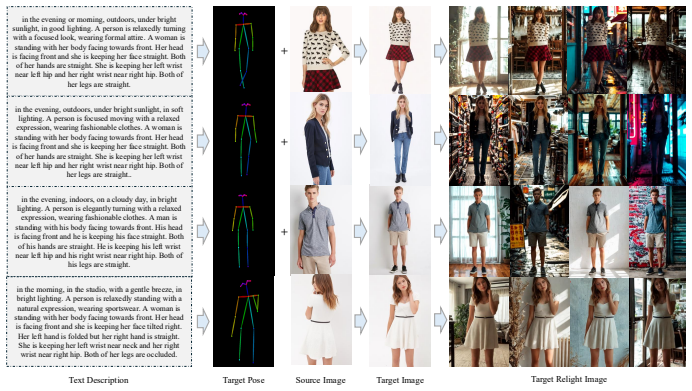
The load-bearing object is the text-to-pose (T2P) transformer: a CLIP-initialized, six-layer, eight-head transformer decoder that maps a frozen CLIP text embedding to 18 COCO keypoints with visibility, trained with coordinate, visibility, invisible-joint, skeleton-consistency, and bidirectional contrastive losses. The predicted keypoints form heatmaps that are concatenated with source-pose heatmaps and injected at every UNet scale of the pose-to-image diffusion stage, which also uses DINO-v2 appearance tokens, an autoregressive prior over target tokens, and a face-and-hair mask that anchors identity. The final stage is the pretrained IC-Light relighting module, which applies prompt-conditioned global illumination. The supporting data object is PoseCap, over 40,000 caption–keypoint pairs built from DeepFashion images, with captions generated by a vision-language model and keypoints by OpenPose.
What would settle it
Take a random subset of DF-PASS test images, obtain human-annotated keypoints, and recompute PCKh@0.5 and MPJPE for FashionPose and the baselines; if the margin over ControlNet and TIPS collapses under human labels, the central claim of state-of-the-art text-to-pose accuracy is not supported.
Extended reading notes
Core claim
The central claim is that explicit pose annotations can be replaced by text as the single conditioning signal that controls geometry, appearance, and illumination in person-image generation. FashionPose implements this as a three-stage pipeline: a CLIP-initialized transformer decoder with a bidirectional contrastive loss translates a caption into 18 COCO 2D keypoints and visibility logits; a diffusion UNet, conditioned on target-pose heatmaps, DINO-v2 appearance tokens, and a face-and-hair identity mask, synthesizes the pose-aligned person; and the pretrained IC-Light relighter applies prompt-consistent global illumination. The paper reports that on DF-PASS, using captions alone, FashionPose reaches PCKh@0.5 of 0.938, MPJPE of 44.43 px, and visibility mAP of 0.987, compared with 0.808, 86.68 px, 0.800 for ControlNet and 0.598, 68.20 px, 0.801 for TIPS.
Load-bearing premise
The headline pose-accuracy numbers presuppose that the DF-PASS benchmark's keypoints are an independent, accurate measure of pose, yet the paper never describes their annotation source.
Editorial extensions
If this is right
- If the reported numbers hold, a single caption suffices to control pose, garment fidelity, and lighting, removing the need for users to supply 2D skeletons or lighting setups.
- The contrastive text–pose alignment could transfer to other pose-guided synthesis tasks, such as virtual try-on and character animation, where caption-level control is desirable.
- The visibility head's high mAP (0.987) suggests the framework can reason about self-occlusion, which is useful for completing occluded garments rather than hallucinating limbs.
- Because the pipeline is driven by one prompt, lighting and pose can be edited jointly by editing the caption, enabling iterative preview without retraining.
- The released PoseCap dataset may become a standard supervision source for text-to-pose and text-driven person synthesis research.
Reading between the lines
- We note that the paper never describes how DF-PASS ground-truth keypoints were annotated; if they come from an automatic estimator related to OpenPose, the reported PCKh and MPJPE margins may partly measure agreement with that estimator's conventions rather than absolute pose understanding.
- The skeleton-consistency loss assumes 2D bone lengths are pose-invariant, which is only approximately true under perspective foreshortening; a testable extension would be to weight the term with per-joint depth confidence or to use 3D bone priors.
- A plausible next step the authors do not explore is using the same text-to-pose head to condition video generation, where per-frame captions could produce temporally coherent pose sequences from one description.
- The relighting stage inherits IC-Light's global single-source illumination assumption, so extending the pipeline to multi-light or directional flash scenes would require replacing the final module rather than the text-to-pose core.
Editorial analysis
A structured set of objections, weighed in public.
Referee Report
Summary. The paper introduces FashionPose, a three-stage pipeline that takes a natural-language caption, generates 2D human pose keypoints via a CLIP-initialized transformer, synthesizes a pose-aligned person image with a diffusion model, and finally relights the result with the pretrained IC-Light module. The authors also introduce PoseCap, a dataset of caption-keypoint pairs derived from DeepFashion, and report quantitative pose-generation results on the DF-PASS benchmark along with qualitative image-synthesis and relighting results. The central claim is that a single text prompt can simultaneously control pose, garment rendering, and lighting, and that the proposed text-to-pose module substantially outperforms existing text-only pose-generation baselines on DF-PASS.
Significance. If the claims were substantiated, the paper would offer a practically useful formulation for fashion e-commerce: unifying text-to-pose, pose-to-image, and relighting in one pipeline, and releasing a new caption-keypoint dataset. The paper gives credit for proposing this task combination, for the planned public release of PoseCap, and for reporting a fairly extensive one-factor-at-a-time hyperparameter study and component ablation. However, the quantitative evidence for the central claim is undermined by internal inconsistencies in the reported numbers, by the absence of any defined configuration for the headline result, and by an unresolved question about the independence of the evaluation keypoints from the OpenPose supervision used in training. These issues prevent the reader from assessing whether the claimed state-of-the-art pose accuracy is real, despite the qualitative promise of the approach.
major comments (6)
- [Section 4.2, Table 1 vs Section 4.6, Table 3] The headline result in Table 1 reports FashionPose MPJPE of 44.43 px on DF-PASS, but Section 4.6/Table 3 reports that the full model with all components achieves MPJPE of 22.65 px, and Table 2 lists default-adjacent configurations with MPJPE around 39-40 px. The paper never states which hyperparameter setting, data split, or metric protocol produced Table 1, so the claimed advantage over ControlNet (86.68 px) and TIPS (68.20 px) cannot be attributed to a single, reproducible system; the abstract's claim of 'accurate pose alignment' rests on these numbers, and the internal inconsistency makes the reported margin untrustworthy.
- [Section 3.1 vs Section 4.3] The final loss weights in Section 3.1 are stated as λ_inv = 0.50 and λ_con = 0.10, while Section 4.3 states that λ_inv = 0.25 and λ_con = 0.05 jointly minimize MPJPE. The paper does not identify which configuration was used for Table 1, Table 2, or Table 3, so the reported results are not tied to a well-defined objective function, and the reader cannot reproduce the experiments from the given equations.
- [Sections 4.1(e) and 4.2] The text-to-pose model is trained on keypoints produced by OpenPose (Section 4.1, step e), while the DF-PASS evaluation (Section 4.2) uses benchmark keypoints whose annotation provenance is never described. If the DF-PASS keypoints were produced by the same or a correlated automatic pose estimator, the reported PCKh and MPJPE would partly measure agreement with that estimator's bias rather than true pose understanding. The paper must establish that the DF-PASS ground truth is independent of the OpenPose supervision used in training before the quantitative pose-accuracy claim can be accepted.
- [Section 3.1, Eq. (4)] The skeleton-consistency loss in Eq. (4) assumes that 2D bone lengths are invariant to pose, but perspective projection foreshortens limbs as a function of viewpoint and articulation, so the same 3D bone can project to different 2D lengths. This assumption can penalize physically valid poses and bias the learned pose distribution; the paper provides no justification, no analysis of how often the assumption is violated on the training data, and no sensitivity test that removes this loss.
- [Sections 4.2-4.6] No error bars, confidence intervals, or multiple-seed results are reported for any of the quantitative comparisons, and the NeurIPS checklist justifies this by asserting that the results are 'stable' without providing evidence. Given that the margins in Table 1 are large (e.g., PCKh 0.938 vs 0.808) but the tables also show that small hyperparameter changes swing MPJPE by 10-20 px (e.g., Table 2, Dropout_p = 0.20), the reader cannot determine whether the headline difference is statistically meaningful or an artifact of a particular configuration.
- [Sections 4.1 and 4.2] The relationship between PoseCap and DF-PASS is not described: PoseCap is constructed from DeepFashion images, and DF-PASS is described as having 40,488 captioned images, while PoseCap is said to contain 'over 40k' pairs. If the same or overlapping images are used for training and evaluation, the benchmark results could be optimistically biased; the paper should clarify the exact split and whether any PoseCap samples appear in the DF-PASS test set.
minor comments (5)
- [Section 4.2] The paper uses PCKh@0.5, PCK@0.10, and PCK@0.05 without defining the normalization for each metric, and MPJPE is reported in pixels without specifying whether it is computed only on visible joints, on all 18 joints, or after any image-resolution normalization; these definitions are necessary to interpret the tables.
- [Section 4.5] The relighting evaluation is purely qualitative and uses only five prompts; at least one quantitative metric (e.g., a lighting-direction consistency score or a small user study) would support the claim of 'flexible lighting control' and 'consistent relighting.'
- [Section 3.2] The diffusion formulation is incomplete: the noise schedule {α_t} is 'omitted for brevity', the definition of x_T in Eq. (7) is unclear ('T = 400 is the initial diffusion step'), and the DDIM sampling uses 50 steps; please provide the exact schedule and state how the face-and-hair mask M is computed from the source image or pose.
- [Figure 2(b) and Section 3.2] The block diagram and the text describing the pose-to-image stage are hard to follow because of missing punctuation and undefined terms such as 'ResNet Block Transformer Block' and 'CLIP+ Timestep CLIP+'; please redraw the figure with clear labels and expand the caption to define each block.
- [Section 4.1] The paper says PoseCap stores only caption-keypoint tuples and not raw pixels, but it does not state the license or terms for the derived dataset beyond a later checklist reply mentioning 'CC-BY 4.0'; please clarify which asset the license applies to, since DeepFashion's own license restrictions would also apply to the derived annotations.
Circularity Check
No circularity found: FashionPose's pose generator is trained and evaluated on external keypoint supervision, and no fitted parameter is renamed as a prediction.
full rationale
I walked the derivation chain and found no step that reduces to its own inputs by construction. The text-to-pose model is supervised by OpenPose keypoints from PoseCap (Section 4.1e) and evaluated on the independent DF-PASS benchmark (Section 4.2). The paper does not state that DF-PASS ground-truth keypoints are produced by the same OpenPose pipeline, so the concern about self-agreement is a provenance hypothesis, not a demonstrated circular reduction. Each loss term in Eqs. 1-6 supervises predictions against ground-truth keypoints; no loss is defined in terms of the headline evaluation metrics, and no hyperparameter is fitted to the DF-PASS numbers that are then reported as predictions. The skeleton-consistency loss (Eq. 4) assumes 2D bone lengths are pose-invariant, which is physically questionable under perspective foreshortening, but this is an incorrect prior, not circular reasoning. The inconsistencies between Table 1 (MPJPE 44.43) and Table 3 (MPJPE 22.65), and between loss weights in Section 3.1 and Section 4.3, are serious reproducibility and correctness concerns, not definitional circularity. There is no load-bearing self-citation chain or author-imported uniqueness theorem; cited prior works are external. The honest verdict is no significant circularity, with the caveat that DF-PASS annotation provenance and the Table 1 configuration should be disclosed for full verification.
Assumptions & free parameters
free parameters (7)
- lambda_inv, lambda_skel, lambda_con (loss weights) =
0.50, 0.10, 0.10 (contested by Sec. 4.3)
- InfoNCE temperature tau =
0.07
- Classifier-free guidance weight gamma =
1.5
- Identity loss weight lambda_id =
1e-2
- Pose-feature alignment weight =
0.05
- Diffusion schedule T and DDIM steps =
T=400; 50 steps
- Stage-2 architecture choices (prior, UNet, blob sigma) =
not specified
assumptions (6)
- domain assumption Frozen CLIP text embeddings capture pose-relevant semantics
- domain assumption 2D bone lengths are invariant to pose
- domain assumption OpenPose keypoints are reliable supervision
- domain assumption Qwen-VL captions accurately describe pose
- domain assumption IC-Light transfers to fashion images without fine-tuning
- domain assumption DF-PASS is an independent and reliable benchmark
Cite this review
Pith. "Pith review of FashionPose: Text to Pose to Relight Image Generation for Personalized Fashion Visualization." pith.science (2026). https://pith.science/paper/2BVUFD6Z
@misc{pith2026250713311,
  author       = {Pith},
  title        = {Pith review of: FashionPose: Text to Pose to Relight Image Generation for Personalized Fashion Visualization},
  year         = {2026},
  howpublished = {\url{https://pith.science/paper/2BVUFD6Z}},
  note         = {Machine review of arXiv:2507.13311}
}
read the original abstract
Realistic and controllable garment visualization is critical for fashion e-commerce, where users expect personalized previews under diverse poses and lighting conditions. Existing methods often rely on predefined poses, limiting semantic flexibility and illumination adaptability. To address this, we introduce FashionPose, the first unified text-to-pose-to-relighting generation framework. Given a natural language description, our method first predicts a 2D human pose, then employs a diffusion model to generate high-fidelity person images, and finally applies a lightweight relighting module, all guided by the same textual input. By replacing explicit pose annotations with text-driven conditioning, FashionPose enables accurate pose alignment, faithful garment rendering, and flexible lighting control. Experiments demonstrate fine-grained pose synthesis and efficient, consistent relighting, providing a practical solution for personalized virtual fashion display.
Figures


Figures from the paper (2 more)


Reference graph
Works this paper leans on
-
[1]
Flamingo: a visual language model for few-shot learning
Jean-Baptiste Alayrac, Jeff Donahue, Pauline Luc, Antoine Miech, Iain Barr, Yana Hasson, Karel Lenc, Arthur Mensch, Katherine Millican, Malcolm Reynolds, et al. Flamingo: a visual language model for few-shot learning. Advances in neural information processing systems, 35:23716–23736, 2022
2022
-
[2]
Monocular 3d pose estimation and tracking by detection
Mykhaylo Andriluka, Stefan Roth, and Bernt Schiele. Monocular 3d pose estimation and tracking by detection. In 2010 IEEE Computer Society Conference on Computer Vision and Pattern Recognition, pages 623–630. Ieee, 2010
2010
-
[3]
Jimmy Lei Ba, Jamie Ryan Kiros, and Geoffrey E Hinton. Layer normalization. arXiv preprint arXiv:1607.06450, 2016
arXiv 2016
-
[4]
Qwen-vl: A versatile vision-language model for understanding, localization, text reading, and beyond, 2023
Jinze Bai, Shuai Bai, Shusheng Yang, Shijie Wang, Sinan Tan, Peng Wang, Junyang Lin, Chang Zhou, and Jingren Zhou. Qwen-vl: A versatile vision-language model for understanding, localization, text reading, and beyond, 2023
2023
-
[5]
Gen- erative neural articulated radiance fields
Alexander Bergman, Petr Kellnhofer, Wang Yifan, Eric Chan, David Lindell, and Gordon Wetzstein. Gen- erative neural articulated radiance fields. Advances in Neural Information Processing Systems, 35:19900– 19916, 2022
2022
-
[6]
Genlit: Reformulating single-image relighting as video generation
Shrisha Bharadwaj, Haiwen Feng, Victoria Abrevaya, and Michael J Black. Genlit: Reformulating single-image relighting as video generation. arXiv preprint arXiv:2412.11224, 2024
arXiv 2024
-
[7]
Person image synthesis via denoising diffusion model
Ankan Kumar Bhunia, Salman Khan, Hisham Cholakkal, Rao Muhammad Anwer, Jorma Laaksonen, Mubarak Shah, and Fahad Shahbaz Khan. Person image synthesis via denoising diffusion model. In Proceedings of the IEEE/CVF conference on computer vision and pattern recognition, pages 5968–5976, 2023
2023
-
[8]
Openpose: Realtime multi- person 2d pose estimation using part affinity fields
Zhe Cao, Gines Hidalgo, Tomas Simon, Shih-En Wei, and Yaser Sheikh. Openpose: Realtime multi- person 2d pose estimation using part affinity fields. IEEE transactions on pattern analysis and machine intelligence, 43(1):172–186, 2019
2019
Show all 102 references
-
[9]
Synthlight: Portrait relighting with diffusion model by learning to re-render synthetic faces
Sumit Chaturvedi, Mengwei Ren, Yannick Hold-Geoffroy, Jingyuan Liu, Julie Dorsey, and Zhixin Shu. Synthlight: Portrait relighting with diffusion model by learning to re-render synthetic faces. arXiv preprint arXiv:2501.09756, 2025
2025 arXiv
-
[10]
Consistent diffusion models: Mitigating sampling drift by learning to be consistent
Giannis Daras, Yuval Dagan, Alex Dimakis, and Constantinos Daskalakis. Consistent diffusion models: Mitigating sampling drift by learning to be consistent. Advances in Neural Information Processing Systems, 36:42038–42063, 2023
2023
-
[11]
Posescript: 3d human poses from natural language
Ginger Delmas, Philippe Weinzaepfel, Thomas Lucas, Francesc Moreno-Noguer, and Grégory Rogez. Posescript: 3d human poses from natural language. In European Conference on Computer Vision, pages 346–362. Springer, 2022
2022
-
[12]
Diffusion models beat gans on image synthesis
Prafulla Dhariwal and Alexander Nichol. Diffusion models beat gans on image synthesis. Advances in neural information processing systems, 34:8780–8794, 2021
2021
-
[13]
Soft-gated warping-gan for pose-guided person image synthesis
Haoye Dong, Xiaodan Liang, Ke Gong, Hanjiang Lai, Jia Zhu, and Jian Yin. Soft-gated warping-gan for pose-guided person image synthesis. Advances in neural information processing systems, 31, 2018
2018
-
[14]
An image is worth 16x16 words: Transformers for image recognition at scale
Alexey Dosovitskiy, Lucas Beyer, Alexander Kolesnikov, Dirk Weissenborn, Xiaohua Zhai, Thomas Unterthiner, Mostafa Dehghani, Matthias Minderer, Georg Heigold, Sylvain Gelly, et al. An image is worth 16x16 words: Transformers for image recognition at scale. arXiv preprint arXiv...
2010 arXiv
-
[15]
Diffusion self-guidance for controllable image generation
Dave Epstein, Allan Jabri, Ben Poole, Alexei Efros, and Aleksander Holynski. Diffusion self-guidance for controllable image generation. Advances in Neural Information Processing Systems, 36:16222–16239, 2023. 10
2023
-
[16]
Exploring warping-guided features via adaptive latent diffusion model for virtual try-on
Bo Gao, Junchi Ren, Fei Shen, Mengwan Wei, and Zijun Huang. Exploring warping-guided features via adaptive latent diffusion model for virtual try-on. In 2024 IEEE International Conference on Multimedia and Expo (ICME), pages 1–6. IEEE, 2024
2024
-
[17]
Fd-gan: Pose-guided feature distilling gan for robust person re-identification.Advances in neural information processing systems, 31, 2018
Yixiao Ge, Zhuowan Li, Haiyu Zhao, Guojun Yin, Shuai Yi, Xiaogang Wang, et al. Fd-gan: Pose-guided feature distilling gan for robust person re-identification.Advances in neural information processing systems, 31, 2018
2018
-
[18]
Yolox: Exceeding yolo series in 2021
Zheng Ge, Songtao Liu, Feng Wang, Zeming Li, and Jian Sun. Yolox: Exceeding yolo series in 2021. arXiv preprint arXiv:2107.08430, 2021
2021 arXiv
-
[19]
Generative adversarial networks.Communications of the ACM, 63(11):139– 144, 2020
Ian Goodfellow, Jean Pouget-Abadie, Mehdi Mirza, Bing Xu, David Warde-Farley, Sherjil Ozair, Aaron Courville, and Yoshua Bengio. Generative adversarial networks.Communications of the ACM, 63(11):139– 144, 2020
2020
-
[20]
Ganspace: Discovering interpretable gan controls
Erik Härkönen, Aaron Hertzmann, Jaakko Lehtinen, and Sylvain Paris. Ganspace: Discovering interpretable gan controls. Advances in neural information processing systems, 33:9841–9850, 2020
2020
-
[21]
Autolink: Self-supervised learning of human skeletons and object outlines by linking keypoints.Advances in Neural Information Processing Systems, 35:36123–36141, 2022
Xingzhe He, Bastian Wandt, and Helge Rhodin. Autolink: Self-supervised learning of human skeletons and object outlines by linking keypoints.Advances in Neural Information Processing Systems, 35:36123–36141, 2022
2022
-
[22]
Gaussian error linear units (gelus)
Dan Hendrycks and Kevin Gimpel. Gaussian error linear units (gelus). arXiv preprint arXiv:1606.08415, 2016
2016 arXiv
-
[23]
Denoising diffusion probabilistic models
Jonathan Ho, Ajay Jain, and Pieter Abbeel. Denoising diffusion probabilistic models. Advances in neural information processing systems, 33:6840–6851, 2020
2020
-
[24]
Video diffusion models
Jonathan Ho, Tim Salimans, Alexey Gritsenko, William Chan, Mohammad Norouzi, and David J Fleet. Video diffusion models. Advances in Neural Information Processing Systems, 35:8633–8646, 2022
2022
-
[25]
Hand-object interaction image generation
Hezhen Hu, Weilun Wang, Wengang Zhou, and Houqiang Li. Hand-object interaction image generation. Advances in Neural Information Processing Systems, 35:23805–23817, 2022
2022
-
[26]
Motiongpt: Human motion as a foreign language
Biao Jiang, Xin Chen, Wen Liu, Jingyi Yu, Gang Yu, and Tao Chen. Motiongpt: Human motion as a foreign language. Advances in Neural Information Processing Systems, 36:20067–20079, 2023
2023
-
[27]
Text2human: Text-driven controllable human image generation
Yuming Jiang, Shuai Yang, Haonan Qiu, Wayne Wu, Chen Change Loy, and Ziwei Liu. Text2human: Text-driven controllable human image generation. ACM Transactions on Graphics (TOG), 41(4):1–11, 2022
2022
-
[28]
Neural gaffer: Relighting any object via diffusion
Haian Jin, Yuan Li, Fujun Luan, Yuanbo Xiangli, Sai Bi, Kai Zhang, Zexiang Xu, Jin Sun, and Noah Snavely. Neural gaffer: Relighting any object via diffusion. In The Thirty-eighth Annual Conference on Neural Information Processing Systems, 2024
2024
-
[29]
Act as you wish: Fine-grained control of motion diffusion model with hierarchical semantic graphs
Peng Jin, Yang Wu, Yanbo Fan, Zhongqian Sun, Wei Yang, and Li Yuan. Act as you wish: Fine-grained control of motion diffusion model with hierarchical semantic graphs. Advances in Neural Information Processing Systems, 36:15497–15518, 2023
2023
-
[30]
Latent diffusion for neural spiking data
Jaivardhan Kapoor, Auguste Schulz, Julius Vetter, Felix Pei, Richard Gao, and Jakob H Macke. Latent diffusion for neural spiking data. Advances in Neural Information Processing Systems, 37:118119–118154, 2024
2024
-
[31]
Elucidating the design space of diffusion-based generative models
Tero Karras, Miika Aittala, Timo Aila, and Samuli Laine. Elucidating the design space of diffusion-based generative models. Advances in neural information processing systems, 35:26565–26577, 2022
2022
-
[32]
Reposedm: Recurrent pose alignment and gradient guidance for pose guided image synthesis
Anant Khandelwal. Reposedm: Recurrent pose alignment and gradient guidance for pose guided image synthesis. In Proceedings of the IEEE/CVF Conference on Computer Vision and Pattern Recognition , pages 2495–2504, 2024
2024
-
[33]
Adam: A method for stochastic optimization
Diederik P Kingma and Jimmy Ba. Adam: A method for stochastic optimization. arXiv preprint arXiv:1412.6980, 2014
2014 arXiv
-
[34]
Blip-diffusion: Pre-trained subject representation for controllable text-to-image generation and editing
Dongxu Li, Junnan Li, and Steven Hoi. Blip-diffusion: Pre-trained subject representation for controllable text-to-image generation and editing. Advances in Neural Information Processing Systems, 36:30146– 30166, 2023
2023
-
[35]
Efficient spatially sparse inference for conditional gans and diffusion models
Muyang Li, Ji Lin, Chenlin Meng, Stefano Ermon, Song Han, and Jun-Yan Zhu. Efficient spatially sparse inference for conditional gans and diffusion models. Advances in neural information processing systems, 35:28858–28873, 2022. 11
2022
-
[36]
Dense intrinsic appearance flow for human pose transfer
Yining Li, Chen Huang, and Chen Change Loy. Dense intrinsic appearance flow for human pose transfer. In Proceedings of the IEEE/CVF conference on computer vision and pattern recognition, pages 3693–3702, 2019
2019
-
[37]
Test-time personalization with a transformer for human pose estimation
Yizhuo Li, Miao Hao, Zonglin Di, Nitesh Bharadwaj Gundavarapu, and Xiaolong Wang. Test-time personalization with a transformer for human pose estimation. Advances in Neural Information Processing Systems, 34:2583–2597, 2021
2021
-
[38]
Posegan: A pose-to-image translation framework for camera localization
Kanglin Liu, Qing Li, and Guoping Qiu. Posegan: A pose-to-image translation framework for camera localization. ISPRS Journal of Photogrammetry and Remote Sensing, 166:308–315, 2020
2020
-
[39]
Deepfashion: Powering robust clothes recognition and retrieval with rich annotations
Ziwei Liu, Ping Luo, Shi Qiu, Xiaogang Wang, and Xiaoou Tang. Deepfashion: Powering robust clothes recognition and retrieval with rich annotations. In Proceedings of IEEE Conference on Computer Vision and Pattern Recognition (CVPR), 2016
2016
-
[40]
Sgdr: Stochastic gradient descent with warm restarts
Ilya Loshchilov and Frank Hutter. Sgdr: Stochastic gradient descent with warm restarts. arXiv preprint arXiv:1608.03983, 2016
2016 arXiv
-
[41]
Decoupled weight decay regularization
Ilya Loshchilov and Frank Hutter. Decoupled weight decay regularization. arXiv preprint arXiv:1711.05101, 2017
2017 arXiv
-
[42]
Dposer: Diffusion model as robust 3d human pose prior
Junzhe Lu, Jing Lin, Hongkun Dou, Ailing Zeng, Yue Deng, Yulun Zhang, and Haoqian Wang. Dposer: Diffusion model as robust 3d human pose prior. arXiv preprint arXiv:2312.05541, 2023
2023 arXiv
-
[43]
Coarse-to-fine latent diffusion for pose-guided person image synthesis
Yanzuo Lu, Manlin Zhang, Andy J Ma, Xiaohua Xie, and Jianhuang Lai. Coarse-to-fine latent diffusion for pose-guided person image synthesis. In Proceedings of the IEEE/CVF Conference on Computer Vision and Pattern Recognition, pages 6420–6429, 2024
2024
-
[44]
Pose guided person image generation
Liqian Ma, Xu Jia, Qianru Sun, Bernt Schiele, Tinne Tuytelaars, and Luc Van Gool. Pose guided person image generation. Advances in neural information processing systems, 30, 2017
2017
-
[45]
A simple yet effective baseline for 3d human pose estimation
Julieta Martinez, Rayat Hossain, Javier Romero, and James J Little. A simple yet effective baseline for 3d human pose estimation. In Proceedings of the IEEE international conference on computer vision, pages 2640–2649, 2017
2017
-
[46]
Controllable person image synthesis with attribute-decomposed gan
Yifang Men, Yiming Mao, Yuning Jiang, Wei-Ying Ma, and Zhouhui Lian. Controllable person image synthesis with attribute-decomposed gan. In Proceedings of the IEEE/CVF conference on computer vision and pattern recognition, pages 5084–5093, 2020
2020
-
[47]
Qc-stylegan-quality controllable image generation and manipulation
Dat Viet Thanh Nguyen, Tan M Dinh, Cuong Pham, Anh Tran, et al. Qc-stylegan-quality controllable image generation and manipulation. Advances in Neural Information Processing Systems, 35:18850–18863, 2022
2022
-
[48]
Diffbody: Diffusion-based pose and shape editing of human images
Yuta Okuyama, Yuki Endo, and Yoshihiro Kanamori. Diffbody: Diffusion-based pose and shape editing of human images. In Proceedings of the IEEE/CVF Winter Conference on Applications of Computer Vision, pages 6333–6342, 2024
2024
-
[49]
Dinov2: Learning robust visual features without supervision
Maxime Oquab, Timothée Darcet, Théo Moutakanni, Huy V o, Marc Szafraniec, Vasil Khalidov, Pierre Fernandez, Daniel Haziza, Francisco Massa, Alaaeldin El-Nouby, et al. Dinov2: Learning robust visual features without supervision. arXiv preprint arXiv:2304.07193, 2023
2023 arXiv
-
[50]
Temos: Generating diverse human motions from textual descriptions
Mathis Petrovich, Michael J Black, and Gül Varol. Temos: Generating diverse human motions from textual descriptions. In European Conference on Computer Vision, pages 480–497. Springer, 2022
2022
-
[51]
Learning transferable visual models from natural language supervision
Alec Radford, Jong Wook Kim, Chris Hallacy, Aditya Ramesh, Gabriel Goh, Sandhini Agarwal, Girish Sastry, Amanda Askell, Pamela Mishkin, Jack Clark, et al. Learning transferable visual models from natural language supervision. In International conference on machine learning, pa...
2021
-
[52]
Neural texture extraction and distribution for controllable person image synthesis
Yurui Ren, Xiaoqing Fan, Ge Li, Shan Liu, and Thomas H Li. Neural texture extraction and distribution for controllable person image synthesis. In Proceedings of the IEEE/CVF conference on computer vision and pattern recognition, pages 13535–13544, 2022
2022
-
[53]
Deep image spatial transformation for person image generation
Yurui Ren, Xiaoming Yu, Junming Chen, Thomas H Li, and Ge Li. Deep image spatial transformation for person image generation. In Proceedings of the IEEE/CVF conference on computer vision and pattern recognition, pages 7690–7699, 2020
2020
-
[54]
High-resolution image synthesis with latent diffusion models
Robin Rombach, Andreas Blattmann, Dominik Lorenz, Patrick Esser, and Björn Ommer. High-resolution image synthesis with latent diffusion models. In Proceedings of the IEEE/CVF conference on computer vision and pattern recognition, pages 10684–10695, 2022. 12
2022
-
[55]
Tips: Text-induced pose synthesis
Prasun Roy, Subhankar Ghosh, Saumik Bhattacharya, Umapada Pal, and Michael Blumenstein. Tips: Text-induced pose synthesis. In The European Conference on Computer Vision (ECCV), October 2022
2022
-
[56]
Nerf for outdoor scene relighting
Viktor Rudnev, Mohamed Elgharib, William Smith, Lingjie Liu, Vladislav Golyanik, and Christian Theobalt. Nerf for outdoor scene relighting. In European Conference on Computer Vision, pages 615–631. Springer, 2022
2022
-
[57]
Modec: Multimodal decomposable models for human pose estimation
Ben Sapp and Ben Taskar. Modec: Multimodal decomposable models for human pose estimation. In Proceedings of the IEEE conference on computer vision and pattern recognition, pages 3674–3681, 2013
2013
-
[58]
Imagdressing-v1: Customizable virtual dressing
Fei Shen, Xin Jiang, Xin He, Hu Ye, Cong Wang, Xiaoyu Du, Zechao Li, and Jinhui Tang. Imagdressing-v1: Customizable virtual dressing. In Proceedings of the AAAI Conference on Artificial Intelligence, volume 39, pages 6795–6804, 2025
2025
-
[59]
Imagpose: A unified conditional framework for pose-guided person generation
Fei Shen and Jinhui Tang. Imagpose: A unified conditional framework for pose-guided person generation. Advances in neural information processing systems, 37:6246–6266, 2024
2024
-
[60]
Long-term talkingface generation via motion-prior conditional diffusion model
Fei Shen, Cong Wang, Junyao Gao, Qin Guo, Jisheng Dang, Jinhui Tang, and Tat-Seng Chua. Long-term talkingface generation via motion-prior conditional diffusion model. arXiv preprint arXiv:2502.09533, 2025
2025 arXiv
-
[61]
Boosting consistency in story visualization with rich-contextual conditional diffusion models
Fei Shen, Hu Ye, Sibo Liu, Jun Zhang, Cong Wang, Xiao Han, and Yang Wei. Boosting consistency in story visualization with rich-contextual conditional diffusion models. In Proceedings of the AAAI Conference on Artificial Intelligence, volume 39, pages 6785–6794, 2025
2025
-
[62]
Advancing pose-guided image synthesis with progressive conditional diffusion models
Fei Shen, Hu Ye, Jun Zhang, Cong Wang, Xiao Han, and Wei Yang. Advancing pose-guided image synthesis with progressive conditional diffusion models. In International Conference on Learning Representations (ICLR), 2024
2024
-
[63]
Imaggarment-1: Fine-grained garment generation for controllable fashion design
Fei Shen, Jian Yu, Cong Wang, Xin Jiang, Xiaoyu Du, and Jinhui Tang. Imaggarment-1: Fine-grained garment generation for controllable fashion design. arXiv preprint arXiv:2504.13176, 2025
2025 arXiv
-
[64]
Deformable gans for pose- based human image generation
Aliaksandr Siarohin, Enver Sangineto, Stéphane Lathuiliere, and Nicu Sebe. Deformable gans for pose- based human image generation. In Proceedings of the IEEE conference on computer vision and pattern recognition, pages 3408–3416, 2018
2018
-
[65]
Denoising diffusion implicit models
Jiaming Song, Chenlin Meng, and Stefano Ermon. Denoising diffusion implicit models. arXiv preprint arXiv:2010.02502, 2020
2010 arXiv
-
[66]
Unsupervised person image generation with semantic parsing transformation
Sijie Song, Wei Zhang, Jiaying Liu, and Tao Mei. Unsupervised person image generation with semantic parsing transformation. In Proceedings of the IEEE/CVF conference on computer vision and pattern recognition, pages 2357–2366, 2019
2019
-
[67]
Dropout: a simple way to prevent neural networks from overfitting
Nitish Srivastava, Geoffrey Hinton, Alex Krizhevsky, Ilya Sutskever, and Ruslan Salakhutdinov. Dropout: a simple way to prevent neural networks from overfitting. The journal of machine learning research , 15(1):1929–1958, 2014
1929
-
[68]
Visual autoregressive modeling: Scalable image generation via next-scale prediction
Keyu Tian, Yi Jiang, Zehuan Yuan, Bingyue Peng, and Liwei Wang. Visual autoregressive modeling: Scalable image generation via next-scale prediction. Advances in neural information processing systems, 37:84839–84865, 2024
2024
-
[69]
Attention is all you need
Ashish Vaswani, Noam Shazeer, Niki Parmar, Jakob Uszkoreit, Llion Jones, Aidan N Gomez, Łukasz Kaiser, and Illia Polosukhin. Attention is all you need. Advances in neural information processing systems, 30, 2017
2017
-
[70]
Ensembling diffusion models via adaptive feature aggregation
Cong Wang, Kuan Tian, Yonghang Guan, Jun Zhang, Zhiwei Jiang, Fei Shen, Xiao Han, Qing Gu, and Wei Yang. Ensembling diffusion models via adaptive feature aggregation. arXiv preprint arXiv:2405.17082, 2024
2024 arXiv
-
[71]
V-express: Conditional dropout for progressive training of portrait video generation
Cong Wang, Kuan Tian, Jun Zhang, Yonghang Guan, Feng Luo, Fei Shen, Zhiwei Jiang, Qing Gu, Xiao Han, and Wei Yang. V-express: Conditional dropout for progressive training of portrait video generation. arXiv preprint arXiv:2406.02511, 2024
2024 arXiv
-
[72]
Stable- pose: Leveraging transformers for pose-guided text-to-image generation
Jiajun Wang, Morteza Ghahremani Boozandani, Yitong Li, Björn Ommer, and Christian Wachinger. Stable- pose: Leveraging transformers for pose-guided text-to-image generation. Advances in Neural Information Processing Systems, 37:65670–65698, 2024
2024
-
[73]
Di 2 pose: Discrete diffusion model for occluded 3d human pose estimation** appendix
Weiquan Wang, Jun Xiao, Chunping Wang, Wei Liu, Zhao Wang, and Long Chen. Di 2 pose: Discrete diffusion model for occluded 3d human pose estimation** appendix. 13
-
[74]
Pose flow: Efficient online pose tracking
Yuliang Xiu, Jiefeng Li, Haoyu Wang, Yinghong Fang, and Cewu Lu. Pose flow: Efficient online pose tracking. arXiv preprint arXiv:1802.00977, 2018
2018 arXiv
-
[75]
Cle diffusion: Controllable light enhancement diffusion model
Yuyang Yin, Dejia Xu, Chuangchuang Tan, Ping Liu, Yao Zhao, and Yunchao Wei. Cle diffusion: Controllable light enhancement diffusion model. In Proceedings of the 31st ACM International Conference on Multimedia, pages 8145–8156, 2023
2023
-
[76]
Constructing non-isotropic gaussian diffusion model using isotropic gaussian diffusion model for image editing
Xi Yu, Xiang Gu, Haozhi Liu, and Jian Sun. Constructing non-isotropic gaussian diffusion model using isotropic gaussian diffusion model for image editing. Advances in Neural Information Processing Systems, 36:76839–76851, 2023
2023
-
[77]
Generating human motion from textual descriptions with discrete representations
Jianrong Zhang, Yangsong Zhang, Xiaodong Cun, Yong Zhang, Hongwei Zhao, Hongtao Lu, Xi Shen, and Ying Shan. Generating human motion from textual descriptions with discrete representations. In Proceedings of the IEEE/CVF conference on computer vision and pattern recognition, pa...
2023
-
[78]
Pise: Person image synthesis and editing with decoupled gan
Jinsong Zhang, Kun Li, Yu-Kun Lai, and Jingyu Yang. Pise: Person image synthesis and editing with decoupled gan. In Proceedings of the IEEE/CVF conference on computer vision and pattern recognition, pages 7982–7990, 2021
2021
-
[79]
Adding conditional control to text-to-image diffusion models, 2023
Lvmin Zhang, Anyi Rao, and Maneesh Agrawala. Adding conditional control to text-to-image diffusion models, 2023
2023
-
[80]
Scaling in-the-wild training for diffusion-based illumi- nation harmonization and editing by imposing consistent light transport
Lvmin Zhang, Anyi Rao, and Maneesh Agrawala. Scaling in-the-wild training for diffusion-based illumi- nation harmonization and editing by imposing consistent light transport. In The Thirteenth International Conference on Learning Representations, 2025
2025
-
[81]
Motiondiffuse: Text-driven human motion generation with diffusion model
Mingyuan Zhang, Zhongang Cai, Liang Pan, Fangzhou Hong, Xinying Guo, Lei Yang, and Ziwei Liu. Motiondiffuse: Text-driven human motion generation with diffusion model. IEEE transactions on pattern analysis and machine intelligence, 46(6):4115–4128, 2024
2024
-
[82]
Exploring dual-task correlation for pose guided person image generation
Pengze Zhang, Lingxiao Yang, Jian-Huang Lai, and Xiaohua Xie. Exploring dual-task correlation for pose guided person image generation. In Proceedings of the IEEE/CVF conference on Computer Vision and Pattern Recognition, pages 7713–7722, 2022
2022
-
[83]
Deep single-image portrait relighting
Hao Zhou, Sunil Hadap, Kalyan Sunkavalli, and David W Jacobs. Deep single-image portrait relighting. In Proceedings of the IEEE/CVF international conference on computer vision, pages 7194–7202, 2019
2019
-
[84]
Cross attention based style distribution for controllable person image synthesis
Xinyue Zhou, Mingyu Yin, Xinyuan Chen, Li Sun, Changxin Gao, and Qingli Li. Cross attention based style distribution for controllable person image synthesis. In European conference on computer vision, pages 161–178. Springer, 2022
2022
-
[85]
Boundary guided learning-free semantic control with diffusion models
Ye Zhu, Yu Wu, Zhiwei Deng, Olga Russakovsky, and Yan Yan. Boundary guided learning-free semantic control with diffusion models. Advances in Neural Information Processing Systems, 36:78319–78346, 2023
2023
-
[86]
Progressive pose attention transfer for person image generation
Zhen Zhu, Tengteng Huang, Baoguang Shi, Miao Yu, Bofei Wang, and Xiang Bai. Progressive pose attention transfer for person image generation. In Proceedings of the IEEE/CVF conference on computer vision and pattern recognition, pages 2347–2356, 2019. 14 NeurIPS Paper Checklist
2019
-
[87]
The concrete position in the abstract will make the introduction
Claims Question: Do the main claims made in the abstract and introduction accurately reflect the paper’s contributions and scope? Answer: [Yes] Justification: Yes, our paper has an accurate description of our contribution and scope. The concrete position in the abstract will m...
-
[88]
Limitations
Limitations Question: Does the paper discuss the limitations of the work performed by the authors? Answer: [Yes] Justification: Yes, we have pointed out what the limitation of our project is. In our Conclu- sion, there is a paragraph that points out the problem in detail. We b...
-
[89]
It is detailed in Methods
Theory assumptions and proofs 15 Question: For each theoretical result, does the paper provide the full set of assumptions and a complete (and correct) proof? Answer: [Yes] Justification: Yes, for each formula, we have described the meaning and effect in detail in the previous...
-
[90]
It is detailed in Methods
Experimental result reproducibility Question: Does the paper fully disclose all the information needed to reproduce the main ex- perimental results of the paper to the extent that it affects the main claims and/or conclusions of the paper (regardless of whether the code and da...
-
[91]
At the same time, the Data set will be published
Open access to data and code Question: Does the paper provide open access to the data and code, with sufficient instruc- tions to faithfully reproduce the main experimental results, as described in supplemental material? Answer: [Yes] Justification: Yes, we will open source ou...
-
[92]
In order for people to achieve better results, we have conducted hyperparameter tests and provided analysis so that people can think about how to improve
Experimental setting/details Question: Does the paper specify all the training and test details (e.g., data splits, hyper- parameters, how they were chosen, type of optimizer, etc.) necessary to understand the results? Answer: [Yes] Justification: Yes, we provide detailed para...
-
[93]
Guidelines: • The answer NA means that the paper does not include experiments
Experiment statistical significance 17 Question: Does the paper report error bars suitably and correctly defined or other appropriate information about the statistical significance of the experiments? Answer: [Yes] Justification: We have conducted several experiments and the r...
-
[94]
Guidelines: • The answer NA means that the paper does not include experiments
Experiments compute resources Question: For each experiment, does the paper provide sufficient information on the com- puter resources (type of compute workers, memory, time of execution) needed to reproduce the experiments? Answer: [Yes] Justification: The Text to Pose part o...
-
[95]
Guidelines: • The answer NA means that the authors have not reviewed the NeurIPS Code of Ethics
Code of ethics Question: Does the research conducted in the paper conform, in every respect, with the NeurIPS Code of Ethics https://neurips.cc/public/EthicsGuidelines? Answer: [Yes] Justification: The research conducted in the paper conform, in every respect, with the NeurIPS...
-
[96]
Guidelines: • The answer NA means that there is no societal impact of the work performed
Broader impacts Question: Does the paper discuss both potential positive societal impacts and negative societal impacts of the work performed? Answer: [Yes] Justification: Yes, we have detailed descriptions of the application scenario of this project in the current society in ...
-
[97]
Safeguards Question: Does the paper describe safeguards that have been put in place for responsible release of data or models that have a high risk for misuse (e.g., pretrained language models, image generators, or scraped datasets)? Answer: [NA] Justification: Guidelines: • T...
-
[98]
Guidelines: • The answer NA means that the paper does not use existing assets
Licenses for existing assets Question: Are the creators or original owners of assets (e.g., code, data, models), used in the paper, properly credited and are the license and terms of use explicitly mentioned and properly respected? 19 Answer: [Yes] Justification: Yes, each of ...
-
[99]
Guidelines: • The answer NA means that the paper does not release new assets
New assets Question: Are new assets introduced in the paper well documented and is the documentation provided alongside the assets? Answer: [Yes] Justification: Yes, there are detailed references to everything we introduced, including the datasets we introduced, the sample ite...
-
[100]
Crowdsourcing and research with human subjects Question: For crowdsourcing experiments and research with human subjects, does the paper include the full text of instructions given to participants and screenshots, if applicable, as well as details about compensation (if any)? A...
-
[101]
• Depending on the country in which research is conducted, IRB approval (or equivalent) may be required for any human subjects research
Institutional review board (IRB) approvals or equivalent for research with human subjects 20 Question: Does the paper describe potential risks incurred by study participants, whether such risks were disclosed to the subjects, and whether Institutional Review Board (IRB) approv...
-
[102]
Declaration of LLM usage Question: Does the paper describe the usage of LLMs if it is an important, original, or non-standard component of the core methods in this research? Note that if the LLM is used only for writing, editing, or formatting purposes and does not impact the ...
2025
Reviewed August 6, 2026 · model on record in the stance chip above.
Discussion (0). Sign in to comment.