The group theory of Raman effect in magnetic materials
Pith reviewed 2026-06-27 15:45 UTC · model grok-4.3
The pith
Onsager reciprocity determines the Raman tensors allowed in every magnetic point group.
A machine-rendered reading of the paper's core claim, the machinery that carries it, and where it could break.
Core claim
Applying Onsager reciprocity directly to the Raman susceptibility tensor in magnetic groups yields the full set of symmetry-allowed Raman tensors for every magnetic point group; the same relation supplies the selection rules through direct-product representations and reveals that the magneto-Raman vector can lie orthogonal to the magnetic moment.
What carries the argument
Onsager reciprocity relation applied to the Raman response tensor, which enforces the symmetry constraints that generate the tensor tables.
Load-bearing premise
Onsager reciprocity can be imposed on the Raman tensor without further restrictions coming from the explicit light-matter Hamiltonian or from higher-order terms in the susceptibility.
What would settle it
Measurement of a Raman mode whose polarization selection rule violates the tensor predicted for the known magnetic point group of the crystal.
Figures
read the original abstract
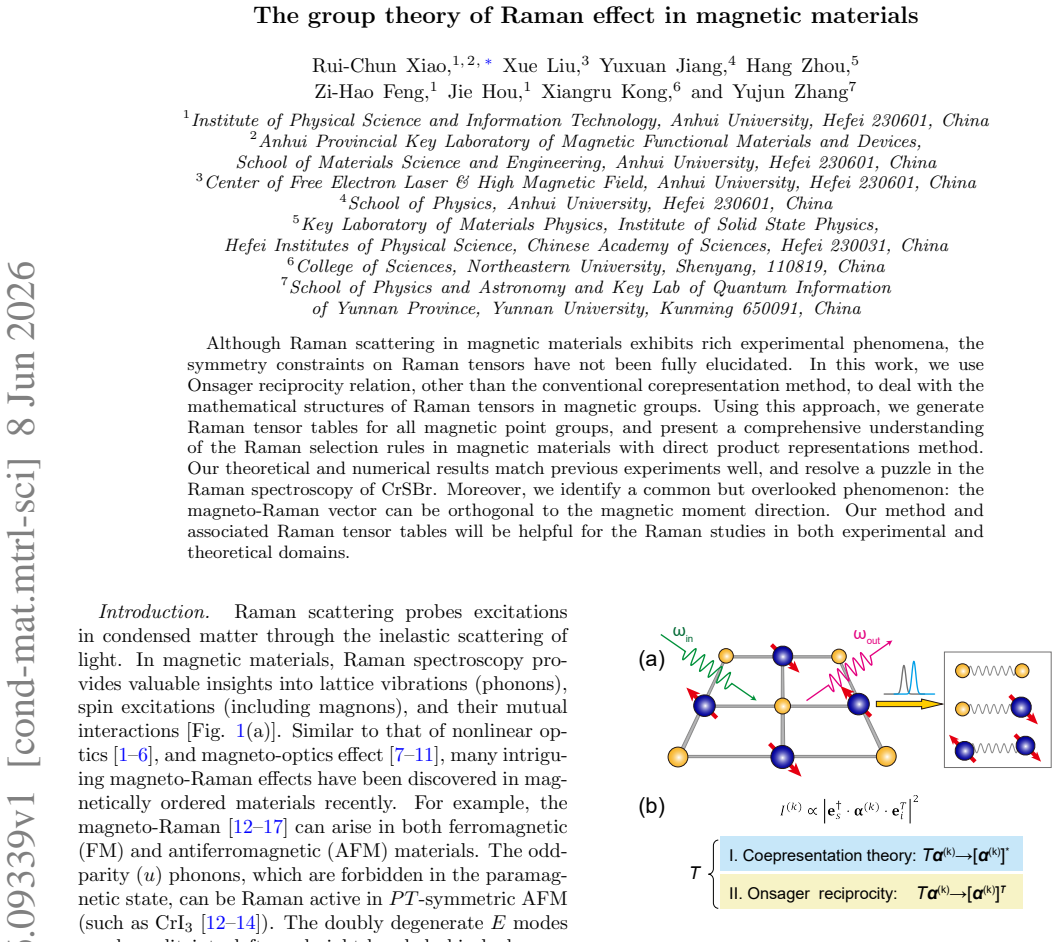
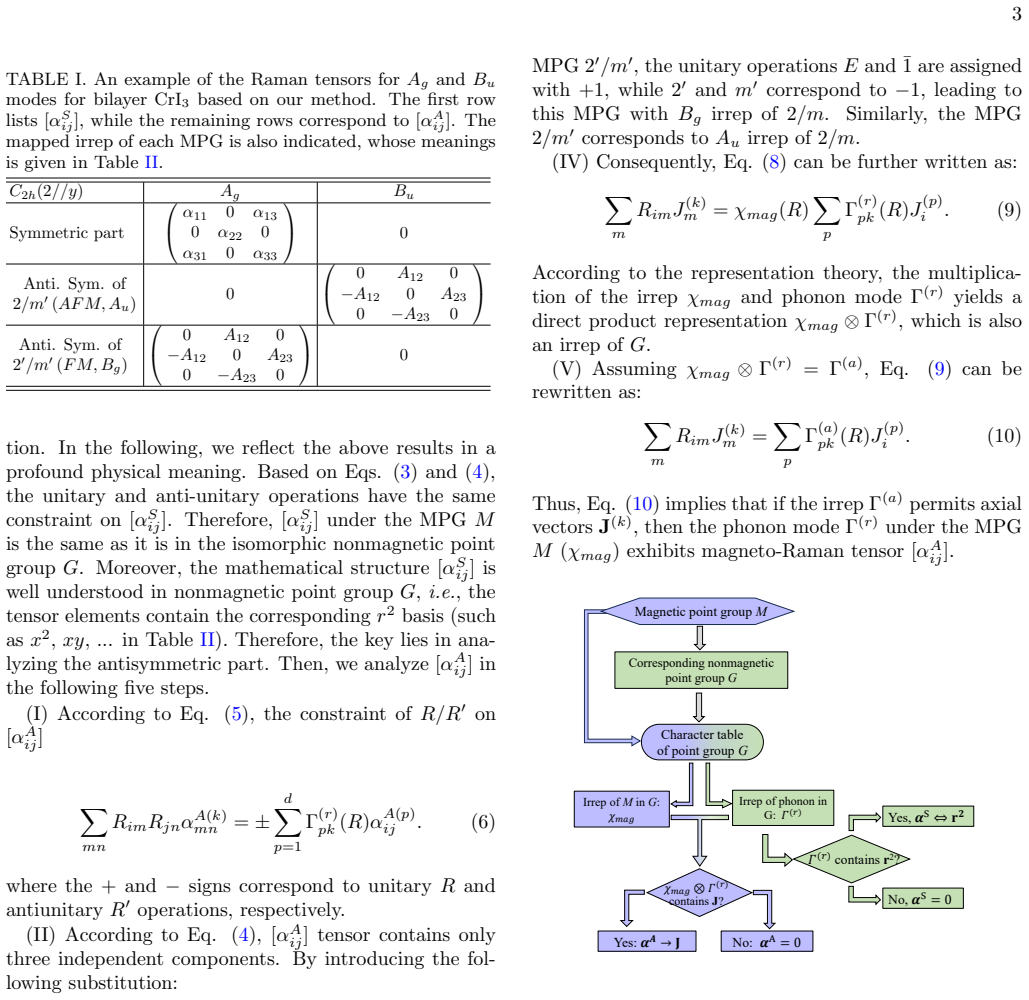
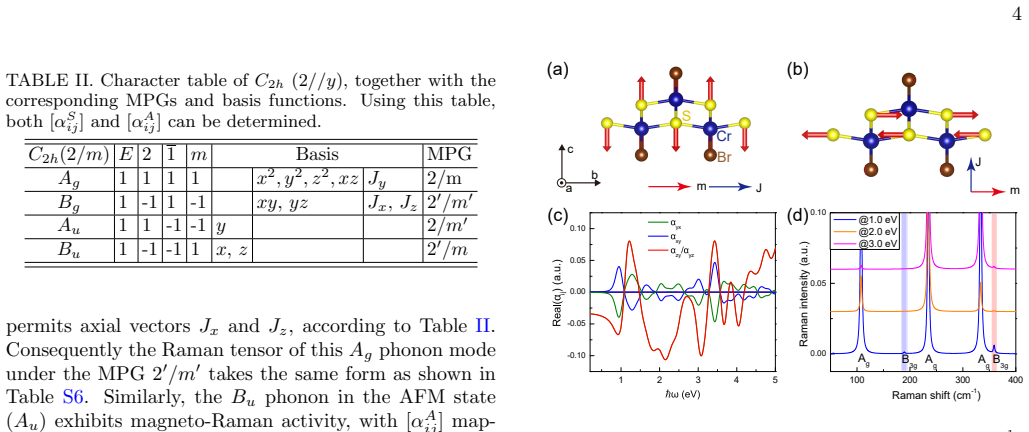
Although Raman scattering in magnetic materials exhibits rich experimental phenomena, the symmetry constraints on Raman tensors have not been fully elucidated. In this work, we use Onsager reciprocity relation, other than the conventional corepresentation method, to deal with the mathematical structures of Raman tensors in magnetic groups. Using this approach, we generate Raman tensor tables for all magnetic point groups, and present a comprehensive understanding of the Raman selection rules in magnetic materials with direct product representations method. Our theoretical and numerical results match previous experiments well, and resolve a puzzle in the Raman spectroscopy of CrSBr. Moreover, we identify a common but overlooked phenomenon: the magneto-Raman vector can be orthogonal to the magnetic moment direction. Our method and associated Raman tensor tables will be helpful for the Raman studies in both experimental and theoretical domains.
Editorial analysis
A structured set of objections, weighed in public.
Referee Report
Summary. The paper claims that applying the Onsager reciprocity relation (rather than the conventional corepresentation approach) yields the symmetry-allowed forms of the Raman tensors for all 122 magnetic point groups. It combines this with direct-product representations to obtain selection rules, reports that the resulting tensors and numerical spectra are consistent with prior experiments, resolves an apparent puzzle in the Raman data for CrSBr, and notes that the magneto-Raman vector is frequently orthogonal to the ordered magnetic moment.
Significance. If the central construction is valid, the work supplies a complete set of Raman-tensor tables for magnetic groups together with an alternative route to selection rules; such tables are a practical resource for experimentalists. The observation that the magneto-Raman vector need not be parallel to the moment is a concrete, falsifiable statement that could be checked in additional materials. The reported consistency with existing CrSBr data, if placed on a firmer quantitative footing, would strengthen the utility of the tables.
major comments (2)
- [Abstract] Abstract (paragraph on method choice): the claim that Onsager reciprocity transfers directly to the second-order Raman response tensor is presented without an explicit derivation showing that the electron-photon interaction Hamiltonian commutes with the assumed symmetry operations in the required way or that higher-order terms in the susceptibility expansion introduce no extra restrictions; this step is load-bearing for every tabulated tensor and for the CrSBr resolution.
- [Abstract] Abstract and results sections: the statements that 'theoretical and numerical results match previous experiments well' and 'resolve a puzzle in CrSBr' are not accompanied by quantitative error metrics, direct side-by-side comparison of predicted versus measured intensities, or an analysis of possible fitting parameters; without these the experimental support remains at the level of qualitative consistency.
minor comments (1)
- [Abstract] Abstract: the phrase 'other than the conventional corepresentation method' is ambiguous; 'rather than' would clarify the intended contrast.
Simulated Author's Rebuttal
We thank the referee for the careful reading of our manuscript and the constructive comments. We address each major comment below and outline the revisions we will make.
read point-by-point responses
-
Referee: [Abstract] Abstract (paragraph on method choice): the claim that Onsager reciprocity transfers directly to the second-order Raman response tensor is presented without an explicit derivation showing that the electron-photon interaction Hamiltonian commutes with the assumed symmetry operations in the required way or that higher-order terms in the susceptibility expansion introduce no extra restrictions; this step is load-bearing for every tabulated tensor and for the CrSBr resolution.
Authors: We agree that the manuscript would benefit from an explicit derivation of the applicability of Onsager reciprocity to the Raman tensor. In the revised manuscript we will add a dedicated subsection (or appendix) deriving the action of the symmetry operations on the electron-photon interaction Hamiltonian and confirming that higher-order terms in the susceptibility do not impose additional constraints beyond those already accounted for by the reciprocity relation. revision: yes
-
Referee: [Abstract] Abstract and results sections: the statements that 'theoretical and numerical results match previous experiments well' and 'resolve a puzzle in CrSBr' are not accompanied by quantitative error metrics, direct side-by-side comparison of predicted versus measured intensities, or an analysis of possible fitting parameters; without these the experimental support remains at the level of qualitative consistency.
Authors: We acknowledge that the experimental comparisons are currently presented at a qualitative level. In the revised manuscript we will augment the results section with quantitative error metrics (where the experimental data permit), direct side-by-side intensity comparisons, and an explicit discussion of fitting parameters used for the CrSBr spectra, thereby placing the agreement on a firmer quantitative footing. revision: yes
Circularity Check
No circularity: Onsager-based derivation is independent of inputs
full rationale
The paper applies the standard Onsager reciprocity relation (a known physical principle) to construct Raman tensors for magnetic point groups, explicitly as an alternative to the corepresentation method. No derivation step reduces by construction to a fitted parameter, self-citation chain, or renamed input; the generated tables are presented as outputs of the symmetry analysis and are checked against external experiments. The central claim remains self-contained against external benchmarks with no load-bearing self-citation or self-definitional reduction.
Axiom & Free-Parameter Ledger
axioms (2)
- domain assumption Onsager reciprocity relation holds for the Raman response tensor in magnetic point groups
- domain assumption Direct product representations fully determine Raman selection rules once the tensors are known
Reference graph
Works this paper leans on
-
[1]
This finding is further supported by our first-principles calculations (Section V, Supplemental Material [34])
for theB u mode in AFM state andA g phonon in the FM state, which has a small magnitude and cannot be captured by the previous phenomenological theory [13, 35]. This finding is further supported by our first-principles calculations (Section V, Supplemental Material [34]). The group structure of the Raman tensor.Although the above approach yields numerical...
-
[2]
Z. Sun, Y. Yi, T. Song, G. Clark, B. Huang, Y. Shan, S. Wu, D. Huang, C. Gao, Z. Chen, M. McGuire, T. Cao, D. Xiao, W. T. Liu, W. Yao, X. Xu, and S. Wu, Nature 572, 497 (2019)
2019
-
[3]
Z. Ni, A. V. Haglund, H. Wang, B. Xu, C. Bernhard, D. G. Mandrus, X. Qian, E. J. Mele, C. L. Kane, and L. Wu, Nat. Nanotechnol.16, 782 (2021)
2021
-
[4]
Xiao, D.-F
R.-C. Xiao, D.-F. Shao, W. Gan, H.-W. Wang, H. Han, Z. G. Sheng, C. Zhang, H. Jiang, and H. Li, npj Quan- tum Mater.8, 62 (2023)
2023
-
[5]
Zhou, R.-C
H. Zhou, R.-C. Xiao, S.-H. Zhang, W. Gan, H. Han, H.- M. Zhao, W. Lu, C. Zhang, Y. Sun, H. Li, and D.-F. Shao, Phys. Rev. Lett.133, 236903 (2024)
2024
-
[6]
Z. Sun, C. Hong, Y. Chen, Z. Sheng, S. Wu, Z. Wang, B. Liang, W.-T. Liu, Z. Yuan, Y. Wu, Q. Mi, Z. Liu, J. Shen, and S. Wu, Nat. Mater.24, 226–233 (2025)
2025
-
[7]
Z. Wang, Y. Xiang, R. Chen, Z. Sun, C. Hong, X. Chen, J. Gao, S. Wu, Z. Guo, Y. Chen, Q. Mi, Z. Liu, S. Yan, H. Lei, W. Ruan, Y. Zhang, W. Yu, W.-T. Liu, Z. Yuan, and S. Wu, Nature650, 340 (2026)
2026
-
[8]
T. Higo, H. Man, D. B. Gopman, L. Wu, T. Koretsune, O. M. J. van ’t Erve, Y. P. Kabanov, D. Rees, Y. Li, M. T. Suzuki, S. Patankar, M. Ikhlas, C. L. Chien, R. Arita, R. D. Shull, J. Orenstein, and S. Nakatsuji, Nat. Pho- tonics12, 73 (2018)
2018
-
[9]
Zhang, Z
H. Zhang, Z. Ni, C. E. Stevens, A. Bai, F. Peiris, J. R. Hendrickson, L. Wu, and D. Jariwala, Nat. Photonics 16, 311 (2022)
2022
-
[10]
Hwangbo, E
K. Hwangbo, E. Rosenberg, J. Cenker, Q. Jiang, H. Wen, D. Xiao, J.-H. Chu, and X. Xu, Nat. Phys.20, 1888 (2024)
2024
-
[11]
Pan, R.-C
H. Pan, R.-C. Xiao, J. Han, H. Zhu, J. Li, Q. Niu, Y. Gao, and D. Hou, Phys. Rev. Lett.136, 036701 (2026)
2026
-
[12]
R.-C. Xiao, H. Li, H. Han, W. Gan, M. Yang, D.-F. Shao, S.-H. Zhang, Y. Gao, M. Tian, and J. Zhou, Sci. China Phys. Mech. Astron.69, 217511 (2026)
2026
-
[13]
Huang, J
B. Huang, J. Cenker, X. Zhang, E. L. Ray, T. Song, T. Taniguchi, K. Watanabe, M. A. McGuire, D. Xiao, and X. Xu, Nat. Nanotechnol.15, 212 (2020)
2020
-
[14]
W. Jin, Z. Ye, X. Luo, B. Yang, G. Ye, F. Yin, H. H. Kim, L. Rojas, S. Tian, Y. Fu, S. Yan, H. Lei, K. Sun, A. W. Tsen, R. He, and L. Zhao, Proc. Natl. Acad. Sci. U.S.A117, 24664 (2020)
2020
-
[15]
Zhang, X
Y. Zhang, X. Wu, B. Lyu, M. Wu, S. Zhao, J. Chen, M. Jia, C. Zhang, L. Wang, X. Wang, Y. Chen, J. Mei, T. Taniguchi, K. Watanabe, H. Yan, Q. Liu, L. Huang, Y. Zhao, and M. Huang, Nano Lett.20, 729 (2020)
2020
-
[16]
B. Lyu, Y. Gao, Y. Zhang, L. Wang, X. Wu, Y. Chen, J. Zhang, G. Li, Q. Huang, N. Zhang, Y. Chen, J. Mei, H. Yan, Y. Zhao, L. Huang, and M. Huang, Nano Lett. 20, 6024 (2020)
2020
-
[17]
McCreary, T
A. McCreary, T. T. Mai, F. G. Utermohlen, J. R. Simp- son, K. F. Garrity, X. Feng, D. Shcherbakov, Y. Zhu, J. Hu, D. Weber, K. Watanabe, T. Taniguchi, J. E. Goldberger, Z. Mao, C. N. Lau, Y. Lu, N. Trivedi, R. Valdes Aguilar, and A. R. Hight Walker, Nat Com- mun11, 3879 (2020)
2020
-
[18]
Z. Liu, K. Guo, G. Hu, Z. Shi, Y. Li, L. Zhang, H. Chen, L. Zhang, P. Zhou, H. Lu, M.-L. Lin, S. Liu, Y. Cheng, X. L. Liu, J. Xie, L. Bi, P.-H. Tan, L. Deng, C.-W. Qiu, and B. Peng, Sci. Adv.6, eabc7628 (2020)
2020
-
[19]
T. Yin, K. A. Ulman, S. Liu, A. Granados del ´Aguila, Y. Huang, L. Zhang, M. Serra, D. Sedmidubsky, Z. Sofer, S. Y. Quek, and Q. Xiong, Adv. Mater.33, 2101618 (2021)
2021
-
[20]
M. Che, J. Liang, Y. Cui, H. Li, B. Lu, W. Sang, X. Li, X. Dong, L. Zhao, S. Zhang, T. Sun, W. Jiang, E. Liu, F. Jin, T. Zhang, and L. Yang, Phys. Rev. Lett.134, 196906 (2025)
2025
-
[21]
F. Wang, X. Liu, H. Sun, H. Wang, S. Murakami, L. Zhang, H. Zhang, and D. Xing, Phys. Rev. Lett.135, 256701 (2025)
2025
-
[22]
A. P. Cracknell, J. Phys. C: Solid State Phys.2, 500 (1969)
1969
-
[23]
Anastassakis and E
E. Anastassakis and E. Burstein, J. Phys. C: Solid State Phys.5, 2468 (1972)
1972
-
[24]
Herzberg,Infrared and Raman spectra of polyatomic molecules, Vol
G. Herzberg,Infrared and Raman spectra of polyatomic molecules, Vol. 2 (van Nostrand, New York, 1945)
1945
-
[25]
Loudon, Adv
R. Loudon, Adv. Phys.13, 423 (1964)
1964
-
[26]
C. J. Bradley and B. L. Davies, Rev. Mod. Phys.40, 359 (1968)
1968
-
[27]
Onsager, Phys
L. Onsager, Phys. Rev.37, 405 (1931)
1931
-
[28]
Shtrikman and H
S. Shtrikman and H. Thomas, Solid State Commun.3, 147 (1965)
1965
-
[29]
H. D. Butzal and R. R. Birss, Physica A114, 518 (1982)
1982
-
[30]
Grimmer, Acta Crystallogr
H. Grimmer, Acta Crystallogr. A49, 763 (1993)
1993
-
[31]
Grimmer, Ferroelectrics161, 181 (1994)
H. Grimmer, Ferroelectrics161, 181 (1994)
1994
-
[32]
Y. Zhai, Y. Tang, T. Zhou, H. Li, T. Qin, Z. Sofer, L. Hu, 6 and Q. Xiong, Nano Lett.25, 12570 (2025)
2025
-
[33]
U. D. Wdowik, V. Varade, J. Vejpravova, and D. Legut, arXiv:2503.15298(2025)
arXiv 2025
-
[34]
Kroumova, M
E. Kroumova, M. I. Aroyo, J. M. Perez-Mato, A. Kirov, C. Capillas, S. Ivantchev, and H. Wondratschek, Phase Transit.76, 155 (2003)
2003
-
[35]
[**- **]
See Supplemental Material at http://xxx for detailed information on Raman tensors for all MPGs, first- principles calculation mehtod, calculated Raman tensor of bilayer Cr3 and CrSBr, Raman characteristics of NiAs- type altermagnetic materials, which includes Refs. [**- **]
-
[36]
X. Kong, P. Ganesh, and L. Liang, npj 2D Mater. Appl. 8, 82 (2024)
2024
-
[37]
Xiao,Lecture on Group Theory in Physics(High Education press, Beijing, 2026)
R.-C. Xiao,Lecture on Group Theory in Physics(High Education press, Beijing, 2026)
2026
-
[38]
Placzek,Rayleigh-streuung und Raman-effekt (Akademische Verlagsgesellschaft, 1934)
G. Placzek,Rayleigh-streuung und Raman-effekt (Akademische Verlagsgesellschaft, 1934)
1934
-
[39]
J. Guo, W. Shi, K. Ni, X. Chen, D. Liu, X. Liu, S. Wang, Q. Li, R.-C. Xiao, and M. Yang, Chin. Phys. B.34, 104203 (2025)
2025
-
[40]
Pawbake, T
A. Pawbake, T. Pelini, N. P. Wilson, K. Mosina, Z. Sofer, R. Heid, and C. Faugeras, Phys. Rev. B107, 075421 (2023)
2023
-
[41]
P. A. McClarty and J. G. Rau, Phys. Rev. Lett.132, 176702 (2024)
2024
-
[42]
M. Roig, Y. Yu, R. C. Ekman, A. Kreisel, B. M. Ander- sen, and D. F. Agterberg, Phys. Rev. Lett.135, 016703 (2025)
2025
-
[43]
R.-C. Xiao, Y. Jin, Z.-F. Zhang, Z.-H. Feng, D.-F. Shao, and M. Tian, Comput. Phys. Commun.318, 109872 (2026)
2026
-
[44]
Y. Liu, X. Chen, Y. Yu, and Q. Liu,arxiv:2506.20739 (2025)
Pith/arXiv arXiv 2025
-
[45]
Z. Liu, Y. Gao, and Q. Niu, Phys. Rev. Lett.136, 026703 (2026)
2026
-
[46]
Z. Liu, M. Wei, W. Peng, D. Hou, Y. Gao, and Q. Niu, Phys. Rev. X15, 031006 (2025)
2025
-
[47]
G.-B. Liu, M. Chu, Z. Zhang, Z.-M. Yu, and Y. Yao, Comput. Phys. Commun.265, 107993 (2021)
2021
-
[48]
Ishito, H
K. Ishito, H. Mao, Y. Kousaka, Y. Togawa, S. Iwasaki, T. Zhang, S. Murakami, J.-i. Kishine, and T. Satoh, Nat. Phys.19, 35 (2023)
2023
-
[49]
Ishito, H
K. Ishito, H. Mao, K. Kobayashi, Y. Kousaka, Y. Togawa, H. Kusunose, J.-i. Kishine, and T. Satoh, Chirality35, 338 (2023)
2023
-
[50]
Porezag and M
D. Porezag and M. R. Pederson, Phys. Rev. B54, 7830 (1996)
1996
-
[51]
Maiti, A
S. Maiti, A. V. Chubukov, and P. J. Hirschfeld, Phys. Rev. B96, 014503 (2017)
2017
-
[52]
R. M. Martin, Phys. Rev. B4, 3676 (1971)
1971
-
[53]
Cantarero, C
A. Cantarero, C. Trallero-Giner, and M. Cardona, Phys. Rev. B40, 12290 (1989)
1989
-
[54]
Kresse and J
G. Kresse and J. Furthm¨ uller, Phys. Rev. B54, 11169 (1996)
1996
-
[55]
Kresse and D
G. Kresse and D. Joubert, Phys. Rev. B59, 1758 (1999)
1999
-
[56]
A. Togo, L. Chaput, T. Tadano, and I. Tanaka, J. Phys.: Condens. Matter35, 353001 (2023)
2023
-
[57]
Zhang, Q
J. Zhang, Q. Lian, Z. Pan, W. Bai, J. Yang, Y. Zhang, X. Tang, and J. Chu, Journal of Raman Spectroscopy 51, 1383 (2020)
2020
-
[58]
S. Li, J. Wu, B. Liang, L. Liu, W. Zhang, N. Wazir, J. Zhou, Y. Liu, Y. Nie, Y. Hao, P. Wang, L. Wang, Y. Shi, and S. Li, Chem. Mater.34, 873 (2022)
2022
-
[59]
Y. Zhao, S. Mandal, C.-X. Liu, and B. Yan,arxiv: 2603.12259(2026)
arXiv 2026
-
[60]
L. Zhou, Z. Yan, H. Rong, Y. Zhao, P. Xiao, L.-K. Lai, Z. Xi, K. Wang, T. Adhikari, G. P. Tiwari, Z. Lin, P. Manue, F. Orlandi, D. D. Khalyavin, A. J. Grutter, C.-X. Liu, B. Yan, and C.-Z. Chang, , arXiv:2602.09363 (2026)
arXiv 2026
-
[61]
A. J. Wu, D. Cheng, X. Wang, M. Zeng, C. Liu, and X. Li,arXiv:2503.17742(2025)
arXiv 2025
-
[62]
The group theory of Raman effect in magnetic materials
B. Thapa, K. D. Belashchenko, and I. I. Mazin,arxiv: 2602.13065(2026). 7 Supplemental Material for “The group theory of Raman effect in magnetic materials” CONTENTS References 5 I. Raman tensor tables for all MPGs 7 II. The characteristics of polarized Raman scattering 25 A. Linearly-polarized Raman scattering 26 B. Circularly-polarized Raman scattering 2...
arXiv 2026
-
[63]
NA” (not available) in the third to the fifth column indicate that there are no symmetry operations along these characteristic directions. 2.The symbols “/
The letters “NA” (not available) in the third to the fifth column indicate that there are no symmetry operations along these characteristic directions. 2.The symbols “/” in the third to the fifth columns denote that there are two or more equivalent character directions
-
[64]
The character directions for grey MPGs and black-white MPGs obey the rules similar to those in original MPGs
-
[65]
The Raman coefficientsα ij(ω) possess both real and imaginary parts, analogous to the dielectric function, and satisfy the Kramers-Kronig relations. 8
-
[66]
While the antisym- metric part αA ij is time-reversal odd (T-odd), and satisfiesα A(−ω) = −αA(ω) ∗
The symmetric part αS ij is time-reversal even (T-even), and satisfiesα S(−ω) = αS(ω) ∗ . While the antisym- metric part αA ij is time-reversal odd (T-odd), and satisfiesα A(−ω) = −αA(ω) ∗ . Consequently, theT-even αS ij(0) may have a nonzero real component at zero frequency limit. Whereasα A(0) vanishes, indicating theα A belongs a non-equilibrium tensor
-
[67]
α”. While the remaining rows correspond to the antisymmetric compo- nents, and the Raman tensor elements are written as the letter “A
The second row of each table presents the symmetric components of the Raman tensor, and the Raman tensor elements are denoted with the letter “α”. While the remaining rows correspond to the antisymmetric compo- nents, and the Raman tensor elements are written as the letter “A”. The symmetric parts are the same as the known results in the textbooks and literature
-
[68]
In this way, the MPGMcan be regarded as a 1D real irrepχ mag of the isomorphic nonmagnetic point groupG, as listed in the first column of each table
If we assign the values +1 and−1 for the unitary (R) and anti-unitary (R ′) operation, respectively, as the main text. In this way, the MPGMcan be regarded as a 1D real irrepχ mag of the isomorphic nonmagnetic point groupG, as listed in the first column of each table
-
[69]
For double degenerateEmodes and triply degenerateTmodes, three indices are used (e.g.,α 112 andA 212), where the first index denotes the number of the irreducible representation, and the last two are the Raman tensor subscripts
-
[70]
The spectrum characteristic of the chiral phonon in MPGs withC 3 symmetry is discussed in Section III
For the MPGs 42 ′2′, 4m′m′, ¯42′m′, 4/mm′m′, 32′, 3m′, ¯6m′2′, ¯3m′, 62′2′, 6m′m′, 6/mm′m′, ¯4′3m′, 4′32′, and m¯3m′, theEmodes undergo splitting [22], forming the chiral phonons (such as Co 3Sn2S2 [19]), and we indicate them by [S] after the MPG names. The spectrum characteristic of the chiral phonon in MPGs withC 3 symmetry is discussed in Section III
-
[71]
For the origin point groups 3, 4, 6, 3/m, 4/m, 6/m, ¯4, ¯3, 23, andm ¯3, the irrepEmodes also split, but they become degenerate again in the corresponding grey groups
-
[72]
Therefore, compatibility relations are required to establish the correspondence between irreducible representations (irreps) before and after the change in MPG
For a given magnetic structure, the change of the magnetic moment direction leads to a different MPG. Therefore, compatibility relations are required to establish the correspondence between irreducible representations (irreps) before and after the change in MPG. The readers can see Section VII for a specific example
-
[73]
TABLE S4
The Raman features under the linearly-polarized and circularly-polarized light are discussed in Section II. TABLE S4. The Raman tensors of the point group 1 (C 1) and corresponding MPG. 1 (C1) A Sym. α11 α12 α13 α12 α22 α23 α13 α23 α33 1 (A) 0A 12 −A31 −A12 0A 23 A31 −A23 0 9 TABLE S5. The Raman tensors of the point group ¯1 (Ci) and corre...
discussion (0)
Sign in with ORCID, Apple, or X to comment. Anyone can read and Pith papers without signing in.