REVIEW 2 major objections 5 minor 1 cited by
Application of Deep Neural Networks to Event Type Classification in IceCube
T0 review · 2 major / 5 minor · reviewed 2026-08-14 · deepseek-v4-flash
Pith's one-line read The paper claims that a deep neural network can classify IceCube events into cascades, tracks, starting tracks, and double bangs directly from low-level pulses, with tracks found at 97% recall and 93% precision.
desk verdict A solid ICRC proceedings paper about a genuinely new engineering application—classifying four IceCube event types, including double bangs, with a multi-task 3D InceptionResNet—but the headline precision and purity numbers are MC-only and class-balanced, so they should not be read as real-data performance. read the letter →
The pith
A machine-rendered reading of the paper's core claim, the machinery that carries it, and where it could break.
The reading
What carries the argument
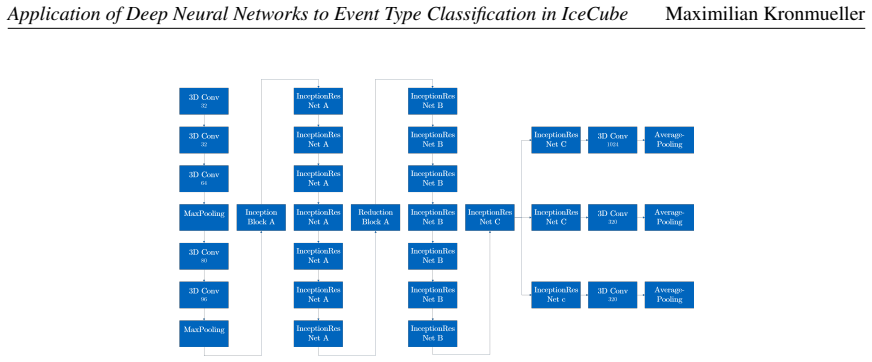
The machinery is a three-dimensional adaptation of the InceptionResNet architecture, taking as input a digitized map of the detector's recorded light. IceCube's hexagonal string grid is rearranged into a regular 10x10x60 volume, and each DOM's pulse series is represented by charge quantiles rather than fixed time bins, so rapidly changing parts of the waveform are sampled finely. Residual connections stabilize training, while inception modules let the network learn multiple filter scales in parallel. The same convolutional backbone is reused for three simultaneous tasks: main event-type classification, starting-event identification, and coincident atmospheric-muon identification, which broadens the output and improves generalization. The single scalar that carries the practical result is the p-score, the maximum softmax output, which is shown to be a monotone purity selector for every class.
What would settle it
Take a sample of recorded IceCube events with independent, high-confidence labels, for example through-going muons passing the existing more-than-99%-purity selection plus cascade-like events identified by a separate reconstruction, run the trained network on them, and compare the confusion matrix and p-score curves to the Monte Carlo results; if the network's precision or recall for tracks or cascades drops by more than a few percent, or if accuracy no longer rises monotonically with p-score, the paper's central claim would be falsified.
Extended reading notes
Core claim
The central claim is that a single network can replace the implicit, analysis-specific event typing in IceCube with a generic, continuous prediction of the true interaction topology. Trained on balanced Monte Carlo samples in the 5 TeV to 10 PeV range, the network's main task reaches 97% recall and 93% precision for tracks and 95% recall and 86% precision for cascades, while starting tracks are identified at 75% recall and 89% precision. Double bangs, which are intrinsically harder because they require two well-separated cascades from a decaying tau, are recovered at only 21% recall, with almost all losses going to the cascade class. The paper shows these confusions follow physical expectations: double bangs merge into cascades for short tau decay lengths, and starting tracks look like cascades at high inelasticity and like tracks at low inelasticity. The prediction score, the network's maximum softmax output, behaves as a valid certainty measure and can be thresholded to select samples at a chosen purity, at the price of lower acceptance.
Load-bearing premise
The reported accuracy numbers are computed on simulated events, so the entire result rests on the assumption that those simulations faithfully reproduce how real IceCube pulses look for each interaction type.
Editorial extensions
If this is right
- An IceCube analysis could use the network's class label plus p-score as a first, generic filter, replacing several separate high-level selections.
- Real-time use is plausible because one prediction takes only a few milliseconds, so event-type labels could enter online alerts rather than offline processing.
- The double-bang channel could provide a tau-neutrino candidate sample, with efficiency concentrated at tau decay lengths above roughly 150 m where cascade confusion vanishes.
- For high-purity muon samples, the network reproduces an existing selection's classification in over 99.9% of events, suggesting it can flag the small cascade contamination that such selections miss.
Reading between the lines
- If the same architecture were trained on simulated events down to 100 GeV and on events depositing light outside the fiducial volume, as the authors list as next steps, the classifier could plausibly replace the current first online filter, where most low-energy and edge-clipping events are rejected.
- The p-score's apparent calibration suggests a natural out-of-distribution test: events from detector noise, breakdowns, or unknown topologies should produce low p-scores, which might make the same network useful as an anomaly veto without retraining.
- Because the physical confusions are encoded as functions of continuous quantities like tau decay length and inelasticity, the network's predicted class probabilities could be read as soft labels for energy-estimation tasks, potentially improving energy reconstruction for cascades and starting tracks.
- The 21% double-bang recall is a physical, not purely architectural, ceiling: with the 5 m separation threshold used as ground truth, most simulated tau events are effectively single cascades, so a dedicated higher-energy sample would be needed to exploit the tau channel.
Signed reviews
Editorial analysis
A structured set of objections, weighed in public.
Referee Report
Summary. The manuscript presents a deep neural network classifier for IceCube event types (cascade, track, starting track, double bang), based on an InceptionResNet v2 architecture adapted to 3D convolutions and multi-task learning. The network is trained on Monte Carlo events with primary energies between 5 TeV and 10 PeV, with the training set deliberately balanced in class and deposited energy. On a held-out test set, confusion matrices show track recall 97% and precision 93%, cascade recall 95% and precision 86%, starting track recall 75% and precision 89%, and double bang recall 21% and precision 57%. Physical plausibility checks show the expected dependence of double-bang classification on tau decay length and of starting-track classification on inelasticity. A comparison with a high-purity muon selection shows >99.9% agreement. The prediction score (the maximum softmax output) is proposed as a purity-selection variable. The paper concludes that deep neural networks are able to classify different event types in IceCube and lists validation on experimental data and CORSIKA simulations as a future step.
Significance. If its claims hold after validation on real data, the paper provides a useful proof-of-concept for a generic low-level event-type classifier in IceCube. The architecture choices, multi-task learning, and physical sanity checks are sensible, and the paper is transparent about the simulation-only nature of the study. The main positive contribution is the demonstration that a 3D InceptionResNet trained on a balanced Monte Carlo sample produces physically interpretable class confusions and can run in a few milliseconds. The principal limitation is that all quantitative performance and purity claims are tied to an artificial class-balanced and energy-balanced test distribution, and the only real-data comparison is too narrow to validate the classifier; the paper's own Section 5 lists validation on experimental data and CORSIKA simulations as necessary future work.
major comments (2)
- [§4 (dataset construction), §4.2 (Figure 6)] The reported precision values and the p-score purity claim are computed on a test set in which classes are balanced and deposited-energy distributions are equalized across classes, as stated in §4. Precision is prior-dependent, so the numbers (e.g., 93% track precision, 86% cascade precision) and the accuracy-versus-p-score curves in Figure 6 would not be expected to hold for IceCube's real, energy-dependent event mixture. To support the conclusion in §5 that the p-score 'provides a cut variable for the purity of a selection,' the authors should either evaluate on a realistic simulated composition (with physical neutrino fluxes and backgrounds) or provide a calibration curve showing purity as a function of p-score under an explicitly stated mixture. Without this, the purity claims remain conditional on the balanced training distribution rather than on IceCube's event mix.
- [§4.1 (muon sample comparison)] The comparison to the diffuse-flux muon sample (>99% purity) is too weak to serve as a validation of the classifier. On a sample that is almost entirely tracks, agreeing with the sample label in more than 99.9% of cases only demonstrates that the network recognizes clean track-like events; it provides no information about false-positive rates on a mixed sample or about the cascade, starting-track, and double-bang classes. Consequently, the acknowledged future step in §5 (validation on experimental data and CORSIKA simulations) is necessary before any data-level performance claim can be made.
minor comments (5)
- [§4.1] The text uses 'accuracy' for what are recall values in the ground-truth-normalized confusion matrix (e.g., 'accuracy of 95%' for cascades). Since the matrices separately show ground-truth and prediction normalization, the authors should use 'recall' and 'precision' consistently to avoid ambiguity.
- [§3] The input representation is described only briefly. A sentence specifying the number of charge quantiles, how the 10×10×60 grid is composed, and the exact shape of the input tensor would improve reproducibility.
- [§3 (architecture)] The paper does not report hyperparameters such as learning rate, batch size, number of training epochs, or the total number of network parameters. For a machine-learning methods paper, this information is needed for reproducibility and comparison.
- [General] No comparison to an existing IceCube event selection or to a simpler baseline classifier is provided. Adding such a baseline would help the reader judge whether the reported performance is a genuine improvement or simply a reflection of the classifier's capacity.
- [§1 and throughout] There are minor typographical and consistency issues, e.g., 'Icecube' in Section 1 and inconsistent use of 'IncResNet' versus 'InceptionResNet.' A careful proofreading pass is recommended.
Circularity Check
No significant circularity: the classifier is evaluated on an independent held-out Monte Carlo test set, and the physical checks are confirmatory sanity checks rather than inputs to the network.
full rationale
The paper's central claim is empirical: a deep neural network can classify IceCube event types. The training, validation, and test sets are separately drawn Monte Carlo samples, and the reported accuracies and precisions come from a test set that the paper describes as 'completely independent of the training processes.' No physical parameter is fitted and then renamed as a prediction; the classifier is trained on labeled simulations and tested on held-out simulations, which is the standard, non-circular evaluation protocol for a supervised classifier. The physical checks in Section 4.1 are also not circular in a load-bearing sense: the network is not given tau decay length or inelasticity as features, so the observed trends show that the classifier has learned features correlated with the physically defined ground truth. One can note that the ground-truth definitions already encode these physical distinctions (double bangs require separated cascades, starting tracks are defined by vertex location), but the paper presents these as behavioral sanity checks rather than as derivations of new physics. Similarly, the p-score discussion only claims that accuracy rises with the softmax threshold and that the p-score can be used as a selection cut; it makes no claim of calibrated probabilities transferable to the real IceCube event mix. The class-balanced test distribution limits how the precision numbers generalize to data, and the paper itself lists validation on experimental data and CORSIKA simulations as future work; these are external-validity or correctness concerns, not circularity. The only self-citation of note, reference [7] for the hexagon-to-cubic-grid input transformation, is a preprocessing choice adopted from prior IceCube Collaboration work; it is not load-bearing for the classification claim and could be replaced by any reasonable rasterization without affecting the method's logic. Therefore the derivation chain does not reduce to its inputs.
Assumptions & free parameters
free parameters (2)
- Network weights (trained on MC)
- Hyperparameters (architecture depth, learning rate, batch size, etc.)
assumptions (3)
- domain assumption Monte Carlo simulations accurately represent the IceCube detector response and neutrino interaction topologies.
- domain assumption The charge-quantile input representation preserves sufficient information for event type classification.
- standard math Standard deep learning training (backpropagation, stochastic gradient descent, softmax classification) behaves as expected.
Cite this review
Pith. "Pith review of Application of Deep Neural Networks to Event Type Classification in IceCube." pith.science (2026). https://pith.science/paper/2BZMKVU6
@misc{pith2026190808763,
  author       = {Pith},
  title        = {Pith review of: Application of Deep Neural Networks to Event Type Classification in IceCube},
  year         = {2026},
  howpublished = {\url{https://pith.science/paper/2BZMKVU6}},
  note         = {Machine review of arXiv:1908.08763}
}
read the original abstract
The IceCube Neutrino Observatory is able to measure the all-flavor neutrino flux in the energy range between 100 GeV and several PeV. Due to the different features of the neutrino interactions and the geometry of the detector, all high-level analyses require a selection of suitable events as a first step. However, presently, no algorithm exists that gives a generic prediction of an event's underlying interaction type. One possible solution to this is the use of deep neural networks similar to the ones commonly used for 2D image recognition. The classifier that we present here is based on the modern InceptionResNet architecture and includes multi-task learning in order to broaden the field of application and increase the overall accuracy of the result. We provide a detailed discussion of the network's architecture, examine the performance of the classifier for event type classification and explain possible applications in IceCube.
Figures


Figures from the paper (3 more)


Forward citations
Cited by 1 Pith paper
-
flashcurve: A machine-learning approach for the simple and fast generation of adaptive-binning light curves with Fermi-LAT data
A convolutional neural network trained on Fermi-LAT light-curve data directly predicts the detection test statistic, enabling fast adaptive-binning gamma-ray light curves.
Reference graph
Works this paper leans on
-
[1]
write newline
" write newline "" before.all 'output.state := FUNCTION blank.sep after.quote 'output.state := FUNCTION fin.entry output.state after.quoted.block = 'skip 'add.period if write newline FUNCTION new.block output.state before.all = 'skip output.state after.quote = after.quoted.block 'output.state := after.block 'output.state := if if FUNCTION new.sentence out...
- [2]
- [3]
- [4]
-
[5]
Halzen, Francis and Klein, Spencer R, Rev. Sci. Instrum. 81 (2010) 081101
work page 2010
-
[6]
J. Beringer et al. , Physical Review D - Particles, Fields, Gravitation and Cosmology 86 (2012)
work page 2012
-
[7]
IceCube Collaboration, M. G. Aartsen et al. , Phys. Rev. D93 (2016) 022001
work page 2016
-
[8]
IceCube Collaboration, PoS(ICRC2017)1057 (2018)
work page 2018
Show all 11 references
-
[9]
IceCube Collaboration, PoS(ICRC2019) 846 (2019)
2019
-
[10]
IceCube Collaboration, Science 342 (2013) 1242856
2013
-
[11]
IceCube Collaboration, Astrophys. J. 833 (2016)
2016
Reviewed August 14, 2026 · model on record in the stance chip above.
Discussion (0). Continue with ORCID to comment.