REVIEW 3 major objections 6 minor 28 references
Privacy-Preserving Support Vector Machine Computing Using Random Unitary Transformation
T0 review · 3 major / 6 minor · reviewed 2026-08-14 · deepseek-v4-flash
Pith's one-line read A random unitary transform hides images without changing SVM results for common kernels.
desk verdict Correct SVM invariance, but the privacy claim is unsupported and contradicted by the paper's own distance-preserving properties; a cloud server can match protected images to public originals without the key. read the letter →
The pith
A machine-rendered reading of the paper's core claim, the machinery that carries it, and where it could break.
The reading
What carries the argument
The load-bearing mechanism is the random unitary transformation $T(f,p) = Q_p f$, applied to feature vectors, along with the three conservation properties it induces: preservation of Euclidean distances, inner products, and correlation coefficients. The paper classifies kernels into class 1 (Euclidean-distance based) and class 2 (inner-product based), and shows that on both classes the kernel matrix—and therefore the SVM dual problem—is identical for protected and unprotected features. A common secret key across clients (condition 1) gives exactly matching performance; per-client keys (condition 2) still preserve the properties within each client's data while strengthening security against spoofing.
What would settle it
Find any dataset and kernel in class 1 or 2 where an SVM trained on protected features disagrees with one trained on original features, or demonstrate that a server can reconstruct recognizable images from protected ones without the key; either outcome would refute the paper's central claims.
Extended reading notes
Core claim
The central claim is that using protected images gives no effect to the performance of the SVM classifier for kernel class 1 (kernels depending only on Euclidean distance, such as RBF) and class 2 (kernels depending only on inner products, such as linear and polynomial). Since a random unitary transform $Q_p$ satisfies $\|Q_p f_i - Q_p f_j\| = \|f_i - f_j\|$ and $\langle Q_p f_i, Q_p f_j \rangle = \langle f_i, f_j \rangle$, every kernel value in these classes is invariant under protection. The kernel matrix is unchanged, so the SVM dual maximum-margin problem with protected images reduces to the same problem as that of the original images. This means classification accuracy, false accept rate, and false reject rate coincide for protected and unprotected data.
Load-bearing premise
The load-bearing premise is that a random unitary transformation with a secret key actually hides visual information from a cloud server that knows the algorithm and stores many protected images; this is asserted from cancelable-biometrics work rather than proved for the SVM cloud scenario.
Editorial extensions
If this is right
- Any off-the-shelf SVM implementation can run on protected features without modification, since the dual problem is identical.
- The same invariance applies to other machine-learning algorithms whose decisions depend only on Euclidean distances or inner products, as the paper notes.
- Under a single shared key, protected and unprotected classifiers have exactly the same accuracy, FAR, and FRR.
- Under per-client keys, authentication is stricter because a query must match both the person and the key, which improves FAR in the reported experiments.
- Random permutation matrices—a cheap special case of unitary transforms—give the same guarantees for large feature vectors.
Reading between the lines
- The privacy guarantee is the paper's weakest link: it is inherited from cancelable-biometrics literature and not proven against an adversary who knows the transform family and holds many protected images, so the scheme might be only performance-preserving.
- Per-client keys prevent cross-client distance comparisons, so a global classifier trained jointly on all clients' protected data would not preserve performance unless clients share one key—an implicit trade-off for security.
- A direct extension is to apply the same transform to deep-network feature embeddings, which often use Euclidean or cosine (inner-product) similarities; whether invariance survives the network's training is untested.
- The class-1/class-2 distinction suggests a ready checklist of which kernels (e.g., sigmoid, Laplacian, histogram intersection) are invariant under unitary protection and which are not.
Signed reviews
Editorial analysis
A structured set of objections, weighed in public.
Referee Report
Summary. The paper proposes a privacy-preserving SVM computing scheme in which image feature vectors are transformed by a keyed random unitary matrix before being sent to a cloud server for training and classification. The main mathematical claim is that, under a common key, unitary transformations preserve Euclidean distances and inner products, so kernels in class 1 (distance-based, e.g., RBF) and class 2 (inner-product-based, e.g., linear and polynomial) yield exactly the same Gram matrix and the same SVM dual problem as on unprotected images. Experiments on the Extended Yale Face Database B using random permutation matrices confirm that FRR/FAR curves coincide for protected and unprotected images under the common-key condition, and the paper also reports FAR results under per-client keys and under key/image leakage scenarios. The paper concludes that the proposed scheme enables privacy-preserving SVM computing without performance degradation and without specialized secure-computation algorithms.
Significance. The invariance observation is mathematically correct and is the paper's solid core: for the stated kernel classes, the kernel matrix and SVM dual problem are literally unchanged by a common unitary transform. The experiments support this performance-preservation claim for the linear and RBF kernels. However, the advertised central contribution is privacy preservation, and that claim is not supported by any threat model, security definition, or attack analysis. Worse, the same invariance properties that make the scheme work also make it vulnerable to a simple record-linkage attack when the server has access to the original public dataset: because all pairwise distances are preserved, protected images can be matched back to original images without the secret key. Thus the paper's main selling point is in tension with its own technical content. If the privacy claim were removed and the paper were reframed as a utility-preserving transformation for outsourced SVM, the contribution would be a correct but modest observation.
major comments (3)
- [Sections 3.1, 3.2.1, 4.1] The privacy guarantee is asserted rather than argued. Section 3.1 cites cancelable-biometrics literature, but no threat model, formal security goal, or attack analysis is given for the cloud-server scenario of Fig. 1. This is not a minor omission: Properties 1 and 2 in Section 3.2.1 imply that the matrix of pairwise Euclidean distances (and inner products) among protected images is identical to that among original images. A cloud server that knows the algorithm and has access to a public face database such as the Extended Yale B set used in Section 4.1 can compute distance profiles of the protected images and match each protected vector to its original by nearest-neighbor or profile-matching, without knowing the secret key. This directly recovers visual identity and the original face image. The paper's own security experiments in Section 4.2.3 only measure FAR under key or image leakage and never consider this reconstruction attack. The central claim of a privacy-preserving SVM scheme is therefore not merely unproven; it is contradicted by the invariance properties that are the paper's main technical contribution.
- [Section 2.2 and Section 3.1] The paper never defines what the cloud server is allowed to learn. The scenario in Fig. 1 has the server performing SVM classification on protected images, so the server must learn the class labels and the classification outcome; yet the paper simultaneously claims to protect 'visual information' from the server. Without a precise statement of the intended security guarantee (e.g., hiding pixel values vs. hiding identity vs. hiding the authentication result), the privacy claim is unfalsifiable and cannot be evaluated. A revision would need to specify the adversarial model and then prove or empirically test the claimed guarantee under that model.
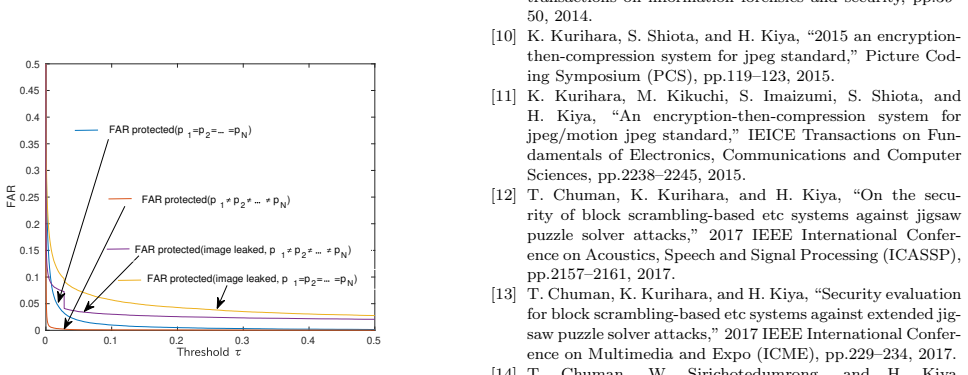
- [Section 4.2.3] The leakage experiments do not address the cloud-server privacy threat. They measure spoofing FAR after a key or original image leaks to an external attacker, which is a template-protection question from the cancelable-biometrics literature. This is orthogonal to whether the server can recover visual information from the stored protected images. Consequently, the experimental section provides no evidence that the scheme is privacy-preserving in the cloud-computing scenario that motivates the paper.
minor comments (6)
- [Eq. (13)] The inner product in the dual objective is typeset as ⟨φ(ˆf_i,j, ˆf_s,t)⟩; it should be ⟨φ(ˆf_i,j), φ(ˆf_s,t)⟩ to denote the inner product of the two feature-map vectors.
- [Property 3, Eq. (9)] The correlation-coefficient formula is incorrectly typeset: the denominators should be the norms ‖f_i,j‖ and ‖f_s,t‖, not repeated inner products of the same pair.
- [Eq. (1)] The sign function definition is wrong as written: it should be sign(u)=1 for u>0 and sign(u)=-1 for u≤0 (or similar), not the thresholds u>1 and u≤0 shown.
- [Section 3.3.2] There are several typos: 'secred keys' should be 'secret keys', 'Fist one' should be 'First one', and 'disc ribed' should be 'described'.
- [Figure 5] The caption states that FRR and FAR are shown, but the plot appears to contain a single curve with only an EER value; no comparison with the unprotected baseline or the common-key condition is visible, so the claim that performance is 'slightly different' is not properly supported by the display.
- [Abstract] The abstract contains a leftover LaTeX control sequence, '\red{information}', which should be resolved before publication.
Circularity Check
No circularity in the derivation; the unitary-invariance argument is self-contained, with only non-load-bearing self-citations.
full rationale
The paper's central derivation, that protected images yield identical SVM kernels, rests on Properties 1 and 2 (Eqs. (7)-(8)): a unitary transformation conserves Euclidean distances and inner products. These properties are stated in the paper itself and follow immediately from Q^H Q = I; the kernel equalities (10)-(12) are then direct substitutions. No parameter is fitted to the target result, and the dual problem (13) is reduced to the original problem by these equalities, not by a fitted or renamed quantity. The properties are attributed to the authors' prior work [25], and the random-unitary construction is attributed to [24,25], which is self-citation; however, it is not load-bearing because the required invariance is fully restated and elementary in this paper. The security claim in Section 3.1, which says 'Security analysis of the protection schemes have been also considered in terms of brute-force attacks, diversity and irreversibility,' is asserted by reference to prior work rather than proved for the SVM cloud scenario; this under-supports the 'privacy-preserving' label, but that is a correctness or security weakness, not circularity. The experimental comparison to unprotected images is an external benchmark and not a circular restatement of the derivation. Accordingly, no circular step can be exhibited.
Assumptions & free parameters
free parameters (2)
- SVM regularization parameter C =
1 (linear kernel), 34 (RBF kernel)
- RBF kernel width parameter gamma =
81
assumptions (4)
- standard math Unitary matrices preserve Euclidean inner products and distances.
- standard math The SVM classifier is fully determined by pairwise kernel values K(x_i,x_j).
- domain assumption All clients use the same secret key under key condition 1.
- domain assumption A random unitary transformation with a secret key protects visual information from the cloud server.
Cite this review
Pith. "Pith review of Privacy-Preserving Support Vector Machine Computing Using Random Unitary Transformation." pith.science (2026). https://pith.science/paper/2C3HWXZI
@misc{pith2026190807915,
  author       = {Pith},
  title        = {Pith review of: Privacy-Preserving Support Vector Machine Computing Using Random Unitary Transformation},
  year         = {2026},
  howpublished = {\url{https://pith.science/paper/2C3HWXZI}},
  note         = {Machine review of arXiv:1908.07915}
}
read the original abstract
A privacy-preserving support vector machine (SVM) computing scheme is proposed in this paper. Cloud computing has been spreading in many fields. However, the cloud computing has some serious issues for end users, such as the unauthorized use of cloud services, data leaks, and privacy being compromised. Accordingly, we consider privacy-preserving SVM computing. We focus on protecting visual \red{information} of images by using a random unitary transformation. Some properties of the protected images are discussed. The proposed scheme enables us not only to protect images, but also to have the same performance as that of unprotected images even when using typical kernel functions such as the linear kernel, radial basis function(RBF) kernel and polynomial kernel. Moreover, it can be directly carried out by using well-known SVM algorithms, without preparing any algorithms specialized for secure SVM computing. In an experiment, the proposed scheme is applied to a face-based authentication algorithm with SVM classifiers to confirm the effectiveness.
Figures


Figures from the paper (4 more)


Reference graph
Works this paper leans on
-
[1]
K. Nakamura, N. Nitta, and N. Babaguchi, “Encryption- free framework of privacy-preserving image recognition for photo-based information services,” IEEE Transactions on Information Forensics and Security, pp.1264–1279, 2019
work page 2019
-
[2]
P3: Toward privacy- preserving photo sharing.,
M. Ra, R. Govindan, and A. Ortega, “P3: Toward privacy- preserving photo sharing.,” USENIX Symposium on Net- worked Systems Design and Implementation, pp.515–528, 2013
work page 2013
-
[3]
Survey on securing data storage in the cloud,
C. T. Huang, L. Huang, Z. Qin, H. Yuan, L. Zhou, V. Varadharajan, and C-C. J. Kuo, “Survey on securing data storage in the cloud,” APSIPA Transactions on Signal and Information Processing, vol.3, 2014
work page 2014
-
[4]
Private computing with gar- bled circuits [applications corner],
R. Lazzeretti and M. Barni, “Private computing with gar- bled circuits [applications corner],” IEEE Signal Processing Magazine, vol.30, no.2, pp.123–127, 2013
work page 2013
-
[5]
M. Barni, G. Droandi, and R. Lazzeretti, “Privacy protec- tion in biometric-based recognition systems: A marriage between cryptography and signal processing,” IEEE Signal Processing Magazine, vol.32, no.5, pp.66–76, 2015
work page 2015
-
[6]
R.L. Lagendijk, Z. Erkin, and M. Barni, “Encrypted sig- nal processing for privacy protection: Conveying the utility of homomorphic encryption and multiparty computation,” IEEE Signal Processing Magazine, vol.30, no.1, pp.82–105, 2013
work page 2013
-
[7]
One-time key based phase scrambling for phaseonly correlation between visually protected im- ages,
I. Ito and H. Kiya, “One-time key based phase scrambling for phaseonly correlation between visually protected im- ages,” EURASIP J. Information Security, 2010
work page 2010
-
[8]
On the security of block scrambling-based etc systems against jigsaw puzzle solver attacks,
T. Chuman, K. Kurihara, and H. Kiya, “On the security of block scrambling-based etc systems against jigsaw puzzle solver attacks,” IEEE International Conference on Acous- tics, Speech and Signal Processing (ICASSP), pp.2157– 2161, 2017
work page 2017
Show all 28 references
-
[9]
Designing an efficient image encryption-then-compression system vi- apredictionerrorclusteringandrandompermutation,
J. Zhou, X. Liu, O. C. Au, and Y. Y. Tang, “Designing an efficient image encryption-then-compression system vi- apredictionerrorclusteringandrandompermutation,” IEEE transactions on information forensics and security, pp.39– 50, 2014
2014
-
[10]
2015 an encryption- then-compression system for jpeg standard,
K. Kurihara, S. Shiota, and H. Kiya, “2015 an encryption- then-compression system for jpeg standard,” Picture Cod- ing Symposium (PCS), pp.119–123, 2015
2015
-
[11]
An encryption-then-compression system for jpeg/motion jpeg standard,
K. Kurihara, M. Kikuchi, S. Imaizumi, S. Shiota, and H. Kiya, “An encryption-then-compression system for jpeg/motion jpeg standard,” IEICE Transactions on Fun- damentals of Electronics, Communications and Computer Sciences, pp.2238–2245, 2015
2015
-
[12]
On the secu- rity of block scrambling-based etc systems against jigsaw puzzle solver attacks,
T. Chuman, K. Kurihara, and H. Kiya, “On the secu- rity of block scrambling-based etc systems against jigsaw puzzle solver attacks,” 2017 IEEE International Confer- ence on Acoustics, Speech and Signal Processing (ICASSP), pp.2157–2161, 2017
2017
-
[13]
Security evaluation for block scrambling-based etc systems against extended jig- saw puzzle solver attacks,
T. Chuman, K. Kurihara, and H. Kiya, “Security evaluation for block scrambling-based etc systems against extended jig- saw puzzle solver attacks,” 2017 IEEE International Confer- ence on Multimedia and Expo (ICME), pp.229–234, 2017
2017
-
[14]
Encryption-then-compression systems using grayscale- based image encryption for jpeg images,
T. Chuman, W. Sirichotedumrong, and H. Kiya, “Encryption-then-compression systems using grayscale- based image encryption for jpeg images,” IEEE Transac- tions on Information Forensics and security, pp.1–1, 2018
2018
-
[15]
Grayscale-based block scrambling image encryption using ycbcr color space for encryption-then-compression systems,
W. Sirichotedumrong and H. Kiya, “Grayscale-based block scrambling image encryption using ycbcr color space for encryption-then-compression systems,” APSIPA Transac- rions on Signal and Information Processing, 2019. (Ac- cepted)
2019
-
[16]
Op- timized honest-majority mpc for malicious adversaries - breaking the 1 billion-gate per second barrier,
T. Araki, A. Barak, J. Furukawa, T. Lichter, Y. Lindell, A. Nof, K. Ohara, A. Watzman, and O. Weinstein, “Op- timized honest-majority mpc for malicious adversaries - breaking the 1 billion-gate per second barrier,” IEEE Sym- posium on Security and Privacy (SP), pp.843–862, 2017
2017
-
[17]
High-throughput semi-honest secure three-party compu- tation with an honest majority,
T. Araki, J. Furukawa, Y. Lindell, A. Nof, and K. Ohara, “High-throughput semi-honest secure three-party compu- tation with an honest majority,” Proceedings of ACM SIGSAC Conference on Computer and Communications Se- curity, pp.805–817, 2016
2016
-
[18]
Using fully homomor- phic encryption for statistical analysis of categorical, ordi- nal and numerical data,
W. Lu, S. Kawasaki, and J. Sakuma, “Using fully homomor- phic encryption for statistical analysis of categorical, ordi- nal and numerical data,” IACR Cryptology ePrint Archive, p.1163, 2016
2016
-
[19]
Privacy-preserving logistic regression with distributed data sources via homomorphic encryption,
Y. Aono and T. Hayashi and L. Phong and L. Wang, “Privacy-preserving logistic regression with distributed data sources via homomorphic encryption,” IEICE Trans- actions on Information and Systems, vol.E99.D, no.8, pp.2079–2089, 2016
2016
-
[20]
A survey on biometric cryptosys- tems and cancelable biometrics,
C. Rathgeb, and A. Uhl, “A survey on biometric cryptosys- tems and cancelable biometrics,” EURASIP J. Information Security, pp.1–25, 2011. MAEKA W A et al.: PRIV ACY-PRESER VING SUPPORT VECTOR MACHINE COMPUTING USING RANDOM UNITARY TRANSFORMATION 7
2011
-
[21]
Biometric template protec- tion: Bridging the performance gap between theory and practice,
K. Nandakumar, A. K. Jain, “Biometric template protec- tion: Bridging the performance gap between theory and practice,” Signal Processing Magazine, IEEE, pp.88–100, 2015
2015
-
[22]
Standardization of biometric template protec- tion,
S. Rane, “Standardization of biometric template protec- tion,” Signal Processing Magazine, IEEE, 2014
2014
-
[23]
Robust face recognition via sparse representation,
J. Wright, A. Yang, A. Ganesh, S. Sastry, and Y. Ma, “Robust face recognition via sparse representation,” IEEE Trans. Pattern Analysis and Machine Intelligence, 2009
2009
-
[24]
Unitary transform-based template protection and its properties,
I. Nakamura, Y. Tonomura, and H. Kiya, “Unitary transform-based template protection and its properties,” European Signal Processing Conference, pp.2466–2470, 2015
2015
-
[25]
Unitary transform-based template protection and its application to l2-norm minimization problems,
I. Nakamura, Y. Tonomura, and H. Kiya, “Unitary transform-based template protection and its application to l2-norm minimization problems,” IEICE Transactions on Information and Systems, pp.60–68, 2016
2016
-
[26]
From few to many: Illumination cone models for face recognition under variable lighting and pose,
A.S. Georghiades, P.N. Belhumeur, and D.J. Kriegman, “From few to many: Illumination cone models for face recognition under variable lighting and pose,” IEEE Trans. Pattern Analysis and Machine Intelligence, pp.643–660, 2001
2001
-
[27]
Classes of kernels for machine learning: A statistics perspective,
M.G. Genton, “Classes of kernels for machine learning: A statistics perspective,” J. Mach. Learn. Res., vol.2, pp.299– 312, 2002. T akahiro Maekawa received his B.Eng. degree from Tokyo Metropolitan University, Japan in 2017. He graduated a Master course at Tokyo Metropolitan ...
2002
-
[1997]
From 2006 to 2007, he was a visiting scientist at Stanford University
Since he joined Nippon Tele- graph and Telephone Corporation (NTT) in 1997, he has been engaged in research on super-high-definition image/video cod- ing, media transport technologies. From 2006 to 2007, he was a visiting scientist at Stanford University. He also actively parti...
1997
Reviewed August 14, 2026 · model on record in the stance chip above.
Discussion (0). Continue with ORCID to comment.