REVIEW 2 major objections 4 minor 14 references
A complete OSV-MP2 analytical gradient theory for molecular structure and dynamics simulations
T0 review · 2 major / 4 minor · reviewed 2026-08-14 · deepseek-v4-flash
Pith's one-line read This paper establishes an exact analytic gradient for OSV-MP2 by solving the OSV response as a perturbed non-degenerate eigenvalue problem, with in-subspace rotations proven to vanish.
desk verdict First OSV-MP2 analytic gradient with explicit OSV relaxation, carefully derived and tested; near-degenerate OSV pairs and missing code are the real soft spots, but this deserves refereeing. read the letter →
The pith
A machine-rendered reading of the paper's core claim, the machinery that carries it, and where it could break.
The reading
What carries the argument
The carrying object is the semi-canonical MP2 diagonal pair-amplitude matrix $T_{kk}$, whose orthonormal eigenvectors define each occupied orbital's OSV set; the OSVs are selected by the size of its eigenvalues $\omega_{\bar\mu k}$. Under a perturbation, the perturbed OSVs are written $Q_k(\lambda) = Q_k^0 O_k(\lambda)$, and the relaxation matrix $O_k^\lambda$ is obtained from the first-order change of the eigenvalue equation. The load-bearing identity is Eq. (25), $O_k^\lambda = \Delta G_k \circ [Q_k^\dagger T_{kk}^\lambda Q_k]$, where the Hadamard product with the inverse eigenvalue-difference matrix $\Delta G_k$ encodes the non-degenerate perturbation solution, together with Eq. (28), which states $\partial E_c^\lambda / \partial [O_k^\lambda]_{\bar\mu\bar\nu} = 0$ for rotations inside the retained subspace; together they reduce the OSV response to a well-defined rotation between kept and discarded OSVs.
What would settle it
Compare OSV-MP2 analytical gradients with finite-difference gradients along a path that forces two eigenvalues of $T_{kk}$ to cross, for instance a symmetric stretch of a linear or high-symmetry molecule; if the analytical-minus-numerical RMSD jumps or the Hadamard product in Eq. (25) diverges, the non-degenerate relaxation treatment is not generally valid.
Extended reading notes
Core claim
The central claim, stated as the author would state it: the OSV-MP2 correlation-energy gradient can be written as a sum of AO-, MO-, and OSV-specific parts, and the OSV part is computable exactly from the first-order perturbation of the eigenvalue equation $T_{kk}(\lambda) Q_k(\lambda) = Q_k(\lambda) \Omega_k(\lambda)$ that defines the OSVs. Differentiating this equation gives the OSV relaxation matrix $O_k^\lambda = \Delta G_k \circ [Q_k^\dagger T_{kk}^\lambda Q_k]$ with $[\Delta G_k]_{\bar\mu\bar\nu} = 1/(\omega_{\bar\nu} - \omega_{\bar\mu})$, and a proof in the paper's Supporting Information shows the gradient is invariant to rotations among retained OSVs, so only rotations between retained and discarded subspaces enter. Because those pairs carry different eigenvalues, the non-degenerate formula is the right tool, and the paper demonstrates numerically that near-degeneracies are smoothed by the Hadamard-product numerator. The working equations are implemented with resolution-of-identity integrals, a Z-vector equation for occupied-virtual response, and a coupled-perturbed localization treatment for the meta-Löwdin localization function.
Load-bearing premise
The whole construction rests on treating the OSV response with ordinary non-degenerate perturbation theory, which requires that no two of an orbital's virtual-space eigenvalues be exactly equal; for near-equal eigenvalues the paper relies on numerical cancellation rather than a proof.
Editorial extensions
If this is right
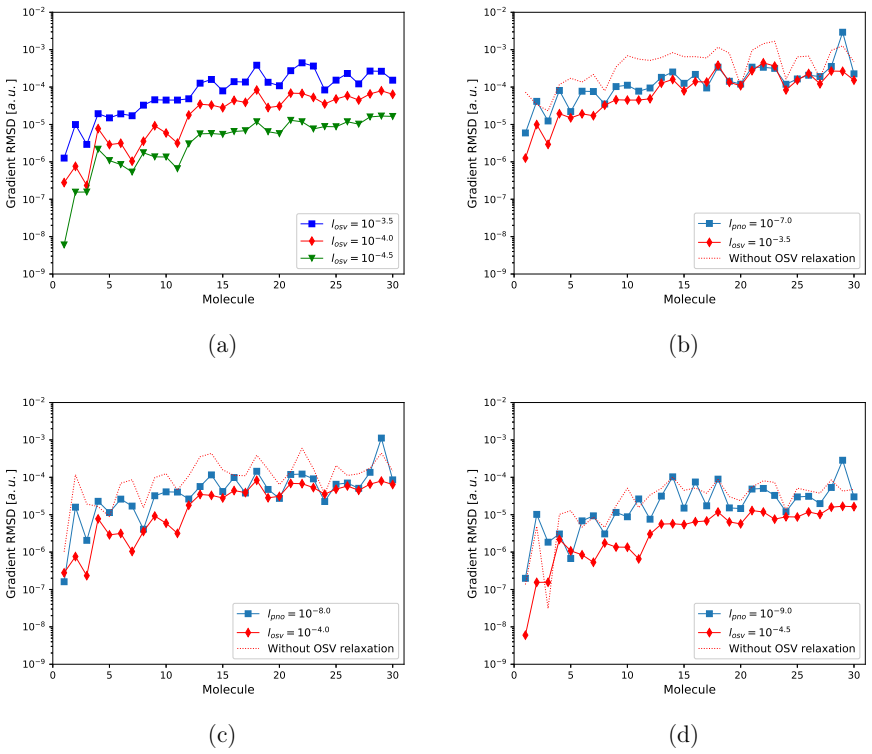
- At the normal OSV threshold, OSV-MP2 analytical gradients reproduce canonical RI-MP2 forces to about $10^{-4}$ a.u., and analytic gradients agree with finite-difference gradients to $10^{-6}$–$10^{-7}$ a.u., so the method can be used as a reliable force engine.
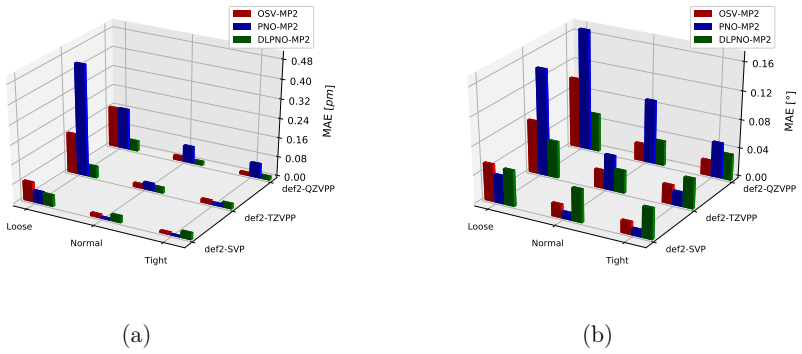
- Optimized geometries at def2-TZVPP recover RI-MP2 bond lengths within 0.017 pm, bond angles within 0.03 degrees, and dihedrals within 0.2 degrees, with errors decreasing as the OSV threshold is tightened.
- Including OSV relaxation lowers gradient errors by roughly an order of magnitude, so omitting it, as some earlier local-MP2 gradient implementations did, is the main accuracy cost at loose thresholds.
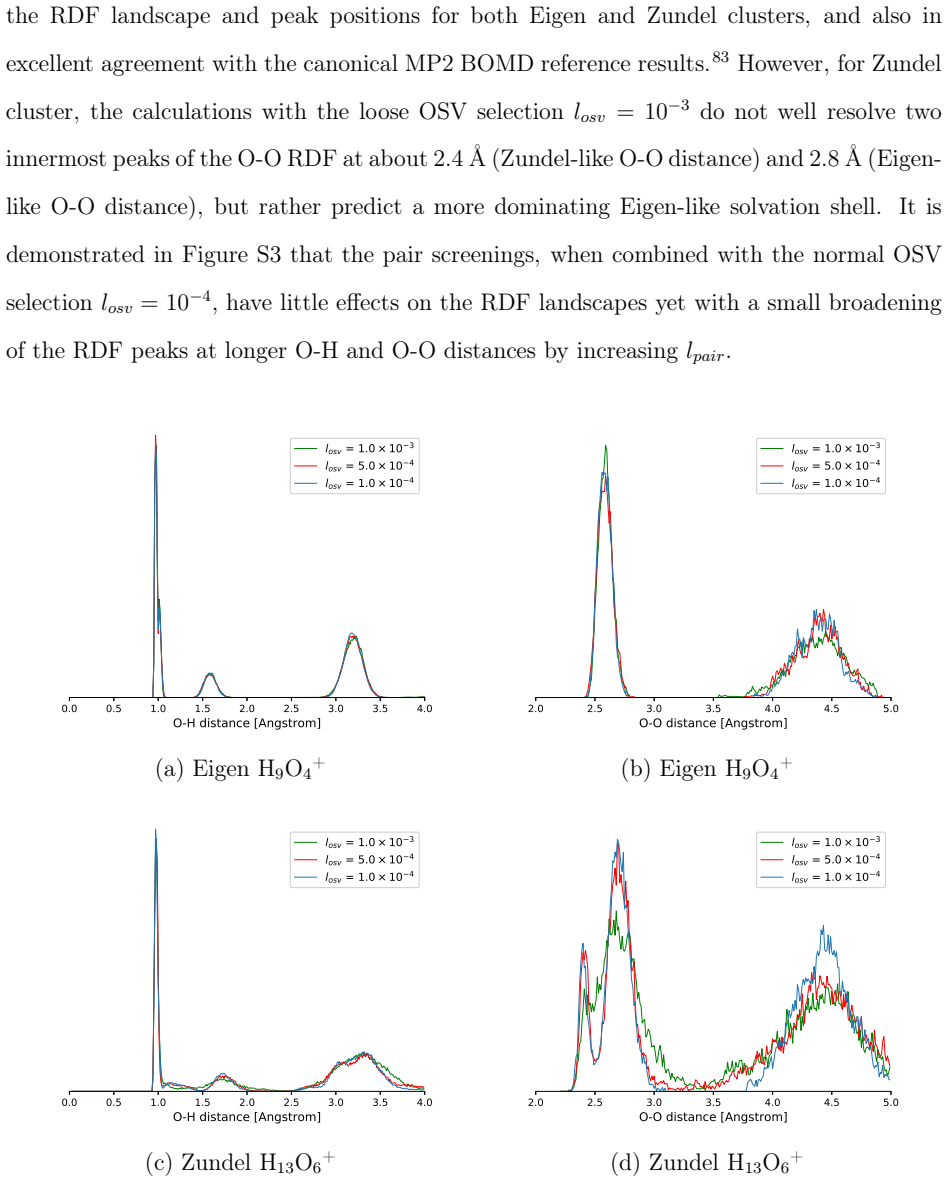
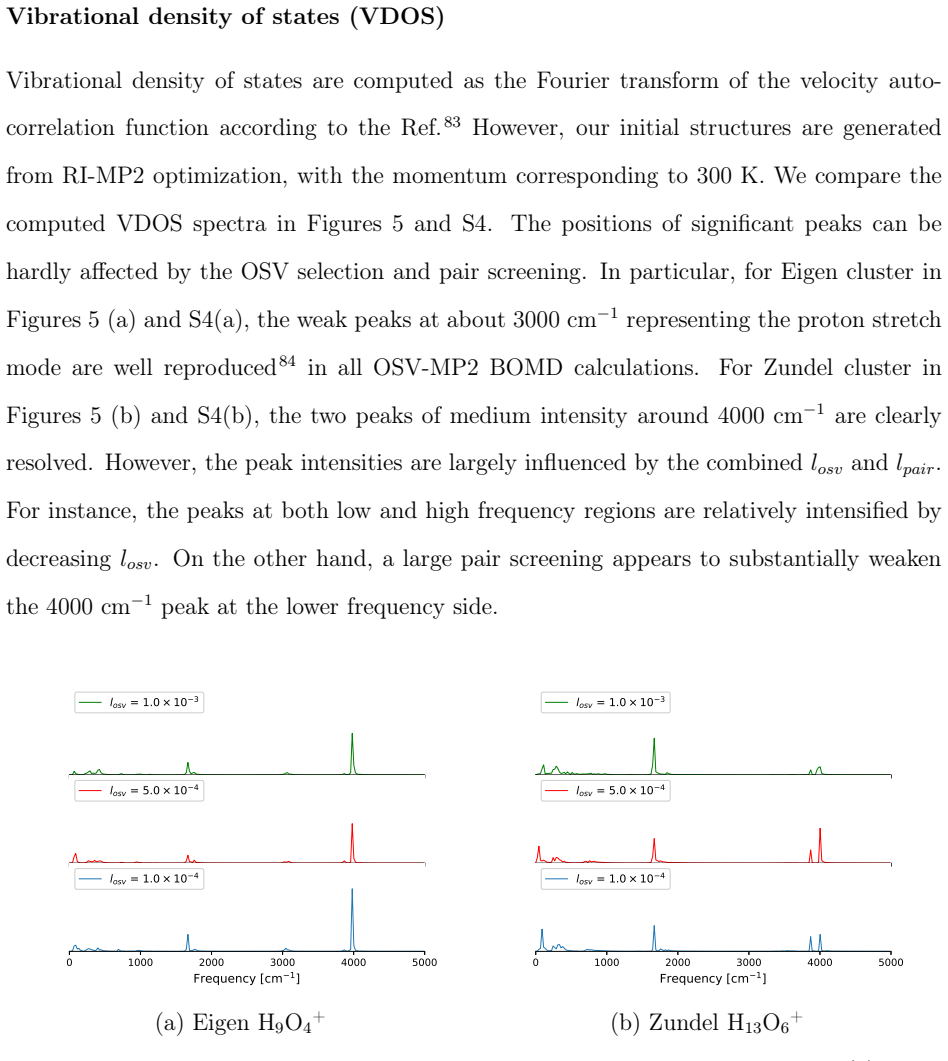
- The gradients conserve energy well enough for NVE Born–Oppenheimer dynamics: drifts below about 0.2 kJ/mol for protonated water cations with normal OSV selection, and the simulated O–H and O–O radial distribution functions and vibrational densities of states match canonical-MP2 dynamics.
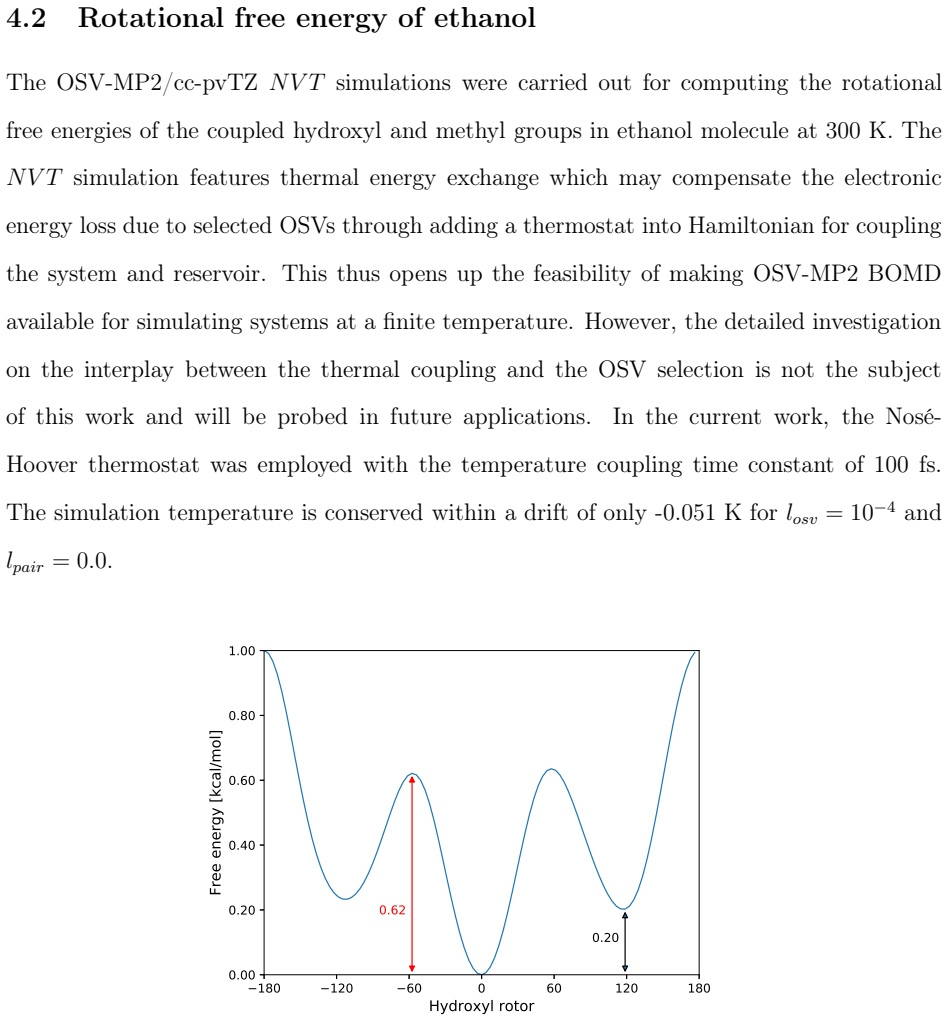
- The 200 ps NVT well-tempered metadynamics simulation of ethanol produces a hydroxyl-rotation free energy surface that distinguishes trans from gauche ethanol, providing OSV-MP2 finite-temperature barriers.
Reading between the lines
- The same relaxation ansatz should transfer to OSV-based coupled-cluster methods, because it decouples pair-specific rotations and only uses the diagonal amplitude matrix that defines the OSVs.
- The invariance result suggests gradient domains can be chosen smaller than energy domains without changing the gradient, which would directly reduce the dominant $O(N^3)$–$O(N^4)$ cost of the working equations.
- The near-degenerate safety of the Hadamard-product formula is only demonstrated numerically; a targeted test on a molecule with enforced exact eigenvalue degeneracy would show whether a degenerate perturbation treatment is ever needed.
- The ethanol metadynamics comparison hints that MP2 and CCSD(T) rotational free-energy surfaces may differ by about 0.5 kcal/mol, within thermal fluctuations at 300 K; repeating the OSV-MP2 run with a smaller thermostat coupling constant would separate thermostat artifact from correlation error.
Signed reviews
Editorial analysis
A structured set of objections, weighed in public.
Referee Report
Summary. The manuscript presents an analytical gradient theory for RI-OSV-MP2 that explicitly includes the relaxation of the orbital-specific virtual orbitals. The OSV response is obtained by solving a perturbed non-degenerate eigenvalue problem for each diagonal pair-amplitude matrix T_kk, with the key relaxation matrix O^λ_k given by a Hadamard product involving 1/(ω_ν − ω_μ) (Eq. 25). The gradient is decomposed into OSV-specific, MO-specific, and AO-specific contributions, and the implementation uses a Z-vector approach together with coupled-perturbed localization for Pipek–Mezey/meta-Löwdin orbitals. The numerical section compares analytical gradients against numerical gradients (RMSD ~10^-6 to 10^-7 a.u.), against RI-MP2 reference gradients, and against DLPNO-MP2 results, and applies the gradients to geometry optimizations, Born–Oppenheimer molecular dynamics of protonated water clusters, and well-tempered metadynamics of ethanol.
Significance. If the central derivation is accepted, this is a significant contribution: it is, to the best of my knowledge, the first complete analytic OSV-MP2 gradient implementation that treats OSV relaxation explicitly, and it enables local-correlation-quality molecular dynamics. The derivation is largely self-contained, uses no fitted parameters (only the convergence thresholds l_osv and l_pair), and the implementation is validated against independent RI-MP2 references and numerical gradients. The reported BOMD and metadynamics applications demonstrate practical utility. The main weakness is the treatment of near-degenerate OSV eigenvalues and of changes in the OSV selection with geometry, which is addressed only by numerical evidence and not by a mathematical argument.
major comments (2)
- [Sec. 2.2.2, Eq. (25); Sec. 1] The claim that the degenerate-eigenvalue issue 'does not occur' is not substantiated in the main text. Equation (25) contains denominators ω_ν − ω_μ, and a retained OSV paired with a discarded OSV of nearly equal eigenvalue that straddles the l_osv threshold can make these denominators arbitrarily small. The invariance in Eq. (28) only removes rotations within the retained OSV block; it does not control the retained/discarded pairs that enter Eq. (25). The numerical compensation shown in Figure 1 for N2 and C6H6 is encouraging but is not a general mathematical argument. The authors should either provide a general bound on the Hadamard product N_ij ∘ ΔG^T (e.g., showing that the numerator vanishes at the same order as Δω when the eigenvalues approach each other) or clearly state the non-degeneracy conditions under which Eq. (25) is valid, and correspondingly qualify the 'complete'/'exact' claim.
- [Sec. 2.2.2 and Sec. IV (BOMD)] The gradient derivation differentiates a fixed partition of OSVs into retained and discarded sets. When a geometry change carries an eigenvalue across the l_osv selection threshold, the selected energy can develop a kink, and the working equations (30)–(53) contain no term representing this discrete change in the OSV selection. This is load-bearing for the BOMD applications, which require smooth forces. The paper itself provides related evidence: in Table 7, the H13O6+ simulation with l_pair = 0.001 and losv = 10^-3 exhibits a large energy drift (δE ≈ 51 kJ/mol), and Sec. 4.1 attributes similar pair-screening drift to temporal changes in the number of kept pairs. The same mechanism is expected for OSV selection changes. Please either demonstrate that no OSV eigenvalue crosses the threshold in the reported simulations or extend the theory to account for selection-boundary changes.
minor comments (4)
- [Sec. 2.2.2, Eq. (28)] The invariance of the gradient with respect to rotations among retained OSVs is stated as a theorem, but the proof is deferred to SI S2. Since Eq. (28) is the key simplification that reduces the OSV response to the retained/discarded block, a short derivation or at least a clear statement of the underlying assumptions should appear in the main text.
- [Figure 1 caption] The caption does not state the geometry or the l_osv threshold used for the N2 and C6H6 examples. Please specify these details so that the reader can judge whether the plotted quantities are representative of the near-threshold regime.
- [Eq. (53) and Sec. 2.4] The central working equation (53) relies on intermediates A_ij,αβ, B_kl,ai, and C_kl,ij that are defined only by reference to Ref. 62. For a self-contained gradient theory, the definitions of these intermediates (or at least a brief statement of their structure) should be included or summarized.
- [General] There are several typographical and formatting issues, including duplicated words, non-ASCII artifacts in the reference list (e.g., 'MÃÿller', '484âĂŞ–507'), and inconsistent capitalization in Figure 2 ('THE OSV-MP2 gradients'). These should be corrected during revision.
Circularity Check
No circularity found: the OSV-MP2 gradient is derived from the defining OSV eigenvalue equation and checked against independent RI-MP2 and numerical gradients.
full rationale
The derivation chain is self-contained in Secs. 2.2 and 2.3. The OSV relaxation matrix O^lambda_k is not fitted or renamed as a prediction: Eq. (25) follows by differentiating the perturbed eigenvalue equation (17), with T^lambda_kk computed from Eq. (20) in terms of K^lambda and F^lambda, neither of which contains the final gradient E^lambda_c. The energy gradient (36) then contracts these first-order responses with the converged amplitudes and integrals. The invariance Eq. (28) is stated as a provable consequence of the Hylleraas residual vanishing, and the diagonal nature of Omega^lambda (Eq. 29) is deferred to SI S3; these are algebraic and numerical robustness claims, not self-referential definitions. The thresholds l_osv and l_pair are user-selected convergence parameters validated against independent RI-MP2 gradients and numerical finite-difference gradients (RMSD 10^-6 to 10^-7 a.u.), so no fitted input is renamed as a prediction. The only caveat is that the non-degenerate perturbation denominators 1/(omega_nu - omega_mu) in Eq. (25) can be large near the l_osv boundary; the paper addresses this with numerical evidence (Fig. 1) and deferred proofs, which is a correctness and robustness concern rather than circularity. Self-citations to the OSV methods (Refs. 20-23) supply the underlying ansatz but do not by themselves establish the gradient result.
Assumptions & free parameters
free parameters (2)
- losv =
10^-4 (normal selection used in applications)
- lpair =
10^-3 in timing tests; 0.0, 10^-4, 10^-3, 10^-2 in MD tests
assumptions (5)
- domain assumption OSVs are defined as eigenvectors of the semi-canonical MP2 diagonal pair amplitudes Tkk (Eq. 2).
- standard math Under a perturbation, perturbed OSVs are expanded in the complete unperturbed OSV basis (Eq. 9).
- ad hoc to paper The perturbed OSV-projected amplitude matrix Omega_k(lambda) remains diagonal (Eq. 29, SI S3).
- domain assumption The unperturbed Hylleraas residual is well converged and the energy is variational in the amplitudes (Eq. 8).
- domain assumption RI approximation for two-electron integrals (Eq. 49).
Cite this review
Pith. "Pith review of A complete OSV-MP2 analytical gradient theory for molecular structure and dynamics simulations." pith.science (2026). https://pith.science/paper/2DFSLKSI
@misc{pith2026190803674,
  author       = {Pith},
  title        = {Pith review of: A complete OSV-MP2 analytical gradient theory for molecular structure and dynamics simulations},
  year         = {2026},
  howpublished = {\url{https://pith.science/paper/2DFSLKSI}},
  note         = {Machine review of arXiv:1908.03674}
}
read the original abstract
We propose an exact algorithm for computing the analytical gradient within the framework of the orbital-specific-virtual (OSV) second-order M{\o}ller-Plesset (MP2) theory in resolution-of-identity (RI) approximation. We implement the exact relaxation of perturbed OSVs through the explicit constraints of the perturbed orthonormality, the perturbed diagonality and the perturbed singular value condition. We explicitly show that the rotation of OSVs within the retained OSV subspace makes no contribution to gradients, as long as the iterative solution of the unperturbed Hylleraas residual equation is well converged. The OSV relaxation is solved as the perturbed non-degenerate singular value problem between the retained and discarded OSV subspaces. The detailed derivation and preliminary implementations for gradient working equations are discussed. The coupled-perturbed localization method is implemented for meta-L\"owdin localization function. The numerical accuracy of computed OSV-MP2 gradients is demonstrated for the geometries of selected molecules that are often discussed in other theories. Moreover, the OSV-MP2 analytical gradients can generate atomic forces that are utilized to drive the Born-Oppenheimer molecular dynamics (BOMD) simulation for studying structural and vibrational properties with respect to OSV selections. By performing the OSV-MP2 NVE BOMD calculation using the normal OSV selection, the structural and vibrational details of protonated water cations are well reproduced. The 200 picoseconds NVT well-tempered metadynamics at 300 K has been simulated to compute the OSV-MP2 rotational free energy surface of coupled hydroxyl and methyl rotors for ethanol molecule.
Figures

Figures from the paper (4 more)

Reference graph
Works this paper leans on
-
[1]
(1) Zaleśny, R.; Papadopoulos, M. G.; Mezey, P. G.; Leszczyn ski, J. Linear-Scaling Tech- niques in Computational Chemistry and Physics: Methods and Applications; Springer Science & Business Media, 2011; Vol
work page 2011
-
[2]
J. Chem. Phys. 1991, 94, 442–447. (60) Hald, K.; Halkier, A.; Jørgensen, P.; Coriani, S.; Hätt ig, C.; Helgaker, T. A La- grangian, integral-density direct formulation and implem entation of the analytic CCSD and CCSD (T) gradients. J. Chem. Phys. 2003, 118, 2985–2998. (61) Bozkaya, U.; Sherrill, C. D. Analytic energy gradients for the coupled-cluster sin...
work page 1930
-
[4]
Parallel explicitly correlated local coupled cluster wi th pair natural orbitals (PNO- LCCSD-F12). J. Chem. Theory Comput. 2017, 13, 4871–4896. (34) Ma, Q.; Werner, H.-J. Scalable Electron Correlation Me thods
work page 2017
-
[5]
Parallel Perturbative Triples Correction for Explicitly Correlated Local Couple d Cluster with Pair Natural Orbitals. J. Chem. Theory Comput. 2018, 14, 198–215. (35) Saitow, M.; Becker, U.; Riplinger, C.; Valeev, E. F.; Ne ese, F. A new near-linear scaling, efficient and accurate, open-shell domain-based local pair n atural orbital coupled cluster singles a...
work page 2018
-
[50]
Numerical Methods For Large Eigenvalue Problems: revised e dition; Siam, 2011; Vol
(75) Saad, Y. Numerical Methods For Large Eigenvalue Problems: revised e dition; Siam, 2011; Vol
work page 2011
-
[66]
44 (76) Pipek, J.; Mezey, P. G. A fast intrinsic localization pr ocedure applicable for abinitio and semiempirical linear combination of atomic orbital wav e functions. J. Chem. Phys. 1989, 90, 4916–4926. (77) Sun, Q.; Chan, G. K.-L. Exact and optimal quantum mechan ics/molecular mechanics boundaries. J. Chem. Theory Comput. 2014, 10, 3784–3790. (78) Feye...
work page 1989
-
[300]
Software update: the ORCA program system, ver sion 4.0
(82) Neese, F. Software update: the ORCA program system, ver sion 4.0. Wiley Interdiscip. Rev. Comput. Mol. Sci. 2018, 8, e1327. (83) Li, J.; Haycraft, C.; Iyengar, S. S. Hybrid extended Lag rangian, post-Hartree–Fock Born–Oppenheimer ab initio molecular dynamics using fragm ent-based electronic struc- ture. J. Chem. Theory Comput. 2016, 12, 2493–2508. (8...
work page 2018
-
[363]
RI-MP 2: optimized auxiliary basis sets and demonstration of efficiency
(79) Weigend, F.; Häser, M.; Patzelt, H.; Ahlrichs, R. RI-MP 2: optimized auxiliary basis sets and demonstration of efficiency. Chem. Phys. Lett. 1998, 294, 143–152. (80) Baker, J. Techniques for geometry optimization: A comp arison of Cartesian and natural internal coordinates. J. Comput. Chem. 1993, 14, 1085–1100. (81) Foster, J.; Boys, S. Canonical config...
work page 1998
Show all 14 references
-
[1169]
C.; Shao, Y.; Head-Gordon, M
(50) Lochan, R. C.; Shao, Y.; Head-Gordon, M. Quartic-Scali ng Analytical Energy Gradient of Scaled Opposite-Spin Second-Order Møller–Plesset Pert urbation Theory. J. Chem. Theory Comput. 2007, 3, 988–1003. (51) Distasio Jr, R. A.; Steele, R. P.; Head-Gordon, M. The an alytica...
2007
-
[1994]
RI-MP2: first derivatives and glo bal consistency
(48) Weigend, F.; Häser, M. RI-MP2: first derivatives and glo bal consistency. Theor. Chem. Acc. 1997, 97, 331–340. (49) Hättig, C.; Hellweg, A.; Köhn, A. Distributed memory pa rallel implementation of energies and gradients for second-order Møller–Plesset pe rturbation theory ...
1997
-
[2017]
J.; Carter, E
(3) Martinez, T. J.; Carter, E. A. Pseudospectral Møller–Pl esset perturbation theory through third order. J. Chem. Phys. 1994, 100, 3631–3638. (4) Ayala, P. Y.; Scuseria, G. E. Linear scaling second-orde r Møller–Plesset theory in the atomic orbital basis for large molecular ...
1994
-
[3114]
F.; Neese, F
(37) Guo, Y.; Sivalingam, K.; Valeev, E. F.; Neese, F. Sparse Maps-A systematic infrastruc- ture for reduced-scaling electronic structure methods. II I. Linear-scaling multireference domain-based pair natural orbital N-electron valence pert urbation theory. J. Chem. Phys. 2016...
2016
-
[3887]
E.; Chmiela, S.; Poltavsky, I.; Müller, K.- R.; Tkatchenko, A
(87) Sauceda, H. E.; Chmiela, S.; Poltavsky, I.; Müller, K.- R.; Tkatchenko, A. Molecular force fields with gradient-domain machine learning: Constr uction and application to dynamics of small molecules with coupled cluster forces. J. Chem. Phys. 2019, 150, 114102. (88) Dyczmon...
2019
-
[6470]
S.; Maslen, P
(6) Lee, M. S.; Maslen, P. E.; Head-Gordon, M. Closely approx imating second-order Mo/ller–Plesset perturbation theory with a local triatomi cs in molecules model. J. Chem. Phys. 2000, 112, 3592–3601. (7) Pulay, P. Localizability of dynamic electron correlati on. Chem. Phys. L...
2000
Reviewed August 14, 2026 · model on record in the stance chip above.
Discussion (0). Continue with ORCID to comment.