REVIEW 3 major objections 5 minor 48 references
UncertainSAM: Fast and Efficient Uncertainty Quantification of the Segment Anything Model
T0 review · 3 major / 5 minor · reviewed 2026-08-15 · deepseek-v4-flash
Pith's one-line read The paper claims that a deterministic post-hoc MLP can separate SAM's uncertainty into model, prompt, and task components, and that this estimator beats SAM's own confidence score on five datasets.
desk verdict A useful, well-engineered post-hoc UQ method for SAM with a sensible uncertainty decomposition, but the evaluation is in-distribution and the 'state-of-the-art' claim is stronger than the data support. read the letter →
The pith
A machine-rendered reading of the paper's core claim, the machinery that carries it, and where it could break.
The reading
What carries the argument
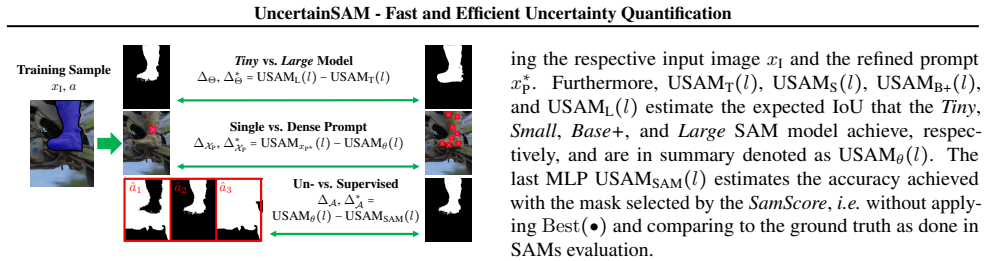
The load-bearing machinery is a Bayesian entropy decomposition of SAM's predictive uncertainty (their Equation 2), which extends the standard aleatoric/epistemic split by explicitly factoring in the prompt and the task-definition step, plus USAM's three-layer MLP gap predictors. The decomposition writes predictive uncertainty as an integral over task hypotheses, prompt distributions, and model weights; the MLPs approximate the same quantities by regressing on differences of expected IoU --- $\Delta_{X_P}$ for prompt quality, $\Delta_A$ for task ambiguity, $\Delta_\Theta$ for model scale --- directly from SAM's mask and IoU tokens. This design lets the method run deterministically at inference time, without image or prompt augmentation, without ensembling, and without any change to SAM's weights.
What would settle it
Train USAM's gap MLPs on SA-V only and evaluate them on COCO, ADE20k, DAVIS, and MOSE; if the relative AUC for task uncertainty drops to the level of the Bayesian entropy baseline, the reported superiority is in-distribution memorization rather than a general latent signal.
Extended reading notes
Core claim
The paper's central claim is that USAM, a set of deterministic post-hoc MLPs that ingest SAM's 256-dimensional mask and IoU tokens, accurately quantifies where SAM's segmentation uncertainty comes from. Starting from a Bayesian entropy decomposition of predictive uncertainty into epistemic, prompt, and task components, the authors train separate MLPs to predict the expected IoU for a given SAM variant and the expected IoU gaps between a single-point and a refined prompt, between supervised and SamScore mask selection, and between the Tiny and Large backbones. They report that these gap estimators identify the samples that most need a better model, a better prompt, or human supervision across SA-V, ADE20k, COCO, DAVIS, and MOSE, and that the direct "delta-star" versions match or surpass a full Bayesian Monte Carlo entropy approximation while adding only a few milliseconds of runtime.
Load-bearing premise
USAM's MLPs are trained with ground-truth masks on the same datasets they are evaluated on, so the headline results measure in-distribution ranking ability rather than transfer to a new distribution.
Editorial extensions
If this is right
- In applications that use SAM Tiny for speed, USAM's $\Delta_\Theta$ can flag the images where switching to SAM Large buys the most accuracy, so the large model is only run when it matters.
- In interactive segmentation, users can be prompted to add points exactly where $\Delta_{X_P}$ is high, improving masks without full manual review.
- USAM's $\Delta_A$ can route ambiguous proposals to human supervision: the experiment shows that supervising the most uncertain samples recovers nearly oracle-level mIoU.
- Since USAM only reads tokens SAM already computes, it can be attached to existing SAM pipelines at negligible latency (about 0.004 seconds per image in the paper's runtime table).
Reading between the lines
- Editorial extension: the published experiments train and evaluate USAM on the same dataset distributions, so the method's cross-dataset generalization is untested; the natural next check is to train on SA-V alone and report AUC on COCO, ADE20k, and DAVIS.
- Editorial extension: because the gap MLPs depend only on SAM's mask and IoU tokens, the same recipe should transfer to SAM 2 and to other promptable segmenters if their decoders expose analogous tokens, but the paper does not demonstrate this transfer.
- Editorial extension: USAM's predicted task uncertainty could be used as a training signal itself, for example to down-weight ambiguous masks during fine-tuning, but the paper does not explore this use.
Signed reviews
Editorial analysis
A structured set of objections, weighed in public.
Referee Report
Summary. The paper introduces UncertainSAM (USAM), a post-hoc uncertainty quantification method for the Segment Anything Model (SAM). It first proposes a Bayesian entropy decomposition that separates predictive uncertainty into aleatoric task uncertainty, aleatoric prompt uncertainty, and epistemic model uncertainty, implemented via Monte Carlo sampling over image augmentations, sampled prompts, SAM's mask proposals, and four pretrained model sizes. It then trains lightweight MLPs on SAM's mask and IoU tokens to directly predict expected IoU and gap quantities (prompt gap, task gap, model gap), avoiding the computational cost of MC sampling. Experiments on SA-V, MOSE, ADE20k, DAVIS, and COCO measure ranking quality through correction-AUC for model selection, prompt refinement, task supervision, and overall segmentation-error correction, comparing USAM against SamScore, mask entropy, and the Bayesian entropy baselines. The paper claims that USAM is faster, lighter, and generally more accurate than existing UQ methods for SAM.
Significance. If the central claim holds, the paper would provide a practical, low-cost uncertainty estimator that can be attached to SAM without retraining the foundation model, with a conceptually useful decomposition into prompt, task, and model uncertainty. The strengths of the paper include a publicly available code repository, a broad set of experiments across five datasets, token ablations, runtime measurements, and cross-dataset tables in the appendix that show some robustness of the trained MLPs. The significance is tempered, however, by the fact that the main comparison is between a supervised method (trained on ground-truth IoU targets) and training-free baselines, and by the absence of a genuine out-of-distribution test. The theoretical framing as a Bayesian formulation rests on ad-hoc uniform/proxy distributions rather than a derived posterior. With these caveats, the contribution is a useful empirical study and a lightweight estimator, but the claimed state-of-the-art superiority is not yet fully established.
major comments (3)
- [§4.1, Tables 1–4] The main evaluation compares USAM, whose MLPs are trained on ground-truth IoU and gap targets computed on the training split of each evaluated dataset, against SamScore, mask entropy, and the Bayesian entropies, all of which are used without any training or ground-truth supervision on the test distribution. The reported 'superior' relative-AUC values therefore do not separate the quality of the uncertainty representation from the advantage of supervised in-distribution fitting. This is a load-bearing issue for the central claim that USAM 'outperforms existing methods.' The appendix cross-dataset tables (Tables 11–13) partially address memorization concerns, but all five datasets are natural-image segmentation benchmarks close to SAM's training distribution, and the abstract motivates medical, satellite, and autonomous-driving applications that are never tested. I ask the authors to (a) move or summarize the cross-dataset experiment in the main text, (b) add at least one genuinely different image distribution, and (c) explicitly state that the main-text comparisons are supervised in-distribution evaluations against training-free baselines.
- [§3.1 and §A, Eqs. (8)–(10)] The Bayesian derivation is not a posterior approximation over network weights: p(θ|D) is set to a uniform distribution over four pretrained checkpoints of different architecture sizes, p(xP|t(xI),a) is a uniform distribution over eight sampled coordinate prompts, and p(â|...) is set proportional to the SamScore. These choices are acknowledged in the appendix, but they are heuristic sampling distributions, not a variational or Monte Carlo approximation of a posterior. In addition, Eq. (2) contains a likelihood term p(y|xI,â,θ), but the computation in Eq. (4) replaces this with deterministic SAM masks and computes the entropy of their weighted average, without defining a likelihood. I therefore find the 'theoretically motivated Bayesian entropy formulation' claim in the abstract stronger than what is actually established. The authors should either provide a concrete link between these sampling distributions and Eq. (1), or rename the approach as a heuristic ensemble-entropy estimator and temper the theoretical claims accordingly.
- [§4.4, Table 3] The task-uncertainty gap is trained to predict the difference between the IoU of the ground-truth-best mask and the IoU of the SamScore-selected mask, and the evaluation protocol ranks samples by exactly this gap and then substitutes the ground-truth-best mask. Since the MLPs are trained and evaluated on the same data distribution, the near-94% relative AUC in Table 3 may reflect successful regression of the supervised target rather than discovery of a distinct 'task uncertainty' signal. The comparison with the unsupervised Bayesian HA is therefore not apples-to-apples. Please add an analysis that separates these explanations: for example, train on one dataset and evaluate on a different domain, compare against a supervised baseline that regresses the same target from the same tokens under an identical protocol but without the USAM decomposition, or report calibration/reliability curves for the predicted gaps. The claim in §4.4 that 'USAM is superior' should be conditional on such an analysis.
minor comments (5)
- [Abstract and §4.2] The abstract states 'superior predictive capabilities on the SA-V, MOSE, ADE20k, DAVIS, and COCO datasets,' but Table 1 shows HΘ outperforming both USAM variants on DAVIS (73.46 vs. 66.85/59.08) and matched results on MOSE, and Table 2 shows HXP outperforming USAM on DAVIS (80.75 vs. 75.04/75.53). Please qualify the claim to avoid overstating the results.
- [Figure 5 caption] There is a typo in the caption: 'The third and foruth' should read 'The third and fourth.'
- [Table 8] Table 8 lists 70 hyperparameter configurations in the main text; this level of detail is better placed in supplementary material or summarized as a range, since it distracts from the method description.
- [Eqs. (4)–(7)] The index notation for the mask y is inconsistent between equations: Eq. (4) uses the order (t, xP, θ, â), while Eqs. (5)–(7) use different orderings or omit indices. Please define a single consistent notation, including the explicit dependence of â on xI, xP, and θ.
- [§4.1] The text says 'the training is performed only using the training data of the respective dataset without access to validation data,' but for MOSE the models are trained on SA-V and evaluated on MOSE train data. This is a deviation from the stated protocol and should be described as a cross-dataset evaluation, not as standard training/validation on 'the respective dataset.'
Circularity Check
No significant circularity: USAM is a supervised post-hoc estimator evaluated on held-out in-distribution data; Bayesian baselines rest on explicitly stated assumptions.
full rationale
I find no circular step. USAM is a set of MLPs trained with MSE against IoU-based gap targets (USAMθ, USAMSAM, USAMxP*, and the Δ* variants) computed from SAM predictions and ground-truth masks (Sec. 3.2). The evaluation measures ranking quality on held-out validation splits of the same five datasets (Sec. 4.1). This is a standard supervised regression evaluation; the targets are not defined in terms of the predictions, and the MLP weights are not derived from the evaluation metric. The Bayesian entropy baselines (HY, HΘ, HXP, HA) are approximations with explicitly stated assumptions (uniform prompt/model probabilities and SamScore-normalized task probabilities, Eqs. 8-10), so their limited performance is an empirical finding, not a tautology. The paper's self-citations (Kaiser et al. 2022/2023/2024, Glandorf et al. 2023) are related-work context and are not load-bearing for the USAM derivation or the main comparisons. The abstract phrase 'use this formulation to train USAM' overstates the link, since Sec. 3.2 trains on IoU objectives rather than on the entropy losses, but this is an expositional mismatch, not a circular reduction. The absence of a true distribution-shift test is a limitation of the empirical claim's scope, not circularity.
Assumptions & free parameters
free parameters (1)
- USAM MLP hyperparameters =
SMAC3-optimized per dataset
assumptions (3)
- ad hoc to paper p(xP | t(xI), a) is uniform over sampled prompts (Eq. 8).
- ad hoc to paper p(theta | D) is uniform over the four model sizes (Eq. 9).
- ad hoc to paper p(a_hat | t(xI), xP, theta) is proportional to SamScore (Eq. 10).
invented entities (1)
-
Task uncertainty
Cite this review
Pith. "Pith review of UncertainSAM: Fast and Efficient Uncertainty Quantification of the Segment Anything Model." pith.science (2026). https://pith.science/paper/2DHSEYTK
@misc{pith2026250505049,
  author       = {Pith},
  title        = {Pith review of: UncertainSAM: Fast and Efficient Uncertainty Quantification of the Segment Anything Model},
  year         = {2026},
  howpublished = {\url{https://pith.science/paper/2DHSEYTK}},
  note         = {Machine review of arXiv:2505.05049}
}
read the original abstract
The introduction of the Segment Anything Model (SAM) has paved the way for numerous semantic segmentation applications. For several tasks, quantifying the uncertainty of SAM is of particular interest. However, the ambiguous nature of the class-agnostic foundation model SAM challenges current uncertainty quantification (UQ) approaches. This paper presents a theoretically motivated uncertainty quantification model based on a Bayesian entropy formulation jointly respecting aleatoric, epistemic, and the newly introduced task uncertainty. We use this formulation to train USAM, a lightweight post-hoc UQ method. Our model traces the root of uncertainty back to under-parameterised models, insufficient prompts or image ambiguities. Our proposed deterministic USAM demonstrates superior predictive capabilities on the SA-V, MOSE, ADE20k, DAVIS, and COCO datasets, offering a computationally cheap and easy-to-use UQ alternative that can support user-prompting, enhance semi-supervised pipelines, or balance the tradeoff between accuracy and cost efficiency.
Figures


Figures from the paper (5 more)


Reference graph
Works this paper leans on
-
[1]
write newline
" write newline "" before.all 'output.state := FUNCTION n.dashify 't := "" t empty not t #1 #1 substring "-" = t #1 #2 substring "--" = not "--" * t #2 global.max substring 't := t #1 #1 substring "-" = "-" * t #2 global.max substring 't := while if t #1 #1 substring * t #2 global.max substring 't := if while FUNCTION format.date year duplicate empty "emp...
-
[2]
Aggarwal, P., Madaan, A., Anand, A., Potharaju, S. P., Mishra, S., Zhou, P., Gupta, A., Rajagopal, D., Kappaganthu, K., Yang, Y., Upadhyay, S., Faruqui, M., and ., M. Automix: Automatically mixing language models. In Proceedings of the Annual Conference on Neural Information Processing Systems (NIPS), 2024
work page 2024
-
[3]
Automatic image colorization via multimodal predictions
Charpiat, G., Hofmann, M., and Scholkopf, B. Automatic image colorization via multimodal predictions. In Proceedings of the European Conference on Computer Vision (ECCV), 2008
work page 2008
-
[4]
SAM - U : Multi -box Prompts Triggered Uncertainty Estimation for Reliable SAM in Medical Image
Deng, G., Zou, K., Ren, K., Wang, M., Yuan, X., Ying, S., and Fu, H. SAM - U : Multi -box Prompts Triggered Uncertainty Estimation for Reliable SAM in Medical Image . In In Proceedings of the Medical Image Computing and Computer Assisted Intervention Workshops (MICCAI), 2023
work page 2023
-
[5]
Ding, H., Liu, C., He, S., Jiang, X., Torr, P. H., and Bai, S. MOSE : A new dataset for video object segmentation in complex scenes. In Proceedings of the International Concference on Computer Vision (ICCV), 2023
work page 2023
-
[6]
An image is worth 16x16 words: Transformers for image recognition at scale
Dosovitskiy, A., Beyer, L., Kolesnikov, A., Weissenborn, D., Zhai, X., Unterthiner, T., Dehghani, M., Minderer, M., Heigold, G., Gelly, S., Uszkoreit, J., and Houlsby, N. An image is worth 16x16 words: Transformers for image recognition at scale. ICLR, 2021
2021
-
[7]
Gal, Y. and Ghahramani, Z. Bayesian convolutional neural networks with bernoulli approximate variational inference. arXiv preprint, 2015
work page 2015
-
[8]
Gal, Y. and Ghahramani, Z. Dropout as a bayesian approximation: Representing model uncertainty in deep learning. In Proceedings of the International Conference on Machine Learning (ICML), 2016
work page 2016
Show all 48 references
-
[9]
A survey of uncertainty in deep neural networks
Gawlikowski, J., Tassi, C., Ali, M., Lee, J., Humt, M., Feng, J., Kruspe, A., Triebel, R., Jung, P., Roscher, R., Shahzad, M., Yang, W., Bamler, R., and Zhu, X. A survey of uncertainty in deep neural networks. Artificial Intelligence Review, 2023
2023
-
[10]
Hypersparse neural networks: Shifting exploration to exploitation through adaptive regularization
Glandorf, P., Kaiser, T., and Rosenhahn, B. Hypersparse neural networks: Shifting exploration to exploitation through adaptive regularization. In Proceedings of the International Conference on Computer Vision Workshop (ICCVW), 2023
2023
-
[11]
and Fookes, C
Goan, E. and Fookes, C. Bayesian neural networks: An introduction and survey. Case Studies in Applied Bayesian Data Science: CIRM Jean-Morlet Chair, Fall 2018, 2020
2018
-
[12]
Safe resetless reinforcement learning: Enhancing training autonomy with risk-averse agents
Gottwald, T., Schier, M., and Rosenhahn, B. Safe resetless reinforcement learning: Enhancing training autonomy with risk-averse agents. In Proceedings of the European Conference on Computer Vision Workshops (ECCVW), 2024
2024
-
[13]
O., Schierholz, M., Kreuter, F., and Kauermann, G
Gruber, C., Schenk, P. O., Schierholz, M., Kreuter, F., and Kauermann, G. Sources of uncertainty in machine learning--a statisticians' view. arXiv preprint, 2023
2023
-
[14]
Multiple choice learning: Learning to produce multiple structured outputs
Guzm\' a n-rivera, A., Batra, D., and Kohli, P. Multiple choice learning: Learning to produce multiple structured outputs. In Advances in Neural Information Processing Systems, 2012
2012
-
[15]
\'E tude comparative de la distribution florale dans une portion des alpes et des jura
Jaccard, P. \'E tude comparative de la distribution florale dans une portion des alpes et des jura. Bull Soc Vaudoise Sci Nat, 1901
1901
-
[16]
Uncertainty-aware adapter: Adapting segment anything model (sam) for ambiguous medical image segmentation
Jiang, M., Zhou, J., Wu, J., Wang, T., Jin, Y., and Xu, M. Uncertainty-aware adapter: Adapting segment anything model (sam) for ambiguous medical image segmentation. arXiv preprint, 2024
2024
-
[17]
Subjective Logic: A formalism for reasoning under uncertainty
Jsang, A. Subjective Logic: A formalism for reasoning under uncertainty. Springer Publishing Company, Incorporated, 2018
2018
-
[18]
Blind knowledge distillation for robust image classification
Kaiser, T., Ehmann, L., Reinders, C., and Rosenhahn, B. Blind knowledge distillation for robust image classification. arXiv preprint, 2022
2022
-
[19]
Compensation learning in semantic segmentation
Kaiser, T., Reinders, C., and Rosenhahn, B. Compensation learning in semantic segmentation. In Proceedings of Conference on Computer Vision and Pattern Recognition Workshops (CVPRW), 2023
2023
-
[20]
Cell tracking according to biological needs--strong mitosis-aware multi-hypothesis tracker with aleatoric uncertainty
Kaiser, T., Schier, M., and Rosenhahn, B. Cell tracking according to biological needs--strong mitosis-aware multi-hypothesis tracker with aleatoric uncertainty. arXiv preprint arXiv:2403.15011, 2024
2024 arXiv
-
[21]
Position: Uncertainty quantification needs reassessment for large language model agents
Kirchhof, M., Kasneci, G., and Kasneci, E. Position: Uncertainty quantification needs reassessment for large language model agents. In Forty-second International Conference on Machine Learning Position Paper Track, 2025. URL https://openreview.net/forum?id=Lrv20S5RZV
2025
-
[22]
C., Lo, W.-Y., et al
Kirillov, A., Mintun, E., Ravi, N., Mao, H., Rolland, C., Gustafson, L., Xiao, T., Whitehead, S., Berg, A. C., Lo, W.-Y., et al. Segment anything. In Proceedings of the International Conference on Computer Vision (ICCV), 2023
2023
-
[23]
and Rosenhahn, B
Kruse, M. and Rosenhahn, B. Multi-flow: Multi-view-enriched normalizing flows for industrial anomaly detection. In CVPR Workshops 2025, June 2025
2025
-
[24]
I., Bertin, P., Rector-Brooks, J., Korablyov, M., and Bengio, Y
Lahlou, S., Jain, M., Nekoei, H., Butoi, V. I., Bertin, P., Rector-Brooks, J., Korablyov, M., and Bengio, Y. DEUP : Direct epistemic uncertainty prediction. Transactions on Machine Learning Research, 2023
2023
-
[25]
Simple and scalable predictive uncertainty estimation using deep ensembles
Lakshminarayanan, B., Pritzel, A., and Blundell, C. Simple and scalable predictive uncertainty estimation using deep ensembles. In Advances in Neural Information Processing Systems, 2017
2017
-
[26]
Flaws can be applause: Unleashing potential of segmenting ambiguous objects in sam
Li, C., Li, W., Liu, H., Liu, X., Xu, Q., Chen, Z., Huang, Y., and Yuan, Y. Flaws can be applause: Unleashing potential of segmenting ambiguous objects in sam. Advances in Neural Information Processing Systems, 37: 0 45578--45599, 2024
2024
-
[27]
L., and Dollár, P
Lin, T.-Y., Maire, M., Belongie, S., Bourdev, L., Girshick, R., Hays, J., Perona, P., Ramanan, D., Zitnick, C. L., and Dollár, P. Microsoft coco: Common objects in context. arXiv preprint, 2015
2015
-
[28]
Smac3: A versatile bayesian optimization package for hyperparameter optimization
Lindauer, M., Eggensperger, K., Feurer, M., Biedenkapp, A., Deng, D., Benjamins, C., Ruhkopf, T., Sass, R., and Hutter, F. Smac3: A versatile bayesian optimization package for hyperparameter optimization. Journal of Machine Learning Research, 2022
2022
-
[29]
Uncertainty-aware fine-tuning of segmentation foundation models
Liu, K., Price, B., Kuen, J., Fan, Y., Wei, Z., Figueroa, L., Geras, K., and Fernandez-Granda, C. Uncertainty-aware fine-tuning of segmentation foundation models. Advances in Neural Information Processing Systems, 37: 0 53317--53389, 2024
2024
-
[30]
Mooney, C. Z. Monte carlo simulation. Sage, 1997
1997
-
[31]
D., Quercia, A., Fortuin, V., N \"o h, K., and Scharr, H
Paul, R. D., Quercia, A., Fortuin, V., N \"o h, K., and Scharr, H. Parameter-efficient bayesian neural networks for uncertainty-aware depth estimation. arXiv preprint arXiv:2409.17085, 2024
2024 arXiv
-
[32]
A benchmark dataset and evaluation methodology for video object segmentation
Perazzi, F., Pont-Tuset, J., McWilliams, B., Van Gool , L., Gross, M., and Sorkine-Hornung, A. A benchmark dataset and evaluation methodology for video object segmentation. In Computer Vision and Pattern Recognition, 2016
2016
-
[33]
Deep-learning uncertainty estimation for data-consistent breast tomosynthesis reconstruction
Quillent, A., Bismuth, V., Bloch, I., Kervazo, C., and Ladjal, S. Deep-learning uncertainty estimation for data-consistent breast tomosynthesis reconstruction. In Proceedings of the International Symposium on Biomedical Imaging (ISBI), 2024
2024
-
[34]
W., Hallacy, C., Ramesh, A., Goh, G., Agarwal, S., Sastry, G., Askell, A., Mishkin, P., Clark, J., et al
Radford, A., Kim, J. W., Hallacy, C., Ramesh, A., Goh, G., Agarwal, S., Sastry, G., Askell, A., Mishkin, P., Clark, J., et al. Learning transferable visual models from natural language supervision. In Proceedings of the International Conference on Machine Learning (ICML), 2021
2021
-
[35]
V., Carion, N., Wu, C.-Y., Girshick, R., Doll \'a r, P., and Feichtenhofer, C
Ravi, N., Gabeur, V., Hu, Y.-T., Hu, R., Ryali, C., Ma, T., Khedr, H., R \"a dle, R., Rolland, C., Gustafson, L., Mintun, E., Pan, J., Alwala, K. V., Carion, N., Wu, C.-Y., Girshick, R., Doll \'a r, P., and Feichtenhofer, C. Sam 2: Segment anything in images and videos. arXiv ...
2024
-
[36]
M., Bradbury, K., and Malof, J
Ren, S., Luzi, F., Lahrichi, S., Kassaw, K., Collins, L. M., Bradbury, K., and Malof, J. M. Segment anything, from space? In Proceedings of the Winter Conference on Applications of Computer Vision (WACV), 2024
2024
-
[37]
Dropout: a simple way to prevent neural networks from overfitting
Srivastava, N., Hinton, G., Krizhevsky, A., Sutskever, I., and Salakhutdinov, R. Dropout: a simple way to prevent neural networks from overfitting. The journal of machine learning research, 2014
2014
-
[38]
Fourier features let networks learn high frequency functions in low dimensional domains
Tancik, M., Srinivasan, P., Mildenhall, B., Fridovich-Keil, S., Raghavan, N., Singhal, U., Ramamoorthi, R., Barron, J., and Ng, R. Fourier features let networks learn high frequency functions in low dimensional domains. In Advances in Neural Information Processing Systems, 2020
2020
-
[39]
Strike the balance: On-the-fly uncertainty based user interactions for long-term video object segmentation
Vujasinovi\'c, S., Becker, S., Bullinger, S., Scherer-Negenborn, N., Arens, M., and Stiefelhagen, R. Strike the balance: On-the-fly uncertainty based user interactions for long-term video object segmentation. In Proceedings of the Asian Conference on Computer Vision (ACCV), 2024
2024
-
[40]
Aleatoric uncertainty estimation with test-time augmentation for medical image segmentation with convolutional neural networks
Wang, G., Li, W., Aertsen, M., Deprest, J., Ourselin, S., and Vercauteren, T. Aleatoric uncertainty estimation with test-time augmentation for medical image segmentation with convolutional neural networks. Neurocomputing, 2019
2019
-
[41]
Utilizing uncertainty in 2d pose detectors for probabilistic 3d human mesh recovery
Wehrbein, T., Rudolph, M., Rosenhahn, B., and Wandt, B. Utilizing uncertainty in 2d pose detectors for probabilistic 3d human mesh recovery. In IEEE/CVF Winter Conference on Applications of Computer Vision (WACV), February 2025
2025
-
[42]
and Xu, M
Wu, J. and Xu, M. One-prompt to segment all medical images. In Proceedings of the Conference on Computer Vision and Pattern Recognition (CVPR), 2024
2024
-
[43]
Eviprompt: A training-free evidential prompt generation method for adapting segment anything model in medical images
Xu, Y., Tang, J., Men, A., and Chen, Q. Eviprompt: A training-free evidential prompt generation method for adapting segment anything model in medical images. Transactions on Image Processing, 2024
2024
-
[44]
Segment-anything models achieve zero-shot robustness in autonomous driving
Yan, J., Wang, P., Wang, D., Huang, W., Watzenig, D., and Yin, H. Segment-anything models achieve zero-shot robustness in autonomous driving. In Proceedings of the International Automated Vehicle Validation Conference (IAVVC). IEEE, 2024 a
2024
-
[45]
Biomedical SAM -2: Segment anything in biomedical images and videos
Yan, Z., Sun, W., Zhou, R., Yuan, Z., Zhang, K., Li, Y., Kim, S., Song, S., Ren, H., Liu, T., Li, Q., Li, X., He, L., and Sun, L. Biomedical SAM -2: Segment anything in biomedical images and videos. In Advancements In Medical Foundation Models: Explainability, Robustness, Secu...
2024
-
[46]
A comprehensive survey on segment anything model for vision and beyond
Zhang, C., Liu, L., Cui, Y., Huang, G., Lin, W., Yang, Y., and Hu, Y. A comprehensive survey on segment anything model for vision and beyond. arXiv preprint, 2023 a
2023
-
[47]
Segment anything model with uncertainty rectification for auto-prompting medical image segmentation
Zhang, Y., Hu, S., Jiang, C., Cheng, Y., and Qi, Y. Segment anything model with uncertainty rectification for auto-prompting medical image segmentation. arXiv preprint, 2023 b
2023
-
[48]
Semantic understanding of scenes through the ade20k dataset
Zhou, B., Zhao, H., Puig, X., Xiao, T., Fidler, S., Barriuso, A., and Torralba, A. Semantic understanding of scenes through the ade20k dataset. International Journal of Computer Vision, 2019
2019
Reviewed August 15, 2026 · model on record in the stance chip above.
Discussion (0). Continue with ORCID to comment.