REVIEW 4 major objections 5 minor 43 references
ReFlex: Text-Guided Editing of Real Images in Rectified Flow via Mid-Step Feature Extraction and Attention Adaptation
T0 review · 4 major / 5 minor · reviewed 2026-08-06 · deepseek-v4-flash
Pith's one-line read Mid-step features let rectified-flow models edit real images without training or masks.
desk verdict Genuinely useful attention-component analysis for FLUX editing, but the headline numeric margins may be within tuning noise. read the letter →
The pith
A machine-rendered reading of the paper's core claim, the machinery that carries it, and where it could break.
The reading
What carries the argument
The key object is the decomposed joint self-attention map of FLUX's multimodal transformer, split as $Q_{\mathrm{image}}K_{\mathrm{image}}^{\mathsf T}$ (I2I-SA), $Q_{\mathrm{image}}K_{\mathrm{text}}^{\mathsf T}$ (I2T-CA), $Q_{\mathrm{text}}K_{\mathrm{image}}^{\mathsf T}$, and $Q_{\mathrm{text}}K_{\mathrm{text}}^{\mathsf T}$, together with the image slice of the block's residual stream. ReFlex treats I2I-SA and I2T-CA as structure carriers, adapts them at injection time, and extracts all three features from one mid-step latent $z_{T/2}$ rather than the fully inverted latent. That mid-step point is what preserves source structure; the attention adaptations are what keep the edits aligned to the target text.
What would settle it
On a set of images for which vanilla rectified-flow inversion already reconstructs the source almost perfectly, run ReFlex using features from the fully inverted latent instead of the mid-step latent, keeping all other adaptations identical. If text alignment and source preservation scores stay the same, then the mid-step extraction point is not what carries the reported gains.
Extended reading notes
Core claim
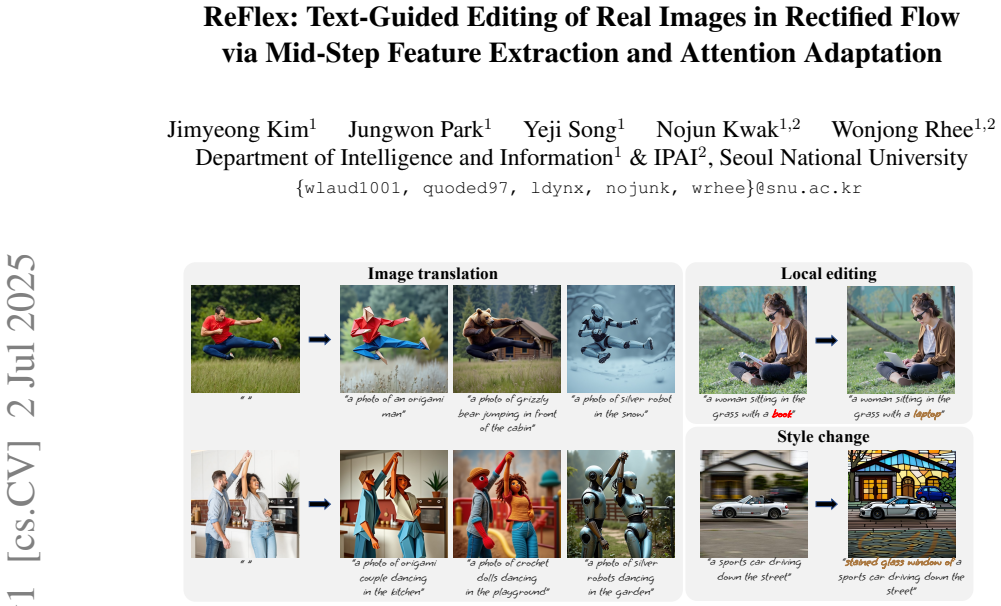
The central claim is that the joint self-attention map in an MM-DiT block can be decomposed by query-key modality, isolating two components that preserve source structure when injected into target generation: image-to-image self-attention (I2I-SA) and image-to-text cross-attention (I2T-CA). The text-to-image and text-to-text components do not carry the structure. Alongside these, the residual connection's image-side output provides a third structure signal. ReFlex extracts all three from a single mid-step latent $z_{T/2}$, which avoids the reconstruction failure of full rectified-flow inversion. At injection, I2T-CA is replaced token-by-token when the token exists in the source prompt and amplified by $\alpha=4$ when it does not; I2I-SA has its top-$k$ values ($k=20$) replaced with target values, then row-normalized. The residual feature is injected unchanged. For local edits, an I2T-CA map of the blended word is Gaussian-smoothed and thresholded with Otsu's method to produce a latent-blending mask.
Load-bearing premise
The load-bearing premise is that the half-inverted latent captures the real image's structure accurately enough that features extracted there still describe the source when injected into early generation steps; the paper supports this with reconstruction visuals and ablations, not proof.
Editorial extensions
If this is right
- Users can edit real images with FLUX-class rectified-flow models without training, masks, or source prompts for global edits, substantially lowering the practical barrier.
- The identified features give an MM-DiT counterpart to U-Net cross- and self-attention editing, so future editing methods can build on I2I-SA, I2T-CA, and the residual image stream instead of value features that leak appearance.
- Mid-step latent extraction becomes a reusable technique for any rectified-flow task that needs faithful real-image features, since full inversion is lossy in these models.
- Local editing can be done without user masks by deriving a binary mask from I2T-CA of the blended word and applying latent blending over the first $0.7T$ steps.
- The fixed hyperparameters $t'=T/2$, $\alpha=4$, $k=20$, and the injection windows $0.4T$, $0.25T$, $0.15T$ offer a direct recipe for strong editing performance on FLUX.
Reading between the lines
- The paper leaves implicit that the same mid-step latent could supply real-image features to other rectified-flow inverse problems, such as style transfer or image-conditioned synthesis, whenever full inversion is unreliable.
- Because the no-source-prompt mode omits I2T-CA injection, pairing ReFlex with an automatic captioner could make the whole pipeline fully automatic, a direction the paper does not explore.
- The reported subject-overlap failure suggests a natural extension: instead of per-token attention adaptation, one could apply adaptation per semantic part using separate masks for each subject word, preventing unintended attribute changes during local edits.
- A testable extension would be to check whether the optimal extraction point $t'=T/2$ transfers across different rectified-flow backbones and sampler step counts, or whether it should scale with the total number of steps.
Editorial analysis
A structured set of objections, weighed in public.
Referee Report
Summary. The paper proposes ReFlex, a training-free method for text-guided editing of real images with rectified-flow models such as FLUX. The method decomposes MM-DiT joint self-attention into four components and identifies I2T-CA, I2I-SA, and residual features as structure-preserving. It extracts these features from a mid-step latent obtained by noised inversion only up to t'=T/2, and injects them during early target-generation steps after two adaptation techniques: scaling/replacement for I2T-CA and top-k replacement for I2I-SA. For local edits, an editing mask is derived from the source I2T-CA of a user-specified blended word and used for latent blending. Experiments on PIE-Bench and Wild-TI2I-Real against nine baselines report improved CLIP text alignment, source-preservation trade-offs, and a user preference of 61–68%.
Significance. If the quantitative claims hold, the paper offers a useful empirical analysis of MM-DiT features and a simple recipe for real-image editing in rectified-flow models, with the mid-step extraction idea being particularly interesting. The paper is strong in its systematic feature decomposition, qualitative analysis, and the breadth of ablations; it also includes two user studies with a large number of responses. However, the central comparative claims currently rest on single-configuration point estimates with no confidence intervals or significance tests, and hyperparameters are selected on the same benchmarks used for evaluation. Until these robustness issues are addressed, the magnitude of the reported improvements should be treated as provisional.
major comments (4)
- [Section 5.2 / Table S.1 / Appendix F] The headline claim of 'substantial' text-alignment improvement is not statistically supported. On PIE-Bench the default configuration (k=20, m=0.7T) achieves a Whole CLIP score of 26.51 versus FlowEdit's 26.07, a margin of 0.44 points (1.69%), while the paper's own alternative configurations differ by up to 0.31 points (26.62 for k=40, m=0.7T). Appendix F additionally reports seed-dependent editing failures. No confidence intervals, paired tests, or multi-seed averages are provided for any quantitative metric. The authors should report mean±std over several seeds, perform paired significance tests, and, ideally, select hyperparameters on a validation split distinct from the final test sets.
- [Appendix B.3 / Section 5.2] Baseline comparisons are asymmetric. ReFlex's hyperparameters (α, k, t', m, n, injection layers) are tuned on the same PIE-Bench and Wild-TI2I-Real sets, whereas RF-Edit and FireFlow use the settings of a single official 'boy' example, and SD-based baselines use default/off-the-shelf settings. This can inflate the reported gains. The authors should tune baselines per benchmark (or justify fixed settings as representative) and report sensitivity of each baseline to its own key hyperparameters.
- [Section 5.4 / Fig. 8 / Fig. S.9] The ablations for the two attention adaptations are only reported on Wild-TI2I-Real (Fig. 8b), with no corresponding numbers on PIE-Bench, and the PIE-Bench table (Table S.1) reports only k/m variants. Moreover, the meaning of 'w/o I2T-CA adaptation' is ambiguous: it could mean injecting the unadapted source I2T-CA or omitting I2T-CA injection entirely. Please clarify the procedure and provide ablation results on both benchmarks.
- [Section 4.4 / Abstract] The method is described as requiring no user-provided mask, but the local-editing pipeline requires the user to specify a blended word, from which the mask is derived. This manual step is acknowledged only in Section 4.4 and not in the abstract or contributions. The limitation should be stated prominently, and the effect of mask quality should be quantified (e.g., automatically detected vs. ground-truth blended word) in addition to the qualitative GT-mask comparison in Fig. S.13(b).
minor comments (5)
- [Section 5.4 / Figure captions] Typos: 'varing' in headings (should be 'varying'), and the caption of Fig. S.12 incorrectly refers to 'I2I-SA adaptation' where α belongs to I2T-CA adaptation.
- [Section 4.3] The notation around the adapted I2I-SA map is inconsistent: the text says 'SA′ denotes the adapted I2I-SA' but the equation uses 'SA′S'.
- [Reproducibility] The paper would benefit from a reproducibility statement; no code or checkpoints are released, which limits independent verification of the central claims.
- [Section 4.3] In the I2T-CA adaptation formula, the definition of f should be stated for the case where source and target prompts have different lengths or reordering; currently the mapping is only described informally.
- [Fig. 8] Fig. 8(a) does not show the ablation markers that appear in Fig. 8(b); if ablations were only performed on Wild-TI2I-Real, this should be stated in the caption.
Circularity Check
No significant circularity: ReFlex's design choices are empirically motivated and evaluated on benchmarks; hyperparameter tuning is a statistical validity concern, not a derivation-level circularity.
full rationale
The paper's claimed derivation chain is an empirical method-development pipeline, not a formal derivation that reduces to its inputs. The three key features (I2T-CA, I2I-SA, residual) are identified in Sec. 4.1 by injection experiments on generated images, and the final method is evaluated on real-image benchmarks; the feature-selection observation is a mechanism, not a prediction that is equivalent to the reported performance. The mid-step extraction choice t'=T/2 is motivated by reconstruction evidence in Fig. 5 and ablated in Sec. 5.4, and the adaptation hyperparameters (alpha=4, k=20, m=0.7T, layer ranges) are selected on the same benchmarks. This is a legitimate concern about in-sample selection and the absence of error bars, but it does not make the reported text-alignment improvements forced by construction: no equation in the paper equates the final scores to the tuning objective, and the method's outputs depend non-trivially on the FLUX generative process, the inversion, and the injected features. There are no load-bearing self-citations; prior works such as P2P, PnP, FlowEdit, and FireFlow are external references, and the paper does not invoke any uniqueness theorem or self-authored ansatz to foreclose alternatives. The candid limitations in Sec. 6 and Appendix F, including seed-dependent variability and imperfect mask generation, further confirm that the claims are empirical rather than definitionally guaranteed. Therefore, no circular step meeting the required evidence standard is present.
Assumptions & free parameters
free parameters (8)
- alpha (I2T-CA scale for unmatched target tokens) =
4
- k (top-k replacement in I2I-SA adaptation) =
20 (default; 40 and 80 shown for some samples)
- t' (mid-step extraction timestep) =
14 (T=28, t'=T/2)
- Injection schedules for I2T-CA, I2I-SA, and residual features =
0.4T, 0.25T, 0.15T with source prompt; 0.4T and 0.25T without source prompt
- Noised inversion steps n =
7
- Latent blending steps m =
0.7T default (also m=T reported)
- Attention injection layers =
Attention layers 20 to 45; residual features from last 6 double-stream blocks and first single-stream block (layers 13…
- I2I-SA adaptation start step =
4th step without I2T-CA injection, 2nd step with I2T-CA injection
assumptions (6)
- standard math ODE discretization in Eq. (4) accurately approximates the rectified flow transport during inversion and generation.
- domain assumption In MM-DiT joint self-attention, image query output (I2I-SA and I2T-CA) directly updates image token embeddings that are passed to the image decoder, while text-query components do not materially affect structure.
- domain assumption The mid-step latent at t'=T/2 is a faithful proxy of source image structure, and its features are valid guides during early target generation.
- domain assumption A token-level mapping f between source and target prompts can be defined, and unmatched target tokens can be boosted by alpha without corrupting semantics.
- domain assumption I2I-SA's global structure is captured by its long-tail attention values, while top-k values over-preserve local details; replacing top-k with target values preserves global layout.
- domain assumption Noised inversion with n=7 yields an initial z_T that is sufficiently aligned with the target prompt while still derived from the source image.
Cite this review
Pith. "Pith review of ReFlex: Text-Guided Editing of Real Images in Rectified Flow via Mid-Step Feature Extraction and Attention Adaptation." pith.science (2026). https://pith.science/paper/2DIXEHSO
@misc{pith2026250701496,
  author       = {Pith},
  title        = {Pith review of: ReFlex: Text-Guided Editing of Real Images in Rectified Flow via Mid-Step Feature Extraction and Attention Adaptation},
  year         = {2026},
  howpublished = {\url{https://pith.science/paper/2DIXEHSO}},
  note         = {Machine review of arXiv:2507.01496}
}
read the original abstract
Rectified Flow text-to-image models surpass diffusion models in image quality and text alignment, but adapting ReFlow for real-image editing remains challenging. We propose a new real-image editing method for ReFlow by analyzing the intermediate representations of multimodal transformer blocks and identifying three key features. To extract these features from real images with sufficient structural preservation, we leverage mid-step latent, which is inverted only up to the mid-step. We then adapt attention during injection to improve editability and enhance alignment to the target text. Our method is training-free, requires no user-provided mask, and can be applied even without a source prompt. Extensive experiments on two benchmarks with nine baselines demonstrate its superior performance over prior methods, further validated by human evaluations confirming a strong user preference for our approach.
Figures


Figures from the paper (7 more)


Reference graph
Works this paper leans on
-
[1]
Cross-image attention for zero- shot appearance transfer
Yuval Alaluf, Daniel Garibi, Or Patashnik, Hadar Averbuch- Elor, and Daniel Cohen-Or. Cross-image attention for zero- shot appearance transfer. In ACM SIGGRAPH 2024 Confer- ence Papers, pages 1–12, 2024. 7
work page 2024
-
[2]
Omri Avrahami, Ohad Fried, and Dani Lischinski. Blended latent diffusion. ACM transactions on graphics (TOG) , 42 (4):1–11, 2023. 1, 2, 5
work page 2023
-
[3]
In- structpix2pix: Learning to follow image editing instructions
Tim Brooks, Aleksander Holynski, and Alexei A Efros. In- structpix2pix: Learning to follow image editing instructions. In Proceedings of the IEEE/CVF Conference on Computer Vision and Pattern Recognition, pages 18392–18402, 2023. 2
2023
-
[4]
Masactrl: Tuning-free mu- tual self-attention control for consistent image synthesis and editing
Mingdeng Cao, Xintao Wang, Zhongang Qi, Ying Shan, Xi- aohu Qie, and Yinqiang Zheng. Masactrl: Tuning-free mu- tual self-attention control for consistent image synthesis and editing. In Proceedings of the IEEE/CVF International Con- ference on Computer Vision, pages 22560–22570, 2023. 1, 2
work page 2023
-
[5]
Emerg- ing properties in self-supervised vision transformers
Mathilde Caron, Hugo Touvron, Ishan Misra, Herv ´e J´egou, Julien Mairal, Piotr Bojanowski, and Armand Joulin. Emerg- ing properties in self-supervised vision transformers. In Pro- ceedings of the IEEE/CVF international conference on com- puter vision, pages 9650–9660, 2021. 3
2021
-
[6]
Diffedit: Diffusion-based seman- tic image editing with mask guidance
Guillaume Couairon, Jakob Verbeek, Holger Schwenk, and Matthieu Cord. Diffedit: Diffusion-based seman- tic image editing with mask guidance. arXiv preprint arXiv:2210.11427, 2022. 2
arXiv 2022
-
[7]
Fireflow: Fast inversion of rec- tified flow for image semantic editing
Yingying Deng, Xiangyu He, Changwang Mei, Peisong Wang, and Fan Tang. Fireflow: Fast inversion of rec- tified flow for image semantic editing. arXiv preprint arXiv:2412.07517, 2024. 1, 2, 3, 7
arXiv 2024
-
[8]
Scaling recti- fied flow transformers for high-resolution image synthesis
Patrick Esser, Sumith Kulal, Andreas Blattmann, Rahim Entezari, Jonas M ¨uller, Harry Saini, Yam Levi, Dominik Lorenz, Axel Sauer, Frederic Boesel, et al. Scaling recti- fied flow transformers for high-resolution image synthesis. In Forty-first International Conference on Machine Learn- ing, 2024. 1, 3
work page 2024
Show all 43 references
-
[9]
FlowEdit
fallenshock. FlowEdit. https : / / github . com / fallenshock/FlowEdit. 2
-
[10]
Deep residual learning for image recognition
Kaiming He, Xiangyu Zhang, Shaoqing Ren, and Jian Sun. Deep residual learning for image recognition. In Proceed- ings of the IEEE conference on computer vision and pattern recognition, pages 770–778, 2016. 3
2016
-
[11]
Prompt-to-prompt im- age editing with cross attention control
Amir Hertz, Ron Mokady, Jay Tenenbaum, Kfir Aberman, Yael Pritch, and Daniel Cohen-Or. Prompt-to-prompt im- age editing with cross attention control. arXiv preprint arXiv:2208.01626, 2022. 1, 2, 3, 4, 5, 7
2022 arXiv
-
[12]
FireFlow-Fast-Inversion-of-Rectified-Flow- for-Image-Semantic-Editing
HolmesShuan. FireFlow-Fast-Inversion-of-Rectified-Flow- for-Image-Semantic-Editing. https://github.com/ HolmesShuan / FireFlow - Fast - Inversion - of - Rectified - Flow - for - Image - Semantic - Editing. 2
-
[13]
An edit friendly ddpm noise space: Inversion and manipulations
Inbar Huberman-Spiegelglas, Vladimir Kulikov, and Tomer Michaeli. An edit friendly ddpm noise space: Inversion and manipulations. In Proceedings of the IEEE/CVF Conference on Computer Vision and Pattern Recognition, pages 12469– 12478, 2024. 1, 2, 3
2024
-
[14]
Direct inversion: Boosting diffusion-based edit- ing with 3 lines of code
Xuan Ju, Ailing Zeng, Yuxuan Bian, Shaoteng Liu, and Qiang Xu. Direct inversion: Boosting diffusion-based edit- ing with 3 lines of code. arXiv preprint arXiv:2310.01506,
-
[15]
Flowedit: Inversion-free text-based editing using pre-trained flow models
Vladimir Kulikov, Matan Kleiner, Inbar Huberman- Spiegelglas, and Tomer Michaeli. Flowedit: Inversion-free text-based editing using pre-trained flow models. arXiv preprint arXiv:2412.08629, 2024. 1, 3, 7, 2
2024 arXiv
-
[16]
Diffusion models already have a semantic latent space
Mingi Kwon, Jaeseok Jeong, and Youngjung Uh. Diffusion models already have a semantic latent space. arXiv preprint arXiv:2210.10960, 2022. 2
2022 arXiv
-
[17]
Announcing black forest labs, 2025
Black Forest Labs. Announcing black forest labs, 2025. 1, 2, 3, 6, 7
2025
-
[18]
Blip: Bootstrapping language-image pre-training for unified vision-language understanding and generation
Junnan Li, Dongxu Li, Caiming Xiong, and Steven Hoi. Blip: Bootstrapping language-image pre-training for unified vision-language understanding and generation. In Interna- tional conference on machine learning, pages 12888–12900. PMLR, 2022. 2
2022
-
[19]
Flow matching for generative mod- eling
Yaron Lipman, Ricky TQ Chen, Heli Ben-Hamu, Maximil- ian Nickel, and Matt Le. Flow matching for generative mod- eling. arXiv preprint arXiv:2210.02747, 2022. 1, 3
2022 arXiv
-
[20]
Flow straight and fast: Learning to generate and transfer data with rectified flow
Xingchao Liu, Chengyue Gong, and Qiang Liu. Flow straight and fast: Learning to generate and transfer data with rectified flow. arXiv preprint arXiv:2209.03003, 2022. 1, 3
2022 arXiv
-
[21]
Sdedit: Guided image synthesis and editing with stochastic differential equations
Chenlin Meng, Yutong He, Yang Song, Jiaming Song, Jiajun Wu, Jun-Yan Zhu, and Stefano Ermon. Sdedit: Guided image synthesis and editing with stochastic differential equations. arXiv preprint arXiv:2108.01073, 2021. 7, 2
2021 arXiv
-
[22]
Null-text inversion for editing real im- ages using guided diffusion models
Ron Mokady, Amir Hertz, Kfir Aberman, Yael Pritch, and Daniel Cohen-Or. Null-text inversion for editing real im- ages using guided diffusion models. In Proceedings of the IEEE/CVF Conference on Computer Vision and Pattern Recognition, pages 6038–6047, 2023. 1, 2, 3, 7
2023
-
[23]
Glide: Towards photorealistic image generation and editing with text-guided diffusion models.arXiv preprint arXiv:2112.10741, 2021
Alex Nichol, Prafulla Dhariwal, Aditya Ramesh, Pranav Shyam, Pamela Mishkin, Bob McGrew, Ilya Sutskever, and Mark Chen. Glide: Towards photorealistic image generation and editing with text-guided diffusion models.arXiv preprint arXiv:2112.10741, 2021. 1, 2
2021 arXiv
-
[24]
A threshold selection method from gray-level histograms
Nobuyuki Otsu et al. A threshold selection method from gray-level histograms. Automatica, 11(285-296):23–27,
-
[25]
Zero-shot image-to-image translation
Gaurav Parmar, Krishna Kumar Singh, Richard Zhang, Yijun Li, Jingwan Lu, and Jun-Yan Zhu. Zero-shot image-to-image translation. In ACM SIGGRAPH 2023 Conference Proceed- ings, pages 1–11, 2023. 2, 7
2023
-
[26]
Scalable diffusion models with transformers
William Peebles and Saining Xie. Scalable diffusion models with transformers. In Proceedings of the IEEE/CVF Inter- national Conference on Computer Vision, pages 4195–4205,
-
[27]
Learning transferable visual models from natural language supervi- sion
Alec Radford, Jong Wook Kim, Chris Hallacy, Aditya Ramesh, Gabriel Goh, Sandhini Agarwal, Girish Sastry, Amanda Askell, Pamela Mishkin, Jack Clark, et al. Learning transferable visual models from natural language supervi- sion. In International conference on machine learning, ...
2021
-
[28]
Zero-shot text-to-image generation
Aditya Ramesh, Mikhail Pavlov, Gabriel Goh, Scott Gray, Chelsea V oss, Alec Radford, Mark Chen, and Ilya Sutskever. Zero-shot text-to-image generation. In International confer- ence on machine learning, pages 8821–8831. Pmlr, 2021. 1
2021
-
[29]
Grounded sam: Assembling open-world models for diverse visual tasks
Tianhe Ren, Shilong Liu, Ailing Zeng, Jing Lin, Kunchang Li, He Cao, Jiayu Chen, Xinyu Huang, Yukang Chen, Feng Yan, et al. Grounded sam: Assembling open-world models for diverse visual tasks. arXiv preprint arXiv:2401.14159 ,
-
[30]
High-resolution image synthesis with latent diffusion models
Robin Rombach, Andreas Blattmann, Dominik Lorenz, Patrick Esser, and Bj ¨orn Ommer. High-resolution image synthesis with latent diffusion models. In Proceedings of the IEEE/CVF conference on computer vision and pattern recognition, pages 10684–10695, 2022. 1, 4, 7
2022
-
[31]
Beyond first-order tweedie: Solving inverse problems using latent diffusion
Litu Rout, Yujia Chen, Abhishek Kumar, Constantine Cara- manis, Sanjay Shakkottai, and Wen-Sheng Chu. Beyond first-order tweedie: Solving inverse problems using latent diffusion. In Proceedings of the IEEE/CVF Conference on Computer Vision and Pattern Recognition , pages 9472–...
2024
-
[32]
Semantic im- age inversion and editing using rectified stochastic differen- tial equations
Litu Rout, Yujia Chen, Nataniel Ruiz, Constantine Carama- nis, Sanjay Shakkottai, and Wen-Sheng Chu. Semantic im- age inversion and editing using rectified stochastic differen- tial equations. arXiv preprint arXiv:2410.10792, 2024. 1, 2, 3, 7
-
[33]
Photorealistic text-to-image diffusion models with deep language understanding
Chitwan Saharia, William Chan, Saurabh Saxena, Lala Li, Jay Whang, Emily L Denton, Kamyar Ghasemipour, Raphael Gontijo Lopes, Burcu Karagol Ayan, Tim Salimans, et al. Photorealistic text-to-image diffusion models with deep language understanding. Advances in neural information...
2022
-
[34]
De- noising diffusion implicit models
Jiaming Song, Chenlin Meng, and Stefano Ermon. De- noising diffusion implicit models. arXiv preprint arXiv:2010.02502, 2020. 2, 3
2010 arXiv
-
[35]
Splicing vit features for semantic appearance transfer
Narek Tumanyan, Omer Bar-Tal, Shai Bagon, and Tali Dekel. Splicing vit features for semantic appearance transfer. In Proceedings of the IEEE/CVF Conference on Computer Vision and Pattern Recognition, pages 10748–10757, 2022. 3
2022
-
[36]
Plug-and-play diffusion features for text-driven image-to-image translation
Narek Tumanyan, Michal Geyer, Shai Bagon, and Tali Dekel. Plug-and-play diffusion features for text-driven image-to-image translation. InProceedings of the IEEE/CVF Conference on Computer Vision and Pattern Recognition , pages 1921–1930, 2023. 1, 2, 3, 4, 6, 7
1921
-
[37]
Attention is all you need
Ashish Vaswani, Noam Shazeer, Niki Parmar, Jakob Uszko- reit, Llion Jones, Aidan N Gomez, Łukasz Kaiser, and Illia Polosukhin. Attention is all you need. Advances in neural information processing systems, 30, 2017. 4
2017
-
[38]
Diffusers: State-of-the-art diffu- sion models
Patrick von Platen, Suraj Patil, Anton Lozhkov, Pedro Cuenca, Nathan Lambert, Kashif Rasul, Mishig Davaadorj, Dhruv Nair, Sayak Paul, Steven Liu, William Berman, Yiyi Xu, and Thomas Wolf. Diffusers: State-of-the-art diffu- sion models. https://github.com/huggingface/ diffusers. 2
-
[39]
Tam- ing rectified flow for inversion and editing
Jiangshan Wang, Junfu Pu, Zhongang Qi, Jiayi Guo, Yue Ma, Nisha Huang, Yuxin Chen, Xiu Li, and Ying Shan. Tam- ing rectified flow for inversion and editing. arXiv preprint arXiv:2411.04746, 2024. 1, 2, 3, 7
2024 arXiv
-
[40]
Instructedit: Improving automatic masks for diffusion-based image editing with user instructions
Qian Wang, Biao Zhang, Michael Birsak, and Peter Wonka. Instructedit: Improving automatic masks for diffusion-based image editing with user instructions. arXiv preprint arXiv:2305.18047, 2023. 2
2023 arXiv
-
[41]
Image quality assessment: from error visibility to structural similarity
Zhou Wang, Alan C Bovik, Hamid R Sheikh, and Eero P Si- moncelli. Image quality assessment: from error visibility to structural similarity. IEEE transactions on image processing, 13(4):600–612, 2004. 3
2004
-
[42]
RF-Solver-Edit
wangjiangshan0725. RF-Solver-Edit. https://github. com/wangjiangshan0725/RF-Solver-Edit. 2
-
[43]
The unreasonable effectiveness of deep features as a perceptual metric
Richard Zhang, Phillip Isola, Alexei A Efros, Eli Shecht- man, and Oliver Wang. The unreasonable effectiveness of deep features as a perceptual metric. In Proceedings of the IEEE conference on computer vision and pattern recogni- tion, pages 586–595, 2018. 3 ReFlex: Text-Guide...
2018
Reviewed August 6, 2026 · model on record in the stance chip above.
Discussion (0). Sign in to comment.