REVIEW 4 major objections 9 minor 105 references
The New Generation Planetary Population Synthesis (NGPPS) VIII. Impact of host star metallicity on planet occurrence rates, orbital periods, eccentricities, and radius valley morphology
T0 review · 4 major / 9 minor · reviewed 2026-08-06 · deepseek-v4-flash
Pith's one-line read A single, untuned planet-formation model reproduces the observed relationships between host star metallicity and planetary properties, including the shape of the radius valley.
desk verdict Solid, honest NGPPS paper with real new predictions, but the f_D/G–[Fe/H] calibration is the load-bearing assumption; deserves peer review with a demand for sensitivity tests. read the letter →
The pith
A machine-rendered reading of the paper's core claim, the machinery that carries it, and where it could break.
The reading
What carries the argument
The load-bearing object is the Generation III Bern model, a global planet formation and evolution code that simultaneously tracks a viscous protoplanetary disk, the growth of planetary cores by planetesimal and gas accretion, Type I and Type II migration, N-body interactions among embryos and planets, giant impacts, and—after 100 million years—the long-term cooling, contraction, and photoevaporative mass loss of each planet. The quantity that carries the metallicity dependence is the disk's dust-to-gas ratio, which the model sets from the stellar iron abundance through a single mapping, $f_{D/G}/f_{D/G,\odot} = 10^{[\mathrm{Fe/H}]}$. This mapping converts every metallicity bin into an initial solid content, and all of the paper's metallicity trends—occurrence rates, periods, eccentricities, and radius-valley morphology—are produced by propagating this one scaling through the full formation and evolution calculation, after applying Kepler and radial-velocity detection biases to the synthetic systems.
What would settle it
Measure the dust-to-gas ratio in protoplanetary disks around stars spanning $-0.5 < [\mathrm{Fe/H}] < +0.5$ and test whether it follows the assumed scaling $10^{[\mathrm{Fe/H}]}$; a clear deviation would miscalibrate the synthetic population's metallicity axis and require re-examining the quantitative agreement with Chen et al. (2022).
Extended reading notes
Core claim
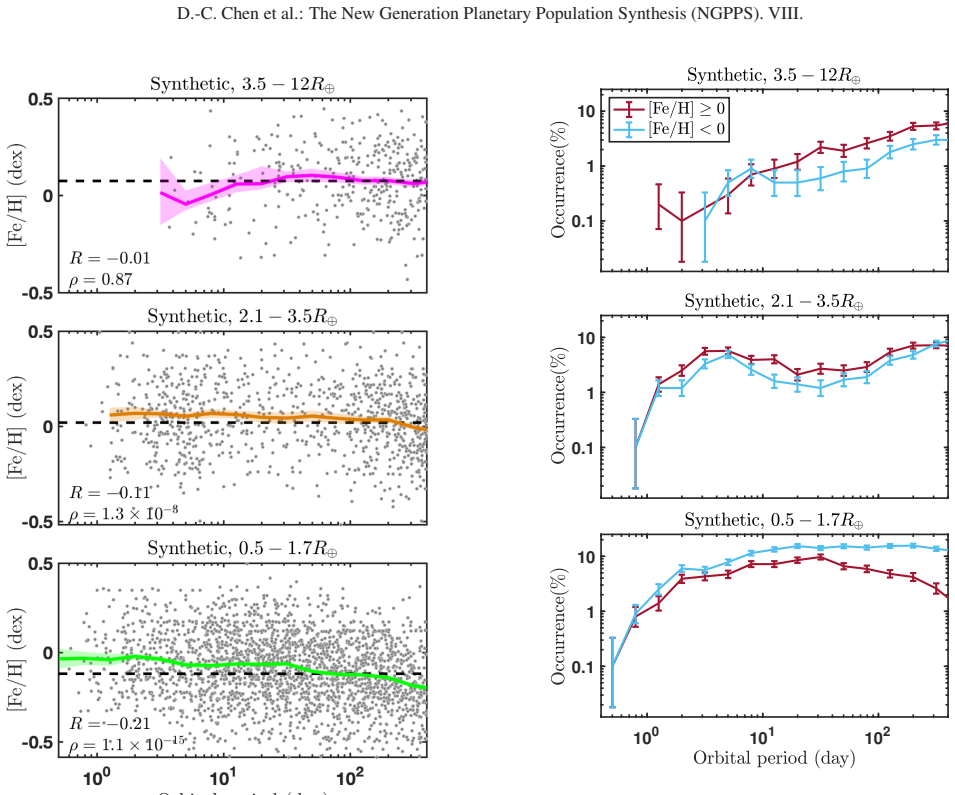
The paper's central claim is that the nominal Generation III Bern model—a global end-to-end simulation of planet formation and evolution that was not adjusted to reproduce any metallicity-dependent observations—produces a synthetic planetary population whose statistical properties depend on host star metallicity in the same way as the observed one. In the synthetic population, the occurrence rates of giant planets and Neptune-size planets rise with [Fe/H] (with slopes β ≈ 1.3 and β ≈ 0.5–0.8 respectively), small planets of 1–3.5 Earth radii first become more common and then less common as [Fe/H] increases past about 0.1 dex, and sub-Earths become rarer around metal-rich stars. The radius valley deepens with increasing [Fe/H]: the contrast between valley and non-valley planets grows, the ratio of super-Earths to sub-Neptunes falls, and the average radius of planets above the valley increases, while the average radius below the valley stays constant. For all five radius-valley morphology metrics defined in Chen et al. (2022), the trends in the synthetic population are quantitatively consistent with the observed trends within roughly 1–2 sigma error bars. The model also predicts that planets inside 10-day orbits are preferentially hosted by metal-rich stars and that eccentric planets are more common around metal-rich stars, though both of these correlations are significantly weaker in the model than in observations; the authors attribute the discrepancy to processes omitted from the model, such as long-term dynamical interactions and the influence of binary companions.
Load-bearing premise
The entire metallicity axis of the synthetic population rests on the assumption that a star's iron abundance maps exactly and linearly into the disk's dust-to-gas ratio through $10^{[\mathrm{Fe/H}]}$, with no dependence on disk evolution, radial drift, grain growth, or other elements.
Editorial extensions
If this is right
- The observed diversity of exoplanet demographics as a function of stellar metallicity can be explained by standard core-accretion physics operating on disks with different solid content; no separate, metallicity-dependent formation mode is required.
- The radius valley's deepening with [Fe/H] emerges naturally from the formation of two distinct populations—rocky super-Earths formed in situ and water-rich sub-Neptunes that migrated inward—rather than from post-formation processes alone.
- The predicted occurrence-rate scaling laws (giants with β ≈ 1.3, Neptunes with β ≈ 0.5–0.8, sub-Earths anti-correlated) give quantitative targets for future surveys such as PLATO and Roman.
- The model's failure to reproduce the full strength of the observed period and eccentricity correlations pinpoints missing physics: long-term dynamical instabilities and the effects of stellar companions.
- Because the same synthetic population is compared with both transit (Kepler) and radial-velocity surveys, the work demonstrates a multi-method consistency check on planet formation theory.
Reading between the lines
- If the assumed dust-to-gas scaling $f_{D/G} \propto 10^{[\mathrm{Fe/H}]}$ is replaced by a relation that accounts for radial drift or grain growth, the predicted metallicity trends would shift; testing the model against carbon-to-oxygen ratio or other abundance diagnostics could reveal whether iron alone is the right tracer of disk solids.
- The predicted anti-correlation between sub-Earth occurrence and [Fe/H] is a falsifiable prediction that current Kepler samples are too small to test; a dedicated search for sub-Earths around metal-poor and metal-rich stars would provide a sharp test of the model.
- The inflection point in small-planet occurrence at [Fe/H] ≈ 0.1 dex might be a signature of the onset of giant-planet perturbation; checking whether the multiplicity of small-planet systems drops at super-solar metallicity could distinguish this from alternative explanations.
- The discrepancy between the model's weak period/eccentricity-metallicity correlations and the stronger observed ones suggests that late dynamical evolution, rather than the initial formation environment, dominates the hot and eccentric populations; including binaries and secular chaos in a next-generation model would directly test this interpretation.
Editorial analysis
A structured set of objections, weighed in public.
Referee Report
Summary. This paper presents the eighth NGPPS paper, using the Generation III Bern model population NG76Longshot (1000 systems) to predict how planet occurrence rates, orbital periods, eccentricities, and radius-valley morphology depend on host-star [Fe/H]. After applying Kepler (KOBE) and RV detection biases, the synthetic population is compared with observational samples from Chen et al. (2022, 2023), Zhu (2019), Buchhave et al. (2014), and An et al. (2023). The main results are positive occurrence-rate slopes of β≈1.3 for giant planets and β≈0.5–0.8 for Neptune-size planets, an inflection near [Fe/H]≈0.1 dex for small planets, an anti-correlation for sub-Earths, a deepening radius valley with increasing [Fe/H], and weak but statistically significant period–metallicity and eccentricity–metallicity correlations. The authors acknowledge that the synthetic eccentricity and period trends are weaker than observed and attribute this to the neglect of long-term dynamical evolution and stellar/binary environment effects.
Significance. If accepted at face value, the claimed quantitative consistency of the radius-valley metrics with Chen et al. (2022) is a notable success for a forward population-synthesis model that was not re-fit to the metallicity trends. The paper's strengths include the use of a previously published population without parameter tuning, the application of realistic detection biases, the transparent reporting of uncertainties via bootstrap and Bayesian methods, and the explicit discussion of model discrepancies. Its main limitation is that all metallicity dependence is injected through the assumed mapping in Eq. (1); if that mapping is miscalibrated, the quantitative agreement would be a coincidence rather than a validation of the formation physics. The paper nonetheless provides a useful benchmark for the Bern model and a clear set of falsifiable predictions.
major comments (4)
- [Sect. 3, Eq. (1)] The assumed mapping f_D/G = 0.0149 × 10^[Fe/H] is the only channel through which stellar metallicity enters the synthetic initial conditions, so every quantitative comparison in Sections 4–7 is contingent on this calibration. The paper states the relation but does not test it against protoplanetary disk observations, nor does it quantify the impact of scatter in disk dust-to-gas ratios, of [M/H] versus [Fe/H] differences, or of refractory/volatile fractionation. The authors should add a sensitivity study that varies the exponent of Eq. (1) or adds a dispersion, and use it to bound the systematic error on the claimed 1–2σ agreements.
- [Sect. 4.1, Fig. 2] The hot-Jupiter analysis is based on only 12 planets, giving β = 1.3+0.9−0.6, a probability for β > 0 of 96.76% (about 2σ), and an AIC difference of 6.6 relative to a constant model. This is too weak to support the statement that the synthetic hot-Jupiter slope is quantitatively consistent with the observed β ≈ 1.6 ± 0.3; the text should either soften this claim or provide a formal assessment of how large a slope difference the 12-planet sample could actually detect.
- [Sect. 5, Fig. 10] The central claim that all five radius-valley metrics are consistent with Chen et al. (2022) 'within ~1–2σ' is supported only by visual inspection of Fig. 10. No formal statistic (per-metric chi-square, p-value, or overlap probability) is reported, so the reader cannot distinguish genuine agreement from agreement driven by large error bars. Please provide a quantitative comparison for each of the five metrics, including the no-dependence case R−valley.
- [Sect. 4.3, Fig. 4] The inflection at [Fe/H] ≈ 0.1 dex for 1–3.5 R⊕ planets is not determined by a statistical search: the data are split at 0.1 dex and monotonic fits are performed on each side. Such a procedure makes a maximum near the chosen split almost inevitable. A change-point or piecewise regression over a grid of breakpoints should be used to test whether 0.1 dex is preferred over neighboring values before this value is quoted as a quantitative result in the abstract.
minor comments (9)
- [Figs. 2 and 3 captions] The figure captions refer to 'the best-fits of Equation (1)', but the exponential occurrence-rate fit is Eq. (2); Eq. (1) is the dust-to-gas ratio mapping.
- [Table 1] The rows for Cvalley and Avalley both cite Eq. (11) and state 'positively-correlated'; the Avalley row should cite Eq. (12) and state that the slope is negative.
- [Sect. 7.1] The acronym 'HIRES/KICK' appears twice and should be 'HIRES/Keck'.
- [Sect. 6] 'Form observations' should read 'From observations'.
- [Sect. 4.4] The sentence beginning 'We initialize our planetary sample...' is grammatically incomplete; it should be split into two sentences.
- [Eq. (17)] The Gaussian kernel is missing the 1/σ normalization factor; the factor cancels in the weighted mean of Eq. (16), but the formula as written is not the stated log-normal kernel.
- [Sect. 4.1, references] The in-text citation 'Chen et al. 2025, submitted' has no corresponding entry in the reference list.
- [Sect. 5] The phrase 'p−value < 0.003 from maximizes Hartigan's dip statistic' is ungrammatical; it should read 'from a maximized Hartigan's dip statistic' or similar.
- [Sect. 5 vs. other sections] The paper evaluates the synthetic population at 2 Gyr for the radius-valley analysis but at 5 Gyr for all other analyses; please justify this choice and cite the age determination for the Chen et al. (2022) sample.
Circularity Check
No definitional circularity found: the metallicity-dependent predictions emerge from the forward simulation; the untested f_D/G–[Fe/H] mapping (Eq. 1) is an input assumption, not a circular reduction.
full rationale
The paper's central claims are that the nominal Bern model, without re-fitting to metallicity-dependent observations, reproduces observed occurrence-rate slopes, radius-valley morphology trends, and period/eccentricity correlations as functions of [Fe/H]. Walking the derivation chain, the only direct input coupling [Fe/H] to the model is Eq. (1), f_D/G / f_D/G,sun = 10^[Fe/H]. This is an explicit initial-condition mapping, not a fitted output: the synthetic population's [Fe/H] distribution is an input, and the occurrence-rate slopes (e.g. beta ~ 1.3 for giants, ~0.5–0.8 for Neptunes) and the five radius-valley metrics are computed forward from the Bern model. No parameter in this paper is fit to the observed metallicity trends and then renamed as a prediction. The comparisons in Sect. 4–7 use the five metrics defined in Chen et al. (2022) and observed slopes from Chen et al. (2023) and An et al. (2023), whose author lists overlap with the present paper. However, these are external observational analyses based on LAMOST-Kepler/CKS data, and the same trends are also benchmarked against independent works such as Johnson et al. (2010), Zhu (2019), Buchhave et al. (2014), Mulders et al. (2016), and Mills et al. (2019). The model description is cited from prior NGPPS papers by the same group, but that is normal method citation rather than a load-bearing self-citation chain; the model's physics is not justified solely by a prior paper. The paper also explicitly reports where the model disagrees with observations (e.g., weaker period and eccentricity dependences), which further indicates the comparisons are not forced by construction. Eq. (1) is a potentially fragile assumption about star–disk metallicity coupling, and the realism of this mapping is a legitimate correctness concern, but it is not circular: the predicted quantities are not defined in terms of the observed quantities they are compared with. Therefore, no circular step can be quoted, and the appropriate circularity score is low.
Assumptions & free parameters
free parameters (6)
- turbulent viscosity parameter alpha =
2e-3
- planetesimal size R_plts =
300 m
- initial embryo mass =
0.01 M_Earth
- inflection point [Fe/H]_inf =
0.1 dex (and -0.1 dex for the <2 R_Earth subsample)
- exponential fit coefficients beta and C =
e.g., beta ~ 1.3 for giants, ~0.5-0.8 for Neptunes; C varies by class
- linear slopes of radius-valley metrics =
C_valley slope 15.9; A_valley slope -1.0; R+ slope 0.06; f_NP slope 0.15
assumptions (5)
- domain assumption Stellar [Fe/H] maps directly to disk dust-to-gas ratio via f_D/G / f_D/G_sun = 10^[Fe/H] (Eq. 1).
- domain assumption Initial disk properties (gas mass, metallicity, size, inner edge, lifetime) sampled from observed young disk distributions are representative of the disk population.
- domain assumption The Generation III Bern model's physical prescriptions (core accretion, type I/II migration, photoevaporation, N-body for 100 Myr) are correct as described in Emsenhuber et al. (2021a).
- domain assumption The KOBE program accurately simulates Kepler detection biases and completeness.
- domain assumption Observational sample selection (LAMOST-Gaia-Kepler, RV surveys) is comparable to the synthetic selection after applying detection biases.
Cite this review
Pith. "Pith review of The New Generation Planetary Population Synthesis (NGPPS) VIII. Impact of host star metallicity on planet occurrence rates, orbital periods, eccentricities, and radius valley morphology." pith.science (2026). https://pith.science/paper/2E2NF7IT
@misc{pith2026250709874,
  author       = {Pith},
  title        = {Pith review of: The New Generation Planetary Population Synthesis (NGPPS) VIII. Impact of host star metallicity on planet occurrence rates, orbital periods, eccentricities, and radius valley morphology},
  year         = {2026},
  howpublished = {\url{https://pith.science/paper/2E2NF7IT}},
  note         = {Machine review of arXiv:2507.09874}
}
read the original abstract
The dust-to-gas ratio in the protoplanetary disk, which is likely imprinted into the host star metallicity, is a property that plays a crucial role during planet formation. We aim at constraining planet formation and evolution processes by statistically analysing planetary systems generated by the Generation III Bern model, comparing with the correlations derived from observational samples. Using synthetic planets biased to observational completeness, we find that (1) the occurrence rates of large giant planets and Neptune-size planets are positively correlated with [Fe/H], while small sub-Earths exhibit an anti-correlation. In between, for sub-Neptune and super-Earth, the occurrence rate first increases and then decreases with increasing [Fe/H] with an inflection point at 0.1 dex. (2) Planets with orbital periods shorter than ten days are more likely to be found around stars with higher metallicity, and this tendency weakens with increasing planet radius. (3) Both giant planets and small planets exhibit a positive correlation between the eccentricity and [Fe/H], which could be explained by the self-excitation and perturbation of outer giant planets. (4) The radius valley deepens and becomes more prominent with increasing [Fe/H], accompanied by a lower super-Earth-to-sub-Neptune ratio. Furthermore, the average radius of the planets above the valley increases with [Fe/H]. Our nominal model successfully reproduces many observed correlations with stellar metallicity, supporting the description of physical processes and parameters included in the Bern model. However, the dependences of orbital eccentricity and period on [Fe/H] predicted by the synthetic population is however significantly weaker than observed. This discrepancy suggests that long-term dynamical interactions between planets, along with the impact of binaries/companions, can drive the system towards a dynamically hotter state.
Figures


Figures from the paper (18 more)




Reference graph
Works this paper leans on
-
[1]
2005, A&A, 434, 3
Alibert, Y ., Mordasini, C., Benz, W., et al. 2005, A&A, 434, 3
2005
-
[2]
& Pollack, J
Bodenheimer, P . & Pollack, J. B. 1986, Icarus, 67,
1986
-
[3]
Rafikov, R. R. 2004, AJ, 128,
work page 2004
-
[5]
Fortier, A., Alibert, Y ., Carron, F., et al. 2013, A&A, 549, A44. Freedman, R. S., Lustig-Y aeger, J., Fortney, J. J., et al. 2014, ApJS, 214,
work page 2013
-
[7]
Dawson, R. I. & Murray-Clay, R. A. 2013, ApJ, 767, L24. Dawson, R. I. & Johnson, J. A. 2018, ARA&A, 56,
2013
- [8]
-
[9]
sample631 Chen, D.-C., Xie, J.-W., Zhou, J.-L., et al
Article number, page 19 of 20 A&A proofs: manuscript no. sample631 Chen, D.-C., Xie, J.-W., Zhou, J.-L., et al. 2023, Proceedin gs of the National Academy of Science, 120, e2304179120. Chen, D.-C., Y ang, J.-Y ., Xie, J.-W., et al. 2021, AJ, 162,
2023
-
[12]
Ormel, C. W. & Klahr, H. H. 2010, A&A, 520, A43. Owen, J. E. & Wu, Y . 2017, ApJ, 847,
work page 2010
Show all 105 references
-
[14]
M., Marcy, G
Weiss, L. M., Marcy, G. W., Petigura, E. A., et al. 2018, AJ, 15 5,
2018
-
[19]
& Santos, N
Udry, S. & Santos, N. C. 2007, ARA&A, 45,
2007
-
[25]
J., Petigura, E
Fulton, B. J., Petigura, E. A., Howard, A. W., et al. 2017, AJ, 154,
2017
-
[26]
Ho, C. S. K. & V an Eylen, V . 2023, MNRAS, 519, 3,
2023
-
[29]
2003, ApJ, 582,
Matsuyama, I., Johnstone, D., & Hartmann, L. 2003, ApJ, 582,
2003
-
[31]
2003, ApJ, 591,
Lodders, K. 2003, ApJ, 591,
2003
-
[33]
Kubyshkina, D. I. & Fossati, L. 2021, Research Notes of the Am erican Astro- nomical Society, 5,
2021
-
[34]
D., Mordasini, C., Pascucci, I., et al
Mulders, G. D., Mordasini, C., Pascucci, I., et al. 2019, ApJ , 887,
2019
-
[37]
2021, A&A, 656 , A72
Burn, R., Schlecker, M., Mordasini, C., et al. 2021, A&A, 656 , A72. Burn, R., Mordasini, C., Mishra, L., et al. 2024, Nature Astr onomy, 8,
2021
-
[38]
W., Duncan, M
Thommes, E. W., Duncan, M. J., & Levison, H. F. 2003, Icarus, 1 61,
2003
-
[39]
2020, A&A, 643, A105
Haldemann, J., Alibert, Y ., Mordasini, C., et al. 2020, A&A, 643, A105. Hamer, J. H. & Schlaufman, K. C. 2022, AJ, 164,
2020
-
[41]
2014, A&A, 56 2, A27
Thiabaud, A., Marboeuf, U., Alibert, Y ., et al. 2014, A&A, 56 2, A27. Thompson, S. E., Coughlin, J. L., Ho ffman, K., et al. 2018, ApJS, 235,
2014
-
[42]
2012, MNRAS, 423,
Lai, D. 2012, MNRAS, 423,
2012
-
[43]
2023, AJ, 165,
An, D.-S., Xie, J.-W., Dai, Y .-Z., et al. 2023, AJ, 165,
2023
-
[44]
X., Petrovich, C., & Deibert, E
Huang, C. X., Petrovich, C., & Deibert, E. 2017, AJ, 153,
2017
-
[47]
2009, ApJ, 698, 1357
Jackson, B., Barnes, R., & Greenberg, R. 2009, ApJ, 698, 1357 . Jackson, B., Greenberg, R., & Barnes, R. 2008, ApJ, 678, 1396 . Jin, S., Mordasini, C., Parmentier, V ., et al. 2014, ApJ, 795 ,
2009
-
[48]
2016, Proceedings of the National Academy of Science, 113, 11431
Xie, J.-W., Dong, S., Zhu, Z., et al. 2016, Proceedings of the National Academy of Science, 113, 11431. Y ang, J.-Y ., Chen, D.-C., Xie, J.-W., et al. 2023, AJ, 166,
2016
-
[51]
Chambers, J. E. 1999, MNRAS, 304,
1999
-
[59]
& Pallé, E
Luque, R. & Pallé, E. 2022, Science, 377,
2022
-
[62]
Poon, S. T. S. & Nelson, R. P . 2020, MNRAS, 498,
2020
-
[65]
& Mordasini, C
Jin, S. & Mordasini, C. 2018, ApJ, 853,
2018
-
[73]
Mulders, G. D. 2018, Handbook of Exoplanets,
2018
-
[74]
V ., et al
Kubyshkina, D., Fossati, L., Erkaev, N. V ., et al. 2018, A&A, 619, A151. Lai, D. & Pu, B. 2017, AJ, 153,
2018
-
[77]
Owen, J. E. & Wu, Y . 2013, ApJ, 775,
2013
-
[79]
2009, A&A, 506,
Kama, M., Min, M., & Dominik, C. 2009, A&A, 506,
2009
-
[84]
& Lai, D
Pu, B. & Lai, D. 2018, MNRAS, 478,
2018
-
[86]
Raymond, S. N. & Morbidelli, A. 2022, Demographics of Exoplanetary Systems, Lecture Notes of the 3rd Advanced School on Exoplanetary Sci ence, 466,
2022
-
[87]
& Pringle, J
Lynden-Bell, D. & Pringle, J. E. 1974, MNRAS, 168,
1974
-
[89]
B., Hubickyj, O., Bodenheimer, P ., et al
Pollack, J. B., Hubickyj, O., Bodenheimer, P ., et al. 1996, I carus, 124,
1996
-
[92]
2018, ApJ, 860,
Zhu, W., Petrovich, C., Wu, Y ., et al. 2018, ApJ, 860,
2018
-
[96]
& Behmard, A
Vissapragada, S. & Behmard, A. 2025, AJ, 169, 2,
2025
-
[100]
J., Pollacco, D
Christian, D. J., Pollacco, D. L., Skillen, I., et al. 2006, M NRAS, 372,
2006
-
[105]
Owen, J. E. & Murray-Clay, R. 2018, MNRAS, 480,
2018
-
[109]
H., & Meibom, S
F˝ urész, G., Szentgyorgyi, A. H., & Meibom, S. 2008, Precision Spectroscopy in Astrophysics,
2008
-
[115]
A., Huber, D., Gaidos, E., et al
Berger, T. A., Huber, D., Gaidos, E., et al. 2020, AJ, 160, 108 . Benítez-Llambay, P ., Masset, F., & Beaugé, C. 2011, A&A, 528, A2. Bodenheimer, P ., Hubickyj, O., & Lissauer, J. J. 2000, Icarus, 143,
2020
-
[117]
& Fischer, D
Wang, J. & Fischer, D. A. 2015, AJ, 149,
2015
-
[125]
M., Wilner, D
Andrews, S. M., Wilner, D. J., Hughes, A. M., et al. 2010, ApJ, 723,
2010
-
[126]
S., et al
V an Eylen, V ., Agentoft, C., Lundkvist, M. S., et al. 2018, MNRAS, 479,
2018
-
[146]
2008, Celestial Mechanics and Dynamical Astronomy, 101,
Ferraz-Mello, S., Rodríguez, A., & Hussmann, H. 2008, Celestial Mechanics and Dynamical Astronomy, 101,
2008
-
[153]
& Nakagawa, Y
Nakamoto, T. & Nakagawa, Y . 1994, ApJ, 421,
1994
-
[157]
D., Pascucci, I., Apai, D., et al
Mulders, G. D., Pascucci, I., Apai, D., et al. 2016, AJ, 152, 1
2016
-
[161]
2012, A&A, 547, A111
Mordasini, C., Alibert, Y ., Klahr, H., et al. 2012, A&A, 547, A111. Mordasini, C., Mollière, P ., Dittkrist, K.-M., et al. 2015, International Journal of Astrobiology, 14,
2012
-
[163]
A., Aller, K
Johnson, J. A., Aller, K. M., Howard, A. W., et al. 2010, PASP , 122,
2010
-
[164]
Y ee, S. W. & Winn, J. N. 2023, ApJ, 949, L21. Zhou, J.-L., Lin, D. N. C., & Sun, Y .-S. 2007, ApJ, 666,
2023
-
[171]
Fischer, D. A. & V alenti, J. 2005, ApJ, 622,
2005
-
[175]
2014, A&A , 567, A121
Dittkrist, K.-M., Mordasini, C., Klahr, H., et al. 2014, A&A , 567, A121. Dong, S., Xie, J.-W., Zhou, J.-L., et al. 2018, Proceedings o f the National Academy of Science, 115,
2014
-
[181]
Fabrycky D., Tremaine S., 2007, ApJ, 669,
2007
-
[197]
Qian, Y . & Wu, Y . 2021, AJ, 161,
2021
-
[198]
2021, A&A, 656, A74
Mishra, L., Alibert, Y ., Leleu, A., et al. 2021, A&A, 656, A74 . Mizuno, H. 1980, Progress of Theoretical Physics, 64,
2021
-
[201]
& Ballard, S
Moriarty, J. & Ballard, S. 2016, ApJ, 832,
2016
-
[205]
2006, Icarus, 180,
Chambers, J. 2006, Icarus, 180,
2006
-
[208]
2019, ApJ, 872,
Chabrier, G., Mazevet, S., & Soubiran, F. 2019, ApJ, 872,
2019
-
[210]
& Lin, D
Ida, S. & Lin, D. N. C. 2004, ApJ, 616,
2004
-
[243]
2020, AJ, 159,
Y ang, J.-Y ., Xie, J.-W., & Zhou, J.-L. 2020, AJ, 159,
2020
-
[266]
J., Acuña, L., et al
Doyle, L., Armstrong, D. J., Acuña, L., et al. 2025, MNRAS, 53 9, 4,
2025
-
[287]
A., Mann, A
Guo, X., Johnson, J. A., Mann, A. W., et al. 2017, ApJ, 838,
2017
-
[291]
Zhu, W. & Wu, Y . 2018, AJ, 156,
2018
-
[367]
C., Ford, E
J/A+A/674/A10 Hsu, D. C., Ford, E. B., Ragozzine, D., et al. 2019, AJ, 158, 10
2019
-
[375]
A., Bizzarro, M., Latham, D
Buchhave, L. A., Bizzarro, M., Latham, D. W., et al. 2014, Nat ure, 509,
2014
-
[391]
J., Koch, D., Basri, G., et al
Borucki, W. J., Koch, D., Basri, G., et al. 2010, Science, 327 ,
2010
-
[397]
& Albrecht, S
V an Eylen, V . & Albrecht, S. 2015, ApJ, 808,
2015
-
[416]
A., Marcy, G
Petigura, E. A., Marcy, G. W., Winn, J. N., et al. 2018, AJ, 155 ,
2018
-
[423]
2019, ApJ, 873,
Zhu, W. 2019, ApJ, 873,
2019
-
[431]
2020, A&A, 636, A74
Trifonov, T., Tal-Or, L., Zechmeister, M., et al. 2020, A&A, 636, A74. Tychoniec, Ł., Tobin, J. J., Karska, A., et al. 2018, ApJS, 23 8,
2020
-
[463]
& Mordasini, C
Burn, R. & Mordasini, C. 2024, Handbook of Exoplanets, 2nd Ed ition, Hans Deeg and Juan Antonio Belmonte (Eds. in Chief), Springer International Pub- lishing (arXiv:2410.00093). Burn, R., Bali, K., Dorn, C., et al. 2024, ArXiv-Preprint, ar Xiv:2411.16879. Butler, R. P ., V ogt...
2024 arXiv
-
[479]
2006, Icarus, 181, 58
Crida, A., Morbidelli, A., & Masset, F. 2006, Icarus, 181, 58
2006
-
[485]
Coleman, G. A. L. & Nelson, R. P . 2014, MNRAS, 445,
2014
-
[486]
Lithwick, Y . & Wu, Y . 2011, ApJ, 739,
2011
-
[496]
2024, A&A, 687 , A25
Chen, D.-C., Mordasini, C., Xie, J.-W., et al. 2024, A&A, 687 , A25. Chen, D.-C., Xie, J.-W., Zhou, J.-L., et al. 2022, AJ, 163, 24
2024
-
[497]
M., Howard, A
Mills, S. M., Howard, A. W., Petigura, E. A., et al. 2019, AJ, 1 57,
2019
-
[544]
2020, A&A, 638, A52
Mordasini, C. 2020, A&A, 638, A52. Mordasini, C., Alibert, Y ., & Benz, W. 2009, A&A, 501,
2020
-
[567]
& Makino, J
Ida, S. & Makino, J. 1993, Icarus, 106,
1993
-
[593]
A., Bitsch, B., Johansen, A., et al
Buchhave, L. A., Bitsch, B., Johansen, A., et al. 2018, ApJ, 8 56,
2018
-
[603]
2014, A&A, 57 0, A35
Marboeuf, U., Thiabaud, A., Alibert, Y ., et al. 2014, A&A, 57 0, A35. Martinez, C. F., Cunha, K., Ghezzi, L., et al. 2019, ApJ, 875,
2014
-
[640]
Neil, A. R. & Rogers, L. A. 2020, ApJ, 891,
2020
-
[667]
& Zhu, Z
Baruteau, C. & Zhu, Z. 2016, MNRAS, 458,
2016
-
[793]
Chambers, J. E. 2001, Icarus, 152,
2001
-
[893]
2011, arXiv:1109.2
Mayor, M., Marmier, M., Lovis, C., et al. 2011, arXiv:1109.2
2011
-
[905]
Johnstone, C. P . 2020, ApJ, 890,
2020
-
[977]
A., Latham, D
Buchhave, L. A., Latham, D. W., Johansen, A., et al. 2012, Nat ure, 486,
2012
-
[1102]
A., Marcy, G
Fischer, D. A., Marcy, G. W., & Spronck, J. F. P . 2014, ApJS, 210,
2014
-
[1117]
J., Gendrin, A., & Sotomayor, M
Clarke, C. J., Gendrin, A., & Sotomayor, M. 2001, MNRAS, 328,
2001
-
[1139]
2009, A&A, 501, 1
Mordasini, C., Alibert, Y ., Benz, W., et al. 2009, A&A, 501, 1
2009
-
[1199]
S., Fegley, B., Schaefer, L., et al
Kite, E. S., Fegley, B., Schaefer, L., et al. 2019, ApJ, 887, L
2019
-
[1211]
1952, Zeitschrift Naturforschung Teil A, 7,
Lüst, R. 1952, Zeitschrift Naturforschung Teil A, 7,
1952
-
[1220]
Lopez, E. D. & Fortney, J. J. 2013, ApJ, 776,
2013
-
[1241]
Ayliffe, B. A. & Bate, M. R. 2012, MNRAS, 427,
2012
-
[1298]
C., Lissauer, J
Fabrycky, D. C., Lissauer, J. J., Ragozzine, D., et al. 2014, ApJ, 790,
2014
-
[1348]
R., Winn, J
Ricker, G. R., Winn, J. N., V anderspek, R., et al. 2015, Journ al of Astronomical Telescopes, Instruments, and Systems, 1, 014003. Santos, N. C., Israelian, G., & Mayor, M. 2001, A&A, 373, 1019 . Santos, N. C., Israelian, G., & Mayor, M. 2004, A&A, 415, 1153 . Schlecker, M., ...
2015
-
[2206]
& Cameron, A
Perri, F. & Cameron, A. G. W. 1974, Icarus, 22,
1974
-
[2597]
2014, P rotostars and Planets VI,
Baruteau, C., Crida, A., Paardekooper, S.-J., et al. 2014, P rotostars and Planets VI,
2014
-
[3138]
2021, A&A, 65 6, A69
Emsenhuber, A., Mordasini, C., Burn, R., et al. 2021, A&A, 65 6, A69. Emsenhuber, A., Mordasini, C., Burn, R., et al. 2021, A&A, 65 6, A70. Emsenhuber, A., Mordasini, C., Mayor, M., et al. 2025, A&A, i n review Emsenhuber, A., Mordasini, C., & Burn, R. 2023, European Phy sical...
2021
-
[3698]
2022, VizieR Onl ine Data Catalog,
Holl, B., Sozzetti, A., Sahlmann, J., et al. 2022, VizieR Onl ine Data Catalog,
2022
-
[3927]
Bashi D., Mazeh T., Faigler S., 2024, AJ, 168,
2024
-
[4056]
Ho, C. S. K., Rogers, J. G., V an Eylen, V ., et al. 2024, MNRAS, 531, 3,
2024
-
[4786]
M., Haldemann J., Ronco M
V enturini J., Guilera O. M., Haldemann J., Ronco M. P ., Morda sini C., 2020, A&A, 643, L1. V enturini, J., Ronco, M. P ., Guilera, O. M., et al. 2024, A&A, 686, L9. V enuti, L., Bouvier, J., Cody, A. M., et al. 2017, A&A, 599, A2
2020
-
[5166]
Pu, B. & Wu, Y . 2015, ApJ, 807,
2015
Reviewed August 6, 2026 · model on record in the stance chip above.
Discussion (0). Continue with ORCID to comment.