Tunable Extended Magnetic Non-Fermi Liquid in Graphene Moir\'e Heterostructures
Pith reviewed 2026-07-01 04:48 UTC · model grok-4.3
The pith
Twisted double bilayer graphene shows tunable extended non-Fermi liquid behavior with density-dependent resistance exponent.
A machine-rendered reading of the paper's core claim, the machinery that carries it, and where it could break.
Core claim
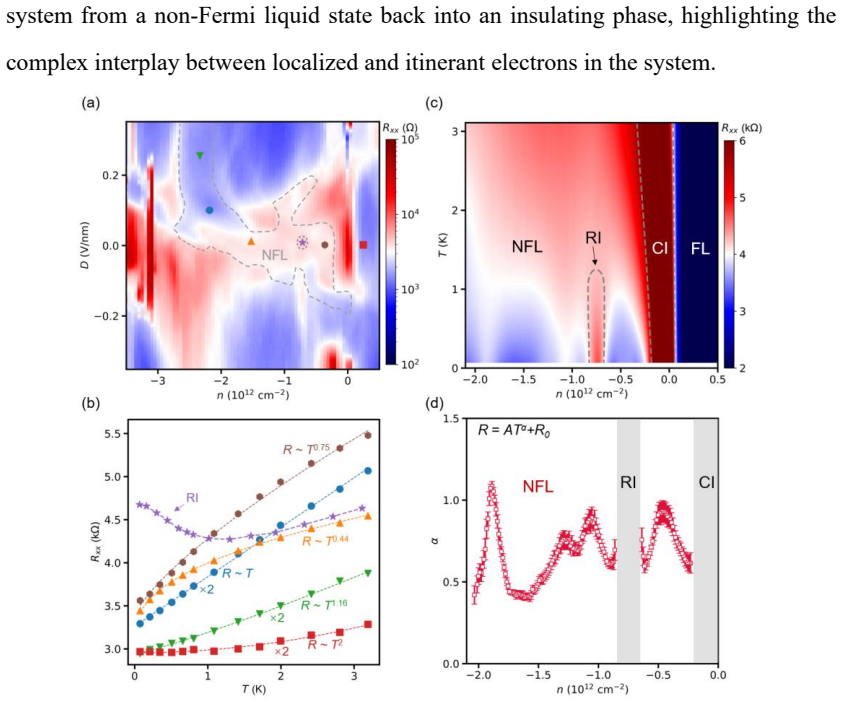
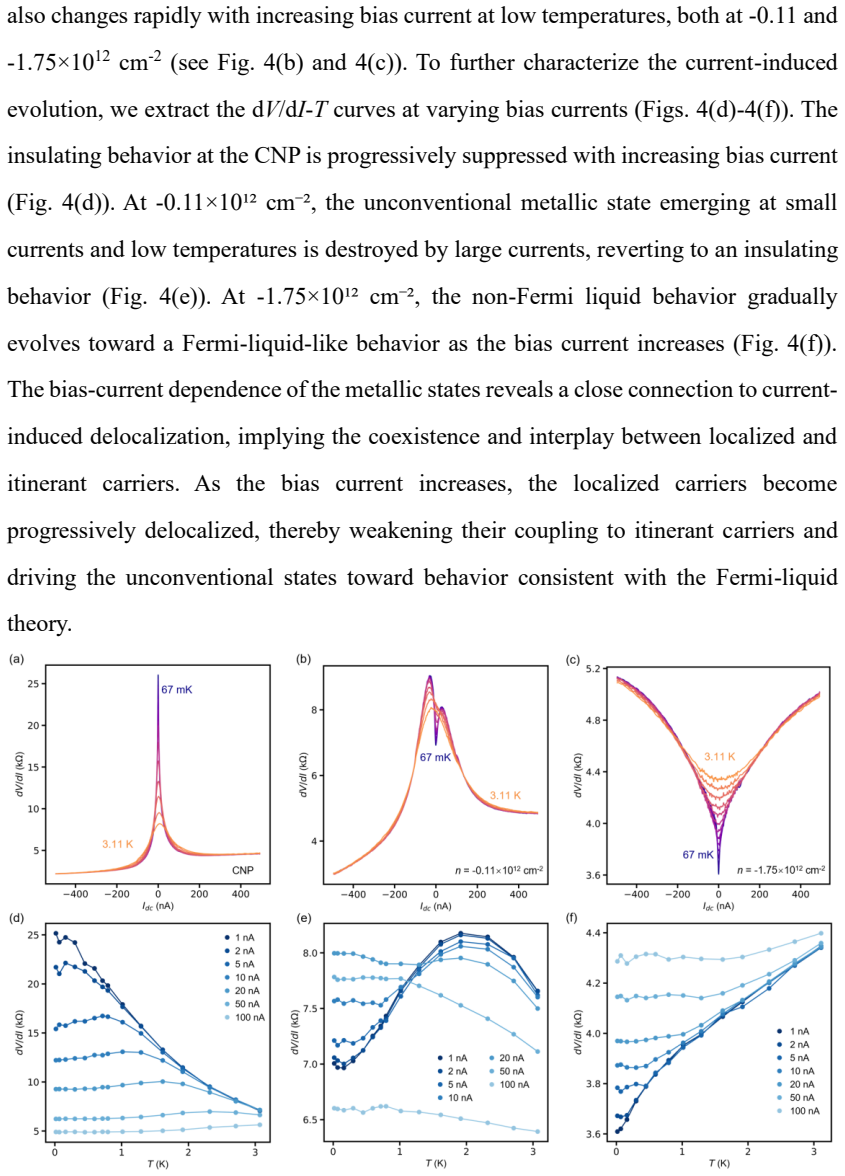
We report the observation of tunable extended non-Fermi liquid behavior in twisted double bilayer graphene encapsulated by aligned hBN layers. This NFL phase spans a broad range of carrier densities and exhibiting a carrier density dependent resistance exponent. Combined with temperature dependent resistance, magnetotransport and differential resistance measurements, these findings support a scenario where strong quantum fluctuations emerge from the interplay between localized and itinerant carriers. Our work establishes a highly tunable platform beyond conventional frameworks to investigate the organizing principles of non-Fermi liquid physics manifested in diverse behaviors.
What carries the argument
The moiré superlattice formed in twisted double bilayer graphene with aligned hBN encapsulation, which hosts localized and itinerant carriers whose interplay produces the quantum fluctuations.
If this is right
- The NFL regime extends over wide carrier-density ranges instead of being pinned to a single critical point.
- Different resistance exponents become accessible by simple electrostatic tuning in one device.
- The platform allows direct comparison of multiple NFL behaviors within the same material class.
- Quantum fluctuations are tied to the specific carrier-interplay mechanism rather than generic criticality.
Where Pith is reading between the lines
- Varying the twist angle or hBN alignment could shift the density window of the NFL phase and test the role of moiré potential strength.
- Analogous extended NFL states may appear in other graphene moiré stacks if similar localized-itinerant coexistence can be engineered.
- Quantitative modeling of the exponent-density relation could predict how the fluctuation spectrum evolves with external magnetic field.
Load-bearing premise
The transport data indicate quantum fluctuations specifically from localized-itinerant carrier interplay rather than from disorder or conventional criticality.
What would settle it
Measurement showing a carrier-density-independent resistance exponent, or magnetotransport and differential resistance lacking the signatures expected from localized-itinerant fluctuations, would falsify the central interpretation.
Figures
read the original abstract
Exploring exotic quantum metallic states beyond Landau's Fermi liquid theory remains a central focus in condensed matter physics. Such non-Fermi liquid behavior is mostly observed near quantum criticality, yet growing attention is directed toward extended NFL phases with intrinsic quantum fluctuations rooted in the extended ground state. While these extended NFL states have been previously reported only in a limited set of d- and f-electron systems, realizing a single, highly tunable platform capable of exhibiting multiple resistance exponent values is essential for uncovering the connection between the resistance exponent and the dominant quantum fluctuations coupled to quasiparticles. However, corresponding experimental progress remains elusive. Here, we report the observation of tunable extended non-Fermi liquid behavior in twisted double bilayer graphene encapsulated by aligned hBN layers. This NFL phase spans a broad range of carrier densities and exhibiting a carrier density dependent resistance exponent. Combined with temperature dependent resistance, magnetotransport and differential resistance measurements, these findings support a scenario where strong quantum fluctuations emerge from the interplay between localized and itinerant carriers. Our work establishes a highly tunable platform beyond conventional frameworks to investigate the organizing principles of non-Fermi liquid physics manifested in diverse behaviors.
Editorial analysis
A structured set of objections, weighed in public.
Referee Report
Summary. The manuscript reports the experimental observation of tunable extended non-Fermi liquid (NFL) behavior in twisted double bilayer graphene encapsulated by aligned hBN layers. This NFL phase is claimed to extend over a broad range of carrier densities, with a carrier-density-dependent resistance exponent. The claim is supported by temperature-dependent resistance, magnetotransport, and differential resistance measurements, interpreted as evidence for strong quantum fluctuations arising from the interplay between localized and itinerant carriers, establishing a tunable platform for NFL physics beyond conventional d- and f-electron systems.
Significance. If the central observational claim and its interpretation hold after detailed scrutiny of the data, the work would provide a highly tunable 2D moiré platform for studying extended NFL phases with multiple resistance exponents in a single system. This could help connect the resistance exponent to specific quantum fluctuation mechanisms, extending beyond the limited set of previously reported systems.
major comments (2)
- [Abstract] The abstract states that the NFL phase 'exhibiting a carrier density dependent resistance exponent' and that the data 'support a scenario where strong quantum fluctuations emerge from the interplay between localized and itinerant carriers.' Without access to the methods section, fitting procedures, raw data, error bars, or exclusion criteria for the power-law fits, it is impossible to assess whether the reported density dependence is robust or influenced by post-hoc analysis choices. This directly impacts the load-bearing claim of tunability.
- [Abstract] The weakest assumption flagged in the review—that the transport signatures arise specifically from localized-itinerant carrier interplay rather than disorder or conventional criticality—is not quantitatively tested in the provided abstract. A concrete test (e.g., comparison of magnetotransport scaling or differential resistance features against disorder models) is needed to substantiate the interpretation.
Simulated Author's Rebuttal
We thank the referee for their careful review and constructive feedback on our manuscript. We address each major comment below and indicate revisions where appropriate to improve clarity and robustness.
read point-by-point responses
-
Referee: [Abstract] The abstract states that the NFL phase 'exhibiting a carrier density dependent resistance exponent' and that the data 'support a scenario where strong quantum fluctuations emerge from the interplay between localized and itinerant carriers.' Without access to the methods section, fitting procedures, raw data, error bars, or exclusion criteria for the power-law fits, it is impossible to assess whether the reported density dependence is robust or influenced by post-hoc analysis choices. This directly impacts the load-bearing claim of tunability.
Authors: The full manuscript includes a Methods section and Extended Data figures that detail the fitting procedures (temperature range 0.3–20 K, adjusted R² > 0.98, chi-squared minimization), raw resistance curves, error bars from multiple cooldowns and devices, and explicit exclusion criteria for non-power-law regimes. The density dependence is reproduced across three independent devices. To make these details immediately accessible from the abstract, we will revise the abstract to reference the Methods section and add a sentence on fit robustness. We will also include a new supplementary note summarizing all individual fits. revision: yes
-
Referee: [Abstract] The weakest assumption flagged in the review—that the transport signatures arise specifically from localized-itinerant carrier interplay rather than disorder or conventional criticality—is not quantitatively tested in the provided abstract. A concrete test (e.g., comparison of magnetotransport scaling or differential resistance features against disorder models) is needed to substantiate the interpretation.
Authors: The main text (Results and Discussion) presents magnetotransport (linear MR, anomalous Hall) and differential resistance data that are inconsistent with conventional disorder-dominated transport and are tied to the tunable moiré flat bands. However, we agree that an explicit side-by-side comparison to disorder models would strengthen the claim. In revision we will add a dedicated paragraph with scaling analysis and disorder-strength estimates derived from mobility data to differentiate the localized-itinerant scenario from alternative interpretations. revision: yes
Circularity Check
No significant circularity
full rationale
The paper is an experimental report of observed transport signatures in a moiré heterostructure, claiming tunable extended NFL behavior across carrier densities with a density-dependent resistance exponent. The abstract and provided text contain no derivation chain, no equations, no fitted parameters renamed as predictions, and no self-citation invoked as a uniqueness theorem or ansatz. The central claim rests on qualitative consistency between temperature-dependent resistance, magnetotransport, and differential resistance data and an interpretive scenario of localized-itinerant carrier interplay; this interpretation is not reduced to any input by construction. No load-bearing step matches any of the enumerated circularity patterns.
Axiom & Free-Parameter Ledger
Reference graph
Works this paper leans on
-
[1]
4School of Physics, Huazhong University of Science and Technology, Wuhan 430074, China
Physics, University of Science and Technology of China, Hefei 230026, China. 4School of Physics, Huazhong University of Science and Technology, Wuhan 430074, China. 5Research Center for Functional Materials, National Institute for Materials Science, 1- 1 Namiki, Tsukuba 305-0044, Japan. 6International Center for Materials Nanoarchitectonics, National Inst...
1957
discussion (0)
Sign in with ORCID, Apple, or X to comment. Anyone can read and Pith papers without signing in.