Towards Whole Hand and Wrist Kinematic Tracking with a Wearable A-Mode Ultrasound Probe
Pith reviewed 2026-06-26 10:07 UTC · model grok-4.3
The pith
A wearable A-mode ultrasound probe with an on-device neural network tracks 23 hand and wrist degrees of freedom while using only 33 milliwatts.
A machine-rendered reading of the paper's core claim, the machinery that carries it, and where it could break.
Core claim
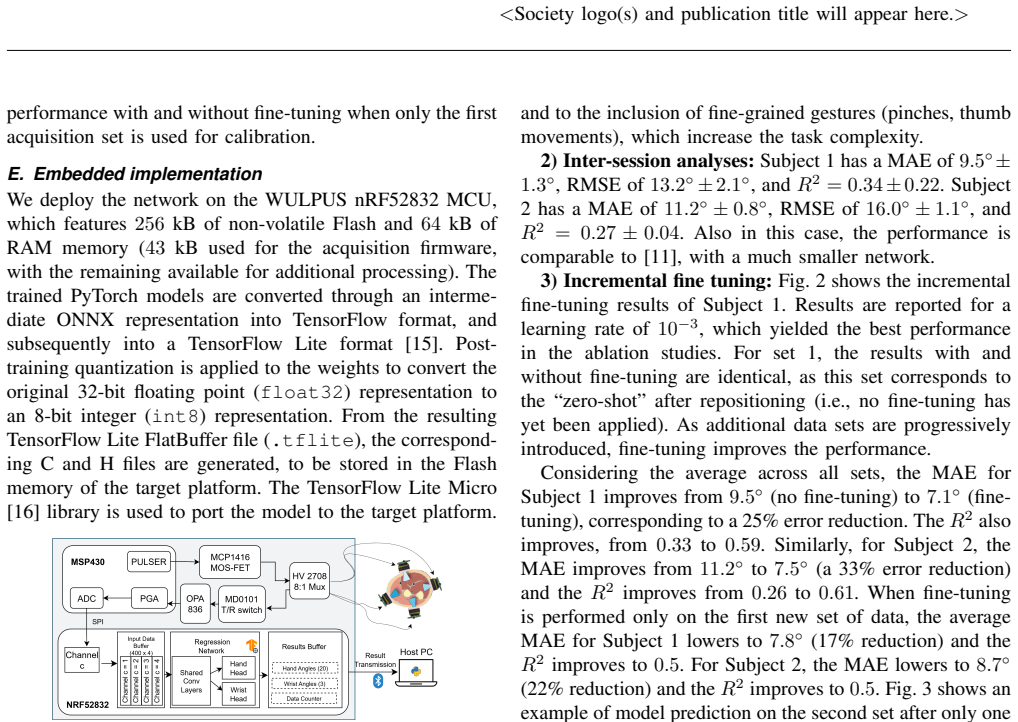
The central claim is that end-to-end regression of 23 degrees of freedom for hand and wrist motion is feasible entirely on the WULPUS wearable A-mode ultrasound platform. A compact multi-output convolutional neural network with 11285 parameters, trained incrementally, is deployed on the nRF52832 microcontroller to achieve 0.73 mJ per inference and 29.1 ms latency. Full operation including data acquisition, online inference, and BLE streaming of results stays within 33 mW, supporting up to 36 hours of continuous use and delivering an 88 percent reduction in wireless bandwidth compared with sending raw data.
What carries the argument
The compact multi-output convolutional neural network with 11285 parameters together with the incremental training strategy, executed directly on the nRF52832 microcontroller inside the WULPUS probe.
If this is right
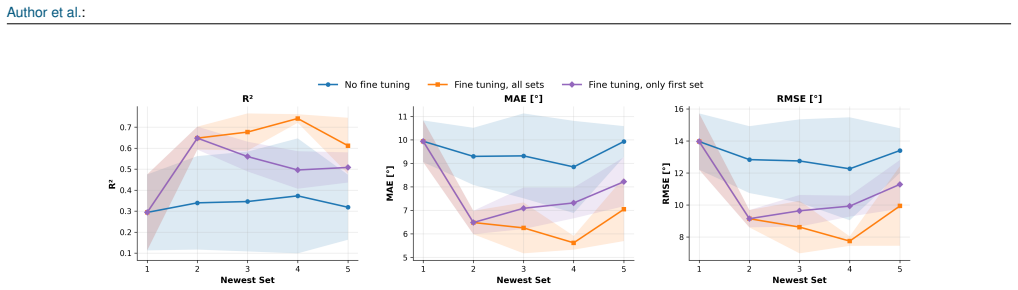
- Incremental training lowers mean absolute error by more than 17 percent relative to a non-incremental baseline.
- On-device inference completes in 29.1 milliseconds while consuming 0.73 millijoules.
- The full pipeline of acquisition, inference, and result streaming fits inside a 33 milliwatt power envelope.
- Streaming only the motion estimates instead of raw ultrasound data cuts wireless bandwidth by 88 percent.
- Battery-powered continuous operation reaches up to 36 hours.
Where Pith is reading between the lines
- The low-power on-device design could support integration with other body-worn sensors for combined motion and physiological monitoring.
- Keeping raw ultrasound data local may reduce privacy exposure in applications such as rehabilitation or prosthetic control.
- Robustness to repositioning raises the possibility of daily use without frequent recalibration.
- The same compact model approach might be tested on other ultrasound frequencies or probe placements to expand the tracked body regions.
Load-bearing premise
The incremental training strategy produces robust inter-session generalization and robustness to sensor repositioning, even though the paper gives limited details on the number of sessions, subjects, or repositioning protocol.
What would settle it
A controlled test with repeated sensor repositioning across multiple sessions and subjects that shows either no more than 17 percent error reduction from incremental training or total power draw exceeding 33 mW during full on-device operation.
Figures

read the original abstract
A-mode ultrasound (US) has emerged as a promising modality for hand and wrist motion tracking. Prior works have mainly addressed static gesture classification or regression of a few degrees of freedom (DoFs), typically relying on non-wearable systems and external computing devices, and highlight the need for strategies to ensure robustness to sensor repositioning. In this work, we propose a framework for robust whole-hand and wrist kinematic tracking via wearable A-mode US using the WULPUS platform, tackling the regression of 23 DoFs directly on the probe. First, we introduce a compact (11285 parameters) multi-output convolutional neural network combined with an incremental training strategy, which improves inter-session generalization and reduces mean absolute error by more than 17% compared to a non-incremental approach. Second, we demonstrate, for the first time, the feasibility of end-to-end hand and wrist kinematic tracking entirely on-device. We deploy the model on the WULPUS nRF52832 microcontroller, achieving 0.73 mJ per inference, 29.1 ms latency, and showing the feasibility of full operation (data acquisition, online inference, and BLE streaming of results) within 33 mW, enabling up to 36 hours of continuous use and an 88% reduction in wireless bandwidth compared to raw data transmission.
Editorial analysis
A structured set of objections, weighed in public.
Referee Report
Summary. The manuscript claims to demonstrate, for the first time, end-to-end whole-hand and wrist kinematic tracking (23 DoFs) entirely on a wearable A-mode ultrasound probe (WULPUS platform). It introduces a compact multi-output CNN (11 285 parameters) paired with an incremental training strategy that purportedly improves inter-session generalization and reduces MAE by >17 % versus non-incremental training; the model is then deployed on the nRF52832 MCU, reporting 0.73 mJ per inference, 29.1 ms latency, full operation within 33 mW (enabling up to 36 h continuous use), and an 88 % reduction in wireless bandwidth relative to raw-data transmission.
Significance. If the reported metrics and generalization claims are substantiated, the work would constitute a meaningful advance in wearable ultrasound-based kinematic sensing by showing that a full 23-DoF regressor can run on-device with power and latency compatible with long-term wearable use, thereby removing the need for external compute and substantially lowering transmission overhead.
major comments (2)
- [Abstract] Abstract: the central claim that incremental training 'improves inter-session generalization and reduces mean absolute error by more than 17 %' is load-bearing for the wearable feasibility argument, yet the abstract (and, by the supplied text, the manuscript) supplies no subject count, session count, repositioning protocol, data-split strategy, or statistical test supporting the 17 % figure.
- [Abstract] Abstract: quantitative performance figures (MAE reduction, 0.73 mJ, 29.1 ms, 33 mW, 36 h) are presented without dataset size, number of subjects, cross-validation scheme, error bars, or explicit repositioning-test protocol, rendering the on-device feasibility claim unverifiable from the given information.
minor comments (1)
- Define all acronyms on first use (DoFs, BLE, MAE, CNN).
Simulated Author's Rebuttal
We thank the referee for the detailed comments on the abstract. The observations correctly note that key supporting details are absent from the abstract, which limits immediate verifiability of the central claims. We will revise the abstract to incorporate the requested context while preserving its length and focus. Point-by-point responses follow.
read point-by-point responses
-
Referee: [Abstract] Abstract: the central claim that incremental training 'improves inter-session generalization and reduces mean absolute error by more than 17 %' is load-bearing for the wearable feasibility argument, yet the abstract (and, by the supplied text, the manuscript) supplies no subject count, session count, repositioning protocol, data-split strategy, or statistical test supporting the 17 % figure.
Authors: We agree that the abstract should supply these details to substantiate the 17 % MAE reduction claim. The manuscript body reports the experimental protocol, but the abstract does not. In revision we will expand the abstract to state the number of subjects and sessions, summarize the repositioning protocol and data-split strategy used for inter-session evaluation, and note that the reported improvement was assessed with appropriate statistical testing. This change directly addresses the concern. revision: yes
-
Referee: [Abstract] Abstract: quantitative performance figures (MAE reduction, 0.73 mJ, 29.1 ms, 33 mW, 36 h) are presented without dataset size, number of subjects, cross-validation scheme, error bars, or explicit repositioning-test protocol, rendering the on-device feasibility claim unverifiable from the given information.
Authors: We concur that the abstract would be strengthened by including these elements. The manuscript provides the underlying dataset size, subject count, cross-validation details, and repositioning protocol in the Methods and Results sections. We will revise the abstract to reference the dataset size and subject count, indicate the cross-validation scheme, allude to the repositioning-test protocol, and note the presence of variability measures for the reported metrics. This will make the on-device claims more self-contained. revision: yes
Circularity Check
No significant circularity; claims rest on direct hardware measurements
full rationale
The paper reports end-to-end on-device deployment results (0.73 mJ/inference, 29.1 ms latency, 33 mW total, 36 h runtime, 88% bandwidth reduction) obtained from physical execution on the nRF52832 microcontroller after training a 11285-parameter CNN. These quantities are measured outputs of the deployed system rather than quantities derived from equations or fitted parameters that are then re-presented as independent predictions. The >17% MAE improvement from incremental training is stated as an empirical comparison but is not supported by any self-referential equations, self-citations, or ansatzes that reduce the result to its own inputs by construction. No load-bearing uniqueness theorems, renamings of known results, or fitted-input-as-prediction patterns appear. The central feasibility claim is therefore self-contained experimental evidence.
Axiom & Free-Parameter Ledger
free parameters (1)
- CNN trainable parameters =
11285
axioms (1)
- domain assumption A-mode ultrasound signals acquired at the wrist contain information sufficient to regress 23 independent kinematic degrees of freedom
Reference graph
Works this paper leans on
-
[1]
Human-machine interaction sensing technology based on hand gesture recognition: A review,
L. Guoet al., “Human-machine interaction sensing technology based on hand gesture recognition: A review,”IEEE Trans. Hum.-Mach. Syst., vol. 51, no. 4, pp. 300–309, 2021
2021
-
[2]
A methodological and structural review of hand gesture recognition across diverse data modalities,
J. Shinet al., “A methodological and structural review of hand gesture recognition across diverse data modalities,”IEEE Access, vol. 12, pp. 142 606–142 639, 2024
2024
-
[3]
Ultrasound as a neurorobotic interface: A review,
X. Yanget al., “Ultrasound as a neurorobotic interface: A review,” IEEE Trans. Syst. Man Cybern.: Syst., vol. 54, no. 6, pp. 3534–3546, 2024
2024
-
[4]
Wearable ultrasound technology,
S. Zhouet al., “Wearable ultrasound technology,”Nat. Rev. Bioeng., vol. 3, no. 10, pp. 835–854, 2025
2025
-
[5]
Wearable ultrasound-based decoding of simultaneous wrist/hand kinematics,
X. Yanget al., “Wearable ultrasound-based decoding of simultaneous wrist/hand kinematics,”IEEE Trans. Ind. Electron., vol. 68, no. 9, pp. 8667–8675, 2021
2021
-
[6]
A wearable ultrasound system for sensing muscular morpho- logical deformations,
——, “A wearable ultrasound system for sensing muscular morpho- logical deformations,”IEEE Trans. Syst. Man Cybern.: Syst., vol. 51, no. 6, pp. 3370–3379, 2021
2021
-
[7]
High performance wearable ultrasound as a human-machine interface for wrist and hand kinematic tracking,
B. G. Sgambatoet al., “High performance wearable ultrasound as a human-machine interface for wrist and hand kinematic tracking,”IEEE Trans. Biomed. Eng., vol. 71, no. 2, pp. 484–493, 2024
2024
-
[8]
Portable ultrasound research system for use in automated bladder monitoring with machine-learning-based segmen- tation,
M. Fournelleet al., “Portable ultrasound research system for use in automated bladder monitoring with machine-learning-based segmen- tation,”Sensors, vol. 21, no. 19, p. 6481, 2021
2021
-
[9]
Tracking of wrist and hand kinematics with ultra low power wearable a-mode ultrasound,
G. Spaconeet al., “Tracking of wrist and hand kinematics with ultra low power wearable a-mode ultrasound,”IEEE Trans. Biomed. Circuits Syst., vol. 19, no. 3, pp. 536–548, 2025
2025
-
[10]
Wulpus: a wearable ultra low-power ultrasound probe for multi-day monitoring of carotid artery and muscle activity,
S. Freyet al., “Wulpus: a wearable ultra low-power ultrasound probe for multi-day monitoring of carotid artery and muscle activity,” in2022 IEEE IUS, 2022, pp. 1–4
2022
-
[11]
Wearable and ultra-low-power fusion of emg and a-mode us for hand-wrist kinematic tracking,
G. Spaconeet al., “Wearable and ultra-low-power fusion of emg and a-mode us for hand-wrist kinematic tracking,” in2025 IEEE BioCAS, 2025, pp. 314–318
2025
-
[12]
The optimal controller delay for myoelectric pros- theses,
T. Farrellet al., “The optimal controller delay for myoelectric pros- theses,”IEEE Trans. Neural Syst. Rehabil. Eng., vol. 15, no. 1, pp. 111–118, 2007
2007
-
[13]
https://amzn.eu/d/9dQ3nRG
Hydrogel pad. https://amzn.eu/d/9dQ3nRG
-
[14]
(2025) Quantum Metagloves
MANUS Technology Group. (2025) Quantum Metagloves. https://www.manus-meta.com/products/quantum-metagloves
2025
-
[15]
https://github.com/tensorflow/tensorflow
TensorFlow. https://github.com/tensorflow/tensorflow
-
[16]
https://github.com/tensorflow/tflite-micro
TF Lite Micro. https://github.com/tensorflow/tflite-micro
-
[17]
(un)supervised (co)adaptation via incremental learning for myoelectric control: Motivation, review, and future direc- tions,
E. Campbellet al., “(un)supervised (co)adaptation via incremental learning for myoelectric control: Motivation, review, and future direc- tions,”IEEE Trans. Neural Syst. Rehabil. Eng., vol. 33, pp. 3565–3582, 2025
2025
-
[18]
Improving intersession reproducibility for fore- arm ultrasound based hand gesture classification through an incremen- tal learning approach,
J. Rothenberget al., “Improving intersession reproducibility for fore- arm ultrasound based hand gesture classification through an incremen- tal learning approach,” in2024 IEEE UFFC-JS, 2024, pp. 1–4. 4 VOLUME ,
2024
discussion (0)
Sign in with ORCID, Apple, or X to comment. Anyone can read and Pith papers without signing in.