Forward-backward correspondence between stationary structure and splitting probabilities in active matter
Pith reviewed 2026-06-30 08:56 UTC · model grok-4.3
The pith
Comparing forward and backward equations in phase space shows stationary density equals the spatial derivative of splitting probability for active particles.
A machine-rendered reading of the paper's core claim, the machinery that carries it, and where it could break.
Core claim
By comparing forward and backward evolution equations directly in position-velocity phase space, exact relations are derived linking stationary distributions and splitting probabilities for run-and-tumble, active Brownian, and active Ornstein-Uhlenbeck particles. The stationary density is generated by the spatial derivative of the splitting probability, while the distribution of dynamically adsorbed particles at the walls is encoded in wall splitting probabilities. The correspondence is valid in arbitrary spatial dimension and establishes an exact bridge between stationary and first-passage descriptions of confined active matter.
What carries the argument
Direct comparison of forward and backward evolution equations in position-velocity phase space, which generates the exact relations between stationary density and splitting probability.
If this is right
- Stationary density is recovered directly as the spatial derivative of the splitting probability.
- The distribution of dynamically adsorbed particles at the walls is encoded in the wall splitting probabilities.
- The relations hold exactly for run-and-tumble, active Brownian, and active Ornstein-Uhlenbeck particles.
- The correspondence remains valid in arbitrary spatial dimension.
- Stationary and first-passage descriptions become complementary representations of the same persistence-driven dynamics.
Where Pith is reading between the lines
- Known stationary distributions could be differentiated to obtain splitting probabilities without separate first-passage calculations.
- The same forward-backward comparison might apply to active particles with interactions or different boundary conditions.
- Similar relations could appear in other persistence-driven systems such as bacterial motility or granular flows.
- Numerical checks in two or three dimensions would test whether the density-splitting link remains exact beyond one dimension.
Load-bearing premise
Direct comparison of forward and backward evolution equations in position-velocity phase space produces exact relations without requiring additional boundary conditions, approximations, or model-specific corrections.
What would settle it
A simulation of run-and-tumble particles in a one-dimensional channel in which the measured stationary density fails to equal the spatial derivative of the measured splitting probability.
Figures
read the original abstract
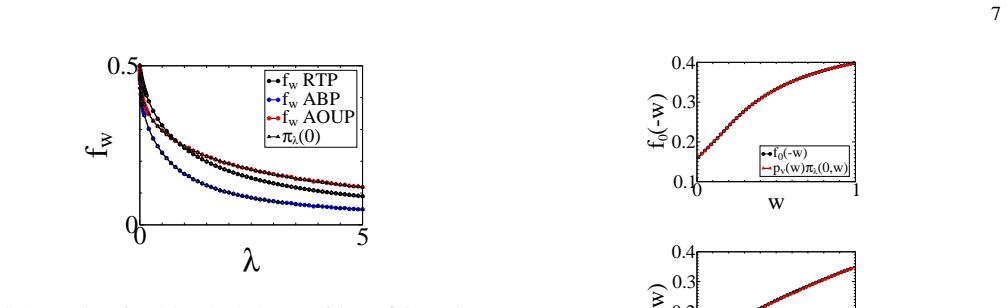
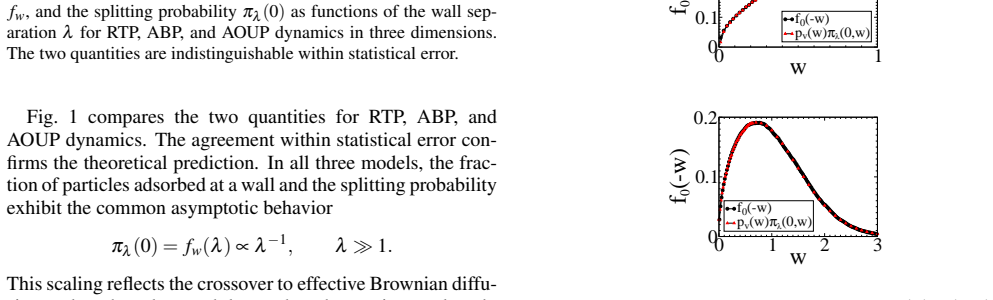
Active particles confined by hard walls accumulate at boundaries and may become dynamically adsorbed due to directional persistence. In this work, we show that the same persistence mechanism also gives rise to a finite wall splitting probability, meaning that a particle initialized at a wall can reach the opposite boundary before returning to its starting point. By comparing forward and backward evolution equations directly in position--velocity phase space, we derive exact relations linking stationary distributions and splitting probabilities for run-and-tumble, active Brownian, and active Ornstein--Uhlenbeck particles. In particular, we show that the stationary density is generated by the spatial derivative of the splitting probability, while the distribution of dynamically adsorbed particles at the walls is encoded in wall splitting probabilities. The correspondence is valid in arbitrary spatial dimension and establishes an exact bridge between stationary and first-passage descriptions of confined active matter, revealing them as complementary representations of the same persistence-driven dynamics.
Editorial analysis
A structured set of objections, weighed in public.
Referee Report
Summary. The paper claims that direct comparison of the stationary forward Fokker-Planck (or master) equation with the backward Kolmogorov equation for splitting probabilities, performed in position-velocity phase space, yields exact relations for run-and-tumble, active Brownian, and active Ornstein-Uhlenbeck particles confined by hard walls. In particular, the stationary density is the spatial derivative of the splitting probability, and the distribution of dynamically adsorbed particles at the walls is encoded in the wall splitting probabilities. The correspondence is asserted to hold in arbitrary spatial dimension and to bridge stationary and first-passage descriptions without additional approximations.
Significance. If the exact correspondence is rigorously established and correctly incorporates hard-wall boundary rules, the result would supply a useful formal link between stationary measures and splitting probabilities in persistent active systems. This could simplify calculations of boundary accumulation and adsorption statistics by allowing one quantity to be obtained from the other via differentiation or evaluation at the walls, and would apply across multiple standard active-particle models in any dimension.
major comments (2)
- [derivation of the forward-backward correspondence (likely §3 or §4)] The central derivation equates the stationary forward operator to the backward operator applied to the splitting probability. For hard-wall confinement, the backward operator must encode the precise reflection or adsorption boundary rules; these rules are not automatically inherited from the forward stationary measure. The manuscript must demonstrate explicitly (with the relevant boundary terms written out) that no model-specific correction terms arise when the comparison is extended to the walls, otherwise the claimed relations for stationary density and adsorbed-particle distributions acquire additional contributions.
- [boundary-condition treatment in the backward equation] The abstract states that the relations are obtained 'by comparing forward and backward evolution equations directly.' It is necessary to verify that the same phase-space operator is used without auxiliary matching conditions at the boundaries for each of the three models (run-and-tumble, ABP, AOUP). If the paper performs the comparison only in the bulk and then invokes the same operator at the walls, the exactness claim for the adsorbed distribution requires an additional proof that the boundary flux terms cancel identically.
minor comments (2)
- [introduction of notation] Notation for the splitting probability (e.g., whether it is defined as a function of initial position-velocity or of the target boundary) should be introduced with a clear equation before the main relations are stated.
- [dimensional generality claim] The statement that the correspondence holds 'in arbitrary spatial dimension' would benefit from an explicit remark on how the phase-space operators generalize when the velocity is a vector in d>1.
Simulated Author's Rebuttal
We thank the referee for the careful reading and constructive comments on the boundary treatment in our forward-backward correspondence. The points raised concern the explicit handling of hard-wall conditions when equating the stationary forward and backward operators. We address each major comment below and will incorporate clarifications and expanded derivations in the revised manuscript.
read point-by-point responses
-
Referee: [derivation of the forward-backward correspondence (likely §3 or §4)] The central derivation equates the stationary forward operator to the backward operator applied to the splitting probability. For hard-wall confinement, the backward operator must encode the precise reflection or adsorption boundary rules; these rules are not automatically inherited from the forward stationary measure. The manuscript must demonstrate explicitly (with the relevant boundary terms written out) that no model-specific correction terms arise when the comparison is extended to the walls, otherwise the claimed relations for stationary density and adsorbed-particle distributions acquire additional contributions.
Authors: We agree that an explicit accounting of the boundary terms is necessary to confirm the absence of model-specific corrections. In the revised version we will augment the derivation (currently in §3) by writing the full phase-space boundary contributions for each model. Because the backward Kolmogorov operator is constructed from the same stochastic rules as the forward Fokker-Planck operator (including the instantaneous reflection or adsorption at the walls), the boundary fluxes that appear when the stationary density is compared with the spatial derivative of the splitting probability cancel identically; no auxiliary correction terms arise. This cancellation holds uniformly for run-and-tumble, active Brownian, and active Ornstein-Uhlenbeck dynamics and will be shown by direct substitution of the boundary conditions into the integrated phase-space identity. revision: yes
-
Referee: [boundary-condition treatment in the backward equation] The abstract states that the relations are obtained 'by comparing forward and backward evolution equations directly.' It is necessary to verify that the same phase-space operator is used without auxiliary matching conditions at the boundaries for each of the three models (run-and-tumble, ABP, AOUP). If the paper performs the comparison only in the bulk and then invokes the same operator at the walls, the exactness claim for the adsorbed distribution requires an additional proof that the boundary flux terms cancel identically.
Authors: The comparison is performed on the complete phase-space domain, with the splitting probability obeying the same reflecting or adsorbing boundary conditions that define the stationary measure. Consequently the identical differential operator (including its boundary action) appears on both sides of the identity. We will add a short subsection that explicitly verifies, for each of the three models, that no auxiliary matching conditions are imposed and that the boundary flux integrals vanish by virtue of the shared boundary rules. This establishes the exact encoding of the adsorbed-particle distribution in the wall splitting probabilities without further assumptions. revision: yes
Circularity Check
No circularity: derivation rests on direct operator comparison without self-referential inputs or fitted predictions
full rationale
The paper's central claim is obtained by equating the stationary forward Fokker-Planck/master equation to the backward Kolmogorov equation for splitting probabilities in (x,v) phase space and reading off algebraic relations between the stationary density and the spatial derivative of the splitting probability. This comparison is a standard adjoint-operator identity for Markov processes and does not reduce any claimed result to a fitted parameter, a self-definition, or a load-bearing self-citation. No equations in the abstract or described derivation chain are shown to be tautological by construction, and boundary handling is presented as part of the same direct comparison rather than an external ansatz imported from prior work by the same author. The derivation is therefore self-contained against external benchmarks.
Axiom & Free-Parameter Ledger
axioms (2)
- domain assumption Active particle dynamics are described by run-and-tumble, active Brownian, or active Ornstein-Uhlenbeck processes.
- domain assumption Hard-wall confinement produces accumulation and dynamic adsorption due to directional persistence.
Reference graph
Works this paper leans on
-
[1]
M. J. Schnitzer, Theory of continuum random walks and appli- cation to chemotaxis, Phys. Rev. E48, 2553 (1993)
1993
-
[2]
Tailleur and M
J. Tailleur and M. E. Cates, Statistical mechanics of interacting run-and-tumble bacteria, Phys. Rev. Lett.100, 218103 (2008)
2008
-
[3]
Fily and M
Y . Fily and M. C. Marchetti, Athermal phase separation of self- propelled particles with no alignment, Phys. Rev. Lett.108, 235702 (2012)
2012
-
[4]
A. P. Solon, J. Stenhammar, R. Wittkowski, M. Kardar, Y . Kafri, M. E. Cates, and J. Tailleur, Pressure and phase equilibria in in- teracting active brownian spheres, Phys. Rev. Lett.114, 198301 (2015)
2015
-
[5]
Bechinger, R
C. Bechinger, R. Di Leonardo, H. Löwen, C. Reichhardt, G. V olpe, and G. V olpe, Active particles in complex and crowded environments, Rev. Mod. Phys.88, 045006 (2016)
2016
-
[6]
Frydel and R
D. Frydel and R. Podgornik, Mean-field theory of active elec- trolytes: Dynamic adsorption and overscreening, Phys. Rev. E 107, 024603 (2023)
2023
-
[7]
Farago and N
O. Farago and N. R. Smith, Confined run-and-tumble parti- cles with non-markovian tumbling statistics, Phys. Rev. E109, 024110 (2024)
2024
-
[8]
Redner,A Guide to First-Passage Processes(Cambridge University Press, Cambridge, 2001)
S. Redner,A Guide to First-Passage Processes(Cambridge University Press, Cambridge, 2001)
2001
-
[9]
Oshanin, R
G. Oshanin, R. Metzler, and G. Schehr, First-passage phenom- ena and their applications, World Scientific (2012)
2012
-
[10]
A. J. Bray, S. N. Majumdar, and G. Schehr, Persistence and first-passage properties in nonequilibrium systems, Advances in Physics62, 225 (2013)
2013
-
[11]
Fedotov, Non-markovian random walks and nonlinear reac- tions, Phys
S. Fedotov, Non-markovian random walks and nonlinear reac- tions, Phys. Rev. E81, 011117 (2010)
2010
-
[12]
Malakar, V
K. Malakar, V . Jemseena, A. Kundu, K. V . Kumar, S. Sabha- pandit, S. N. Majumdar, S. Redner, and A. Dhar, Steady state, relaxation and first-passage properties of a run-and-tumble par- ticle in one-dimension, Journal of Statistical Mechanics: The- ory and Experiment2018, 043215 (2018)
2018
-
[13]
F. Mori, P. Le Doussal, S. N. Majumdar, and G. Schehr, Uni- versal survival probability for ad-dimensional run-and-tumble particle, Phys. Rev. Lett.124, 090603 (2020)
2020
-
[14]
U. Basu, S. N. Majumdar, A. Rosso, and G. Schehr, Active brownian motion in two dimensions, Phys. Rev. E100, 062116 (2019)
2019
-
[15]
Frydel, Run-and-tumble particles in slit geometry as a split- ting probability problem, Physics of Fluids36, 111901 (2024)
D. Frydel, Run-and-tumble particles in slit geometry as a split- ting probability problem, Physics of Fluids36, 111901 (2024)
2024
-
[16]
U. Basu, S. Sabhapandit, and I. Santra, Target search by active particles, inTarget Search Problems, edited by D. Grebenkov, R. Metzler, and G. Oshanin (Springer Nature Switzerland, Cham, 2024) pp. 463–487
2024
-
[17]
Demaerel and C
T. Demaerel and C. Maes, Active processes in one dimension, Phys. Rev. E97, 032604 (2018), rigorous treatment of back- ward/forward operators in active 1D systems
2018
-
[18]
Klinger, R
J. Klinger, R. V oituriez, and O. Bénichou, Splitting probabili- ties of symmetric jump processes, Phys. Rev. Lett.129, 140603 (2022)
2022
-
[19]
Guéneau and L
M. Guéneau and L. Touzo, Relating absorbing and hard wall boundary conditions for a one-dimensional run-and-tumble par- ticle, Journal of Physics A: Mathematical and Theoretical57, 225005 (2024)
2024
-
[20]
Siegmund, The equivalence of absorbing and reflecting bar- rier problems for stochastically monotone Markov processes, The Annals of Probability4, 914 (1976)
D. Siegmund, The equivalence of absorbing and reflecting bar- rier problems for stochastically monotone Markov processes, The Annals of Probability4, 914 (1976)
1976
-
[21]
Guéneau and L
M. Guéneau and L. Touzo, Siegmund duality for physi- cists: a bridge between spatial and first-passage properties of continuous- and discrete-time stochastic processes, Journal of Statistical Mechanics: Theory and Experiment2024, 083208 (2024)
2024
-
[22]
Y . Baouche, M. Guéneau, and C. Kurzthaler, Spatiotempo- ral characterization of active Brownian dynamics in channels, arXiv preprint arXiv:2603.12080 (2026), arXiv:2603.12080 [physics.bio-ph]. 9
-
[23]
D. Frydel, Generalized run-and-tumble model in 1d geometry for an arbitrary distribution of drift velocities, Journal of Statis- tical Mechanics: Theory and Experiment2021, 083220 (2021)
2021
discussion (0)
Sign in with ORCID, Apple, or X to comment. Anyone can read and Pith papers without signing in.