REVIEW 3 major objections 5 minor 88 references
Evolution of specialized microbial cooperation in dynamic fluids
T0 review · 3 major / 5 minor · reviewed 2026-08-14 · deepseek-v4-flash
Pith's one-line read In a simulated microbial community, physical transport—diffusion, decay, and fluid flow—can override fitness economics, keeping generalist cooperation stable where invasion fitness alone predicts specialists or cheaters should win.
desk verdict A credible simulation study showing fluid flow can flip microbial specialisation outcomes, but the abstract's broad claim outstrips what one passive Turing mechanism can carry. read the letter →
The pith
A machine-rendered reading of the paper's core claim, the machinery that carries it, and where it could break.
The reading
What carries the argument
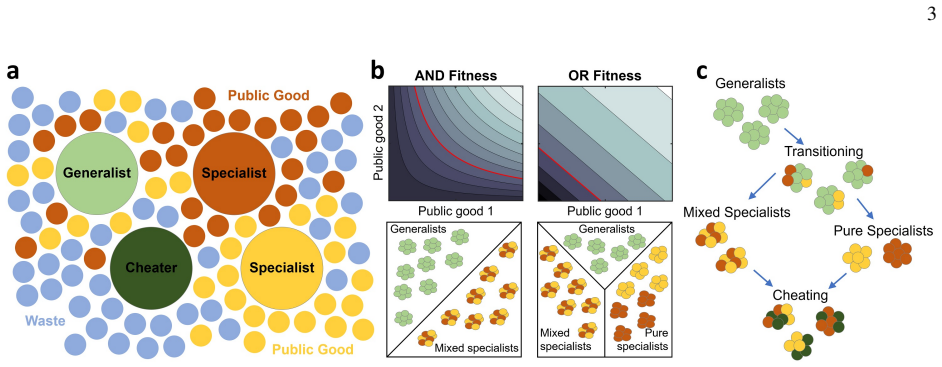
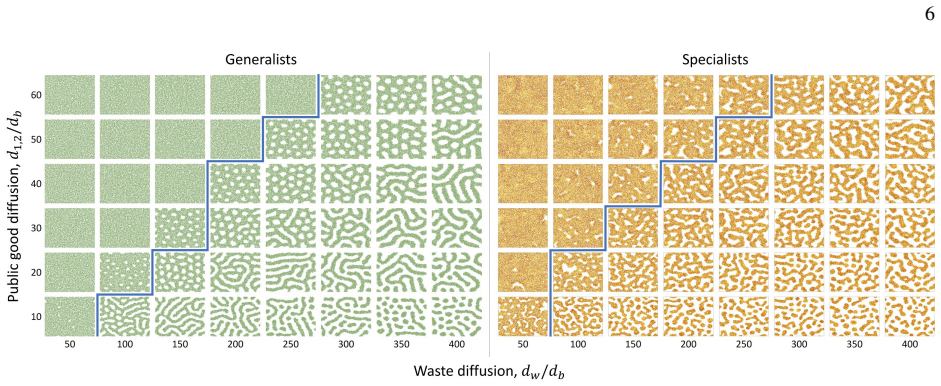
The load-bearing machinery is a reaction-diffusion-advection model of seven coupled fields: number densities of four phenotypes (generalist, two specialists, cheater) and concentrations of two public goods plus waste. Growth follows saturating Monod/Hill kinetics with either AND logic (both goods required) or OR logic (goods substitute), mutations toggle secretion functions on and off, and chemicals diffuse, decay, and are advected by the flow field. A Turing instability—waste diffusing faster than public goods—produces the self-organized cooperative clusters that are the real evolutionary units; an effective group model then tracks these clusters as growing, fragmenting entities. The key quantities are the fragmentation rates of group types measured from simulation, compared with mutation supply: if fragmentation outruns mutation, the group type is stable; if mutation outruns fragmentation, the group is taken over. This is what connects physical parameters (diffusion constants, decay rates, flow shear) to evolutionary outcomes.
What would settle it
A controlled microfluidic experiment with an engineered non-motile, non-adherent bacterium secreting two diffusible public goods could test the claim: if measured population composition across increasing shear rates does not shift from generalist to specialist, or if generalists are already absent at low shear where invasion fitness predicts specialization, the proposed dominance of physical transport over fitness economics would be contradicted. Alternatively, measuring group fragmentation and mutation supply directly and showing that specialists win even when fragmentation outruns mutation would break the mechanism.
Extended reading notes
Core claim
The paper claims that abiotic transport can override fitness economics in determining microbial community structure. In the model, microbes that secrete both public goods (generalists), one good (specialists), or none (cheaters) compete while their secretions and metabolic waste diffuse, decay, and advect in a flowing fluid. Because waste diffuses faster than public goods under the chosen parameters, the population self-organizes into Turing-like spots and stripes—cooperative clusters that grow, fragment, and reproduce as units. Group structure then governs evolution: large, dense groups generate more mutant specialists or cheaters and are taken over, whereas small, frequently fragmenting groups shed mutants and remain stable. The paper reports three results that contradict pure fitness-economics reasoning: generalist communities can resist invasion by specialists despite specialists' higher invasion fitness; generalist and specialist communities can resist cheaters despite the free-riding fitness advantage; and multiple community structures can coexist in a single fluid niche, including stable coexistence across shear zones in pipe and vortex flows.
Load-bearing premise
The central claim assumes that real microbial community structure is set by abiotic diffusion-advection instabilities among passive point-particle cells, and the parameters are chosen to make those Turing patterns strong and sensitive to cost; if active biological clustering (taxis, adhesion, or flow feedback) actually determines group formation, the override of fitness economics could be an artifact of that choice.
Editorial extensions
If this is right
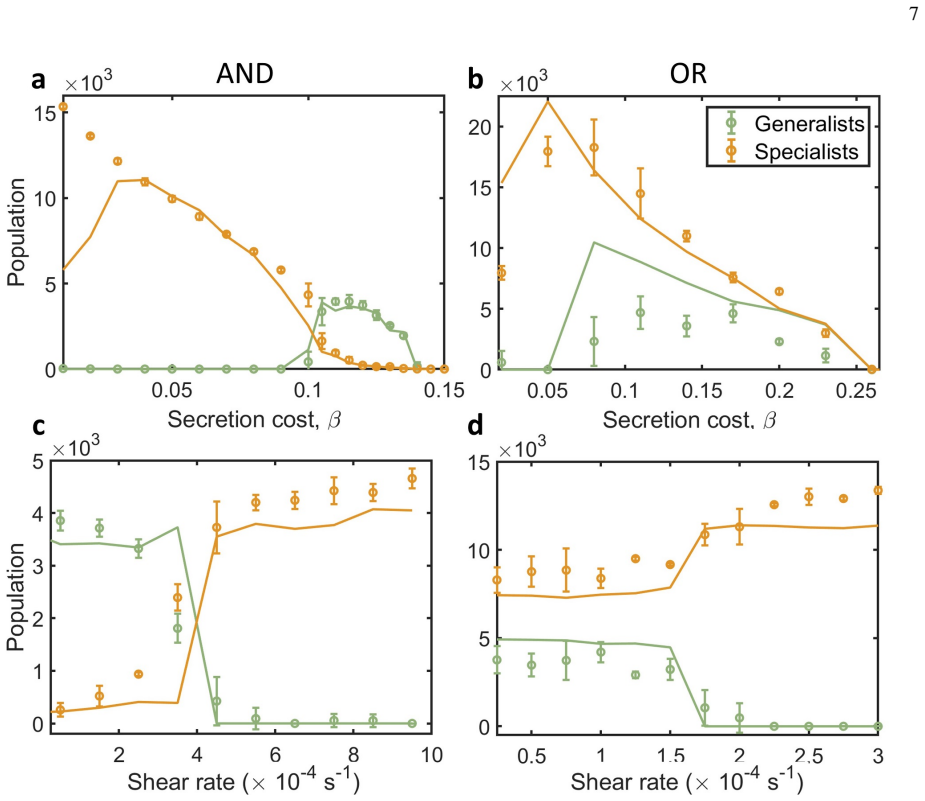
- A shearing flow promotes specialization: shear fragments specialist groups faster and enlarges generalist groups, making generalists more mutation-prone, so increasing shear can switch a coexisting population to a specialist state.
- Spatially varying shear, as in a pipe or vortex, partitions the niche: generalists persist in low-shear regions, specialists in high-shear regions, and in some regions all three types coexist, counteracting competitive exclusion.
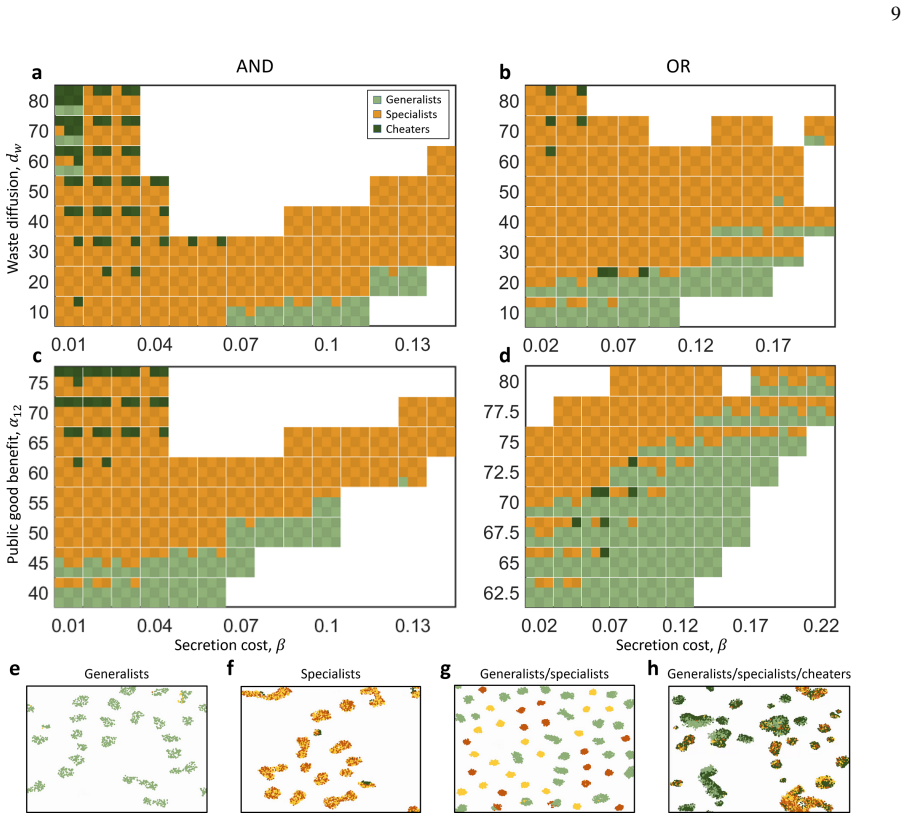
- High waste diffusion and high public-good benefit favor specialists and cheaters; high secretion cost favors generalists; there are two distinct extinction regimes, one driven by cheater takeover of 'too fit' groups and one by self-pollution of dense groups.
- The AND fitness form enables true division of labor with mixed specialist groups, while the OR form yields pure specialist groups, because specialist mutations sweep generalist groups before complementary specialists arise.
Reading between the lines
- If the mechanism is right, any manipulation that changes group fragmentation—stirring rate, confinement geometry, biofilm matrix strength, or cell-cell adhesion—should be a practical lever for steering microbial communities toward or away from specialization, even when payoff parameters are unchanged.
- The paper notes asymmetric diffusion or decay between the two goods is unexplored; a natural extension is that the more private (shorter diffusion length) good will be produced by more microbes and the more public good will be exploited more heavily, a prediction that could be tested by varying the molecular size of the two goods.
- Because microbes are modeled as passive point particles with no taxis, adhesion, or feedback on flow, an equally plausible world is one where active clustering dominates; comparing motile or adherent strains with non-motile passive ones under identical flow would show whether abiotic transport alone is the causal driver.
Signed reviews
Editorial analysis
A structured set of objections, weighed in public.
Referee Report
Summary. The paper presents a mechanistic simulation and analytical study of the evolution of specialization in microbial communities that secrete two public goods and a waste compound in a fluid environment. The authors use agent-based stochastic simulations coupled to diffusion-advection equations for three chemicals, with two fitness architectures (AND and OR), and supplement these with a Turing instability analysis of homogeneous generalist and specialist states. They then extract group-level fragmentation rates and group sizes from the simulations and build a mean-field 'effective group model' to reproduce the simulated proportions of generalists, specialists, and cheaters. The central claims are that abiotic physical factors—diffusion constants, molecular decay rates, and fluid flow patterns—can be as influential as fitness economics, so that generalists can resist invasion by specialists, cooperators can resist cheaters, and multiple community structures can coexist despite competitive exclusion. The main results are presented as phase diagrams and flow-profile-dependent spatial patterns (Figs. 4-6).
Significance. If the central claim is supported, the paper is significant: it demonstrates a mechanism by which passive transport processes can alter evolutionary outcomes in social microbial systems, going beyond invasion-fitness arguments. The manuscript has notable strengths: the Turing analysis is a genuine linear-stability derivation, the agent-based model is described in enough detail that the source code is provided, and the qualitative agreement between the pattern-formation region and simulations (Fig. 3) is a useful validation. The prediction that higher secretion cost can favor generalists over specialists, and that spatially varying shear can create coexistence, is falsifiable in principle. However, the broader claim that physical factors are 'as influential as fitness economics' currently rests on a parameterized regime and on an effective model calibrated on the same simulations it explains, which weakens the generality of the conclusion.
major comments (3)
- [Supplementary Section III; Fig. 4] The effective-group model is not an independent theoretical test. The fragmentation/extinction rates (rg, rt, rm, rc, rp) and group sizes (mg, mt, mm, mc, mp) are measured from the same complex simulations whose outcomes the model then reproduces in Fig. 4. The agreement is therefore partly by construction, not an independent prediction. To support the claim that the analytical formulas 'match' the simulations, the authors should either derive these rates from the Turing-scale physics, or explicitly frame the effective model as a descriptive reduction and validate it out-of-sample (e.g., predict Fig. 5 or a different parameter region without re-measuring the rates). As written, the theoretical curves in Fig. 4 do not provide independent evidence for the abstract's claim that physical factors override fitness economics.
- [Fig. 5 caption] The phase diagrams in Fig. 5 are generated from a single simulation run per parameter set, time-averaged over T = 1e6 to 2e6 s. With stochastic mutation, reproduction, and death, single-run outcomes are not sufficient to establish phase boundaries, particularly the extinction and coexistence regions. The authors should report multiple independent runs (at least the 5 used in Fig. 4) with variability measures, or provide convergence diagnostics showing that the time averages are stationary and independent of initial conditions. Without this, the quantitative structure of the phase diagrams is not robustly supported.
- [Supplementary Section II; Discussion] The broad causal claim in the abstract that diffusion, flow, and decay are 'as influential as fitness economics' is not established for microbial communities generally. The parameters were explicitly chosen to produce strong Turing patterns and 'sensitive dependence on cost' (Supplementary Section II), and the model omits taxis, adhesion, and microbial feedback on flow, as acknowledged in the Discussion. The paper therefore demonstrates a possible mechanism for passive point particles in a selected parameter regime, but not that physical factors are generally as influential as fitness. The authors should either soften the general claim or add a systematic sensitivity analysis over a wider range of diffusion/decay ratios and including weak-patterning regimes, to show that the reported phenomena are not an artifact of the chosen parameter region. This is a correctness-risk concern about external validity, not an internal inconsistency.
minor comments (5)
- [Introduction, references] The reference list contains literal '?' placeholders, e.g., '(Cooper and West 2018, Gavrilets 2010,?, Ispolatov et al. 2012...)' and '(Willensdorfer 2008,?)'. These incomplete citations should be completed before publication.
- [Results, 'Fluid dyanmical forces'] There is a typo in the Results section: 'Fluid dyanmical forces' should be 'Fluid dynamical forces'.
- [Fig. 5h caption] The caption of Fig. 5h contains 'fintess' which should be 'fitness'.
- [Supplementary Section II] The text states 'We see in Fig. 1 that varying decay and secretion rates...' but the referenced figure appears to be Supplementary Figure 1, not main-text Fig. 1. The cross-reference should be corrected.
- [Effective model, Eqs. (5)-(8)] The factor 1/2 in the mutation terms is stated to be an approximation for fixation probability. The authors note that the exact fixation probability could be added as a measured parameter; since this factor is used in the central stability conditions (e.g., rg > max(μmg/2, ...)), a sensitivity check on this assumption would be useful.
Circularity Check
The main analytical curves (Fig. 4) are produced by an effective model whose key parameters are measured from the very same simulations it is then used to reproduce, making that agreement a consistency check rather than an independent prediction.
-
fitted input called prediction
[Methods, 'Simple Effective Model'; Supplementary Section III 'Effective Group Models']
"These parameters are “measured” from our complex simulations and depend on the physical properties of the system (see Supplementary Figures 2,3). The results of our effective model are compared to simulation results in Fig. 4. ... Parameter values were obtained from simulations without mutations to determine the natural state and growth of an isolated phenotype."
The effective model's inputs—group fragmentation rates, extinction rates, group sizes, and carrying capacities—are measured by fitting to the same agent-based simulations whose outcomes the model is then used to reproduce in Fig. 4. The steady-state composition computed from Eqs. (5)–(11) is a direct function of these measured rates (e.g., generalists persist when rg > max(µmg/2, mgrm/mm)), so the agreement between the solid curves and the simulation points is not an independent test of the model; it is a consistency check of the coarse-graining.
full rationale
The agent-based simulations and the Turing analysis are self-contained and not circular: the pattern-forming region shown in Fig. 3 is derived from a linear stability analysis of the model equations and compared to independent simulations, and the simulation outcomes themselves follow from the specified stochastic rules. The circularity is confined to the effective group model of Supplementary Section III, which is calibrated on simulation outputs (fragmentation rates, group sizes, carrying capacities) and then used to generate the theoretical curves in Fig. 4. Because those curves are the paper's main quantitative support for the claim that generalists can resist specialists at high cost, one central piece of the argument reduces to fitting the same simulation data it claims to explain. The overall score reflects that this is a partial circularity: the qualitative simulation results are independent, but the 'matching analytical formulas' advertised in the abstract and results are not independent predictions. The discussion's acknowledged neglect of taxis, adhesion, and microbial feedback on flow is a threat to external validity, not a circularity, and the authors' self-citation for shear-enhanced fragmentation is backed by the present simulations as well.
Assumptions & free parameters
free parameters (3)
- Effective model fragmentation/extinction rates (rg, rt, rm, rc/rp) and group sizes (mg, mt, mm, mc/mp) =
Measured from agent-based simulations; values shown only in Supplementary Figures 2 and 3
- Mutation fixation probability factor (1/2) =
0.5
- Diffusion constants d1, d2, dw and flow parameters =
e.g., d1 = d2 = 5e-6 cm2/s, dw = 15e-6 cm2/s; flow rates in figure captions
assumptions (4)
- domain assumption Fitness is a saturating (Hill) function of public good concentration and waste concentration (Eq. 3 and 4)
- domain assumption Waste is produced at no metabolic cost, and public-good secretion is binary with symmetric mutation rates between phenotypes (M matrix)
- domain assumption Microbes are passive point particles in a prescribed flow field; there is no taxis, adhesion, or cell-chemistry feedback on the fluid
- standard math Linear Turing stability analysis of the no-mutation, no-flow reaction-diffusion system gives the pattern-forming region used to interpret the simulations
Cite this review
Pith. "Pith review of Evolution of specialized microbial cooperation in dynamic fluids." pith.science (2026). https://pith.science/paper/2F6Y2HO6
@misc{pith2026190807884,
  author       = {Pith},
  title        = {Pith review of: Evolution of specialized microbial cooperation in dynamic fluids},
  year         = {2026},
  howpublished = {\url{https://pith.science/paper/2F6Y2HO6}},
  note         = {Machine review of arXiv:1908.07884}
}
read the original abstract
Here, we study the evolution of specialization using realistic computer simulations of bacteria that secrete two public goods in a dynamic fluid. Through this first principles approach, we find physical factors such as diffusion, flow patterns, and decay rates are as influential as fitness economics in governing the evolution of community structure, to the extent that when mechanical factors are taken into account, (1) Generalist communities can resist becoming specialists, despite the invasion fitness of specialization, (2) Generalist and specialists can both resist cheaters despite the invasion fitness of free-riding, (3) Multiple community structures can coexist despite the opposing force of competitive exclusion. Our results emphasize the role of spatial assortment and physical forces on niche partitioning and the evolution of diverse community structures.
Figures

Figures from the paper (3 more)

Reference graph
Works this paper leans on
-
[1]
C., McNally, L., Popat, R., and Brown, S
Allen, R. C., McNally, L., Popat, R., and Brown, S. P. (2016). Quorum sensing protects bacterial co-operation from exploitation by cheats. The ISME journal
2016
-
[2]
Allen, R. J. and Waclaw, B. (2018). Bacterial growth: A statistical physicist’s guide. Reports on Progress in Physics , 82(1):016601
2018
-
[3]
An, D., Danhorn, T., Fuqua, C., and Parsek, M. R. (2006). Quorum sensing and motility mediate interactions between pseudomonas aeruginosa and agrobacterium tumefaciens in biofilm cocultures. Proceedings of the National Academy of Sciences , 103(10):3828--3833
2006
-
[4]
Bachmann, H., Molenaar, D., Kleerebezem, M., and van Hylckama Vlieg, J. E. (2011). High local substrate availability stabilizes a cooperative trait. The ISME journal , 5(5):929
2011
-
[5]
Beshers, S. N. and Fewell, J. H. (2001). Models of division of labor in social insects. Annual review of entomology , 46(1):413--440
2001
-
[6]
Biancalani, T., Fanelli, D., and Di Patti, F. (2010). Stochastic turing patterns in the brusselator model. Physical Review E , 81(4):046215
2010
-
[7]
and Eisenbach, M
Blat, Y. and Eisenbach, M. (1995). Tar-dependent and-independent pattern formation by salmonella typhimurium. Journal of bacteriology , 177(7):1683--1691
1995
-
[8]
Bonner, J. T. (1998). The origins of multicellularity. Integrative Biology: Issues, News, and Reviews: Published in Association with The Society for Integrative and Comparative Biology , 1(1):27--36
1998
Show all 88 references
-
[9]
Budrene, E. O. and Berg, H. C. (1991). Complex patterns formed by motile cells of escherichia coli. Nature , 349(6310):630
1991
-
[10]
and Goldenfeld, N
Butler, T. and Goldenfeld, N. (2009). Robust ecological pattern formation induced by demographic noise. Physical Review E , 80(3):030902
2009
-
[11]
Carroll, S. B. (2001). Chance and necessity: the evolution of morphological complexity and diversity. Nature , 409(6823):1102
2001
-
[12]
Cooper, G. A. and West, S. A. (2018). Division of labour and the evolution of extreme specialization. Nature ecology & evolution , 2(7):1161
2018
-
[13]
Davies, D. (2003). Understanding biofilm resistance to antibacterial agents. Nature reviews Drug discovery , 2(2):114
2003
-
[14]
Dobay, A., Bagheri, H., Messina, A., K \"u mmerli, R., and Rankin, D. (2014). Interaction effects of cell diffusion, cell density and public goods properties on the evolution of cooperation in digital microbes. Journal of evolutionary biology , 27(9):1869--1877
2014
-
[15]
Drago s , A., Kiesewalter, H., Martin, M., Hsu, C.-Y., Hartmann, R., Wechsler, T., Eriksen, C., Brix, S., Drescher, K., Stanley-Wall, N., et al. (2018). Division of labor during biofilm matrix production. Current Biology , 28(12):1903--1913
2018
-
[16]
W., Charlesworth, B., Charlesworth, D., and Crow, J
Drake, J. W., Charlesworth, B., Charlesworth, D., and Crow, J. F. (1998). Rates of spontaneous mutation. Genetics , 148(4):1667--1686
1998
-
[17]
and Levin, S
Durrett, R. and Levin, S. (1994). The importance of being discrete (and spatial). Theoretical population biology , 46(3):363--394
1994
-
[18]
Fletcher, J. A. and Doebeli, M. (2009). A simple and general explanation for the evolution of altruism. Proceedings of the Royal Society of London B: Biological Sciences , 276(1654):13--19
2009
-
[19]
H., He, C., Vural, D
Fu, X., Kato, S., Long, J., Mattingly, H. H., He, C., Vural, D. C., Zucker, S. W., and Emonet, T. (2018). Spatial self-organization resolves conflicts between individuality and collective migration. Nature communications , 9(1):2177
2018
-
[20]
Futuyma, D. J. and Moreno, G. (1988). The evolution of ecological specialization. Annual review of Ecology and Systematics , 19(1):207--233
1988
-
[21]
Gavrilets, S. (2010). Rapid transition towards the division of labor via evolution of developmental plasticity. PLoS computational biology , 6(6):e1000805
2010
-
[22]
J., Feil, E., and Eyre-Walker, A
Gibson, B., Wilson, D. J., Feil, E., and Eyre-Walker, A. (2018). The distribution of bacterial doubling times in the wild. Proceedings of the Royal Society B: Biological Sciences , 285(1880):20180789
2018
-
[23]
J., Dornhaus, A., Kerr, B., and Ofria, C
Goldsby, H. J., Dornhaus, A., Kerr, B., and Ofria, C. (2012). Task-switching costs promote the evolution of division of labor and shifts in individuality. Proceedings of the National Academy of Sciences , 109(34):13686--13691
2012
-
[24]
and Travisano, M
Greig, D. and Travisano, M. (2004). The prisoner's dilemma and polymorphism in yeast suc genes. Proceedings of the Royal Society of London B: Biological Sciences , 271(Suppl 3):S25--S26
2004
-
[25]
S., West, S
Griffin, A. S., West, S. A., and Buckling, A. (2004). Cooperation and competition in pathogenic bacteria. Nature , 430(7003):1024
2004
-
[26]
Guerinot, M. L. (1994). Microbial iron transport. Annual Reviews in Microbiology , 48(1):743--772
1994
-
[27]
Harrison F, B. A. (2009). Cooperative production of siderophores by pseudomonas aeruginosa. Frontiers in Bioscience , 14(14):4113--26
2009
-
[28]
B., Blair, J
Hedges, S. B., Blair, J. E., Venturi, M. L., and Shoe, J. L. (2004). A molecular timescale of eukaryote evolution and the rise of complex multicellular life. BMC evolutionary biology , 4(1):2
2004
-
[29]
F., Gardner, A., Cornelis, P., and Buckling, A
Inglis, R. F., Gardner, A., Cornelis, P., and Buckling, A. (2009). Spite and virulence in the bacterium pseudomonas aeruginosa. Proceedings of the National Academy of Sciences , 106(14):5703--5707
2009
-
[30]
Ispolatov, I., Ackermann, M., and Doebeli, M. (2012). Division of labour and the evolution of multicellularity. Proceedings of the Royal Society of London B: Biological Sciences , 279(1734):1768--1776
2012
-
[31]
JB, N. (1984). Siderophores of bacteria and fungi. Microbiological sciences , 1(1):9--14
1984
-
[32]
M., Lu, T., DeLateur, N
Karig, D., Martini, K. M., Lu, T., DeLateur, N. A., Goldenfeld, N., and Weiss, R. (2018). Stochastic turing patterns in a synthetic bacterial population. Proceedings of the National Academy of Sciences , 115(26):6572--6577
2018
-
[33]
Kearns, D. B. (2010). A field guide to bacterial swarming motility. Nature Reviews Microbiology , 8(9):634
2010
-
[34]
Kim, Y.-C. (1996). Diffusivity of bacteria. Korean Journal of Chemical Engineering , 13(3):282--287
1996
-
[35]
Kirk, D. L. (2001). Germ--soma differentiation in volvox. Developmental biology , 238(2):213--223
2001
-
[36]
Kirk, D. L. and Kirk, M. M. (1983). Protein synthetic patterns during the asexual life cycle of volvox carteri. Developmental biology , 96(2):493--506
1983
-
[37]
Kohler T, Buckling A, V. D. C. (2009). Cooperation and virulence of clinical pseudomonas aeruginosa populations. Proceedings of the National Academy of Sciences , 106(14):6339--44
2009
-
[38]
Koufopanou, V. (1994). The evolution of soma in the volvocales. The American Naturalist , 143(5):907--931
1994
-
[39]
and Niklas, K
Kutschera, U. and Niklas, K. J. (2005). Endosymbiosis, cell evolution, and speciation. Theory in Biosciences , 124(1):1--24
2005
-
[40]
Kümmerli R, B. S. (2010). Molecular and regulatory properties of a public good shape the evolution of cooperation. Proceedings of the National Academy of Sciences , 107(107):18921--6
2010
-
[41]
Lewis, K. (2007). Persister cells, dormancy and infectious disease. Nature Reviews Microbiology , 5(1):48
2007
-
[42]
and Baalen, M
Lion, S. and Baalen, M. v. (2008). Self-structuring in spatial evolutionary ecology. Ecology Letters , 11(3):277--295
2008
-
[43]
Ma, Y., Zhu, C., Ma, P., and Yu, K. (2005). Studies on the diffusion coefficients of amino acids in aqueous solutions. Journal of Chemical & Engineering Data , 50(4):1192--1196
2005
-
[44]
Mah, T.-F. C. and O'toole, G. A. (2001). Mechanisms of biofilm resistance to antimicrobial agents. Trends in microbiology , 9(1):34--39
2001
-
[45]
May, R. M. and Seger, J. (1986). Ideas in ecology. American Scientist , 74(3):256--267
1986
-
[46]
Mazzola, M., Cook, R., Thomashow, L., Weller, D., and Pierson, L. (1992). Contribution of phenazine antibiotic biosynthesis to the ecological competence of fluorescent pseudomonads in soil habitats. Appl. Environ. Microbiol. , 58(8):2616--2624
1992
-
[47]
P., Hammer, B
McNally, L., Bernardy, E., Thomas, J., Kalziqi, A., Pentz, J., Brown, S. P., Hammer, B. K., Yunker, P. J., and Ratcliff, W. C. (2017). Killing by type vi secretion drives genetic phase separation and correlates with increased cooperation. Nature communications , 8:14371
2017
-
[48]
Mendelson, N. H. and Lega, J. (1998). A complex pattern of traveling stripes is produced by swimming cells of bacillus subtilis. Journal of bacteriology , 180(13):3285--3294
1998
-
[49]
and Korolev, K
Menon, R. and Korolev, K. S. (2015). Public good diffusion limits microbial mutualism. Physical review letters , 114(16):168102
2015
-
[50]
Michod, R. E. (2007). Evolution of individuality during the transition from unicellular to multicellular life. Proceedings of the National Academy of Sciences , 104(suppl 1):8613--8618
2007
-
[51]
E., Viossat, Y., Solari, C
Michod, R. E., Viossat, Y., Solari, C. A., Hurand, M., and Nedelcu, A. M. (2006). Life-history evolution and the origin of multicellularity. Journal of theoretical Biology , 239(2):257--272
2006
-
[52]
Monod, J. (1949). The growth of bacterial cultures. Annual Reviews in Microbiology , 3(1):371--394
1949
-
[53]
Moons, P., Van Houdt, R., Aertsen, A., Vanoirbeek, K., Engelborghs, Y., and Michiels, C. W. (2006). Role of quorum sensing and antimicrobial component production by serratia plymuthica in formation of biofilms, including mixed biofilms with escherichia coli. Appl. Environ. Mic...
2006
-
[54]
Moons, P., Van Houdt, R., Aertsen, A., Vanoirbeek, K., and Michiels, C. (2005). Quorum sensing dependent production of antimicrobial component influences establishment of e. coli in dual species biofilms with serratia plymuthica. Communications in agricultural and applied biol...
2005
-
[55]
J., Lenski, R
Morris, J. J., Lenski, R. E., and Zinser, E. R. (2012). The black queen hypothesis: evolution of dependencies through adaptive gene loss. MBio , 3(2):e00036--12
2012
-
[56]
D., Ricaurte, D., Yan, J., Drescher, K., and Bassler, B
Nadell, C. D., Ricaurte, D., Yan, J., Drescher, K., and Bassler, B. L. (2017). Flow environment and matrix structure interact to determine spatial competition in pseudomonas aeruginosa biofilms. Elife , 6:e21855
2017
-
[57]
M., Niehus, R., and Foster, K
Oliveira, N. M., Niehus, R., and Foster, K. R. (2014). Evolutionary limits to cooperation in microbial communities. Proceedings of the National Academy of Sciences , 111(50):17941--17946
2014
-
[58]
and Bonhoeffer, S
Pfeiffer, T. and Bonhoeffer, S. (2003). An evolutionary scenario for the transition to undifferentiated multicellularity. Proceedings of the National Academy of Sciences , 100(3):1095--1098
2003
-
[59]
Pirhonen, M., Flego, D., Heikinheimo, R., and Palva, E. T. (1993). A small diffusible signal molecule is responsible for the global control of virulence and exoenzyme production in the plant pathogen erwinia carotovora. The EMBO journal , 12(6):2467--2476
1993
-
[60]
and Dover, L
Ratledge, C. and Dover, L. G. (2000). Iron metabolism in pathogenic bacteria. Annual reviews in microbiology , 54(1):881--941
2000
-
[61]
E., Bernasconi, M
Rossetti, V., Schirrmeister, B. E., Bernasconi, M. V., and Bagheri, H. C. (2010). The evolutionary path to terminal differentiation and division of labor in cyanobacteria. Journal of Theoretical Biology , 262(1):23--34
2010
-
[62]
Rueffler, C., Hermisson, J., and Wagner, G. P. (2012). Evolution of functional specialization and division of labor. Proceedings of the National Academy of Sciences , 109(6):E326--E335
2012
-
[63]
and Stocker, R
Rusconi, R. and Stocker, R. (2015). Microbes in flow. Current opinion in microbiology , 25:1--8
2015
-
[64]
and Hollowell, A
Sachs, J. and Hollowell, A. (2012). The origins of cooperative bacterial communities. MBio , 3(3):e00099--12
2012
-
[65]
M., Mitzimberg, S
Sandoz, K. M., Mitzimberg, S. M., and Schuster, M. (2007). Social cheating in pseudomonas aeruginosa quorum sensing. Proceedings of the National Academy of Sciences , 104(40):15876--15881
2007
-
[66]
T., Ross-Gillespie, A., Cornforth, D
Schiessl, K. T., Ross-Gillespie, A., Cornforth, D. M., Weigert, M., Bigosch, C., Brown, S. P., Ackermann, M., and K \"u mmerli, R. (2019). Individual-versus group-optimality in the production of secreted bacterial compounds. Evolution , 73(4):675--688
2019
-
[67]
Siegel, R. (1960). Hereditary endosymbiosis in paramecium bursaria. Experimental cell research , 19(2):239--252
1960
-
[68]
R., Toth, A
Smith, C. R., Toth, A. L., Suarez, A. V., and Robinson, G. E. (2008). Genetic and genomic analyses of the division of labour in insect societies. Nature Reviews Genetics , 9(10):735
2008
-
[69]
A., Kessler, J
Solari, C. A., Kessler, J. O., and Goldstein, R. E. (2013). A general allometric and life-history model for cellular differentiation in the transition to multicellularity. The American Naturalist , 181(3):369--380
2013
-
[70]
A., Kessler, J
Solari, C. A., Kessler, J. O., and Michod, R. E. (2006). A hydrodynamics approach to the evolution of multicellularity: flagellar motility and germ-soma differentiation in volvocalean green algae. The American Naturalist , 167(4):537--554
2006
-
[71]
Sriswasdi, S., Yang, C.-c., and Iwasaki, W. (2017). Generalist species drive microbial dispersion and evolution. Nature communications , 8(1):1162
2017
-
[72]
M., Johnson, E
Stump, S. M., Johnson, E. C., and Klausmeier, C. A. (2018). Local interactions and self-organized spatial patterns stabilize microbial cross-feeding against cheaters. Journal of The Royal Society Interface , 15(140):20170822
2018
-
[73]
Tannenbaum, E. (2007). When does division of labor lead to increased system output? Journal of theoretical biology , 247(3):413--425
2007
-
[74]
Taylor, P. D. (1992). Altruism in viscous populations—an inclusive fitness model. Evolutionary ecology , 6(4):352--356
1992
-
[75]
Terborgh, J. (1986). Guilds and their utility in ecology. Community ecology: pattern and process
1986
-
[76]
Tsimring, L., Levine, H., Aranson, I., Ben-Jacob, E., Cohen, I., Shochet, O., and Reynolds, W. N. (1995). Aggregation patterns in stressed bacteria. Physical review letters , 75(9):1859
1995
-
[77]
and Vural, D
Uppal, G. and Vural, D. C. (2018). Shearing in flow environment promotes evolution of social behavior in microbial populations. eLife , 7:e34862
2018
-
[78]
C., Isakov, A., and L., M
Vural, D. C., Isakov, A., and L., M. (2015). The organization and control of an evolving interdependent population. Proceedings of the Royal Society, B , 12(108):20150044
2015
-
[79]
Y., Nowak, M
Wakano, J. Y., Nowak, M. A., and Hauert, C. (2009). Spatial dynamics of ecological public goods. Proceedings of the National Academy of Sciences , 106(19):7910--7914
2009
-
[80]
A., Diggle, S
West, S. A., Diggle, S. P., Buckling, A., Gardner, A., and Griffin, A. S. (2007). The social lives of microbes. Annu. Rev. Ecol. Evol. Syst. , 38:53--77
2007
-
[81]
A., Fisher, R
West, S. A., Fisher, R. M., Gardner, A., and Kiers, E. T. (2015). Major evolutionary transitions in individuality. Proceedings of the National Academy of Sciences , 112(33):10112--10119
2015
-
[82]
Willensdorfer, M. (2008). Organism size promotes the evolution of specialized cells in multicellular digital organisms. Journal of evolutionary biology , 21(1):104--110
2008
-
[83]
Willensdorfer, M. (2009). On the evolution of differentiated multicellularity. Evolution: International Journal of Organic Evolution , 63(2):306--323
2009
-
[84]
Wilson, W., Morris, W., and Bronstein, J. (2003). Coexistence of mutualists and exploiters on spatial landscapes. Ecological monographs , 73(3):397--413
2003
-
[85]
B., Kim, W., and Foster, K
Xavier, J. B., Kim, W., and Foster, K. R. (2011). A molecular mechanism that stabilizes cooperative secretions in pseudomonas aeruginosa. Molecular microbiology , 79(1):166--179
2011
-
[86]
R., Gruden, C
Xue, Z., Sendamangalam, V. R., Gruden, C. L., and Seo, Y. (2012). Multiple roles of extracellular polymeric substances on resistance of biofilm and detached clusters. Environmental science & technology , 46(24):13212--13219
2012
-
[87]
R., Bork, P., and Patil, K
Zelezniak, A., Andrejev, S., Ponomarova, O., Mende, D. R., Bork, P., and Patil, K. R. (2015). Metabolic dependencies drive species co-occurrence in diverse microbial communities. Proceedings of the National Academy of Sciences , 112(20):6449--6454
2015
-
[88]
B., Vance, R
Zhu, J., Miller, M. B., Vance, R. E., Dziejman, M., Bassler, B. L., and Mekalanos, J. J. (2002). Quorum-sensing regulators control virulence gene expression in vibrio cholerae. Proceedings of the National Academy of Sciences , 99(5):3129--3134
2002
Reviewed August 14, 2026 · model on record in the stance chip above.
Discussion (0). Continue with ORCID to comment.