REVIEW 3 major objections 3 minor 82 references
Magnon Pairs and Spin-Nematic Correlation in the Spin-Seebeck Effect
T0 review · 3 major / 3 minor · reviewed 2026-08-14 · deepseek-v4-flash
Pith's one-line read In LiCuVO4, an applied magnetic field suppresses the spin-Seebeck effect despite a linear magnetization, because growing spin-nematic correlation binds single magnons into spin-2 pairs that cannot inject spin into the metal contact.
desk verdict A real effect with a plausible but under-quantified magnon-pair interpretation; referee, but hold the authors to a common-field comparison. read the letter →
The pith
A machine-rendered reading of the paper's core claim, the machinery that carries it, and where it could break.
The reading
What carries the argument
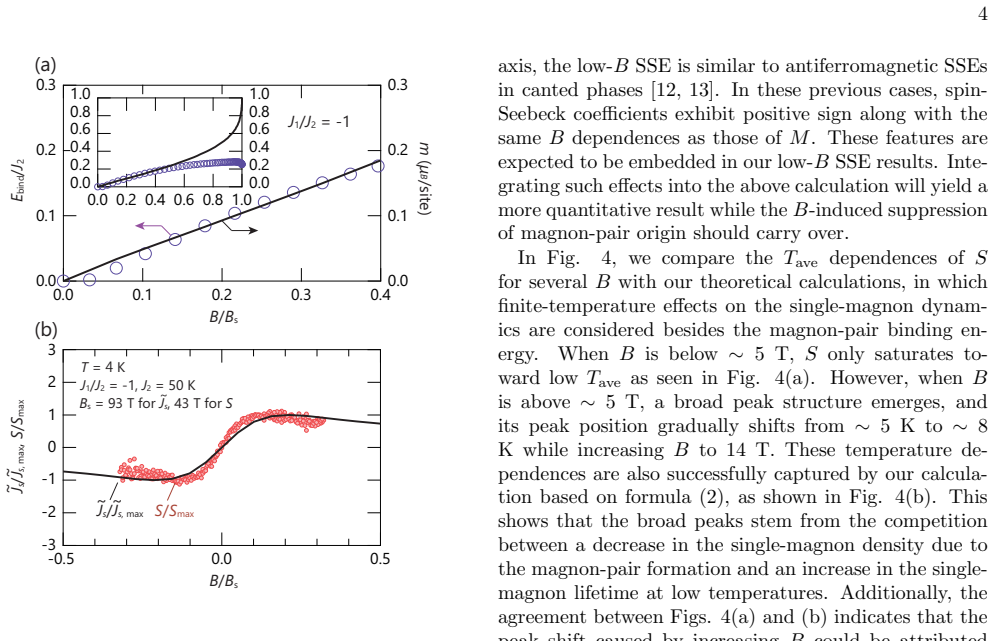
The paper's working engine is the spin-nematic (magnon-pair) correlation of a frustrated spin-$\frac12$ chain: a quadrupolar correlation in which magnons pair up into spin-2 objects, so that single magnons open an energy gap equal to the binding energy $E_{\rm bind}$ while pairs remain gapless. The load-bearing formula is the linear-response expression for the interfacial spin current $\tilde{J}_s$, which weights the single-magnon dynamical susceptibility $\chi^{-+}_{\rm mag}$ by a thermal kernel and shows that a gap $E_{\rm bind}$ suppresses the spin-1 current injected into the metal contact. The calculation sets $E_{\rm bind}$ from the $J_1$-$J_2$ chain with $J_1/J_2=-1$ and $J_2=50$ K, finding $E_{\rm bind}$ to grow linearly with $B$ in the low-field regime, which converts a $B$-linear magnetization into a gapped single-magnon response at the interface.
What would settle it
Measure the low-energy spin excitations of LiCuVO4 by inelastic neutron scattering at $B=9$ T and $T=4$ K: the claim predicts a single-magnon gap of about 3 K, equal to the magnon-pair binding energy, opening above about 2 T. If the spectrum instead shows a gapless continuum of single magnons in the same field and temperature range where the spin-Seebeck signal is suppressed, the central claim is falsified.
Extended reading notes
Core claim
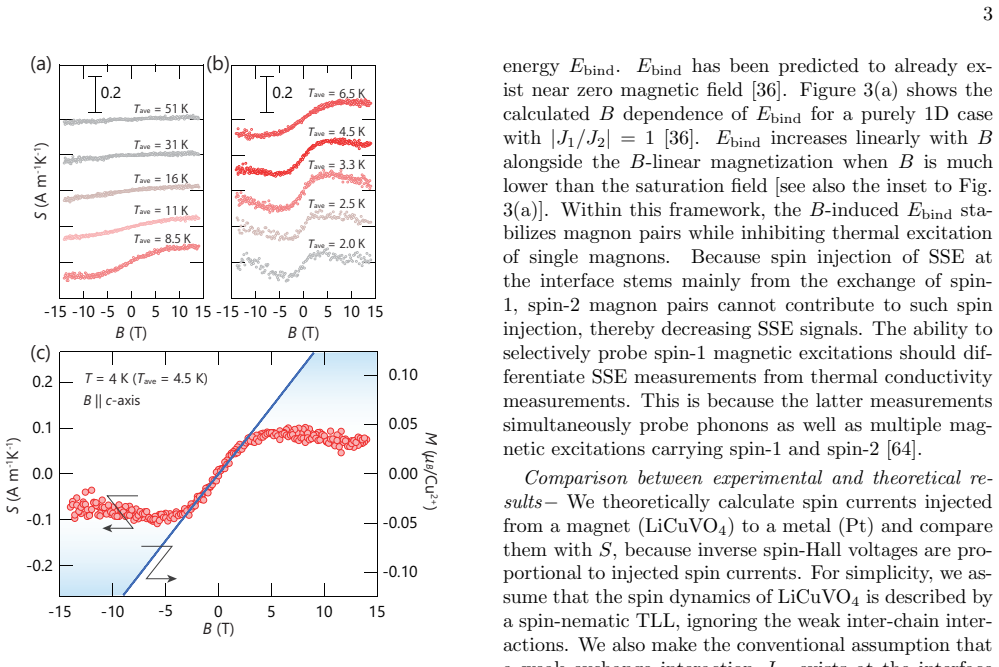
In a LiCuVO4/Pt junction, the transverse thermopower S associated with the spin-Seebeck effect initially grows with magnetic field but, above about 2 T, deviates below the $B$-linear trend and even acquires a negative slope beyond about 5 T at $T=4$ K, while the isothermal magnetization remains linear in $B$ over the same range. The paper's claim is that this suppression is a crossover from single-magnon to magnon-pair (spin-nematic) correlation: the field increases the binding energy $E_{\rm bind}$ of spin-2 magnon pairs, opening a gap in the single-magnon spectrum, and because the interfacial exchange with conduction electrons transfers spin-1, the pair-carrying channel cannot inject spin current into the platinum. A calculation of the interfacial spin current from a spin-nematic Tomonaga-Luttinger description, with the single-magnon susceptibility gapped by $E_{\rm bind}$, reproduces both the field dependence of $S$ and the broad peak in its temperature profile that shifts upward with increasing field. The claimed conclusion is that spin-Seebeck measurements probe spin-1 magnetic excitations selectively and can detect spin-nematic order in quantum magnets.
Load-bearing premise
The measured suppression is produced solely by a field-induced energy gap in LiCuVO4's single-spin-flip excitations, equal to the magnon-pair binding energy computed for an isolated one-dimensional $J_1$-$J_2$ chain, with weak interchain coupling, coexisting spiral or spin-density-wave correlations, and any magnon-pair-driven spin current all making negligible contributions.
Editorial extensions
If this is right
- The spin-Seebeck effect can serve as a probe of spin-nematic correlation: a field-induced suppression of the spin-Seebeck signal in a material whose magnetization remains $B$-linear is a sign that single magnons are being bound into spin-2 pairs.
- The interfacial spin transfer in the spin-Seebeck effect is dominated by spin-1 exchange, so spin-2 magnon pairs do not inject spin current into the metal contact; this makes the effect a selective detector of the spin quantum number of magnetic excitations.
- The broad peak in the temperature dependence of the spin-Seebeck signal, and its shift to higher temperatures as the field grows, arise from the competition between the magnon-pair gap, which suppresses single magnons at low temperature, and the increasing angular momentum per single magnon, which enhances the signal at higher temperature.
- Because $E_{\rm bind}$ grows linearly with $B$ in the low-field regime of the spin-nematic Tomonaga-Luttinger description, the field scale for the spin-Seebeck suppression is set by the exchange couplings of the chain, not by the Zeeman energy alone.
Reading between the lines
- If the mechanism is correct, the same suppression should show up in other quasi-1D $J_1$-$J_2$ chain compounds, with the onset field scaling with $J_2$; comparing the spin-Seebeck field profiles of such compounds would test the generality of the magnon-pair picture.
- A direct check would be to measure the field-dependent single-magnon gap spectroscopically (for instance, by inelastic neutron scattering or Raman scattering) and to verify that a gap close to $E_{\rm bind}$ opens above roughly 2 T and tracks the spin-Seebeck suppression.
- Since the authors ignore the magnon-pair contribution to the injected spin current, a residual, weakly field-dependent spin-Seebeck signal at high fields would bound the importance of higher-order interfacial processes that transfer spin-2.
- The normalized comparison could be turned into a parameter-free test by extracting $E_{\rm bind}(B)$ directly from the measured suppression and comparing it with the theoretical curve, without fixing $J_1$ and $J_2$ in advance.
Signed reviews
Editorial analysis
A structured set of objections, weighed in public.
Referee Report
Summary. The manuscript reports spin-Seebeck effect (SSE) measurements on LiCuVO4/Pt junctions. The authors observe a field-induced suppression of the transverse thermopower at low temperatures even though the magnetization is B-linear, and interpret it as evidence for the growth of spin-nematic (magnon-pair) correlations that bind single magnons into spin-2 pairs, thereby suppressing interfacial spin-1 exchange. They support this interpretation with a theoretical calculation of the injected spin current from a spin-nematic Tomonaga-Luttinger liquid with a B-linear magnon-pair binding energy, and claim good agreement with the B and T dependence of the data.
Significance. If the interpretation holds, the work would establish SSE as a probe of spin-nematic correlations in frustrated quantum magnets, a potentially valuable advance. The experimental data are clean and show a robust, reproducible suppression that is difficult to explain by simple Zeeman physics. The theoretical calculation is based on a transparent formula and shows that a single-magnon gap set by the magnon-pair binding energy can produce a broad peak in the spin current. However, the quantitative comparison in Fig. 3(b) is weakened by the use of different saturation fields for theory and experiment, and the temperature comparison in Fig. 4 is not calibrated against the measured magnetization. These issues are central to the claimed agreement.
major comments (3)
- [Comparison between experimental and theoretical results, Fig. 3(b)] The central quantitative comparison is made after normalizing B by different saturation fields: Bs = 93 T for the theory and Bs ≈ 43 T for the experiment. The theoretical spin current peaks near |B| ≈ 9 T (B/Bs ≈ 0.1) while the measured S at T = 4 K turns over near |B| ≈ 4–5 T (also B/Bs ≈ 0.1). The authors argue that the B-linearity of Ebind makes the Bs difference non-essential, but this argument is incomplete: in Eq. (2), the single-magnon spectral weight is also controlled by the magnetization m(B/Bs), and the peak position is set by the competition between the growth of m and the growth of the gap. Since m(B/Bs) changes with Bs at fixed physical B, the peak field can depend on Bs even if Ebind(B) is linear. The manuscript provides no replot on a common physical-field axis, so the claimed quantitative agreement is not established. Please show the calculation for the experimental Bs (or for a range of Bs values) on the same Tesla axis as the data and discuss the resulting peak position.
- [Fig. 4 and 'Comparison between experimental and theoretical results'] The temperature comparison in Fig. 4 maps experimental B values to theoretical magnetization m values, but the manuscript does not use the measured M(B) curve from Fig. 2(c) to make this mapping. The theoretical m(B) depends on the same J1/J2 and Bs parameters that are already mismatched between theory and experiment. Without a calibrated mapping, the agreement in peak position and peak shift shown in Fig. 4 is qualitative. The authors should use the measured M(B) curve, or at least explicitly show the B-to-m relation used, to place the theoretical curves at the experimental fields.
- [Spin-nematic nature of LiCuVO4 and 'Comparison between experimental and theoretical results'] The theoretical treatment assumes that the spin dynamics of LiCuVO4 in the measured B-T window is described by a purely 1D spin-nematic TLL, ignoring interchain coupling and coexisting spiral/SDW correlations. The authors acknowledge this and argue that integrating the other effects will yield a more quantitative result. However, the central claim of a 'well reproduced' B and T dependence rests on this simplified model, and no estimate is given for how the neglected interchain coupling J' (of order a few K) or the 3D spiral correlations might shift the peak field or suppress the signal. A quantitative error estimate on the predicted Js would help assess whether the agreement is meaningful.
minor comments (3)
- [References] Reference [19] is incomplete; it lacks the journal name, volume, and page numbers.
- [Introduction and experimental results] The sentence 'spin-Seebeck coefficients exhibit positive sign along with the same B dependences as those of M' should read 'positive sign and the same B dependence as that of M'.
- [Fig. 1 caption] The caption of Fig. 1(a) would be clearer if it explicitly stated which panel is the purely 1D phase diagram and which is the quasi-1D one; currently this is only discernible from the figure itself.
Circularity Check
No significant circularity: the magnon-pair binding energy is an externally computed input and the measured SSE data are independent.
full rationale
The paper's interpretive chain is: measured S(B) shows a field-induced suppression while M(B) stays linear; the authors hypothesize that a growing magnon-pair (spin-nematic) correlation opens a single-magnon gap; they import Ebind from the published J1-J2 chain calculation [36] (J1/J2=-1, J2=50 K from literature ranges, not fitted to SSE); they insert this gap into the single-magnon spin-current formula Eq. (2); and they compare the resulting Js(B,T) with the measured S(B,T). Ebind is not determined from the SSE data, so the agreement is a consistency check rather than a fitted-input-called-prediction. The statement 'For simplicity, we assume that the spin dynamics of LiCuVO4 is described by a spin-nematic TLL' is an explicit ansatz, but the paper does not claim to derive the spin-nematic state from the SSE data; it uses the independent spin-nematic physics to interpret an external observation. The different normalizing fields (Bs=93 T for the theory, about 43 T for the experiment) and the neglect of interchain coupling and magnon-pair spin current are quantitative-robustness concerns, not circularity. No equation reduces by construction to its own input, and the self-citations carry independently published results whose assumptions do not include the SSE outcome. Therefore no circular step is exhibited.
Assumptions & free parameters
free parameters (3)
- J2 (next-nearest-neighbor exchange) =
50 K
- J1/J2 (exchange ratio) =
-1
- tau_s (spin relaxation time in Pt) =
not stated in main text
assumptions (5)
- domain assumption The spin dynamics of LiCuVO4 is described by a spin-nematic Tomonaga-Luttinger liquid in the relevant B,T range.
- domain assumption A weak exchange interaction Jsd at the magnet-metal interface and the linear-response formula (2) describe the SSE spin current.
- domain assumption The magnon-pair-driven spin current is negligible compared to the single-magnon contribution.
- domain assumption The low-energy form of the single-magnon susceptibility chi_{-+} with an energy gap is determined within a practical approximation.
- domain assumption The B-linearity of the magnetization implies the absence of a simple single-magnon Zeeman gap and supports a gapless spin-nematic description.
Cite this review
Pith. "Pith review of Magnon Pairs and Spin-Nematic Correlation in the Spin-Seebeck Effect." pith.science (2026). https://pith.science/paper/2FADHMLO
@misc{pith2026190808701,
  author       = {Pith},
  title        = {Pith review of: Magnon Pairs and Spin-Nematic Correlation in the Spin-Seebeck Effect},
  year         = {2026},
  howpublished = {\url{https://pith.science/paper/2FADHMLO}},
  note         = {Machine review of arXiv:1908.08701}
}
abstract
Investigating exotic magnetic materials with spintronic techniques is effective at advancing magnetism as well as spintronics. In this work, we report unusual field-induced suppression of the spin-Seebeck effect (SSE) in a quasi one-dimensional frustrated spin-$\frac{1}{2}$ magnet LiCuVO$_4$, known to exhibit spin-nematic correlation in a wide range of external magnetic field $B$. The suppression takes place above $|B| > 2$ T in spite of the $B$-linear isothermal magnetization curves in the same $B$ range. The result can be attributed to the growth of the spin-nematic correlation while increasing $B$. The correlation stabilizes magnon pairs carrying spin-2, thereby suppressing the interfacial spin injection of SSE by preventing the spin-1 exchange between single magnons and conduction electrons at the interface. This interpretation is supported by integrating thermodynamic measurements and theoretical analysis on the SSE.
Figures

Figures from the paper (1 more)

Reference graph
Works this paper leans on
-
[1]
Uchida, H
K. Uchida, H. Adachi, T. Ota, H. Nakayama, S. Maekawa, and E. Saitoh, Observation of longitudinal spin-Seebeck effect in magnetic insulators, Appl. Phys. Lett. 97, 172505 (2010)
2010
-
[2]
J. Xiao, G. E. W. Bauer, K. Uchida, E. Saitoh, and S. Maekawa, Theory of magnon-driven spin Seebeck effect, Phys. Rev. B 81, 214418 (2010)
2010
- [3]
-
[4]
S. S.-L. Zhang and S. Zhang, Spin convertance at mag- netic interfaces, Phys. Rev. B 86, 214424 (2012)
work page 2012
- [5]
-
[6]
S. M. Rezende, R. L. Rodriguez-Suarez, R. O. Cunha, A. R. Rodrigues, F. L. A. Machado, G. A. Fonseca Guerra, J. C. Lopez Ortiz, and A. Azevedo, Magnon spin-current theory for the longitudinal spin-Seebeck effect, Phys. Rev. B 89, 014416 (2014)
work page 2014
-
[7]
S. M. Wu, J. E. Pearson, and A. Bhattacharya, Param- agnetic spin Seebeck effect, Phys. Rev. Lett. 114, 186602 (2015)
work page 2015
-
[8]
T. Kikkawa, K. Uchida, S. Daimon, Z. Qiu, Y. Shiomi, and E. Saitoh, Critical suppression of spin Seebeck effect by magnetic fields, Phys. Rev. B 92, 054436 (2015)
work page 2015
Show all 82 references
-
[9]
H. Jin, S. R. Boona, Z. Yang, R. C. Myers, and J. P. Heremans, Effect of the magnon dispersion on the longi- tudinal spin Seebeck effect in yttrium iron garnets, Phys. Rev. B 92, 054436 (2015)
2015
-
[10]
Kehlberger, U
A. Kehlberger, U. Ritzmann, D. Hinzke, E.-J. Guo, J. Cramer, G. Jakob, M. C. Onbasli, D. H. Kim, C. A. Ross, M. B. Jungfleisch, B. Hillebrands, U. Nowak, and M. Klaui, Length scale of the spin Seebeck effect, Phys. Rev. Lett. 115, 096602 (2015)
2015
-
[11]
Aqeel, N
A. Aqeel, N. Vlietstra, J. A. Heuver, G. E. W. Bauer, B. Noheda, B. J. van Wees, and T. T. M. Palstra, Spin-Hall magnetoresistance and spin Seebeck effect in spin-spiral and paramagnetic phases of multiferroic CoCr 2O4 films, Phys. Rev. B 92, 224410 (2015)
2015
-
[12]
S. Seki, T. Ideue, M Kubota, Y. Kozuka, R. Takagi, M. Nakamura, Y. Kaneko, M. Kawasaki, and Y. Tokura, Thermal generation of spin current in an antiferromag- net, Phys. Rev. Lett. 115, 266601 (2015)
2015
-
[13]
S. M. Wu, W. Zhang, A. KC, P. Borisov, J. E. Pearson, J. S. Jiang, D. Lederman, A. Hoffmann, and A. Bhat- tacharya, Antiferromagnetic spin Seebeck effect, Phys. Rev. Lett. 116, 097204 (2016)
2016
-
[14]
Geprags, A
S. Geprags, A. Kehlberger, F. D. Coletta, Z. Qiu, E.-J. Guo, T. Schulz, C. Mix, S. Meyer, A. Kamra, M. Al- thammer, H. Huebl, G. Jakob, Y. Ohnuma, H. Adachi, J. Barker, S. Maekawa, G. E. W. Bauer, E. Saitoh, R. Gross, S. T. B. Goennenwein, and M. Klaui, Origin of the spin Seeb...
2016
-
[15]
J. Li, Y. Xu, M. Aldosary, C. Tang, Z. Lin, S. Zhang, R. Lake, and J. Shi, Observation of magnon-mediated current drag in Pt/yttrium iron garnet/Pt(Ta) trilayers, Nat. Commun.7, 10858 (2016). 6
2016
-
[16]
Hirobe, M
D. Hirobe, M. Sato, T. Kawamawa, Y. Shiomi, K. Uchida, R. Iguchi, Y. Koike, S. Maekawa, and E. Saitoh, One-dimensional spinon spin currents, Nat. Phys.13, 30- 34 (2017)
2017
-
[17]
Hirobe, T
D. Hirobe, T. Kawamata, K. Oyanagi, Y. Koike, and E. Saitoh, Generation of spin currents from one-dimensional quantum spin liquid, J. Appl. Phys. 123, 123903 (2018)
2018
-
[18]
C. Liu, S. M. Wu, J. E. Pearson, J. S. Jiang, N. d’Ambrumenil, and A. Bhattacharya, Probing short- range magnetic order in a geometrically frustrated mag- net by means of the spin Seebeck effect, Phys. Rev. B 98, 060415(R) (2018)
2018
-
[19]
Z. Qiu, D. Hou, J. Barker, K. Yamamoto, O. Gomonay, and E. Saitoh, Spin colossal magnetoresistance in an an- tiferromagnetic insulator
-
[20]
Azevedo, L
A. Azevedo, L. H. Vilela-Leao,, R. L. Rodriguez-Suarez, A. B. Oliveira, and S. M. Rezende, dc effect in ferromag- netic resonance: Evidence of the spin-pumping effect?, J. Appl. Phys. 97, 10C715 (2005)
2005
-
[21]
Saitoh, M
E. Saitoh, M. Ueda, H. Miyajima, and G. Tatara, Con- version of spin current into charge current at room tem- perature: Inverse spin-Hall effect, Appl. Phys. Lett. 88, 182509 (2006)
2006
-
[22]
S. O. Valenzuela and M. Tinkham, Direct electronic mea- surement of the spin Hall effect, Nature 442, 176 (2006)
2006
-
[23]
Sinova, S
J. Sinova, S. O. Valenzuela, J. Wunderlich, C. H.Back, and T. Jungwirth, Spin Hall effects, Rev. Mod. Phys. 87, 1213 (2015)
2015
-
[24]
X. G. Wen, Quantum Field Theory of Many-Body Sys- tems, (Oxford Univ. Press, Oxford, 2004)
2004
-
[25]
Sachdev, Quantum magnetism and criticality, Nat
S. Sachdev, Quantum magnetism and criticality, Nat. Phys. 4, 173-185 (2008)
2008
-
[26]
Balents, Spin liquids in frustrated magnets, Nature 464, 199-208 (2010)
L. Balents, Spin liquids in frustrated magnets, Nature 464, 199-208 (2010)
2010
-
[27]
Giamarchi, Quantum Physics in One Dimension, (Ox- ford Univ
T. Giamarchi, Quantum Physics in One Dimension, (Ox- ford Univ. Press, Oxford, 2003)
2003
-
[28]
Penc and A
K. Penc and A. M. L¨ auchli, Introduction to Frustrated Magnetism, edited by C. Lacroix, P. Mendels, and F. Mila, p. 331. (Springer, Berlin, 2011)
2011
-
[29]
Shannon, T
N. Shannon, T. Momoi, and P. Sindzingre, Nematic Or- der in Square Lattice Frustrated Ferromagnets, Phys. Rev. Lett. 96, 027213 (2006)
2006
-
[30]
A. V. Chubukov, Chiral, nematic, and dimer states in quantum spin chains, Phys. Rev. B 44, 4693(R) (1991)
1991
-
[31]
Vekua, A
T. Vekua, A. Honecker, H.-J. Mikeska, and F. Heidrich- Meisner, Correlation functions and excitation spectrum of the frustrated ferromagnetic spin- 1 2 chain in an exter- nal magnetic field, Phys. Rev. B 76, 174420 (2007)
2007
-
[32]
Hikihara, L
T. Hikihara, L. Kecke, T. Momoi, and A. Furusaki, Vec- tor chiral and multipolar orders in the spin- 1 2 frustrated ferromagnetic chain in magnetic field, Phys. Rev. B 78, 144404 (2008)
2008
-
[33]
Sudan, A
J. Sudan, A. Luscher, and A. M. L¨ auchli, Emergent mul- tipolar spin correlations in a fluctuating spiral: The frus- trated ferromagnetic spin- 1 2 Heisenberg chain in a mag- netic field, Phys. Rev. B 80, 140402(R) (2009)
2009
-
[34]
M. Sato, T. Momoi, and A. Furusaki, NMR relaxation rate and dynamical structure factors in nematic and mul- tipolar liquids of frustrated spin chains under magnetic fields, Phys. Rev. B 79, 060406(R) (2009)
2009
-
[35]
M. Sato, T. Hikihara, and T. Momoi, Field and tempera- ture dependence of NMR relaxation rate in the magnetic quadrupolar liquid phase of spin- 1 2 frustrated ferromag- netic chains, Phys. Rev. B 83, 064405 (2011)
2011
-
[36]
M. Sato, T. Hikihara, and T. Momoi, Spin-Nematic and Spin-Density-Wave Orders in Spatially Anisotropic Frus- trated Magnets in a Magnetic Field, Phys. Rev. Lett. 110, 077206 (2013)
2013
-
[37]
A. A. Nersesyan, A. O. Gogolin, and F. H. L. Eßler, Incommensurate Spin Correlations in Spin- 1 2 Frustrated Two-Leg Heisenberg Ladders, Phys. Rev. Lett. 81, 910 (1998)
1998
-
[38]
Hikihara, M
T. Hikihara, M. Kaburagi, and H. Kawamura, Ground- state phase diagrams of frustrated spin- S XXZ chains: Chiral ordered phases, Phys. Rev. B 63, 174430 (2001)
2001
-
[39]
Furukawa, M
S. Furukawa, M. Sato, and S. Onoda, Chiral Order and Electromagnetic Dynamics in One-Dimensional Multifer- roic Cuprates, Phys. Rev. Lett. 105, 257205 (2010)
2010
-
[40]
Furukawa, M
S. Furukawa, M. Sato, S. Onoda, and A. Furusaki, Ground-state phase diagram of a spin- 1 2 frustrated fer- romagnetic XXZ chain: Haldane dimer phase and gapped/gapless chiral phases, Phys. Rev. B 86, 094417 (2012)
2012
-
[41]
M. Sato, S. Furukawa, S. Onoda, and A. Furusaki, Com- peting phases in spin- 1 2 J1-J2 chain with easy-plane anisotropy, Mod. Phys. Lett. B 25, 901 (2011)
2011
-
[42]
Enderle, C
M. Enderle, C. Mukherjee, B. F˚ ak, R. K. Kremer, J.-M. Broto, H. Rosner, S.-L. Drechsler, J. Richter, J. Malek, A. Prokofiev, W. Assmus, S. Pujol, J.-L. Raggazzoni, H. Rakoto, M. Rheinst¨ adter, and H. M. Rønnow, Quantum helimagnetism of the frustrated spin- 1 2 chain LiCuVO4,...
2005
-
[43]
Naito, K
Y. Naito, K. Sato, Y. Yasui, Y. Kobayashi, Y. Kobayashi, and M. Sato, Ferroelectric Transition Induced by the In- commensurate Magnetic Ordering in LiCuVO 4, J. Phys. Soc. Jpn. 76, 023708 (2007)
2007
-
[44]
L. E. Svistov, T. Fujita, H. Yamaguchi, S. Kimura, K. Omura, A. Prokofiev, A. I. Smirnov, Z. Honda, and M. Hagiwara, New high magnetic field phase of the frus- trated S = 1 2 chain compound LiCuVO 4, JETP Lett. 93, 21 (2011)
2011
-
[45]
B¨ uttgen, P
N. B¨ uttgen, P. Kuhns, A. Prokofiev, A. P. Reyes, and L. E. Svistov, High-field NMR of the quasi-one-dimensional antiferromagnet LiCuVO 4, Phys. Rev. B 85, 214421 (2012)
2012
-
[46]
Enderle, B
M. Enderle, B. F˚ ak, H.-J. Mikeska, R. K. Kremer, A. Prokofiev, and W. Assmus, Two-Spinon and Four-Spinon Continuum in a Frustrated Ferromagnetic Spin-1 2 Chain, Phys. Rev. Lett. 104, 237207 (2010)
2010
-
[47]
Two-Spinon and Four- Spinon Continuum in a Frustrated Ferromagnetic Spin-1 2 Chain
S.-L. Drechsler, S. Nishimoto, R. O. Kuzian, J. M´ alek, W. E. A. Lorenz, J. Richter, J. van den Brink, M. Schmitt, and H. Rosner, Comment on “Two-Spinon and Four- Spinon Continuum in a Frustrated Ferromagnetic Spin-1 2 Chain”, Phys. Rev. Lett. 106, 219701 (2011)
2011
-
[48]
M. Hase, H. Kuroe, K. Ozawa, O. Suzuki, H. Ki- tazawa, G. Kido, and T. Sekine, Magnetic properties of Rb 2Cu2Mo3O12 including a one-dimensional spin- 1 2 Heisenberg system with ferromagnetic first-nearest- neighbor and antiferromagnetic second-nearest-neighbor exchange interact...
2004
-
[49]
Matsui, A
K. Matsui, A. Yagi, Y. Hoshino, S. Atarashi, M. Hase, T. Sasaki, and T. Goto, Rb-NMR study of the quasi-one-dimensional competing spin-chain compound Rb2Cu2Mo3O12, Phys. Rev. B 96, 220402(R) (2017)
2017
-
[50]
A. U. B. Wolter, F. Lipps, M. Sch¨ apers, S.-L. Drechsler, S. Nishimoto, R. Vogel, V. Kataev, B. B¨ uchner, H. Ros- ner, M. Schmitt, M. Uhlarz, Y. Skourski, J. Wosnitza, S. S¨ ullow, and K. C. Rule, Magnetic properties and ex- 7 change integrals of the frustrated chain cuprate...
2012
-
[51]
Sch¨ apers, A
M. Sch¨ apers, A. U. B. Wolter, S.-L. Drechsler, S. Nishi- moto, K.-H. M¨ uller, M. Abdel-Hafiez, W. Schottenhamel, B. B¨ uchner, J. Richter, B. Ouladdiaf, M. Uhlarz, R. Beyer, Y. Skourski, J. Wosnitza, K. C. Rule, H. Ryll, B. Klemke, K. Kiefer, M. Reehuis, B. Willenberg, and S...
2013
-
[52]
K. Nawa, Y. Okamoto, A. Matsuo, K. Kindo, Y. Kita- hara, S. Yoshida, S. Ikeda, S. Hara, T. Sakurai, S. Okubo, H. Ohta, and Z. Hiroi, NaCuMoO 4(OH) as a Candidate FrustratedJ1-J2 Chain Quantum Magnet, J. Phys. Soc. Jpn. 83, 103702 (2014)
2014
-
[53]
K. Nawa, M. Yoshida, M. Takigawa, Y. Okamoto, and Z. Hiroi, Collinear Spin-Density-Wave Order and Anisotropic Spin Fluctuations in the Frustrated J1- J2 Chain Magnet NaCuMoO 4(OH), Phys. Rev. B 96, 174433 (2017)
2017
-
[54]
S. E. Dutton, M. Kumar, M. Mourigal, Z. G. Soos, J.- J. Wen, C. L. Broholm, N. H. Andersen, Q. Huang, M. Zbiri, R. Toft-Petersen, and R. J. Cava, Quantum Spin Liquid in Frustrated One-Dimensional LiCuSbO 4, Phys. Rev. Lett. 108, 187206 (2012)
2012
-
[55]
Grafe, S
H.-J. Grafe, S. Nishimoto, M. Iakovleva, E. Vavilova, L. Spillecke, A. Alfonsov, M.-I. Sturza, S. Wurmehl, H. No- jiri, H. Rosner, J. Richter, U. K. R¨ oßler, S.-L. Drechsler, V. Kataev, and B. B¨ uchner, Signatures of a magnetic- field-induced unconventional nematic liquid in ...
2017
-
[56]
Pregelj, A
M. Pregelj, A. Zorko, O. Zaharko, H. Nojiri, H. Berger, L.C. Chapon, and D. Arc˘ on, Spin-stripe phase in a frustrated zigzag spin- 1 2 chain, Nature Comm. 6, 7255 (2015)
2015
-
[57]
M. E. Zhitomirsky and H. Tsunetsugu, Magnon pair- ing in quantum spin nematic, Europhys. Lett. 92, 37001 (2010)
2010
-
[58]
Ueda and K
H. Ueda and K. Totsuka, Magnon Bose-Einstein conden- sation and various phases of three-dimensional quantum helimagnets under high magnetic field, Phys. Rev. B 80, 014417 (2009)
2009
-
[59]
Orlova, E
A. Orlova, E. L. Green, J. M. Law, D. I. Gorbunov, G. Chanda, S. Kr¨ amer, M. Horvatic, R. K. Kremer, J. Wos- nitza, and G. L. J. A. Rikken, Nuclear Magnetic Reso- nance Signature of the Spin-Nematic Phase in LiCuVO 4 at High Magnetic Fields, Phys. Rev. Lett. 118, 247201 (2017)
2017
-
[60]
K. Nawa, M. Takigawa, M. Yoshida, and K. Yoshimura, Anisotropic Spin Fluctuations in the Quasi One- Dimensional Frustrated Magnet LiCuVO4, J. Phys. Soc. Jpn. 82, 094709 (2013)
2013
-
[61]
B¨ uttgen, K
N. B¨ uttgen, K. Nawa, T. Fujita, M. Hagiwara, P. Kuhns, A. Prokofiev, A. P. Reyes, L. E. Svistov, K. Yoshimura, and M. Takigawa, Search for a spin-nematic phase in the quasi-one-dimensional frustrated magnet LiCuVO 4, Phys. Rev. B 90, 134401 (2014)
2014
-
[62]
Masuda, M
T. Masuda, M. Hagihara, Y. Kondoh, K. Kaneko, and N. Metoki, Spin Density Wave in Insulating Ferromag- netic Frustrated Chain LiCuVO4, J. Phys. Soc. Jpn. 80, 113705 (2011)
2011
-
[63]
Mourigal, M
M. Mourigal, M. Enderle, B. F˚ ak, R. K. Kremer, J. M. Law, A. Schneidewind, A. Hiess, and A. Prokofiev, Evi- dence of a Bond-Nematic Phase in LiCuVO 4, Phys. Rev. Lett. 109, 027203 (2012)
2012
-
[64]
70–82, for details on experimental methods, additional data, and theoretical calculations
See Supplemental Material, which includes Refs. 70–82, for details on experimental methods, additional data, and theoretical calculations
-
[65]
Haldane Gap
M. Oshikawa, M. Yamanaka, and I. Affleck, Magnetiza- tion Plateaus in Spin Chains: “Haldane Gap” for Half- Integer Spins, Phys. Rev. Lett. 78, 1984 (1997)
1997
-
[66]
Oshikawa, Commensurability, Excitation Gap, and Topology in Quantum Many-Particle Systems on a Peri- odic Lattice, Phys
M. Oshikawa, Commensurability, Excitation Gap, and Topology in Quantum Many-Particle Systems on a Peri- odic Lattice, Phys. Rev. Lett. 84, 1535 (2000)
2000
-
[67]
M. B. Hastings, Lieb-Schultz-Mattis in higher dimen- sions, Phys. Rev. B 69, 104431 (2004)
2004
-
[68]
Jauho, N
A-P. Jauho, N. S. Wingreen, and Y. Meir, Time- dependent transport in interacting and noninteracting resonant-tunneling systems, Phys. Rev. B 50, 5528 (1994)
1994
-
[69]
In the magnon picture, this enhancement can be regarded as the growth of the angular momentum per single magnon
In formula (2), the growth of the uniform magnetic moment was represented by the enhancement of the renormalization factor of χ−+ mag (see Supplemental Mate- rial [64]). In the magnon picture, this enhancement can be regarded as the growth of the angular momentum per single magnon
-
[70]
S. R. Boona and J. P. Heremans, Magnon thermal mean free path in yttrium iron garnet, Phys. Rev. B90, 064421 (2014)
2014
-
[71]
Onose, Y
Y. Onose, Y. Shiomi, and Y. Tokura, Lorentz Num- ber Determination of the Dissipationless Nature of the Anomalous Hall Effect in Itinerant Ferromagnets, Phys. Rev. Lett. 100, 016601 (2008)
2008
-
[72]
Shiomi, Y
Y. Shiomi, Y. Onose, and Y. Tokura, Extrinsic anoma- lous Hall effect in charge and heat transport in pure iron, Fe 0.997Si0.003, and Fe 0.97Co0.03, Phys. Rev. B 79, 100404(R) (2009)
2009
-
[73]
Shiomi, Y
Y. Shiomi, Y. Onose, and Y. Tokura, Effect of scattering on intrinsic anomalous Hall effect investigated by Lorenz ratio, Phys. Rev. B 81, 054414 (2010)
2010
-
[74]
Onose, T
Y. Onose, T. Ideue, H. Katsura, Y. Shiomi, N. Nagaosa, and Y. Tokura, Observation of the Magnon Hall Effect, Science 329, 297 (2010)
2010
-
[75]
Hirobe, M
D. Hirobe, M. Sato, Y. Shiomi, H. Tanaka, and E. Saitoh, Magnetic thermal conductivity far above the N´ eel tem- perature in the Kitaev-magnet candidateα-RuCl3, Phys. Rev. B 95, 24112(R) (2017)
2017
-
[76]
Shiomi, T
Y. Shiomi, T. Ohtani, S. Iguchi, T. Sasaki, Z. Qiu, H. Nakayama, K. Uchida, and E. Saitoh, Interface- dependent magnetotransport properties for thin Pt films on ferrimagnetic Y 3Fe5O12, Appl. Phys. Lett. 104, 242406 (2014)
2014
-
[77]
Iguchi, K
R. Iguchi, K. Uchida, S. Daimon, and E. Saitoh, Con- comitant enhancement of the longitudinal spin Seebeck effect and the thermal conductivity in a Pt/YIG/Pt system at low temperatures, Phys. Rev. B 95, 174401 (2017)
2017
-
[78]
L. S. Parfen’eva, I. A. Smirnov, H. Misiorek, J. Mucha, A. Jezowski, A. V. Prokof’ev, and W. Assmus, Spinon Thermal Conductivity of −(CuO2)− Spin Chains in LiCuVO4, Phys. Solid State 46, 357-363 (2004)
2004
-
[79]
A. M. Zagoskin, Quantum Theory of Many-Body Sys- tems: Techniques and Applications 2nd ed. (Springer, 2014)
2014
-
[80]
Stefanucci, and R
G. Stefanucci, and R. v. Leeuwen, Nonequilibrium Many- Body Theory of Quantum Systems: A Modern Introduc- tion (Cambridge Univ. Press, 2013). 8
2013
-
[81]
Onishi, J
H. Onishi, J. Phys. Soc. Jpn. 84, 083702 (2015)
2015
-
[82]
A. A. Abrikosov, L. P. Gorkov, and I. E. Dzyaloshinski, Methods of Quantum Field Theory in Statistical Physics , (Dover Publications; Revised version, 1975)
1975
Reviewed August 14, 2026 · model on record in the stance chip above.
Discussion (0). Continue with ORCID to comment.