REVIEW 5 major objections 5 minor 15 references
Accelerating PDE-Constrained Optimization by the Derivative of Neural Operators
T0 review · 5 major / 5 minor · reviewed 2026-08-07 · deepseek-v4-flash
Pith's one-line read Neural-operator surrogates can drive PDE-constrained optimization without derailing if trained on optimizer trajectories, supervised on sensitivities, and periodically recalibrated by the numerical solver.
desk verdict Useful hybrid framework for neural-operator PDECO, but a 10x discrepancy between Table 1 and Table 4 on the central sensitivity metric needs reconciliation before the derivative claims can be trusted. read the letter →
The pith
A machine-rendered reading of the paper's core claim, the machinery that carries it, and where it could break.
The reading
What carries the argument
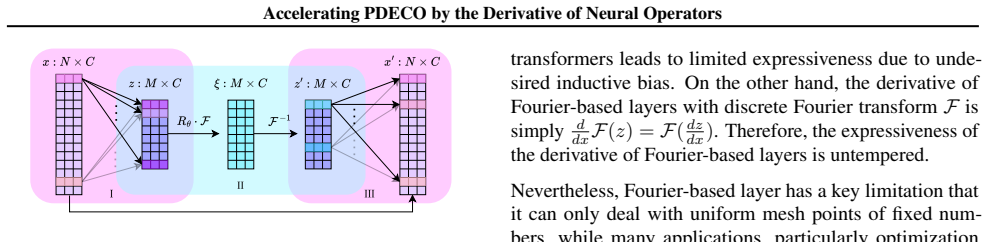
The load-bearing object is the reference neural operator (RNO): a neural operator that takes a query design $\lambda_q$, a reference solution $u_r$, and a smooth transformation $\varphi$ with $\varphi(\lambda_r)=\lambda_q$ (and $u_r \circ \varphi^{-1}=u_q$) and outputs the query solution $u_q$. A Virtual-Fourier (VF) layer supplies the operator's core: it maps points on an arbitrary mesh to a fixed number of virtual sensors by softmax-weighted aggregation, applies a Fourier spectral layer on that virtual grid, and projects back; the identity $\frac{d}{dx}\mathcal{F}(z)=\mathcal{F}(\frac{dz}{dx})$ keeps the layer's derivative structurally simple, which the sensitivity loss $\mathcal{L}_{\mathrm{sens}}=\|\nabla_\lambda J(G_\theta,\lambda)-\partial J/\partial\lambda\|$ then supervises against numerical adjoint sensitivities. The hybrid optimization scheme (Algorithm 1) is the third mechanism: it runs gradient steps on the operator, and whenever the predicted field drifts more than a radius $r$ from the last validated ground truth, it calls the numerical solver once, resets the reference, and continues.
What would settle it
Run the same hybrid RNO-VF pipeline on a design space where the optimum requires a topological change (e.g., inserting a hole) rather than a smooth perturbation; if the reference-conditioned operator's error or the optimizer's objective trajectory collapses relative to the smooth case, the smooth-bijective-map assumption is the load-bearing premise.
Extended reading notes
Core claim
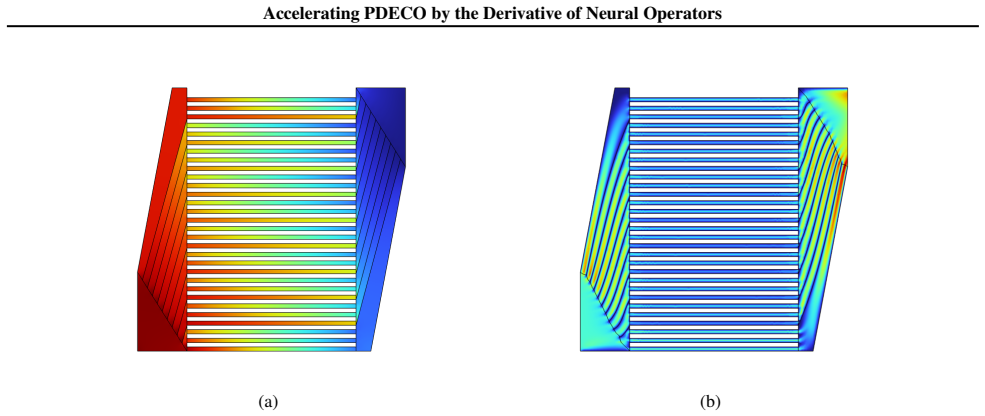
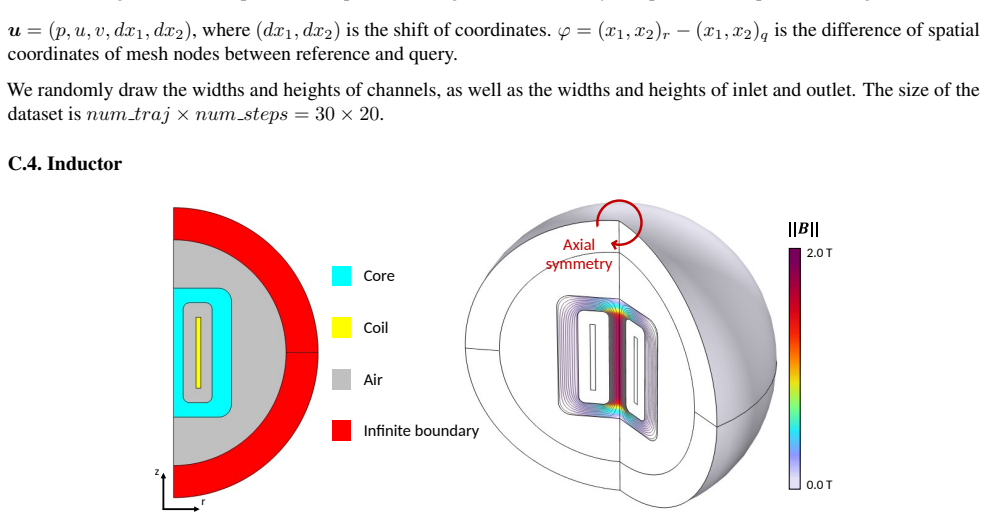
On its own terms, the paper establishes that the failure mode of surrogate-driven optimization—error accumulation as the optimizer leaves the surrogate's training distribution—can be controlled without retraining. It does so by learning a reference-conditioned operator $G_\theta(\lambda_q, u_r, \varphi)$ that predicts a query solution from a nearby reference solution and the transformation $\varphi$ between them, which lets a freshly computed ground-truth solution recalibrate the next prediction. Derivative accuracy is improved by a Virtual-Fourier layer that embeds irregular mesh data into a fixed-size virtual grid, applies a spectral convolution there, and projects back; because the Fourier transform commutes with differentiation, the layer's derivative keeps a simple form that sensitivity supervision can exploit. The paper's experiments on four COMSOL-simulated design problems show that reference-conditioned training reduces operator and sensitivity errors by large margins over vanilla baselines, and that the hybrid optimizer converges robustly on a microreactor topology design while the surrogate-only run derails.
Load-bearing premise
The paper assumes that the PDE solution depends smoothly and bijectively on the design parameters, so that a small change in design can be captured by a smooth transformation between a reference solution and a nearby query solution; if the design changes alter topology or the PDE loses smoothness, this reference-conditioned mapping breaks down.
Editorial extensions
If this is right
- Reference-conditioned training on optimization trajectories suppresses overfitting from the highly correlated, near-optimal data that standard i.i.d. training fails on; even with references dropped, the RNO framework outperforms vanilla neural operator baselines.
- Virtual-Fourier layers reduce sensitivity error consistently across four datasets (by 3.8%–17.5% over the second-best baseline), so architecture choice for derivative smoothness matters for optimization surrogates.
- The hybrid method reaches objectives comparable to a full numerical optimizer within the first four solver calls in the Microreactor2D test, and each solver call costs about half an adjoint step, so early termination can cut wall-clock time substantially.
- Per-iteration wall-clock cost grows mildly with mesh size (0.53 s GPU / 1.89 s CPU on a 4.9k-node 2D problem vs 3.2 s numerical; 0.62 s / 3.20 s vs 49.4 s on a 21k-node 3D problem), so the speedup widens as problems scale.
Reading between the lines
- If the gains come from relative/contrastive structure rather than from optimization data per se, the same reference-conditioned training could be applied to arbitrary paired PDE samples, decoupling the method from the need to run an optimizer to build the dataset.
- The recalibration trigger is a fixed radius in solution space; an adaptive or learned schedule for when to call the solver could reduce the number of expensive calls further while preserving the demonstrated stability.
- The Virtual-Fourier layer's permutation-equivariant, derivative-friendly form is a candidate building block for other gradient-hungry operator tasks, such as PDE-constrained inverse problems or adjoint-based uncertainty quantification on irregular meshes.
- The smooth-bijective-map assumption rules out topology-changing designs; a multi-reference or piecewise-transformation extension might cover those cases, but the paper does not address them.
Editorial analysis
A structured set of objections, weighed in public.
Referee Report
Summary. The paper proposes a framework for accelerating PDE-constrained optimization with neural operators. It combines (i) optimization-oriented training of reference neural operators (RNO) on optimization-trajectory data, (ii) a Virtual-Fourier layer intended to improve derivative learning, and (iii) a hybrid inference scheme that periodically recalibrates the surrogate with numerical solver calls. The authors evaluate operator and sensitivity accuracy on four COMSOL-generated datasets (Microreactor2D, Fuelcell2D, Inductor2D, Drone3D) and demonstrate one hybrid optimization run on Microreactor2D. The central claims are that the proposed model accurately learns operators and their derivatives and that the hybrid approach exhibits robust convergence.
Significance. If established, the contribution is useful: the Virtual-Fourier layer is a principled way to extend Fourier-type derivative-friendly processing to irregular meshes, the RNO-based recalibration is a practical mechanism for error control during optimization, and the analysis of derivative behavior in transformer versus Fourier layers is a valuable design insight. The paper also ships code and uses external COMSOL ground-truth sensitivities, so the derivative learning is not circular. However, the empirical support for the headline claims has inconsistencies and thin validation, so the significance is conditional on resolving those issues.
major comments (5)
- [Section 4, Table 1 and Table 4] On Microreactor2D, the sensitivity error Ls for the same models differs by roughly an order of magnitude between Table 1 (R-LA 2.05e-1, R-PA 2.02e-1, R-VF 1.70e-1) and Table 4 (R-LA 2.16e-2 +/- 3.55e-4, R-PA 2.02e-2 +/- 7.8e-4, R-VF 1.76e-2 +/- 3.81e-4). Both tables report relative-l2 error, so at least one presentation is wrong or the training/evaluation protocol differs. Because Section 4.1 uses these numbers to quantify the Virtual-Fourier advantage ("between 3.8% and 17.5%") and the central claim of accurate derivative learning rests on Ls, this must be reconciled before the results can be assessed.
- [Section 4.2, Figure 6] The hybrid optimization experiment uses a single randomly selected test case from Microreactor2D and reports no repeated trials or error bars. The claim that the hybrid approach "exhibits robust convergence" and the comparison with the "w/o reference" baseline need statistics across at least several test cases and random seeds. In addition, there is no end-to-end wall-clock comparison of the full optimization runs; Table 2 reports seconds per iteration for the surrogate but not the number of numerical solver calls required to reach a given objective value, which is the quantity that determines the claimed acceleration.
- [Section 4, sensitivity loss and Appendix B] The supervised sensitivity loss (Eq. 5) is computed with simplified objective approximations (node-value averages, Lagrange-multiplier constraint handling, and cosine-similarity equivalence for all datasets except Microreactor2D), not with the exact objectives used to generate the COMSOL data. This is disclosed, but it leaves open whether the reported Ls measures fidelity to the true design sensitivities or only to the simplified surrogate objective. Please quantify the gap (e.g., evaluate Ls against the true objective gradient on at least one dataset) or explain why the discrepancy does not affect the optimization results.
- [Section 3.3, Remark 3.2] The framework assumes a smooth, invertible reference-query transformation phi; Remark 3.2 correctly notes that existence and smoothness depend on the PDE and the design-to-solution map. Given that the experiments span topology optimization (Microreactor, Drone) and shape optimization (Fuelcell, Inductor), the paper should state for each dataset how the assumption is satisfied (e.g., the distance threshold dr in the reference dataloader, mesh bijections) and where the tested design space could violate it. Without this, the scope of the central claim is not precisely delimited.
- [Section 4, Tables 1-3] Only Table 4 (Microreactor2D) reports standard deviations; Tables 1 and 3 are single runs. Since the paper draws comparative conclusions across all four datasets from these tables, please provide seed variation or at least state the number of runs for each reported number.
minor comments (5)
- [Section 3.1, Eq. (5)] The norm in Eq. (5) is unqualified; specify the norm (e.g., L2 over the design-parameter dimension) for reproducibility.
- [Section 3.3.2 and Algorithm 1] The text uses buffer size M in Eq. (14) while Algorithm 1 uses N2; unify the notation.
- [Section 4.2, Figure 6 caption] The text says the "w/o reference" scenario validates intermediate objective values every 20 optimization iterations, while the caption says it makes no calls to the numerical solver; clarify whether the validation uses a solver or the surrogate.
- [Throughout] There are several typos, e.g., "Acknowlegement" in the acknowledgments heading, "eletromagnetics" in Section 4, and "wtih" in the Figure 2 caption.
- [Section 4.1 and Figure 5] Figure 5 is described as showing a Pareto front over alpha, but the printed figure lacks axis labels and a legend; please add them.
Circularity Check
No significant circularity: derivative supervision is anchored to external COMSOL sensitivities, and the self-cited RNO component is not load-bearing.
full rationale
The paper's central claims—accurate operator and derivative learning and robust hybrid optimization—are supported by supervision and evaluation against external numerical data, not by construction from the model's own outputs. The sensitivity loss (Eq. 5) directly supervises ∇λJ(Gθ,λ) using ground-truth sensitivities ∂J/∂λ obtained from COMSOL, an independent numerical solver; the operator loss (Eq. 6) supervises Gθ(λ) using true solutions u. Thus the derivative predictions are fitted against external labels, not renamed as predictions. The RNO component is self-cited from Cheng et al. (2024), but the paper redefines the mapping (Eq. 11–12), modifies the target in Remark 3.3, and empirically validates it on held-out trajectories. The prior work is not invoked as a uniqueness theorem or as the sole justification for the main result; the scaling and ablation experiments in Tables 1, 3, and 4 carry the claim. The Virtual-Fourier layer is explicitly compared with the external Transolver baseline and supported by a direct derivative analysis (Appendix A), so it is not a renamed known result. The hybrid optimization (Algorithm 1) uses numerical solver calls as a robustness mechanism, and Figure 6 compares against both full numerical optimization and no-feedback neural-operator optimization, so the convergence claim is not tautological. The discrepancy between sensitivity errors in Table 1 and Table 4 is a potential data-consistency/correctness issue, not a circularity, and does not make the derivation self-referential. Overall, the derivation chain is self-contained against external benchmarks.
Assumptions & free parameters
free parameters (8)
- sensitivity loss weight alpha =
not fully specified; tested on {0, 0.1, 0.5, 0.9}
- reference dropout ratio =
0.3
- reference dataloader distance d =
2
- reference dataloader threshold dr =
0.5
- validation radius r =
not specified
- noise scale sigma =
1% of input std
- buffer sizes N1, N2 =
not specified
- Virtual-Fourier sensor count M =
not specified
assumptions (4)
- domain assumption Well-posedness and smooth dependence of the solution operator on design parameters (shape holomorphy, regularity)
- domain assumption One-to-one mesh correspondence between reference and query solutions
- standard math The discrete Fourier transform and convolution theorem
- standard math Gradient computations via autodiff are exact for the neural operator
Cite this review
Pith. "Pith review of Accelerating PDE-Constrained Optimization by the Derivative of Neural Operators." pith.science (2026). https://pith.science/paper/2FHBHRCX
@misc{pith2026250613120,
  author       = {Pith},
  title        = {Pith review of: Accelerating PDE-Constrained Optimization by the Derivative of Neural Operators},
  year         = {2026},
  howpublished = {\url{https://pith.science/paper/2FHBHRCX}},
  note         = {Machine review of arXiv:2506.13120}
}
read the original abstract
PDE-Constrained Optimization (PDECO) problems can be accelerated significantly by employing gradient-based methods with surrogate models like neural operators compared to traditional numerical solvers. However, this approach faces two key challenges: (1) **Data inefficiency**: Lack of efficient data sampling and effective training for neural operators, particularly for optimization purpose. (2) **Instability**: High risk of optimization derailment due to inaccurate neural operator predictions and gradients. To address these challenges, we propose a novel framework: (1) **Optimization-oriented training**: we leverage data from full steps of traditional optimization algorithms and employ a specialized training method for neural operators. (2) **Enhanced derivative learning**: We introduce a *Virtual-Fourier* layer to enhance derivative learning within the neural operator, a crucial aspect for gradient-based optimization. (3) **Hybrid optimization**: We implement a hybrid approach that integrates neural operators with numerical solvers, providing robust regularization for the optimization process. Our extensive experimental results demonstrate the effectiveness of our model in accurately learning operators and their derivatives. Furthermore, our hybrid optimization approach exhibits robust convergence.
Figures


Figures from the paper (6 more)



Reference graph
Works this paper leans on
-
[1]
Allen, K. R., Lopez-Guevara, T., Stachenfeld, K., Sanchez- Gonzalez, A., Battaglia, P., Hamrick, J., and Pfaff, T. Physical design using differentiable learned simulators. arXiv preprint arXiv:2202.00728,
-
[5]
Fourier neural operator for parametric partial differential equa- tions
Li, Z., Kovachki, N., Azizzadenesheli, K., Liu, B., Bhat- tacharya, K., Stuart, A., and Anandkumar, A. Fourier neural operator for parametric partial differential equa- tions. arXiv preprint arXiv:2010.08895,
arXiv 2010
-
[6]
C. Dataset and Dataloader C.1. Reference Dataloader To train RNO with pairwise data as query and reference, we use a custom dataloader to select a reference point from the same optimization trajectory for each query point. Given a trajectory {(λi, ui)}Ns i=0, where Ns is the number of steps. the reference for the i-th data point is chosen from the index r...
work page 2024
-
[7]
Neural operators with localized integral and differential kernels
Liu-Schiaffini, M., Berner, J., Bonev, B., Kurth, T., Aziz- zadenesheli, K., and Anandkumar, A. Neural operators with localized integral and differential kernels. arXiv preprint arXiv:2402.16845,
-
[10]
Wang, S., Bhouri, M. A., and Perdikaris, P. Fast pde- constrained optimization via self-supervised operator learning. arXiv preprint arXiv:2110.13297,
-
[14]
Drone (a) (b) Figure 10: (a) The optimized density ε filtered by a threshold
C.5. Drone (a) (b) Figure 10: (a) The optimized density ε filtered by a threshold. (b) The magnitude of corresponding displacement u of the loadcase of vertical acceleration. We modified a model from COMSOL optimization gallery that designs the arms of a drone with linear elastic material. The problem minimizes elastic strain energy with physical variable...
work page 2009
-
[15]
The only field variable of interest is displacement
Bower (2009)). The only field variable of interest is displacement. The problem is optimized under two load cases, a vertical acceleration on the whole body and a torque on the motor surface. The optimization process is performed on a single arm, and the final result is then mirrored twice to obtain the complete drone body. See Fig
work page 2009
-
[1987]
Tran, A., Mathews, A., Xie, L., and Ong, C. S. Factorized fourier neural operators. arXiv preprint arXiv:2111.13802,
Show all 15 references
-
[2016]
Learning neural pde solvers with convergence guarantees
Hsieh, J.-T., Zhao, S., Eismann, S., Mirabella, L., and Er- mon, S. Learning neural pde solvers with convergence guarantees. arXiv preprint arXiv:1906.01200,
1906 arXiv
-
[2018]
11 Accelerating PDECO by the Derivative of Neural Operators A. Derivative of Virtual-Fourier Layer First, let us take a closer look at the derivative of nonlinear attention, d dx softmax(QK)V , ignoring constant coefficient and the transpose of matrix. Suppose t ∈ RN and s = s...
2023
-
[2020]
Li, Z., Meidani, K., and Farimani, A. B. Transformer for partial differential equations’ operator learning. arXiv preprint arXiv:2205.13671,
-
[2021]
Tran- solver: A fast transformer solver for pdes on general geometries
Wu, H., Luo, H., Wang, H., Wang, J., and Long, M. Tran- solver: A fast transformer solver for pdes on general geometries. arXiv preprint arXiv:2402.02366,
-
[2022]
and Eberhart, R
Kennedy, J. and Eberhart, R. Particle swarm optimization. In Proceedings of ICNN’95-international conference on neural networks, volume 4, pp. 1942–1948. ieee,
1942
-
[2023]
and Gimpel, K
Hendrycks, D. and Gimpel, K. Gaussian error linear units (gelus). arXiv preprint arXiv:1606.08415,
-
[2024]
Lu, L., Jin, P., and Karniadakis, G. E. Deeponet: Learning nonlinear operators for identifying differential equations based on the universal approximation theorem of opera- tors. arXiv preprint arXiv:1910.03193,
1910 arXiv
Reviewed August 7, 2026 · model on record in the stance chip above.
Discussion (0). Sign in to comment.