REVIEW 3 major objections 5 minor 1 cited by
Self-Critique Guided Iterative Reasoning for Multi-hop Question Answering
T0 review · 3 major / 5 minor · reviewed 2026-08-07 · deepseek-v4-flash
Pith's one-line read A model that criticizes each intermediate retrieval and reasoning step beats the previous best multi-hop QA systems by 8.6%.
desk verdict Useful method paper whose headline SOTA claim is not supported by the reported retrieval setup — needs a re-run or a clear caveat before I'd trust the numbers. read the letter →
The pith
A machine-rendered reading of the paper's core claim, the machinery that carries it, and where it could break.
The reading
What carries the argument
The load-bearing mechanism is the merged reasoner-critic, called SC-Reasoner, which writes self-critique tokens after each sub-process (decomposition, retrieval, reasoning, and question reduction) and therefore produces its own rewards without a separate scoring pass. At inference, iteration-level beam search uses cumulative process rewards $r^c_t = r^c_{t-1} + r^{retr}_t + r^{reas}_t$ to keep the top-k candidate trajectories at each step, and the trajectory with the highest cumulative reward supplies the final answer. The design works because the rewards are fine-grained and process-level: ablations show that coarse binary rewards lose their discriminative power exactly when the search branches broadly, while graded retrieval and reasoning rewards keep the search on promising paths.
What would settle it
Inspect the released retrieval pool: if any development-set question's gold supporting paragraphs are missing, re-run SiGIR with those documents included or with an unrestricted Wikipedia index and compare F1; the 8.6% margin would shrink if the current gain comes from searching a closed, easier pool.
Extended reading notes
Core claim
The central discovery the paper argues for is that iterative reasoning can be guided from inside the generator: instead of a separate verifier that only judges complete answers, the model itself rates each retrieval as relevant, partially relevant, or irrelevant, and each reasoning step as fully, partially, or not supported, and these fine-grained process rewards are accumulated across iterations. A beam search then retains the most promising trajectories, so bad decompositions and bad retrieval calls are pruned before they cascade into wrong final answers. The paper reports that this system, SiGIR, surpasses the prior state of the art on all three benchmarks, with the largest absolute gains on MuSiQue, and that the gain is 15.0% on MuSiQue overall, including 47.1% and 24.37% improvements on 3-hop and 4-hop questions respectively.
Load-bearing premise
The comparison rests on the retrieval corpus being a fair open-domain test, but the corpus is built only from training-instance supporting facts and irrelevant documents, and the paper does not state that development-set evidence documents are in it.
Editorial extensions
If this is right
- Fine-tuning a small model to emit its own step-level scores can substitute for expensive Monte Carlo tree search or a large external verifier in multi-hop QA, since reward-guided beam search performs better than greedy inference at similar cost.
- Fine-grained process rewards should be preferred over binary rewards when the inference budget permits branching over decomposition and retrieval candidates, because coarse rewards lose discrimination as search width grows.
- Exploration must span question decompositions, not just retrieved documents: setting the decomposition branch width to one costs 13.57 points in average F1.
- Self-critique can generate its own training data: after two self-improvement iterations on 40% labeled data, the model reaches about 97.8% of the full-SFT performance, so the pipeline should transfer to low-resource settings.
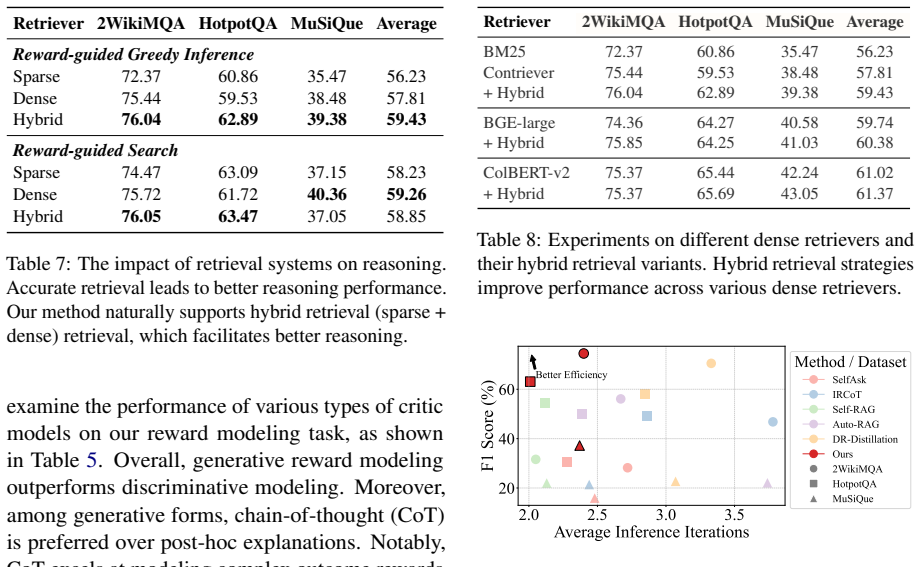
- Hybrid sparse-dense retrieval can be added without retraining because each retrieved document is evaluated independently, and it improves F1 across the three benchmarks.
Reading between the lines
- A reader should test the benchmark setup before trusting the 8.6% claim: the retrieval pool is built only from supporting facts and irrelevant documents of training instances, and the paper never states that development-set gold paragraphs are included, so the reported F1 may not be open-domain as claimed.
- The paper's own limitations point to the next experiment: replace temperature-sampled sub-question branching with a dedicated decomposition or query-rewriting module and measure whether wider exploration converts into further gains.
- The self-critique-plus-cumulative-reward pattern is not QA-specific; it is a general design for any multi-step agent task in which intermediate actions can be scored, such as tool use, code execution, or database lookup.
- Following the ablations, an adaptive inference scheme using coarse rewards under greedy decoding and fine-grained rewards only during wide search would likely capture most of the benefit at lower cost, though the paper does not propose it.
Signed reviews
Editorial analysis
A structured set of objections, weighed in public.
Referee Report
Summary. The paper introduces SiGIR, a training and inference framework for multi-hop question answering in which a single model iteratively decomposes the question into atomic sub-questions, triggers external retrieval, performs retrieval-augmented reasoning, emits self-critique rewards for retrieval relevance and reasoning utility, and uses these rewards in a beam-style search to keep the most promising trajectories. The model is obtained by SFT on synthetic iterative reasoning rationales produced by DeepSeek-V2.5, with a separate distilled critic used to annotate intermediate and outcome rewards and then merged into the reasoner. On HotpotQA, 2WikiMQA, and MuSiQue the authors report token-level F1 of 63.09, 74.47, and 37.15 with Mistral-7B, claiming an average relative improvement of 8.6% over previous state-of-the-art methods. The paper also includes ablations on search, reward granularity, reward modeling, retrieval systems, and self-improvement data synthesis, and it releases code, data, and models.
Significance. If the reported evaluation setup is valid, SiGIR is a practically relevant contribution: the idea of using a single model for iterative decomposition, retrieval, reasoning, and self-critique, with cumulative process rewards guiding a small beam search, is clearly presented, and the ablations (especially the comparison of cumulative vs. outcome reward selection and the training-scaling analysis) give useful insights. The release of code, data, and models, and the moderate training cost (about 3 hours on 4 A100 GPUs) are strengths. However, the significance of the headline 8.6% claim depends entirely on the fairness of the evaluation, which is currently not established (see major comments). The method appears internally consistent and the circularity risk is low because final scoring uses external ground-truth answers, but the numerical claims need to be placed on solid evaluative ground before the contribution can be assessed.
major comments (3)
- [4.1 vs. A.4] The paper states in Section 4.1 that 'The experiments are conducted in the open-domain setting,' but Appendix A.4 describes a retrieval corpus built from 'supporting facts and irrelevant documents from the training instances.' This is an in-domain, closed retrieval pool, not a Wikipedia-scale open-domain index. The paper never states whether development-set gold paragraphs are added to this pool, never reports the pool size, and never reports gold recall. If dev gold paragraphs are absent, the reported F1 values could not be achieved for unseen dev questions; if they are present, the task is not open-domain. The authors must specify the exact composition of the retrieval pool, report gold recall, and either re-run the experiments in a genuine open-domain setting or rename the task (e.g., 'in-scope retrieval') and adjust the claims accordingly.
- [Table 1] The footnote ':' indicates that the numbers for ProbTree, BeamAggR, RAG-Star, and GenGround are 'derived from the original paper' and were not obtained under the retrieval setup described in Appendix A.4. In particular, the previous-SOTA values used in the 8.6% calculation on HotpotQA and MuSiQue (RAG-Star 60.00 and BeamAggR 32.30) come from different retrieval environments. Without evidence that those baselines used the same retrieval corpus (or a comparable open-domain index), the comparison is not apples-to-apples, and the central claim that SiGIR 'surpasses the previous SOTA by 8.6%' is unsupported. The authors should re-run these baselines in the same retrieval setting or, failing that, clearly restrict the scope of the comparison and re-compute the claimed improvement.
- [Section 5 / Table 1] All reported F1 numbers in Table 1 are from a single run, while the inference procedure relies on stochastic sampling (temperature 1.15 in Table 9) and beam search. Differences between SiGIR and the strongest baseline are as small as 3.09 F1 on HotpotQA. The paper should provide at least the variance over multiple seeds (or bootstrap over test instances) and a statistical test or confidence interval to show the headline improvements are not sampling noise. This is essential before the method can be recommended as a reliable SOTA.
minor comments (5)
- [Equation 7] Equation (7) has malformed underbrace labels ('rc t loooomoooon previous reward'); please fix the LaTeX/typesetting.
- [Table 9] Table 9 reports hyperparameters such as 'N 3' and '# Retrieval Reward 1.0 / 0.5 / -1.0' without explaining what they correspond to; please add a note or define N in the caption.
- [Figure 4] Figure 4 contains corrupted Unicode tokens that make the axis labels unreadable; please replace with proper labels.
- [Algorithm 2] The self-improvement threshold in Algorithm 2 (line 37) is never specified; please report the threshold or state how it was chosen.
- [Section 3.1] The relationship between the separate critic C and the merged self-critique reasoner is described somewhat ambiguously; it would help to state explicitly whether C is used at test time in the 'Separated' mode of Table 6.
Circularity Check
No circularity: SiGIR's headline F1 scores are evaluated against external ground-truth answers, and its self-critique rewards are internal search signals rather than the evaluation target.
full rationale
The paper's derivation chain is: teacher-LLM synthetic rationales -> SFT of iterative reasoner R -> critic C distilled from LLM-graded retrieval/reasoning/overall quality -> merged self-critique reasoner Rsc -> inference-time branching with cumulative self-rewards -> final answer scored by token F1 against gold answers on three benchmarks. None of these steps defines the evaluated quantity in terms of the training signal. The self-critique rewards guide trajectory selection, but the reported F1 is computed against external ground-truth answers, so the headline improvement is not forced by construction. The only self-citation with any role is the BeamAggR baseline (Chu et al. 2024a), whose numbers are taken from the original paper; comparing against one's own prior baseline is normal and is not load-bearing for the method's derivation. No uniqueness theorem or ansatz is imported from the authors' prior work. The self-improvement loop filters the model's own generations with critic C, which is a mild self-training risk, but the filter originates from LLM reward labels and the final benchmark remains external. Appendix A.4's retrieval corpus ('we construct a retrieval corpus using supporting facts and irrelevant documents from the training instances') raises a benchmark-validity question about whether the 'open-domain' comparison is apples-to-apples, but that is a correctness/evaluation concern, not a circularity of the derivation. The paper's Limitations section acknowledges sampling-based decomposition and lack of RL, which are scope limitations rather than circular steps. Therefore no circular step can be identified by the paper's own equations or citations.
Assumptions & free parameters
free parameters (6)
- Retrieval reward scale values =
1.0 / 0.5 / -1.0
- Reasoning reward scale values =
0.5 / 0.25 / -0.5
- Beam width (number of kept candidates) =
2
- Number of decomposition branches =
2
- Number of retrieved documents =
5 or 6
- Self-improvement filtering threshold =
unspecified
assumptions (4)
- domain assumption The retrieval corpus built from training instances is sufficient to answer development-set questions.
- domain assumption DeepSeek-V2.5's synthetic rationales and reward labels are reliable enough to serve as supervision.
- domain assumption The critic model's labels transfer to the self-critique reasoner when both are trained on disjoint data.
- ad hoc to paper Cumulative process rewards are a valid proxy for the correctness of a reasoning trajectory.
Cite this review
Pith. "Pith review of Self-Critique Guided Iterative Reasoning for Multi-hop Question Answering." pith.science (2026). https://pith.science/paper/2FMQJPJU
@misc{pith2026250519112,
  author       = {Pith},
  title        = {Pith review of: Self-Critique Guided Iterative Reasoning for Multi-hop Question Answering},
  year         = {2026},
  howpublished = {\url{https://pith.science/paper/2FMQJPJU}},
  note         = {Machine review of arXiv:2505.19112}
}
abstract
Although large language models (LLMs) have demonstrated remarkable reasoning capabilities, they still face challenges in knowledge-intensive multi-hop reasoning. Recent work explores iterative retrieval to address complex problems. However, the lack of intermediate guidance often results in inaccurate retrieval and flawed intermediate reasoning, leading to incorrect reasoning. To address these, we propose Self-Critique Guided Iterative Reasoning (SiGIR), which uses self-critique feedback to guide the iterative reasoning process. Specifically, through end-to-end training, we enable the model to iteratively address complex problems via question decomposition. Additionally, the model is able to self-evaluate its intermediate reasoning steps. During iterative reasoning, the model engages in branching exploration and employs self-evaluation to guide the selection of promising reasoning trajectories. Extensive experiments on three multi-hop reasoning datasets demonstrate the effectiveness of our proposed method, surpassing the previous SOTA by $8.6\%$. Furthermore, our thorough analysis offers insights for future research. Our code, data, and models are available at Github: https://github.com/zchuz/SiGIR-MHQA.
Figures


Figures from the paper (5 more)


Forward citations
Cited by 1 Pith paper
-
AI4Research: A Survey of Artificial Intelligence for Scientific Research
A survey that organizes AI-for-research work into five tasks, comprehension, survey, discovery, writing, and peer review, and compiles associated tools and benchmarks.
Reference graph
Works this paper leans on
-
[1]
Akari Asai, Zeqiu Wu, Yizhong Wang, Avirup Sil, and Hannaneh Hajishirzi. 2024. https://openreview.net/forum?id=hSyW5go0v8 Self-rag: Learning to retrieve, generate, and critique through self-reflection . In The Twelfth International Conference on Learning Representations, ICLR 2024, Vienna, Austria, May 7-11, 2024 . OpenReview.net
2024
-
[2]
Rae, Erich Elsen, and Laurent Sifre
Sebastian Borgeaud, Arthur Mensch, Jordan Hoffmann, Trevor Cai, Eliza Rutherford, Katie Millican, George van den Driessche, Jean - Baptiste Lespiau, Bogdan Damoc, Aidan Clark, Diego de Las Casas, Aurelia Guy, Jacob Menick, Roman Ring, Tom Hennigan, Saffron Huang, Loren Maggiore, Chris Jones, Albin Cassirer, Andy Brock, Michela Paganini, Geoffrey Irving, O...
work page 2022
-
[3]
Bradley C. A. Brown, Jordan Juravsky, Ryan Saul Ehrlich, Ronald Clark, Quoc V. Le, Christopher R \' e , and Azalia Mirhoseini. 2024. https://doi.org/10.48550/ARXIV.2407.21787 Large language monkeys: Scaling inference compute with repeated sampling . CoRR, abs/2407.21787
-
[4]
Shulin Cao, Jiajie Zhang, Jiaxin Shi, Xin Lv, Zijun Yao, Qi Tian, Lei Hou, and Juanzi Li. 2023. https://doi.org/10.18653/V1/2023.FINDINGS-EMNLP.835 Probabilistic tree-of-thought reasoning for answering knowledge-intensive complex questions . In Findings of the Association for Computational Linguistics: EMNLP 2023, Singapore, December 6-10, 2023 , pages 12...
-
[5]
Chi - Min Chan, Chunpu Xu, Ruibin Yuan, Hongyin Luo, Wei Xue, Yike Guo, and Jie Fu. 2024. https://doi.org/10.48550/ARXIV.2404.00610 RQ-RAG: learning to refine queries for retrieval augmented generation . CoRR, abs/2404.00610
-
[6]
Zheng Chu, Jingchang Chen, Qianglong Chen, Haotian Wang, Kun Zhu, Xiyuan Du, Weijiang Yu, Ming Liu, and Bing Qin. 2024 a . https://doi.org/10.18653/V1/2024.ACL-LONG.67 Beamaggr: Beam aggregation reasoning over multi-source knowledge for multi-hop question answering . In Proceedings of the 62nd Annual Meeting of the Association for Computational Linguistic...
-
[7]
Zheng Chu, Jingchang Chen, Qianglong Chen, Weijiang Yu, Tao He, Haotian Wang, Weihua Peng, Ming Liu, Bing Qin, and Ting Liu. 2024 b . https://doi.org/10.18653/V1/2024.ACL-LONG.65 Navigate through enigmatic labyrinth A survey of chain of thought reasoning: Advances, frontiers and future . In Proceedings of the 62nd Annual Meeting of the Association for Com...
-
[8]
DeepSeek - AI, Aixin Liu, Bei Feng, Bin Wang, Bingxuan Wang, Bo Liu, Chenggang Zhao, Chengqi Deng, Chong Ruan, Damai Dai, Daya Guo, Dejian Yang, Deli Chen, Dongjie Ji, Erhang Li, Fangyun Lin, Fuli Luo, Guangbo Hao, Guanting Chen, Guowei Li, Hao Zhang, Hanwei Xu, Hao Yang, Haowei Zhang, Honghui Ding, Huajian Xin, Huazuo Gao, Hui Li, Hui Qu, J. L. Cai, Jian...
Show all 42 references
-
[9]
Zhang, Han Bao, Hanwei Xu, Haocheng Wang, Haowei Zhang, Honghui Ding, Huajian Xin, Huazuo Gao, Hui Li, Hui Qu, J
DeepSeek - AI, Aixin Liu, Bei Feng, Bing Xue, Bingxuan Wang, Bochao Wu, Chengda Lu, Chenggang Zhao, Chengqi Deng, Chenyu Zhang, Chong Ruan, Damai Dai, Daya Guo, Dejian Yang, Deli Chen, Dongjie Ji, Erhang Li, Fangyun Lin, Fucong Dai, Fuli Luo, Guangbo Hao, Guanting Chen, Guowei...
- [10]
-
[11]
Xanh Ho, Anh - Khoa Duong Nguyen, Saku Sugawara, and Akiko Aizawa. 2020. https://doi.org/10.18653/V1/2020.COLING-MAIN.580 Constructing A multi-hop QA dataset for comprehensive evaluation of reasoning steps . In Proceedings of the 28th International Conference on Computational ...
2020 doi
-
[12]
Hu, Yelong Shen, Phillip Wallis, Zeyuan Allen - Zhu, Yuanzhi Li, Shean Wang, Lu Wang, and Weizhu Chen
Edward J. Hu, Yelong Shen, Phillip Wallis, Zeyuan Allen - Zhu, Yuanzhi Li, Shean Wang, Lu Wang, and Weizhu Chen. 2022. https://openreview.net/forum?id=nZeVKeeFYf9 Lora: Low-rank adaptation of large language models . In The Tenth International Conference on Learning Representat...
2022
- [13]
-
[14]
Gautier Izacard, Mathilde Caron, Lucas Hosseini, Sebastian Riedel, Piotr Bojanowski, Armand Joulin, and Edouard Grave. 2022. https://openreview.net/forum?id=jKN1pXi7b0 Unsupervised dense information retrieval with contrastive learning . Trans. Mach. Learn. Res., 2022
2022
- [15]
- [16]
-
[17]
Xu, Luyu Gao, Zhiqing Sun, Qian Liu, Jane Dwivedi - Yu, Yiming Yang, Jamie Callan, and Graham Neubig
Zhengbao Jiang, Frank F. Xu, Luyu Gao, Zhiqing Sun, Qian Liu, Jane Dwivedi - Yu, Yiming Yang, Jamie Callan, and Graham Neubig. 2023 b . https://doi.org/10.18653/V1/2023.EMNLP-MAIN.495 Active retrieval augmented generation . In Proceedings of the 2023 Conference on Empirical Me...
2023 doi
-
[18]
u ttler, Mike Lewis, Wen - tau Yih, Tim Rockt \
Patrick S. H. Lewis, Ethan Perez, Aleksandra Piktus, Fabio Petroni, Vladimir Karpukhin, Naman Goyal, Heinrich K \" u ttler, Mike Lewis, Wen - tau Yih, Tim Rockt \" a schel, Sebastian Riedel, and Douwe Kiela. 2020. https://proceedings.neurips.cc/paper/2020/hash/6b493230205f780e...
2020
-
[19]
Xiang Li, Shizhu He, Fangyu Lei, JunYang JunYang, Tianhuang Su, Kang Liu, and Jun Zhao. 2024. https://doi.org/10.18653/V1/2024.FINDINGS-ACL.464 Teaching small language models to reason for knowledge-intensive multi-hop question answering . In Findings of the Association for Co...
2024 doi
-
[20]
Xinbei Ma, Yeyun Gong, Pengcheng He, Hai Zhao, and Nan Duan. 2023. https://doi.org/10.18653/V1/2023.EMNLP-MAIN.322 Query rewriting in retrieval-augmented large language models . In Proceedings of the 2023 Conference on Empirical Methods in Natural Language Processing, EMNLP 20...
2023 doi
- [21]
-
[22]
OpenAI. 2024. https://openai.com/o1/ Introducing openai o1
2024
-
[23]
Smith, and Mike Lewis
Ofir Press, Muru Zhang, Sewon Min, Ludwig Schmidt, Noah A. Smith, and Mike Lewis. 2023. https://aclanthology.org/2023.findings-emnlp.378 Measuring and narrowing the compositionality gap in language models . In Findings of the Association for Computational Linguistics: EMNLP 20...
2023
- [24]
-
[25]
Robertson and Hugo Zaragoza
Stephen E. Robertson and Hugo Zaragoza. 2009. https://doi.org/10.1561/1500000019 The probabilistic relevance framework: BM25 and beyond . Found. Trends Inf. Retr., 3(4):333--389
2009 doi
-
[26]
Zhihong Shao, Yeyun Gong, Yelong Shen, Minlie Huang, Nan Duan, and Weizhu Chen. 2023. https://doi.org/10.18653/V1/2023.FINDINGS-EMNLP.620 Enhancing retrieval-augmented large language models with iterative retrieval-generation synergy . In Findings of the Association for Comput...
2023 doi
-
[27]
Zhengliang Shi, Shuo Zhang, Weiwei Sun, Shen Gao, Pengjie Ren, Zhumin Chen, and Zhaochun Ren. 2024. https://doi.org/10.18653/V1/2024.ACL-LONG.397 Generate-then-ground in retrieval-augmented generation for multi-hop question answering . In Proceedings of the 62nd Annual Meeting...
2024 doi
- [28]
-
[29]
Xin Su, Tiep Le, Steven Bethard, and Phillip Howard. 2024. https://doi.org/10.18653/V1/2024.NAACL-LONG.475 Semi-structured chain-of-thought: Integrating multiple sources of knowledge for improved language model reasoning . In Proceedings of the 2024 Conference of the North Ame...
2024 doi
- [30]
-
[31]
Harsh Trivedi, Niranjan Balasubramanian, Tushar Khot, and Ashish Sabharwal. 2022. https://doi.org/10.1162/TACL\_A\_00475 Musique: Multihop questions via single-hop question composition . Trans. Assoc. Comput. Linguistics, 10:539--554
2022 doi
-
[32]
Harsh Trivedi, Niranjan Balasubramanian, Tushar Khot, and Ashish Sabharwal. 2023. https://doi.org/10.18653/V1/2023.ACL-LONG.557 Interleaving retrieval with chain-of-thought reasoning for knowledge-intensive multi-step questions . In Proceedings of the 61st Annual Meeting of th...
2023 doi
- [33]
-
[34]
Le, Ed H
Xuezhi Wang, Jason Wei, Dale Schuurmans, Quoc V. Le, Ed H. Chi, Sharan Narang, Aakanksha Chowdhery, and Denny Zhou. 2023. https://openreview.net/forum?id=1PL1NIMMrw Self-consistency improves chain of thought reasoning in language models . In The Eleventh International Conferen...
2023
-
[35]
Chi, Quoc V
Jason Wei, Xuezhi Wang, Dale Schuurmans, Maarten Bosma, Brian Ichter, Fei Xia, Ed H. Chi, Quoc V. Le, and Denny Zhou. 2022. http://papers.nips.cc/paper\_files/paper/2022/hash/9d5609613524ecf4f15af0f7b31abca4-Abstract-Conference.html Chain-of-thought prompting elicits reasoning...
2022
-
[36]
Chunlei Xin, Yaojie Lu, Hongyu Lin, Shuheng Zhou, Huijia Zhu, Weiqiang Wang, Zhongyi Liu, Xianpei Han, and Le Sun. 2024. https://aclanthology.org/2024.findings-emnlp.104 Chain-of-rewrite: Aligning question and documents for open-domain question answering . In Findings of the A...
2024
- [37]
-
[38]
Cohen, Ruslan Salakhutdinov, and Christopher D
Zhilin Yang, Peng Qi, Saizheng Zhang, Yoshua Bengio, William W. Cohen, Ruslan Salakhutdinov, and Christopher D. Manning. 2018. https://doi.org/10.18653/V1/D18-1259 Hotpotqa: A dataset for diverse, explainable multi-hop question answering . In Proceedings of the 2018 Conference...
2018 doi
- [39]
-
[40]
Dan Zhang, Sining Zhoubian, Ziniu Hu, Yisong Yue, Yuxiao Dong, and Jie Tang. 2024. http://papers.nips.cc/paper\_files/paper/2024/hash/76ec4dc30e9faaf0e4b6093eaa377218-Abstract-Conference.html Rest-mcts*: LLM self-training via process reward guided tree search . In Advances in ...
2024
-
[41]
online" 'onlinestring :=
ENTRY address archivePrefix author booktitle chapter edition editor eid eprint eprinttype howpublished institution journal key month note number organization pages publisher school series title type volume year doi pubmed url lastchecked label extra.label sort.label short.list...
-
[42]
write newline
" write newline "" before.all 'output.state := FUNCTION n.dashify 't := "" t empty not t #1 #1 substring "-" = t #1 #2 substring "--" = not "--" * t #2 global.max substring 't := t #1 #1 substring "-" = "-" * t #2 global.max substring 't := while if t #1 #1 substring * t #2 gl...
Reviewed August 7, 2026 · model on record in the stance chip above.
Discussion (0). Continue with ORCID to comment.