Importance of multicranked configuration mixing for angular-momentum-projection calculations: Study of superdeformed rotational bands in ¹⁵²Dy and ¹⁹⁴Hg
Pith reviewed 2026-05-25 14:29 UTC · model grok-4.3
The pith
Mixing several cranked mean-field states after angular-momentum projection reproduces the yrast superdeformed bands in 152Dy and 194Hg with the Gogny D1S force.
A machine-rendered reading of the paper's core claim, the machinery that carries it, and where it could break.
Core claim
Coupling several cranked mean-field states after projection onto good angular momentum produces a fully microscopic account of the rotational bands, with energies and both static and dynamic moments of inertia in agreement with data for the yrast superdeformed sequences in 152Dy and 194Hg. The Gogny D1S force is used without adjustment, and the variation-after-particle-number-projection treatment of pairing accounts for the different J(2) trends seen in the A approximately 150 and A approximately 190 regions.
What carries the argument
Multicranked configuration mixing after angular-momentum projection, in which several cranked mean-field states are coupled post-projection to restore rotational symmetry and improve the energy surface.
If this is right
- The method yields consistent rotational spectra over the observed spin range for both nuclei.
- Particle-number projection can be performed on top of angular-momentum projection within the same mixing framework.
- Pairing strength variations explain the opposite trends of J(2) versus angular momentum in the two mass regions.
- The approach works uniformly in the A approximately 150 and A approximately 190 superdeformed regions with one force.
Where Pith is reading between the lines
- Similar mixing may improve microscopic calculations of other collective bands where single-configuration projection falls short.
- The framework could be used to compute electromagnetic transition rates without additional parameters.
- Extending the set of cranked states systematically would test how many configurations are truly required for convergence.
Load-bearing premise
A modest number of cranked mean-field states is enough to capture the essential physics of these superdeformed bands.
What would settle it
A calculation that adds substantially more cranked configurations or switches to a different effective interaction produces visibly worse agreement with the measured J(2) values or band energies at high spin.
Figures






read the original abstract
Recently we have investigated an effective method of multicranked configuration-mixing for angular-momentum-projection calculation, where several cranked mean-field states are coupled after projection: The basic idea was originally proposed by Peierls and Thouless more than fifty years ago. With this method a good description of the rotational band has been achieved in a fully microscopic manner. In the present work, we apply the method to the high-spin superdeformed band, for which long rotational sequence is observed, and study how the good description is obtained for the rotational spectrum as well as the $\Jonem$ and $\Jtwom$ moments of inertia as functions of angular momentum. The Gogny D1S force is employed as an effective interaction, and the yrast superdeformed bands in $^{152}$Dy and $^{194}$Hg are taken as typical examples in the $A\approx 150$ and $A\approx 190$ regions, respectively. The effect of pairing correlations is examined by the variation after particle-number projection approach to understand the different behaviors of $\Jtwom$ moments of inertia observed in these two nuclei. The particle-number projection on top of the angular-momentum projection has been performed for the first time with the multicranked configuration-mixing.
Editorial analysis
A structured set of objections, weighed in public.
Referee Report
Summary. The paper applies a multicranked configuration-mixing method for angular-momentum projection (AMP) calculations, originally inspired by Peierls and Thouless, to the yrast superdeformed bands in 152Dy and 194Hg using the Gogny D1S force. It reports a good microscopic description of the rotational spectrum together with the J(1) and J(2) moments of inertia versus spin, examines the role of pairing via variation-after-particle-number-projection (VAPNP), and performs particle-number projection on top of AMP for the first time within this multicranked framework.
Significance. If the results prove robust, the work would establish that mixing a modest set of cranked mean-field states after projection can yield parameter-free agreement with experimental moments of inertia for long superdeformed sequences, clarifying why pairing produces opposite J(2) trends in the A≈150 and A≈190 regions.
major comments (2)
- [Results and discussion of moments of inertia (J(1), J(2) versus spin)] The central claim that a modest number of cranked configurations suffices to capture the essential physics of the yrast SD bands rests on the reported agreement for J(1) and J(2); however, the manuscript provides no explicit tests of stability when additional cranked states or finer cranking-frequency grids are included, leaving open the possibility that the good description depends on the specific basis chosen rather than being a converged outcome of the multicranked procedure.
- [Section on pairing correlations and VAPNP] The VAPNP treatment is used to explain differing J(2) behaviors, yet the paper does not quantify how the particle-number projection alters the mixing amplitudes or the effective pairing gaps relative to the pure AMP case; without this, the attribution of the observed differences to pairing remains qualitative.
minor comments (1)
- [Introduction / Method] Notation for the moments of inertia (J(1) and J(2)) should be defined explicitly at first use, and the precise definition of the cranking frequencies employed for the basis states should be stated.
Simulated Author's Rebuttal
We thank the referee for the careful reading of our manuscript and the constructive comments. We address each major comment below.
read point-by-point responses
-
Referee: [Results and discussion of moments of inertia (J(1), J(2) versus spin)] The central claim that a modest number of cranked configurations suffices to capture the essential physics of the yrast SD bands rests on the reported agreement for J(1) and J(2); however, the manuscript provides no explicit tests of stability when additional cranked states or finer cranking-frequency grids are included, leaving open the possibility that the good description depends on the specific basis chosen rather than being a converged outcome of the multicranked procedure.
Authors: We acknowledge that explicit tests varying the number of cranked states or using finer frequency grids are not presented. The basis was constructed by selecting cranking frequencies that span the observed spin range of the SD bands, following the procedure validated in our earlier applications of the multicranked method. The resulting agreement with experimental J(1) and J(2) supports that the essential physics is captured. To strengthen the presentation we will add a short paragraph discussing the stability with respect to basis size, referencing the convergence behavior observed in our prior studies. revision: partial
-
Referee: [Section on pairing correlations and VAPNP] The VAPNP treatment is used to explain differing J(2) behaviors, yet the paper does not quantify how the particle-number projection alters the mixing amplitudes or the effective pairing gaps relative to the pure AMP case; without this, the attribution of the observed differences to pairing remains qualitative.
Authors: The referee correctly notes that a direct quantitative comparison of mixing amplitudes and pairing gaps with and without PNP is absent. The section demonstrates that VAPNP produces opposite J(2) trends in the A≈150 and A≈190 regions, consistent with experiment, while the pure AMP case does not. A full quantification of amplitude changes would require additional post-processing not performed here. We will revise the text to state explicitly that the attribution relies on the qualitative difference in the J(2) behavior obtained with VAPNP versus AMP. revision: partial
Circularity Check
No significant circularity; derivation self-contained against external benchmarks
full rationale
The paper builds on the external Peierls-Thouless idea and applies the standard Gogny D1S interaction plus VAPNP to compute projected spectra and moments of inertia for two nuclei, then compares directly to experimental J(1) and J(2) data. No quoted equations or claims reduce by construction to fitted parameters renamed as predictions, nor does the central result depend on a self-citation chain whose content is unverified. The modest-basis mixing is presented as a calculational choice whose adequacy is tested by agreement with independent data rather than by internal redefinition. This is the normal case of a self-contained microscopic calculation.
Axiom & Free-Parameter Ledger
axioms (1)
- domain assumption The Gogny D1S force is an appropriate effective interaction for these nuclei.
Reference graph
Works this paper leans on
-
[1]
Projection from the mean-field determined by cranked HFB m ethod Our Gogny HFB calculation gives a superdeformed minimum with deform ation β2 = 0.715 at zero rotational frequency with very weak pairing correlatio ns in 152Dy. The pairing correlations quickly vanish and the mean-field states are non -superconducting at ℏωrot ≥ 0.3 MeV, with which the multicr...
-
[2]
Projection from the mean-field determined by cranked VANP method 0.0 0.2 0.4 0.6 0.8 1.0 0.3 0.35 0.4 0.45 0.5 0.55 0.6 0.65 0.7 ∆ [MeV] − h ωrot [MeV] 152Dy neutron(VANP) proton(VANP) neutron(HFB) proton(HFB) FIG. 5: (Color online) Average pairing gaps as functions of t he rotational frequency for 152Dy, defined by Eq. (9) and calculated by the cranked HFB...
-
[3]
Again, the axial-symmetry is kept very well up to high rotational frequency
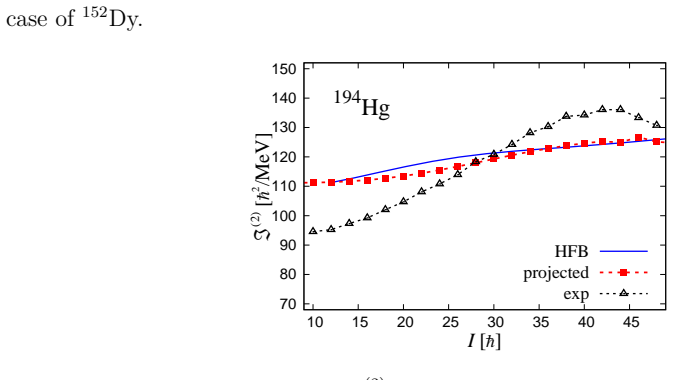
Projection from the mean-field determined by cranked HFB m ethod Our Gogny HFB calculation gives a superdeformed minimum in 194Hg with β2 = 0.548 and 0 .529 at ℏωrot = 0.10 and 0 .49 MeV, respectively. Again, the axial-symmetry is kept very well up to high rotational frequency. The calculated J (2) moment of inertia by the configuration-mixing using the fou...
-
[4]
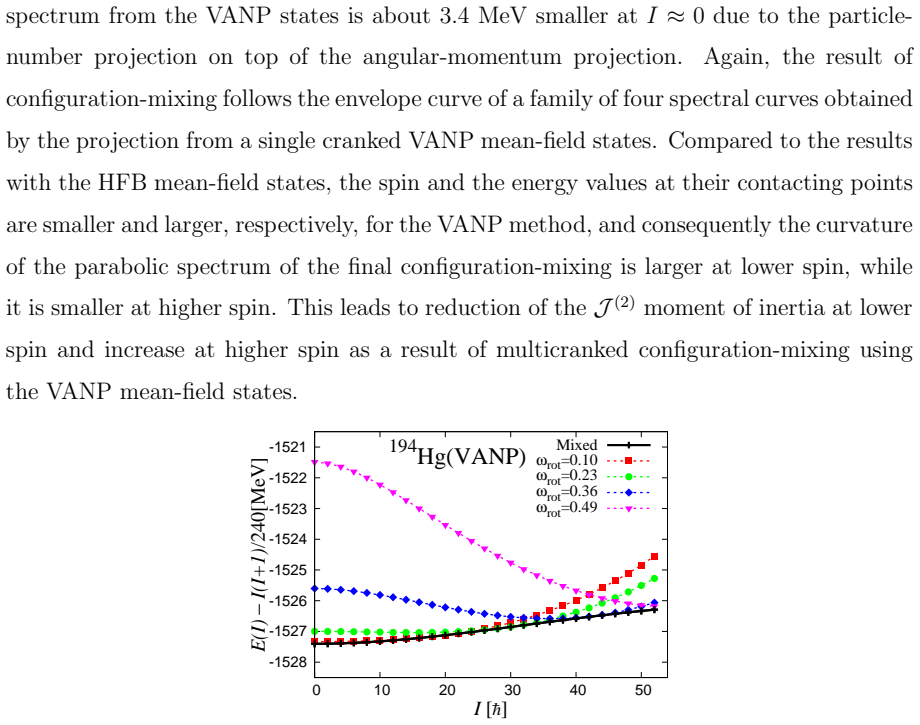
Projection from the mean-field determined by cranked VANP method In order to see the effect of dynamic pairing correlations, we have p erformed the angular-momentum-projection calculations employing the mean-fie ld states obtained by the V ANP method for 194Hg; the particle-number projection is also performed in this case, cf. Eq. (5). The calculated values ...
-
[5]
No number projection with cranked VANP method The numerical cost to perform both the particle-number and angu lar-momentum pro- jection at the same time is very large. On the other hand, the effect of the number projection is usually not very large, see e.g. Ref. [11]. We have also co nfirmed it in the calculation of the spectrum for a tetrahedrally deforme...
-
[6]
A. Bohr and B. R. Mottelson, Nuclear Structure, Vol. II Benjamin, New York (1975)
work page 1975
-
[7]
P. Ring and P. Schuck, The Nuclear Many-Body Problem , Springer, New York (1980)
work page 1980
-
[8]
M. J. A. de Voigt, J. Dudek, and Z. Szymanski, Rev. Mod. Phy s. 55, 949 (1983)
work page 1983
-
[9]
J. D. Garrett, G. B. Hagemann, and B. Herskind, Ann. Rev. N ucl. Part. Sci. 36, 419 (1986)
work page 1986
- [10]
-
[11]
D. Ward and P. Fallon, Advances in Nuclear Physics , vol. 26, Chap. 3, 167 (2001)
work page 2001
-
[12]
W. Satu/suppress la and R. A. Wyss, Rep. Prog. Phys.68, 131 (2005)
work page 2005
- [13]
-
[14]
M. Shimada, S. Tagami, and Y. R. Shimizu, Prog. Theor. Exp . Phys. 2015, 063D02 (2015)
work page 2015
- [15]
- [16]
- [17]
-
[18]
J. A. Sheikh, G. H. Bhat, W. A. Dar, S. Jehangir, and P. A. G anai, Phys. Scr. 91, 063015 (2016)
work page 2016
-
[19]
R. E. Peierls and D. J. Thouless, Nucl. Phys. 38, 154 (1962)
work page 1962
- [20]
-
[21]
M. Borrajo, T. R. Rodr ´ ıguez, J. L. Egido, Phys. Lett. B 746, 341 (2015)
work page 2015
-
[22]
P. J. Twin et al., Phys. Rev. Lett. 57, 811 (1986)
work page 1986
-
[23]
P. J. Nolan and P. J. Twin, Annu. Rev. Nucl. Part. Sci. 38, 533 (1988)
work page 1988
-
[24]
R. V. F. Janssens and T. L. Khoo, Annu. Rev. Nucl. Part. Sc i. 41, 321 (1991)
work page 1991
-
[25]
C. Baktash, B. Haas, and W. Nazarewicz, Annu. Rev. Nucl. Part. Sci. 45, 485 (1995). 29
work page 1995
- [26]
- [27]
- [28]
-
[29]
J. F. Berger, M. Girod, and D. Gogny, Comput. Phys. Commu n. 63, 365 (1991)
work page 1991
-
[30]
J. L. Egido, Phys. Scr. 91, 073003 (2016)
work page 2016
- [31]
- [32]
- [33]
-
[34]
Y. R. Shimizu, J. D. Garrett, R. A. Broglia, M. Gallardo a nd E. Vigezzi, Rev. Mod. Phys. 61, 131 (1989)
work page 1989
-
[35]
Y. R. Shimizu, P. Donati and R. A. Broglia, Phys. Rev. Let t. 85, 2260 (2000)
work page 2000
-
[36]
D. Almehed, F. D¨ onau, S. Frauendorf, and R. G. Nazmitdi nov, Phys. Scr. T88, 62 (2000)
work page 2000
-
[37]
Y. R. Shimizu, E. Vigezzi, and R. A. Broglia, Nucl. Phys. A 509, 80 (1990)
work page 1990
- [38]
-
[39]
Y. R. Shimizu and R. A. Broglia, Nucl. Phys. A515, 38 (1990)
work page 1990
-
[40]
Y. R. Shimizu, Nucl. Phys. A 520, 477c (1990)
work page 1990
- [41]
-
[42]
J. Terasaki, P. -H. Heenen, P. Bonche, J. Dobaczewski, a nd H. Flocard, Nucl. Phys. A 593, 1 (1995)
work page 1995
- [43]
- [44]
- [45]
-
[46]
A. V. Afanasjev, J. K¨ onig, and P. Ring, Nucl. Phys. A 608, 107 (1996)
work page 1996
-
[47]
J. A. Sheikh and P. Ring, Nucl. Phys. A 665, 71 (2000)
work page 2000
-
[48]
T. Inakura, S. Mizutori, M. Yamagami, and K. Matsuyanag i, Nucl. Phys. A 710, 261 (2002)
work page 2002
- [49]
- [50]
-
[51]
T. R. Werner and J. Dudek, At. Data and Nuclear Data Table s, 50, 179 (1992)
work page 1992
-
[52]
T. R. Werner and J. Dudek, At. Data and Nuclear Data Table s, 59, 1 (1995). 30
work page 1995
- [53]
- [54]
-
[55]
M. A. Riley et al., Nucl. Phys. A 512, 178 (1990)
work page 1990
-
[56]
T. L. Khoo et al., Phys. Rev. Lett. 76, 1583 (1996)
work page 1996
-
[57]
R. R. Chasmann, Phys. Lett. B 219, 227 (1989)
work page 1989
- [58]
- [59]
discussion (0)
Sign in with ORCID, Apple, or X to comment. Anyone can read and Pith papers without signing in.