REVIEW 3 major objections 6 minor 73 references
Local Vorticity Computation in Double Distribution Functions based Lattice Boltzmann Methods for Flow and Scalar Transport
T0 review · 3 major / 6 minor · reviewed 2026-08-14 · deepseek-v4-flash
Pith's one-line read The paper derives a local, second-order-accurate formula for vorticity in double-distribution lattice Boltzmann simulations from second-order non-equilibrium moments of the flow and scalar schemes, without any finite-difference velocity…
desk verdict Genuinely local DDF-LB vorticity that works in the tested low-Mach, nonzero-scalar regime, but the analysis overclaims generality by dropping O(u^2) terms without a bound. read the letter →
The pith
A machine-rendered reading of the paper's core claim, the machinery that carries it, and where it could break.
The reading
What carries the argument
The mechanism is a pair of equations: the flow solver's second-order off-diagonal non-equilibrium moment gives $\partial_x u_y + \partial_y u_x = N_{xy}$, while the scalar solver, with anisotropic third-order equilibria of the form $\hat{\eta}^{eq'}_{xxy} = \beta_1 c_{s\phi}^2 \phi u_y + \phi u_x^2 u_y$ and $\hat{\eta}^{eq'}_{xyy} = \beta_2 c_{s\phi}^2 \phi u_x + \phi u_x u_y^2$, gives $\beta_1 \partial_x u_y + \beta_2 \partial_y u_x = N^\phi_{xy}$. Because $\beta_1 \neq \beta_2$, these two equations can be inverted to isolate the two cross-derivatives, and the antisymmetric combination gives the vorticity. The second-order non-equilibrium moments are read directly from the distribution functions as the deviation of the raw moments from their equilibria, so the whole computation uses only node-local data.
What would settle it
Run the paper's four-rolls mill benchmark with the usual flow field but replace the uniform scalar initialization of 2.0 by one that is zero on a patch of nodes (for instance, a strip through the domain). If the local vorticity formula is used as written, nodes where the scalar is zero should produce undefined or divergent values, confirming the hidden nonzero-scalar requirement.
Extended reading notes
Core claim
The paper's central claim is that the skew-symmetric velocity gradient tensor—i.e., the vorticity—is recoverable locally in a DDF-LB scheme by combining second-order non-equilibrium moments from the flow and scalar solvers, provided the scalar solver's third-order off-diagonal moment equilibria contain a small intentional anisotropy parametrized by $\beta_1$ and $\beta_2$. With $N_{xy}$ the flow solver's off-diagonal non-equilibrium moment (normalized) and $N^\phi_{xy}$ the corresponding scalar-solver combination, the two cross-derivatives separate as $\partial_x u_y = (N^\phi_{xy} - \beta_2 N_{xy})/(\beta_1-\beta_2)$ and $\partial_y u_x = (\beta_1 N_{xy} - N^\phi_{xy})/(\beta_1-\beta_2)$, so the vorticity is $\omega_z = [2N^\phi_{xy} - (\beta_1+\beta_2)N_{xy}]/(\beta_1-\beta_2)$. The diagonal velocity derivatives come from the flow solver's diagonal second-order moments. The paper derives these relations through a multiscale asymptotic expansion of the moment equations on a two-dimensional nine-velocity (D2Q9) lattice with multiple-relaxation-time collisions, and reports second-order convergence against analytical and finite-difference solutions for steady, unsteady, and cavity flows.
Load-bearing premise
The vorticity formula divides by the value of the transported scalar field in the definition of the normalized scalar moment, so the local construction requires that field to be nonzero at every node where vorticity is wanted; the paper never states this limitation and all of its benchmarks keep the scalar strictly positive.
Editorial extensions
If this is right
- Any lattice pair that supports third-order off-diagonal moments—D2Q9 in two dimensions and, by the paper's argument, D3Q15, D3Q19, and D3Q27 in three—can carry this local vorticity algorithm; the previous local approach required a lattice supporting fifth-order moments.
- Because the flow solver's equilibria are left untouched, the method can be grafted onto existing MRT, SRT, or central-moment flow solvers by modifying only the scalar solver's third-order equilibria.
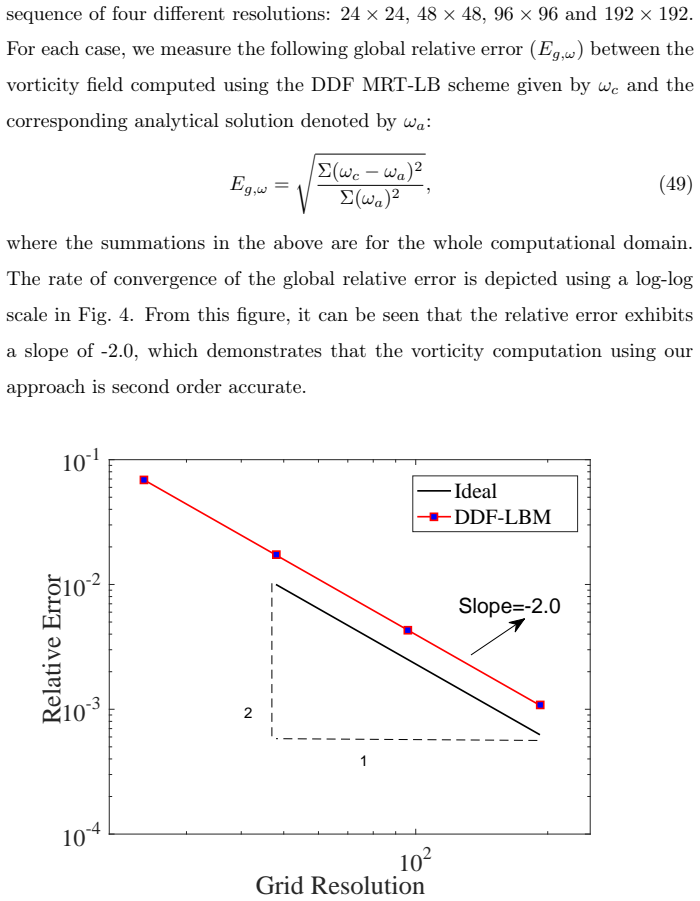
- In the four-rolls mill benchmark the global relative error of the vorticity decreases with slope -2.0 on a log-log grid-refinement plot, so the vorticity field inherits the lattice Boltzmann schemes' second-order accuracy.
- Vorticity computed this way is a combination of local moments, not a finite-difference stencil, so the approach is naturally suited to parallel implementations and to on-the-fly extraction of vortex-identification quantities.
Reading between the lines
- The same anisotropic-moment trick could be reused in any double-distribution simulation where the second distribution carries a nonzero scalar, so thermal convection, combustion, or phase-field multiphase simulations could obtain local vorticity 'for free'—subject to the nonzero-scalar condition.
- Because the defining equation for the normalized scalar moment divides by the scalar value, applying the method to sign-changing or zero-valued scalar fields (common in phase-field models) would require regularization or a different normalization; the paper's benchmarks all keep the scalar positive, so this boundary of validity is untested.
- The two-equation inversion is not limited to the antisymmetric derivative: choosing different anisotropies or using higher-order moments may let other local kinematic quantities, such as the convective acceleration or the Lamb vector, be extracted node-locally as well.
Signed reviews
Editorial analysis
A structured set of objections, weighed in public.
Referee Report
Summary. The paper proposes a local, finite-difference-free formula for computing vorticity within double-distribution-function lattice Boltzmann simulations of flow and scalar transport. The idea is to introduce an intentional anisotropy through the parameters β1 and β2 in the third-order off-diagonal equilibrium moments of the scalar distribution function, then combine the second-order non-equilibrium off-diagonal moment of the scalar scheme, obtained from a Chapman-Enskog analysis, with the corresponding moment of the flow scheme. The central result is Eq. (44), which expresses ωz in terms of Nxy and Nφxy, both evaluated from local moments. The derivation is carried out for an MRT-LB scheme on D2Q9, and the appendices sketch extensions to SRT and central-moment collision models. Validation is reported for Poiseuille flow, four-roll mill flow with a grid-convergence study, Womersley flow, and lid-driven cavity flow.
Significance. If the result holds, it gives a cheap, local way to obtain the complete velocity gradient tensor, including its skew-symmetric part, in DDF-LB simulations, which is relevant for vortex identification, complex-fluid modeling, and parallel implementations. The construction is not circular: β1 and β2 are chosen a priori and cancel in exact arithmetic, and the relation is grounded in a standard Chapman-Enskog expansion rather than fitted to benchmark data. The four-roll-mill convergence study provides the right kind of evidence, with a measured second-order slope. The main strengths are the clean derivation of the two-equation reconstruction, the explicit treatment of the D2Q9 MRT case, and the validation against analytical solutions. The limitations identified below concern the unquantified truncation of O(u^2) terms in the scalar moment balance, the singular behavior when the scalar field vanishes, and the conditioning of the β1−β2 denominator; these are addressable but currently prevent the unqualified form of the claim in the abstract.
major comments (3)
- [Section 3.1, Eq. (38)] The central relation (38) is obtained from Eq. (35f) by dropping ∂t0(φuxuy), ∂x(φux^2uy), and ∂y(φuxuy^2) with the statement that terms of O(u^2) and higher are eliminated. These terms are O(Ma^2) relative to the retained βc_{sφ}^2∂(φu) terms under convective scaling, but the time-derivative term scales as O(Ma^2 St) and can be large under strong unsteadiness; no Strouhal-number bound is given. Since Eq. (38) feeds directly into Nφxy and hence into Eqs. (42)–(44), the claim that Eq. (44) gives the local vorticity is currently validated only for steady or very slow flows, such as the Womersley case with T = 10,000. Please provide an explicit error bound or additional tests that exercise the dropped terms.
- [Section 4, Eq. (41b)] The definition of Nφxy divides by φ, so the local vorticity formula is singular at any node where the scalar field vanishes. The manuscript does not state this restriction in the abstract or conclusions, and all four benchmarks use strictly positive scalar fields: φL = 1, φH = 2 in Sections 5.1 and 5.3, uniform φ = 2 in Section 5.2, and φ = 1 on the cavity walls in Section 5.4. The tests therefore do not exercise the singular case. The paper should either explicitly qualify the general claim to φ ≠ 0 or provide a regularized local treatment for zero or sign-changing scalar fields.
- [Section 4, Eqs. (42)–(44)] The reconstructed cross-derivatives and the vorticity contain the factor 1/(β1−β2), and the paper fixes β1 = 1, β2 = 0.9 without any sensitivity study. In exact arithmetic the β-dependence cancels, but any numerical error in Nxy or Nφxy is amplified by 1/(β1−β2), which is a factor of 10 at the chosen parameters, and the conditioning degrades as β1 approaches β2. Since β1 and β2 are free parameters, the manuscript should report how the result depends on their separation and recommend a practical range.
minor comments (6)
- [Eqs. (35b)–(35e)] The terms c_{sφ}^2 and 2c_{sφ}^2 appear without the factor φ; they should read c_{sφ}^2 φ and 2c_{sφ}^2 φ to be consistent with Eq. (31) and with the subsequent first-order moment relations in Eq. (37).
- [Section 5.1] The text states that five maximum centerline velocities are considered, but only four values are listed: Umax = 0.01, 0.03, 0.05, and 0.08. Please correct the count or add the missing case.
- [Abstract and Introduction] The phrase "intensional anisotropy" appears to be a typo for "intentional anisotropy".
- [Section 5.4, Fig. 6 caption] The caption begins with an extra colon (": :").
- [Abstract and Summary] The broad claim that any pair of lattice sets supporting third-order off-diagonal moments enables local vorticity computation is not demonstrated in this paper; the detailed derivation and all validations are for D2Q9, and the three-dimensional extension is explicitly deferred to future work.
- [Introduction, Section 6] Minor language issues: "The since method is based" and "deveopment" should be corrected.
Circularity Check
No significant circularity: the vorticity formula is derived from Chapman-Enskog analysis of two MRT-LBMs and validated against external analytical benchmarks, with free parameters not fitted to data.
full rationale
The central result Eq. (44) follows algebraically from the two independent moment relations (40a) and (40b), obtained by separate Chapman-Enskog analyses of the flow and scalar MRT-LBMs. The anisotropy parameters β1 and β2 are prescribed a priori (β1=1, β2=0.9) and cancel in exact arithmetic; they are not calibrated to the benchmark vorticity fields. The derivation is self-contained: every step from the moment equilibria in Eq. (31) through the C-E equations (35f), (37a), (37b), and (41a)-(41b) is explicitly written out, and the final vorticity is then tested against independent analytical solutions for Poiseuille flow, four-rolls mill flow, Womersley flow, and lid-driven cavity flow, exhibiting second-order convergence. The paper's self-citations, notably [57] and [62], acknowledge the authors' prior development of the underlying LB collision models and the philosophical idea of exploiting scalar-field degrees of freedom, but none of these citations supplies a load-bearing theorem or fitted value; the present manuscript contains the complete derivation and numerical validation. The limitations identified by the skeptic, such as neglect of O(u^2) terms in Eq. (38) and the φ≠0 requirement in Eq. (41b), are accuracy/scope caveats rather than circular reasoning. No equation is equivalent to its inputs by construction, and no fitted parameter is renamed as a prediction.
Assumptions & free parameters
free parameters (2)
- beta1 =
1.0
- beta2 =
0.9
assumptions (4)
- domain assumption The flow is in the incompressible, low-Mach limit and terms of O(u^2) and higher are negligible in the Chapman-Enskog analysis.
- domain assumption The scalar field phi is nonzero wherever the vorticity is computed.
- standard math The D2Q9 lattice and the natural non-orthogonal moment basis are nonsingular and support independent third-order off-diagonal moment equilibria.
- standard math The Chapman-Enskog expansion and discrete Maxwellian equilibria recover the Navier-Stokes and convection-diffusion equations.
Cite this review
Pith. "Pith review of Local Vorticity Computation in Double Distribution Functions based Lattice Boltzmann Methods for Flow and Scalar Transport." pith.science (2026). https://pith.science/paper/2G3K43VG
@misc{pith2026190806742,
  author       = {Pith},
  title        = {Pith review of: Local Vorticity Computation in Double Distribution Functions based Lattice Boltzmann Methods for Flow and Scalar Transport},
  year         = {2026},
  howpublished = {\url{https://pith.science/paper/2G3K43VG}},
  note         = {Machine review of arXiv:1908.06742}
}
read the original abstract
Computation of vorticity in conjunction with the strain rate tensor, plays an important role in fluid mechanics in vortical structure identification and in the modeling of various complex fluids. For the simulation of flows accompanied by the advection-diffusion transport of a scalar field, double distribution functions (DDF) based lattice Boltzmann methods (LBMs) are commonly used. We present a new local vorticity computation approach by introducing an intensional anisotropy of the scalar flux in the third order, off-diagonal moment equilibria of the LB scheme for the scalar field, and then combining the second order non-equilibrium components of both the LBMs. As such, any pair of lattice sets in the DDF formulation that can independently support the third order off-diagonal moments would enable local determination of the complete flow kinematics, with the LBMs for the fluid motion and the transport of the passive scalar respectively providing the necessary moment relationships to determine the symmetric and skew-symmetric components of the velocity gradient tensor. Since the resulting formulation is completely local and do not rely on finite difference approximations for velocity derivatives, it is by design naturally suitable for parallel computation. As an illustration of our approach, we formulate a DDF-LB scheme for local vorticity computation using a pair of multiple relaxation times (MRT) based collision approaches on two-dimensional, nine velocity (D2Q9) lattices, where the necessary moment relationships to determine the velocity gradient tensor and the vorticity are established via a Chapman-Enskog analysis. Simulations of various benchmark flows demonstrate good accuracy of the predicted vorticity fields, with a second order convergence. Furthermore, extensions of our formulation for a variety of collision models to enable local vorticity computation are presented.
Figures


Figures from the paper (3 more)


Reference graph
Works this paper leans on
-
[1]
P. G. Saffman, Vortex dynamics, Cambridge university press, 1992
work page 1992
- [2]
-
[3]
H. Helmholtz, LXIII. On integrals of the hydrodynamical equations, which express vortex-motion, The London, Edinburgh, and Dublin Philosophical Magazine and Journal of Science 33 (226) (1867) 485–512
-
[4]
Aref, 150 years of vortex dynamics, Theoretical and Computational Fluid Dynamics 24 (2010) 1–7
H. Aref, 150 years of vortex dynamics, Theoretical and Computational Fluid Dynamics 24 (2010) 1–7
work page 2010
-
[5]
Truesdell, The kinematics of vorticity, Courier Dover Publications, 2018
C. Truesdell, The kinematics of vorticity, Courier Dover Publications, 2018
work page 2018
-
[6]
Lamb, Hydrodynamics, Cambridge university press, London, 1932
H. Lamb, Hydrodynamics, Cambridge university press, London, 1932
work page 1932
-
[7]
Truesdell, Two measures of vorticity, Journal of Rational Mechanics and Analysis 2 (1953) 173–217
C. Truesdell, Two measures of vorticity, Journal of Rational Mechanics and Analysis 2 (1953) 173–217
work page 1953
-
[8]
J. C. Hunt, A. A. Wray, P. Moin, Eddies, streams, and convergence zones in turbulent flows, Center for Turbulence Research Report CTR-S88 (1988) 193–208
work page 1988
Show all 73 references
-
[9]
M. S. Chong, A. E. Perry, B. J. Cantwell, A general classification of three- dimensional flow fields, Physics of Fluids A: Fluid Dynamics 2 (5) (1990) 765–777
1990
-
[10]
Jeong, F
J. Jeong, F. Hussain, On the identification of a vortex, Journal of fluid mechanics 285 (1995) 69–94
1995
-
[11]
J. Zhou, R. J. Adrian, S. Balachandar, T. Kendall, Mechanisms for gener- ating coherent packets of hairpin vortices in channel flow, Journal of fluid mechanics 387 (1999) 353–396. 42
1999
-
[12]
P.Chakraborty, S.Balachandar, R.J.Adrian, Ontherelationshipsbetween local vortex identification schemes, Journal of fluid mechanics 535 (2005) 189–214
2005
-
[13]
Haller, An objective definition of a vortex, Journal of fluid mechanics 525 (2005) 1–26
G. Haller, An objective definition of a vortex, Journal of fluid mechanics 525 (2005) 1–26
2005
-
[14]
Zhang, D
S. Zhang, D. Choudhury, Eigen helicity density: a new vortex identification scheme and its application in accelerated inhomogeneous flows, Physics of fluids 18 (5) (2006) 058104
2006
-
[15]
Kolář, Vortex identification: New requirements and limitations, Inter- national Journal of Heat and Fluid Flow 28 (4) (2007) 638–652
V. Kolář, Vortex identification: New requirements and limitations, Inter- national Journal of Heat and Fluid Flow 28 (4) (2007) 638–652
2007
-
[16]
Haller, A
G. Haller, A. Hadjighasem, M. Farazmand, F. Huhn, Defining coherent vor- tices objectively from the vorticity, Journal of Fluid Mechanics 795 (2016) 136–173
2016
-
[17]
Elsas, L
J. Elsas, L. Moriconi, Vortex identification from local properties of the vorticity field, Physics of Fluids 29 (1) (2017) 015101
2017
-
[18]
Y. Gao, C. Liu, Rortex and comparison with eigenvalue-based vortex iden- tification criteria, Physics of Fluids 30 (8) (2018) 085107
2018
-
[19]
S. Tian, Y. Gao, X. Dong, C. Liu, Definitions of vortex vector and vortex, Journal of Fluid Mechanics 849 (2018) 312–339
2018
-
[20]
8549–8570
B.Epps, Reviewofvortexidentificationmethods, in: 55thAIAAAerospace Sciences Meeting, 2017, pp. 8549–8570
2017
-
[21]
C. W. Hamman, J. C. Klewicki, R. M. Kirby, On the Lamb vector di- vergence in Navier–Stokes flows, Journal of Fluid Mechanics 610 (2008) 261–284
2008
-
[22]
M. S. Howe, Theory of vortex sound, Vol. 33, Cambridge University Press, 2003. 43
2003
-
[23]
Pope, A more general effective-viscosity hypothesis, Journal of Fluid Mechanics 72 (2) (1975) 331–340
S. Pope, A more general effective-viscosity hypothesis, Journal of Fluid Mechanics 72 (2) (1975) 331–340
1975
-
[24]
F. M. Leslie, Theory of flow phenomena in liquid crystals, in: Advances in liquid crystals, Vol. 4, Elsevier, 1979, pp. 1–81
1979
-
[25]
A. N. Beris, B. J. Edwards, B. J. Edwards, Thermodynamics of flowing systems: with internal microstructure, no. 36, Oxford University Press, 1994
1994
-
[26]
R. G. Larson, The structure and rheology of complex fluids, Vol. 150, Ox- ford university press, 1999
1999
-
[27]
Deville, T
M. Deville, T. B. Gatski, Mathematical modeling for complex fluids and flows, Springer Science & Business Media, 2012
2012
-
[28]
S.R.DeGroot, P.Mazur, Non-equilibriumthermodynamics, CourierDover Publications, 2013
2013
-
[29]
Hansen, P
J. Hansen, P. J. Daivis, B. Todd, Molecular spin in nano-confined fluidic flows, Microfluidics and nanofluidics 6 (6) (2009) 785–795
2009
-
[30]
J. S. Hansen, J. C. Dyre, P. J. Daivis, B. Todd, H. Bruus, Nanoflow hy- drodynamics, Physical Review E 84 (3) (2011) 036311
2011
-
[31]
J. S. Hansen, J. C. Dyre, P. Daivis, B. D. Todd, H. Bruus, Continuum nanofluidics, Langmuir 31 (49) (2015) 13275–13289
2015
-
[32]
He, L.-S
X. He, L.-S. Luo, Theory of the lattice Boltzmann method: From the Boltzmann equation to the lattice Boltzmann equation, Phys. Rev. E. 56 (1997) 6811–6817
1997
-
[33]
d’Humieres, I
D. d’Humieres, I. Ginzburg, M. Krafczyk, P. Lallemand, L.-S. Luo., Multiple-relaxation-time lattice Boltzmann models in three dimensions, Phil. Trans. R. Soc. Lond. A. 360 (2002) 437–451. 44
2002
-
[34]
Succi, The Lattice Boltzmann equation for fluid dynamics and beyond, Oxford University Press., New York, 2001
S. Succi, The Lattice Boltzmann equation for fluid dynamics and beyond, Oxford University Press., New York, 2001
2001
-
[35]
C. K. Aidun, J. R. Clausen, Lattice-Boltzmann method for complex flows, Annu. Rev. Fluid Mech. 42 (2010) 439–472
2010
-
[36]
L.-S. Luo, M. Krafczyk, W. Shyy, Lattice Boltzmann method for compu- tational fluid dynamics, Encyclopedia of Aerospace Engineering 56 (2010) 651–660
2010
-
[37]
Z. Guo, C. Shu, Lattice Boltzmann algorithms and its application in engi- neering, Vol. 3, World Scientific, 2013
2013
-
[38]
Geier, M
M. Geier, M. Schonherr, A. Pasquali, M. Krafczyk, The cumulant lattice Boltzmann equation in three dimensions: Theory and validation, Comp. Math. Appl. 704 (2015) 507–547
2015
-
[39]
Kruger, H
T. Kruger, H. Kusumaatmaja, A. Kuzmin, O. Shardt, G. Silva, E. Viggen, The Lattice Boltzmann Method - Principles and Practice, Springer, 2016
2016
-
[40]
Krüger, F
T. Krüger, F. Varnik, D. Raabe, Second-order convergence of the deviatoric stress tensor in the standard Bhatnagar-Gross-Krook lattice Boltzmann method, Physical Review E 82 (2) (2010) 025701
2010
-
[41]
Yong, L.-S
W.-A. Yong, L.-S. Luo, et al., Accuracy of the viscous stress in the lattice Boltzmann equation with simple boundary conditions, Physical Review E 86 (6) (2012) 065701
2012
-
[42]
Y. Ning, K. N. Premnath, D. V. Patil, Numerical study of the properties of the central moment lattice Boltzmann method, Int. J. Numer Meth Fluids 82 (2016) 59–90
2016
-
[43]
C. Peng, Z. Guo, L.-P. Wang, Lattice Boltzmann model capable of meso- scopic vorticity computation, Physical Review E 96 (5) (2017) 053304
2017
-
[44]
Ponce Dawson, S
S. Ponce Dawson, S. Chen, G. D. Doolen, Lattice Boltzmann computations for reaction-diffusion equations, J. Chem. Phys. 98 (2) (1993) 1514–1523. 45
1993
-
[45]
X. He, S. Chen, G. D. Doolen, A novel thermal model for the lattice Boltz- mann method in incompressible limit, J. Comp. Phys. 146 (1) (1998) 282– 300
1998
-
[46]
Van der Sman, M
R. Van der Sman, M. Ernst, Convection-diffusion lattice Boltzmann scheme for irregular lattices, J. Comp. Phys. 160 (2) (2000) 766–782
2000
-
[47]
P.Lallemand, L.-S.Luo, TheoryofthelatticeBoltzmann method: Acoustic and thermal properties in two and three dimensions, Phys. Rev. E 68 (3) (2003) 036706
2003
-
[48]
Rasin, S
I. Rasin, S. Succi, W. Miller, A multi-relaxation lattice kinetic method for passive scalar diffusion, Journal of Computational Physics 206 (2) (2005) 453–462
2005
-
[49]
Chopard, J
B. Chopard, J. Falcone, J. Latt, The lattice Boltzmann advection-diffusion model revisited, Euro. Phys. J.-Special Topics 171 (1) (2009) 245–249
2009
-
[50]
Yoshida, M
H. Yoshida, M. Nagaoka, Multiple-relaxation-time lattice Boltzmann model for the convection and anisotropic diffusion equation, J. Comp. Phys. 229 (20) (2010) 7774–7795
2010
-
[51]
J. Wang, D. Wang, P. Lallemand, L.-S. Luo, Lattice Boltzmann simulations of thermal convective flows in two dimensions, Comp. Math. Appl. 65 (2) (2013) 262–286
2013
-
[52]
Z. Chai, T. S. Zhao, Lattice Boltzmann model for the convection-diffusion equation, Physical Review E 87 (2013) 063309
2013
-
[53]
Contrino, P
D. Contrino, P. Lallemand, P. Asinari, L. Luo, Lattice-Boltzmann simula- tions of the thermally driven 2D square cavity at high Rayleigh numbers, J. Comput. Phys 257 (2014) 257–272
2014
-
[54]
Hajabdollahi, K
F. Hajabdollahi, K. Premnath, Central moments-based cascaded lattice Boltzmann method for thermal convective flows in three-dimensions, Int. J. Heat Mass Transfer 120 (2018) 838–850. 46
2018
-
[55]
Hajabdollahi, K
F. Hajabdollahi, K. N. Premnath, Symmetrized operator split schemes for force and source modeling in cascaded lattice Boltzmann methods for flow and scalar transport, Physical Review E 97 (6) (2018) 063303
2018
-
[56]
Hajabdollahi, K
F. Hajabdollahi, K. N. Premnath, S. W. Welch, Cascaded lattice Boltz- mann method based on central moments for axisymmetric thermal flows including swirling effects, International Journal of Heat and Mass Transfer 128 (2019) 999–1016
2019
-
[57]
thesis, University of Colorado Denver, Denver, CO (March 2019)
F.Hajabdollahi, Cascaded latticeBoltzmannmethods basedoncentralmo- ments for thermal convection, multiphase flows and complex fluids, Ph.D. thesis, University of Colorado Denver, Denver, CO (March 2019)
2019
-
[58]
K. N. Premnath, S. Banerjee, Incorporating forcing terms in cascaded lat- tice Boltzmann approach by method of central moments, Phys. Rev. E 80 (2009) 036702
2009
-
[59]
X.He, S.Chen, G.Doelen, AnovelthermalmodelforthelatticeBoltzmann method in incompressible limit, J. Comput. Phys 146 (1998) 282–300
1998
-
[60]
X. He, S. Chen, R. Zhang, A lattice Boltzmann scheme for incompress- ible multiphase flow and its application in simulation of Rayleigh-Taylor instability, J. Comput. Phys 152 (1999) 642–663
1999
-
[61]
Chapman, T
S. Chapman, T. G. Cowling, The mathematical theory of non-uniform gases: an account of the kinetic theory of viscosity, thermal conduction and diffusion in gases, Cambridge university press, 1990
1990
-
[62]
Hajabdollahi, K
F. Hajabdollahi, K. N. Premnath, Galilean-invariant preconditioned central-moment lattice Boltzmann method without cubic velocity errors for efficient steady flow simulations, Physical Review E 97 (5) (2018) 053303
2018
-
[63]
I. G. Currie, Fundamental mechanics of fluids, CRC Press, 2002
2002
-
[64]
U. Ghia, K. N. Ghia, J. Shin, High-Re solutions for incompressible flow using the Navier-Stokes equations and a multigrid method, J. Comput. Phys 48 (1982) 387–411. 47
1982
-
[65]
Erturk, T
E. Erturk, T. C. Corke, C. Gökçöl, Numerical solutions of 2-d steady in- compressible driven cavity flow at high reynolds numbers, International journal for Numerical Methods in fluids 48 (7) (2005) 747–774
2005
-
[66]
Bruneau, M
C.-H. Bruneau, M. Saad, The 2d lid-driven cavity problem revisited, Com- puters & Fluids 35 (3) (2006) 326–348
2006
-
[67]
Premnath, F
K. Premnath, F. Hajabdollahi, Local computation of skew-symmetric ve- locity gradient tensor using double distribution functions-based lattice Boltzmann schemes on standard lattices in three-dimensions, Tech. rep., University of Colorado Denver, Denver, CO (2019)
2019
-
[68]
P. J. Dellar, Lattice kinetic formulation for ferrofluids, Journal of statistical physics 121 (1-2) (2005) 105–118
2005
-
[69]
Denniston, E
C. Denniston, E. Orlandini, J. Yeomans, Lattice boltzmann simulations of liquid crystal hydrodynamics, Physical Review E 63 (5) (2001) 056702
2001
-
[70]
Dahler, L
J. Dahler, L. Scriven, Theory of structured continua i. general consideration of angular momentum and polarization, Proceedings of the Royal Society of London. Series A. Mathematical and Physical Sciences 275 (1363) (1963) 504–527
1963
-
[71]
A. C. Eringen, Theory of micropolar fluids, Journal of Mathematics and Mechanics (1966) 1–18
1966
-
[72]
A. C. Eringen, Simple microfluids, International Journal of Engineering Science 2 (2) (1964) 205–217
1964
-
[73]
Geier, J
M. Geier, J. Greiner, F. Korvink, Cascaded digital lattice Boltzmann au- tomata for high Reynolds number flow, Phys. Rev. E 73 (2006) 066705. 48
2006
Reviewed August 14, 2026 · model on record in the stance chip above.
Discussion (0). Continue with ORCID to comment.