REVIEW 3 major objections 4 minor 51 references
Direct wave simulations of fuzzy dark matter halos can reproduce the observed image positions of the quadruply lensed quasar HS 0810+2554 to within about 3 milliarcseconds, matching the data better than Gaussian-random-field or smooth-halo
Reviewed by Pith at T0; open to challenge. T0 means a machine referee read the full paper against a public rubric. the ladder, T0–T4 →
Wave-simulated fuzzy dark matter halos at 10^-22 eV produce lensed-image position anomalies for HS 0810+2554 that match observations better than Gaussian-random-field or NFW models.
T0 review reviewed 2026-08-01 challenge →
load-bearing objection First direct Schrödinger–Poisson FDM lensing predictions, but the headline 3σ match is an uncalibrated best-of-selection; the method is worth referee time with revisions. the 3 major comments →
Gravitational Lensing Predictions from Wave Simulations of Fuzzy Dark Matter
The pith
A machine-rendered reading of the paper's core claim, the machinery that carries it, and where it could break.
The reading
Core claim
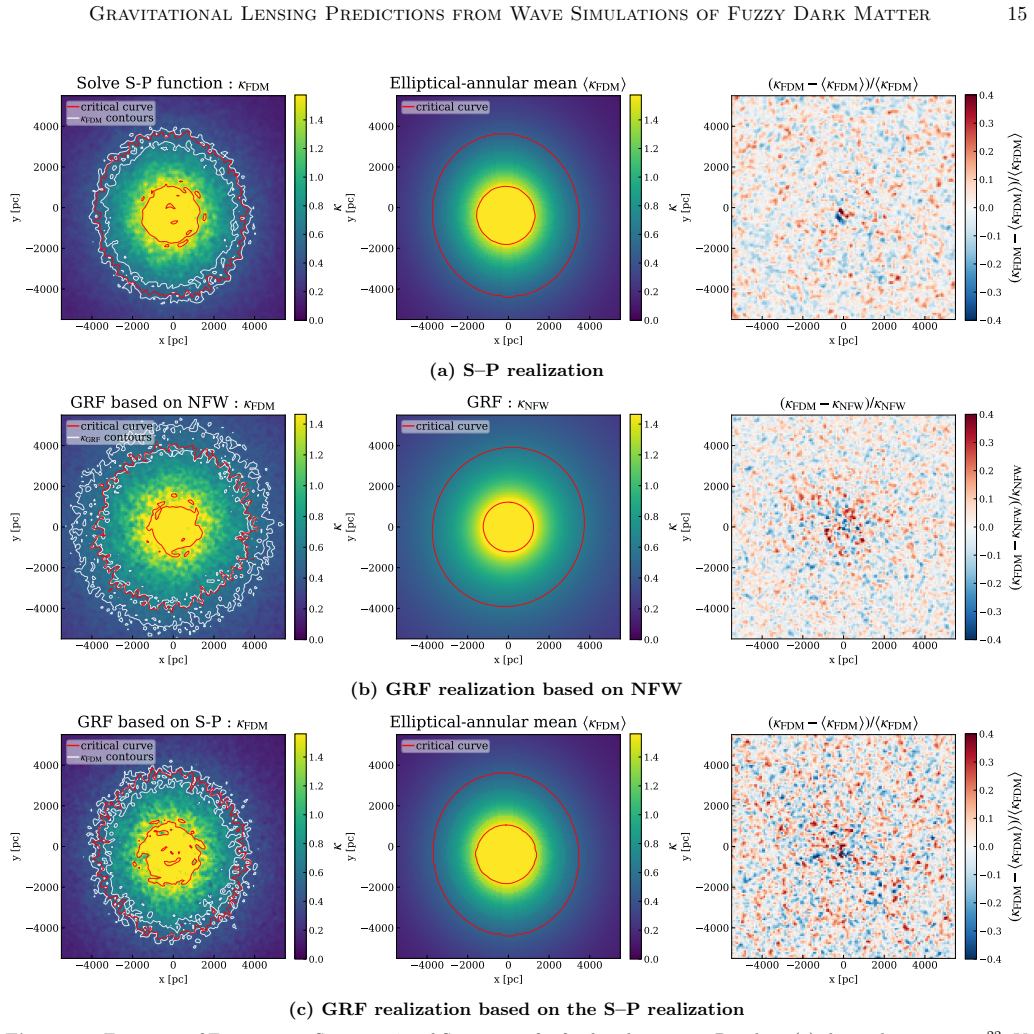
The central discovery is that lensing predictions made from 1000 Schrödinger–Poisson evolved halos of mass 4×10^11 M⊙ produce a distribution of image-position anomalies whose best realizations are small enough to sit inside the observed astrometric uncertainty of HS 0810+2554, at a level the authors state is better than both the Gaussian-random-field approximation and a best-fit NFW model. The evolved halos naturally contain a central soliton core surrounded by granular interference fluctuations with ~10% projected-density contrast; these fluctuations perturb the critical curve and shift the lensed images. For mψ = 10^-22 eV the median anomaly is 12 and 6 mas for the two radio components, an
What carries the argument
The load-bearing machinery is the direct numerical solution of the Schrödinger–Poisson system with a global Fourier pseudospectral split-step method, which yields 1000 independent three-dimensional halos from random multi-wave-packet initial conditions. Each halo is projected along 10^3 sampled viewing directions, and for each projection the lens equation is solved for 10^4 source positions; the relative geometry of the resulting four-image configuration is compared with the observed radio images using the six pairwise image separations and a Procrustes shape-matching step that removes global translation and rotation. This forward-modelling search identifies the viewing direction and source
Load-bearing premise
The entire comparison rests on the assumption that selecting the best matching viewing direction and source position from 1000 halos (with 1000 orientations and 10,000 source positions each) does not itself generate sub-3-milliarcsecond image offsets purely by chance; if that search freedom is not accounted for, the claimed match to HS 0810+2554 is not yet evidence for 10^-22 eV fuzzy dark matter.
What would settle it
Run the same forward-modelling search—1000 realizations, 1000 viewing directions, 10,000 source positions—on smooth NFW halos with no wave fluctuations, and count the fraction of realizations with A<3 mas for the HS 0810+2554 geometry. If smooth halos yield a comparable fraction of sub-3-mas 'matches', the wave-simulated result is an artifact of the search. Alternatively, demand that a single halo, with a single orientation and source position, reproduce all eight lensed image positions simultaneously within 3σ; the paper's component-wise 'some realizations' claim would fail this stricter test
If this is right
- If fuzzy dark matter halos at 10^-22 eV really produce sub-3-mas image offsets, then astrometric measurements of multiply lensed quasars can be used to pin down the dark matter particle mass, since the predicted anomaly scales strongly with mass (10^-23 eV gives roughly fourfold larger offsets).
- Because the wave-simulated halos outperform the Gaussian-random-field approximation, inferences about dark matter drawn from GRF-based lensing models will need to be re-checked with full wave evolution; the GRF may remain adequate for average statistics but not for individual systems.
- The result suggests that the observed position anomalies in HS 0810+2554 do not require additional lens-model complexity such as multipole perturbations or external shear; the wave fluctuations in a single FDM halo can supply the needed perturbative power.
- The same forward-modelling framework can be extended to flux-ratio anomalies, time delays, and resolved image morphologies, which the authors list as planned next steps and which would provide independent tests of the same fuzzy-dark-matter hypothesis.
Where Pith is reading between the lines
- The paper's 'no best-fitting procedure' statement is only partly fair: the pipeline still searches over 10^3 orientations and 10^4 source positions per halo and reports the best match, so the 3-mas realizations are selected from a large ensemble. A sharper test would be to run the identical search on smooth NFW halos or pure noise and compare how often A<3 mas arises by chance; until then, part of
- If the best-of-1000 selection is not the main driver, the implication is that the match is statistical—most FDM halos do not fit, but a non-negligible fraction do—so a single lens system cannot by itself confirm 10^-22 eV dark matter; the natural next step is to apply the same pipeline to a sample of lens systems and ask whether the observed anomalies are drawn from the predicted distribution.
- The appendix's Gaussianity tests show that the projected S-P fluctuations are nearly Gaussian at fixed radius, which means the GRF approximation is not wrong in a statistical-average sense; what full wave evolution adds is the correct spatial correlation structure and non-Gaussian tail behavior, which matter for the specific image configurations of individual lenses. A practical extension is to bu
Editorial analysis
A structured set of objections, weighed in public.
Referee Report
Summary. This paper presents gravitational lensing predictions generated from 3D density fields obtained by Schrödinger–Poisson (SP) simulations of fuzzy dark matter (FDM) halos. For m_ψ = 10^-22 eV, the authors simulate 1000 halo realizations, project each along optimized viewing directions, and forward-model lensed image positions using the public lenstronomy package. They compare the position anomaly A (Eq. 2) with the two radio components of HS 0810+2554, reporting median anomalies of ~12 and ~6 mas, with some realizations within ~3 mas (3σ). They also compare against GRF-based approximations and a smooth NFW model, claiming the SP halos reproduce the observed image positions better than both. The central claim is that wave-simulated halos can reproduce the observed positions 'despite involving no best-fitting procedure.'
Significance. The framework is a potentially important methodological step beyond the GRF approximation used in earlier FDM lensing papers, and the direct use of SP evolution is physically better motivated. The authors make a concrete, falsifiable prediction and use a widely available lensing code; the three-model comparison on the same system is a useful sanity check. However, the headline '3σ match' is not yet supported because the reported anomaly is the minimum over a very large parameter search (§6.2), and the claim of no fitting is contradicted by the pipeline. With proper null calibration and a more careful statement of what is being tested, this could become a valuable contribution.
major comments (3)
- [§6.2, Eqs. (20)–(23)] The 'best' anomaly for each halo is the minimum over N_dir=10^3 viewing directions (Eq. 20) and N_src=10^4 source positions (Eq. 23), and Figure 4 shows only the 300 smallest-A realizations out of 1000. This is effectively a best-of-10^10 selection. The paper provides no null calibration (e.g., the same search applied to a smooth NFW lens or to randomly permuted observed image positions), so the expected minimum A under the null is unknown. The statement in §3 that 'some realizations are within 3σ' is an uncalibrated extreme-value statistic. This is load-bearing because it underpins the conclusion that SP halos match the observations.
- [§3, final paragraph] The claim that the match arises 'despite involving no best-fitting procedure' is contradicted by §6.2, where the viewing direction (Eq. 20) and source position (Eq. 23) are free parameters chosen to minimize A, followed by Procrustes alignment (Eqs. 24–28) that removes translation, rotation, and reflection. The same paragraph also states that images from different realizations can be combined to reproduce all eight lensed images, which implies that no single physical halo actually matches all eight. The paper should be reframed as a statistical distribution of anomalies, not as a demonstration that one wave-simulated halo reproduces the system.
- [§2 and §6.1] The halo ensemble is generated from five initially random Gaussian wave packets in an isolated 40 kpc box with fixed total mass M = 4×10^11 M⊙. This is not a cosmological simulation, and it is unclear whether it samples the diversity of real FDM halos (triaxiality, soliton position, merger history, concentration). If the ensemble is biased, the fact that some realizations match after a massive orientation/source search is less informative. The authors should demonstrate that the statistical properties of the projected convergence fields are consistent with cosmological FDM simulations, or explicitly discuss this limitation.
minor comments (4)
- [Eq. (2)] The expression for A is written as |(x_obs,i - x_pred,i) + (y_obs,i - y_pred,i)|^2, which is not the standard Euclidean distance squared. It should be (Δx)^2 + (Δy)^2. Please correct the notation.
- [Fig. 4 caption] The caption states 'only the 300 best-matching realizations' are shown, but the text says '300 unique FDM halos.' It should be clarified whether the selection is made per radio component or jointly, and what criterion defines 'best.'
- [§6.5] The description refers to 'Equation (8) of A. Amruth et al. (2023)' without reproducing the equation. For self-containedness, include the relevant equation or a complete description of how σ_κ is computed.
- [Abstract and §1] The text refers to 'the quadruply-lensed radio jets in system HS 0810+2554.' The system has two radio components, each quadruply lensed (eight images). The wording should be adjusted to avoid ambiguity.
Circularity Check
The '3σ, no best-fitting' headline is the minimum of the paper's own orientation/source-position optimization and a halo mass chosen to match the Einstein radius, so the headline prediction reduces to the fitted residual.
specific steps
-
fitted input called prediction
[Section 2 (simulation setup) and Section 3 (summary claim)]
""These parameter choices are determined only by the approximate halo-mass scale of the lens system with the aim of reproducing the correct Einstein radius and the observed lensing configuration (See Appendix for further discussion). ... It is remarkable that the wave-simulated halos can reproduce the observed image positions of HS 0810+2554 to within 3σ, despite involving no best-fitting procedure: the halos are evolved from initial conditions without any control over their final states.""
The total halo mass M=4×10^11 M⊙ is selected "with the aim of reproducing the correct Einstein radius and the observed lensing configuration" of the target system; the Einstein radius is set by the observed image positions. Calling the subsequent agreement "no best-fitting procedure" ignores that a global parameter was already fitted to the target system. The halo evolution is independent only conditional on that mass choice.
-
fitted input called prediction
[Appendix §6.2, Eqs. (20)–(29); Section 3]
""For each principal-axis direction, the source position that minimizes this norm is selected as the optimal source position. ... By comparing the residual anomaly A over all sampled directions, we identify the best-matching pair (ê_k^best, β_m^best), which specifies the preferred spatial orientation of the simulated FDM density field and the source position that most closely reproduce the observed relative image geometry.""
By construction, the reported A is the minimum of Eq. (29) (Procrustes-aligned rms) over 10^3 viewing directions (Eq. 20) and 10^4 source positions (Eq. 23). The histograms in Fig. 3 and the "some realizations within 3σ" statement are therefore best-fit residuals, not predictions from a fixed model with no free parameters. The observed positions are the objective of the search; the "no best-fitting" claim is contradicted by the paper's own matching procedure.
full rationale
The Schrödinger–Poisson simulations themselves are not circular: they are evolved independently and compared against GRF/NFW. The relative ordering wave-simulated vs GRF may survive because both are processed the same way. However, the absolute headline claim — 10^-22 eV FDM halos reproduce HS 0810+2554 within 3σ with no fitting — is materially weakened because (i) the halo mass is set by the requirement to reproduce the Einstein radius / observed lensing configuration, and (ii) the 3 mas value is the minimum over 10^3×10^4 choices of orientation and source position, plus Procrustes alignment. The paper itself describes the search for 'the source position that minimizes this norm' and 'the best-matching pair'. Thus the 'predicted' anomaly reduces, by construction, to a fitted residual. This is a partial circularity: the central claim as stated is not supported as a parameter-free prediction, although the pipeline has independent components. No load-bearing self-citation or uniqueness-import issue found; self-citations to Amruth et al. (2023) supply the GRF prescription and are not used to force the main result.
Axiom & Free-Parameter Ledger
free parameters (6)
- FDM particle mass mψ =
10^-22 eV (and 10^-23 eV for comparison)
- Total halo mass M =
4×10^11 M⊙
- Box size L / grid N =
40 kpc / 512
- Initial condition: number of Gaussian wave packets =
5
- Viewing direction θ per halo =
Optimized per realization over 10^3 directions
- Source position (βx, βy) per halo =
Optimized per realization over 10^4 sources
axioms (6)
- domain assumption Schrödinger–Poisson equations govern FDM halo dynamics
- domain assumption Thin-lens approximation is valid for projecting 3-D density to convergence
- domain assumption Planck 2020 cosmology and redshifts z_s=1.51, z_l=0.89 for HS 0810+2554
- ad hoc to paper Isolated-box evolution with five wave packets yields statistically representative lens halos
- domain assumption Observed astrometric uncertainties from Hartley et al. 2019 are correct
- domain assumption GRF construction of Amruth et al. 2023 is the appropriate baseline
Cite this review
Pith. "Pith review of Gravitational Lensing Predictions from Wave Simulations of Fuzzy Dark Matter." pith.science (2026). https://pith.science/paper/2GJHGCLM
@misc{pith2026260720614,
  author       = {Pith},
  title        = {Pith review of: Gravitational Lensing Predictions from Wave Simulations of Fuzzy Dark Matter},
  year         = {2026},
  howpublished = {\url{https://pith.science/paper/2GJHGCLM}},
  note         = {Machine review of arXiv:2607.20614}
}
read the original abstract
In the cold dark matter paradigm, ultra-light particles are emerging as strong contenders to conventional massive particles. A unique prediction of dark matter comprising such ultra-light particles, known as fuzzy dark matter (FDM), is the presence of strong density modulations throughout galactic halos due to wave interference, which -- when approximated by a Gaussian random field (GRF) -- have been proposed to account for the inability to reproduce the observed positions (when measured at sufficient precisions) and flux ratios of multiply-lensed images of quasars. Here, we predict for the first time the properties of gravitationally lensed images generated from 3-D density fields obtained by wave simulations that directly evolve the Schr\"odinger--Poisson equations. Using a novel framework to project these evolved density fields along various axes of the 3-D halo, we obtain the distribution of perturbations to the positions of lensed images. As an exacting test, we find that particles of mass $10^{-22}$ eV can reproduce the positions of the quadruply-lensed radio jets in system HS 0810+2554 to a level better than that of either the GRF approximation or, to a greater extent, an NFW best-fit solution, both of which rely on accurately capturing the global 3-D density field of dark matter halos. Our work highlights the importance of wave simulations for making accurate FDM lensing predictions and the potential for high-resolution observations of lensed systems to serve as a direct probe of the nature of dark matter.
Figures



Reference graph
Works this paper leans on
-
[1]
2023, Nature Astronomy, 7, 736, doi: 10.1038/s41550-023-01943-9
Amruth, A., Broadhurst, T., Lim, J., et al. 2023, Nature Astronomy, 7, 736, doi: 10.1038/s41550-023-01943-9
-
[2]
Banik, N., Bovy, J., Bertone, G., Erkal, D., & de Boer, T. J. L. 2021, JCAP, 2021, 043, doi: 10.1088/1475-7516/2021/10/043
-
[3]
2018, Physics of the Dark Universe, 22, 189, doi: 10.1016/j.dark.2018.11.002
Birrer, S., & Amara, A. 2018, Physics of the Dark Universe, 22, 189, doi: 10.1016/j.dark.2018.11.002
-
[4]
Birrer, S., Shajib, A. J., Gilman, D., et al. 2021, Journal of Open Source Software, 6, 3283, doi: 10.21105/joss.03283
-
[5]
Boylan-Kolchin, M., Bullock, J. S., & Kaplinghat, M. 2011, MNRAS, 415, L40, doi: 10.1111/j.1745-3933.2011.01074.x
arXiv 2011
-
[6]
Boylan-Kolchin, M., Bullock, J. S., & Kaplinghat, M. 2012, MNRAS, 422, 1203, doi: 10.1111/j.1365-2966.2012.20695.x
arXiv 2012
-
[7]
Broadhurst, T., De Martino, I., Luu, H. N., Smoot, G. F., & Tye, S.-H. H. 2020, Phys. Rev. D, 101, 083012, doi: 10.1103/PhysRevD.101.083012
-
[8]
Bullock, J. S., & Boylan-Kolchin, M. 2017, ARA&A, 55, 343, doi: 10.1146/annurev-astro-091916-055313
-
[9]
2020, PhRvL, 125, 111102, doi: 10.1103/PhysRevLett.125.111102
Broadhurst, T. 2020, PhRvL, 125, 111102, doi: 10.1103/PhysRevLett.125.111102
-
[10]
2017, MNRAS, 468, 1338, doi: 10.1093/mnras/stx449
Chen, S.-R., Schive, H.-Y., & Chiueh, T. 2017, MNRAS, 468, 1338, doi: 10.1093/mnras/stx449
-
[11]
Dalal, N., & Kochanek, C. S. 2002, ApJ, 572, 25, doi: 10.1086/340303
doi:10.1086/340303 2002
-
[12]
2022, PhRvD, 106, 063517, doi: 10.1103/PhysRevD.106.063517 de Blok, W
Dalal, N., & Kravtsov, A. 2022, PhRvD, 106, 063517, doi: 10.1103/PhysRevD.106.063517 de Blok, W. J. G. 2010, Advances in Astronomy, 2010, 789293, doi: 10.1155/2010/789293
-
[13]
Evans, N. W., & Witt, H. J. 2003, MNRAS, 345, 1351, doi: 10.1046/j.1365-2966.2003.07057.x
arXiv 2003
-
[14]
Ferreira, E. G. M. 2021, A&A Rv, 29, 7, doi: 10.1007/s00159-021-00135-6
-
[15]
2025, PhRvD, 111, L081302, doi: 10.1103/PhysRevD.111.L081302
Gao, R., Tian, S., Li, Z., et al. 2025, PhRvD, 111, L081302, doi: 10.1103/PhysRevD.111.L081302
-
[16]
Vives-Arias, H. 2019, MNRAS, 485, 3009, doi: 10.1093/mnras/stz510 Herrera-Mart ´ ın, A., Hendry, M., Gonzalez-Morales, A. X., & Ure˜ na-L´ opez, L. A. 2019, The Astrophysical Journal, 872, 11, doi: 10.3847/1538-4357/aafaf0
-
[17]
2026, arXiv e-prints, arXiv:2601.16818, doi: 10.48550/arXiv.2601.16818
Hou, S., Xiang, S., Sming Tsai, Y.-L., et al. 2026, arXiv e-prints, arXiv:2601.16818, doi: 10.48550/arXiv.2601.16818
-
[18]
2000, PhRvL, 85, 1158, doi: 10.1103/PhysRevLett.85.1158
Hu, W., Barkana, R., & Gruzinov, A. 2000, PhRvL, 85, 1158, doi: 10.1103/PhysRevLett.85.1158
-
[19]
2021, ARA&A, 59, 247, doi: 10.1146/annurev-astro-120920-010024
Hui, L. 2021, ARA&A, 59, 247, doi: 10.1146/annurev-astro-120920-010024
-
[21]
Hui, L., Ostriker, J. P., Tremaine, S., & Witten, E. 2017b, PhRvD, 95, 043541, doi: 10.1103/PhysRevD.95.043541 Irˇ siˇ c, V., Viel, M., Haehnelt, M. G., Bolton, J. S., &
-
[22]
Becker, G. D. 2017, PhRvL, 119, 031302, doi: 10.1103/PhysRevLett.119.031302
-
[23]
Keeton, C. R., Gaudi, B. S., & Petters, A. O. 2003, The Astrophysical Journal, 598, 138–161, doi: 10.1086/378934
doi:10.1086/378934 2003
-
[24]
Klypin, A., Gottl¨ ober, S., Kravtsov, A. V., & Khokhlov, A. M. 1999a, The Astrophysical Journal, 516, 530, doi: 10.1086/307122
-
[25]
V., Valenzuela, O., & Prada, F
Klypin, A., Kravtsov, A. V., Valenzuela, O., & Prada, F. 1999b, The Astrophysical Journal, 522, 82, doi: 10.1086/307643
-
[26]
Kochanek, C. S., & Dalal, N. 2004, The Astrophysical Journal, 610, 69–79, doi: 10.1086/421436
doi:10.1086/421436 2004
-
[27]
2022, Monthly Notices of the Royal Astronomical Society, 517, 1867–1883, doi: 10.1093/mnras/stac2677
Laroche, A., Gilman, D., Li, X., Bovy, J., & Du, X. 2022, Monthly Notices of the Royal Astronomical Society, 517, 1867–1883, doi: 10.1093/mnras/stac2677
-
[28]
Liao, P.-Y., Su, G.-M., Schive, H.-Y., et al. 2025, Phys. Rev. Lett., 135, 061002, doi: 10.1103/9dqj-q6mt
-
[29]
2024, PhRvD, 110, 083536, doi: 10.1103/PhysRevD.110.083536
Liu, J., Gao, Z., Biesiada, M., & Liao, K. 2024, PhRvD, 110, 083536, doi: 10.1103/PhysRevD.110.083536
-
[30]
2026, arXiv e-prints, arXiv:2606.06969, doi: 10.48550/arXiv.2606.06969
Liu, J., Gong, Y., & Zhou, X. 2026, arXiv e-prints, arXiv:2606.06969, doi: 10.48550/arXiv.2606.06969
-
[31]
Mao, S., Jing, Y., Ostriker, J. P., & Weller, J. 2004, The Astrophysical Journal, 604, L5–L8, doi: 10.1086/383413
doi:10.1086/383413 2004
-
[32]
1998, MNRAS, 295, 587, doi: 10.1046/j.1365-8711.1998.01319.x
Mao, S., & Schneider, P. 1998, MNRAS, 295, 587, doi: 10.1046/j.1365-8711.1998.01319.x
arXiv 1998
-
[33]
Metcalf, R. B., & Madau, P. 2001, ApJ, 563, 9, doi: 10.1086/323695
doi:10.1086/323695 2001
-
[34]
Metcalf, R. B., & Zhao, H. 2002, The Astrophysical Journal, 567, L5–L8, doi: 10.1086/339798
doi:10.1086/339798 2002
-
[35]
Miller, John H., J., & Williams, L. L. R. 2025, MNRAS, 543, 3952, doi: 10.1093/mnras/staf1650
-
[36]
2017, MNRAS, 471, 4559, doi: 10.1093/mnras/stx1887
Mocz, P., Vogelsberger, M., Robins, D., et al. 2017, MNRAS, 471, 4559, doi: 10.1093/mnras/stx1887
-
[37]
O., Drlica-Wagner, A., Bechtol, K., et al
Nadler, E. O., Drlica-Wagner, A., Bechtol, K., et al. 2021, Phys. Rev. Lett., 126, 091101, doi: 10.1103/PhysRevLett.126.091101 Planck Collaboration, Aghanim, N., Akrami, Y., et al. 2020, A&A, 641, A6, doi: 10.1051/0004-6361/201833910
-
[38]
Powell, D. M., Vegetti, S., McKean, J. P., et al. 2023, MNRAS, 524, L84, doi: 10.1093/mnrasl/slad074
-
[39]
Pozo, A., Broadhurst, T., de Martino, I., et al. 2024, Phys. Rev. D, 110, 043534, doi: 10.1103/PhysRevD.110.043534 18Zhou et al
-
[40]
2002, A&A, 382, L26, doi: 10.1051/0004-6361:20011664
Reimers, D., Hagen, H.-J., Baade, R., Lopez, S., & Tytler, D. 2002, A&A, 382, L26, doi: 10.1051/0004-6361:20011664
-
[41]
Rogers, K. K., & Peiris, H. V. 2021, Phys. Rev. Lett., 126, 071302, doi: 10.1103/PhysRevLett.126.071302
-
[42]
Safarzadeh, M., & Spergel, D. N. 2020, ApJ, 893, 21, doi: 10.3847/1538-4357/ab7db2
-
[43]
2026, Living Reviews in Computational Astrophysics, 12, 1, doi: 10.1007/s41115-026-00027-5
Schive, H.-Y. 2026, Living Reviews in Computational Astrophysics, 12, 1, doi: 10.1007/s41115-026-00027-5
-
[44]
2014a, Nature Physics, 10, 496, doi: 10.1038/nphys2996
Schive, H.-Y., Chiueh, T., & Broadhurst, T. 2014a, Nature Physics, 10, 496, doi: 10.1038/nphys2996
-
[45]
2014b, PhRvL, 113, 261302, doi: 10.1103/PhysRevLett.113.261302 Sch¨ onemann, P
Schive, H.-Y., Liao, M.-H., Woo, T.-P., et al. 2014b, PhRvL, 113, 261302, doi: 10.1103/PhysRevLett.113.261302 Sch¨ onemann, P. H. 1966, Psychometrika, 31, 1, doi: 10.1007/BF02289451
-
[46]
Schwabe, B., Niemeyer, J. C., & Engels, J. F. 2016, PhRvD, 94, 043513, doi: 10.1103/PhysRevD.94.043513
-
[47]
J., Birrer, S., Treu, T., et al
Shajib, A. J., Birrer, S., Treu, T., et al. 2018, Monthly Notices of the Royal Astronomical Society, 483, 5649–5671, doi: 10.1093/mnras/sty3397
-
[48]
Taha, T. R., & Ablowitz, M. I. 1984, Journal of Computational Physics, 55, 203, doi: 10.1016/0021-9991(84)90003-2
-
[49]
Vegetti, S., Czoske, O., Koopmans, L. V. E., & McKean, J. P. 2010, MNRAS, 407, 225, doi: 10.1111/j.1365-2966.2010.16952.x
arXiv 2010
-
[50]
Vegetti, S., & Koopmans, L. V. E. 2009, MNRAS, 392, 945, doi: 10.1111/j.1365-2966.2008.14005.x
arXiv 2009
-
[51]
Veltmaat, J., Niemeyer, J. C., & Schwabe, B. 2018, PhRvD, 98, 043509, doi: 10.1103/PhysRevD.98.043509
-
[52]
2015, Monthly Notices of the Royal Astronomical Society, 447, 3189–3206, doi: 10.1093/mnras/stu2673
Xu, D., Sluse, D., Gao, L., et al. 2015, Monthly Notices of the Royal Astronomical Society, 447, 3189–3206, doi: 10.1093/mnras/stu2673
This paper was first reviewed by deepseek-v4-flash on August 1, 2026.
discussion (0)
Sign in with ORCID, Apple, or X to comment. Anyone can read and Pith papers without signing in.