Simulating Exciton Transport with Complex Absorbing Potentials
Pith reviewed 2026-05-19 21:52 UTC · model grok-4.3
The pith
A stochastic framework with complex absorbing potentials models exciton transport in large molecular aggregates.
A machine-rendered reading of the paper's core claim, the machinery that carries it, and where it could break.
Core claim
We introduce a stochastic framework based on complex absorbing potentials (CAPs) to investigate exciton transport in large molecular aggregates. Within this approach, CAPs act as non-Hermitian reservoirs and sinks that enable effective measurement of transport efficiency. We apply this framework to cyanine dye aggregates and examine how vacancy defects and system size influence exciton dynamics in two-dimensional sheets and quasi-one-dimensional tubes. We also introduce a CAPs-based classification scheme that links molecular packing in 2D aggregates to transport behavior. Our results demonstrate how aggregate topology and structural disorder govern exciton dynamics and provide guidance for
What carries the argument
Complex absorbing potentials (CAPs) functioning as non-Hermitian reservoirs and sinks to measure transport efficiency in simulated exciton dynamics.
Load-bearing premise
Complex absorbing potentials can function as non-Hermitian reservoirs and sinks that enable effective measurement of transport efficiency in the simulated exciton dynamics.
What would settle it
A direct comparison between the transport efficiencies predicted by the CAPs framework and either exact quantum calculations on small aggregates or experimental exciton diffusion lengths measured in cyanine dye samples with controlled vacancy densities would settle the claim.
Figures



read the original abstract
We introduce a stochastic framework based on complex absorbing potentials (CAPs) to investigate exciton transport in large molecular aggregates. Within this approach, CAPs act as non-Hermitian reservoirs and sinks that enable effective measurement of transport efficiency. We apply this framework to cyanine dye aggregates and examine how vacancy defects and system size influence exciton dynamics in two-dimensional sheets and quasi-one-dimensional tubes. We also introduce a CAPs-based classification scheme that links molecular packing in 2D aggregates to transport behavior. Our results demonstrate how aggregate topology and structural disorder govern exciton dynamics and provide guidance for designing materials with enhanced energy transport.
Editorial analysis
A structured set of objections, weighed in public.
Referee Report
Summary. The paper introduces a stochastic framework based on complex absorbing potentials (CAPs) to investigate exciton transport in large molecular aggregates. Within this approach, CAPs act as non-Hermitian reservoirs and sinks that enable effective measurement of transport efficiency. The framework is applied to cyanine dye aggregates to examine how vacancy defects and system size influence exciton dynamics in two-dimensional sheets and quasi-one-dimensional tubes. A CAPs-based classification scheme is introduced that links molecular packing in 2D aggregates to transport behavior. Results demonstrate how aggregate topology and structural disorder govern exciton dynamics.
Significance. If the central claims are validated, the work offers a potentially efficient stochastic alternative to full open-quantum-system simulations for studying exciton transport in large aggregates. The explicit applications to cyanine dyes, analysis of vacancies and topology, and the proposed classification scheme could provide practical guidance for material design. The approach's computational advantages for large systems would be a notable strength if benchmarks confirm consistency with established methods.
major comments (2)
- [Methods] Methods section: The manuscript does not supply an explicit mapping or benchmark demonstrating that the chosen CAP strength and spatial profile recover the correct long-time transport scaling (ballistic vs. diffusive) when compared to a Hermitian Lindblad or Redfield treatment on the same aggregate Hamiltonian. This mapping is load-bearing for the claim that CAP absorption rates directly quantify physical transport efficiency.
- [Results] Results section: No validation data, error analysis, or direct comparisons to benchmarks are reported for the claimed regimes of 2D sheets and quasi-1D tubes. Without these, the reported effects of vacancies and topology on dynamics cannot be distinguished from possible artifacts of the artificial non-Hermitian absorption.
minor comments (1)
- [Abstract] The abstract refers to a 'stochastic sampling scheme' but the precise implementation details (e.g., how survival probabilities are sampled and averaged) are not summarized with sufficient clarity for immediate reproducibility.
Simulated Author's Rebuttal
We thank the referee for the thoughtful and constructive report. The comments highlight important points regarding validation of the CAP framework against established open-quantum-system methods. We address each major comment below and indicate the revisions we will make to strengthen the manuscript.
read point-by-point responses
-
Referee: [Methods] Methods section: The manuscript does not supply an explicit mapping or benchmark demonstrating that the chosen CAP strength and spatial profile recover the correct long-time transport scaling (ballistic vs. diffusive) when compared to a Hermitian Lindblad or Redfield treatment on the same aggregate Hamiltonian. This mapping is load-bearing for the claim that CAP absorption rates directly quantify physical transport efficiency.
Authors: We agree that an explicit benchmark is valuable for establishing the physical correspondence. The original manuscript provides a theoretical derivation linking CAP absorption to transport efficiency and selects parameters based on convergence tests and prior CAP literature for open systems. However, we acknowledge the absence of a direct side-by-side comparison to Lindblad/Redfield scaling on the same Hamiltonian. In the revised version we will add a dedicated benchmark subsection in Methods, using small aggregates (N ≤ 20) where both approaches are computationally feasible, demonstrating that the chosen CAP strength and profile reproduce the expected crossover from ballistic to diffusive scaling. revision: yes
-
Referee: [Results] Results section: No validation data, error analysis, or direct comparisons to benchmarks are reported for the claimed regimes of 2D sheets and quasi-1D tubes. Without these, the reported effects of vacancies and topology on dynamics cannot be distinguished from possible artifacts of the artificial non-Hermitian absorption.
Authors: We recognize that the lack of explicit error bars and cross-method validation leaves open the possibility of method-specific artifacts. The presented results already include averages over multiple stochastic trajectories for each configuration, but we did not report the associated standard deviations or perform limited-system comparisons. In the revision we will incorporate error analysis (standard deviation across realizations) for all reported transport efficiencies and add a supplementary figure comparing CAP and Redfield results on representative small 2D and tube geometries to confirm that vacancy and topology trends are preserved. revision: yes
Circularity Check
No significant circularity detected; framework is introduced as a new simulation method.
full rationale
The paper presents an original stochastic framework that deploys complex absorbing potentials (CAPs) as non-Hermitian reservoirs and sinks to simulate exciton transport in molecular aggregates. The central steps consist of defining the CAP-augmented Hamiltonian, performing stochastic sampling on cyanine dye systems, and proposing a CAP-based classification that correlates packing geometry with observed dynamics. No load-bearing step reduces by construction to a prior fit or self-citation; the reported influences of vacancies, size, and topology are outputs of the new simulation rather than reparameterizations of its inputs. The derivation chain remains self-contained against external benchmarks because the method is benchmarked by direct application rather than by tautological re-derivation of its own assumptions.
Axiom & Free-Parameter Ledger
axioms (1)
- domain assumption CAPs act as non-Hermitian reservoirs and sinks that enable effective measurement of transport efficiency.
Lean theorems connected to this paper
-
IndisputableMonolith/Cost/FunctionalEquation.leanwashburn_uniqueness_aczel unclear?
unclearRelation between the paper passage and the cited Recognition theorem.
We introduce a stochastic framework based on complex absorbing potentials (CAPs) to investigate exciton transport... CAPs act as non-Hermitian reservoirs and sinks that enable effective measurement of transport efficiency.
-
IndisputableMonolith/Foundation/AlphaCoordinateFixation.leanJ_uniquely_calibrated_via_higher_derivative unclear?
unclearRelation between the paper passage and the cited Recognition theorem.
The energy-dependent transmission probability T(E) = 4 Tr[ G(E) VR G†(E) VL ] ... thermally averaged transmission T-bar
What do these tags mean?
- matches
- The paper's claim is directly supported by a theorem in the formal canon.
- supports
- The theorem supports part of the paper's argument, but the paper may add assumptions or extra steps.
- extends
- The paper goes beyond the formal theorem; the theorem is a base layer rather than the whole result.
- uses
- The paper appears to rely on the theorem as machinery.
- contradicts
- The paper's claim conflicts with a theorem or certificate in the canon.
- unclear
- Pith found a possible connection, but the passage is too broad, indirect, or ambiguous to say the theorem truly supports the claim.
Reference graph
Works this paper leans on
-
[1]
Store the lattice coordinates and center them in thex–yplane A(xn, yn)→B=A−A mid. 9
-
[2]
Convert the centered coordinates to cylindrical coordinates B→C(R, θ), R= p x2 n +y 2 n, θ n = arctan yn xn
-
[3]
Select lattice points lying on a circle of radiusR a within a specified tolerance
-
[4]
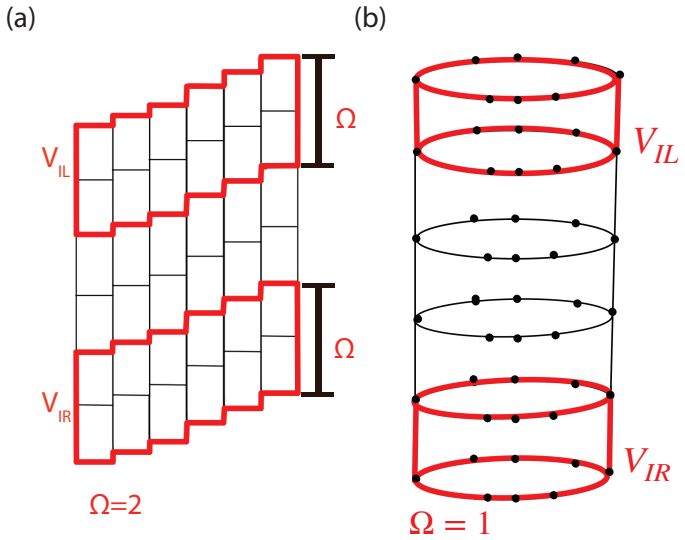
Construct the CAPs on the upper and lower arcs of the resulting circle of radiusR a. VIL VIR Y(Å) X(Å) Brick Lattice with Angle Dependent 2D CAPs(VIL , VIR) 200 160 120 80 40 00 150 300 Ra FIG. 3. Schematic of the 2D circular absorbing potentials applied to a 2D sheet geometry. The circular boundary defines the absorbing region of radiusR a. The angle-dep...
work page 2000
-
[5]
Brixner, T.; Hildner, R.; K¨ ohler, J.; Lambert, C.; W¨ urthner, F. Exciton Transport in Molecu- lar Aggregates – From Natural Antennas to Synthetic Chromophore Systems.Advanced Energy Materials2017,7
-
[6]
Barford, W.; Duffy, C. D. P. Role of quantum coherence and energetic disorder in exciton transport in polymer films.Physical Review B2006,74
-
[7]
Popp, W.; Brey, D.; Binder, R.; Burghardt, I. Quantum Dynamics of Exciton Transport and Dissociation in Multichromophoric Systems.Annual Review of Physical Chemistry2021,72, 591–616
-
[8]
Wong, C. Y.; Cotts, B. L.; Wu, H.; Ginsberg, N. S. Exciton dynamics reveal aggregates with intermolecular order at hidden interfaces in solution-cast organic semiconducting films.Nature Communications2015,6. 19
-
[9]
Lebedenko, A. N.; Grynyov, R. S.; Guralchuk, G. Y.; Sorokin, A. V.; Yefimova, S. L.; Ma- lyukin, Y. V. Coherent Mechanism of Exciton Transport in Disordered J-Aggregates.The Journal of Physical Chemistry C2009,113, 12883–12887
-
[10]
Kalinowski, J.Electrical and Related Properties of Organic Solids; Springer Netherlands, 1997; p 167–206
work page 1997
-
[11]
Hedley, G. J.; Ruseckas, A.; Samuel, I. D. W. Light Harvesting for Organic Photovoltaics. Chemical Reviews2016,117, 796–837
-
[12]
K.; Eisfeld, A.; Valleau, S.; Aspuru-Guzik, A
Saikin, S. K.; Eisfeld, A.; Valleau, S.; Aspuru-Guzik, A. Photonics meets excitonics: natural and artificial molecular aggregates.Nanophotonics2013,2, 21–38
-
[13]
Kasha, M. Energy Transfer Mechanisms and the Molecular Exciton Model for Molecular Ag- gregates.Radiation Research1963,20, 55
-
[14]
Jelley, E. E. Molecular, Nematic and Crystal States of I: I-Diethyl–Cyanine Chloride.Nature 1937,139, 631–631
work page 1937
-
[15]
Jelley, E. E. Spectral Absorption and Fluorescence of Dyes in the Molecular State.Nature 1936,138, 1009–1010
work page 1936
-
[16]
Deshmukh, A. P.; Geue, N.; Bradbury, N. C.; Atallah, T. L.; Chuang, C.; Pengshung, M.; Cao, J.; Sletten, E. M.; Neuhauser, D.; Caram, J. R. Bridging the gap between H- and J-aggregates: Classification and supramolecular tunability for excitonic band structures in two-dimensional molecular aggregates.Chemical Physics Reviews2022,3
-
[17]
W¨ urthner, F.; Kaiser, T. E.; Saha-M¨ oller, C. R. J-Aggregates: From Serendipitous Discovery to Supramolecular Engineering of Functional Dye Materials.Angewandte Chemie Interna- tional Edition2011,50, 3376–3410
-
[18]
Petrenko, V.; Dimitriev, O.; Slominskii, Y.; Smirnova, A. Efficient energy transfer between J-aggregates of thiamonomethinecyanine dyes.Chemical Physics Letters2015,621, 22–28
-
[19]
Anderson, P. W. Absence of Diffusion in Certain Random Lattices.Physical Review1958, 109, 1492–1505
-
[20]
Evensky, D. A.; Scalettar, R. T.; Wolynes, P. G. Localization and dephasing effects in a time- dependent Anderson Hamiltonian.The Journal of Physical Chemistry1990,94, 1149–1154
-
[21]
Uchiyama, C.; Munro, W. J.; Nemoto, K. Environmental engineering for quantum energy transport.npj Quantum Information2018,4
-
[22]
Lee, C. K.; Shi, L.; Willard, A. P. Modeling the Influence of Correlated Molecular Disorder 20 on the Dynamics of Excitons in Organic Molecular Semiconductors.The Journal of Physical Chemistry C2018,123, 306–314
-
[23]
Akselrod, G. M.; Deotare, P. B.; Thompson, N. J.; Lee, J.; Tisdale, W. A.; Baldo, M. A.; Menon, V. M.; Bulovi´ c, V. Visualization of exciton transport in ordered and disordered molec- ular solids.Nature Communications2014,5
-
[24]
Reineker, P.; Warns, C.; Neidlinger, T.; Barv´ ık, I. Exciton transport in dynamically disordered molecular aggregates: influence on optical line shapes.Chemical Physics1993,177, 715–726
-
[25]
Pant, R.; W¨ uster, S. Excitation transport in molecular aggregates with thermal motion.Phys- ical Chemistry Chemical Physics2020,22, 21169–21184
-
[26]
Dom´ ınguez-Adame, F.; Malyshev, V. Frenkel excitons in one-dimensional systems with corre- lated disorder.Journal of Luminescence1999,83–84, 61–67
-
[27]
A single defect approximation for localized states on random lattices
Biroli, G.; Monasson, R. A single defect approximation for localized states on random lattices. Journal of Physics A: Mathematical and General1999,32, L255–L261
-
[28]
Doria, S.; Sinclair, T. S.; Klein, N. D.; Bennett, D. I. G.; Chuang, C.; Freyria, F. S.; Steiner, C. P.; Foggi, P.; Nelson, K. A.; Cao, J.; Aspuru-Guzik, A.; Lloyd, S.; Caram, J. R.; Bawendi, M. G. Photochemical Control of Exciton Superradiance in Light-Harvesting Nan- otubes.ACS Nano2018,12, 4556–4564
-
[29]
Giannini, S.; Peng, W.-T.; Cupellini, L.; Padula, D.; Carof, A.; Blumberger, J. Exciton trans- port in molecular organic semiconductors boosted by transient quantum delocalization.Nature Communications2022,13
-
[30]
Ishizaki, A.; Fleming, G. R. On the adequacy of the Redfield equation and related approaches to the study of quantum dynamics in electronic energy transfer.The Journal of Chemical Physics2009,130
-
[31]
Environment-assisted quantum transport and trapping in dimers
M¨ ulken, O.; Schmid, T. Environment-assisted quantum transport and trapping in dimers. Physical Review E2010,82
-
[32]
Kondov, I.; Kleinekath¨ ofer, U.; Schreiber, M. Stochastic unraveling of Redfield master equa- tions and its application to electron transfer problems.The Journal of Chemical Physics2003, 119, 6635–6646
-
[33]
Stochastically Bundled Dissipators for the Quantum Master Equation
Adhikari, S.; Baer, R. Stochastically Bundled Dissipators for the Quantum Master Equation. Journal of Chemical Theory and Computation2025,21, 4142–4150
-
[34]
Dempwolff, A. L.; Belogolova, A. M.; Sommerfeld, T.; Trofimov, A. B.; Dreuw, A. CAP/EA- 21 ADC method for metastable anions: Computational aspects and application toπ ∗ resonances resonances of norbornadiene and 1, 4-cyclohexadiene.The Journal of Chemical Physics2021, 155
-
[35]
Gyamfi, J. A.; Jagau, T.-C. Ab Initio Molecular Dynamics of Temporary Anions Using Com- plex Absorbing Potentials.The Journal of Physical Chemistry Letters2022,13, 8477–8483
-
[36]
Vibok, A.; Balint-Kurti, G. G. Parametrization of complex absorbing potentials for time- dependent quantum dynamics.The Journal of Physical Chemistry1992,96, 8712–8719
-
[37]
Neuhasuer, D.; Baer, M. The time-dependent Schr¨ odinger equation: Application of absorbing boundary conditions.The Journal of Chemical Physics1989,90, 4351–4355
-
[38]
Collepardo-Guevara, R.; Walter, D.; Neuhauser, D.; Baer, R. A H¨ uckel study of the effect of a molecular resonance cavity on the quantum conductance of an alkene wire.Chemical Physics Letters2004,393, 367–371
-
[39]
Landauer, R. Conductance determined by transmission: probes and quantised constriction resistance.Journal of Physics: Condensed Matter1989,1, 8099–8110
-
[40]
de Castro, S. G.; Ferreira, A.; Bahamon, D. A. Efficient Chebyshev polynomial approach to quantum conductance calculations: Application to twisted bilayer graphene.Physical Review B2023,107
-
[41]
Datta, S.Electronic transport in Mesoscopic Systems; Cambridge Univ. Press, 1999
work page 1999
-
[42]
Sharma, D.; Bose, A. Non-Hermitian State-to-State Analysis of Transport in Aggregates with Multiple Endpoints.Journal of Chemical Theory and Computation2025,21, 5858–5866
-
[43]
Mandelshtam, V. A.; Taylor, H. S. Spectral projection approach to the quantum scattering calculations.The Journal of Chemical Physics1995,102, 7390–7399
-
[44]
Bradbury, N. C.; Chuang, C.; Deshmukh, A. P.; Rabani, E.; Baer, R.; Caram, J. R.; Neuhauser, D. Stochastically Realized Observables for Excitonic Molecular Aggregates.The Journal of Physical Chemistry A2020,124, 10111–10120
-
[45]
Bradbury, N. C.; Ribeiro, R. F.; Caram, J. R.; Neuhauser, D. Stochastic methodology shows molecular interactions protect two-dimensional polaritons.Physical Review B2024,109
-
[46]
Varga, K. Quantum transport calculations using complex absorbing potentials.physica status solidi (b)2009,246, 1407–1412
work page 2009
-
[47]
Xie, H.; Kwok, Y.; Jiang, F.; Zheng, X.; Chen, G. Complex absorbing potential based Lorentzian fitting scheme and time dependent quantum transport.The Journal of Chemi- 22 cal Physics2014,141
-
[48]
Morales-Curiel, L. F.; Le´ on-Montiel, R. d. J. Photochemical dynamics under incoherent illu- mination: Light harvesting in self-assembled molecular J-aggregates.The Journal of Chemical Physics2020,152
-
[49]
Didraga, C.; Klugkist, J. A.; Knoester, J. Optical Properties of Helical Cylindrical Molecu- lar Aggregates: The Homogeneous Limit.The Journal of Physical Chemistry B2002,106, 11474–11486
-
[50]
Seideman, T.; Miller, W. H. Calculation of the cumulative reaction probability via a discrete variable representation with absorbing boundary conditions.The Journal of Chemical Physics 1992,96, 4412–4422
work page 1992
-
[51]
Sneyd, A. J. et al. Efficient energy transport in an organic semiconductor mediated by transient exciton delocalization.Science Advances2021,7
-
[52]
Chuang, C.; Lee, C. K.; Moix, J. M.; Knoester, J.; Cao, J. Quantum Diffusion on Molecular Tubes: Universal Scaling of the 1D to 2D Transition.Physical Review Letters2016,116. 23
discussion (0)
Sign in with ORCID, Apple, or X to comment. Anyone can read and Pith papers without signing in.