REVIEW 4 major objections 4 minor 75 references
Ultrafast nonlinear dynamics of indium tin oxide nanocrystals probed via fieldoscopy
T0 review · 4 major / 4 minor · reviewed 2026-08-15 · deepseek-v4-flash
Pith's one-line read Transmission through ITO nanocrystals near their epsilon-near-zero wavelength can be modulated reversibly by about 10% at one-megahertz repetition, with irreversible damage setting in above 3.3 mJ/cm2, and fieldoscopy resolves this…
desk verdict Direct field-resolved look at ITO nanocrystal switching at 1 MHz with a genuine subtraction-based claim that needs a null test and error bars before the numbers can be trusted. read the letter →
The pith
A machine-rendered reading of the paper's core claim, the machinery that carries it, and where it could break.
The reading
What carries the argument
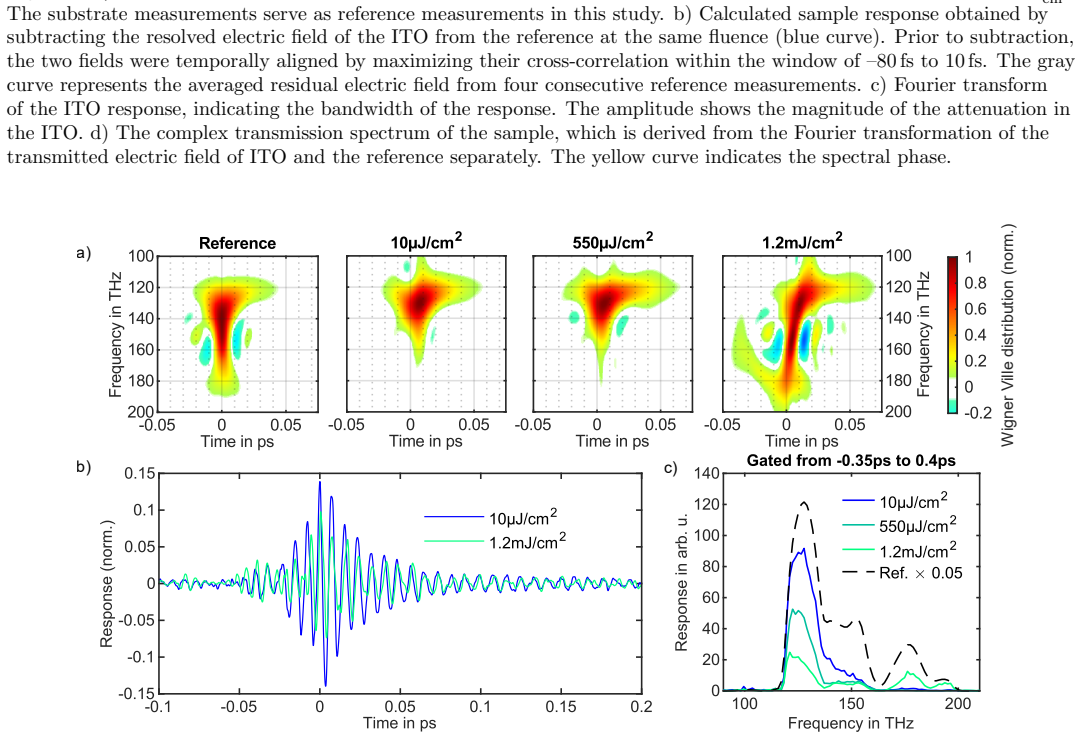
The central object is fieldoscopy, an electric-field sampling measurement in which a short probe pulse upconverts the transmitted excitation field in a thin nonlinear crystal, and a balanced detector reads the cross-polarised sum-frequency signal while the probe delay is scanned, giving about 90 attoseconds of temporal resolution and 110 dB dynamic range. The sample response is defined as $E_{\mathrm{Response}}(t) = (E_R(t)-E_S(t))/\max(|E_R(t)|)$, the difference between the substrate and ITO transmitted fields after aligning their cross-correlation in a pre-pulse window; this subtraction is what turns the raw field traces into an effective interferometric measurement of ITO attenuation and dephasing. The ITO response itself is carried by the localized surface plasmon resonance of the nanocrystals, whose epsilon-near-zero band sits in the 120–150 THz range of the excitation spectrum.
What would settle it
Take a pristine area of the same ITO-coated substrate and expose it once to the 1.2 mJ/cm2 train, recording the full response field and the low-fluence OFF trace; then expose the same spot repeatedly. If the reversible switch is real, the first exposure should be reversible, and only repeated exposure beyond 3.3 mJ/cm2 should produce the permanent 20% change. If a single exposure at 1.2 mJ/cm2 already leaves a changed OFF response, the 10% reversible claim collapses. Independently, measuring the transmitted power with a thermal power meter while the beam is chopped at 1 MHz would confirm the 10% modulation depth without relying on field subtraction.
Extended reading notes
Core claim
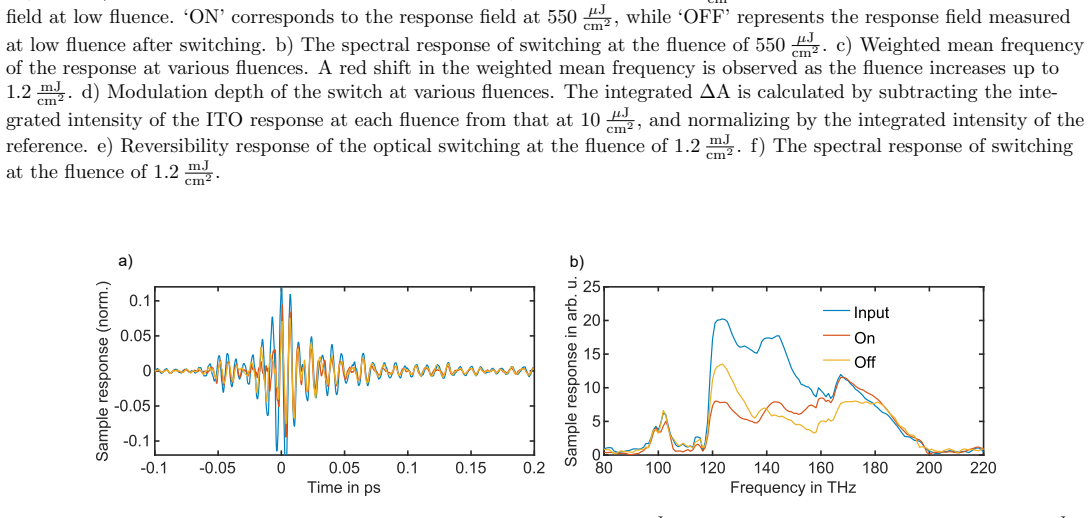
The central claim is that near its epsilon-near-zero wavelength, a dip-coated multilayer of 14-nm ITO nanocrystals on glass exhibits a nonlinear transmission response fast enough and strong enough for practical all-optical switching: at 1 MHz repetition, two-cycle 10.7-fs pulses spanning 1.5–2.5 µm bleach the localized surface plasmon resonance, increasing transmission by about 10% reversibly up to 1.2 mJ/cm2, and by up to about 20% irreversibly above 3.3 mJ/cm2. The field-resolved measurement shows the response rising during the first optical cycle and peaking in the second, with the first-cycle contribution diminishing at higher fluence; the resolved transient persists for about 400 fs. The paper argues this combination of high duty cycle, fast recovery, substantial modulation depth, and full reversibility in the lower fluence range is what an effective optical switch requires.
Load-bearing premise
The measurement assumes that the bare-substrate reference area is optically identical to the ITO-coated area apart from the nanocrystal film, so that subtracting the two field traces, after aligning them in a pre-pulse window, cancels all substrate, filter, dispersion, and water-vapour contributions.
Editorial extensions
If this is right
- Reversible 10% modulation at 1 MHz means the ITO nanocrystal film can be switched on and off hundreds of thousands of times per second without measurable degradation up to 1.2 mJ/cm2.
- Because the modulation spans 120–200 THz (2–2.5 µm), the same film could serve as a broadband modulator rather than a narrow-line filter.
- The roughly 400 fs transient response implies that after each switching event the film recovers before the next pulse arrives at 1 MHz, which is what keeps the duty cycle high.
- The measured damage boundary at 3.3 mJ/cm2, with peak intensity near 1.8 TW/cm2, sets an explicit operating limit for device design.
- Fieldoscopy resolves the sub-cycle sequence of bleaching: the first optical cycle contributes less at high fluence, showing that the nonlinearity is not a simple instantaneous Kerr effect.
Reading between the lines
- A testable extension would be to use the 25 fs earlier arrival of the substrate back-reflection under the ITO film as a direct readout of the fluence-dependent refractive index of the nanocrystal layer.
- The reduced first-cycle contribution at high fluence may be a fingerprint of cumulative carrier heating rather than purely instantaneous electronic nonlinearity; varying the carrier-envelope phase of the two-cycle pulse would test that separation.
- Fieldoscopy's ability to resolve sub-cycle responses in the short-wavelength infrared could be carried over to other epsilon-near-zero materials, such as cadmium-oxide nanocrystals, to map their reversible modulation range in a single measurement series.
Signed reviews
Editorial analysis
A structured set of objections, weighed in public.
Referee Report
Summary. The paper reports fieldoscopy measurements of the ultrafast nonlinear transmission response of colloidal ITO nanocrystals excited by two-cycle, CEP-stable pulses at 1 MHz repetition rate near their epsilon-near-zero wavelength. The central experimental claims are that the transmitted-field modulation is reversible up to a fluence of 1.2 mJ/cm2 with a modulation depth of 10%, becomes fully irreversible above 3.3 mJ/cm2, reaches modulation depths up to 20%, and that the sub-cycle field response shows a fluence-dependent reduction of the first-cycle contribution. The analysis is based on subtracting the field transmitted through a bare substrate region from that transmitted through an ITO-coated region, followed by Fourier analysis of the response and before/after comparison to assess reversibility.
Significance. If the central claims hold, the work would be a valuable demonstration of a scalable, high-repetition-rate ultrafast optical switch platform based on ITO nanocrystals and would extend field-resolved metrology to the near-infrared plasmonic response of a relevant material. The experiment is direct in design, and the modulation depth and spectral response are defined from measured field transients rather than from a fitted model, which is a structural strength. The paper also includes a useful reversibility protocol and identifies a clear fluence boundary between reversible and irreversible operation. However, the quantitative thresholds and the reversibility boundary currently rest on a reference-subtraction procedure that has not been validated as robust against substrate inhomogeneity, alignment bias, or temporal-window choice, and the reported modulation depths and weighted-mean-frequency shifts lack uncertainty quantification.
major comments (4)
- [Section 2, Fig. 2b] The central observable, EResponse(t) = (ER(t) - ES(t))/max(|ER(t)|), is obtained from two spatially separated regions of the sample that are translated into the focus with a manual three-way stage (Methods, Section 4). The claim of 10% reversible modulation up to 1.2 mJ/cm2 and full irreversibility beyond 3.3 mJ/cm2 therefore assumes that the bare-substrate reference and the ITO-coated region are optically identical except for the ITO film. This is not demonstrated. The manuscript reports no null experiment in which two bare-substrate positions are processed through the same subtraction and alignment pipeline, and it does not quantify the effect of the 25 fs shift of the back-surface reflection (SI Fig. 8) on the main-pulse window. Without such a control or an error budget, the subtraction could generate or bias the apparent response. I request a null test on two substrate positions and an uncertainty estimate for the 10% and 20% modulation-depth values.
- [Section 2 vs. Fig. 2 caption] The temporal alignment of ES(t) and ER(t) is described inconsistently: the main text states that cross-correlation is maximized in the window from -60 fs to -10 fs, while the Fig. 2 caption states -80 fs to 10 fs. A window that is mostly pre-pulse noise, or one that includes the main-pulse edge, can bias the difference field and therefore the amplitude and spectrum of the response. The authors should specify the exact alignment procedure, justify the chosen window, and show the sensitivity of the extracted modulation depth and spectral phase to the window boundaries.
- [Section 2, Fig. 4d and Fig. 4a-4b] The reversibility criterion is qualitative. The text describes the behavior at 550 uJ/cm2 as 'qualitatively unchanged' and at 1.2 mJ/cm2 as showing a 'slight alteration of the spectral distribution', but no quantitative metric is defined for reversibility, no error bars are given for the modulation-depth curve in Fig. 4d, and no repeated measurements are reported to establish that the before/after traces are statistically indistinguishable. Since the reversible/irreversible boundary at 1.2-3.3 mJ/cm2 is one of the main claims, the authors should define a quantitative reversibility criterion, such as a threshold on the normalized difference between the 'OFF' and initial low-fluence responses, and report its fluence dependence with uncertainties.
- [Section 2, Fig. 4c and SI Fig. 9a] The claim of a fluence-dependent redshift of the weighted mean frequency is load-bearing for the interpretation of bleaching and the transition to irreversibility, but the paper provides no error bars on the weighted-mean-frequency estimates and no statistical test comparing different fluences. Similarly, the statement that the relative contribution of the first optical cycle weakens with increasing fluence (conclusion and SI Fig. 11) is presented without a quantitative estimator or uncertainty. Please provide a defined metric for the first-cycle contribution and its fluence dependence, along with measurement repeatability.
minor comments (4)
- [Throughout] There are typographical errors, including 'nanocrytals' in Section 2 and 'powerermeter' in the SI caption of Fig. 9, which should be corrected.
- [Affiliations] The affiliation 'Funtional Nanosystems, Istituto Italiano di Tecnologia' contains a typo ('Funtional' should be 'Functional'); please correct it.
- [Section 2, Fig. 2d] The definition of the spectral response, DeltaI(omega)/IR(omega) = (IR - IS)/IR, is presented in the text but the symbols DeltaI and IR are not explicitly defined in the figure or its caption; a short definition in the caption would improve readability.
- [Section 4, Methods] The description of the reference area says the film on one side of the cover glass was removed, while later the sample is described as having a section of exposed substrate that was not dipped. These two statements should be reconciled so the reader understands whether the reference is an uncoated region of the same substrate or a region where the coating was removed.
Circularity Check
No significant circularity: the modulation-depth and reversibility claims are defined directly from measured field differences, with no fitted parameter or self-citation chain supplying the result.
full rationale
The paper's central claims (reversible 10% modulation up to 1.2 mJ/cm2, irreversibility beyond 3.3 mJ/cm2) are obtained by arithmetic on measured electric fields: EResponse(t) = (ER(t)-ES(t))/max|ER(t)|, and the modulation depth is the integrated intensity difference normalized by the reference. No parameter is fitted to data and then renamed a prediction; the thresholds are read off the same defined quantity. The only salient self-citations are to the authors' earlier fieldoscopy papers [32,53] for the detector's sensitivity and jitter, but the method is also described in the Methods section and the measured transients are presented directly; the central result does not reduce to that citation. The paper does contain an acknowledged reference-area mismatch (25 fs shift of the back-surface reflection between ITO and bare substrate, SI Fig. 8) and an inconsistency in the stated cross-correlation alignment window (-60 to -10 fs in main text vs -80 to 10 fs in the Fig. 2 caption). These are correctness or control-experiment concerns about the substrate subtraction, not circularity: the difference-field definition does not presuppose the magnitude or reversibility of the ITO response. Hence no circular step can be exhibited.
Assumptions & free parameters
assumptions (3)
- domain assumption ITO nanocrystal LSPR near 2 um is responsible for the measured attenuation in the response spectra.
- domain assumption Subtracting electric fields from ITO-coated and uncoated substrate after temporal alignment cancels all linear substrate and filter contributions.
- domain assumption Fieldoscopy yields a faithful, linear representation of the transmitted electric field with 90 as timing jitter.
Cite this review
Pith. "Pith review of Ultrafast nonlinear dynamics of indium tin oxide nanocrystals probed via fieldoscopy." pith.science (2026). https://pith.science/paper/2HCSZF3M
@misc{pith2026250821518,
  author       = {Pith},
  title        = {Pith review of: Ultrafast nonlinear dynamics of indium tin oxide nanocrystals probed via fieldoscopy},
  year         = {2026},
  howpublished = {\url{https://pith.science/paper/2HCSZF3M}},
  note         = {Machine review of arXiv:2508.21518}
}
read the original abstract
Scalable, high-speed, small-footprint photonic switching platforms are essential for advancing optical communication. An effective optical switch must operate at high duty cycles with fast recovery times, while maintaining substantial modulation depth and full reversibility. Colloidal nanocrystals, such as indium tin oxide (ITO), offer a scalable platform to meet these requirements. In this work, the transmission of ITO nanocrystals near their epsilon-near-zero wavelength is modulated by two-cycle optical pulses at a repetition rate of one megahertz. The modulator exhibits a broad bandwidth spanning from 2 um to 2.5 um. Sensitive fieldoscopy measurements resolve the transient electric-field response of the ITO for the first time, showing that the modulation remains reversible for excitation fluences up to 1.2 mJ/cm2 with a modulation depth of 10%, and becomes fully irreversible beyond 3.3 mJ/cm2, while reaching modulation depth of up to 20%. Field sampling further indicates that at higher excitation fluences, the relative contribution from the first cycle of the optical pulses is reduced. These findings are crucial for the development of all-optical switching, telecommunications, and sensing technologies capable of operating at terahertz switching frequencies.
Figures


Figures from the paper (8 more)



Reference graph
Works this paper leans on
- [1]
-
[2]
M. Sennary, J. Shah, M. Yuan, A. Mahjoub, V. Pervak, N. V. Golubev, M. T. Hassan, Nature Communications 2025, 16, 1 4335
work page 2025
-
[3]
L. A. Sweatlock, K. Diest, Optics Express 2012, 20, 8 8700
work page 2012
-
[4]
P. Guo, R. D. Schaller, J. B. Ketterson, R. P. Chang, Nature Photonics 2016, 10, 4 267
work page 2016
- [5]
-
[6]
D. Hui, H. Alqattan, S. Zhang, V. Pervak, E. Chowdhury, M. T. Hassan, Science Advances 2023, 9, 8 eadf1015
work page 2023
-
[7]
D. Hui, H. Alqattan, S. Yamada, V. Pervak, K. Yabana, M. T. Hassan, Nature Photonics 2022, 16, 1 33
work page 2022
-
[8]
M. Z. Alam, I. De Leon, R. W. Boyd, Science 2016, 352, 6287 795
work page 2016
Show all 75 references
-
[9]
D. K. Kim, Y. Lai, B. T. Diroll, C. B. Murray, C. R. Kagan, Nature communications 2012, 3, 1 1216
2012
-
[10]
M. Abb, Y. Wang, C. De Groot, O. L. Muskens, Nature communications 2014, 5, 1 4869
2014
-
[11]
G. Ni, L. Wang, M. Goldflam, M. Wagner, Z. Fei, A. McLeod, M. Liu, F. Keilmann, B. \"O zyilmaz, A. Castro Neto, et al., Nature Photonics 2016, 10, 4 244
2016
-
[12]
J.-H. Choi, H. Wang, S. J. Oh, T. Paik, P. Sung, J. Sung, X. Ye, T. Zhao, B. T. Diroll, C. B. Murray, et al., Science 2016, 352, 6282 205
2016
-
[13]
Kim, K.-S
T.-H. Kim, K.-S. Cho, E. K. Lee, S. J. Lee, J. Chae, J. W. Kim, D. H. Kim, J.-Y. Kwon, G. Amaratunga, S. Y. Lee, et al., Nature photonics 2011, 5, 3 176
2011
-
[14]
A. T. Fafarman, S.-H. Hong, H. Caglayan, X. Ye, B. T. Diroll, T. Paik, N. Engheta, C. B. Murray, C. R. Kagan, Nano Letters 2013, 13, 2 350
2013
-
[15]
Kriegel, F
I. Kriegel, F. Scotognella, L. Manna, Physics Reports 2017, 674 1
2017
-
[16]
N. J. Halas, S. Lal, W.-S. Chang, S. Link, P. Nordlander, Chemical Reviews 2011, 111, 6 3913
2011
-
[17]
Garcia, R
G. Garcia, R. Buonsanti, E. L. Runnerstrom, R. J. Mendelsberg, A. Llordes, A. Anders, T. J. Richardson, D. J. Milliron, Nano Letters 2011, 11, 10 4415
2011
-
[18]
Scotognella, G
F. Scotognella, G. Della Valle, A. R. Srimath Kandada, M. Zavelani-Rossi, S. Longhi, G. Lanzani, F. Tassone, The European Physical Journal B 2013, 86, 4 154
2013
-
[19]
J. M. Luther, P. K. Jain, T. Ewers, A. P. Alivisatos, Nature Materials 2011, 10, 5 361
2011
-
[20]
J. Wu, Z. T. Xie, Y. Sha, H. Y. Fu, Q. Li, Photon. Res. 2021, 9, 8 1616, publisher: Optica Publishing Group
2021
-
[21]
Issah, J
I. Issah, J. Pietila, T. Kujala, M. Koivurova, H. Caglayan, M. Ornigotti, Physical Review A 2023, 107, 2 023501
2023
-
[22]
K. Kim, Z. M. Sherman, A. Cleri, W. J. Chang, J.-P. Maria, T. M. Truskett, D. J. Milliron, Nano Letters 2023, 23, 16 7633
2023
-
[23]
J. Bohn, T. S. Luk, C. Tollerton, S. W. Hutchings, I. Brener, S. Horsley, W. L. Barnes, E. Hendry, Nature communications 2021, 12, 1 1017
2021
-
[24]
Rebecchi, I
L. Rebecchi, I. Martin, I. M. Albo, P. Ranjan, T. Gatti, F. Scotognella, A. Rubino, I. Kriegel, Chemistry – A European Journal 2025, 31, 8 e202401711
2025
-
[25]
Q. Guo, Y. Cui, Y. Yao, Y. Ye, Y. Yang, X. Liu, S. Zhang, X. Liu, J. Qiu, H. Hosono, Advanced Materials 2017, 29, 27 1700754
2017
-
[26]
M. A. Blemker, S. L. Gibbs, E. K. Raulerson, D. J. Milliron, S. T. Roberts, ACS Photonics 2020, 7, 5 1188
2020
-
[27]
D. B. Tice, S.-Q. Li, M. Tagliazucchi, D. B. Buchholz, E. A. Weiss, R. P. H. Chang, Nano Lett. 2014
2014
-
[28]
B. T. Diroll, P. Guo, R. P. H. Chang, R. D. Schaller, ACS Nano 2016, 10, 11 10099
2016
-
[29]
M. P. Fischer, N. Maccaferri, K. Gallacher, J. Frigerio, G. Pellegrini, D. J. Paul, G. Isella, A. Leitenstorfer, P. Biagioni, D. Brida, Optica 2021, 8, 6 898
2021
-
[30]
Scheffter, J
K. Scheffter, J. Will, C. Riek, H. Jousselin, S. Coudreau, N. Forget, H. Fattahi, Ultrafast Science 2024, 4 0062
2024
-
[31]
Herbst, K
A. Herbst, K. Scheffter, M. M. Bidhendi, M. Kieker, A. Srivastava, H. Fattahi, J. Phys. B: At. Mol. Opt. Phys. 2022
2022
-
[32]
Srivastava, A
A. Srivastava, A. Herbst, M. M. Bidhendi, M. Kieker, F. Tani, H. Fattahi, Nature Photonics 2024, 18, 12 1320
2024
-
[33]
W. Cho, S. I. Hwang, C. H. Nam, M. R. Bionta, P. Lassonde, B. E. Schmidt, H. Ibrahim, F. L \'e gar \'e , K. T. Kim, Scientific Reports 2019, 9, 1 16067
2019
-
[34]
S. B. Park, K. Kim, W. Cho, S. I. Hwang, I. Ivanov, C. H. Nam, K. T. Kim, Optica 2018, 5, 4 402
2018
-
[35]
Sederberg, D
S. Sederberg, D. Zimin, S. Keiber, F. Siegrist, M. S. Wismer, V. S. Yakovlev, I. Floss, C. Lemell, J. Burgd \"o rfer, M. Schultze, F. Krausz, N. Karpowicz, Nature Communications 2020, 11, 1 430
2020
-
[36]
Zimin, M
D. Zimin, M. Weidman, J. Sch\" o tz, M. F. Kling, V. S. Yakovlev, F. Krausz, N. Karpowicz, Optica 2021, 8, 5 586
2021
-
[37]
Y. Liu, S. Gholam-Mirzaei, J. E. Beetar, J. Nesper, A. Yousif, M. Nrisimhamurty, M. Chini, Photon. Res. 2021, 9, 6 929
2021
-
[38]
Y. Liu, J. E. Beetar, J. Nesper, S. Gholam-Mirzaei, M. Chini, Nature Photonics 2021
2021
-
[39]
Beckh, P
C. Beckh, P. Sulzer, N. Fritzsche, C. Riek, A. Leitenstorfer, Journal of Infrared, Millimeter, and Terahertz Waves 2021, 42, 6 701
2021
-
[40]
Alismail, H
A. Alismail, H. Wang, G. Barbiero, N. Altwaijry, S. A. Hussain, V. Pervak, W. Schweinberger, A. M. Azzeer, F. Krausz, H. Fattahi, Science Advances 2020, 6, 7 eaax3408
2020
-
[41]
D. A. Zimin, V. S. Yakovlev, N. Karpowicz 2022, 8, 51 eade1029
2022
-
[42]
M. R. Bionta, F. Ritzkowsky, M. Turchetti, Y. Yang, D. Cattozzo Mor, W. P. Putnam, F. X. K \"a rtner, K. K. Berggren, P. D. Keathley, Nature Photonics 2021, 15, 6 456
2021
-
[43]
Korobenko, K
A. Korobenko, K. Johnston, M. Kubullek, L. Arissian, Z. Dube, T. Wang, M. K\" u bel, A. Y. Naumov, D. M. Villeneuve, M. F. Kling, P. B. Corkum, A. Staudte, B. Bergues, Optica 2020, 7, 10 1372
2020
-
[44]
A. S. Kowligy, H. Timmers, A. J. Lind, U. Elu, F. C. Cruz, P. G. Schunemann, J. Biegert, S. A. Diddams, Science Advances 2019, 5, 6 eaaw8794
2019
-
[45]
C. Riek, P. Sulzer, M. Seeger, A. S. Moskalenko, G. Burkard, D. V. Seletskiy, A. Leitenstorfer, Nature 2017, 541, 7637 376
2017
-
[46]
Saito, N
N. Saito, N. Ishii, T. Kanai, J. Itatani, Opt. Express 2018, 26, 19 24591
2018
-
[47]
Keiber, S
S. Keiber, S. Sederberg, A. Schwarz, M. Trubetskov, V. Pervak, F. Krausz, N. Karpowicz, Nature Photonics 2016, 10, 3 159, publisher: Nature Publishing Group
2016
-
[48]
Y. Liu, S. Gholam-Mirzaei, D. Khatri, T.-C. Truong, T. D. Journigan, C. Cabello, C. Lantigua, A. Staudte, P. B. Corkum, M. Chini, Optica 2024, 11, 6 846
2024
-
[49]
Kubullek, M
M. Kubullek, M. A. Silva-Toledo, R. E. Mainz, F. Scheiba, R. de Q. Garcia, F. Ritzkowsky, G. M. Rossi, F. X. Kärtner, Ultrafast Science 2025, 5 0081
2025
-
[50]
K.-F. Wong, W. Li, Z. Wang, V. Wanie, E. Månsson, D. Hoeing, J. Blöchl, T. Nubbemeyer, A. Azzeer, A. Trabattoni, H. Lange, F. Calegari, M. F. Kling, Nano Letters 2024, 24, 18 5506
2024
-
[51]
o hme, G. Rain \`o , M. V. Kovalenko, H. J. W \
D. A. Zimin, I. Cherniukh, S. C. B \"o hme, G. Rain \`o , M. V. Kovalenko, H. J. W \"o rner, arXiv preprint arXiv:2312.11727 2023
2023 arXiv
-
[52]
Mamaikin, Y.-L
M. Mamaikin, Y.-L. Li, E. Ridente, W. T. Chen, J.-S. Park, A. Y. Zhu, F. Capasso, M. Weidman, M. Schultze, F. Krausz, et al., Optica 2022, 9, 6 616
2022
-
[53]
Srivastava, K
A. Srivastava, K. Scheffter, S. Jun, A. Herbst, H. Fattahi, Applied Physics Letters 2024, 125, 20 204101
2024
-
[54]
G. V. Hartland, Chemical reviews 2011, 111, 6 3858
2011
-
[55]
J.-H. Yoo, A. Lange, J. Bude, S. Elhadj, Optical Materials Express 2017, 7, 3 817
2017
-
[56]
L. Peng, Y. Zhao, X. Liu, Y. Liu, Z. Cao, M. Zhu, J. Shao, R. Hong, C. Tao, D. Zhang, Optical Materials Express 2019, 9, 2 911
2019
-
[57]
Huang, D
J. Huang, D. Liu, L. Chen, N. Li, L. Miao, C. Zhao, Optics Letters 2022, 47, 24 6413
2022
-
[58]
Fattahi, H
H. Fattahi, H. G. Barros, M. Gorjan, T. Nubbemeyer, B. Alsaif, C. Y. Teisset, M. Schultze, S. Prinz, M. Haefner, M. Ueffing, et al., Optica 2014, 1, 1 45
2014
-
[59]
Alismail, H
A. Alismail, H. Wang, G. Barbiero, N. Altwaijry, S. A. Hussain, V. Pervak, W. Schweinberger, A. M. Azzeer, F. Krausz, H. Fattahi, Science advances 2020, 6, 7 eaax3408
2020
-
[60]
Alismail, H
A. Alismail, H. Wang, N. Altwaijry, H. Fattahi, Applied Optics 2017, 56, 17 4990
2017
-
[61]
H. Wang, A. Alismail, G. Barbiero, M. Wendl, H. Fattahi, Optics letters 2017, 42, 13 2595
2017
-
[62]
Buberl, A
T. Buberl, A. Alismail, H. Wang, N. Karpowicz, H. Fattahi, Optics express 2016, 24, 10 10286
2016
-
[63]
A. Li, M. Bahri, R. M. Gray, S. Choi, S. Hoseinkhani, A. Srivastava, A. Marandi, H. Fattahi, APL Photonics 2024, 9, 10
2024
-
[64]
C. J. Saraceno, D. Sutter, T. Metzger, M. A. Ahmed, Journal of the European Optical Society-Rapid Publications 2019, 15, 1 15
2019
-
[65]
Rebecchi, N
L. Rebecchi, N. Petrini, I. Maqueira Albo, N. Curreli, A. Rubino, Optical Materials: X 2023, 19 100247
2023
-
[66]
Guizzardi, M
M. Guizzardi, M. Ghini, A. Villa, L. Rebecchi, Q. Li, G. Mancini, F. Marangi, A. M. Ross, X. Zhu, I. Kriegel, F. Scotognella, The Journal of Physical Chemistry Letters 2022, 13, 42 9903
2022
-
[67]
Noginov, L
M. Noginov, L. Gu, J. Livenere, G. Zhu, A. Pradhan, R. Mundle, M. Bahoura, Y. A. Barnakov, V. Podolskiy, Applied Physics Letters 2011, 99, 2
2011
-
[68]
C. Wu, B. Neuner III, J. John, A. Milder, B. Zollars, S. Savoy, G. Shvets, Journal of Optics 2012, 14, 2 024005
2012
-
[69]
C. Wu, A. B. Khanikaev, R. Adato, N. Arju, A. A. Yanik, H. Altug, G. Shvets, Nature materials 2012, 11, 1 69
2012
-
[70]
Tittl, A.-K
A. Tittl, A.-K. U. Michel, M. Sch \"a ferling, X. Yin, B. Gholipour, L. Cui, M. Wuttig, T. Taubner, F. Neubrech, H. Giessen, Advanced Materials 2015, 27, 31 4597
2015
-
[71]
Kohoutek, A
J. Kohoutek, A. Bonakdar, R. Gelfand, D. Dey, I. Hassani Nia, V. Fathipour, O. G. Memis, H. Mohseni, Nano letters 2012, 12, 5 2537
2012
-
[72]
Amotchkina, H
T. Amotchkina, H. Fattahi, Y. A. Pervak, M. Trubetskov, V. Pervak, Optics express 2016, 24, 15 16752
2016
-
[73]
Rebecchi, I
L. Rebecchi, I. Martin, I. M. Albo, P. Ranjan, T. Gatti, F. Scotognella, A. Rubino, I. Kriegel, Chemistry--A European Journal 2025, 31, 8 e202401711
2025
-
[74]
, " * write output.state after.block =
ENTRY address author booktitle chapter edition editor eid howpublished institution isbn issn journal key month note number organization pages publisher school series title type url volume year label INTEGERS output.state before.all mid.sentence after.sentence after.block FUNCT...
-
[75]
write newline
" write newline "" before.all 'output.state := FUNCTION n.dashify 't := "" t empty not t #1 #1 substring "-" = t #1 #2 substring "--" = not "--" * t #2 global.max substring 't := t #1 #1 substring "-" = "-" * t #2 global.max substring 't := while if t #1 #1 substring * t #2 gl...
Reviewed August 15, 2026 · model on record in the stance chip above.
Discussion (0). Continue with ORCID to comment.