REVIEW 3 minor 300 references
Testing for Single-Population Ancestry in the Admixture Model
T0 review · 0 major / 3 minor · reviewed 2026-06-28 · grok-4.3
Pith's one-line read A bootstrap-calibrated test decides if genetic markers support single-ancestry dominance above a chosen threshold.
desk verdict This paper gives a constrained parametric bootstrap test for dominant single ancestry under the supervised admixture model, with proofs of asymptotic level and consistency plus simulations. read the letter →
The pith
A machine-rendered reading of the paper's core claim, the machinery that carries it, and where it could break.
The reading
What carries the argument
Constrained parametric bootstrap that draws replicates under the null-constrained maximum-likelihood estimator to obtain critical values for the single-ancestry test statistic.
What would settle it
Empirical type-I error rate under the boundary null (maximum admixture proportion exactly equal to the threshold) that exceeds the nominal alpha by more than sampling error in repeated simulations with the same marker panel and sample size.
Extended reading notes
Core claim
The central claim is that a test for the hypothesis that the largest admixture component is at least a fixed threshold tau can be calibrated by a constrained parametric bootstrap and, under standard regularity conditions, achieves asymptotic level alpha while remaining consistent for detecting departures from single-population dominance.
Load-bearing premise
Ancestral allele frequencies are treated as known fixed constants.
Editorial extensions
If this is right
- False declarations of single ancestry are controlled at the nominal level even with finite markers and individuals.
- Power increases as the largest ancestry proportion moves farther below the threshold.
- The same bootstrap machinery applies across different numbers of ancestral populations and allele-frequency distributions.
- The method extends bootstrap calibration to independent but non-identically distributed genetic marker data.
Reading between the lines
- The procedure could be embedded directly into existing ancestry-assignment pipelines to replace post-hoc thresholds.
- If ancestral frequencies must be estimated from the same sample, a two-stage bootstrap would be needed to preserve the level guarantee.
- The framework may transfer to other constrained mixture models where component weights are tested against a dominance bound.
Signed reviews
Editorial analysis
A structured set of objections, weighed in public.
Referee Report
Summary. The manuscript proposes a hypothesis test for single-population ancestry under the supervised admixture model (known ancestral allele frequencies). The null hypothesis is that the largest admixture proportion meets or exceeds a user-specified dominance threshold. The test is calibrated by a constrained parametric bootstrap that uses the null-constrained MLE and respects marker-wise heterogeneity. The authors prove that the resulting test has asymptotic level α and is consistent under standard regularity conditions for independent but non-identically distributed markers; they support the claims with simulation studies across varying K, marker-panel sizes, thresholds, and allele-frequency distributions, and illustrate the procedure on 1000 Genomes data.
Significance. If the asymptotic results hold, the paper supplies a statistically rigorous, threshold-based procedure for ancestry assessment that controls false single-ancestry declarations while retaining power to detect dominant components. The explicit extension of constrained bootstrap methodology to the non-i.i.d. genetic-marker setting, together with the provision of both theoretical guarantees and simulation validation, constitutes a useful methodological contribution to population and forensic genetics.
minor comments (3)
- [§2] The abstract and introduction state that ancestral allele frequencies are treated as known, but the manuscript should add a brief discussion (perhaps in §2) of how sensitive the test is to small perturbations in these frequencies when they are in fact estimated from reference panels.
- [Simulation studies] Simulation results are described as showing 'good finite-sample performance,' but a summary table reporting empirical rejection rates under the null for each combination of K, L, and δ would make the finite-sample level control easier to assess at a glance.
- [Methods] Notation for the constrained MLE and the bootstrap distribution is introduced without an explicit equation number in the methods section; adding an equation label would improve traceability when the asymptotic arguments are referenced later.
Simulated Author's Rebuttal
We thank the referee for their accurate summary of the manuscript and for the positive evaluation of its contribution. The recommendation of minor revision is noted. No specific major comments were provided in the report.
Circularity Check
No significant circularity
full rationale
The paper develops a constrained parametric bootstrap for testing single-ancestry dominance in the supervised admixture model (known ancestral frequencies). The central result establishes asymptotic level α and consistency under standard regularity conditions for the independent but non-identically distributed marker setting; the bootstrap is constructed explicitly from the null-constrained MLE to account for the hypothesis constraint and heterogeneity. No derivation step reduces by construction to a fitted quantity, no load-bearing uniqueness theorem is imported via self-citation, and the procedure is externally falsifiable via the stated regularity conditions and simulation benchmarks. The derivation chain is therefore self-contained.
Assumptions & free parameters
assumptions (1)
- domain assumption standard regularity conditions for asymptotic level and consistency of the constrained parametric bootstrap
Cite this review
Pith. "Pith review of Testing for Single-Population Ancestry in the Admixture Model." pith.science (2026). https://pith.science/paper/2HOMWQPW
@misc{pith2026260601990,
  author       = {Pith},
  title        = {Pith review of: Testing for Single-Population Ancestry in the Admixture Model},
  year         = {2026},
  howpublished = {\url{https://pith.science/paper/2HOMWQPW}},
  note         = {Machine review of arXiv:2606.01990}
}
abstract
The Admixture Model describes genetic marker data by representing each individual's genome as a mixture of contributions from $K$ ancestral populations, with the individual admixture vector summarizing the corresponding ancestry proportions. In population and forensic genetics, a key question is whether an individual's genome supports a predominantly single-ancestry interpretation or whether an admixed interpretation is more appropriate. We propose a statistical test for single-population ancestry in the supervised Admixture Model, where ancestral allele frequencies are treated as known. The test assesses whether the largest admixture component exceeds a practitioner-chosen dominance threshold, giving precise meaning to the notion of a sufficiently strong single-population contribution. To calibrate the test, we develop a constrained parametric bootstrap procedure that generates data under a null-constrained maximum likelihood estimator, accounting for the constrained hypothesis structure, the marker-wise heterogeneity and small sample sizes. Under standard regularity conditions, we prove that the proposed test has asymptotic level $\alpha$ and is consistent, ensuring control of false single-ancestry declarations while reliably detecting dominant ancestry components. Simulation studies demonstrate good finite-sample performance across different numbers of ancestral populations, marker-panel sizes, dominance thresholds, and allele-frequency distributions. We further illustrate the practical utility of the method using data from the 1000 Genomes Project. The proposed framework delivers interpretable, threshold-based ancestry assessment with rigorous error control, and extends constrained bootstrap methodology to the independent but non-identically distributed setting of genetic marker data.
Figures


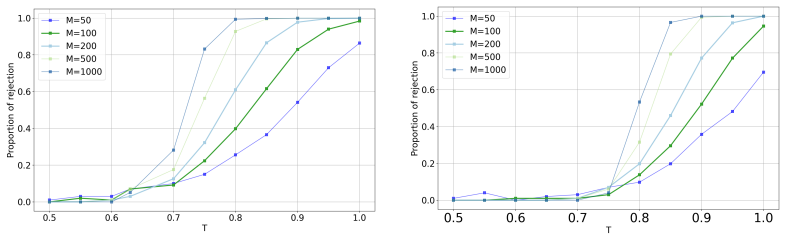
Figures from the paper (2 more)


Reference graph
Works this paper leans on
-
[1]
PM&R , volume=
The problem of multiple testing , author=. PM&R , volume=
-
[2]
bioRxiv , pages=
Enhancing Intra-Continental Biogeographical Ancestry Prediction Through a Machine Learning Marker Selection Method , author=. bioRxiv , pages=. 2025 , publisher=
2025
-
[3]
Advances in genetics , volume=
Methods for handling multiple testing , author=. Advances in genetics , volume=. 2008 , publisher=
2008
-
[4]
American journal of epidemiology , volume=
Some desirable properties of the Bonferroni correction: is the Bonferroni correction really so bad? , author=. American journal of epidemiology , volume=. 2019 , publisher=
2019
-
[5]
Pfaffelhuber and A
P. Pfaffelhuber and A. Rohde. A central limit theorem concerning uncertainty in estimates of individual admixture
-
[6]
Proceedings of the COLING/ACL 2006 Main Conference Poster Sessions , pages=
BiTAM: Bilingual topic admixture models for word alignment , author=. Proceedings of the COLING/ACL 2006 Main Conference Poster Sessions , pages=
2006
-
[7]
Proceedings of the 22nd acm sigkdd international conference on knowledge discovery and data mining , pages=
Xgboost: A scalable tree boosting system , author=. Proceedings of the 22nd acm sigkdd international conference on knowledge discovery and data mining , pages=
-
[8]
Forensic Science International: Genetics , volume=
Machine learning applications in forensic DNA profiling: A critical review , author=. Forensic Science International: Genetics , volume=. 2024 , publisher=
2024
Show all 300 references
-
[9]
Nature genetics , volume=
Genomic history of the Sardinian population , author=. Nature genetics , volume=. 2018 , publisher=
2018
-
[10]
Current Biology , volume=
Genetic origins, singularity, and heterogeneity of Basques , author=. Current Biology , volume=. 2021 , publisher=
2021
-
[11]
Genes & genomics , volume=
Forensic biogeographical ancestry inference: recent insights and current trends , author=. Genes & genomics , volume=. 2023 , publisher=
2023
-
[12]
Scientific reports , volume=
LEI: a novel allele frequency-based feature selection method for multi-ancestry admixed populations , author=. Scientific reports , volume=. 2019 , publisher=
2019
-
[13]
Nature , volume=
Genomic analyses inform on migration events during the peopling of Eurasia , author=. Nature , volume=. 2016 , publisher=
2016
-
[14]
arXiv preprint arXiv:2402.11137 , year=
TuneTables: Context Optimization for Scalable Prior-Data Fitted Networks , author=. arXiv preprint arXiv:2402.11137 , year=
-
[15]
arXiv preprint arXiv:2402.06971 , year=
In-Context Data Distillation with TabPFN , author=. arXiv preprint arXiv:2402.06971 , year=
-
[16]
NeurIPS 2024 Third Table Representation Learning Workshop , year=
TabFlex: Scaling Tabular Learning to Millions with Linear Attention , author=. NeurIPS 2024 Third Table Representation Learning Workshop , year=
2024
-
[17]
arXiv preprint arXiv:2410.18164 , year=
TabDPT: Scaling Tabular Foundation Models , author=. arXiv preprint arXiv:2410.18164 , year=
-
[18]
Nature , volume=
Accurate predictions on small data with a tabular foundation model , author=. Nature , volume=. 2025 , publisher=
2025
-
[19]
Abdelfattah and A
M. Abdelfattah and A. Mehrotra and L. Dudziak and N. Lane , crossref =. Zero-Cost Proxies for Lightweight
-
[20]
A. Abram. On the Extension of Learning for
-
[21]
Forensic Science International: Genetics , volume=
Development and evaluations of the ancestry informative markers of the VISAGE Enhanced Tool for Appearance and Ancestry , author=. Forensic Science International: Genetics , volume=. 2023 , publisher=
2023
-
[22]
Abudayyeh and J
O. Abudayyeh and J. Gootenberg and S. Konermann and J. Joung and I. Slaymaker and D. Cox and S. Shmakov and K. Makarova and E. Semenova and L. Minakhin and others , year = 2016, journal =
2016
-
[23]
Operations Research , volume = 54, number = 1, pages =
Fine-tuning of Algorithms Using Fractional Experimental Design and Local Search , author =. Operations Research , volume = 54, number = 1, pages =
-
[24]
Automated Dynamic Algorithm Configuration , author =
-
[25]
, author =
Towards a White Box Approach to Automated Algorithm Design. , author =
-
[26]
Journal of Artificial Intelligence Research (JAIR) , volume = 75, pages =
Automated Dynamic Algorithm Configuration , author =. Journal of Artificial Intelligence Research (JAIR) , volume = 75, pages =
-
[27]
On the Semi-automated Design of Reusable Heuristics , author =
-
[28]
2020 , journal=
Debiasing classifiers: is reality at variance with expectation? , author=. 2020 , journal=
2020
-
[29]
and Dao, D
Aguilar Melgar, L. and Dao, D. and Gan, S. and Gürel, N. and Hollenstein, N. and Jiang, J. and Karlaš, B. and Lemmin, T. and Li, T. and Li, Y. and Rao, S. and Rausch, J. and Renggli, C. and Rimanic, L. and Weber, M. and Zhang, S. and Zhao, Z. and Schawinski, K. and Wu, W. and ...
2021
-
[30]
Aha , pages =
D. Aha , pages =. Generalizing from
-
[31]
An Empirical Study of Optimization for Maximizing Diffusion in Networks , author =
-
[32]
harmless
M. Ahmed and B. Shahriari and M. Schmidt , crossref =. Do we need “harmless”
-
[33]
Akiba and S
T. Akiba and S. Sano and T. Yanase and T. Ohta and M. Koyama , pages =. Optuna: A Next-Generation
-
[34]
Akrour and D
R. Akrour and D. Sorokin and J. Peters and G. Neumann , pages =. Local
-
[35]
Alaa and M
A. Alaa and M. van der Schaar , pages =
-
[36]
Demystifying Black-box Models with Symbolic Metamodels , author =
-
[37]
A Systematic Literature Review of Adaptive Parameter Control Methods for Evolutionary Algorithms , author =
-
[38]
Noah Hollmann and Samuel M. Tab. NeurIPS 2022 First Table Representation Workshop , year=
2022
-
[39]
Machine learning , volume=
Random forests , author=. Machine learning , volume=. 2001 , publisher=
2001
-
[40]
Advances in neural information processing systems , volume=
Attention is all you need , author=. Advances in neural information processing systems , volume=
-
[41]
Advances in Neural Information Processing Systems , volume=
When do neural nets outperform boosted trees on tabular data? , author=. Advances in Neural Information Processing Systems , volume=
-
[42]
Advances in neural information processing systems , volume=
Lightgbm: A highly efficient gradient boosting decision tree , author=. Advances in neural information processing systems , volume=
-
[43]
Advances in neural information processing systems , volume=
CatBoost: unbiased boosting with categorical features , author=. Advances in neural information processing systems , volume=
-
[44]
International Journal of Molecular Sciences , volume=
A machine-learning-based Approach to Prediction of Biogeographic Ancestry within Europe , author=. International Journal of Molecular Sciences , volume=. 2023 , publisher=
2023
-
[45]
Improved training of wasserstein gans , author =
-
[46]
Malkomes and R
G. Malkomes and R. Garnett , pages =. Automating
-
[47]
Mallik and C
N. Mallik and C. Hvarfner and E. Bergman and D. Stoll and M. Janowski and M. Lindauer and L. Nardi and F. Hutter , crossref =
-
[48]
Mehrotra and A
A. Mehrotra and A. Ramos and S. Bhattacharya and
-
[49]
Forensic Science International: Genetics Supplement Series , volume=
Applying machine learning algorithms to a real forensic case to predict Y-SNP haplogroup based on Y-STR haplotype , author=. Forensic Science International: Genetics Supplement Series , volume=. 2019 , publisher=
2019
-
[50]
A review of feature selection and its methods , author=. Cybern. Inf. Technol , volume=
-
[51]
Human genetics , volume=
Prediction of skin color, tanning and freckling from DNA in Polish population: linear regression, random forest and neural network approaches , author=. Human genetics , volume=. 2019 , publisher=
2019
-
[52]
Forensic Science International: Genetics , volume=
XGBoost as a reliable machine learning tool for predicting ancestry using autosomal STR profiles-Proof of method , author=. Forensic Science International: Genetics , volume=. 2025 , publisher=
2025
-
[53]
GluonTS: Probabilistic and Neural Time Series Modeling in Python , author =
-
[54]
ieee access , publisher =
Evolutionary deep learning-based energy consumption prediction for buildings , author =. ieee access , publisher =
-
[55]
A Generalizable Approach to Learning Optimizers , author =
-
[56]
On-Line Learning in Neural Networks , publisher =
Parameter Adaptation in Stochastic Optimization , author =. On-Line Learning in Neural Networks , publisher =
-
[57]
Introduction to machine learning , author =
-
[58]
Amadini and M
R. Amadini and M. Gabbrielli and J. Mauro , year = 2014, journal =
2014
-
[59]
Tuning of multiple parameter sets in evolutionary algorithms , author =
-
[60]
Andronescu and A
M. Andronescu and A. Fejes and F. Hutter and H. Hoos and A. Condon , year = 2004, journal =. A new algorithm for
2004
-
[61]
What Matters for On-Policy Deep Actor-Critic Methods? A Large-Scale Study , author =
-
[62]
Scientific Reports , volume=
Multivariate statistical approach and machine learning for the evaluation of biogeographical ancestry inference in the forensic field , author=. Scientific Reports , volume=. 2022 , publisher=
2022
-
[63]
Learning dexterous in-hand manipulation , author =
-
[64]
Learning to learn by gradient descent by gradient descent , author =
-
[65]
An evolutionary algorithm that constructs recurrent neural networks , author =
-
[66]
Neurocomputing , volume = 55, number =
Hyperparameter design criteria for support vector classifiers , author =. Neurocomputing , volume = 55, number =
-
[67]
OpenTuner: an extensible framework for program autotuning , author =
-
[68]
MaxSAT by Improved Instance-Specific Algorithm Configuration , author =
-
[69]
C. Ans. Reactive Dialectic Search Portfolios for
-
[70]
MaxSAT by improved instance-specific algorithm configuration , author =
-
[71]
Fields of logic and computation II: Essays dedicated To Yuri Gurevich on the Occasion of His 75th Birthday , pages=
The fundamental nature of the log loss function , author=. Fields of logic and computation II: Essays dedicated To Yuri Gurevich on the Occasion of His 75th Birthday , pages=. 2015 , publisher=
2015
-
[72]
A Gender-Based Genetic Algorithm for the Automatic Configuration of Algorithms , author =
-
[73]
Model-Based Genetic Algorithms for Algorithm Configuration , author =
-
[74]
A survey on modern trainable activation functions , author =
-
[75]
Objects that sound , author =
-
[76]
Learning Sequential and Parallel Runtime Distributions for Randomized Algorithms , author =
-
[77]
NADS: Neural architecture distribution search for uncertainty awareness , author =
-
[78]
A reductions approach to fair classification , author=
-
[79]
Deep reinforcement learning at the edge of the statistical precipice , author =
-
[80]
Arik and T
S. Arik and T. Pfister , year = 2019, journal =
2019
-
[81]
Assael and Z
J. Assael and Z. Wang and N. Freitas , year = 2014, journal =. Heteroscedastic Treed
2014
-
[82]
The theta model: a decomposition approach to forecasting , author =
-
[83]
Derivative-free and blackbox optimization , author =
-
[84]
SIAM Journal on Optimization , volume = 17, number = 3, pages =
Finding optimal algorithmic parameters using the mesh adaptive direct search algorithm , author =. SIAM Journal on Optimization , volume = 17, number = 3, pages =
-
[85]
Proceedings of IEEE 36th Annual Foundations of Computer Science , pages =
Gambling in a rigged casino: The adversarial multi-armed bandit problem , author =. Proceedings of IEEE 36th Annual Foundations of Computer Science , pages =
-
[86]
Auger and N
A. Auger and N. Hansen , pages =. A restart
-
[87]
Awad and G
N. Awad and G. Shala and D. Deng and N. Mallik and M. Feurer and K. Eggensperger and A. Biedenkapp and D. Vermetten and H. Wang and C. Doerr and M. Lindauer and F. Hutter , year = 2020, journal =. Squirrel: A Switching Hyperparameter Optimizer Description of the entry by
2020
-
[88]
Awad and N
N. Awad and N. Mallik and F. Hutter , crossref =. Differential Evolution for
-
[89]
Awad and N
N. Awad and N. Mallik and F. Hutter , pages =
-
[90]
Structural Abstraction of Software Verification Conditions , author =
-
[91]
Agent57: Outperforming the Atari Human Benchmark , author =
-
[92]
Baek and I
W. Baek and I. Kim and S. Kim and S. Lim , year = 2020, journal =. Auto
2020
-
[93]
The great time series classification bake off: a review and experimental evaluation of recent algorithmic advances , author =
-
[94]
Neural machine translation by jointly learning to align and translate , author =
-
[95]
An Empirical Evaluation of Generic Convolutional and Recurrent Networks for Sequence Modeling , author =
-
[96]
Designing Neural Network Architectures using Reinforcement Learning , author =
-
[97]
Accelerating neural architecture search using performance prediction , author =
-
[98]
Balandat and B
M. Balandat and B. Karrer and D. Jiang and S. Daulton and B. Letham and A. Wilson and E. Bakshy , crossref =. BoTorch: A Framework for Efficient Monte-Carlo
-
[99]
Improvement Strategies for the F-Race Algorithm: Sampling Design and Iterative Refinement , author =
-
[100]
Generalization in portfolio-based algorithm selection , author =
-
[101]
Bansal and D
A. Bansal and D. Stoll and M. Janowski and A. Zela and F. Hutter , crossref =
-
[102]
Bao and A
M. Bao and A. Zhou and S. Zottola and B. Brubach and S. Desmarais and A. Horowitz and K. Lum and S. Venkatasubramanian , crossref =. It's
-
[103]
Knowledge Representation, Reasoning and Declarative Problem Solving , author =
-
[104]
Forensic Science International: Genetics , volume=
Development and validation of the VISAGE AmpliSeq basic tool to predict appearance and ancestry from DNA , author=. Forensic Science International: Genetics , volume=. 2020 , publisher=
2020
-
[105]
1991 , publisher=
An introduction to probability theory and its applications, Volume 2 , author=. 1991 , publisher=
1991
-
[106]
, title =
Pedregosa et al. , title =. JMLR , year =
-
[107]
Deutsches
The use of forensic DNA phenotyping in predicting appearance and biogeographic ancestry , author=. Deutsches. 2019 , publisher=
2019
-
[108]
Genetic Epidemiology: The Official Publication of the International Genetic Epidemiology Society , volume=
Information on ancestry from genetic markers , author=. Genetic Epidemiology: The Official Publication of the International Genetic Epidemiology Society , volume=. 2004 , publisher=
2004
-
[109]
The redesigned Forensic Research/Reference on Genetics-knowledge base, FROG-kb , year =
Kidd, Kenneth K and Soundararajan, Usha and Rajeevan, Haseena and Pakstis, Andrew J and Moore, Katherine N and Ropero-Miller, Jeri D , journal =. The redesigned Forensic Research/Reference on Genetics-knowledge base, FROG-kb , year =
-
[110]
Forensic Science International: Genetics , title =
Bradbury, Cedric and K. Forensic Science International: Genetics , title =. 2019 , pages =
2019
-
[111]
Forensic Science International: Genetics , title =
Phillips, Chris and Salas, Antonio and Sanchez, JJ and Fondevila, Manuel and G. Forensic Science International: Genetics , title =. 2007 , number =
2007
-
[112]
How to choose sets of ancestry informative markers: A supervised feature selection approach , year =
Pfaffelhuber, Peter and Grundner-Culemann, Franziska and Lipphardt, Veronika and Baumdicker, Franz , journal =. How to choose sets of ancestry informative markers: A supervised feature selection approach , year =
-
[113]
Forensic genetic analysis of bio-geographical ancestry , year =
Phillips, Chris , journal =. Forensic genetic analysis of bio-geographical ancestry , year =
-
[114]
Estimation of individual admixture: analytical and study design considerations , year =
Tang, Hua and Peng, Jie and Wang, Pei and Risch, Neil J , journal =. Estimation of individual admixture: analytical and study design considerations , year =
-
[115]
Fast model-based estimation of ancestry in unrelated individuals , year =
Alexander, David H and Novembre, John and Lange, Kenneth , journal =. Fast model-based estimation of ancestry in unrelated individuals , year =
-
[116]
Forensic Science International: Genetics , title =
Eduardoff, M and Gross, TE and Santos, C and De La Puente, M and Ballard, D and Strobl, C and B. Forensic Science International: Genetics , title =. 2016 , pages =
2016
-
[117]
The computer program STRUCTURE does not reliably identify the main genetic clusters within species: simulations and implications for human population structure , year =
Kalinowski, Steven T , journal =. The computer program STRUCTURE does not reliably identify the main genetic clusters within species: simulations and implications for human population structure , year =
-
[118]
Weight of the evidence of genetic investigations of ancestry informative markers , year =
Tvedebrink, Torben and Eriksen, Poul Svante and Mogensen, Helle Smidt and Morling, Niels , journal =. Weight of the evidence of genetic investigations of ancestry informative markers , year =
-
[119]
A central limit theorem concerning uncertainty in estimates of individual admixture , year =
Pfaffelhuber, Peter and Rohde, Angelika , journal =. A central limit theorem concerning uncertainty in estimates of individual admixture , year =
-
[120]
Nature communications , title =
Elhaik, Eran and Tatarinova, Tatiana and Chebotarev, Dmitri and Piras, Ignazio S and Maria Cal. Nature communications , title =. 2014 , number =
2014
-
[121]
PLoS genetics , volume=
Clines, clusters, and the effect of study design on the inference of human population structure , author=. PLoS genetics , volume=. 2005 , publisher=
2005
-
[122]
PLoS genetics , title =
Friedlaender, Jonathan S and Friedlaender, Fran. PLoS genetics , title =. 2008 , number =
2008
-
[123]
A course in large sample theory , year =
Ferguson, Thomas S , publisher =. A course in large sample theory , year =
-
[124]
Asymptotic properties of maximum likelihood estimators for the independent not identically distributed case , year =
Hoadley, Bruce , journal =. Asymptotic properties of maximum likelihood estimators for the independent not identically distributed case , year =
-
[125]
Asymptotic normality of the maximum likelihood estimate in the independent not identically distributed case , year =
Philippou, Andreas N and Roussas, George G , journal =. Asymptotic normality of the maximum likelihood estimate in the independent not identically distributed case , year =
-
[126]
On the parametric maximum likelihood estimator for independent but non-identically distributed observations with application to truncated data , year =
Leroy, Fanny and Dauxois, Jean-Yves and Tubert-Bitter, Pascale , journal =. On the parametric maximum likelihood estimator for independent but non-identically distributed observations with application to truncated data , year =
-
[127]
Biogeographic ancestry, self-identified race, and admixture-phenotype associations in the Heart SCORE Study , year =
Halder, Indrani and Kip, Kevin E and Mulukutla, Suresh R and Aiyer, Aryan N and Marroquin, Oscar C and Huggins, Gordon S and Reis, Steven E , journal =. Biogeographic ancestry, self-identified race, and admixture-phenotype associations in the Heart SCORE Study , year =
-
[128]
Personal genomics: Where are we now? , year =
Angrist, Misha , journal =. Personal genomics: Where are we now? , year =
-
[129]
Design and analysis of admixture mapping studies , year =
Hoggart, Clive J and Shriver, Mark D and Kittles, Rick A and Clayton, David G and McKeigue, Paul M , journal =. Design and analysis of admixture mapping studies , year =
-
[130]
On the heterozygosity of an admixed population , year =
Boca, Simina M and Huang, Lucy and Rosenberg, Noah A , journal =. On the heterozygosity of an admixed population , year =
-
[131]
Inference of population structure using multilocus genotype data , year =
Pritchard, Jonathan K and Stephens, Matthew and Donnelly, Peter , journal =. Inference of population structure using multilocus genotype data , year =
-
[132]
Block Relaxation , url =
-
[133]
bioRxiv , title =
Mantes, Albert Dominguez and Montserrat, Daniel Mas and Bustamante, Carlos D and Gir. bioRxiv , title =. 2021 , pages =
2021
-
[134]
Gesetzliche Grundlage und Rechtsprechung zur DNA-Analyse , url =
-
[135]
Forensic inference of biogeographical ancestry from genotype: The Genetic Ancestry Lab , year =
McNevin, Dennis , journal =. Forensic inference of biogeographical ancestry from genotype: The Genetic Ancestry Lab , year =
-
[136]
What is next generation sequencing? , year =
Behjati, Sam and Tarpey, Patrick S , journal =. What is next generation sequencing? , year =
-
[137]
Inferring separate parental admixture components in unknown DNA samples using autosomal SNPs , year =
Crouch, Daniel JM and Weale, Michael E , journal =. Inferring separate parental admixture components in unknown DNA samples using autosomal SNPs , year =
-
[138]
Efficient analysis of large datasets and sex bias with ADMIXTURE , year =
Shringarpure, Suyash S and Bustamante, Carlos D and Lange, Kenneth and Alexander, David H , journal =. Efficient analysis of large datasets and sex bias with ADMIXTURE , year =
-
[139]
Enhancements to the ADMIXTURE algorithm for individual ancestry estimation , year =
Alexander, David H and Lange, Kenneth , journal =. Enhancements to the ADMIXTURE algorithm for individual ancestry estimation , year =
-
[140]
A quasi-Newton acceleration for high-dimensional optimization algorithms , year =
Zhou, Hua and Alexander, David and Lange, Kenneth , journal =. A quasi-Newton acceleration for high-dimensional optimization algorithms , year =
-
[141]
A method for quantifying differentiation between populations at multi-allelic loci and its implications for investigating identity and paternity , year =
Balding, David J and Nichols, Richard A , journal =. A method for quantifying differentiation between populations at multi-allelic loci and its implications for investigating identity and paternity , year =
-
[142]
Population structure and eigenanalysis , year =
Patterson, Nick and Price, Alkes L and Reich, David , journal =. Population structure and eigenanalysis , year =
-
[143]
A fast and flexible statistical model for large-scale population genotype data: applications to inferring missing genotypes and haplotypic phase , year =
Scheet, Paul and Stephens, Matthew , journal =. A fast and flexible statistical model for large-scale population genotype data: applications to inferring missing genotypes and haplotypic phase , year =
-
[144]
The history and geography of human genes , year =
Cavalli-Sforza, Luigi Luca and Menozzi, Paolo and Piazza, Alberto , publisher =. The history and geography of human genes , year =
-
[145]
A global reference for human genetic variation , year =
1000 Genomes Project Consortium and others , journal =. A global reference for human genetic variation , year =
-
[146]
The Simons genome diversity project: 300 genomes from 142 diverse populations , year =
Mallick, Swapan and Li, Heng and Lipson, Mark and Mathieson, Iain and Gymrek, Melissa and Racimo, Fernando and Zhao, Mengyao and Chennagiri, Niru and Nordenfelt, Susanne and Tandon, Arti and others , journal =. The Simons genome diversity project: 300 genomes from 142 diverse ...
-
[147]
Forensic Science International: Genetics , title =
Kidd, Kenneth K and Speed, William C and Pakstis, Andrew J and Furtado, Manohar R and Fang, Rixun and Madbouly, Abeer and Maiers, Martin and Middha, Mridu and Friedlaender, Fran. Forensic Science International: Genetics , title =. 2014 , pages =
2014
-
[148]
Estimating the number of contributors to a DNA profile using decision trees , year =
Kruijver, Maarten and Kelly, Hannah and Cheng, Kevin and Lin, Meng-Han and Morawitz, Judi and Russell, Laura and Buckleton, John and Bright, Jo-Anne , journal =. Estimating the number of contributors to a DNA profile using decision trees , year =
-
[149]
Forensic Science International: Genetics , title =
Xavier, Catarina and de la Puente, Maria and Sidstedt, Maja and Junker, Klara and Minawi, Angelika and Unterl. Forensic Science International: Genetics , title =. 2022 , pages =
2022
-
[150]
Genetic structure of human populations , year =
Rosenberg, Noah A and Pritchard, Jonathan K and Weber, James L and Cann, Howard M and Kidd, Kenneth K and Zhivotovsky, Lev A and Feldman, Marcus W , journal =. Genetic structure of human populations , year =
-
[151]
Nature , title =
Novembre, John and Johnson, Toby and Bryc, Katarzyna and Kutalik, Zolt. Nature , title =. 2008 , number =
2008
-
[152]
Adaptive transfer learning , year =
Reeve, Henry WJ and Cannings, Timothy I and Samworth, Richard J , journal =. Adaptive transfer learning , year =
-
[153]
Comparison of measures of marker informativeness for ancestry and admixture mapping , year =
Ding, Lili and Wiener, Howard and Abebe, Tilahun and Altaye, Mekbib and Go, Rodney CP and Kercsmar, Carolyn and Grabowski, Greg and Martin, Lisa J and Khurana Hershey, Gurjit K and Chakorborty, Ranajit and others , journal =. Comparison of measures of marker informativeness fo...
-
[154]
Forensic Science International: Genetics , title =
Buchanan, Nicholas and Staubach, Fabian and Wienroth, Matthias and Pfaffelhuber, Peter and Surdu, Mihai and Lipphardt, Anna and K. Forensic Science International: Genetics , title =. 2018 , pages =
2018
-
[155]
Europe’s Roma people are vulnerable to poor practice in genetics , year =
Lipphardt, Veronika and Surdu, Mihai and Ellebrecht, Nils and Pfaffelhuber, Peter and Wienroth, Matthias and Rappold, Gudrun A , journal =. Europe’s Roma people are vulnerable to poor practice in genetics , year =
-
[156]
A statistical framework for SNP calling, mutation discovery, association mapping and population genetical parameter estimation from sequencing data , year =
Li, Heng , journal =. A statistical framework for SNP calling, mutation discovery, association mapping and population genetical parameter estimation from sequencing data , year =
-
[157]
Sequence and organization of the human mitochondrial genome , year =
Anderson, Sharon and Bankier, Alan T and Barrell, Bart G and de Bruijn, Maarten HL and Coulson, Alan R and Drouin, Jacques and Eperon, Ian C and Nierlich, Donald P and Roe, Bruce A and Sanger, Frederick and others , journal =. Sequence and organization of the human mitochondri...
-
[158]
The Genome Analysis Toolkit: a MapReduce framework for analyzing next-generation DNA sequencing data , year =
McKenna, Aaron and Hanna, Matthew and Banks, Eric and Sivachenko, Andrey and Cibulskis, Kristian and Kernytsky, Andrew and Garimella, Kiran and Altshuler, David and Gabriel, Stacey and Daly, Mark and others , journal =. The Genome Analysis Toolkit: a MapReduce framework for an...
-
[159]
A tutorial on how not to over-interpret STRUCTURE and ADMIXTURE bar plots , year =
Lawson, Daniel J and Van Dorp, Lucy and Falush, Daniel , journal =. A tutorial on how not to over-interpret STRUCTURE and ADMIXTURE bar plots , year =
-
[160]
Forensic Science International: Genetics , title =
Chaitanya, Lakshmi and Breslin, Krystal and Zu. Forensic Science International: Genetics , title =. 2018 , pages =
2018
-
[161]
Algorithms for selecting informative marker panels for population assignment , year =
Rosenberg, Noah A , journal =. Algorithms for selecting informative marker panels for population assignment , year =
-
[162]
A genealogical interpretation of principal components analysis , year =
McVean, Gil , journal =. A genealogical interpretation of principal components analysis , year =
-
[163]
Inference of population splits and mixtures from genome-wide allele frequency data , year =
Pickrell, Joseph and Pritchard, Jonathan , journal =. Inference of population splits and mixtures from genome-wide allele frequency data , year =
-
[164]
PLINK: a tool set for whole-genome association and population-based linkage analyses , year =
Purcell, Shaun and Neale, Benjamin and Todd-Brown, Kathe and Thomas, Lori and Ferreira, Manuel AR and Bender, David and Maller, Julian and Sklar, Pamela and De Bakker, Paul IW and Daly, Mark J and others , journal =. PLINK: a tool set for whole-genome association and populatio...
-
[165]
Bioinformatics , title =
Lepp. Bioinformatics , title =. 2017 , number =
2017
-
[166]
A genetic atlas of human admixture history , year =
Hellenthal, Garrett and Busby, George BJ and Band, Gavin and Wilson, James F and Capelli, Cristian and Falush, Daniel and Myers, Simon , journal =. A genetic atlas of human admixture history , year =
-
[167]
Ancient admixture in human history , year =
Patterson, Nick and Moorjani, Priya and Luo, Yontao and Mallick, Swapan and Rohland, Nadin and Zhan, Yiping and Genschoreck, Teri and Webster, Teresa and Reich, David , journal =. Ancient admixture in human history , year =
-
[168]
The influence of family groups on inferences made with the program Structure , year =
Anderson, EC and Dunham, KK , journal =. The influence of family groups on inferences made with the program Structure , year =
-
[169]
The program structure does not reliably recover the correct population structure when sampling is uneven: subsampling and new estimators alleviate the problem , year =
Puechmaille, Sebastien J , journal =. The program structure does not reliably recover the correct population structure when sampling is uneven: subsampling and new estimators alleviate the problem , year =
-
[170]
Analysis of population structure: a unifying framework and novel methods based on sparse factor analysis , year =
Engelhardt, Barbara E and Stephens, Matthew , journal =. Analysis of population structure: a unifying framework and novel methods based on sparse factor analysis , year =
-
[171]
Sensitive detection of chromosomal segments of distinct ancestry in admixed populations , year =
Price, Alkes L and Tandon, Arti and Patterson, Nick and Barnes, Kathleen C and Rafaels, Nicholas and Ruczinski, Ingo and Beaty, Terri H and Mathias, Rasika and Reich, David and Myers, Simon , journal =. Sensitive detection of chromosomal segments of distinct ancestry in admixe...
-
[172]
Estimating local ancestry in admixed populations , year =
Sankararaman, Sriram and Sridhar, Srinath and Kimmel, Gad and Halperin, Eran , journal =. Estimating local ancestry in admixed populations , year =
-
[173]
Brisbin, Abra , title =
-
[174]
Social and ethical aspects of forensic genetics: a critical review , year =
Williams, Robin and Wienroth, Matthias , journal =. Social and ethical aspects of forensic genetics: a critical review , year =
-
[175]
Forensically relevant SNaPshot
Mehta, Bhavik and Daniel, Runa and Phillips, Chris and McNevin, Dennis , journal =. Forensically relevant SNaPshot. 2017 , pages =
2017
-
[176]
Cell , volume=
The genomic history of the Middle East , author=. Cell , volume=. 2021 , publisher=
2021
-
[177]
How spatial heterogeneity shapes multiscale biochemical reaction network dynamics , year =
Pfaffelhuber, Peter and Popovic, Lea , journal =. How spatial heterogeneity shapes multiscale biochemical reaction network dynamics , year =
-
[178]
Prediction of biogeographical ancestry in admixed individuals , year =
Cheung, Elaine YY and Gahan, Michelle Elizabeth and McNevin, Dennis , journal =. Prediction of biogeographical ancestry in admixed individuals , year =
-
[179]
Gene admixture in human populations: models and predictions , year =
Chakraborty, Ranajit , journal =. Gene admixture in human populations: models and predictions , year =
-
[180]
Methods in Ecology and Evolution , title =
Frichot, Eric and Fran. Methods in Ecology and Evolution , title =. 2015 , number =
2015
-
[181]
Inferring the ancestry of parents and grandparents from genetic data , year =
Pei, Jingwen and Zhang, Yiming and Nielsen, Rasmus and Wu, Yufeng , journal =. Inferring the ancestry of parents and grandparents from genetic data , year =
-
[182]
Inferring parental genomic ancestries using pooled semi-Markov processes , year =
Zou, James Y and Halperin, Eran and Burchard, Esteban and Sankararaman, Sriram , journal =. Inferring parental genomic ancestries using pooled semi-Markov processes , year =
-
[183]
Note limitations of DNA legislation , year =
Staubach, Fabian , journal =. Note limitations of DNA legislation , year =
-
[184]
A multidimensional version of the Kolmogorov--Smirnov test , year =
Fasano, Giovanni and Franceschini, Alberto , journal =. A multidimensional version of the Kolmogorov--Smirnov test , year =
-
[185]
Forensic Science International: Genetics , title =
Phillips, Christopher and Parson, W and Lundsberg, B and Santos, C and Freire-Aradas, A and Torres, M and Eduardoff, M and B. Forensic Science International: Genetics , title =. 2014 , pages =
2014
-
[186]
The human genome diversity project: past, present and future , year =
Cavalli-Sforza, L Luca , journal =. The human genome diversity project: past, present and future , year =
-
[187]
Evaluating the possibility of detecting evidence of positive selection across Asia with sparse genotype data from the HUGO Pan-Asian SNP Consortium , year =
Liu, Xuanyao and Saw, Woei-Yuh and Ali, Mohammad and Ong, Rick Twee-Hee and Teo, Yik-Ying , journal =. Evaluating the possibility of detecting evidence of positive selection across Asia with sparse genotype data from the HUGO Pan-Asian SNP Consortium , year =
-
[188]
BMC bioinformatics , title =
Amigo, Jorge and Salas, Antonio and Phillips, Christopher and Carracedo,. BMC bioinformatics , title =. 2008 , number =
2008
-
[189]
Bootstrap methods: with applications in R , year =
Dikta, Gerhard and Scheer, Marsel , publisher =. Bootstrap methods: with applications in R , year =
-
[190]
Detecting individual ancestry in the human genome , year =
Wollstein, Andreas and Lao, Oscar , journal =. Detecting individual ancestry in the human genome , year =
-
[191]
Jolliffe, I. T. , publisher =. Principal Component Analysis , year =
-
[192]
Principal components analysis corrects for stratification in genome-wide association studies , year =
Price, Alkes L and Patterson, Nick J and Plenge, Robert M and Weinblatt, Michael E and Shadick, Nancy A and Reich, David , journal =. Principal components analysis corrects for stratification in genome-wide association studies , year =
-
[193]
adegenet: a R package for the multivariate analysis of genetic markers , year =
Jombart, Thibaut , journal =. adegenet: a R package for the multivariate analysis of genetic markers , year =
-
[194]
Accurate inference of subtle population structure (and other genetic discontinuities) using principal coordinates , year =
Reeves, Patrick A and Richards, Christopher M , journal =. Accurate inference of subtle population structure (and other genetic discontinuities) using principal coordinates , year =
-
[195]
GAGA: a new algorithm for genomic inference of geographic ancestry reveals fine level population substructure in Europeans , year =
Lao, Oscar and Liu, Fan and Wollstein, Andreas and Kayser, Manfred , journal =. GAGA: a new algorithm for genomic inference of geographic ancestry reveals fine level population substructure in Europeans , year =
-
[196]
Bioinformatics , title =
Corander, Jukka and Waldmann, Patrik and Marttinen, Pekka and Sillanp. Bioinformatics , title =. 2004 , number =
2004
-
[197]
A model-based approach for analysis of spatial structure in genetic data , year =
Yang, Wen-Yun and Novembre, John and Eskin, Eleazar and Halperin, Eran , journal =. A model-based approach for analysis of spatial structure in genetic data , year =
-
[198]
fastSTRUCTURE: variational inference of population structure in large SNP data sets , year =
Raj, Anil and Stephens, Matthew and Pritchard, Jonathan K , journal =. fastSTRUCTURE: variational inference of population structure in large SNP data sets , year =
-
[199]
Inference of population structure using dense haplotype data , year =
Lawson, Daniel John and Hellenthal, Garrett and Myers, Simon and Falush, Daniel , journal =. Inference of population structure using dense haplotype data , year =
-
[200]
Discovering genetic ancestry using spectral graph theory , year =
Lee, Ann B and Luca, Diana and Klei, Lambertus and Devlin, Bernie and Roeder, Kathryn , journal =. Discovering genetic ancestry using spectral graph theory , year =
-
[201]
Laplacian eigenfunctions learn population structure , year =
Zhang, Jun and Niyogi, Partha and McPeek, Mary Sara , journal =. Laplacian eigenfunctions learn population structure , year =
-
[202]
GemTools: a fast and efficient approach to estimating genetic ancestry , year =
Klei, Lambertus and Kent, Brian P and Melhem, Nadine and Devlin, Bernie and Roeder, Kathryn , journal =. GemTools: a fast and efficient approach to estimating genetic ancestry , year =
-
[203]
Molecular Ecology Notes , title =
Chen, Chibiao and Durand, Eric and Forbes, Florence and Fran. Molecular Ecology Notes , title =. 2007 , number =
2007
-
[204]
The American Journal of Human Genetics , title =
Baran, Yael and Quintela, In. The American Journal of Human Genetics , title =. 2013 , number =
2013
-
[205]
Genetics , title =
Frichot, Eric and Mathieu, Fran. Genetics , title =. 2014 , number =
2014
-
[206]
Familial identification: population structure and relationship distinguishability , year =
Rohlfs, Rori V and Fullerton, Stephanie Malia and Weir, Bruce S , journal =. Familial identification: population structure and relationship distinguishability , year =
-
[207]
Case--control studies of association in structured or admixed populations , year =
Pritchard, Jonathan K and Donnelly, Peter , journal =. Case--control studies of association in structured or admixed populations , year =
-
[208]
Using DNA to track the origin of the largest ivory seizure since the 1989 trade ban , year =
Wasser, Samuel K and Mailand, Celia and Booth, Rebecca and Mutayoba, Benezeth and Kisamo, Emily and Clark, Bill and Stephens, Matthew , journal =. Using DNA to track the origin of the largest ivory seizure since the 1989 trade ban , year =
1989
-
[209]
Inference of population structure using multilocus genotype data: linked loci and correlated allele frequencies , year =
Falush, Daniel and Stephens, Matthew and Pritchard, Jonathan K , journal =. Inference of population structure using multilocus genotype data: linked loci and correlated allele frequencies , year =
-
[210]
Inferring weak population structure with the assistance of sample group information , year =
Hubisz, Melissa J and Falush, Daniel and Stephens, Matthew and Pritchard, Jonathan K , journal =. Inferring weak population structure with the assistance of sample group information , year =
-
[211]
Performance of ancestry-informative SNP and microhaplotype markers , year =
Cheung, Elaine YY and Phillips, Christopher and Eduardoff, Mayra and Lareu, Maria Victoria and McNevin, Dennis , journal =. Performance of ancestry-informative SNP and microhaplotype markers , year =
-
[212]
Informativeness of genetic markers for inference of ancestry , year =
Rosenberg, Noah A and Li, Lei M and Ward, Ryk and Pritchard, Jonathan K , journal =. Informativeness of genetic markers for inference of ancestry , year =
-
[213]
Population structure analysis using rare and common functional variants , year =
Baye, Tesfaye M and He, Hua and Ding, Lili and Kurowski, Brad G and Zhang, Xue and Martin, Lisa J , booktitle =. Population structure analysis using rare and common functional variants , year =
-
[214]
Nonlinear dependency of intracellular fluxes on growth rate in miniaturized continuous cultures of Escherichia coli , year =
Nanchen, Annik and Schicker, Alexander and Sauer, Uwe , journal =. Nonlinear dependency of intracellular fluxes on growth rate in miniaturized continuous cultures of Escherichia coli , year =
-
[215]
Multidimensional optimality of microbial metabolism , year =
Schuetz, Robert and Zamboni, Nicola and Zampieri, Mattia and Heinemann, Matthias and Sauer, Uwe , journal =. Multidimensional optimality of microbial metabolism , year =
-
[216]
How to estimate the measurement error variance associated with ancestry proportion estimates , year =
Divers, Jasmin and Redden, David T and Carroll, Raymond J and Allison, David B , journal =. How to estimate the measurement error variance associated with ancestry proportion estimates , year =
-
[217]
Nature computational science , title =
Dominguez Mantes, Albert and Mas Montserrat, Daniel and Bustamante, Carlos D and Gir. Nature computational science , title =. 2023 , number =
2023
-
[218]
Convex optimization , year =
Boyd, Stephen P and Vandenberghe, Lieven , publisher =. Convex optimization , year =
-
[219]
A roadmap for interpreting 13C metabolite labeling patterns from cells , year =
Buescher, Joerg M and Antoniewicz, Maciek R and Boros, Laszlo G and Burgess, Shawn C and Brunengraber, Henri and Clish, Clary B and DeBerardinis, Ralph J and Feron, Olivier and Frezza, Christian and Ghesquiere, Bart and others , journal =. A roadmap for interpreting 13C metabo...
-
[220]
Patterns of admixture and population structure in native populations of Northwest North America , year =
Verdu, Paul and Pemberton, Trevor J and Laurent, Romain and Kemp, Brian M and Gonzalez-Oliver, Angelica and Gorodezky, Clara and Hughes, Cris E and Shattuck, Milena R and Petzelt, Barbara and Mitchell, Joycelynn and others , journal =. Patterns of admixture and population stru...
-
[221]
CLUMPP: a cluster matching and permutation program for dealing with label switching and multimodality in analysis of population structure , year =
Jakobsson, Mattias and Rosenberg, Noah A , journal =. CLUMPP: a cluster matching and permutation program for dealing with label switching and multimodality in analysis of population structure , year =
-
[222]
Pong: fast analysis and visualization of latent clusters in population genetic data , year =
Behr, Aaron A and Liu, Katherine Z and Liu-Fang, Gracie and Nakka, Priyanka and Ramachandran, Sohini , journal =. Pong: fast analysis and visualization of latent clusters in population genetic data , year =
-
[223]
Genetics , volume=
Empirical evaluation of genetic clustering methods using multilocus genotypes from 20 chicken breeds , author=. Genetics , volume=. 2001 , publisher=
2001
-
[224]
Review of the forensic applicability of biostatistical methods for inferring ancestry from autosomal genetic markers , year =
Tvedebrink, Torben , journal =. Review of the forensic applicability of biostatistical methods for inferring ancestry from autosomal genetic markers , year =
-
[225]
Molecular ecology resources , volume=
The computer program structure for assigning individuals to populations: easy to use but easier to misuse , author=. Molecular ecology resources , volume=. 2017 , publisher=
2017
-
[226]
University of Chicago, Chicago, IL , pages=
Documentation for structure software: Version 2.3 , author=. University of Chicago, Chicago, IL , pages=. 2010 , publisher=
2010
-
[227]
Molecular ecology , volume=
Detecting the number of clusters of individuals using the software STRUCTURE: a simulation study , author=. Molecular ecology , volume=. 2005 , publisher=
2005
-
[228]
Ecology and Evolution , volume=
Determining population structure and hybridization for two iris species , author=. Ecology and Evolution , volume=. 2014 , publisher=
2014
-
[229]
1995 , publisher=
Python reference manual , author=. 1995 , publisher=
1995
-
[230]
1994 , publisher=
A direct search optimization method that models the objective and constraint functions by linear interpolation , author=. 1994 , publisher=
1994
-
[231]
SIAM Journal on Optimization , volume=
On the implementation of an algorithm for large-scale equality constrained optimization , author=. SIAM Journal on Optimization , volume=. 1998 , publisher=
1998
-
[232]
Forschungsbericht- Deutsche Forschungs- und Versuchsanstalt fur Luft- und Raumfahrt , year=
A software package for sequential quadratic programming , author=. Forschungsbericht- Deutsche Forschungs- und Versuchsanstalt fur Luft- und Raumfahrt , year=
-
[233]
Genetics , volume=
Estimating the number of subpopulations (K) in structured populations , author=. Genetics , volume=. 2016 , publisher=
2016
-
[234]
Molecular ecology notes , volume=
Inference of population structure using multilocus genotype data: dominant markers and null alleles , author=. Molecular ecology notes , volume=. 2007 , publisher=
2007
-
[235]
Molecular Ecology , volume=
The K= 2 conundrum , author=. Molecular Ecology , volume=. 2017 , publisher=
2017
-
[236]
Nature , volume=
The sunflower genome provides insights into oil metabolism, flowering and Asterid evolution , author=. Nature , volume=. 2017 , publisher=
2017
-
[237]
Nature , volume=
Genomic mechanisms of climate adaptation in polyploid bioenergy switchgrass , author=. Nature , volume=. 2021 , publisher=
2021
-
[238]
Genetic structure of the Han Chinese population revealed by genome-wide SNP variation , year =
Chen, Jieming and Zheng, Houfeng and Bei, Jin-Xin and Sun, Liangdan and Jia, Wei-hua and Li, Tao and Zhang, Furen and Seielstad, Mark and Zeng, Yi-Xin and Zhang, Xuejun and others , journal =. Genetic structure of the Han Chinese population revealed by genome-wide SNP variatio...
-
[239]
Content-based recommendations with poisson factorization , year =
Gopalan, Prem K and Charlin, Laurent and Blei, David , journal =. Content-based recommendations with poisson factorization , year =
-
[240]
Clumpak: a program for identifying clustering modes and packaging population structure inferences across K , year =
Kopelman, Naama M and Mayzel, Jonathan and Jakobsson, Mattias and Rosenberg, Noah A and Mayrose, Itay , journal =. Clumpak: a program for identifying clustering modes and packaging population structure inferences across K , year =
-
[241]
Characterizing patterns of care using administrative claims data: ADHD treatment in children , year =
Klein, GR and Greenhouse, JB and Stein, BD and Seltman, HJ , journal =. Characterizing patterns of care using administrative claims data: ADHD treatment in children , year =
-
[242]
Multi-state modelling with R: the msm package , year =
Jackson, Christopher , journal =. Multi-state modelling with R: the msm package , year =
-
[243]
Nature communications , title =
De Martino, Daniele and Mc Andersson, Anna and Bergmiller, Tobias and Guet, C. Nature communications , title =. 2018 , number =
2018
-
[244]
Growth against entropy in bacterial metabolism: the phenotypic trade-off behind empirical growth rate distributions in E
De Martino, Daniele and Capuani, Fabrizio and De Martino, Andrea , journal =. Growth against entropy in bacterial metabolism: the phenotypic trade-off behind empirical growth rate distributions in E. coli , year =
-
[245]
Maximum entropy decomposition of flux distribution at steady state to elementary modes , year =
Zhao, Quanyu and Kurata, Hiroyuki , journal =. Maximum entropy decomposition of flux distribution at steady state to elementary modes , year =
-
[246]
Use of maximum entropy principle with Lagrange multipliers extends the feasibility of elementary mode analysis , year =
Zhao, Quanyu and Kurata, Hiroyuki , journal =. Use of maximum entropy principle with Lagrange multipliers extends the feasibility of elementary mode analysis , year =
-
[247]
Quantifying the entropic cost of cellular growth control , year =
De Martino, Daniele and Capuani, Fabrizio and De Martino, Andrea , journal =. Quantifying the entropic cost of cellular growth control , year =
-
[248]
Maximum entropy and population heterogeneity in continuous cell cultures , year =
Fernandez-de-Cossio-Diaz, Jorge and Mulet, Roberto , journal =. Maximum entropy and population heterogeneity in continuous cell cultures , year =
-
[249]
Dynamic metabolic resource allocation based on the maximum entropy principle , year =
Tourigny, David S , journal =. Dynamic metabolic resource allocation based on the maximum entropy principle , year =
-
[250]
Inference of recent admixture using genotype data , year =
Pfaffelhuber, Peter and Sester-Huss, Elisabeth and Baumdicker, Franz and Naue, Jana and Lutz-Bonengel, Sabine and Staubach, Fabian , journal =. Inference of recent admixture using genotype data , year =
-
[251]
Human mutation , volume=
Ancestry informative marker sets for determining continental origin and admixture proportions in common populations in America , author=. Human mutation , volume=. 2009 , publisher=
2009
-
[252]
An overview of methods to evaluate uncertainty of deterministic models in decision support , journal =
Laura Uusitalo and Annukka Lehikoinen and Inari Helle and Kai Myrberg , keywords =. An overview of methods to evaluate uncertainty of deterministic models in decision support , journal =. 2015 , issn =. doi:https://doi.org/10.1016/j.envsoft.2014.09.017 , url =
2015 doi
-
[253]
Iterative pruning PCA improves resolution of highly structured populations , year =
Intarapanich, Apichart and Shaw, Philip J and Assawamakin, Anunchai and Wangkumhang, Pongsakorn and Ngamphiw, Chumpol and Chaichoompu, Kridsadakorn and Piriyapongsa, Jittima and Tongsima, Sissades , journal =. Iterative pruning PCA improves resolution of highly structured popu...
-
[254]
Prediction of biogeographical ancestry from genotype: a comparison of classifiers , year =
Cheung, Elaine YY and Gahan, Michelle Elizabeth and McNevin, Dennis , journal =. Prediction of biogeographical ancestry from genotype: a comparison of classifiers , year =
-
[255]
Wiley Interdisciplinary Reviews: Computational Statistics , volume=
Bootstrap , author=. Wiley Interdisciplinary Reviews: Computational Statistics , volume=. 2011 , publisher=
2011
-
[256]
Forensic Science International: Genetics , volume=
Ancestry prediction efficiency of the software GenoGeographer using a z-score method and the ancestry informative markers in the Precision ID Ancestry Panel , author=. Forensic Science International: Genetics , volume=. 2020 , publisher=
2020
-
[257]
Ecosphere , volume=
Probabilistic genetic identification of wild boar hybridization to support control of invasive wild pigs (Sus scrofa) , author=. Ecosphere , volume=. 2024 , publisher=
2024
-
[258]
Forensic Science International: Genetics , volume=
Inference of admixed ancestry with Ancestry Informative Markers , author=. Forensic Science International: Genetics , volume=. 2019 , publisher=
2019
-
[259]
Frontiers in genetics , volume=
Evaluation of the precision of ancestry inferences in South American admixed populations , author=. Frontiers in genetics , volume=. 2020 , publisher=
2020
-
[260]
Theoretical Population Biology , volume=
A central limit theorem concerning uncertainty in estimates of individual admixture , author=. Theoretical Population Biology , volume=. 2022 , publisher=
2022
-
[261]
2016 , publisher=
Forensic DNA typing protocols , author=. 2016 , publisher=
2016
-
[262]
Molecular ecology notes , volume=
DISTRUCT: a program for the graphical display of population structure , author=. Molecular ecology notes , volume=. 2004 , publisher=
2004
-
[263]
Cell , volume=
Large-scale comparative analyses of tick genomes elucidate their genetic diversity and vector capacities , author=. Cell , volume=. 2020 , publisher=
2020
-
[264]
Current Biology , volume=
Philippine Ayta possess the highest level of Denisovan ancestry in the world , author=. Current Biology , volume=. 2021 , publisher=
2021
-
[265]
Conservation genetics resources , volume=
STRUCTURE HARVESTER: a website and program for visualizing STRUCTURE output and implementing the Evanno method , author=. Conservation genetics resources , volume=. 2012 , publisher=
2012
-
[266]
population
Who and what is a “population”? Historical debates, current controversies, and implications for understanding “population health” and rectifying health inequities , author=. The Milbank Quarterly , volume=. 2012 , publisher=
2012
-
[267]
Science , volume=
The prehistoric peopling of Southeast Asia , author=. Science , volume=. 2018 , publisher=
2018
-
[268]
Nature , volume=
Population genomics of the Viking world , author=. Nature , volume=. 2020 , publisher=
2020
-
[269]
Forensic Science International: Genetics , volume=
Evaluation of supervised machine-learning methods for predicting appearance traits from DNA , author=. Forensic Science International: Genetics , volume=. 2021 , publisher=
2021
-
[270]
Forensic Science International: Genetics , volume=
Comparative evaluation of the MAPlex, Precision ID Ancestry Panel, and VISAGE Basic Tool for biogeographical ancestry inference , author=. Forensic Science International: Genetics , volume=. 2023 , publisher=
2023
-
[271]
BMC genetics , volume=
Discriminant analysis of principal components: a new method for the analysis of genetically structured populations , author=. BMC genetics , volume=. 2010 , publisher=
2010
-
[272]
Asymptotic analysis of noisy fitness maximization, applied to metabolism & growth , year =
De Martino, Daniele and Masoero, Davide , journal =. Asymptotic analysis of noisy fitness maximization, applied to metabolism & growth , year =
-
[273]
Forensic Science International: Genetics , volume=
Eurasiaplex: a forensic SNP assay for differentiating European and South Asian ancestries , author=. Forensic Science International: Genetics , volume=. 2013 , publisher=
2013
-
[274]
Forensic Science International: Genetics , volume=
Pacifiplex: an ancestry-informative SNP panel centred on Australia and the Pacific region , author=. Forensic Science International: Genetics , volume=. 2016 , publisher=
2016
-
[275]
Forensic Science International: Genetics Supplement Series , volume=
An assessment of Bayesian and multinomial logistic regression classification systems to analyse admixed individuals , author=. Forensic Science International: Genetics Supplement Series , volume=. 2013 , publisher=
2013
-
[276]
Annals of Pharmacotherapy , volume=
The influence of ethnicity on warfarin dosage requirement , author=. Annals of Pharmacotherapy , volume=. 2005 , publisher=
2005
-
[277]
International journal of hematology , volume=
Racial background is a determinant factor in the maintenance dosage of warfarin , author=. International journal of hematology , volume=. 2003 , publisher=
2003
-
[278]
Current Biology , volume=
Eye color and the prediction of complex phenotypes from genotypes , author=. Current Biology , volume=. 2009 , publisher=
2009
-
[279]
Forensic Science International: Genetics , volume=
IrisPlex: a sensitive DNA tool for accurate prediction of blue and brown eye colour in the absence of ancestry information , author=. Forensic Science International: Genetics , volume=. 2011 , publisher=
2011
-
[280]
Human mutation , volume=
Evaluating self-declared ancestry of US Americans with autosomal, Y-chromosomal and mitochondrial DNA , author=. Human mutation , volume=. 2010 , publisher=
2010
-
[281]
The American Journal of Human Genetics , volume=
Unsupervised discovery of ancestry-informative markers and genetic admixture proportions in biobank-scale datasets , author=. The American Journal of Human Genetics , volume=. 2023 , publisher=
2023
-
[282]
Forensic Science International: Genetics , volume=
Predicting haplogroups using a versatile machine learning program (PredYMaLe) on a new mutationally balanced 32 Y-STR multiplex (CombYplex): Unlocking the full potential of the human STR mutation rate spectrum to estimate forensic parameters , author=. Forensic Science Interna...
2020
-
[283]
The American Journal of Human Genetics , volume=
Proportioning whole-genome single-nucleotide--polymorphism diversity for the identification of geographic population structure and genetic ancestry , author=. The American Journal of Human Genetics , volume=. 2006 , publisher=
2006
-
[284]
Journal of forensic sciences , volume=
A classifier for the SNP-based inference of ancestry , author=. Journal of forensic sciences , volume=. 2003 , publisher=
2003
-
[285]
Forensic Science International: Genetics , volume=
Inferring ancestral origin using a single multiplex assay of ancestry-informative marker SNPs , author=. Forensic Science International: Genetics , volume=. 2007 , publisher=
2007
-
[286]
Forensic Science International: Genetics , volume=
How to choose sets of ancestry informative markers: A supervised feature selection approach , author=. Forensic Science International: Genetics , volume=. 2020 , publisher=
2020
-
[287]
Forensic Science International: Genetics , volume=
NOCIt: a computational method to infer the number of contributors to DNA samples analyzed by STR genotyping , author=. Forensic Science International: Genetics , volume=. 2015 , publisher=
2015
-
[288]
Significance , volume=
Machine learning in forensic applications , author=. Significance , volume=. 2019 , publisher=
2019
-
[289]
Forensic Science International: Genetics , pages=
Machine learning applications in forensic DNA profiling: A critical review , author=. Forensic Science International: Genetics , pages=. 2023 , publisher=
2023
-
[290]
PloS one , volume=
Ancestry analysis in the 11-M Madrid bomb attack investigation , author=. PloS one , volume=. 2009 , publisher=
2009
-
[291]
, author=
Revealing the range of maximum likelihood estimates in the admixture model. , author=. bioRxiv , pages=. 2024 , publisher=
2024
-
[292]
Science advances , volume=
Ancient mitochondrial DNA provides high-resolution time scale of the peopling of the Americas , author=. Science advances , volume=. 2016 , publisher=
2016
-
[293]
Forensic Science International: Genetics , volume=
The HIrisPlex system for simultaneous prediction of hair and eye colour from DNA , author=. Forensic Science International: Genetics , volume=. 2013 , publisher=
2013
-
[294]
Clinical Pharmacology & Therapeutics , volume=
Gender-dependent racial difference in disposition of cyclosporine among healthy African American and white volunteers , author=. Clinical Pharmacology & Therapeutics , volume=. 2000 , publisher=
2000
-
[295]
Forensic Science International: Genetics , volume=
PIMA: A population informative multiplex for the Americas , author=. Forensic Science International: Genetics , volume=. 2020 , publisher=
2020
-
[296]
Terminologies for Reproducible Research , author =
-
[297]
Collaborative hyperparameter tuning , author =
-
[298]
Fairness and Machine Learning , author =
-
[299]
Benchmarking in Optimization: Best Practice and Open Issues , author =
-
[300]
Tuning search algorithms for real-world applications: a regression tree based approach , author =
Reviewed June 28, 2026 · model on record in the stance chip above.
Discussion (0). Continue with ORCID to comment.