REVIEW 4 major objections 4 minor 87 references
CHIP: A Hawkes Process Model for Continuous-time Networks with Scalable and Consistent Estimation
T0 review · 4 major / 4 minor · reviewed 2026-08-14 · deepseek-v4-flash
Pith's one-line read Spectral clustering on aggregated event counts is a consistent community detector as node count and observation time grow.
desk verdict Useful, scalable Hawkes block model with a real proof gap in the spectral clustering guarantee; worth serious refereeing but the headline consistency claim needs an honest fix. read the letter →
The pith
A machine-rendered reading of the paper's core claim, the machinery that carries it, and where it could break.
The reading
What carries the argument
The load-bearing construction is independence between node pairs: for each block pair $(a,b)$, every ordered node pair $(i,j)$ with $c_i=a$, $c_j=b$ generates events as an independent univariate exponential Hawkes process with shared intensity parameters $\mu_{ab}$, $\alpha_{ab}$, $\beta_{ab}$. This makes the aggregated count matrix $N$ a matrix of independent entries whose per-entry mean and variance are the Hawkes asymptotic moments $\nu_{ab}=\mu_{ab}T/(1-\alpha_{ab}/\beta_{ab})$ and $\sigma_{ab}^2=\mu_{ab}T/(1-\alpha_{ab}/\beta_{ab})^3$. The argument then uses three standard pieces: the ratio of sample mean to sample variance identifies $m=\alpha/\beta$ and $\mu$; a sharp nonasymptotic bound on the spectral norm of a random matrix with independent entries controls $\|N-\mathbb{E}[N]\|$; and a standard eigenvector-perturbation argument converts that control into a bound on the spectral-clustering misclustering rate. To recover $\alpha$ and $\beta$ separately, $\hat{m}$ is plugged into the exponential-Hawkes log-likelihood, leaving a scalar line search over $\beta$.
What would settle it
Simulate the simplified CHIP model with known parameters at moderate $T$ and $\mu \asymp \log(n)/(nT)$, then compare spectral-clustering adjusted Rand scores to the $k^2/(nT)$ rate and compare sample count means to $\mu T/(1-\alpha/\beta)$. A systematic negative bias equal to the finite-time correction $-\mu\alpha(1-e^{-(\beta-\alpha)T})/(\beta-\alpha)^2$, or a misclustering rate that does not shrink as predicted, would show the asymptotic assumptions are not met in that regime.
Extended reading notes
Core claim
The paper claims that for the CHIP model, spectral clustering applied to the weighted adjacency matrix $N$—the matrix of pairwise event counts—is a consistent estimator of community membership. In the simplified equal-size two-parameter version, the misclustering rate satisfies $r \lesssim \frac{k^2}{nT}\frac{\sigma_1^2}{(\nu_1-\nu_2)^2}$ as $n$ and $T$ grow, where $\nu=\mu T/(1-\alpha/\beta)$ and $\sigma^2=\mu T/(1-\alpha/\beta)^3$ are the asymptotic Hawkes count mean and variance. The paper further establishes that the moment estimators $\hat{m}=1-\sqrt{\bar{N}/S^2}$ and $\hat{\mu}=\frac{1}{T}\sqrt{\bar{N}^3/S^2}$ are consistent and asymptotically normal at rate $\sqrt{n_{ab}}$, and gives an end-to-end mean-squared-error bound for estimating block-pair mean counts when communities are themselves estimated. In practice, the procedure is reported to fit a Facebook wall-post network with over 40,000 nodes and 800,000 events and to give better held-out-event log-likelihoods than prior models.
Load-bearing premise
The load-bearing premise is that, once $T$ is large, each pairwise event count is approximately Gaussian with mean $\mu T/(1-\alpha/\beta)$ and variance $\mu T/(1-\alpha/\beta)^3$; if observation time is too short or counts are too sparse, the dropped finite-time corrections become non-negligible and both the community-detection bound and the estimator consistency can fail.
Editorial extensions
If this is right
- As $T$ grows with $n$ and $k$ fixed, the misclustering rate bound falls like $1/T$, so observing the same network for longer yields the same accuracy gain as adding more nodes.
- In sparse settings with $\mu \asymp \log(n)/(nT)$, consistent recovery holds when the number of communities satisfies $k=o(\sqrt{\log n}\,|c_1-c_2|)$.
- The count matrix alone—without timestamps—suffices to estimate $\mu$ and the branching ratio $m=\alpha/\beta$ with $\sqrt{n_{ab}}$-consistent, asymptotically normal estimators, enabling closed-form confidence intervals.
- With communities estimated by spectral clustering, the average mean-squared error for estimating block-pair mean counts decays at least linearly in $n/k$, not quadratically as it would with known communities.
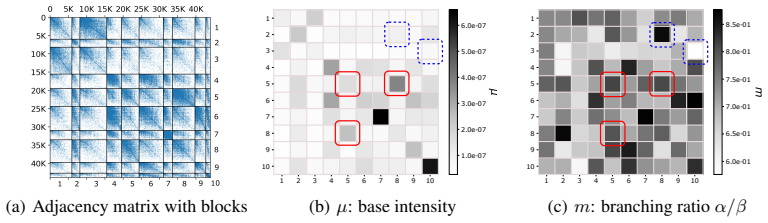
- Fitting the model to a 43,953-node, 852,833-event Facebook wall-post network takes about 141 seconds for $k=10$ blocks and yields better held-out log-likelihoods than the compared models.
Reading between the lines
- The moment estimators need only the count matrix, so they could serve as fast initialization or as inference when event timestamps are missing or too expensive to process—an application the paper does not itself propose.
- Because the model assumes independent node pairs, reciprocity is captured only indirectly through symmetric block-pair parameters; adding an explicit reciprocity term would be a natural testable extension, which the paper's limitations discussion hints at.
- The finite-time correction to the count mean quoted in the supplement implies a simple diagnostic: at moderate $T$, if sample means systematically fall below $\mu T/(1-\alpha/\beta)$, the asymptotic regime behind the consistency theorems has not been reached.
- The supplement's comparison of weighted versus unweighted adjacency matrices suggests a hybrid clustering rule—use the unweighted matrix when only $\mu$ separates communities and the weighted matrix when burstiness carries the signal—that could outperform either alone in sparse networks.
Signed reviews
Editorial analysis
A structured set of objections, weighed in public.
Referee Report
Summary. The paper introduces CHIP, a continuous-time network generative model in which each directed node pair follows an independent univariate exponential Hawkes process whose parameters depend only on the pair's communities. Estimation proceeds by spectral clustering on the aggregated count matrix N, followed by closed-form method-of-moments estimators for m = alpha/beta and mu, and a line search for beta. The main theoretical claims are that spectral clustering consistently recovers communities as n and T grow, with the misclustering rate bounded by k^2/(nT) in a simplified two-parameter setting, and that the estimators for m and mu are consistent and asymptotically normal. The paper also presents simulation experiments and comparisons on three real timestamped networks, emphasizing scalability to tens of thousands of nodes.
Significance. If the theoretical results were fully rigorous, this would be a notable contribution: it proposes a tractable Hawkes-based block model for timestamped relational data, gives the first consistency guarantees for community detection and parameter estimation in such a model, and provides a scalable implementation with reproducible code, simulation studies, and real-data comparisons against BHM and REM. The empirical scalability to the Facebook wall-post network is a clear strength. However, the core proofs have substantial gaps, so the guarantees as currently written are not established.
major comments (4)
- [Supplementary B.1.3, proof of Lemma B.1 and Theorem B.1]
- [Section 4.2, Theorem 2 and Supplementary B.2.2]
- [Abstract, Section 3.2, Section 5.2]
- [Supplementary B.2.2, proof of Theorem 3]
minor comments (4)
- [Supplementary B.1, Lemma B.1]
- [Supplementary B.1, finite-time correction]
- [Section 4.1, Theorem 1]
- [Section 5.2, Figure 2]
Circularity Check
No circularity: the central consistency proofs are self-contained, and self-citations are not load-bearing.
full rationale
The CHIP paper does not exhibit a derivation that reduces to its own inputs. The moment estimators (2) are explicit inverses of the standard Hawkes mean and variance relations (3); this is parameter estimation by method of moments, not a fitted quantity being relabeled as a prediction. The spectral-clustering theorems for the weighted count matrix use external concentration results (Bandeira–van Handel) and SBM eigen-structure arguments (Rohe et al., Lei–Rinaldo), with the misclustering bound in Theorem 1 following algebraically from lambda_min(E[N]) = (n/k)(nu1-nu2)T and the norm bound on N - E[N]. The paper does cite prior work by its own authors (BHM [9], Xu [12,13], Han et al. [33], Paul and Chen [59]), but none of these citations is the load-bearing step: BHM is a modeling inspiration and empirical comparison baseline, and the spectral-clustering framework comes from external literature. The finite-time mean correction from Da Fonseca and Zaatour is explicitly dropped as asymptotically negligible, which is a quantitative approximation rather than a circular argument. The main legitimate concern raised by the skeptic is that Lemma B.1 replaces Hawkes counts with i.i.d. Gaussian entries without a joint approximation error bound; that is a rigor gap in the proof of Theorem 1 in the sparse regime, not a circularity, because no stated theorem or estimator is defined in terms of the conclusion it is used to prove. Simulations use the same generative model as the theory, which is ordinary model checking rather than circular inference. Overall, the paper's claims are supported by an independent derivation chain, with no step equivalent to its own input by construction.
Assumptions & free parameters
free parameters (1)
- Number of communities k =
k=10 for Facebook (eigengap), k=2 for Enron (singular value gap)
assumptions (5)
- domain assumption Asymptotic count moments for stationary exponential Hawkes processes: E[N]=mu*T/(1-m), Var[N]=mu*T/(1-m)^3 (Eq. 3).
- domain assumption Pairwise independence of Hawkes processes given community assignments.
- domain assumption Stationarity condition alpha<beta for each exponential Hawkes process.
- ad hoc to paper Simplified special-case model in Theorem 1: equal community sizes, common within/between parameters, nu_1>nu_2, nu_1 approximately nu_2, sigma_1 approximately sigma_2.
- standard math Matrix concentration bounds (Bandeira-van Handel) and eigenvector perturbation bounds (Davis-Kahan, Lei-Rinaldo) for random matrices with independent entries.
Cite this review
Pith. "Pith review of CHIP: A Hawkes Process Model for Continuous-time Networks with Scalable and Consistent Estimation." pith.science (2026). https://pith.science/paper/2HWCENLP
@misc{pith2026190806940,
  author       = {Pith},
  title        = {Pith review of: CHIP: A Hawkes Process Model for Continuous-time Networks with Scalable and Consistent Estimation},
  year         = {2026},
  howpublished = {\url{https://pith.science/paper/2HWCENLP}},
  note         = {Machine review of arXiv:1908.06940}
}
read the original abstract
In many application settings involving networks, such as messages between users of an on-line social network or transactions between traders in financial markets, the observed data consist of timestamped relational events, which form a continuous-time network. We propose the Community Hawkes Independent Pairs (CHIP) generative model for such networks. We show that applying spectral clustering to an aggregated adjacency matrix constructed from the CHIP model provides consistent community detection for a growing number of nodes and time duration. We also develop consistent and computationally efficient estimators for the model parameters. We demonstrate that our proposed CHIP model and estimation procedure scales to large networks with tens of thousands of nodes and provides superior fits than existing continuous-time network models on several real networks.
Figures


Figures from the paper (1 more)
Reference graph
Works this paper leans on
-
[1]
write newline
" write newline "" before.all 'output.state := FUNCTION n.dashify 't := "" t empty not t #1 #1 substring "-" = t #1 #2 substring "--" = not "--" * t #2 global.max substring 't := t #1 #1 substring "-" = "-" * t #2 global.max substring 't := while if t #1 #1 substring * t #2 global.max substring 't := if while FUNCTION format.date year duplicate empty "emp...
-
[2]
Modeling relational events via latent classes
Christopher DuBois and Padhraic Smyth. Modeling relational events via latent classes . In Proceedings of the 16th ACM SIGKDD International Conference on Knowledge Discovery and Data Mining, pages 803--812, 2010
2010
-
[3]
Charles Blundell, Jeff Beck, and Katherine A. Heller. Modelling reciprocating relationships with Hawkes processes. In Advances in Neural Information Processing Systems 25, pages 2600--2608, 2012
2012
-
[4]
Butts, and Padhraic Smyth
Christopher DuBois, Carter T. Butts, and Padhraic Smyth. Stochastic blockmodeling of relational event dynamics . In Proceedings of the 16th International Conference on Artificial Intelligence and Statistics, pages 238--246, 2013
2013
-
[5]
A continuous-time stochastic block model for basketball networks
Lu Xin, Mu Zhu, and Hugh Chipman. A continuous-time stochastic block model for basketball networks. The Annals of Applied Statistics, 11 0 (2): 0 553--597, 2017
2017
-
[6]
A semiparametric extension of the stochastic block model for longitudinal networks
Catherine Matias, Tabea Rebafka, and Fanny Villers. A semiparametric extension of the stochastic block model for longitudinal networks . Biometrika, 105 0 (3): 0 665--680, 2018
2018
-
[7]
Decoupling Homophily and Reciprocity with Latent Space Network Models
Jiasen Yang, Vinayak Rao, and Jennifer Neville. Decoupling Homophily and Reciprocity with Latent Space Network Models . In Proceedings of the Conference on Uncertainty in Artificial Intelligence, 2017
2017
-
[8]
Modelling sparsity, heterogeneity, reciprocity and community structure in temporal interaction data
Xenia Miscouridou, Fran c ois Caron, and Yee Whye Teh. Modelling sparsity, heterogeneity, reciprocity and community structure in temporal interaction data. In Advances in Neural Information Processing Systems, pages 2343--2352, 2018
work page 2018
Show all 87 references
-
[9]
Junuthula, Maysam Haghdan, Kevin S
Ruthwik R. Junuthula, Maysam Haghdan, Kevin S. Xu, and Vijay K. Devabhaktuni. The Block Point Process Model for continuous-time event-based dynamic networks . In Proceedings of the World Wide Web Conference, pages 829--839, 2019
2019
-
[10]
Xing, Wenjie Fu, and Le Song
Eric P. Xing, Wenjie Fu, and Le Song. A state-space mixed membership blockmodel for dynamic network tomography . The Annals of Applied Statistics, 4: 0 535--566, 2010
2010
-
[11]
Detecting communities and their evolutions in dynamic social networks---a Bayesian approach
Tianbao Yang, Yun Chi, Shenghuo Zhu, Yihong Gong, and Rong Jin. Detecting communities and their evolutions in dynamic social networks---a Bayesian approach . Machine Learning, 82 0 (2): 0 157--189, 2011
2011
-
[12]
Xu and Alfred O
Kevin S. Xu and Alfred O. Hero III . Dynamic stochastic blockmodels for time-evolving social networks . IEEE Journal of Selected Topics in Signal Processing, 8 0 (4): 0 552--562, 2014
2014
-
[13]
Kevin S. Xu. Stochastic block transition models for dynamic networks . In Proceedings of the 18th International Conference on Artificial Intelligence and Statistics, pages 1079--1087, 2015
2015
-
[14]
Statistical clustering of temporal networks through a dynamic stochastic block model
Catherine Matias and Vincent Miele. Statistical clustering of temporal networks through a dynamic stochastic block model . Journal of the Royal Statistical Society: Series B (Statistical Methodology), 79 0 (4): 0 1119--1141, 2017
2017
-
[15]
Consistent estimation of dynamic and multi-layer block models
Qiuyi Han, Kevin Xu, and Edoardo Airoldi. Consistent estimation of dynamic and multi-layer block models. In International Conference on Machine Learning, pages 1511--1520, 2015
2015
-
[16]
Detectability thresholds and optimal algorithms for community structure in dynamic networks
Amir Ghasemian, Pan Zhang, Aaron Clauset, Cristopher Moore, and Leto Peel. Detectability thresholds and optimal algorithms for community structure in dynamic networks. Physical Review X, 6 0 (3): 0 031005, 2016
2016
-
[17]
Spectral clustering for multiple sparse networks: I
Sharmodeep Bhattacharyya and Shirshendu Chatterjee. Spectral clustering for multiple sparse networks: I. arXiv preprint arXiv:1805.10594, 2018
2018 arXiv
-
[18]
Spectral clustering in the dynamic stochastic block model
Marianna Pensky, Teng Zhang, et al. Spectral clustering in the dynamic stochastic block model. Electronic Journal of Statistics, 13 0 (1): 0 678--709, 2019
2019
-
[19]
Stochastic blockmodels: First steps
Paul W Holland, Kathryn Blackmond Laskey, and Samuel Leinhardt. Stochastic blockmodels: First steps. Social networks, 5 0 (2): 0 109--137, 1983
1983
-
[20]
Spectra of some self-exciting and mutually exciting point processes
Alan G Hawkes. Spectra of some self-exciting and mutually exciting point processes. Biometrika, 58 0 (1): 0 83--90, 1971 a
1971
-
[21]
Extending earthquakes' reach through cascading
David Marsan and Olivier Lengline. Extending earthquakes' reach through cascading. Science, 319 0 (5866): 0 1076--1079, 2008
2008
-
[22]
Multivariate hawkes processes: an application to financial data
Paul Embrechts, Thomas Liniger, and Lu Lin. Multivariate hawkes processes: an application to financial data. Journal of Applied Probability, 48 0 (A): 0 367--378, 2011
2011
-
[23]
Hawkes processes in finance
Emmanuel Bacry, Iacopo Mastromatteo, and Jean-Fran c ois Muzy. Hawkes processes in finance. Market Microstructure and Liquidity, 1 0 (01): 0 1550005, 2015
2015
-
[24]
Learning triggering kernels for multi-dimensional hawkes processes
Ke Zhou, Hongyuan Zha, and Le Song. Learning triggering kernels for multi-dimensional hawkes processes. In International Conference on Machine Learning, pages 1301--1309, 2013 a
2013
-
[25]
Modelling dyadic interaction with hawkes processes
Peter F Halpin and Paul De Boeck. Modelling dyadic interaction with hawkes processes. Psychometrika, 78 0 (4): 0 793--814, 2013
2013
-
[26]
Self-exciting point process modeling of conversation event sequences
Naoki Masuda, Taro Takaguchi, Nobuo Sato, and Kazuo Yano. Self-exciting point process modeling of conversation event sequences. In Temporal Networks, pages 245--264. Springer, 2013
2013
-
[27]
Seismic: A self-exciting point process model for predicting tweet popularity
Qingyuan Zhao, Murat A Erdogdu, Hera Y He, Anand Rajaraman, and Jure Leskovec. Seismic: A self-exciting point process model for predicting tweet popularity. In Proceedings of the 21th ACM SIGKDD International Conference on Knowledge Discovery and Data Mining, pages 1513--1522....
2015
-
[28]
A survey of statistical network models
Anna Goldenberg, Alice X Zheng, Stephen E Fienberg, Edoardo M Airoldi, et al. A survey of statistical network models. Foundations and Trends in Machine Learning, 2 0 (2): 0 129--233, 2010
2010
-
[29]
A tutorial on spectral clustering
Ulrike Von Luxburg. A tutorial on spectral clustering. Statistics and computing, 17 0 (4): 0 395--416, 2007
2007
-
[30]
Spectral clustering of graphs with general degrees in the extended planted partition model
Kamalika Chaudhuri, Fan Chung, and Alexander Tsiatas. Spectral clustering of graphs with general degrees in the extended planted partition model. In Conference on Learning Theory, pages 35--1, 2012
2012
-
[31]
Pseudo-likelihood methods for community detection in large sparse networks
Arash A Amini, Aiyou Chen, Peter J Bickel, Elizaveta Levina, et al. Pseudo-likelihood methods for community detection in large sparse networks. The Annals of Statistics, 41 0 (4): 0 2097--2122, 2013
2013
-
[32]
K. Rohe, S. Chatterjee, and B. Yu. Spectral clustering and the high-dimensional stochastic blockmodel. Ann. Statist, 39 0 (4): 0 1878--1915, 2011
1915
-
[33]
Sussman, Minh Tang, Donniell E
Daniel L. Sussman, Minh Tang, Donniell E. Fishkind, and Carey E. Priebe. A consistent adjacency spectral embedding for stochastic blockmodel graphs . Journal of the American Statistical Association, 107 0 (499): 0 1119--1128, 2012
2012
-
[34]
Regularized spectral clustering under the degree-corrected stochastic blockmodel
Tai Qin and Karl Rohe. Regularized spectral clustering under the degree-corrected stochastic blockmodel . In Advances in Neural Information Processing Systems 26, pages 3120--3128, 2013
2013
-
[35]
Consistency of spectral clustering in stochastic block models
Jing Lei and Alessandro Rinaldo. Consistency of spectral clustering in stochastic block models. The Annals of Statistics, 43 0 (1): 0 215--237, 2015
2015
-
[36]
Stochastic block model and community detection in sparse graphs: A spectral algorithm with optimal rate of recovery
Peter Chin, Anup Rao, and Van Vu. Stochastic block model and community detection in sparse graphs: A spectral algorithm with optimal rate of recovery. In COLT, pages 391--423, 2015
2015
-
[37]
Impact of regularization on spectral clustering
Antony Joseph, Bin Yu, et al. Impact of regularization on spectral clustering. The Annals of Statistics, 44 0 (4): 0 1765--1791, 2016
2016
-
[38]
Achieving optimal misclassification proportion in stochastic block models
Chao Gao, Zongming Ma, Anderson Y Zhang, and Harrison H Zhou. Achieving optimal misclassification proportion in stochastic block models. The Journal of Machine Learning Research, 18 0 (1): 0 1980--2024, 2017
1980
-
[39]
A simple svd algorithm for finding hidden partitions
Van Vu. A simple svd algorithm for finding hidden partitions. Combinatorics, Probability and Computing, 27 0 (1): 0 124--140, 2018
2018
-
[40]
Understanding regularized spectral clustering via graph conductance
Yilin Zhang and Karl Rohe. Understanding regularized spectral clustering via graph conductance. In Advances in Neural Information Processing Systems, pages 10631--10640, 2018
2018
-
[41]
Structure of growing social networks
Emily M Jin, Michelle Girvan, and Mark EJ Newman. Structure of growing social networks. Physical review E, 64 0 (4): 0 046132, 2001
2001
-
[42]
Tie-decay temporal networks in continuous time and eigenvector-based centralities
Walid Ahmad, Mason A Porter, and Mariano Beguerisse-D \' az. Tie-decay temporal networks in continuous time and eigenvector-based centralities. arXiv preprint arXiv:1805.00193, 2018
2018 arXiv
-
[43]
Models of continuous-time networks with tie decay, diffusion, and convection
Xinzhe Zuo and Mason A Porter. Models of continuous-time networks with tie decay, diffusion, and convection. arXiv preprint arXiv:1906.09394, 2019
1906 arXiv
-
[44]
Linderman and Ryan P
Scott W. Linderman and Ryan P. Adams. Discovering latent network structure in point process data . In Proceedings of the 31st International Conference on Machine Learning, pages 1413--1421, 2014
2014
-
[45]
Linderman and Ryan P
Scott W. Linderman and Ryan P. Adams. Scalable Bayesian inference for excitatory point process networks. arXiv preprint arXiv:1507.03228, 2015. URL https://arxiv.org/abs/1507.03228
2015 arXiv
-
[46]
COEVOLVE: A joint point process model for information diffusion and network co-evolution
Mehrdad Farajtabar, Yichen Wang, Manuel Gomez Rodriguez, Shuang Li, Hongyuan Zha, and Le Song. COEVOLVE: A joint point process model for information diffusion and network co-evolution . In Advances in Neural Information Processing Systems 28, pages 1945--1953, 2015
1945
-
[47]
NetCodec: Community detection from individual activities
Long Tran, Mehrdad Farajtabar, Le Song, and Hongyuan Zha. NetCodec: Community detection from individual activities . In Proceedings of the SIAM International Conference on Data Mining, pages 91--99, 2015
2015
-
[48]
HawkesTopic: A joint model for network inference and topic modeling from text-based cascades
Xinran He, Theodoros Rekatsinas, James Foulds, Lise Getoor, and Yan Liu. HawkesTopic: A joint model for network inference and topic modeling from text-based cascades . In Proceedings of the 32nd International Conference on Machine Learning, pages 871--880, 2015
2015
-
[49]
Hall and Rebecca M
Eric C. Hall and Rebecca M. Willett. Tracking dynamic point processes on networks . IEEE Transactions on Information Theory, 62 0 (7): 0 4327--4346, 2016
2016
-
[50]
P. D. Hoff, A. E. Raftery, and M. S. Handcock. Latent space approaches to social network analysis. J. Amer. Statist. Assoc., 97: 0 1090--1098, 2002
2002
-
[51]
Learning social infectivity in sparse low-rank networks using multi-dimensional hawkes processes
Ke Zhou, Hongyuan Zha, and Le Song. Learning social infectivity in sparse low-rank networks using multi-dimensional hawkes processes. In Artificial Intelligence and Statistics, pages 641--649, 2013 b
2013
-
[52]
Mean-field inference of hawkes point processes
Emmanuel Bacry, St \'e phane Ga \" ffas, Iacopo Mastromatteo, and Jean-Fran c ois Muzy. Mean-field inference of hawkes point processes. Journal of Physics A: Mathematical and Theoretical, 49 0 (17): 0 174006, 2016
2016
-
[53]
Tick: a python library for statistical learning, with an emphasis on hawkes processes and time-dependent models
Emmanuel Bacry, Martin Bompaire, Philip Deegan, St \'e phane Ga \" ffas, and S ren V Poulsen. Tick: a python library for statistical learning, with an emphasis on hawkes processes and time-dependent models. The Journal of Machine Learning Research, 18 0 (1): 0 7937--7941, 2017
2017
-
[54]
A cluster process representation of a self-exciting process
Alan G Hawkes and David Oakes. A cluster process representation of a self-exciting process. Journal of Applied Probability, 11 0 (3): 0 493--503, 1974
1974
-
[55]
Point spectra of some mutually exciting point processes
Alan G Hawkes. Point spectra of some mutually exciting point processes. Journal of the Royal Statistical Society. Series B (Methodological), pages 438--443, 1971 b
1971
-
[56]
Asymptotic properties and equilibrium conditions for branching poisson processes
P.A.W Lewis. Asymptotic properties and equilibrium conditions for branching poisson processes. Journal of Applied Probability, 6 0 (2): 0 355--371, 1969
1969
-
[57]
Spectral and matrix factorization methods for consistent community detection in multi-layer networks
Subhadeep Paul, Yuguo Chen, et al. Spectral and matrix factorization methods for consistent community detection in multi-layer networks. The Annals of Statistics, 48 0 (1): 0 230--250, 2020
2020
-
[58]
Community detection in general stochastic block models: Fundamental limits and efficient algorithms for recovery
Emmanuel Abbe and Colin Sandon. Community detection in general stochastic block models: Fundamental limits and efficient algorithms for recovery. In IEEE 56th Annual Symposium on Foundations of Computer Science (FOCS), pages 670--688. IEEE, 2015
2015
-
[59]
Community detection and stochastic block models: recent developments
Emmanuel Abbe. Community detection and stochastic block models: recent developments. The Journal of Machine Learning Research, 18 0 (1): 0 6446--6531, 2017
2017
-
[60]
Comparing partitions
Lawrence Hubert and Phipps Arabie. Comparing partitions . Journal of Classification, 2: 0 193--218, 1985
1985
-
[61]
Inferring friendship network structure by using mobile phone data
Nathan Eagle, Alex Sandy Pentland, and David Lazer. Inferring friendship network structure by using mobile phone data. Proceedings of the national academy of sciences, 106 0 (36): 0 15274--15278, 2009
2009
-
[62]
The enron corpus: A new dataset for email classification research
Bryan Klimt and Yiming Yang. The enron corpus: A new dataset for email classification research. In European Conference on Machine Learning, pages 217--226. Springer, 2004
2004
-
[63]
On the evolution of user interaction in facebook
Bimal Viswanath, Alan Mislove, Meeyoung Cha, and Krishna P Gummadi. On the evolution of user interaction in facebook. In Proceedings of the 2nd ACM workshop on Online social networks, pages 37--42. ACM, 2009
2009
-
[64]
Codebook for the dyadic militarized interstate incident data, version 3.10
Faten Ghosn and Scott Bennett. Codebook for the dyadic militarized interstate incident data, version 3.10. Online: http://correlatesofwar.org, 2003
2003
-
[65]
Murder by structure: Dominance relations and the social structure of gang homicide
Andrew V Papachristos. Murder by structure: Dominance relations and the social structure of gang homicide. American journal of sociology, 115 0 (1): 0 74--128, 2009
2009
-
[66]
Randomized controlled field trials of predictive policing
George O Mohler, Martin B Short, Sean Malinowski, Mark Johnson, George E Tita, Andrea L Bertozzi, and P Jeffrey Brantingham. Randomized controlled field trials of predictive policing. Journal of the American statistical association, 110 0 (512): 0 1399--1411, 2015
2015
-
[67]
Does predictive policing lead to biased arrests? results from a randomized controlled trial
P Jeffrey Brantingham, Matthew Valasik, and George O Mohler. Does predictive policing lead to biased arrests? results from a randomized controlled trial. Statistics and Public Policy, 5 0 (1): 0 1--6, 2018
2018
-
[68]
S., Van Handel, R., et al
Bandeira, A. S., Van Handel, R., et al. Sharp nonasymptotic bounds on the norm of random matrices with independent entries. The Annals of Probability, 44 0 (4): 0 2479--2506, 2016
2016
-
[69]
Blundell, C., Beck, J., and Heller, K. A. Modelling reciprocating relationships with Hawkes processes. In Advances in Neural Information Processing Systems 25, pp.\ 2600--2608, 2012
2012
-
[70]
and Kahan, W
Davis, C. and Kahan, W. M. The rotation of eigenvectors by a perturbation. iii. SIAM Journal on Numerical Analysis, 7 0 (1): 0 1--46, 1970
1970
-
[71]
and Smyth, P
DuBois, C. and Smyth, P. Modeling relational events via latent classes . In Proceedings of the 16th ACM SIGKDD International Conference on Knowledge Discovery and Data Mining, pp.\ 803--812, 2010
2010
-
[72]
T., and Smyth, P
DuBois, C., Butts, C. T., and Smyth, P. Stochastic blockmodeling of relational event dynamics . In Proceedings of the 16th International Conference on Artificial Intelligence and Statistics, pp.\ 238--246, 2013
2013
-
[73]
S., and Lazer, D
Eagle, N., Pentland, A. S., and Lazer, D. Inferring friendship network structure by using mobile phone data. Proceedings of the national academy of sciences, 106 0 (36): 0 15274--15278, 2009
2009
-
[74]
Hawkes, A. G. and Oakes, D. A cluster process representation of a self-exciting process. Journal of Applied Probability, 11 0 (3): 0 493--503, 1974
1974
-
[75]
R., Haghdan, M., Xu, K
Junuthula, R. R., Haghdan, M., Xu, K. S., and Devabhaktuni, V. K. The Block Point Process Model for continuous-time event-based dynamic networks . In Proceedings of the World Wide Web Conference, pp.\ 829--839, 2019
2019
-
[76]
and Yang, Y
Klimt, B. and Yang, Y. The enron corpus: A new dataset for email classification research. In European Conference on Machine Learning, pp.\ 217--226. Springer, 2004
2004
-
[77]
J., Taimre, T., and Pollett, P
Laub, P. J., Taimre, T., and Pollett, P. K. Hawkes processes. arXiv preprint arXiv:1507.02822, 2015
2015 arXiv
-
[78]
Lehmann, E. L. Elements of large-sample theory. Springer Science & Business Media, 2004
2004
-
[79]
and Rinaldo, A
Lei, J. and Rinaldo, A. Consistency of spectral clustering in stochastic block models. The Annals of Statistics, 43 0 (1): 0 215--237, 2015
2015
-
[80]
A semiparametric extension of the stochastic block model for longitudinal networks
Matias, C., Rebafka, T., and Villers, F. A semiparametric extension of the stochastic block model for longitudinal networks . Biometrika, 105 0 (3): 0 665--680, 2018
2018
-
[81]
and Wright, S
Nocedal, J. and Wright, S. Numerical optimization. Springer Science & Business Media, 2006
2006
-
[82]
Maximum likelihood estimation of hawkes' self-exciting point processes
Ozaki, T. Maximum likelihood estimation of hawkes' self-exciting point processes. Annals of the Institute of Statistical Mathematics, 31 0 (1): 0 145--155, 1979
1979
-
[83]
Spectral clustering in the dynamic stochastic block model
Pensky, M., Zhang, T., et al. Spectral clustering in the dynamic stochastic block model. Electronic Journal of Statistics, 13 0 (1): 0 678--709, 2019
2019
-
[84]
Spectral clustering and the high-dimensional stochastic blockmodel
Rohe, K., Chatterjee, S., and Yu, B. Spectral clustering and the high-dimensional stochastic blockmodel. Ann. Statist, 39 0 (4): 0 1878--1915, 2011
1915
-
[85]
Stewart, G. W. and Sun, J.-G. Matrix Perturbation Theory. Academic Press, Boston, MA., 1990
1990
-
[86]
Viswanath, B., Mislove, A., Cha, M., and Gummadi, K. P. On the evolution of user interaction in facebook. In Proceedings of the 2nd ACM workshop on Online social networks, pp.\ 37--42. ACM, 2009
2009
-
[87]
A continuous-time stochastic block model for basketball networks
Xin, L., Zhu, M., and Chipman, H. A continuous-time stochastic block model for basketball networks. The Annals of Applied Statistics, 11 0 (2): 0 553--597, 2017
2017
Reviewed August 14, 2026 · model on record in the stance chip above.
Discussion (0). Continue with ORCID to comment.