REVIEW 4 major objections 5 minor 39 references
Sparse Quantum Voxel Encoding for Readout-Efficient Molecular Geometry Reconstruction on NISQ Devices
T0 review · 4 major / 5 minor · reviewed 2026-07-30 · grok-4.5
Pith's one-line read Encoding molecules as sparse equal superpositions turns geometry readout into a coupon-collector problem needing only O(A log A) shots.
desk verdict Solid NISQ encoding-and-demo paper: coupon-collector readout works on hardware for oracle recall, but unsupervised support recovery under real device bias is not shown and state prep is left open. read the letter →
The pith
A machine-rendered reading of the paper's core claim, the machinery that carries it, and where it could break.
The reading
What carries the argument
Sparse quantum voxel encoding: each atom maps to one basis state via a combined voxel-index and atom-type index; the molecule is the equal superposition over those occupied states, so reconstruction is classical coupon collection on measurement outcomes.
What would settle it
Prepare the same 8-qubit ethylamine support state on comparable hardware and check whether mean reconstruction recall stays near 0.94 at ~116 shots and near 0.98 at ~200 shots; failure to reach high recall at those budgets, or circuits so deep that the support is destroyed before sampling, would refute the practical claim.
Extended reading notes
Core claim
Once a molecule is prepared as an equal superposition over the A computational-basis states that encode its voxelized atom positions and types, complete support recovery by computational-basis sampling requires O(A log A) shots in the noise-free case, and on noisy NISQ hardware a 10-atom molecule can still be recovered at high mean recall with only O(10^2) shots—orders of magnitude fewer measurements than full state tomography.
Load-bearing premise
The paper assumes a usable way already exists to prepare or learn that sparse equal-superposition state; without it the cheap readout does not yield a practical end-to-end method.
Editorial extensions
If this is right
- Quantum generative models that emit states in this encoding can hand molecular geometries to classical post-processing with coupon-collector shot budgets instead of tomography.
- Measurement cost at readout scales with atom count A, not with 3^n Pauli settings, for fixed voxel resolution.
- Spatial precision is capped by voxel size, forcing an explicit qubits-versus-resolution trade-off when targeting sub-ångström work.
- Signal-to-noise over empty voxels can serve as a ground-truth-free proxy to decide which basis states are real atoms in a generative setting.
Reading between the lines
- If state-preparation depth cannot be cut well below the demonstrated ~1200-gate regime, the encoding’s readout win may stay confined to proof-of-concept circuits rather than larger generative models.
- Adaptive or symmetry-aware grids (hinted in the paper’s outlook) would be the natural next test: same coupon-collector math, less orientation dependence and fewer wasted basis states.
- The method is closest in spirit to basis encoding with a deliberately sparse support; neighbouring quantum ML tasks that only need set-like outputs could reuse the same support-recovery pattern.
Editorial analysis
A structured set of objections, weighed in public.
Referee Report
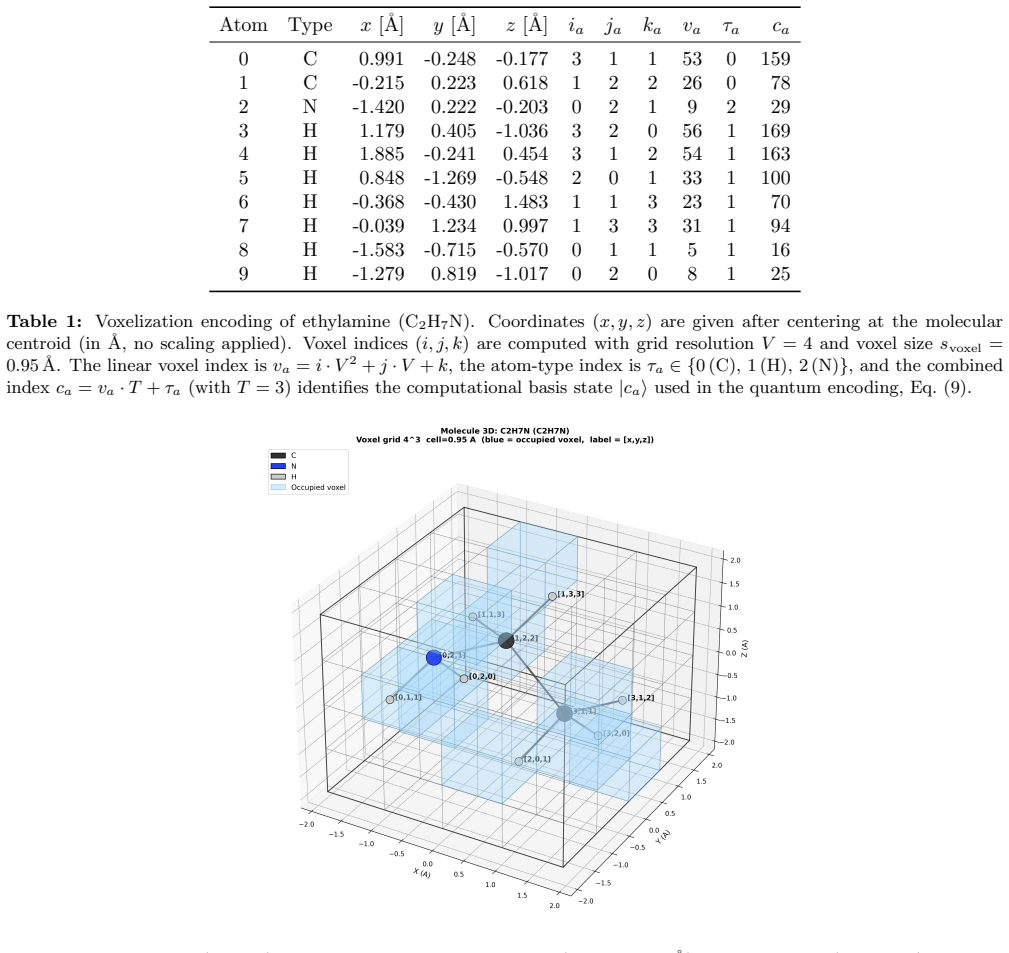
Summary. The paper proposes quantum voxelization encoding: molecular geometries are discretized onto a 3D voxel grid, each atom’s voxel index and chemical type are packed into a single computational-basis label c_a, and the molecule is represented as an equal superposition over the A occupied basis states. Once that sparse support state is prepared, reconstruction reduces to classical coupon-collector sampling in the computational basis, requiring O(A log A) shots in the noise-free case (Sec. 3.2, App. C). The authors assume state preparation exists and focus on readout. They encode 10-atom ethylamine into 8 qubits (V=4, T=3, C=192), run on IBM Kingston and a noisy simulator, and report mean reconstruction recall R̄=0.94 at 116 shots and R̄=0.98 at 200 shots despite ~70% wasted shots, arguing this is a practical, readout-efficient representation for NISQ molecular generative models.
Significance. If the encoding is usable end-to-end, converting geometry readout from exponential tomography to polynomial support sampling is a genuine and useful contribution for quantum generative chemistry on NISQ hardware. The coupon-collector analysis is standard and correctly applied; the hardware campaign is concrete (10 repeats per shot budget, wasted-shot and noise breakdowns, simulator baseline, device appendix). Explicit acknowledgment that preparation is out of scope and that spatial precision is lost to the grid is appropriate. The work is best read as a readout-compatible representation and a small-scale NISQ feasibility demo, not as a complete data-loading or generative pipeline.
major comments (4)
- [Section 4.3, Eq. (15)] Sec. 4.3 and Eq. (15): reconstruction recall R is an oracle metric—it scores only whether known atoms in M* appear at least once and does not penalize false positives. The intended generative use case (Sec. 5 pipeline; end of Sec. 4.3) requires inferring an unknown support from the histogram alone. The paper never reports unsupervised recovery (e.g., top-A frequency ranking, thresholding, or clustering) of the true indices in Table 1. With the strong low-index/ground-state bias in Fig. 2a from T1 leakage, high oracle R at O(10^2) shots does not establish that an unknown molecule can be reconstructed. This is load-bearing for the “practical generative readout” claim.
- [Section 4.3, Eq. (16)] Sec. 4.3, Eq. (16): SNR is introduced as a “ground-truth-free proxy,” but it is defined with labeled partitions ⟨N_valid⟩ over the 10 true atoms and ⟨N_empty⟩ over the 182 empties. That measures separability given M*, not recovery without M*. Either redefine SNR from unlabeled histogram statistics only, or drop the “ground-truth-free” language and add an actual unsupervised recovery experiment under the observed hardware bias.
- [Section 3.1; Appendix E; Abstract/Conclusions] Sec. 3.1 and App. E: preparation of |ψ_M*⟩ is assumed to exist; the demo uses isometry initialization yielding ~1213-gate 8-qubit circuits, already near coherence-limited depth. The abstract and conclusions frame the scheme as a “practical… representation for molecular geometries on near-term devices” and a building block for QAE/QGAN. Without either a scalable preparation path or a clear scope restriction to “readout of already-prepared sparse support states,” the NISQ practicality claim overreaches. Tighten claims to readout-only, or quantify when preparation remains feasible.
- [Section 3.1; Section 5] Sec. 3.1 collision-free grid: the worst-case condition √3 s_voxel < d_min would require s_voxel < 0.63 Å, but experiments use 0.95 Å and rely on molecule-specific orientation/centering. For multi-molecule datasets the paper defers “optimal collision-free grid design.” For the claimed use in generative libraries this is not a minor engineering detail—it determines qubit count and whether the encoding is universal. At minimum, state the qubit/resolution scaling for a fixed universal grid over a standard set (e.g., QM9 subset) or clearly limit claims to single-molecule, orientation-fixed encoding.
minor comments (5)
- [Abstract; Section 2] Abstract and Intro compare to O(3^n × 10^{2–3}) full tomography; for fairness also cite classical shadows / Pauli grouping limits when the task is full geometry recovery, as partially done in Sec. 2, so the baseline is not only naive tomography.
- [Figure 2] Fig. 2: mark the 10 true c_a values from Table 1 on the histogram (or an inset) so readers can see whether true atoms sit above the noise floor under hardware bias.
- [Appendix C.4] App. C.4 η̂ estimates (0.19–0.24) are lower than the direct valid-shot fraction ~0.29 in Fig. 3; a one-sentence reconciliation would help.
- [Introduction; Section 5] Typos/notation: “V AEs” spacing in Intro; consistent use of M* vs M^∗; “angstr¨ om” encoding in Sec. 5.
- [Title page; Section 4.1] Dates say July 30, 2026 / experiments April 2026—fine for arXiv, but confirm consistency before journal submission.
Circularity Check
No significant circularity: coupon-collector bound is classical theorem on a constructed equal superposition; hardware recall is external measurement.
full rationale
The paper’s central readout claim is that once a molecule is prepared as an equal superposition over A occupied computational-basis labels (Eq. 9), support recovery reduces to the classical coupon-collector problem, giving O(A log A) shots in the noise-free case (Eqs. 12–13, Appendix C). That bound is not fitted from the ethylamine hardware outcomes; it is the standard coupon-collector expectation/union-bound applied to a uniform support of size A by construction of the encoding. Reconstruction recall R (Eq. 15) and the shot-budget table are evaluated against that external classical formula and against measured bitstrings on IBM Kingston and a noisy simulator; they do not redefine a fitted parameter as a prediction. State preparation is explicitly assumed out of scope and implemented only via a generic isometry for the demo—there is no circular claim that preparation efficiency follows from the readout analysis. No load-bearing self-citation, uniqueness theorem from the same authors, or ansatz smuggled via prior work appears in the derivation chain. Concerns that R is an oracle metric and that SNR (Eq. 16) still partitions on known M* are validity/scope issues for the generative use-case, not circular reductions of outputs to inputs. Score 0.
Assumptions & free parameters
free parameters (3)
- grid resolution V and voxel size s_voxel =
V=4, s_voxel=0.95 Å
- shot budget schedule S =
47–300 shots
- atom-type set size T =
T=3
assumptions (4)
- ad hoc to paper A sparse equal-superposition support state |ψ_M*⟩ over the A occupied basis states can be prepared (existence assumed; preparation algorithm out of scope).
- domain assumption At most one atom per voxel after discretization (collisions resolved by refining the grid).
- standard math Ideal measurements sample uniformly from the A occupied basis states (coupon collector model).
- domain assumption Reconstruction quality is measured by recall of known support (and SNR as ground-truth-free proxy), not by continuous geometry or bond recovery.
invented entities (1)
-
quantum voxelization encoding (sparse product index c_a = v_a·T + τ_a as computational-basis support)
Cite this review
Pith. "Pith review of Sparse Quantum Voxel Encoding for Readout-Efficient Molecular Geometry Reconstruction on NISQ Devices." pith.science (2026). https://pith.science/paper/2I3VT7MB
@misc{pith2026260726925,
  author       = {Pith},
  title        = {Pith review of: Sparse Quantum Voxel Encoding for Readout-Efficient Molecular Geometry Reconstruction on NISQ Devices},
  year         = {2026},
  howpublished = {\url{https://pith.science/paper/2I3VT7MB}},
  note         = {Machine review of arXiv:2607.26925}
}
abstract
We propose a sparse computational-basis encoding of voxelized molecular geometries that converts molecular reconstruction from full-state tomography into support recovery by computational-basis sampling. To realize the encoding scheme, the molecular space is discretized into a 3D grid, and each atom's position and chemical species is mapped to a single computational basis state. This discretization introduces spatial quantization at the voxel-resolution scale. The molecule is then encoded as an equal superposition over this sparse set of occupied states, where we assume that a suitable state preparation method exists. In contrast to full state tomography, which requires on the order of $\mathcal{O}(3^n \times 10^{2\text{--}3})$ measurement shots, where $n$ is the number of qubits, our proposed encoding scheme reduces to a coupon-collector sampling problem in the computational basis. Complete recovery of an $A$-atom molecule requires $\mathcal{O}(A\log A)$ shots on noise-free hardware. On noisy hardware, the required number of shots increases. We demonstrate the method on the 156-qubit IBM Kingston device using 8-qubit circuits to reconstruct the discretized geometry of a 10-atom ethylamine molecule with high mean reconstruction recall using only $\mathcal{O}(10^2)$ shots despite substantial hardware noise. These results demonstrate that our proposed encoding scheme is a practical, readout-efficient representation for molecular geometries on near-term devices.
Figures


Reference graph
Works this paper leans on
-
[1]
Estimation of the size of drug- like chemical space based on GDB-17 data
Pavel G Polishchuk, Timur I Madzhidov, and Alexandre Varnek. “Estimation of the size of drug- like chemical space based on GDB-17 data”. In: Journal of computer-aided molecular design27.8 (2013), pp. 675–679
2013
-
[2]
Neural message passing for quantum chemistry
Justin Gilmer et al. “Neural message passing for quantum chemistry”. In:International conference on machine learning (ICML)(2017), pp. 1263– 1272
2017
-
[3]
Convolutional networks on graphs for learning molecular fingerprints
David K Duvenaud et al. “Convolutional networks on graphs for learning molecular fingerprints”. In: Advances in neural information processing systems 28 (2015)
2015
-
[4]
Automatic chemi- cal design using a data-driven continuous represen- tation of molecules
Rafael G´ omez-Bombarelli et al. “Automatic chemi- cal design using a data-driven continuous represen- tation of molecules”. In:ACS central science4.2 (2018), pp. 268–276. 13
2018
-
[5]
Grammar variational autoen- coder
Matt J Kusner, Brooks Paige, and Jos´ e Miguel Hern´ andez-Lobato. “Grammar variational autoen- coder”. In:International conference on machine learning (ICML)(2017), pp. 1945–1954
2017
-
[6]
Equivariant diffusion for molecule generation in 3d
Emiel Hoogeboom et al. “Equivariant diffusion for molecule generation in 3d”. In:International conference on machine learning (ICML)(2022), pp. 8867–8887
2022
-
[7]
Geometric latent diffusion mod- els for 3d molecule generation
Minkai Xu et al. “Geometric latent diffusion mod- els for 3d molecule generation”. In:International conference on machine learning (ICML)(2023), pp. 38592–38610
2023
-
[8]
Nielsen and Isaac L
Michael A. Nielsen and Isaac L. Chuang.Quan- tum Computation and Quantum Information: 10th Anniversary Edition. Cambridge University Press, 2010
2010
Show all 39 references
-
[9]
Quantum chemistry in the age of quantum computing
Yudong Cao et al. “Quantum chemistry in the age of quantum computing”. In:Chemical Reviews 119.19 (2019), pp. 10856–10915.doi:10 . 1021 / acs.chemrev.8b00803
2019
-
[10]
Quantum computational chemistry
Sam McArdle et al. “Quantum computational chemistry”. In:Reviews of Modern Physics92.1 (2020), p. 015003
2020
-
[11]
A Survey of Quan- tum Machine Learning: Foundations, Algorithms, Frameworks, Data and Applications
Francesc Rodr ´ ıguez-D ´ ıaz et al. “A Survey of Quan- tum Machine Learning: Foundations, Algorithms, Frameworks, Data and Applications”. In:ACM Comput. Surv.58.4 (Oct. 2025), pp. 1–35.issn: 0360-0300.doi:10.1145/3764582
2025 doi
-
[12]
Haimeng Zhao et al.Exponential quantum advan- tage in processing massive classical data. 2026. arXiv:2604 . 07639 [quant-ph].url:https : / / arxiv.org/abs/2604.07639
2026 arXiv
-
[13]
Quantum autoencoders for effi- cient compression of quantum data
Jonathan Romero, Jonathan P. Olson, and Al´ an Aspuru-Guzik. “Quantum autoencoders for effi- cient compression of quantum data”. In:Quantum Science and Technology2.4 (2017), p. 045001.doi: 10.1088/2058-9565/aa8072
2017 doi
-
[14]
Parameterized quantum circuits as machine learning models
Marcello Benedetti et al. “Parameterized quantum circuits as machine learning models”. In:Quantum Science and Technology4.4 (2019), p. 043001.doi: 10.1088/2058-9565/ab4eb5
2019 doi
-
[15]
QV AE- Mole: The Quantum V AE with Spherical Latent Variable Learning for 3-D Molecule Generation
Huaijin Wu, Xinyu Ye, and Junchi Yan. “QV AE- Mole: The Quantum V AE with Spherical Latent Variable Learning for 3-D Molecule Generation”. In:The Thirty-eighth Annual Conference on Neu- ral Information Processing Systems. 2024
2024
-
[16]
Experimental Single-Setting Quantum State Tomography
Roman Stricker et al. “Experimental Single-Setting Quantum State Tomography”. In:PRX Quan- tum3 (4 Oct. 2022), p. 040310.doi:10 . 1103 / PRXQuantum.3.040310
2022
-
[17]
A tailor-made quantum state tomography approach
D. Binosi et al. “A tailor-made quantum state tomography approach”. In:APL Quantum1.3 (2024), p. 036112.doi:10.1063/5.0219143
2024 doi
-
[18]
Yi Pan et al.MolQAE: Quantum Autoencoder for Molecular Representation Learning. 2025. arXiv: 2505.01875 [quant-ph].url:https://arxiv. org/abs/2505.01875
2025 arXiv
-
[19]
Noisy intermediate-scale quantum algorithm for semidefinite program- ming
Kishor Bharti et al. “Noisy intermediate-scale quantum algorithm for semidefinite program- ming”. In:Phys. Rev. A105 (5 May 2022), p. 052445.doi:10.1103/PhysRevA.105.052445
2022 doi
-
[20]
Quantum Computing in the NISQ era and beyond
John Preskill. “Quantum Computing in the NISQ era and beyond”. In:Quantum2 (Aug. 2018), p. 79. issn: 2521-327X.doi:10.22331/q-2018-08-06- 79
2018 doi
-
[21]
Maria Schuld and Francesco Petruccione.Machine Learning with Quantum Computers. 2nd. Springer, 2021
2021
-
[22]
Robust data en- codings for quantum classifiers
Ryan LaRose and Brian Coyle. “Robust data en- codings for quantum classifiers”. In:Physical Re- view A102.3 (2020), p. 032420
2020
-
[23]
Data encoding patterns for quantum computing
Manuela Weigold et al. “Data encoding patterns for quantum computing”. In:Proceedings of the 27th Conference on Pattern Languages of Pro- grams. PLoP ’20. Virtual Event: The Hillside Group, 2022.isbn: 9781941652169
2022
-
[24]
SMILES, a chemical lan- guage and information system. 1. Introduction to methodology and encoding rules
David Weininger. “SMILES, a chemical lan- guage and information system. 1. Introduction to methodology and encoding rules”. In:Journal of Chemical Information and Computer Sciences28.1 (1988), pp. 31–36.doi:10.1021/ci00057a005
1988 doi
-
[25]
Predicting many properties of a quantum system from very few measurements
Hsin-Yuan Huang, Richard Kueng, and John Preskill. “Predicting many properties of a quantum system from very few measurements”. In:Nature Physics16.10 (June 2020), pp. 1050–1057.issn: 1745-2481.doi:10.1038/s41567-020-0932-7
2020 doi
-
[26]
Measurement optimization in the variational quantum eigensolver using a minimum clique cover
Vladyslav Verteletskyi, Tzu-Ching Yen, and Ar- tur F. Izmaylov. “Measurement optimization in the variational quantum eigensolver using a minimum clique cover”. In:The Journal of Chemical Physics 152.12 (Mar. 2020), p. 124114.issn: 0021-9606. doi:10.1063/1.5141458
2020 doi
-
[27]
Neural-network quantum state tomography
Giacomo Torlai et al. “Neural-network quantum state tomography”. In:Nature Physics14.5 (2018), pp. 447–450
2018
-
[28]
Quantum circuits for isome- tries
Raban Iten et al. “Quantum circuits for isome- tries”. In:Phys. Rev. A93 (3 Mar. 2016), p. 032318. doi:10.1103/PhysRevA.93.032318
2016 doi
-
[29]
The quantum measurement problem: a review of recent trends
Anderson A. Tomaz, Rafael S. Mattos, and Mario Barbatti. “The quantum measurement problem: a review of recent trends”. In:Philosophical Maga- zine(Dec. 2025), pp. 1–38.issn: 1478-6443.doi: 10.1080/14786435.2025.2601922. 14
2025
-
[30]
Problems and Snapshots from the World of Prob- ability
Gunnar Blom, Lars Holst, and Dennis Sandell. Problems and Snapshots from the World of Prob- ability. eng. New York, NY: Springer New York, 1994.isbn: 1-4612-4304-1
1994
-
[31]
Qiskit Community.Qiskit: An Open-Source Frame- work for Quantum Computing. Mar. 2017.doi:10. 5281 / zenodo . 2562110.url:https : / / github . com/Qiskit/qiskit
2017
-
[32]
A quantum engineer’s guide to superconducting qubits
P. Krantz et al. “A quantum engineer’s guide to superconducting qubits”. In:Applied Physics Re- views6.2 (June 2019), p. 021318.issn: 1931-9401. doi:10.1063/1.5089550
2019 doi
-
[33]
Quantum generative adversarial learning
Seth Lloyd and Christian Weedbrook. “Quantum generative adversarial learning”. In:Physical Re- view Letters121.4 (2018), p. 040502
2018
-
[34]
Quantum chemistry structures and properties of 134 kilo molecules
Raghunathan Ramakrishnan et al. “Quantum chemistry structures and properties of 134 kilo molecules”. In:Scientific Data1 (2014), p. 140022. doi:10.1038/sdata.2014.22
2014 doi
-
[35]
ZINC – A Free Database of Commercially Available Com- pounds for Virtual Screening
John J. Irwin and Brian K. Shoichet. “ZINC – A Free Database of Commercially Available Com- pounds for Virtual Screening”. In:Journal of Chemical Information and Modeling45.1 (2005), pp. 177–182.doi:10.1021/ci049714+
2005 doi
-
[36]
Exploiting symmetry in variational quantum machine learning
Johannes Jakob Meyer et al. “Exploiting symmetry in variational quantum machine learning”. In:PRX Quantum4.1 (2023), p. 010328
2023
-
[37]
Theory for equivariant quantum neural networks
Quynh T. Nguyen et al. “Theory for equivariant quantum neural networks”. In:PRX Quantum5.2 (2024), p. 020328
2024
-
[38]
Better informed distance geometry: using what we know to improve conformation generation
Sereina Riniker and Gregory A. Landrum. “Better informed distance geometry: using what we know to improve conformation generation”. In:Jour- nal of Chemical Information and Modeling55.12 (2015), pp. 2562–2574
2015
-
[39]
Merck molecular force field. I. Basis, form, scope, parameterization, and perfor- mance of MMFF94
Thomas A Halgren. “Merck molecular force field. I. Basis, form, scope, parameterization, and perfor- mance of MMFF94”. In:Journal of Computational Chemistry17.5-6 (1996), pp. 490–519. 15
1996
Reviewed July 30, 2026 · model on record in the stance chip above.
Discussion (0). Continue with ORCID to comment.