REVIEW 3 major objections 4 minor 39 references
Liouville Theory, AdS$_2$ String, and Three-Point Functions
T0 review · 3 major / 4 minor · reviewed 2026-08-14 · deepseek-v4-flash
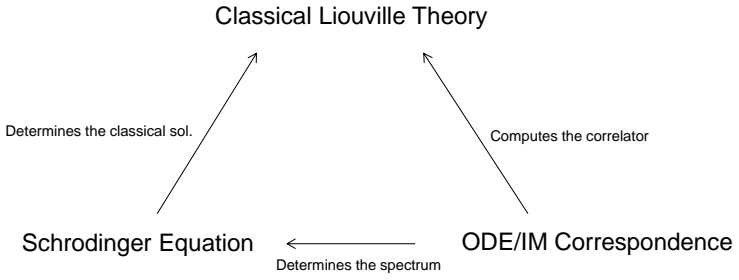
Pith's one-line read Wronskian functional equations compute Liouville and AdS2 three-point functions
desk verdict A clear lecture write-up that reproduces the Liouville three-point function from functional equations and reviews the AdS2 string result; the latter's final formula (111) rests on CDD=0 and S5 imported from [4], a limitation the author openly admits. read the letter →
The pith
A machine-rendered reading of the paper's core claim, the machinery that carries it, and where it could break.
The reading
What carries the argument
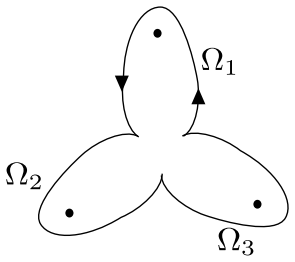
The load-bearing object is the Wronskian $\langle A,B\rangle = A\partial B - B\partial A$ of two solutions of the same Schrödinger-like (Liouville) or flat-connection (AdS2) linear problem. Around each puncture the solutions are normalized so that $\langle i_+, i_-\rangle = 1$ and diagonalize the monodromy with phases $e^{\pm i p_i}$; the product of the three monodromies around a thrice-punctured sphere must be trivial, which reduces to the functional equations (42) and (103). Reconstruction formulas $e^{-\varphi} = \psi_1 \tilde\psi_1 - \psi_2 \tilde\psi_2$ (Liouville) and $g^{-1} = (\psi_1,\psi_2)|_{x=0}$ (AdS2) then express the vertex-operator data, and hence the three-point function, directly in terms of those Wronskians. The formal solutions of the functional equations carry a CDD ambiguity; in Liouville it is fixed by comparing with a WKB expansion, while in AdS2 the paper takes the relevant analyticity analysis, which fixes the CDD factor to zero, from a separate reference.
What would settle it
Evaluate the Wronskians numerically from the flat-connection linear system for three finite operator dimensions and compare the ratio in (102) with the logarithm of the direct saddle-point three-point function of the AdS2 string action; the two agree only if the CDD-free solution (108)-(109) is the correct branch.
Extended reading notes
Core claim
The central claim is that the classical three-point function is encoded in Wronskians of two independent solutions of an auxiliary linear problem, and that those Wronskians satisfy a functional equation forced by monodromy around the three operator insertions. For Liouville theory, the equation is (42) and its solution, after a WKB comparison fixes the CDD ambiguity, gives $b^2 \log C_{123} = \sum_i F(2\eta_i) - F(\eta_1+\eta_2+\eta_3) - \sum_{i\neq j\neq k} F(\eta_i+\eta_j-\eta_k)$, which the paper states matches the classical limit of the DOZZ formula. For AdS2 strings, the same monodromy argument yields the functional equation (103), whose formal solution produces $\log C_{123} = \sum_i F[2p_i] - (F[p_1+p_2+p_3] + \sum_{i\neq j\neq k} F[p_i+p_j-p_k]) + \mathrm{CDD} + S_5$, where $F$ is a contour integral of a dilogarithm and $p_i$ are the quasi-momenta. The paper is explicit that this AdS2 result is not complete: the CDD ambiguity is not fixed in the lecture and the S5 contribution is deferred, but the AdS2 contribution itself is the stated formula.
Load-bearing premise
The whole construction hangs on the assumption that the CDD factor in the AdS2 functional equation is zero; the paper does not prove this and instead imports the result from a separate analysis, so if that analyticity argument fails the final formula changes.
Editorial extensions
If this is right
- The Liouville part establishes that ODE/IM-style functional equations can compute correlation functions, not only spectra: the classical three-point function follows purely from monodromy plus a WKB comparison.
- For AdS2 strings, formula (111) gives an explicit strong-coupling prediction for the AdS2 contribution to planar N=4 SYM three-point functions of scalar operators on a one-dimensional subspace.
- The same µ-deformed Gamma function appears in the AdS2 answer, in plane-wave string field theory, and in twistorial topological strings, suggesting that one special function underlies several exact computations.
- The close structural parallel between the Liouville and AdS2 results supports the expectation that quantum Liouville three-point functions and string three-point functions share a common integrable skeleton based on monodromy data.
- A direct corollary is that classical correlation data in integrable sigma models are encoded in monodromy data, so no explicit construction of the full string worldsheet is needed to read off the three-point function.
Reading between the lines
- If the imported CDD=0 result survives a full analyticity check, the AdS2 three-point function becomes a pure combination of dilogarithm contour integrals; a testable consequence is that its large-dimension limit should reduce to the supergravity point-particle answer without extra phases.
- The same functional-equation machinery applied to four-point functions would require fixing a CDD factor in a new variable; checking that the crossing-symmetric solution reproduces the known classical conformal blocks would validate the approach.
- The appearance of the µ-deformed Gamma function in the AdS2 answer suggests that the classical formula may be the leading term of an exact non-perturbative three-point function of the same form, with the dilogarithm replaced by a quantum or periodic analogue; a two-loop weak-coupling computation would test this.
- Because the argument uses only monodromy and reconstruction, it should extend to other integrable string backgrounds, such as AdS3 or AdS4, with the final answer again taking the same combination of contour integrals if the structural parallel with Liouville is genuine.
Signed reviews
Editorial analysis
A structured set of objections, weighed in public.
Referee Report
Summary. This is a lecture-notes-style paper in two parts. Lecture I derives the classical three-point function of Liouville theory by relating the Liouville equation to a Schrödinger-type equation, introducing a spectral parameter, and using monodromy/Wronskian analysis to obtain functional equations for the Wronskians. Solving these equations and fixing the CDD ambiguity by a WKB comparison yields eq. (51) for the structure constant C123, which the paper notes matches the classical limit of the DOZZ formula. Lecture II extends the same strategy to the classical string sigma model on AdS2, deriving the functional equation (103) for Wronskians of solutions to the associated linear problem, giving a formal contour-integral solution (108), and presenting the final three-point function (110)-(111) in terms of dilogarithm integrals, with an undetermined CDD term and an S5 contribution. The paper is transparent throughout about which steps are delegated to previous work, particularly refs. [4] and [16].
Significance. If the advertised results hold, the paper demonstrates a genuine methodological bridge: ODE/IM-style functional equations can compute classical correlation functions, not just spectra. The Liouville analysis is credible and the final match with the classical limit of DOZZ is a strong check. The AdS2 result, conditional on imported inputs, would be a nontrivial strong-coupling prediction for three-point functions and reinforces the connection between integrability-based methods at weak and strong coupling. The paper also has pedagogical value as a concise synthesis of a research program. Its strengths include an explicit and honest account of its own limitations, a clear derivation of the structural steps, and concrete final formulas that are falsifiable once the CDD and S5 inputs are supplied.
major comments (3)
- [Section 3.4, Eq. (108)-(111)] The central AdS2 result is not a closed consequence of the method presented in this paper. The functional equation (103) determines log⟨i−,j−⟩ only up to solutions of the homogeneous CDD condition, and the text explicitly states 'we will not discuss the CDD ambiguities in this lecture' and then imports CDD=0 from ref. [4]. Moreover, the S5 term in (111) is similarly delegated entirely to [4]. Thus formula (111), as written, contains two external inputs that are not derived here. If the analyticity argument in [4] is wrong, or if different branch conventions are used, the numerical value of the three-point function changes. The paper should either provide the missing analyticity analysis, or clearly state that (110)-(111) is a conditional result quoted from [4] rather than derived within these lectures.
- [Section 2.4, Eq. (41)] The key functional equation (41) is introduced after the statement 'carrying out these simple but tedious analyses,' with no derivation of the Wronskian product. Since this equation is the load-bearing input for the Liouville three-point function, a reader cannot independently verify the signs, phases, and normalization conventions that lead to (41). For a lecture write-up a reference to [16] may be acceptable, but for a journal publication the derivation should be included in an appendix or the statement should be flagged as an external result.
- [Section 2.5, Eq. (49)] The determination of the CDD factor f(θ) by WKB comparison is delegated to ref. [16] ('see [16] for details'), and the surrounding text notes that the regularity argument is 'difficult to make rigorous.' This is a real gap in self-containedness for the Liouville derivation. It is mitigated by the fact that the final result matches the classical DOZZ formula, which provides an independent check, but the derivation as presented is not fully self-contained.
minor comments (4)
- [General] There are several typographical errors, e.g. 'Lioville' (Section 2.1), 'experss' (Section 3.1), 'coordniates' (Section 3.1), and 'anlalytic' (Section 3.4). A careful proofread is recommended.
- [Section 2.5] In the sentence 'Here the factor denoted in blue was introduced...' the reference to color is not meaningful in a black-and-white copy of the paper; please replace with a mathematical definition.
- [Section 3.4] The notation f[p1+p2+p3]/2 in eq. (108) is ambiguous: it is later clear that the argument is (p1+p2+p3)/2, but this should be written explicitly to avoid confusion.
- [References] Ref. [5], cited as J. Caetano and J. Toledo, 'χ-Systems for Correlation Functions,' JHEP 1901, 050 (2019), has arXiv number 1208.4548 in the reference list, which appears to belong to a different paper. Please verify the arXiv identifier.
Circularity Check
No constructional circularity: the Liouville three-point function is derived from Wronskian functional equations and matched against the independent DOZZ formula; the AdS2 formula is honestly conditional on prior-work inputs (CDD=0 and S5) cited, not re-derived, but those are external inputs rather than fitted predictions.
full rationale
The central Liouville derivation is not circular. The paper derives the functional equation (42) from monodromy/Wronskian analysis (Section 2.4), constructs a Gamma-function solution (45) with an arbitrary CDD factor f(theta), fixes f by a WKB comparison (with the detailed computation delegated to [16]), and then obtains (50)-(52), explicitly checked against the classical limit of the DOZZ formula [11,12]. No parameter of the three-point function is fitted; the DOZZ match is an independent external benchmark, not an input. The AdS2 derivation likewise starts from the Wronskian functional equation (103), which is not imposed from the desired correlation function. The formal solution (108) contains an undetermined CDD term, and the final formula (111) also includes an S5 contribution. The paper is transparent that CDD=0 is shown in the authors' earlier work [4] ('A more detailed analysis in [4] actually shows CDD = 0') and that the S5 part is computed in [4] ('See [4] for details and the final result'). This is self-citation for two coefficients of the final answer, making the AdS2 result not fully self-contained as presented, but it is not circular: no equation is defined in terms of the target correlation function, and the imported results are prior externally checkable computations rather than fits to the quantity being predicted. The Liouville part is independently benchmarked against DOZZ. The paper's explicit statements about the CDD ambiguity are candid and do not disguise an input as a derivation. Therefore, no circular step reduces a prediction to its inputs by construction; the appropriate finding is minor reliance on same-author prior work, which is a completeness caveat rather than a circularity. Concerns about whether the analyticity argument in [4] is correct belong to a correctness review, not to the circularity score.
Assumptions & free parameters
free parameters (1)
- CDD ambiguity in AdS2 functional equation solution =
0 (assumed from [4]; not derived in this write-up)
assumptions (9)
- domain assumption Saddle-point approximation dominates the semi-classical path integral in the b to 0 (Liouville) and sqrt(lambda) to infinity (AdS2) limits.
- domain assumption Heavy-operator weights satisfy eta_i < 1/2 (and are real and positive in the WKB regime), so the exponential term in the Liouville equation can be neglected near insertions and the asymptotic form (9) holds.
- standard math Any classical solution of the Liouville equation can be reconstructed as e^{-phi}=psi1 psitilde1 - psi2 psitilde2 from two solutions of the Schrodinger equation with Wronskian normalization (18)-(20).
- domain assumption The stress-energy tensor of the three-point Liouville solution is fully determined by its double poles at the insertions and regularity at infinity, eq. (17).
- standard math The product of the three monodromies around the punctures is trivial, Omega1 Omega2 Omega3 = 1 (34), because the enclosing contour can be contracted.
- domain assumption WKB expansion is valid for large positive spectral parameter theta, and comparison of the WKB solution with (45) fixes the CDD factor f(theta) as in (49).
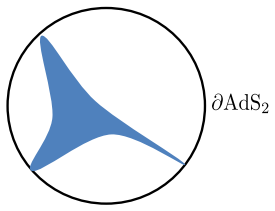
- domain assumption In the AdS2 case, the worldsheet is a thrice-punctured sphere and near each vertex operator the solutions of the linear problem approach the simple two-point solutions (68), with asymptotic forms (86) and normalization conditions (84)-(85).
- domain assumption The CDD ambiguity in the AdS2 functional equation is fixed by analytic properties of the Wronskians, with the result CDD=0, as established in [4]; this paper does not reproduce the analysis.
- domain assumption The S5 contribution to the AdS2 three-point function, included in formula (111), is taken from [4] and not computed here.
Cite this review
Pith. "Pith review of Liouville Theory, AdS$_2$ String, and Three-Point Functions." pith.science (2026). https://pith.science/paper/2INSV5SI
@misc{pith2026190803219,
  author       = {Pith},
  title        = {Pith review of: Liouville Theory, AdS$_2$ String, and Three-Point Functions},
  year         = {2026},
  howpublished = {\url{https://pith.science/paper/2INSV5SI}},
  note         = {Machine review of arXiv:1908.03219}
}
read the original abstract
This is a write-up of the lectures given in Young Researchers Integrability School 2017. The main goal is to explain the connection between the ODE/IM correspondence and the classical integrability of strings in AdS. As a warm up, we first discuss the classical three-point function of the Liouville theory. The starting point is the well-known fact that the classical solutions to the Liouville equation can be constructed by solving a Schrodinger-like differential equation. We then convert it into a set of functional equations using a method similar to the ODE/IM correspondence. The classical three-point functions can be computed directly from these functional equations, and the result matches with the classical limit of the celebrated DOZZ formula. We then discuss the semi-classical three-point function of strings in AdS2 and show that one can apply a similar idea by making use of the classical integrability of the string sigma model on AdS2. The result is given in terms of the "massive" generalization of Gamma functions, which show up also in string theory on pp-wave backgrounds and the twistorial generalization of topological string.
Figures
Reference graph
Works this paper leans on
-
[4]
Classical Integrability for Three-point Functions: Cognate Structure at Weak and Strong Couplings,
Y. Kazama, S. Komatsu and T. Nishimura, “Classical Integrability for Three-point Functions: Cognate Structure at Weak and Strong Couplings,” JHEP 1610, 042 (2016) arXiv:1603.03164
arXiv 2016
-
[16]
Classical Liouville Three-point Functions from Riemann-Hilbert Analysis
D. Honda and S. Komatsu, “Classical Liouville Three-point Functions from Riemann- Hilbert Analysis,” JHEP 1403, 038 (2014) arXiv:1311.2888
work page Pith review arXiv 2014
-
[1]
Review of AdS/CFT Integrability: An Overview,
N. Beisert et al., “Review of AdS/CFT Integrability: An Overview,” Lett. Math. Phys. 99, 3 (2012) arXiv:1012.3982
arXiv 2012
-
[2]
Y-system for Scattering Ampli- tudes,
L. F. Alday, J. Maldacena, A. Sever and P. Vieira, “Y-system for Scattering Ampli- tudes,” J. Phys. A 43, 485401 (2010) arXiv:1002.2459. 26It is worth noting that a counterpart of the BPZ differential equation on the worldsheet theory was identified in [26] for string theory on AdS3 with NSNS fluxes. 27See also a recent beautiful work on a related subject [2...
arXiv 2010
-
[3]
Correlation functions of three heavy operators: The AdS contribution,
R. A. Janik and A. Wereszczynski, “Correlation functions of three heavy operators: The AdS contribution,” JHEP 1112, 095 (2011) arXiv:1109.6262
arXiv 2011
-
[5]
χ-Systems for Correlation Functions,
J. Caetano and J. Toledo, “ χ-Systems for Correlation Functions,” JHEP 1901, 050 (2019) arXiv:1208.4548
arXiv 2019
-
[6]
On holographic three point functions for GKP strings from integrability,
Y. Kazama and S. Komatsu, “On holographic three point functions for GKP strings from integrability,” JHEP 1201, 110 (2012) Erratum: [JHEP 1206, 150 (2012)] arXiv:1110.3949
arXiv 2012
-
[7]
Wave functions and correlation functions for GKP strings from integrability,
Y. Kazama and S. Komatsu, “Wave functions and correlation functions for GKP strings from integrability,” JHEP 1209, 022 (2012) arXiv:1205.6060
arXiv 2012
Show all 39 references
-
[8]
Three-point functions in the SU(2) sector at strong coupling,
Y. Kazama and S. Komatsu, “Three-point functions in the SU(2) sector at strong coupling,” JHEP 1403, 052 (2014) arXiv:1312.3727
2014 arXiv
-
[9]
The ODE/IM Correspondence,
P. Dorey, C. Dunning and R. Tateo, “The ODE/IM Correspondence,” J. Phys. A 40, R205 (2007) hep-th/0703066
2007 arXiv
-
[10]
TBA equations and resurgent Quantum Mechanics,
K. Ito, M. Mario and H. Shu, “TBA equations and resurgent Quantum Mechanics,” JHEP 1901, 228 (2019) doi:10.1007/JHEP01(2019)228 arXiv:1811.04812
2019 arXiv
-
[11]
Two and three point functions in Liouville theory,
H. Dorn and H. J. Otto, “Two and three point functions in Liouville theory,” Nucl. Phys. B 429, 375 (1994) hep-th/9403141
1994 arXiv
-
[12]
Structure constants and conformal bootstrap in Liouville field theory,
A. B. Zamolodchikov and A. B. Zamolodchikov, “Structure constants and conformal bootstrap in Liouville field theory,” Nucl. Phys. B 477, 577 (1996) hep-th/9506136
1996 arXiv
-
[13]
Notes on quantum Liouville theory and quantum gravity,
N. Seiberg, “Notes on quantum Liouville theory and quantum gravity,” Prog. Theor. Phys. Suppl. 102, 319 (1990)
1990
-
[14]
Review of AdS/CFT Integrability, Chapter III.3: The Dressing factor,
P. Vieira and D. Volin, “Review of AdS/CFT Integrability, Chapter III.3: The Dressing factor,” Lett. Math. Phys. 99, 231 (2012) arXiv:1012.3992
2012 arXiv
-
[15]
Low’s scattering equation for the charged and neutral scalar theories,
L. Castillejo, R. H. Dalitz and F. J. Dyson, “Low’s scattering equation for the charged and neutral scalar theories,” Phys. Rev. 101, 453 (1956)
1956
-
[17]
Tailoring Three-Point Functions and Integrability III. Classical Tunneling,
N. Gromov, A. Sever and P. Vieira, “Tailoring Three-Point Functions and Integrability III. Classical Tunneling,” JHEP 1207, 044 (2012) arXiv:1111.2349
2012 arXiv
-
[18]
Classical Limit of the Three-Point Function of N=4 Supersymmet- ric Yang-Mills Theory from Integrability,
I. Kostov, “Classical Limit of the Three-Point Function of N=4 Supersymmet- ric Yang-Mills Theory from Integrability,” Phys. Rev. Lett. 108, 261604 (2012) arXiv:1203.6180. 24
2012 arXiv
-
[19]
Clustering and the Three-Point Func- tion,
Y. Jiang, S. Komatsu, I. Kostov and D. Serban, “Clustering and the Three-Point Func- tion,” J. Phys. A 49, no. 45, 454003 (2016) arXiv:1604.03575
2016 arXiv
-
[20]
On the exact open closed vertex in plane wave light cone string field theory,
J. Lucietti, S. Schafer-Nameki and A. Sinha, “On the exact open closed vertex in plane wave light cone string field theory,” Phys. Rev. D 69, 086005 (2004) hep-th/0311231
2004 arXiv
-
[21]
Three-point functions at strong coupling in the BMN limit,
B. Basso and D. L. Zhong, “Three-point functions at strong coupling in the BMN limit,” arXiv:1907.01534
1907 arXiv
-
[22]
Twistorial topological strings and a tt ∗ geometry forN = 2 theories in 4d,
S. Cecotti, A. Neitzke and C. Vafa, “Twistorial topological strings and a tt ∗ geometry forN = 2 theories in 4d,” Adv. Theor. Math. Phys. 20, 193 (2016) arXiv:1412.4793
2016 arXiv
-
[23]
On the Liouville three point function,
J. Teschner, “On the Liouville three point function,” Phys. Lett. B 363, 65 (1995) hep-th/9507109
1995 arXiv
-
[24]
Liouville theory revisited,
J. Teschner, “Liouville theory revisited,” Class. Quant. Grav. 18, R153 (2001) hep-th/0104158
2001 arXiv
-
[25]
Classical and Quantum Conformal Field Theory,
G. W. Moore and N. Seiberg, “Classical and Quantum Conformal Field Theory,” Com- mun. Math. Phys. 123, 177 (1989)
1989
-
[26]
Three-point functions in AdS3/CFT2 holog- raphy,
A. Dei, L. Eberhardt and M. R. Gaberdiel, “Three-point functions in AdS3/CFT2 holog- raphy,” arXiv:1907.13144
1907 arXiv
- [27]
-
[29]
Tau functions as Widom constants,
M. Cafasso, P. Gavrylenko and O. Lisovyy, “Tau functions as Widom constants,” Com- mun. Math. Phys. 365, no. 2, 741 (2019) arXiv:1712.08546
2019 arXiv
-
[30]
Irregular singularities in Liouville theory and Argyres- Douglas type gauge theories, I,
D. Gaiotto and J. Teschner, “Irregular singularities in Liouville theory and Argyres- Douglas type gauge theories, I,” JHEP 1212, 050 (2012) arXiv:1203.1052
2012 arXiv
- [31]
-
[32]
Boundary Liouville field theory. 1. Boundary state and boundary two point function,
V. Fateev, A. B. Zamolodchikov and A. B. Zamolodchikov, “Boundary Liouville field theory. 1. Boundary state and boundary two point function,” hep-th/0001012
-
[33]
Remarks on Liouville theory with boundary,
J. Teschner, “Remarks on Liouville theory with boundary,” PoS tmr 2000, 041 (2000) hep-th/0009138
2000 arXiv
-
[34]
One-point Functions in Defect CFT and Integrability,
M. de Leeuw, C. Kristjansen and K. Zarembo, “One-point Functions in Defect CFT and Integrability,” JHEP 1508, 098 (2015) arXiv:1506.06958
2015 arXiv
-
[35]
One-point Functions in AdS/dCFT from Matrix Product States,
I. Buhl-Mortensen, M. de Leeuw, C. Kristjansen and K. Zarembo, “One-point Functions in AdS/dCFT from Matrix Product States,” JHEP 1602, 052 (2016) arXiv:1512.02532. 25
2016 arXiv
-
[36]
Asymp- totic One-Point Functions in Gauge-String Duality with Defects,
I. Buhl-Mortensen, M. de Leeuw, A. C. Ipsen, C. Kristjansen and M. Wilhelm, “Asymp- totic One-Point Functions in Gauge-String Duality with Defects,” Phys. Rev. Lett.119, no. 26, 261604 (2017) arXiv:1704.07386
2017 arXiv
-
[37]
Introduction to Integrability and One-point Functions inN = 4 SYM and its Defect Cousin,
M. de Leeuw, A. C. Ipsen, C. Kristjansen and M. Wilhelm, “Introduction to Integrability and One-point Functions inN = 4 SYM and its Defect Cousin,” arXiv:1708.02525
-
[38]
A Quantum Check of Non-Supersymmetric AdS/dCFT,
A. Gimenez Grau, C. Kristjansen, M. Volk and M. Wilhelm, “A Quantum Check of Non-Supersymmetric AdS/dCFT,” JHEP 1901, 007 (2019) arXiv:1810.11463
2019 arXiv
-
[39]
Structure Constants in N = 4 SYM at Finite Coupling as Worldsheet g-Function,
Y. Jiang, S. Komatsu and E. Vescovi, “Structure Constants in N = 4 SYM at Finite Coupling as Worldsheet g-Function,” arXiv:1906.07733
1906 arXiv
-
[40]
Exact Three-Point Functions of Determinant Operators in Planar N=4 Supersymmetric Yang-Mills Theory,
Y. Jiang, S. Komatsu and E. Vescovi, “Exact Three-Point Functions of Determinant Operators in Planar N=4 Supersymmetric Yang-Mills Theory,” arXiv:1907.11242. 26
1907 arXiv
Reviewed August 14, 2026 · model on record in the stance chip above.
Discussion (0). Continue with ORCID to comment.