REVIEW 4 major objections 5 minor 80 references
EclipseTouch: Touch Segmentation on Ad Hoc Surfaces using Worn Infrared Shadow Casting
T0 review · 4 major / 5 minor · reviewed 2026-08-05 · deepseek-v4-flash
Pith's one-line read The paper claims that a headset-mounted active infrared shadow-casting system can estimate touch contact and hover distance on uninstrumented surfaces with 98.0% touch accuracy and 6.9 mm mean hover error, with no surface, user, or environm
desk verdict A well-engineered headset-only shadow-casting touch system whose 98.0% headline is honest for the tested conditions, with soft spots in per-condition reporting, orientation evaluation, and unreleased artifacts; the fast-motion concern is plausible but not a demonstrated flaw. read the letter →
The pith
A machine-rendered reading of the paper's core claim, the machinery that carries it, and where it could break.
The reading
What carries the argument
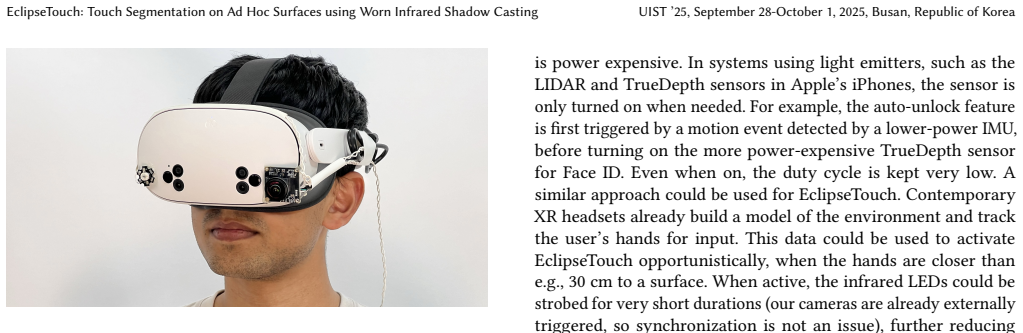
The mechanism is active infrared shadow casting with synchronized frame subtraction. LEDs offset from the camera cast a shadow whose gap from the fingertip shrinks as the finger nears the surface and vanishes at contact. The load-bearing signal is the difference image: each lit subframe minus the unlit subframe leaves only the headset-cast shadow, stripped of ambient shadows. The model is a 3.3M-parameter hybrid vision transformer built on a backbone the authors call FastViT; it takes fingertip-centered patches from the LED channels plus a finger identity, and outputs one logit that serves both as touch probability and as hover distance.
What would settle it
Run EclipseTouch during fast swipes and flicks over an instrumented surface with ground-truth contact, plotting touch accuracy against finger speed; if the 12.5 ms frame stack no longer behaves as one instant, accuracy should fall noticeably below 98% at high speeds.
Extended reading notes
Core claim
The central discovery is that shadow casting, long used for touch sensing with fixed cameras, can be compressed into a single worn device if the shadow source is actively controlled and ambient shadows are subtracted away. Four infrared LEDs fire one at a time in a 2.5 ms sequence while a global-shutter camera snaps a frame per step; the lit frames and one unlit frame are composited into one multi-channel image. Because light adds on the sensor, subtracting the unlit frame from each lit frame cancels ambient shadows, leaving only the headset's own structured shadow. A compact vision transformer on fingertip patches jointly predicts touch state and hover distance, reaching 98.0% touch accurac
Load-bearing premise
The load-bearing premise is that subtracting the no-LED image from each lit image leaves only the headset's own shadow; if the hand or head moves during the 12.5 ms capture window, or lighting changes between frames, the subtraction stops lining up and the model receives corrupted input.
Editorial extensions
If this is right
- Existing headsets with two IR illuminators and IR-sensitive cameras could gain ad hoc surface touch through a software update, since a single well-placed LED already reaches 96.7% accuracy.
- Touch input no longer requires instrumenting surfaces or wearing rings, wristbands, or fingertip sensors; the headset alone suffices.
- Because the model jointly outputs hover distance, systems can offer pre-touch feedback while the finger is still above the surface, unlike depth-camera approaches that need a large lift to separate hover from contact.
- The method keeps working in near-total darkness because it brings its own illumination, a regime where headset-camera touch methods previously failed.
- Leave-one-participant-out evaluation on unseen users supports the no-calibration claim: the reported 98.0% is not tuned per person or per surface.
Reading between the lines
- Editorial inference: the 12.5 ms frame stack is treated as one instant, so fast swipes or head motion should stress the subtraction; measuring accuracy versus finger speed would map where the 98% figure degrades.
- Editorial inference: because shadow visibility, not illumination power, seems to drive accuracy (distant LEDs beat the near-inline LED), adding LEDs far from the camera is likely more valuable than brighter LEDs in a commercial design.
- Editorial inference: since mirrors and glass are excluded, fusing the shadow channel with fingertip reflection images is a natural path to cover glossy surfaces.
- Editorial inference: the paper's synthetic-data plan is plausible because shadow casting is well modeled in graphics engines; a purely synthetic training corpus could replace the million-frame human study and expand material coverage.
Editorial analysis
A structured set of objections, weighed in public.
Referee Report
Summary. EclipseTouch proposes a headset-integrated, active-infrared shadow-casting method for detecting touch contact and estimating hover distance on uninstrumented surfaces. The system captures a five-subframe sequence at 400 FPS (no-LED plus four IR illuminators), subtracts the no-LED frame to suppress ambient shadows, composites the subframes into one 80 FPS multi-channel image, extracts fingertip patches with MediaPipe, and feeds them to a FastViT-based network that jointly outputs touch state and hover distance. The main evaluation uses 10 participants, 1,008,000 frames, 11 non-skin materials plus skin, three lighting levels, and two orientations, with leave-one-participant-out cross-validation. The headline results are a 98.0% touch-segmentation accuracy and a 6.9 mm hover-distance mean error, supported by an ablation of 26 illuminator configurations.
Significance. If the reported results hold, this is a meaningful step toward practical ad hoc touch input for AR/VR headsets: the sensing is entirely headset-worn, requires no per-user or per-surface calibration, works in darkness, and supports on-skin input. The empirical effort is unusually broad for this area, including a large multi-participant dataset, 26 illuminator-geometry ablations, three lighting levels, and both horizontal and vertical orientations. The paper also reports a very fast 0.47 ms inference time, and the authors are commendably explicit about failure modes such as glass, mirrors, very dark IR surfaces, and direct sunlight. The central phenomenon—that structured shadows from headset-mounted LEDs encode fingertip-surface distance—is well motivated and is a credible alternative to depth-camera and RGB-only approaches.
major comments (4)
- [§3.4, §3.5, §4] The frame-compositing and ambient-subtraction pipeline assumes the hand is effectively stationary across the 12.5 ms five-subframe firing sequence. Section 3.4 asserts that this duration is 'short enough' to treat the subframes as simultaneous, but no hand-speed measurements, speed-binned accuracy, or worst-case displacement analysis are provided. During a fast swipe, the finger can move many pixels between the no-LED frame and the later LED subframes, leaving subtraction residuals and misaligning the shadow channel with the fingertip patch center. Since the training data includes continuous touch/drag behavior, the 98.0% figure may partially absorb this artifact, but the claim that the method works for realistic interaction dynamics is not yet supported. Please report motion statistics from the study or add a speed-controlled evaluation.
- [§3.7, §6/Conclusion] The 30-frame mean filter over the 80 FPS output creates a 375 ms smoothing window, which introduces an unquantified output latency of roughly half the window for step changes in touch state. The conclusion claims EclipseTouch runs 'with low latency,' but only the 0.47 ms neural-network inference time is reported. For touch input, event timing is as important as classification accuracy; a threshold crossing delayed by 150–200 ms is noticeable. Please report end-to-end latency (capture, compositing, tracking, inference, smoothing) and the effect of the smoothing window on tap-onset timing.
- [§4, §5.3, §5.4] The lighting and orientation results are based on only two non-skin materials (white wall and patterned wallpaper), not the full set of 12 materials. Section 5.4 reports vertical-orientation accuracy of 95.8% overall and 93.5% for the patterned wallpaper, substantially below the horizontal numbers. The summary statement 'Across all materials (including skin), in both orientations and all three lighting conditions' is therefore stronger than the factorial design supports. I ask the authors to rephrase the claim to describe pooled/segmented coverage, or, ideally, to add at least one more material to the orientation/lighting cells to support the cross-condition claim.
- [§5.1, §5] The illuminator-geometry ablation uses six participants for training and four for testing, and the best configuration (LED 3 & 4) is then used in the leave-one-participant-out evaluation that includes those same four test participants. This creates a mild selection leak: the choice of geometry is informed by participants who later appear in the final 'unseen user' numbers. The effect is probably small because the configuration is physically motivated, but it should be acknowledged, or the geometry selection should be nested inside cross-validation, to keep the headline accuracy clean.
minor comments (5)
- [§3.7] Typo: 'Finger patches contain contain N channels' duplicates 'contain'.
- [§3.6] The text says 'we only use the five fingertip points' but then describes using wrist, MCP, and PIP joints for normalization. Please clarify which keypoints are actually used.
- [§5.1 / Figure 8] The terms 'Single Channel' and 'Multiple Channel' are not defined in the text. Clarify that 'channel' refers to the number of subframes (LED groups) input to the network as separate image channels.
- [§5.2] The phrase 'none of our materials were fully reflective, like glass' is slightly ambiguous—consider 'fully reflective, such as glass'.
- [§5.5] The skin model is trained separately from the surface model; the overall 'across all materials' statement should state this explicitly to avoid implying a single model handles skin and non-skin surfaces.
Circularity Check
No significant circularity; the reported touch and hover metrics rest on held-out participant evaluation and independent ground-truth measurement, not on self-referential fits.
full rationale
The paper's central claims are not derived from their own inputs by construction. Touch segmentation labels come from a scripted data-collection protocol in which participants either touch or hover (Section 4), and all main results use leave-one-participant-out cross-validation, always testing on unseen users (Section 5). Hover distance ground truth is obtained from an independent side webcam calibrated in millimeters (Section 5.6), so the 6.9 mm error is not a re-statement of the model's own confidence. The shadow-suppression and compositing pipeline (Sections 3.3–3.5) is a physical signal-processing chain based on additive light transport; it does not assume the quantities being predicted. Self-citations, such as EgoTouch [38], appear only as prior-work comparisons or contextual limitations, not as load-bearing justification for EclipseTouch's accuracy. The paper also explicitly acknowledges failure cases (mirrors/glass, direct sunlight, very dark or highly textured surfaces, Section 6), which further indicates the evaluation was not engineered to force a circular conclusion. The only notable methodological caveat is that the illumination geometry was selected from a 6/4 ablation split before the overall LOPO accuracy was reported; this is a potential model-selection/overfitting concern, but it does not make the reported 98.0% equal to a fitted parameter by construction. Accordingly, no circular step meets the evidentiary bar for flagging.
Assumptions & free parameters
free parameters (4)
- Neural network weights (FastViT backbone + MLP head) =
not enumerated (3.3M parameters)
- Soft touch threshold on the sigmoid output
- Mean filter window (30 frames) =
30 frames = 375 ms of latency at 80 FPS
- Model training details: epochs=10, batch=128, LR=3e-06 =
10 epochs, 128, 3e-06
assumptions (5)
- domain assumption Additive light transport on the CMOS sensor (intensity of superimposed light sources is the sum of their intensities)
- domain assumption Frame-to-frame stability: hand and scene are approximately static over the 12.5 ms five-frame capture sequence
- domain assumption MediaPipe hand tracker provides reliable 2.5D fingertip keypoints on the IR-lit subframe
- domain assumption Leave-one-participant-out performance on 10 participants generalizes to the broader population
- domain assumption The side-webcam pixel-to-mm calibration in the hover study is accurate ground truth
Cite this review
Pith. "Pith review of EclipseTouch: Touch Segmentation on Ad Hoc Surfaces using Worn Infrared Shadow Casting." pith.science (2026). https://pith.science/paper/2J3ISR54
@misc{pith2026250903430,
  author       = {Pith},
  title        = {Pith review of: EclipseTouch: Touch Segmentation on Ad Hoc Surfaces using Worn Infrared Shadow Casting},
  year         = {2026},
  howpublished = {\url{https://pith.science/paper/2J3ISR54}},
  note         = {Machine review of arXiv:2509.03430}
}
read the original abstract
The ability to detect touch events on uninstrumented, everyday surfaces has been a long-standing goal for mixed reality systems. Prior work has shown that virtual interfaces bound to physical surfaces offer performance and ergonomic benefits over tapping at interfaces floating in the air. A wide variety of approaches have been previously developed, to which we contribute a new headset-integrated technique called \systemname. We use a combination of a computer-triggered camera and one or more infrared emitters to create structured shadows, from which we can accurately estimate hover distance (mean error of 6.9~mm) and touch contact (98.0\% accuracy). We discuss how our technique works across a range of conditions, including surface material, interaction orientation, and environmental lighting.
Figures


Figures from the paper (8 more)


Reference graph
Works this paper leans on
-
[1]
Y. Adajania, J. Gosalia, A. Kanade, H. Mehta, and N. Shekokar. 2010. Virtual Key- board Using Shadow Analysis. In 2010 3rd International Conference on Emerging Trends in Engineering and Technology . 163–165. https://doi.org/10.1109/ICETET. 2010.115 ISSN: 2157-0485
-
[2]
Ankur Agarwal, Shahram Izadi, Manmohan Chandraker, and Andrew Blake
-
[3]
Hrvoje Benko and Andrew Wilson. 2009. DepthTouch: Using depth-sensing camera to enable freehand interactions on and above the interactive surface. In UIST ’25, September 28-October 1, 2025, Busan, Republic of Korea Mollyn, DeVrio & Harrison Proceedings of the IEEE workshop on tabletops and interactive surfaces , Vol. 8. 21
work page 2009
-
[4]
Kefan Chen, Chaerin Min, Linguang Zhang, Shreyas Hampali, Cem Keskin, and Srinath Sridhar. 2025. FoundHand: Large-Scale Domain-Specific Learning for Controllable Hand Image Generation. In Proceedings of the Computer Vision and Pattern Recognition Conference (CVPR) . 17448–17460
work page 2025
-
[5]
Edin, and Patrick Van Der Smagt
Nutan Chen, Göran Westling, Benoni B. Edin, and Patrick Van Der Smagt. 2020. Es- timating Fingertip Forces, Torques, and Local Curvatures from Fingernail Images. Robotica 38, 7 (July 2020), 1242–1262. https://doi.org/10.1017/S0263574719001383
-
[6]
Camille Dupré, Caroline Appert, Stéphanie Rey, Houssem Saidi, and Emmanuel Pietriga. 2024. TriPad: Touch Input in AR on Ordinary Surfaces with Hand Track- ing Only. In Proceedings of the CHI Conference on Human Factors in Computing Systems. ACM, Honolulu HI USA, 1–18. https://doi.org/10.1145/3613904.3642323
arXiv 2024
-
[7]
Neil Xu Fan and Robert Xiao. 2022. Reducing the Latency of Touch Tracking on Ad-hoc Surfaces. Proc. ACM Hum.-Comput. Interact. 6, ISS (Nov. 2022), 577:489– 577:499. https://doi.org/10.1145/3567730
-
[8]
Markus Funk, Stefan Schneegass, Michael Behringer, Niels Henze, and Albrecht Schmidt. 2015. An Interactive Curtain for Media Usage in the Shower. InProceed- ings of the 4th International Symposium on Pervasive Displays. ACM, Saarbruecken Germany, 225–231. https://doi.org/10.1145/2757710.2757713
Show all 80 references
-
[9]
Jun Gong, Aakar Gupta, and Hrvoje Benko. 2020. Acustico: Surface Tap Detection and Localization using Wrist-based Acoustic TDOA Sensing. In Proceedings of the 33rd Annual ACM Symposium on User Interface Software and Technology (UIST ’20). Association for Computing Machinery, N...
2020
-
[10]
Patrick Grady, Jeremy A Collins, Chengcheng Tang, Christopher D Twigg, Kunal Aneja, James Hays, and Charles C Kemp. 2024. PressureVision++: Estimating Fingertip Pressure from Diverse RGB Images. IEEE/CVF Winter Conference on Applications of Computer Vision (W ACV)(2024)
2024
-
[11]
Twigg, Chengde Wan, James Hays, and Charles C
Patrick Grady, Chengcheng Tang, Samarth Brahmbhatt, Christopher D. Twigg, Chengde Wan, James Hays, and Charles C. Kemp. 2022. PressureVision: Estimat- ing Hand Pressure from a Single RGB Image. In Computer Vision – ECCV 2022: 17th European Conference, Tel A viv, Israel, Octobe...
2022 doi
-
[12]
Yizheng Gu, Chun Yu, Zhipeng Li, Weiqi Li, Shuchang Xu, Xiaoying Wei, and Yuanchun Shi. 2019. Accurate and Low-Latency Sensing of Touch Contact on Any Surface with Finger-Worn IMU Sensor. In Proceedings of the 32nd Annual ACM Symposium on User Interface Software and Technology...
2019
-
[13]
Yizheng Gu, Chun Yu, Zhipeng Li, Zhaoheng Li, Xiaoying Wei, and Yuanchun Shi. 2020. QwertyRing: Text Entry on Physical Surfaces Using a Ring. Proc. ACM Interact. Mob. Wearable Ubiquitous Technol. 4, 4 (Dec. 2020), 128:1–128:29. https://doi.org/10.1145/3432204
2020 doi
-
[15]
Chris Harrison, Hrvoje Benko, and Andrew D. Wilson. 2011. OmniTouch: wearable multitouch interaction everywhere. In Proceedings of the 24th an- nual ACM symposium on User interface software and technology (UIST ’11) . As- sociation for Computing Machinery, New York, NY, USA, 4...
2011
-
[16]
Chris Harrison and Scott E. Hudson. 2008. Scratch input: creating large, inex- pensive, unpowered and mobile finger input surfaces. In Proceedings of the 21st Annual ACM Symposium on User Interface Software and Technology (Monterey, CA, USA) (UIST ’08). Association for Computi...
2008
-
[17]
Chris Harrison, Desney Tan, and Dan Morris. 2010. Skinput: appropriating the body as an input surface. In Proceedings of the SIGCHI Conference on Human Factors in Computing Systems (CHI ’10) . Association for Computing Machinery, New York, NY, USA, 453–462. https://doi.org/10....
2010
-
[18]
Zhe He, Xiangyang Wang, Yuanchun Shi, Chi Hsia, Chen Liang, and Chun Yu
-
[19]
David Heaney. 2024. Quest 3S Has Better Low-Light Hand Tracking Than Quest
2024
- [20]
-
[21]
Yuhan Hu, Sara Maria Bejarano, and Guy Hoffman. 2020. ShadowSense: Detecting Human Touch in a Social Robot Using Shadow Image Classification. Proc. ACM Interact. Mob. Wearable Ubiquitous Technol. 4, 4 (Dec. 2020), 132:1–132:24. https: //doi.org/10.1145/3432202
2020 doi
-
[22]
https://www.uploadvr.com/quest3s-hand-tracking-better-than-quest-3/
-
[23]
Daisuke Iwai and Kosuke Sato. 2005. Heat sensation in image creation with thermal vision. In Proceedings of the 2005 ACM SIGCHI International Conference on Advances in computer entertainment technology (ACE ’05) . Association for Computing Machinery, New York, NY, USA, 213–216...
2005
-
[24]
Wolf Kienzle and Ken Hinckley. 2014. LightRing: always-available 2D input on any surface. In Proceedings of the 27th annual ACM symposium on User interface software and technology. ACM, Honolulu Hawaii USA, 157–160. https://doi.org/ 10.1145/2642918.2647376
2014
-
[25]
Iacolina, Alessandro Soro, and Riccardo Scateni
Samuel A. Iacolina, Alessandro Soro, and Riccardo Scateni. 2011. Improving FTIR based multi-touch sensors with IR shadow tracking. In Proceedings of the 3rd ACM SIGCHI symposium on Engineering interactive computing systems. ACM, Pisa Italy, 241–246. https://doi.org/10.1145/199...
2011
-
[26]
Daehwa Kim, Keunwoo Park, and Geehyuk Lee. 2021. AtaTouch: Robust Finger Pinch Detection for a VR Controller Using RF Return Loss. In Proceedings of the 2021 CHI Conference on Human Factors in Computing Systems (Yokohama, Japan) (CHI ’21). Association for Computing Machinery, ...
2021
-
[27]
Daehwa Kim, Eric Whitmire, Roger Boldu, Wolf Kienzle, and Hrvoje Benko
-
[28]
Wolf Kienzle, Eric Whitmire, Chris Rittaler, and Hrvoje Benko. 2021. ElectroRing: Subtle Pinch and Touch Detection with a Ring. In Proceedings of the 2021 CHI Conference on Human Factors in Computing Systems (CHI ’21) . Association for Computing Machinery, New York, NY, USA, 1...
2021
-
[29]
Daniel Kurz. 2014. Thermal touch: Thermography-enabled everywhere touch interfaces for mobile augmented reality applications. In 2014 IEEE International Symposium on Mixed and Augmented Reality (ISMAR) . 9–16. https://doi.org/10. 1109/ISMAR.2014.6948403
2014
-
[30]
Gierad Laput and Chris Harrison. 2019. SurfaceSight: A New Spin on Touch, User, and Object Sensing for IoT Experiences. In Proceedings of the 2019 CHI Conference on Human Factors in Computing Systems (Glasgow, Scotland Uk) (CHI ’19) . Association for Computing Machinery, New Y...
2019
-
[31]
Eric Larson, Gabe Cohn, Sidhant Gupta, Xiaofeng Ren, Beverly Harrison, Dieter Fox, and Shwetak Patel. 2011. HeatWave: thermal imaging for surface user inter- action. In Proceedings of the SIGCHI Conference on Human Factors in Computing Systems (CHI ’11). Association for Comput...
2011
-
[32]
Krueger, Thomas Gionfriddo, and Katrin Hinrichsen
Myron W. Krueger, Thomas Gionfriddo, and Katrin Hinrichsen. 1985. VIDEO- PLACE—an artificial reality. In Proceedings of the SIGCHI Conference on Human Factors in Computing Systems (CHI ’85) . Association for Computing Machinery, New York, NY, USA, 35–40. https://doi.org/10.114...
1985
-
[33]
Chen Liang, Chun Yu, Yue Qin, Yuntao Wang, and Yuanchun Shi. 2021. DualRing: Enabling Subtle and Expressive Hand Interaction with Dual IMU Rings. Proceed- ings of the ACM on Interactive, Mobile, Wearable and Ubiquitous Technologies 5, 3 (Sept. 2021), 1–27. https://doi.org/10.1...
2021 doi
-
[34]
Joe Marshall, Tony Pridmore, Mike Pound, Steve Benford, and Boriana Koleva
-
[35]
Damien Masson, Alix Goguey, Sylvain Malacria, and Géry Casiez. 2017. WhichFin- gers: Identifying Fingers on Touch Surfaces and Keyboards using Vibration Sen- sors. In Proceedings of the 30th Annual ACM Symposium on User Interface Software and Technology (UIST ’17) . Associatio...
2017
-
[37]
Manuel Meier, Paul Streli, Andreas Fender, and Christian Holz. 2021. TapID: Rapid Touch Interaction in Virtual Reality using Wearable Sensing. In 2021 IEEE Virtual Reality and 3D User Interfaces (VR) . 519–528. https://doi.org/10.1109/ VR50410.2021.00076 ISSN: 2642-5254
2021
-
[38]
Vimal Mollyn and Chris Harrison. 2024. EgoTouch: On-Body Touch Input Using AR/VR Headset Cameras. In Proceedings of the 37th Annual ACM Symposium on User Interface Software and Technology (UIST ’24) . Association for Computing Machinery, New York, NY, USA, 1–11. https://doi.or...
2024
-
[39]
Tan, Dan Morris, Shwetak N
Adiyan Mujibiya, Xiang Cao, Desney S. Tan, Dan Morris, Shwetak N. Patel, and Jun Rekimoto. 2013. The sound of touch: on-body touch and gesture sensing EclipseTouch: Touch Segmentation on Ad Hoc Surfaces using Worn Infrared Shadow Casting UIST ’25, September 28-October 1, 2025,...
2013
-
[40]
Takehiro Niikura, Takashi Matsubara, and Naoki Mori. 2016. Touch Detection System for Various Surfaces Using Shadow of Finger. In Proceedings of the 2016 ACM International Conference on Interactive Surfaces and Spaces (Niagara Falls, Ontario, Canada) (ISS ’16). Association for...
2016
-
[41]
Takashi Matsubara, Naoki Mori, Takehiro Niikura, and Shun’ichi Tano. 2017. Touch detection method for non-display surface using multiple shadows of finger. In 2017 IEEE 6th Global Conference on Consumer Electronics (GCCE) . 1–5. https://doi.org/10.1109/GCCE.2017.8229364
2017
-
[42]
Ju Young Oh, Ji-Hyung Park, and Jung-Min Park. 2020. FingerTouch: Touch Interaction Using a Fingernail-Mounted Sensor on a Head-Mounted Display for Augmented Reality. IEEE Access 8 (2020), 101192–101208. https://doi.org/10. 1109/ACCESS.2020.2997972 Conference Name: IEEE Access
2020
-
[43]
Makoto Ono, Buntarou Shizuki, and Jiro Tanaka. 2013. Touch & activate: adding interactivity to existing objects using active acoustic sensing. In Proceedings of the 26th annual ACM symposium on User interface software and technology . ACM, St. Andrews Scotland, United Kingdom,...
2013 doi
-
[44]
Pak-Kiu Chung, Bing Fang, and F. Quek. 2008. MirrorTrack - a vision based multi-touch system for glossy display surfaces. In 5th International Conference on Visual Information Engineering (VIE 2008) . IEE, Xi’an, China, 571–576. https: //doi.org/10.1049/cp:20080379
2008 doi
-
[45]
Siyou Pei, Pradyumna Chari, Xue Wang, Xiaoying Yang, Achuta Kadambi, and Yang Zhang. 2022. ForceSight: Non-Contact Force Sensing with Laser Speckle Imaging. In Proceedings of the 35th Annual ACM Symposium on User Interface Software and Technology (Bend, OR, USA) (UIST ’22). As...
2022
-
[46]
Ju Young Oh, Jun Lee, Joong Ho Lee, and Ji Hyung Park. 2017. AnywhereTouch: Finger Tracking Method on Arbitrary Surface Using Nailed-Mounted IMU for Mobile HMD. In HCI International 2017 – Posters’ Extended Abstracts , Constantine Stephanidis (Ed.). Springer International Publ...
2017 doi
-
[47]
Erez Posner, Nick Starzicki, and Eyal Katz. 2012. A single camera based floating virtual keyboard with improved touch detection. In 2012 IEEE 27th Convention of Electrical and Electronics Engineers in Israel . 1–5. https://doi.org/10.1109/EEEI. 2012.6377072
2012
-
[48]
Mark Richardson, Matt Durasoff, and Robert Wang. 2020. Decoding Surface Touch Typing from Hand-Tracking. In Proceedings of the 33rd Annual ACM Symposium on User Interface Software and Technology . ACM, Virtual Event USA, 686–696. https://doi.org/10.1145/3379337.3415816
2020
-
[49]
Vivian Shen, James Spann, and Chris Harrison. 2021. FarOut Touch: Extending the Range of ad hoc Touch Sensing with Depth Cameras. InSymposium on Spatial User Interaction. ACM, Virtual Event USA, 1–12. https://doi.org/10.1145/3485279. 3485281
2021 doi
-
[50]
Xiyuan Shen, Chun Yu, Xutong Wang, Chen Liang, Haozhan Chen, and Yuanchun Shi. 2024. MouseRing: Always-available Touchpad Interaction with IMU Rings. In Proceedings of the 2024 CHI Conference on Human Factors in Computing Systems (CHI ’24) . Association for Computing Machinery...
2024
-
[51]
DT Pham, M Al-Kutubi, Z Ji, M Yang, Z Wang, and S Catheline. 2005. Tangible acoustic interface approaches. In Proceedings of IPROMS 2005 Virtual Conference . Citeseer, 497–502
2005
-
[52]
Yilei Shi, Haimo Zhang, Kaixing Zhao, Jiashuo Cao, Mengmeng Sun, and Suranga Nanayakkara. 2020. Ready, Steady, Touch!: Sensing Physical Contact with a Finger-Mounted IMU. Proceedings of the ACM on Interactive, Mobile, Wearable and Ubiquitous Technologies 4, 2 (June 2020), 1–25...
2020 doi
-
[53]
Garth Shoemaker, Anthony Tang, and Kellogg S. Booth. 2007. Shadow reaching: a new perspective on interaction for large displays.Proceedings of the 20th annual ACM symposium on User interface software and technology (Oct. 2007), 53–56. https://doi.org/10.1145/1294211.1294221 Co...
2007
-
[54]
Paul Streli, Jiaxi Jiang, Juliete Rossie, and Christian Holz. 2023. Structured Light Speckle: Joint Ego-Centric Depth Estimation and Low-Latency Contact Detection via Remote Vibrometry. In Proceedings of the 36th Annual ACM Symposium on User Interface Software and Technology ....
2023
-
[55]
Paul Streli, Mark Richardson, Fadi Botros, Shugao Ma, Robert Wang, and Christian Holz. 2024. TouchInsight: Uncertainty-aware Rapid Touch and Text Input for Mixed Reality from Egocentric Vision. In Proceedings of the 37th Annual ACM Symposium on User Interface Software and Tech...
2024
-
[56]
Yilei Shi, Haimo Zhang, Jiashuo Cao, and Suranga Nanayakkara. 2020. Ver- saTouch: A Versatile Plug-and-Play System that Enables Touch Interactions on Everyday Passive Surfaces. InProceedings of the Augmented Humans International Conference (AHs ’20). Association for Computing ...
2020
-
[57]
Naoki Sugita, Daisuke Iwai, and Kosuke Sato. 2008. Touch sensing by image analysis of fingernail. In 2008 SICE Annual Conference. 1520–1525. https://doi. org/10.1109/SICE.2008.4654901
2008
-
[58]
Joseph Thomas. 2013. A Camera Based Virtual Keyboard with Touch Detection by Shadow Analysis. (2013). jsthomas.github.io/docs/vkeyboard/vkeyboard.pdf
2013
-
[59]
Pavan Kumar Anasosalu Vasu, James Gabriel, Jeff Zhu, Oncel Tuzel, and Anurag Ranjan. 2023. FastViT: A Fast Hybrid Vision Transformer using Structural Reparameterization. In Proceedings of the IEEE/CVF International Conference on Computer Vision
2023
-
[60]
Boga Vishal and K Deepak Lawrence. 2017. Paper piano — Shadow analysis based touch interaction. In 2017 2nd International Conference on Man and Machine Interfacing (MAMI). 1–6. https://doi.org/10.1109/MAMI.2017.8307890
2017
-
[61]
Joshua Strickon and Joseph Paradiso. 1998. Tracking hands above large interac- tive surfaces with a low-cost scanning laser rangefinder. In CHI 98 Conference Summary on Human Factors in Computing Systems (CHI ’98) . Association for Computing Machinery, New York, NY, USA, 231–2...
1998
-
[62]
Anandghan Waghmare, Youssef Ben Taleb, Ishan Chatterjee, Arjun Narendra, and Shwetak Patel. 2023. Z-Ring: Single-Point Bio-Impedance Sensing for Gesture, Touch, Object and User Recognition. In Proceedings of the 2023 CHI Conference on Human Factors in Computing Systems . ACM, ...
2023
-
[63]
Wikipedia. 2025. Lux. https://en.wikipedia.org/w/index.php?title=Lux&oldid= 1284696029 Page Version ID: 1284696029
2025
-
[64]
Andrew D. Wilson. 2005. PlayAnywhere: a compact interactive tabletop projection-vision system. In Proceedings of the 18th annual ACM symposium on User interface software and technology . ACM, Seattle WA USA, 83–92. https: //doi.org/10.1145/1095034.1095047
2005
-
[65]
Andrew D. Wilson. 2010. Using a depth camera as a touch sensor. In ACM International Conference on Interactive Tabletops and Surfaces . ACM, Saarbrücken Germany, 69–72. https://doi.org/10.1145/1936652.1936665
2010
-
[66]
Huateng Vision. 2023. HT-SUA33GM-T1V-C : Huateng Vision. https: //huatengvision.com/product/195/
2023
-
[67]
Robert Xiao, Scott Hudson, and Chris Harrison. 2016. DIRECT: Making Touch Tracking on Ordinary Surfaces Practical with Hybrid Depth-Infrared Sensing. In Proceedings of the 2016 ACM International Conference on Interactive Surfaces and Spaces. ACM, Niagara Falls Ontario Canada, ...
2016
-
[68]
Robert Xiao, Scott Hudson, and Chris Harrison. 2017. Supporting Responsive Cohabitation Between Virtual Interfaces and Physical Objects on Everyday Sur- faces. Proc. ACM Hum.-Comput. Interact. 1, EICS, Article 12 (June 2017), 17 pages. https://doi.org/10.1145/3095814
2017 doi
-
[69]
Wilson, and Hrvoje Benko
Robert Xiao, Julia Schwarz, Nick Throm, Andrew D. Wilson, and Hrvoje Benko
-
[70]
Dickerson
Chungkuk Yoo, Inseok Hwang, Eric Rozner, Yu Gu, and Robert F. Dickerson
-
[71]
Ziyi Xia, Xincheng Huang, Sidney S Fels, and Robert Xiao. 2025. HaloTouch: Using IR Multi-Path Interference to Support Touch Interactions with General Surfaces. In Proceedings of the 2025 CHI Conference on Human Factors in Computing Systems (CHI ’25). Association for Computing...
2025
- [72]
-
[73]
Lvmin Zhang, Anyi Rao, and Maneesh Agrawala. 2025. Scaling In-the-Wild Training for Diffusion-based Illumination Harmonization and Editing by Impos- ing Consistent Light Transport. In The Thirteenth International Conference on Learning Representations. https://openreview.net/f...
2025
-
[74]
Ng, Hrvoje Benko, and Chris Harrison
Yang Zhang, Wolf Kienzle, Yanjun Ma, Shiu S. Ng, Hrvoje Benko, and Chris Harrison. 2019. ActiTouch: Robust Touch Detection for On-Skin AR/VR Interfaces. In Proceedings of the 32nd Annual ACM Symposium on User Interface Software and Technology (UIST ’19) . Association for Compu...
2019
-
[75]
Yang Zhang, Junhan Zhou, Gierad Laput, and Chris Harrison. 2016. SkinTrack: Using the Body as an Electrical Waveguide for Continuous Finger Tracking on the Skin. In Proceedings of the 2016 CHI Conference on Human Factors in Computing UIST ’25, September 28-October 1, 2025, Bus...
2016
-
[76]
Yiming Zhao, Taein Kwon, Paul Streli, Marc Pollefeys, and Christian Holz. 2025. EgoPressure: A Dataset for Hand Pressure and Pose Estimation in Egocentric Vision. In Proceedings of the Computer Vision and Pattern Recognition Conference (CVPR). 27727–27738
2025
-
[78]
Cunefare, Omer T
Cheng Zhang, Qiuyue Xue, Anandghan Waghmare, Sumeet Jain, Yiming Pu, Sinan Hersek, Kent Lyons, Kenneth A. Cunefare, Omer T. Inan, and Gregory D. Abowd. 2017. SoundTrak: Continuous 3D Tracking of a Finger Using Active Acoustics. Proceedings of the ACM on Interactive, Mobile, We...
2017 doi
-
[2007]
In Second Annual IEEE International Workshop on Horizontal Interactive Human- Computer Systems (TABLETOP’07)
High precision multi-touch sensing on surfaces using overhead cameras. In Second Annual IEEE International Workshop on Horizontal Interactive Human- Computer Systems (TABLETOP’07). IEEE, 197–200
-
[2009]
In Proceedings of the 6th International Conference on Pervasive Computing (Pervasive ’08)
Pressing the Flesh: Sensing Multiple Touch and Finger Pressure on Arbitrary Surfaces. In Proceedings of the 6th International Conference on Pervasive Computing (Pervasive ’08). Springer-Verlag, Berlin, Heidelberg, 38–55. https://doi.org/10. 1007/978-3-540-79576-6_3
-
[2016]
In Proceedings of the 2016 CHI Conference on Human Factors in Computing Systems (CHI ’16)
SymmetriSense: Enabling Near-Surface Interactivity on Glossy Surfaces using a Single Commodity Smartphone. In Proceedings of the 2016 CHI Conference on Human Factors in Computing Systems (CHI ’16) . Association for Computing Machinery, New York, NY, USA, 5126–5137. https://doi...
2016 doi
-
[2018]
IEEE Transactions on Visualization and Computer Graphics 24, 4 (April 2018), 1653–1660
MRTouch: Adding Touch Input to Head-Mounted Mixed Reality. IEEE Transactions on Visualization and Computer Graphics 24, 4 (April 2018), 1653–1660. https://doi.org/10.1109/TVCG.2018.2794222
2018
-
[2024]
In Proceedings of the 2024 ACM International Symposium on Wearable Computers (ISWC ’24)
SoundScroll: Robust Finger Slide Detection Using Friction Sound and Wrist- Worn Microphones. In Proceedings of the 2024 ACM International Symposium on Wearable Computers (ISWC ’24) . Association for Computing Machinery, New York, NY, USA, 63–70. https://doi.org/10.1145/3675095.3676614
2024
Reviewed August 5, 2026 · model on record in the stance chip above.
Discussion (0). Sign in to comment.