REVIEW 2 major objections 5 minor 1 cited by
Exploring the encoding of linguistic representations in the Fully-Connected Layer of generative CNNs for Speech
T0 review · 2 major / 5 minor · reviewed 2026-08-10 · deepseek-v4-flash
Pith's one-line read A speech-generating CNN encodes similar vowels with similar internal weight patterns across different words, rather than storing each word as an unanalyzable whole.
desk verdict A genuinely novel set of FC-layer interpretability manipulations for a speech GAN, but the main claim about shared vowel encodings is undermined by output-dependent column selection and a lack of statistical controls. read the letter →
The pith
A machine-rendered reading of the paper's core claim, the machinery that carries it, and where it could break.
The reading
What carries the argument
The central object is the variable-specific weight matrix $W_i$ of the fully-connected layer: for each of the 100 latent inputs (9 one-hot lexical codes plus 91 noise variables), the trained weights form a $1024 \times 16$ feature-map matrix whose time axis mirrors the output waveform. Because the FC layer's pre-activation output is the sum of these 100 weight matrices each scaled by its latent variable value, each matrix can be treated as an independently testable blueprint of that variable's contribution. Passing a full weight matrix into the convolutional block reproduces the corresponding word, and passing a single extracted column in isolation yields a single vowel. Correlation matrices of these vowel columns, together with correlation matrices of the averaged output spectra, carry the argument that representational similarity in the FC layer tracks acoustic and phonological similarity.
What would settle it
Train a fresh ciwGAN on the same nine words with a different random seed, extract vowel columns by a fixed rule that does not listen to outputs (for example, the column at the temporal position matching each vowel's known duration in the training data), and compute the correlation matrix of those columns; if high-vowel columns no longer correlate more strongly with each other than with low-vowel columns, the reported structure is an artifact of output-guided column selection.
Extended reading notes
Core claim
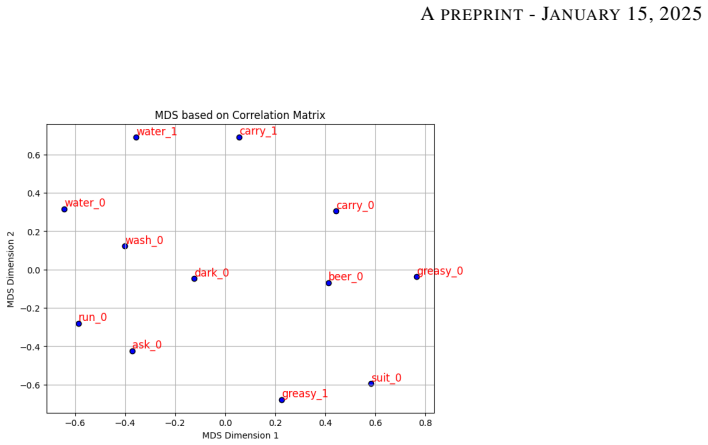
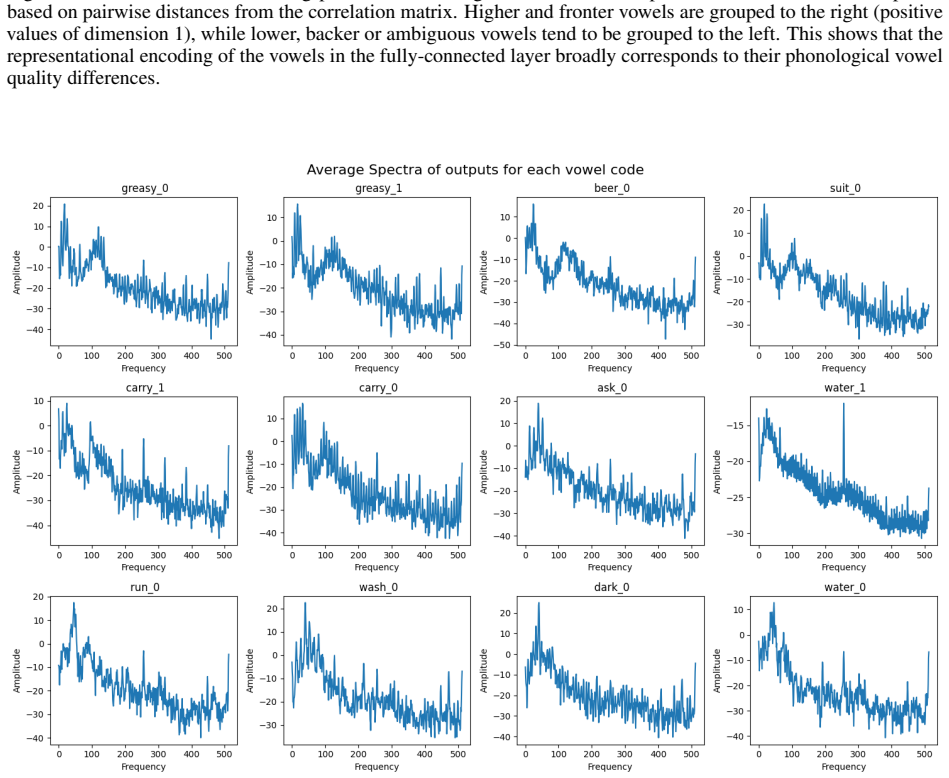
The paper's central discovery is that in ciwGAN each latent code's fully-connected weight matrix is not a monolithic word code but contains temporally organized columns that, passed alone through the convolutional layers, produce a single vowel. Comparing 12 such vowel columns taken from the 9 lexical items shows that phonetically similar vowels have positively correlated weight patterns, while high and low vowels are negatively correlated; multidimensional scaling places the high vowels together and the low vowels apart. The authors state this as evidence that similar-sounding vowels are encoded in similar ways in the FC layer, both within and across the weight matrices of lexically specific latent codes. They further show that these vowel columns behave compositionally: placing a vowel column beside a copy of itself or beside a vowel column from another word consistently yields an /s/ plus vowel output, with the /s/ and vowel information located in distinct channel groups.
Load-bearing premise
The central result assumes that a single 1024-sample column of FC weights, chosen by inspecting which column produces only a vowel when run through the convolutional layers, is a valid and representative encoding of that vowel in the model; if that selection is confounded by how the convolutional layers respond to isolated columns, the clustering of similar vowels could be an artifact.
Editorial extensions
If this is right
- If the claim is correct, ciwGAN's lexical codes are not holistic word templates; shared sublexical structure across words implies the model has learned emergent vowel categories without supervision.
- The weight-matrix-as-input technique provides a label-free way to explore a latent space: each code's weight matrix alone can regenerate its lexical item's waveform, enabling bottom-up analysis of other trained models.
- The column-extraction and recombination technique shows that FC columns act as compositional units, which could support segment-level manipulation in latent speech models, such as swapping vowel columns between words.
- The finding that distinct channel groups specialize in frication versus vowel information suggests redundancy in the FC layer, implying the network might be compressible without losing its linguistically structured representations.
- Because the methods only require a fully-connected projection from a latent space, the same techniques should transfer to other generative architectures, such as autoencoders, for probing their internal linguistic structure.
Reading between the lines
- The paper selects vowel columns by listening to which isolated column yields a clean vowel; a fully blind selection rule based only on temporal position or spectral criteria would be a stronger test that the correlation structure is not an artifact of output-guided column choice.
- The demonstrated compositionality of columns suggests a concrete next experiment the paper does not run: transplanting the /i/ column from 'greasy' into the feature map of 'suit' and checking whether the output becomes something like 'seat', which would test word-level recombination from sublexical units.
- If the channel-localization result generalizes, ablating the specific channel groups that the paper found to carry pure vowel or pure frication information should remove those sounds from a full word output, giving a causal test of the claimed representational dissociation.
- A natural extension is to apply column extraction to consonants rather than only vowels; the prediction would be that any sublexical segment with a consistent acoustic realization forms its own correlated cluster of FC columns across codes.
Signed reviews
Editorial analysis
A structured set of objections, weighed in public.
Referee Report
Summary. The paper proposes two interpretability techniques for the fully-connected (FC) layer of ciwGAN, a WaveGAN variant with categorical latent codes trained on TIMIT words. Experiment 1 shows that latent-code weight matrices have larger average magnitudes than noise-variable matrices and, when passed through the convolutional layers, generate the corresponding lexical items. Experiment 2 extracts individual FC columns that, in isolation, produce single vowels; comparing 12 such columns across 9 lexical codes, the paper reports that high vowels cluster together and low vowels cluster together in a correlation matrix and MDS plot, and that recombining vowel columns yields predictable /s/+vowel outputs. The central claim is that ciwGAN encodes lexical information in a linguistically principled way, with shared lexically-invariant sublexical representations in the FC layer.
Significance. If the central claim is substantiated, the paper makes a genuinely useful contribution to interpretability of generative speech models: it introduces weight-matrix-as-input probing and column/channel manipulation as tools that go beyond latent-space interpolation, and it provides evidence against purely holistic lexical encoding in a GAN generator. The work is exploratory and methodologically creative, and the channel-masking experiment (Fig. 17) is a nice illustration of how information can be localized. However, the main conclusion currently rests on a manual, potentially circular column-selection procedure and on descriptive statistics without significance testing, so the strength of the claim is not yet commensurate with the evidence.
major comments (2)
- [Section 4.1, Figs. 10-13] The correlation and MDS analyses are purely descriptive, with no significance tests, confidence intervals, or effect sizes reported. With only 12 columns and strong dependencies among the 1024 values within each column, the observed high/low grouping could plausibly arise by chance. A permutation test (e.g., shuffling vowel-category labels or the set of columns) or a bootstrap over latent codes is needed before concluding that similar-sounding vowels are encoded similarly in the FC layer.
- [Section 2.2 and Section 4] The isolated-column probe sets all other latent variables to zero and omits the trainable bias term, even though the convolutional layers were trained on feature maps that are sums of 100 scaled weight matrices plus a bias. The paper acknowledges this limitation for z-variables in Section 3.4 ('their outputs should be interpreted as mere approximations'), but it does not address the same issue in Experiment 2, where the isolated-column input is the basis for the main claim. The authors should show that the results are robust to including the bias term or to varying the other latent variables, or explicitly justify why an off-manifold single-column input is a valid probe of the FC layer's encoding.
minor comments (5)
- [Section 1.2] There is a typo: 'have been frequently used for for image and audio generation' should read 'frequently used for image and audio generation.'
- [Section 3.2] The phrase 'we demonstrates that' should be 'we demonstrate that.'
- [Section 4.1 (Fig. 12 caption)] The caption states that high-front vowels have a bimodal peak 'representing a high F1 and low F2,' but high-front vowels have low F1 and high F2; mid-low vowels have higher F1 and lower F2. This should be corrected for accuracy.
- [Section 4.2] The claim that feature columns 'can function as compositional units' is asserted on the basis of /s/+vowel outputs from repeated columns, but the paper itself proposes an alternative explanation in terms of convolutional kernel interactions and channel alignment. This wording should be moderated, since the evidence distinguishes predictable contextual effects from true compositionality only weakly.
- [General] No code, model checkpoint, or data availability statement is provided; given that the analysis relies on manual selection and qualitative inspection, releasing code and the exact column indices would substantially improve reproducibility.
Circularity Check
No significant circularity; the central clustering result is not forced by construction, though manual column selection poses a validity risk.
full rationale
The paper's central claim, that lexically specific ciwGAN latent codes share sublexical FC-weight structure, is not derived from a fitted parameter or from the vowel labels themselves. Experiment 2 extracts one weight column per vowel by passing columns through the convolutional layers and selecting the column whose output contains only vowel information; the 12x12 FC correlation matrix and MDS are then computed on those same selected columns. The observed grouping of high versus low vowels is not guaranteed by construction: the selection criterion (output is a clear vowel) does not entail that columns for similar vowels will be mutually correlated, and the paper provides some independent contrasts, such as z-variable weight matrices yielding non-lexical outputs in Experiment 1b. The principal weakness is selection bias: columns are chosen manually by inspecting outputs, with no algorithmic rule, inter-rater reliability, or null baseline of randomly selected columns, so the clustering could partly reflect the selection criterion rather than a general lexically invariant encoding. That is a methodological validity concern, not a circular derivation. Self-citations to Beguš's prior ciwGAN work supply the model architecture and background, but the new weight-matrix analysis is conducted in this paper and does not reduce to those citations. The unsupported assertion that the current implementation showed 'similar success, according to metrics used by prior studies' is a reporting gap, not a circular step. No equation or claim is equivalent to its own input by construction; thus no significant circularity is found.
Assumptions & free parameters
free parameters (1)
- Manually selected vowel column indices (12 columns) =
not reported (only figure references)
assumptions (2)
- ad hoc to paper Isolated weight matrices or columns, passed alone into the convolutional layers, are valid probes of what a latent code encodes, even though the convolutional layers were trained on feature maps that sum all 100 latent variables plus a bias term.
- ad hoc to paper A manually selected FC column that produces only a vowel in isolation is a faithful representation of that vowel in the model's lexical code.
Cite this review
Pith. "Pith review of Exploring the encoding of linguistic representations in the Fully-Connected Layer of generative CNNs for Speech." pith.science (2026). https://pith.science/paper/2JAPKN25
@misc{pith2026250107726,
  author       = {Pith},
  title        = {Pith review of: Exploring the encoding of linguistic representations in the Fully-Connected Layer of generative CNNs for Speech},
  year         = {2026},
  howpublished = {\url{https://pith.science/paper/2JAPKN25}},
  note         = {Machine review of arXiv:2501.07726}
}
read the original abstract
Interpretability work on the convolutional layers of CNNs has primarily focused on computer vision, but some studies also explore correspondences between the latent space and the output in the audio domain. However, it has not been thoroughly examined how acoustic and linguistic information is represented in the fully connected (FC) layer that bridges the latent space and convolutional layers. The current study presents the first exploration of how the FC layer of CNNs for speech synthesis encodes linguistically relevant information. We propose two techniques for exploration of the fully connected layer. In Experiment 1, we use weight matrices as inputs into convolutional layers. In Experiment 2, we manipulate the FC layer to explore how symbolic-like representations are encoded in CNNs. We leverage the fact that the FC layer outputs a feature map and that variable-specific weight matrices are temporally structured to (1) demonstrate how the distribution of learned weights varies between latent variables in systematic ways and (2) demonstrate how manipulating the FC layer while holding constant subsequent model parameters affects the output. We ultimately present an FC manipulation that can output a single segment. Using this technique, we show that lexically specific latent codes in generative CNNs (ciwGAN) have shared lexically invariant sublexical representations in the FC-layer weights, showing that ciwGAN encodes lexical information in a linguistically principled manner.
Figures


Figures from the paper (14 more)




Forward citations
Cited by 1 Pith paper
-
A Technique for Isolating Lexically-Independent Phonetic Dependencies in Generative CNNs
A new probe that bypasses the fully-connected layer shows convolutional layers of a small-bottleneck WaveGAN can reflect a phonotactic restriction learned from lexical training data.
Reference graph
Works this paper leans on
-
[1]
Gašper Beguš. Ciwgan and fiwgan: Encoding information in acoustic data to model lexical learning with generative adversarial networks. Neural Networks, 139:305–325, 2021
work page 2021
-
[2]
Generative adversarial networks
Ian Goodfellow, Jean Pouget-Abadie, Mehdi Mirza, Bing Xu, David Warde-Farley, Sherjil Ozair, Aaron Courville, and Yoshua Bengio. Generative adversarial networks. Communications of the ACM, 63(11):139–144, 2020
2020
-
[3]
Modeling unsupervised phonetic and phonological learning in generative adversarial phonology
Gašper Beguš. Modeling unsupervised phonetic and phonological learning in generative adversarial phonology. In Proceedings of the Society for Computation in Linguistics 2020, pages 38–48, 2020
work page 2020
-
[4]
Exploring how generative adversarial networks learn phonological representations
Jingyi Chen and Micha Elsner. Exploring how generative adversarial networks learn phonological representations. arXiv preprint arXiv:2305.12501, 2023
arXiv 2023
-
[5]
Linguistic generalization and compositionality in modern artificial neural networks
Marco Baroni. Linguistic generalization and compositionality in modern artificial neural networks. Philosophical Transactions of the Royal Society B, 375(1791):20190307, 2020
work page 2020
-
[6]
Analyzing hidden representations in end-to-end automatic speech recognition systems
Yonatan Belinkov and James Glass. Analyzing hidden representations in end-to-end automatic speech recognition systems. Advances in Neural Information Processing Systems, 30, 2017
work page 2017
-
[7]
Naomi H Feldman, Thomas L Griffiths, and James L Morgan. The influence of categories on perception: explaining the perceptual magnet effect as optimal statistical inference. Psychological review, 116(4):752, 2009
work page 2009
-
[8]
V owel normalization as perceptual constancy
Santiago Barreda. V owel normalization as perceptual constancy. Language, 96(2):224–254, 2020
work page 2020
Show all 36 references
-
[9]
Systematicity, but not compositionality: Examining the emergence of linguistic structure in children and adults using iterated learning
Limor Raviv and Inbal Arnon. Systematicity, but not compositionality: Examining the emergence of linguistic structure in children and adults using iterated learning. Cognition, 181:160–173, 2018
2018
-
[10]
Statistical learning of tone sequences by human infants and adults
Jenny R Saffran, Elizabeth K Johnson, Richard N Aslin, and Elissa L Newport. Statistical learning of tone sequences by human infants and adults. Cognition, 70(1):27–52, 1999
1999
-
[11]
Categorization of speech by infants: Support for speech-sound prototypes
DiAnne Grieser and Patricia K Kuhl. Categorization of speech by infants: Support for speech-sound prototypes. Developmental Psychology, 25(4):577, 1989
1989
-
[12]
Acquiring language from speech by learning to remember and predict
Cory Shain and Micha Elsner. Acquiring language from speech by learning to remember and predict. In Raquel Fernández and Tal Linzen, editors, Proceedings of the 24th Conference on Computational Natural Language Learning, pages 195–214, Online, November 2020. Association for Co...
2020
-
[13]
Cnn-generated images are surprisingly easy to spot
Sheng-Yu Wang, Oliver Wang, Richard Zhang, Andrew Owens, and Alexei A Efros. Cnn-generated images are surprisingly easy to spot... for now. In Proceedings of the IEEE/CVF conference on computer vision and pattern recognition, pages 8695–8704, 2020
2020
-
[14]
Unsupervised cross-domain image generation
Yaniv Taigman, Adam Polyak, and Lior Wolf. Unsupervised cross-domain image generation. arXiv preprint arXiv:1611.02200, 2016
2016 arXiv
-
[15]
Unsupervised modeling of vowel harmony using wavegan
Sneha Ray Barman, Shakuntala Mahanta, and Neeraj Kumar Sharma. Unsupervised modeling of vowel harmony using wavegan. In Proc. SpeechProsody 2024, pages 200–204, 2024
2024
-
[16]
Identity-based patterns in deep convolutional networks: Generative adversarial phonology and reduplication
Gašper Beguš. Identity-based patterns in deep convolutional networks: Generative adversarial phonology and reduplication. Transactions of the Association for Computational Linguistics, 9:1180–1196, 2021
2021
-
[17]
Articulation GAN: Unsupervised modeling of articulatory learning
Gašper Beguš, Alan Zhou, Peter Wu, and Gopala K Anumanchipalli. Articulation GAN: Unsupervised modeling of articulatory learning. In ICASSP 2023-2023 IEEE International Conference on Acoustics, Speech and Signal Processing (ICASSP), pages 1–5. IEEE, 2023
2023
-
[18]
Measuring the perceptual availability of phonological features during language acquisition using unsupervised binary stochastic autoencoders
Cory Shain and Micha Elsner. Measuring the perceptual availability of phonological features during language acquisition using unsupervised binary stochastic autoencoders. In Proceedings of the 2019 Conference of the North American Chapter of the Association for Computational L...
2019
-
[19]
How familiar does that sound? cross-lingual representational similarity analysis of acoustic word embeddings
Badr M Abdullah, Iuliia Zaitova, Tania Avgustinova, Bernd Möbius, and Dietrich Klakow. How familiar does that sound? cross-lingual representational similarity analysis of acoustic word embeddings. arXiv preprint arXiv:2109.10179, 2021
2021 arXiv
-
[20]
Disentanglement in a gan for unconditional speech synthesis
Matthew Baas and Herman Kamper. Disentanglement in a gan for unconditional speech synthesis. IEEE/ACM Transactions on Audio, Speech, and Language Processing, 2024
2024
-
[21]
Interpreting intermediate convolutional layers in unsupervised acoustic word classification
Gašper Beguš and Alan Zhou. Interpreting intermediate convolutional layers in unsupervised acoustic word classification. In ICASSP 2022-2022 IEEE International Conference on Acoustics, Speech and Signal Processing (ICASSP), pages 8207–8211. IEEE, 2022
2022
-
[22]
Interpreting intermediate convolutional layers of generative cnns trained on waveforms
Gašper Beguš and Alan Zhou. Interpreting intermediate convolutional layers of generative cnns trained on waveforms. IEEE/ACM Transactions on Audio, Speech, and Language Processing, 30:3214–3229, 2022
2022
-
[23]
Local and non-local dependency learning and emergence of rule-like representations in speech data by deep convolutional generative adversarial networks
Gašper Beguš. Local and non-local dependency learning and emergence of rule-like representations in speech data by deep convolutional generative adversarial networks. Computer Speech & Language, 71:101244, 2022
2022
-
[24]
Modeling speech recognition and synthesis simultaneously: Encoding and decoding lexical and sublexical semantic information into speech with no direct access to speech data
Gašper Beguš and Alan Zhou. Modeling speech recognition and synthesis simultaneously: Encoding and decoding lexical and sublexical semantic information into speech with no direct access to speech data. In Proc. Interspeech 2022, pages 5298–5302, 2022
2022
-
[25]
Adversarial audio synthesis
Chris Donahue, Julian McAuley, and Miller Puckette. Adversarial audio synthesis. arXiv preprint arXiv:1802.04208, 2018
2018 arXiv
-
[26]
InfoGAN: Interpretable representation learning by information maximizing generative adversarial nets
Xi Chen, Yan Duan, Rein Houthooft, John Schulman, Ilya Sutskever, and Pieter Abbeel. InfoGAN: Interpretable representation learning by information maximizing generative adversarial nets. In Advances in Neural Information Processing Systems 29, pages 2172–2180. Curran Associate...
2016
-
[27]
Timit acoustic-phonetic continuous speech corpus
John S Garofolo, Lori F Lamel, William M Fisher, David S Pallett, Nancy L Dahlgren, Victor Zue, and Jonathan G Fiscus. Timit acoustic-phonetic continuous speech corpus. (No Title), 1993
1993
-
[28]
Weiss, Samy Bengio, and Aäron van den Oord
Jan Chorowski, Ron J. Weiss, Samy Bengio, and Aäron van den Oord. Unsupervised speech representation learning using wavenet autoencoders. IEEE/ACM Transactions on Audio, Speech, and Language Processing, 27(12):2041–2053, 2019
2019
-
[29]
Visualizing and understanding convolutional networks, 2013
Matthew D Zeiler and Rob Fergus. Visualizing and understanding convolutional networks, 2013
2013
-
[30]
Approaching an unknown communication system by latent space exploration and causal inference
Gašper Beguš, Andrej Leban, and Shane Gero. Approaching an unknown communication system by latent space exploration and causal inference. arXiv, 2024
2024
-
[31]
Speech perception without speaker normalization: An exemplar model
Keith Johnson et al. Speech perception without speaker normalization: An exemplar model. Talker variability in speech processing, pages 145–165, 1997
1997
-
[32]
Exemplar dynamics: Word frequency, lenition, and contrast
Janet Pierrehumbert. Exemplar dynamics: Word frequency, lenition, and contrast. Frequency and the Emergence of Linguistic Structure/John Benjamins, 2001
2001
-
[33]
Advancement of phonetics in the 21st century: Exemplar models of speech production
Matthew Goldrick and Jennifer Cole. Advancement of phonetics in the 21st century: Exemplar models of speech production. Journal of Phonetics, 99:101254, 2023
2023
-
[34]
The representation of speech variability and variation in deep neural networks
Badr Mohammed Badr Abdullah. The representation of speech variability and variation in deep neural networks. PhD thesis, Saarland University, 2024. 18 A PREPRINT - JANUARY 15, 2025
2024
-
[35]
Walking the tightrope: An investigation of the convolutional autoencoder bottleneck
Ilja Manakov, Markus Rohm, and V olker Tresp. Walking the tightrope: An investigation of the convolutional autoencoder bottleneck. arXiv preprint arXiv:1911.07460, 2019
1911 arXiv
-
[36]
Christina Zhao
Gašper Beguš, Alan Zhou, and T. Christina Zhao. Encoding of speech in convolutional layers and the brain stem based on language experience. Scientific Reports, 13(1):6480, 2023. 19
2023
Reviewed August 10, 2026 · model on record in the stance chip above.
Discussion (0). Continue with ORCID to comment.