Temperature Diagnostics of Chromospheric Fibrils using DKIST/ViSP Observations: K-Means Clustering Approach
Pith reviewed 2026-06-27 21:16 UTC · model grok-4.3
The pith
Chromospheric fibrils cool smoothly by 1000 K along their length but show abrupt temperature jumps across their sides.
A machine-rendered reading of the paper's core claim, the machinery that carries it, and where it could break.
Core claim
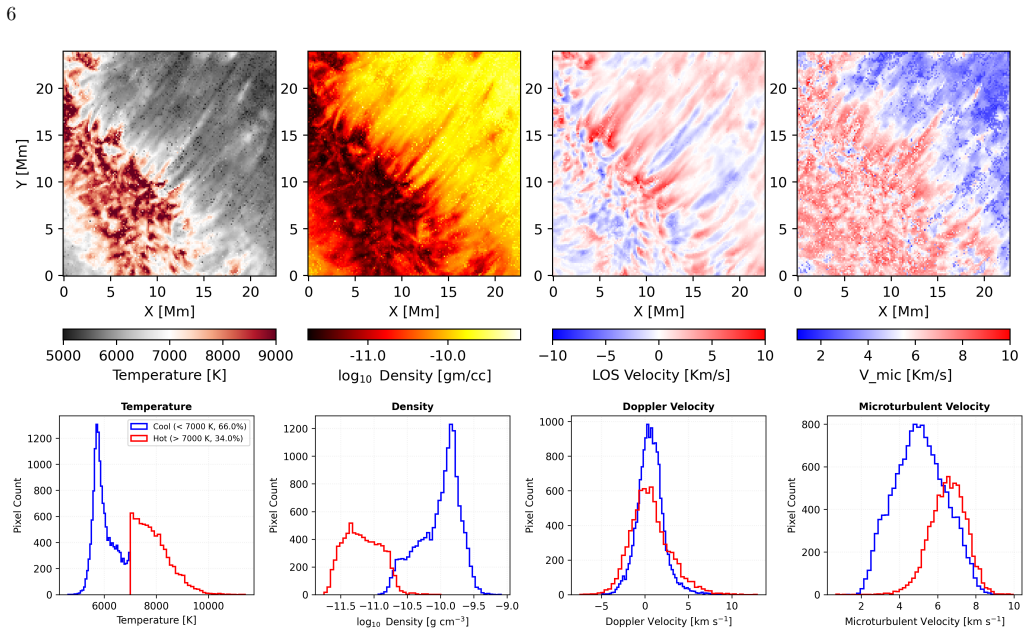
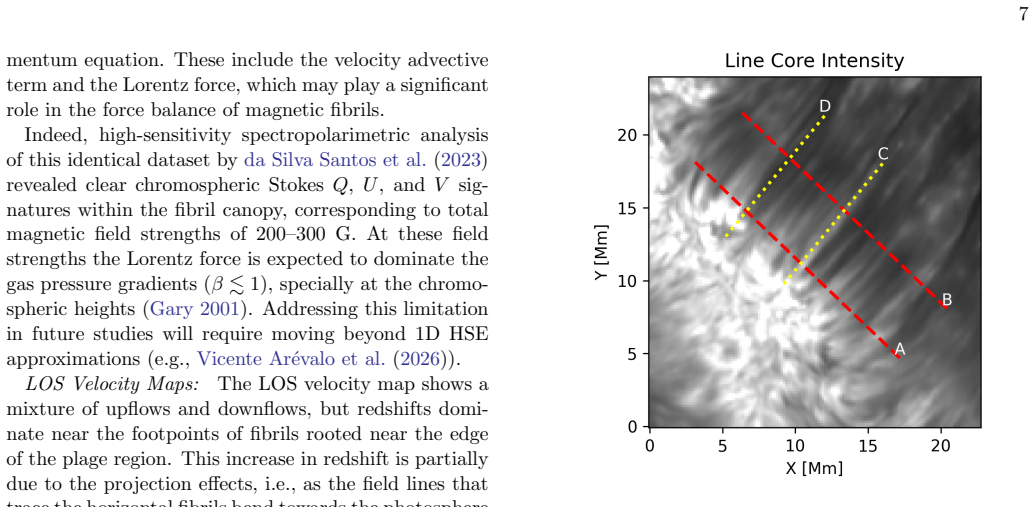
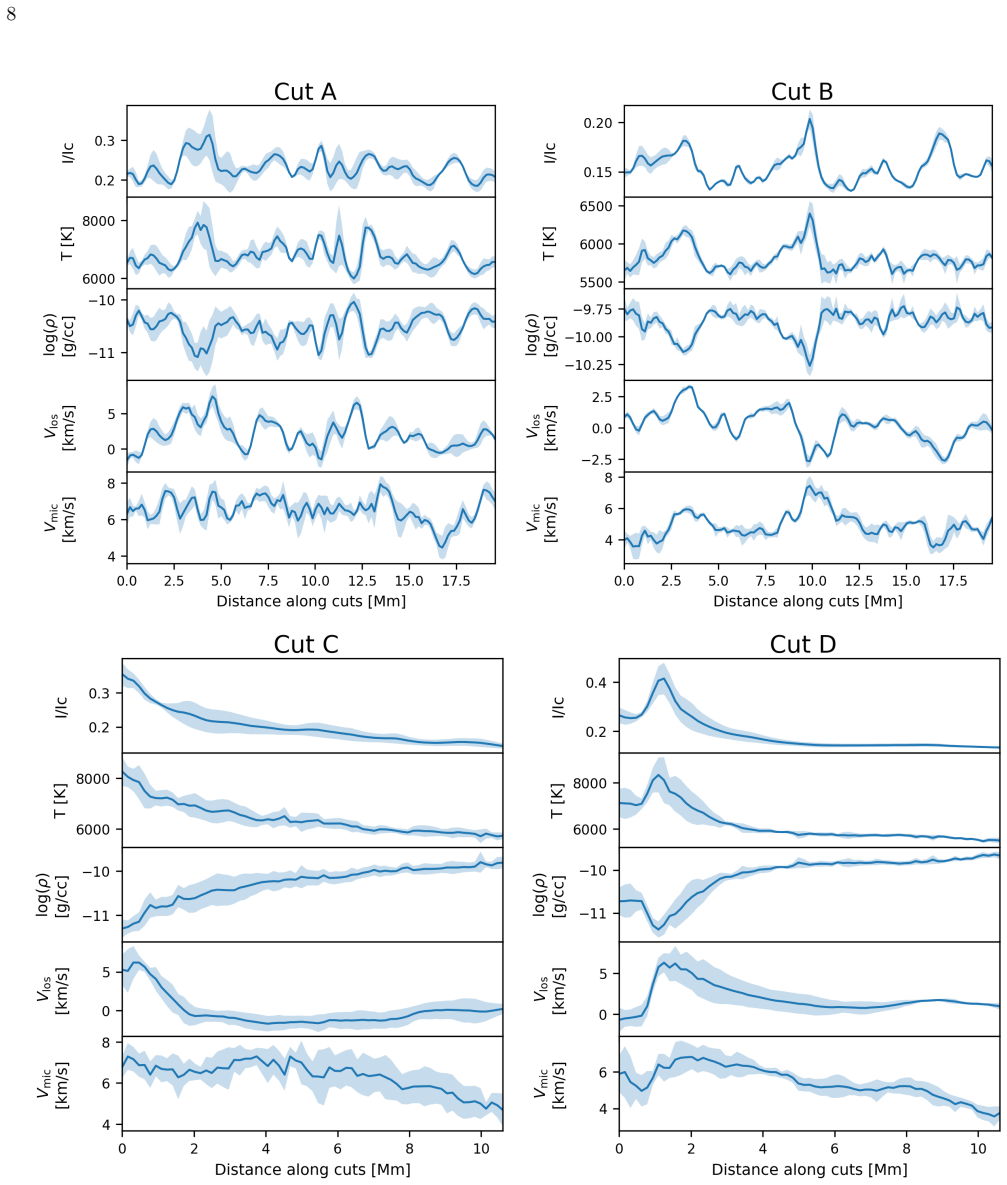
Non-LTE inversions of DKIST/ViSP Ca II 854.2 nm profiles combined with K-means clustering show that temperature along fibril length decreases smoothly by about 1000 K from hotter footpoints toward the mid-axis, while temperature across the lateral boundary varies more abruptly by several hundred kelvin over a megameter; denser fibrils link to cooler, downflowing plasma whereas less-dense ones do not, and hotter segments exhibit higher microturbulent velocities.
What carries the argument
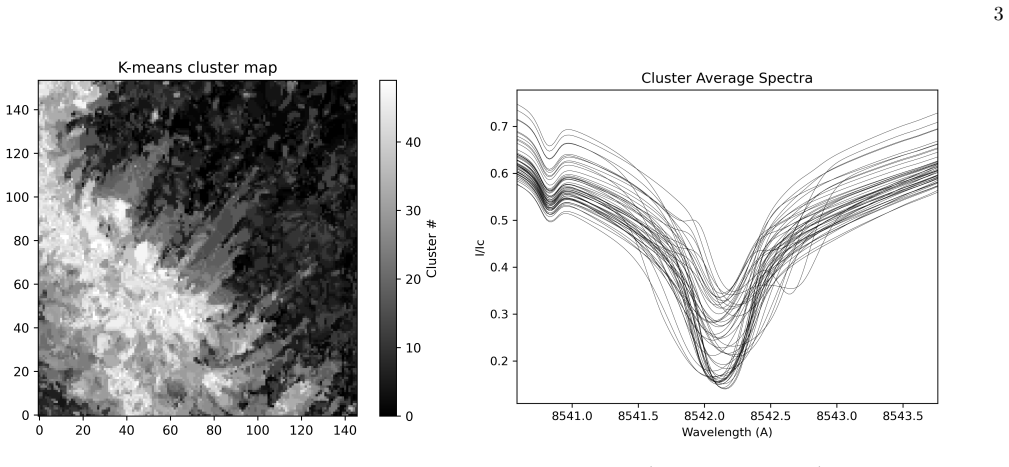
K-means clustering of thermodynamic parameters retrieved from non-LTE spectral inversions of the Ca II 854.2 nm line.
If this is right
- Footpoint heating or reduced cooling must operate to maintain the observed along-fibril temperature gradient.
- Sharp lateral temperature jumps imply well-defined plasma boundaries that separate fibril interiors from surrounding material.
- The density-temperature-velocity correlation suggests mass loading influences the thermal state of the denser structures.
- Higher microturbulence in hotter segments points to increased small-scale motions where temperatures are elevated.
Where Pith is reading between the lines
- The observed gradients could be used to test whether wave damping or magnetic reconnection dominates energy deposition along fibrils.
- Clustering methods similar to those applied here could be extended to other chromospheric lines to build multi-height temperature maps.
- The results suggest that models of chromospheric fibrils should incorporate density-dependent cooling rates to reproduce the downflow association.
Load-bearing premise
Thermodynamic parameters are derived assuming hydrostatic equilibrium, so the density and temperature values neglect dynamic and magnetic pressure contributions.
What would settle it
Direct comparison of the derived densities and temperatures against simultaneous magnetic field measurements or time-dependent flow observations that reveal large non-hydrostatic support.
Figures
read the original abstract
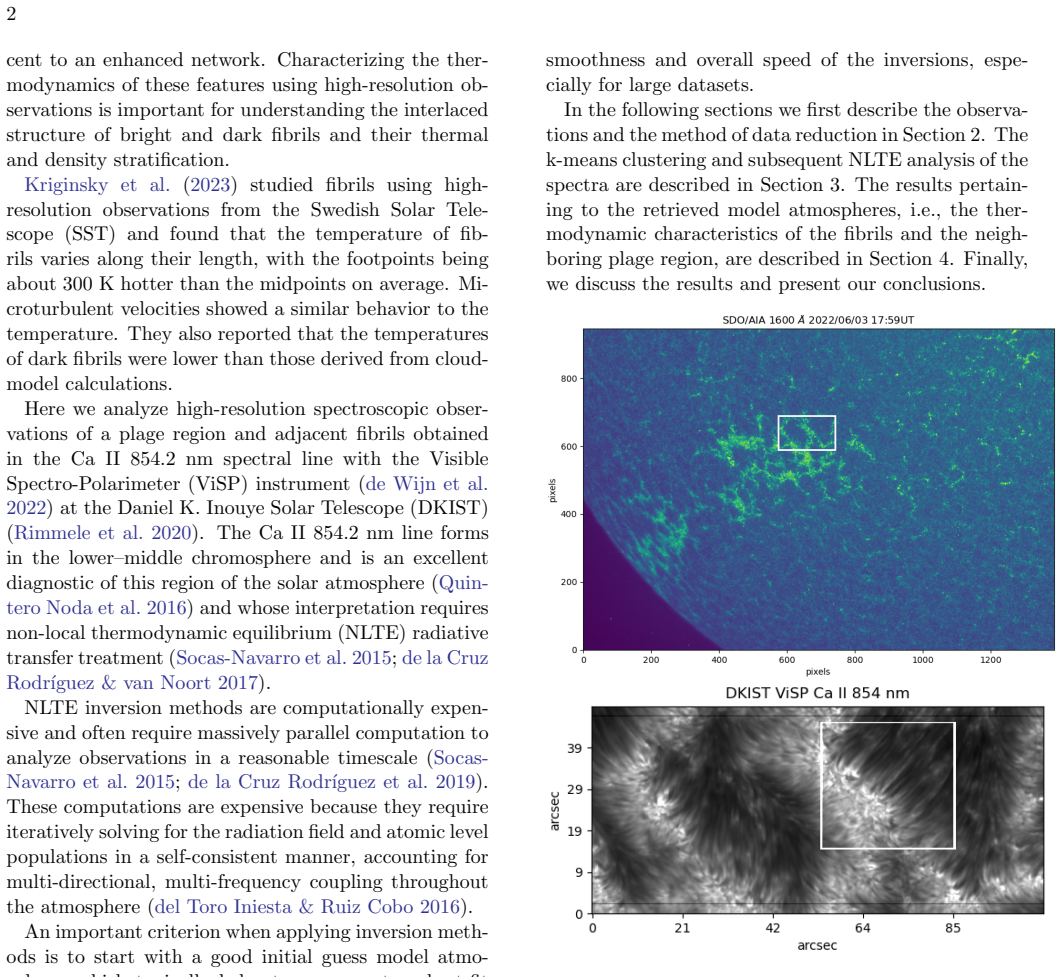
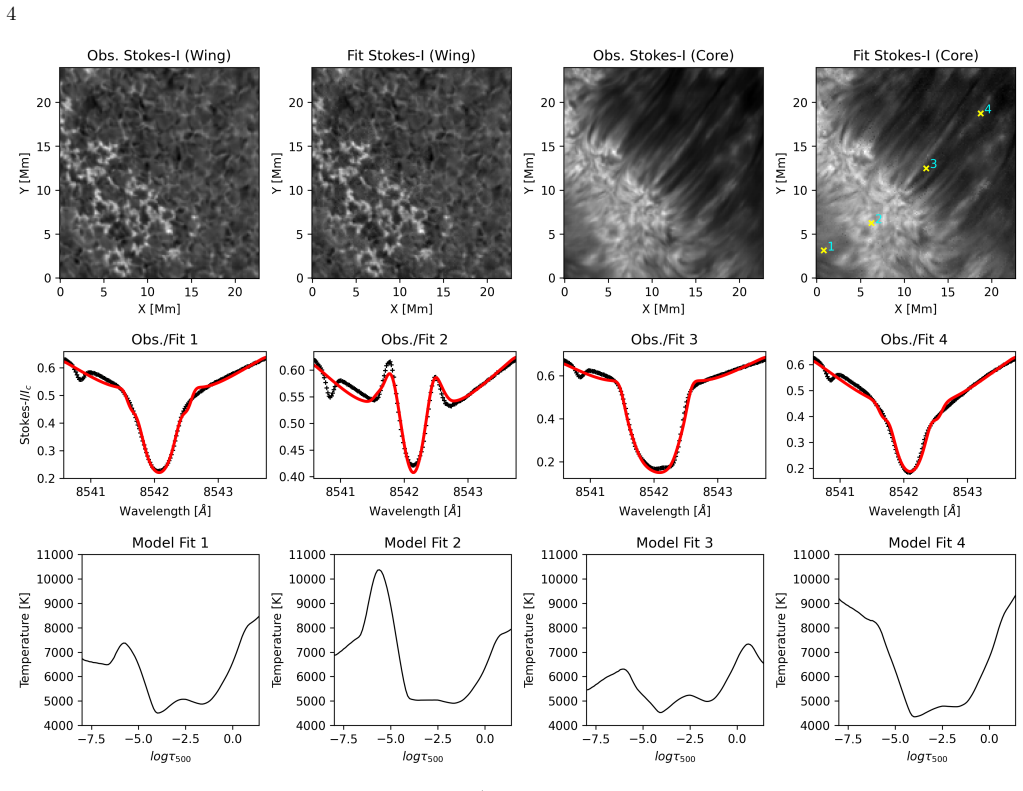
The chromosphere is a critical layer of the solar atmosphere situated between the photosphere and the corona. Studying its temperature structure is important to understand the complex dynamics and energy-transfer processes between these layers. We investigate the thermodynamic properties of chromospheric fibrils adjacent to a plage region using high-resolution DKIST/ViSP observations of the Ca II 854.2 nm spectral line. We analyze the spectral profiles with the non-LTE inversion code NICOLE combined with K-means clustering. The high spectral and spatial resolution of the DKIST observations allows us to trace thermodynamic properties temperature, density, line-of-sight velocity, and microturbulent velocity along and across the fibrils. We note that while the thermodynamic parameters are retrieved under the assumption of hydrostatic equilibrium, the resulting density and temperature values should be interpreted with the caveat that dynamic and magnetic terms are neglected. The temperature along the fibril length decreases smoothly by about 1000 K from the hotter footpoints toward the mid-axis. The temperature variation across the lateral boundary of fibrils is more abrupt and can vary by several hundreds of degree Kelvin across a megameter. Denser fibrils tend to be associated with cooler, downflowing plasma, while less-dense fibrils do not show this trend. Furthermore, the hotter parts of the fibrils tend to exhibit higher microturbulent velocities than the cooler parts.
Editorial analysis
A structured set of objections, weighed in public.
Referee Report
Summary. The paper investigates the thermodynamic properties of chromospheric fibrils using high-resolution DKIST/ViSP observations of the Ca II 854.2 nm line. It applies non-LTE inversions with the NICOLE code under the assumption of hydrostatic equilibrium, followed by K-means clustering to analyze temperature, density, line-of-sight velocity, and microturbulent velocity along and across the fibrils. The main results include a smooth temperature decrease of about 1000 K from the footpoints to the mid-axis, abrupt lateral temperature changes of several hundred K over a megameter, a correlation between denser fibrils and cooler downflowing plasma, and higher microturbulent velocities in hotter regions, with an explicit caveat on the hydrostatic assumption.
Significance. If the results hold under the stated assumptions, the study provides important high-resolution diagnostics of chromospheric fibril thermodynamics, which can inform models of chromospheric heating and dynamics. The application of K-means clustering to inverted parameters is a useful approach for pattern identification in complex observational data. The explicit acknowledgment of the hydrostatic equilibrium caveat is a strength, though it limits the definitiveness of the quantitative claims.
major comments (1)
- [Abstract] Abstract: The temperature decrease along the fibril length (~1000 K) and the density-downflow association are derived from NICOLE inversions that assume hydrostatic equilibrium. Given that the abstract notes dynamic and magnetic terms are neglected, and considering observed LOS velocities in fibrils, the paper should demonstrate through additional analysis (e.g., comparison to non-hydrostatic models) that these trends remain robust when the assumption is relaxed.
minor comments (2)
- [Abstract] Abstract: The abstract does not include any mention of uncertainty estimates or error bars on the reported temperature variations, densities, or velocities.
- The description of the K-means clustering method and the number of clusters used could be expanded for clarity on how the patterns were identified.
Simulated Author's Rebuttal
We thank the referee for their constructive review and for recognizing the value of the K-means approach and the explicit hydrostatic caveat. We address the single major comment below.
read point-by-point responses
-
Referee: [Abstract] Abstract: The temperature decrease along the fibril length (~1000 K) and the density-downflow association are derived from NICOLE inversions that assume hydrostatic equilibrium. Given that the abstract notes dynamic and magnetic terms are neglected, and considering observed LOS velocities in fibrils, the paper should demonstrate through additional analysis (e.g., comparison to non-hydrostatic models) that these trends remain robust when the assumption is relaxed.
Authors: We agree that the hydrostatic-equilibrium assumption is a fundamental limitation of the NICOLE inversions and that the reported temperature drop and density-downflow correlation must be interpreted in that context. The manuscript already states this caveat explicitly in the abstract and in the methods section. Performing the suggested additional analysis—i.e., repeating the inversions or post-processing with non-hydrostatic or MHD-constrained models—would require an entirely different inversion framework and is beyond the scope of the present observational study. We therefore maintain the results as valid under the stated assumptions while clearly flagging their limitations for the reader. revision: no
- Demonstration that the reported temperature and density trends remain robust when the hydrostatic assumption is relaxed (would require new non-hydrostatic inversions not performed in this work)
Circularity Check
No circularity: observational inversion + clustering with explicit caveat on hydrostatic assumption
full rationale
The paper reports results from applying the external NICOLE inversion code to DKIST/ViSP spectra, followed by K-means clustering on the retrieved parameters. The hydrostatic-equilibrium assumption is stated once as a caveat applying to all outputs; it is not derived from or equivalent to any quantity defined inside the paper. No equations, fitted parameters, or self-citations are shown that would make reported temperature/density trends reduce by construction to the paper's own inputs. This matches the default expectation of a self-contained data-analysis study.
Axiom & Free-Parameter Ledger
axioms (1)
- domain assumption Hydrostatic equilibrium for retrieval of thermodynamic parameters from spectral inversions
Reference graph
Works this paper leans on
-
[1]
Asensio Ramos, A., de la Cruz Rodr´ ıguez, J., Mart´ ınez Gonz´ alez, M. J., & Socas-Navarro, H. 2017, A&A, 599, A133, doi: 10.1051/0004-6361/201629755 Astropy Collaboration, Price-Whelan, A. M., Sip˝ ocz, B. M., et al. 2018, AJ, 156, 123, doi: 10.3847/1538-3881/aabc4f Bjørgen, J. P., Leenaarts, J., Rempel, M., et al. 2019, A&A, 631, A33, doi: 10.1051/000...
-
[2]
Chappell, B. A., & Pereira, T. M. D. 2022, A&A, 658, A182, doi: 10.1051/0004-6361/202142625 da Silva Santos, J. M., Reardon, K., Cauzzi, G., et al. 2023, ApJL, 954, L35, doi: 10.3847/2041-8213/acf21f de la Cruz Rodr´ ıguez, J., Leenaarts, J., Danilovic, S., &
-
[3]
2019, A&A, 623, A74, doi: 10.1051/0004-6361/201834464 de la Cruz Rodr´ ıguez, J., & Socas-Navarro, H
Uitenbroek, H. 2019, A&A, 623, A74, doi: 10.1051/0004-6361/201834464 de la Cruz Rodr´ ıguez, J., & Socas-Navarro, H. 2011, A&A, 527, L8, doi: 10.1051/0004-6361/201016018 de la Cruz Rodr´ ıguez, J., & van Noort, M. 2017, SSRv, 210, 109, doi: 10.1007/s11214-016-0294-8 de Wijn, A. G., Casini, R., Carlile, A., et al. 2022, SoPh, 297, 22, doi: 10.1007/s11207-0...
-
[4]
2025, MNRAS, 543, 1303, doi: 10.1093/mnras/staf1567
Dong, Q., Yan, X., Xue, Z., et al. 2025, MNRAS, 543, 1303, doi: 10.1093/mnras/staf1567
-
[5]
K., Leenaarts, J., Carlsson, M., & Szydlarski, M
Druett, M. K., Leenaarts, J., Carlsson, M., & Szydlarski, M. 2022, A&A, 665, A6, doi: 10.1051/0004-6361/202142399
-
[6]
2021, A&A, 651, A31, doi: 10.1051/0004-6361/201936910
Gafeira, R., Orozco Su´ arez, D., Mili´ c, I., et al. 2021, A&A, 651, A31, doi: 10.1051/0004-6361/201936910
-
[7]
Gary, G. A. 2001, SoPh, 203, 71, doi: 10.1023/A:1012722021820
-
[8]
Gingerich, O., Noyes, R. W., Kalkofen, W., & Cuny, Y. 1971, SoPh, 18, 347, doi: 10.1007/BF00149057
-
[9]
Gudiksen, B. V., Carlsson, M., Hansteen, V. H., et al. 2011, A&A, 531, A154, doi: 10.1051/0004-6361/201116520
-
[10]
Harris, C. R., & ... 2020, Nature, doi: 10.1038/s41586-020-2649-2
-
[11]
Henriques, V. M. J., Nelson, C. J., Rouppe van der Voort, L. H. M., & Mathioudakis, M. 2020, A&A, 642, A215, doi: 10.1051/0004-6361/202038538
-
[12]
Hunter, J. D. 2007, Computing in Science & Engineering
2007
-
[13]
U., & Nso Staff
Keller, C. U., & Nso Staff. 1998, in Astronomical Society of the Pacific Conference Series, Vol. 154, Cool Stars, Stellar Systems, and the Sun, ed. R. A. Donahue & J. A. Bookbinder, 636
1998
-
[14]
2023, A&A, 672, A89, doi: 10.1051/0004-6361/202245527
Kriginsky, M., Oliver, R., & Kuridze, D. 2023, A&A, 672, A89, doi: 10.1051/0004-6361/202245527
-
[15]
2024, ApJ, 965, 15, doi: 10.3847/1538-4357/ad2702
Kuridze, D., Uitenbroek, H., W¨ oger, F., et al. 2024, ApJ, 965, 15, doi: 10.3847/1538-4357/ad2702
-
[16]
L., Furenlid, I., Brault, J., & Testerman, L
Kurucz, R. L., Furenlid, I., Brault, J., & Testerman, L. 1984, Solar flux atlas from 296 to 1300 nm
1984
-
[17]
2012, ApJ, 749, 136, doi: 10.1088/0004-637X/749/2/136
Leenaarts, J., Carlsson, M., & Rouppe van der Voort, L. 2012, ApJ, 749, 136, doi: 10.1088/0004-637X/749/2/136
-
[18]
1982, IEEE transactions on information theory, 28, 129
Lloyd, S. 1982, IEEE transactions on information theory, 28, 129
1982
-
[19]
1967, in Proceedings of the Fifth Berkeley Symposium on Mathematical Statistics and Probability, Volume 1: Statistics, Vol
MacQueen, J. 1967, in Proceedings of the Fifth Berkeley Symposium on Mathematical Statistics and Probability, Volume 1: Statistics, Vol. 5, University of California press, 281–298 14 Mart´ ınez-Sykora, J., De Pontieu, B., Carlsson, M., &
1967
-
[20]
2016, ApJL, 831, L1, doi: 10.3847/2041-8205/831/1/L1 Mili´ c, I., & Gafeira, R
Hansteen, V. 2016, ApJL, 831, L1, doi: 10.3847/2041-8205/831/1/L1 Mili´ c, I., & Gafeira, R. 2020, A&A, 644, A129, doi: 10.1051/0004-6361/201936537
-
[21]
2005, SoPh, 229, 13, doi: 10.1007/s11207-005-4081-z
Neckel, H. 2005, SoPh, 229, 13, doi: 10.1007/s11207-005-4081-z
-
[22]
2011, Journal of Machine Learning Research, 12, 2825
Pedregosa, F., Varoquaux, G., Gramfort, A., et al. 2011, Journal of Machine Learning Research, 12, 2825
2011
-
[23]
2007, ApJ, 663, 1386, doi: 10.1086/518714
Pietarila, A., Socas-Navarro, H., & Bogdan, T. 2007, ApJ, 663, 1386, doi: 10.1086/518714
-
[24]
Flannery, B. P. 1992, Numerical recipes in C (2nd ed.): the art of scientific computing (USA: Cambridge University Press) Quintero Noda, C., Shimizu, T., de la Cruz Rodr´ ıguez, J., et al. 2016, MNRAS, 459, 3363, doi: 10.1093/mnras/stw867
-
[25]
2017, ApJ, 834, 10, doi: 10.3847/1538-4357/834/1/10
Rempel, M. 2017, ApJ, 834, 10, doi: 10.3847/1538-4357/834/1/10
-
[26]
Rimmele, T. R., Warner, M., Keil, S. L., et al. 2020, SoPh, 295, 172, doi: 10.1007/s11207-020-01736-7 Sainz Dalda, A., de la Cruz Rodr´ ıguez, J., De Pontieu, B., & Goˇ si´ c, M. 2019, ApJL, 875, L18, doi: 10.3847/2041-8213/ab15d9
-
[27]
Schad, T. A., Penn, M. J., & Lin, H. 2013, ApJ, 768, 111, doi: 10.1088/0004-637X/768/2/111
-
[28]
2021, arXiv e-prints, arXiv:2101.11445, doi: 10.48550/arXiv.2101.11445
Socas-Navarro, H., & Asensio Ramos, A. 2021, arXiv e-prints, arXiv:2101.11445, doi: 10.48550/arXiv.2101.11445
-
[29]
2015, A&A, 577, A7, doi: 10.1051/0004-6361/201424860
Ramos, A., Trujillo Bueno, J., & Ruiz Cobo, B. 2015, A&A, 577, A7, doi: 10.1051/0004-6361/201424860
-
[30]
2000, ApJ, 530, 977, doi: 10.1086/308414 The SunPy Community, Barnes, W
Socas-Navarro, H., Trujillo Bueno, J., & Ruiz Cobo, B. 2000, ApJ, 530, 977, doi: 10.1086/308414 The SunPy Community, Barnes, W. T., Bobra, M. G., et al. 2020, The Astrophysical Journal, 890, 68, doi: 10.3847/1538-4357/ab4f7a
-
[31]
Thorndike, R. L. 1953, Psychometrika, 18, 267
1953
-
[32]
1989, A&A, 213, 360 Vicente Ar´ evalo, A., Borrero, J
Uitenbroek, H. 1989, A&A, 213, 360 Vicente Ar´ evalo, A., Borrero, J. M., Mili´ c, I., et al. 2026, A&A, 708, A351, doi: 10.1051/0004-6361/202659286 Wedemeyer-B¨ ohm, S., & Carlsson, M. 2011, A&A, 528, A1, doi: 10.1051/0004-6361/201016186
-
[33]
Zaqarashvili, T. V., & Erd´ elyi, R. 2009, SSRv, 149, 355, doi: 10.1007/s11214-009-9549-y
discussion (0)
Sign in with ORCID, Apple, or X to comment. Anyone can read and Pith papers without signing in.