Seq103: A Unified Neuroevolution Framework for Compact Sequence Architecture Discovery
Pith reviewed 2026-06-28 02:30 UTC · model grok-4.3
The pith
Seq103 evolves compact sequence models that retain 82-87% of baseline accuracy with up to 160,000 times fewer parameters.
A machine-rendered reading of the paper's core claim, the machinery that carries it, and where it could break.
Core claim
Seq103 consists of a shared evolutionary backbone and an optional recurrent extension. The backbone uses an elementary node-and-connection representation, per-class RMSE-based evaluation, mutation-based evolution with class-wise recombination, and elitism. The hidden-state extension adds hidden nodes and connections when step-wise recurrent inference is required. With the hidden-state mechanism enabled for recurrent tasks and disabled for feedforward tasks, the same core search produces compact architectures that retain 86.96% of best-baseline accuracy on average for step-wise tasks using 34.6x to 3218.0x fewer parameters and 81.95% for sample-wise tasks over UCRArchive2018 using 11.8x to 16
What carries the argument
The shared evolutionary backbone with elementary node-and-connection representation, per-class RMSE evaluation, mutation-based evolution with class-wise recombination, and elitism, plus optional hidden-state nodes for temporal memory.
Load-bearing premise
The evolutionary search with the elementary node-and-connection representation, per-class RMSE evaluation, mutation-based evolution with class-wise recombination, and elitism will reliably produce architectures that generalize to held-out test data across the reported benchmarks.
What would settle it
Seq103 search run on additional sequence datasets where the evolved models fail to retain at least 80% of best-baseline accuracy while using at least 10 times fewer parameters would falsify the central performance claim.
Figures
read the original abstract
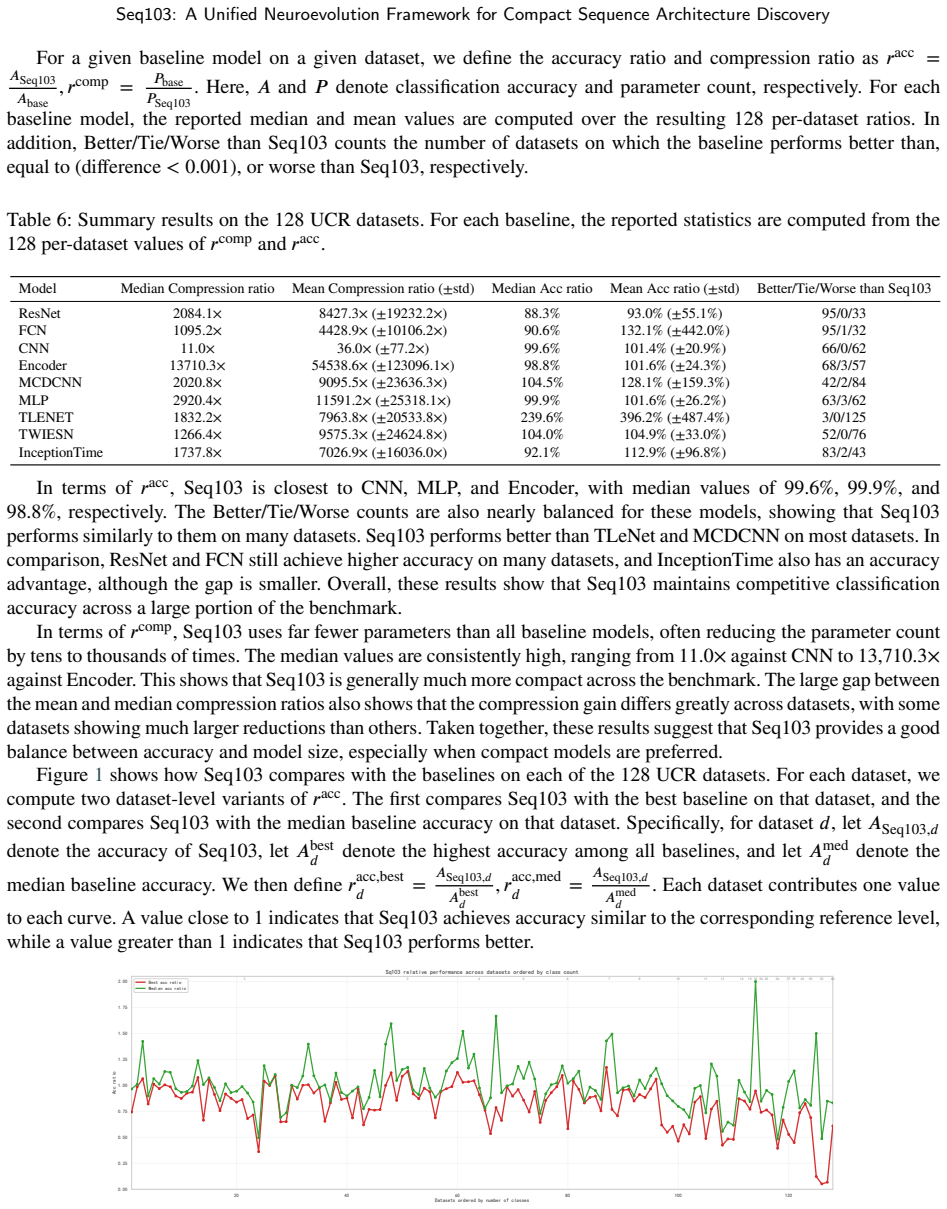
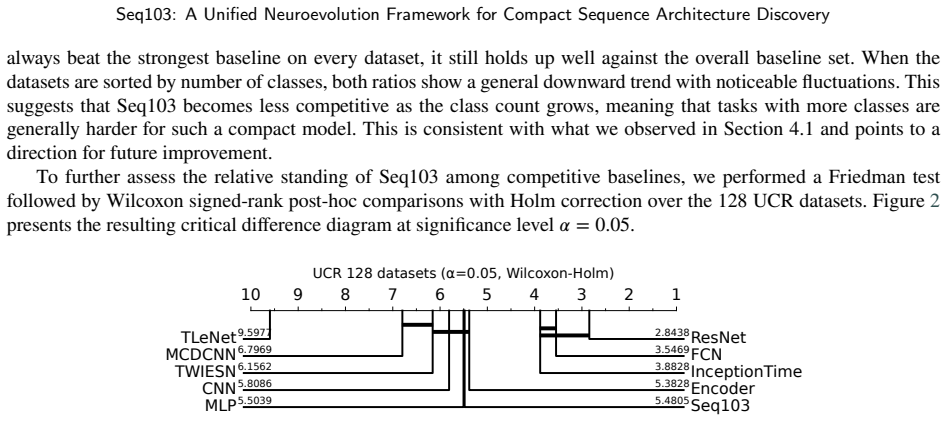
Neuroevolution is a representative neural architecture search paradigm that evolves both network topology and weights through evolutionary algorithms. In this paper, we propose Seq103, a unified NEAT-style neuroevolution framework for compact sequence architecture discovery. Seq103 consists of a shared evolutionary backbone and an optional recurrent extension. The shared backbone includes an elementary node-and-connection representation, per-class RMSE-based evaluation, mutation-based evolution with class-wise recombination, and elitism. The optional hidden-state mechanism extends the search space with hidden-state nodes and hidden connections, enabling temporal memory when step-wise recurrent inference is required. With this design, Seq103 applies the same core search pipeline to both step-wise recurrent and sample-wise feedforward sequence classification. In recurrent tasks, the hidden-state extension is enabled to provide temporal memory; in feedforward tasks, it is disabled while the shared evolutionary backbone remains unchanged. We evaluate Seq103 on 8 text classification datasets and the full UCRArchive2018 benchmark with 128 univariate time-series datasets. On step-wise tasks, Seq103 retains 86.96% of the best-baseline accuracy on average while using 34.6x to 3218.0x fewer parameters. On sample-wise tasks over the full UCRArchive2018 benchmark, Seq103 retains 81.95% of the best-baseline accuracy on average while using 11.8x to 160,601.0x fewer parameters.
Editorial analysis
A structured set of objections, weighed in public.
Referee Report
Summary. The manuscript presents Seq103 as a unified neuroevolution framework extending NEAT for compact sequence architecture discovery. It maintains a shared backbone consisting of an elementary node-and-connection genome representation, per-class RMSE fitness evaluation, mutation-based evolution incorporating class-wise recombination, and elitism. An optional hidden-state mechanism allows extension to recurrent inference for step-wise tasks. The same pipeline is used for both recurrent (with hidden states enabled) and feedforward (disabled) sequence classification. Claims are supported by evaluations on 8 text classification datasets for step-wise tasks, retaining on average 86.96% of the best baseline accuracy with 34.6x to 3218.0x fewer parameters, and on the full UCRArchive2018 benchmark of 128 univariate time-series datasets for sample-wise tasks, retaining 81.95% accuracy with 11.8x to 160,601.0x fewer parameters.
Significance. If the empirical results hold under rigorous validation, the work would offer a notable contribution to neuroevolution by demonstrating a single search pipeline that achieves extreme parameter reduction across both recurrent and feedforward sequence tasks while retaining substantial accuracy. The scale of evaluation on the full UCRArchive2018 is a strength, and the unification via optional hidden-state extension is conceptually clean. However, the significance is currently limited by the absence of variance, statistical testing, and split details needed to confirm generalization.
major comments (2)
- [Abstract] Abstract: The headline retention rates (86.96% on step-wise tasks and 81.95% on sample-wise tasks) and the associated parameter reduction ranges are stated without any reference to the number of independent evolutionary runs performed, standard deviations across runs, or statistical significance tests against baselines. This is load-bearing for the central claim because neuroevolution results are known to exhibit high variance; without these, it is impossible to determine whether the reported compactness-accuracy tradeoff reflects reliable discovery or run-specific outcomes.
- [Abstract] Abstract (per-class RMSE-based evaluation and evolutionary process): The fitness function is described as per-class RMSE with mutation-based evolution and elitism, but no information is provided on whether fitness evaluation uses a validation split strictly isolated from the final held-out test sets, or on the train/validation/test partitioning protocol. This directly affects the weakest assumption that the search produces architectures that generalize, as overlap or leakage between fitness data and test data would invalidate the generalization claims.
Simulated Author's Rebuttal
We thank the referee for the constructive feedback on result reporting and experimental protocol. We address each major comment below and will revise the manuscript accordingly to improve clarity and rigor.
read point-by-point responses
-
Referee: [Abstract] Abstract: The headline retention rates (86.96% on step-wise tasks and 81.95% on sample-wise tasks) and the associated parameter reduction ranges are stated without any reference to the number of independent evolutionary runs performed, standard deviations across runs, or statistical significance tests against baselines. This is load-bearing for the central claim because neuroevolution results are known to exhibit high variance; without these, it is impossible to determine whether the reported compactness-accuracy tradeoff reflects reliable discovery or run-specific outcomes.
Authors: We agree that neuroevolution exhibits high variance and that the absence of run counts, standard deviations, and statistical tests weakens the central claims. The manuscript reports only aggregate retention rates without these details. We will revise the abstract and results sections to specify the number of independent evolutionary runs, include standard deviations, and report statistical significance tests against baselines. revision: yes
-
Referee: [Abstract] Abstract (per-class RMSE-based evaluation and evolutionary process): The fitness function is described as per-class RMSE with mutation-based evolution and elitism, but no information is provided on whether fitness evaluation uses a validation split strictly isolated from the final held-out test sets, or on the train/validation/test partitioning protocol. This directly affects the weakest assumption that the search produces architectures that generalize, as overlap or leakage between fitness data and test data would invalidate the generalization claims.
Authors: We acknowledge that explicit details on data partitioning are required to support generalization claims. The manuscript does not currently describe the train/validation/test protocol or confirm isolation of fitness data from test sets. We will add a clear description of the partitioning protocol in the revised manuscript, specifying that per-class RMSE fitness uses training data with a strictly held-out test set and no leakage. revision: yes
Circularity Check
No circularity: purely empirical claims with no derivations or self-referential fits
full rationale
The manuscript describes a neuroevolution method and reports benchmark retention rates (86.96% and 81.95% of baseline accuracy) together with parameter-reduction factors. These are presented as measured experimental outcomes on held-out test sets from UCRArchive2018 and text-classification corpora. No equations, uniqueness theorems, ansatzes, or parameter-fitting steps appear in the abstract or surrounding context; the evolutionary search components (node-connection genome, per-class RMSE, mutation, elitism) are described as design choices whose performance is evaluated directly rather than derived from prior results by the same authors. Because the central claims rest on external benchmark measurements rather than any reduction to fitted inputs or self-citations, the derivation chain contains no circular steps.
Axiom & Free-Parameter Ledger
Reference graph
Works this paper leans on
-
[1]
and Ng, Andrew and Potts, Christopher
Socher, Richard and Perelygin, Alex and Wu, Jean and Chuang, Jason and Manning, Christopher D. and Ng, Andrew and Potts, Christopher. Recursive Deep Models for Semantic Compositionality Over a Sentiment Treebank. Proceedings of the 2013 Conference on Empirical Methods in Natural Language Processing. 2013
2013
-
[2]
and Daly, Raymond E
Maas, Andrew L. and Daly, Raymond E. and Pham, Peter T. and Huang, Dan and Ng, Andrew Y. and Potts, Christopher , title =. Proceedings of the 49th Annual Meeting of the Association for Computational Linguistics: Human Language Technologies , month =. 2011 , address =
2011
-
[3]
Bo Pang and Lillian Lee , title =
-
[4]
NIPS , year=
Character-level Convolutional Networks for Text Classification , author=. NIPS , year=
-
[5]
Automated Learning of Decision Rules for Text Categorization , journal =
Chidanand Apt. Automated Learning of Decision Rules for Text Categorization , journal =
-
[6]
Demszky, Dorottya and Movshovitz-Attias, Dana and Ko, Jeongwoo and Cowen, Alan and Nemade, Gaurav and Ravi, Sujith , booktitle =
-
[8]
Proceedings of the Twenty-Fifth International Joint Conference on Artificial Intelligence (IJCAI 2016) , pages =
Liu, Pengfei and Qiu, Xipeng and Huang, Xuanjing , title =. Proceedings of the Twenty-Fifth International Joint Conference on Artificial Intelligence (IJCAI 2016) , pages =
2016
-
[9]
Proceedings of the 2014 Conference on Empirical Methods in Natural Language Processing (EMNLP) , pages =
Kim, Yoon , title =. Proceedings of the 2014 Conference on Empirical Methods in Natural Language Processing (EMNLP) , pages =
2014
-
[10]
Proceedings of the 2016 Conference of the North American Chapter of the Association for Computational Linguistics: Human Language Technologies , pages =
Yang, Zichao and Yang, Diyi and Dyer, Chris and He, Xiaodong and Smola, Alex and Hovy, Eduard , title =. Proceedings of the 2016 Conference of the North American Chapter of the Association for Computational Linguistics: Human Language Technologies , pages =
2016
-
[11]
Vaswani, Ashish and Shazeer, Noam and Parmar, Niki and Uszkoreit, Jakob and Jones, Llion and Gomez, Aidan N. and. Attention Is All You Need , booktitle =
-
[12]
Keras-TextClassification , author =
-
[13]
Data Mining and Knowledge Discovery , Year =
Deep learning for time series classification: a review , Author =. Data Mining and Knowledge Discovery , Year =
-
[14]
2018 , month =
The UCR Time Series Classification Archive , author =. 2018 , month =
2018
-
[15]
2017 International Joint Conference on Neural Networks (IJCNN) , pages =
Wang, Zhiguang and Yan, Weizhong and Oates, Tim , title =. 2017 International Joint Conference on Neural Networks (IJCNN) , pages =
2017
-
[16]
and Weber, Jonathan and Webb, Geoffrey I
Ismail Fawaz, Hassan and Lucas, Benjamin and Forestier, Germain and Pelletier, Charlotte and Schmidt, Daniel F. and Weber, Jonathan and Webb, Geoffrey I. and Petitjean, Fran. InceptionTime: Finding AlexNet for Time Series Classification , journal =
-
[17]
Data Mining and Knowledge Discovery , volume =
Bagnall, Anthony and Lines, Jason and Bostrom, Aaron and Large, James and Keogh, Eamonn , title =. Data Mining and Knowledge Discovery , volume =
-
[18]
ECML/PKDD Workshop on Advanced Analytics and Learning on Temporal Data , year =
Le Guennec, Arthur and Malinowski, Simon and Tavenard, Romain , title =. ECML/PKDD Workshop on Advanced Analytics and Learning on Temporal Data , year =
-
[19]
Leon , title =
Zheng, Yi and Liu, Qi and Chen, Enhong and Ge, Yong and Zhao, J. Leon , title =. International Conference on Web-Age Information Management , pages =
-
[20]
Towards a Universal Neural Network Encoder for Time Series , booktitle =
Serr. Towards a Universal Neural Network Encoder for Time Series , booktitle =
-
[21]
and Lu, H
Zhao, B. and Lu, H. and Chen, S. and Liu, J. and Wu, D. , title =. Journal of Systems Engineering and Electronics , volume =
-
[22]
Data Mining and Knowledge Discovery , volume =
Ismail Fawaz, Hassan and Forestier, Germain and Weber, Jonathan and Idoumghar, Lhassane and Muller, Pierre-Alain , title =. Data Mining and Knowledge Discovery , volume =
-
[24]
and Miikkulainen, Risto , title =
Stanley, Kenneth O. and Miikkulainen, Risto , title =. Evolutionary Computation , volume =
-
[25]
, author Damerau, F
author Apt \'e , C. , author Damerau, F. , author Weiss, S.M. , year 1994 . title Automated learning of decision rules for text categorization . journal ACM Transactions on Information Systems
1994
-
[26]
, author Lines, J
author Bagnall, A. , author Lines, J. , author Bostrom, A. , author Large, J. , author Keogh, E. , year 2017 . title The great time series classification bake off: A review and experimental evaluation of recent algorithmic advances . journal Data Mining and Knowledge Discovery volume 31 , pages 606--660
2017
-
[27]
, author Keogh, E
author Dau, H.A. , author Keogh, E. , author Kamgar, K. , author Yeh, C.C.M. , author Zhu, Y. , author Gharghabi, S. , author Ratanamahatana, C.A. , author Yanping , author Hu, B. , author Begum, N. , author Bagnall, A. , author Mueen, A. , author Batista, G. , author Hexagon-ML , year 2018 . title The ucr time series classification archive . note https:/...
2018
-
[28]
, author Movshovitz-Attias, D
author Demszky, D. , author Movshovitz-Attias, D. , author Ko, J. , author Cowen, A. , author Nemade, G. , author Ravi, S. , year 2020 . title GoEmotions: A Dataset of Fine-Grained Emotions , in: booktitle 58th Annual Meeting of the Association for Computational Linguistics (ACL)
2020
-
[29]
, author Forestier, G
author Ismail Fawaz, H. , author Forestier, G. , author Weber, J. , author Idoumghar, L. , author Muller, P.A. , year 2019 . title Deep learning for time series classification: a review . journal Data Mining and Knowledge Discovery volume 33 , pages 917--963
2019
-
[30]
, author Lucas, B
author Ismail Fawaz, H. , author Lucas, B. , author Forestier, G. , author Pelletier, C. , author Schmidt, D.F. , author Weber, J. , author Webb, G.I. , author Petitjean, F. , author Muller, P.A. , year 2020 . title Inceptiontime: Finding alexnet for time series classification . journal Data Mining and Knowledge Discovery volume 34 , pages 1936--1962
2020
-
[31]
Bag of Tricks for Efficient Text Classification
author Joulin, A. , author Grave, E. , author Bojanowski, P. , author Mikolov, T. , year 2016 . title Bag of tricks for efficient text classification . journal arXiv preprint arXiv:1607.01759
work page internal anchor Pith review Pith/arXiv arXiv 2016
-
[32]
, year 2014
author Kim, Y. , year 2014 . title Convolutional neural networks for sentence classification , in: booktitle Proceedings of the 2014 Conference on Empirical Methods in Natural Language Processing (EMNLP) , pp. pages 1746--1751
2014
-
[33]
, author Malinowski, S
author Le Guennec, A. , author Malinowski, S. , author Tavenard, R. , year 2016 . title Data augmentation for time series classification using convolutional neural networks , in: booktitle ECML/PKDD Workshop on Advanced Analytics and Learning on Temporal Data
2016
-
[34]
, author Qiu, X
author Liu, P. , author Qiu, X. , author Huang, X. , year 2016 . title Recurrent neural network for text classification with multi-task learning , in: booktitle Proceedings of the Twenty-Fifth International Joint Conference on Artificial Intelligence (IJCAI 2016) , pp. pages 2873--2879
2016
-
[35]
, author Daly, R.E
author Maas, A.L. , author Daly, R.E. , author Pham, P.T. , author Huang, D. , author Ng, A.Y. , author Potts, C. , year 2011 . title Learning word vectors for sentiment analysis , in: booktitle Proceedings of the 49th Annual Meeting of the Association for Computational Linguistics: Human Language Technologies , publisher Association for Computational Lin...
2011
-
[36]
author McIntyre, A. , author Kallada, M. , author Miguel, C.G. , author Feher de Silva, C. , author Netto, M.L. , . title neat-python . https://github.com/CodeReclaimers/neat-python, :10.5281/zenodo.19024753
-
[37]
, year 2019
author Mo, Y. , year 2019 . title Keras-textclassification . howpublished https://github.com/yongzhuo/Keras-TextClassification
2019
-
[38]
, author Lee, L
author Pang, B. , author Lee, L. , year 2005 . title Seeing stars: Exploiting class relationships for sentiment categorization with respect to rating scales , in: booktitle Proceedings of the ACL
2005
-
[39]
, author Pascual, S
author Serr \`a , J. , author Pascual, S. , author Karatzoglou, A. , year 2018 . title Towards a universal neural network encoder for time series , in: booktitle Artificial Intelligence Research and Development , pp. pages 120--129
2018
-
[40]
, author Perelygin, A
author Socher, R. , author Perelygin, A. , author Wu, J. , author Chuang, J. , author Manning, C.D. , author Ng, A. , author Potts, C. , year 2013 . title Recursive deep models for semantic compositionality over a sentiment treebank , in: booktitle Proceedings of the 2013 Conference on Empirical Methods in Natural Language Processing , publisher Associati...
2013
-
[41]
, author Miikkulainen, R
author Stanley, K.O. , author Miikkulainen, R. , year 2002 . title Evolving neural networks through augmenting topologies . journal Evolutionary Computation volume 10 , pages 99--127
2002
-
[42]
, author Shazeer, N
author Vaswani, A. , author Shazeer, N. , author Parmar, N. , author Uszkoreit, J. , author Jones, L. , author Gomez, A.N. , author Kaiser, . , author Polosukhin, I. , year 2017 . title Attention is all you need , in: booktitle Advances in Neural Information Processing Systems 30 , pp. pages 5998--6008
2017
-
[43]
, author Yan, W
author Wang, Z. , author Yan, W. , author Oates, T. , year 2017 . title Time series classification from scratch with deep neural networks: A strong baseline , in: booktitle 2017 International Joint Conference on Neural Networks (IJCNN) , pp. pages 1578--1585
2017
-
[44]
, author Yang, D
author Yang, Z. , author Yang, D. , author Dyer, C. , author He, X. , author Smola, A. , author Hovy, E. , year 2016 . title Hierarchical attention networks for document classification , in: booktitle Proceedings of the 2016 Conference of the North American Chapter of the Association for Computational Linguistics: Human Language Technologies , pp. pages 1...
2016
-
[45]
, author Zhao, J.J
author Zhang, X. , author Zhao, J.J. , author LeCun, Y. , year 2015 . title Character-level convolutional networks for text classification , in: booktitle NIPS
2015
-
[46]
, author Lu, H
author Zhao, B. , author Lu, H. , author Chen, S. , author Liu, J. , author Wu, D. , year 2017 . title Convolutional neural networks for time series classification . journal Journal of Systems Engineering and Electronics volume 28 , pages 162--169
2017
-
[47]
, author Liu, Q
author Zheng, Y. , author Liu, Q. , author Chen, E. , author Ge, Y. , author Zhao, J.L. , year 2014 . title Time series classification using multi-channels deep convolutional neural networks , in: booktitle International Conference on Web-Age Information Management , pp. pages 298--310
2014
discussion (0)
Sign in with ORCID, Apple, or X to comment. Anyone can read and Pith papers without signing in.