REVIEW 4 major objections 6 minor 49 references
Loop-Mamba: A Loop Mamba with Degradation-Aware and Shared Memory for Old Photo Restoration
T0 review · 4 major / 6 minor · reviewed 2026-08-04 · deepseek-v4-flash
Pith's one-line read Loop-Mamba treats old-photo restoration as a progressive state evolution guided by explicit damage maps and shared memory, and reports the best scores on the public SynOld benchmark with far lower computational cost than prior methods.
desk verdict Solid loop-Mamba design, but the headline ODRS superiority is unreproducible from the paper's own equations. read the letter →
The pith
A machine-rendered reading of the paper's core claim, the machinery that carries it, and where it could break.
The reading
What carries the argument
The key machinery is the loop-state evolution built on a state-space model (Mamba). Three components carry the argument: the Semantic-Guided Degradation Estimator (SGDE), which predicts a pixel-level damage map D_l and a global damage score D_g and injects them into the state update; the Shared Structural Memory Mamba (S2M-Mamba), which maintains a persistent memory M_t that is exponentially blended with each new state, then fused back; and a multi-directional scan that runs the state transition along four spatial directions and aggregates the outputs. The claimed mechanism is that the looped first-order recursion S_{t+1}=A S_t + B X_t keeps the gradient of the loss with respect to the state
What would settle it
Compute ODRS on a real old-photo test set with public, fixed weights and compare Loop-Mamba against Restormer; or re-run the same benchmark with 5 random seeds and report confidence intervals on PSNR. If the PSNR lead over Restormer (30.13 vs 30.09) falls within noise, or ODRS ranking flips under fixed weights, the central claim is undercut.
Extended reading notes
Core claim
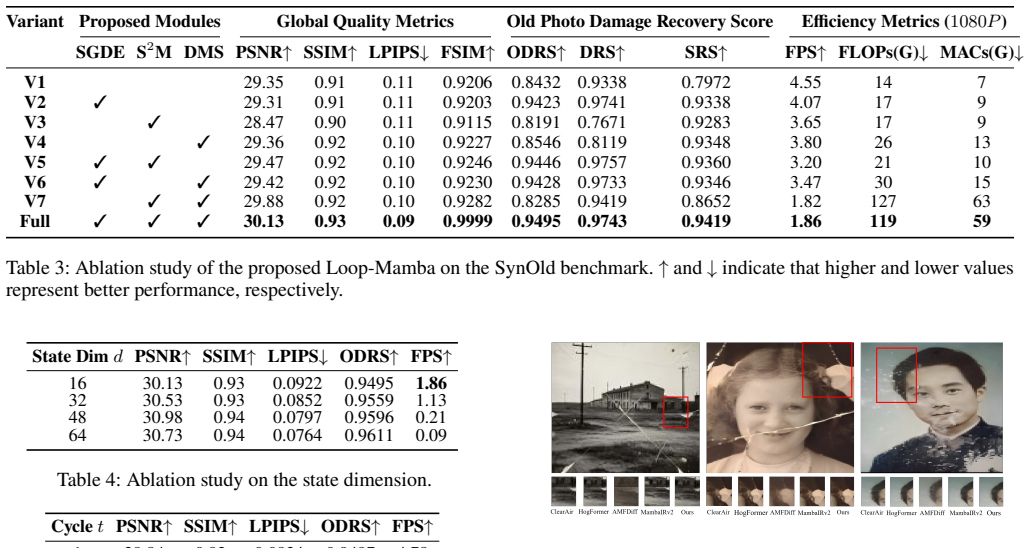
The central claim is that old-photo restoration can be reformulated as a first-order recurrent state evolution: a latent restoration state S_t is updated by a state-space operator under degradation-aware guidance, shared structural memory, and multi-directional scanning, and the final state is decoded into the restored image. The paper reports that this design achieves the best PSNR (30.13), SSIM (0.93), FSIM (0.9999), and ODRS (0.9495) on the SynOld benchmark, surpassing Restormer and other prior methods, while requiring only 119 GFLOPs versus 4568 GFLOPs for Restormer and running at 1.86 FPS on 1080p inputs. The narrative is that recurrent state propagation, instead of repeated feature rec
Load-bearing premise
The load-bearing premise is that the evaluation on 128x128 synthetic old photos, using the authors' own ODRS with unspecified adaptive weights, fairly measures restoration quality on real old photographs; if synthetic degradations do not match real damage or ODRS is not a valid perceptual measure, the claimed superiority lacks quantitative support.
Editorial extensions
If this is right
- Old-photo restoration can be made efficient enough for mobile deployment; the paper shows a smartphone run with acceptable quality, suggesting practical archival tools.
- Explicit degradation maps could enable controllable restoration—users could inspect which regions the model considers damaged and adjust the global damage score to change restoration strength.
- The ODRS metric gives a task-oriented target that weights damage regions and structural similarity, so future methods can be directly optimized or compared on the regions viewers care about.
- Because the state recursion is linear in sequence length, the framework can scale to higher-resolution scans without the quadratic attention cost, making archival-quality restoration of large old photos feasible.
- The ablation shows performance peaks at t=3 restoration cycles; this gives a simple operational rule: run the loop a fixed small number of times rather than until convergence.
Reading between the lines
- The looped state-evolution formulation is not limited to old photos; it could be applied to other inverse problems with coupled degradations, such as deblurring-plus-deraining or low-light enhancement, though the paper does not make that claim.
- If ODRS's adaptive weights w_d and w_s were fixed to public constants, the metric would become a reproducible benchmark; the paper currently leaves them unspecified, so the published ODRS ranking cannot be recomputed by an independent lab without guessing.
- The degradation map D_l could double as an interpretable damage heatmap for archivists, highlighting which regions the model judged most degraded; this is an application the paper does not discuss.
Editorial analysis
A structured set of objections, weighed in public.
Referee Report
Summary. The paper proposes Loop-Mamba, a loop-based state-space model for old photo restoration. Restoration is formulated as progressive state evolution, guided by a Semantic-Guided Degradation Estimator (SGDE) that predicts local degradation maps and a global degradation score, and implemented with a Shared Structural Memory Mamba (S2M-Mamba) plus a multi-directional scanning strategy. The authors also introduce a task-specific metric, the Old Photo Damage Recovery Score (ODRS), and report state-of-the-art quantitative results on the SynOld benchmark, together with efficiency gains and a mobile-deployment demonstration. The central architectural idea—persistent state propagation via a lightweight Mamba loop—is coherent and potentially useful, but the empirical and theoretical support as written is not yet convincing.
Significance. If the claims are substantiated, Loop-Mamba would offer an efficient and effective alternative to CNN/Transformer/diffusion baselines for old photo restoration, with a sensible mechanism for degradation-aware progressive refinement. The paper has clear strengths: the module-level ablation study (Table 3) supports the contribution of each component, the efficiency analysis is unusually detailed, and the mobile deployment experiment is a useful practical check. However, the evaluation is currently compromised by an unreproducible definition of ODRS, internally inconsistent numbers in Table 1, implausible FSIM values, and a theoretical gradient-dilution argument that does not apply to the actual nonlinear, input-dependent recurrence. These issues directly affect the paper's main quantitative claims, so the current manuscript cannot be accepted without substantial revision.
major comments (4)
- [Eq. (24) and Table 1] ODRS is defined as ODRS = w_d*DRS + w_s*SRS with 'adaptive weights determined according to the statistical variation of DRS and SRS', but no formula, procedure, or numerical values are given for w_d and w_s. Worse, the numbers in Table 1 are mutually inconsistent under any fixed weighting. Solving for w_s from w_d + w_s = 1 gives w_s = (ODRS - DRS) / (SRS - DRS). For MemNet this is (0.9336 - 0.9237)/(0.9506 - 0.9237) ≈ 0.37; for Restormer (0.9381 - 0.9568)/(0.9222 - 0.9568) ≈ 0.54; for Loop-Mamba (0.9495 - 0.9743)/(0.9419 - 0.9743) ≈ 0.77. A single metric cannot use three different weights across rows. It must be specified exactly how per-image or per-method adaptive weighting is averaged, otherwise the claimed ODRS advantage (0.9495 vs. 0.9381) is not a valid quantitative finding and the conclusion 'consistently outperforms' is unsupported. This is load-bearing because ODRS is one of th
- [Table 1, FSIM column] Several reported FSIM values are implausibly high for heavily degraded outputs. For example, DiffBIR has SSIM 0.47 and SwinIR SSIM 0.64, yet both are assigned FSIM 0.9991; NAFNet and MambaIR are assigned 0.9998. FSIM is a full-reference metric that typically reacts strongly to structural degradation, so values above 0.999 for methods with such low SSIM suggest a computation error or an incorrect pairing of reference/restored images. This undermines the credibility of the quantitative table and must be corrected, with the exact metric implementation described.
- [Section 3.4, Eqs. (15)–(17)] The theoretical argument that Loop-Mamba 'keeps the gradient propagation path constant' and 'avoids progressive gradient dilution' is built on Eq. (15), which is a constant-coefficient linear recurrence S_{t+1} = A S_t + B X_t. The actual architecture is not of this form: the state update in Eq. (8) includes nonlinear feature transformations and dependence on the degradation map and score; the Mamba transition in Eq. (9) is a selective state-space model with input-dependent A and B; and Eqs. (10)–(14) introduce memory fusion and multi-directional scanning. For a nonlinear, time-varying recurrence, the gradient of the loss with respect to S_t is a product of per-step Jacobians, not simply A^T, and the path length does grow with the number of loop iterations. The claim in the abstract and Introduction that the method 'alleviates gradient dilution' is therefore not established. Please eithe
- [Experiments, Implementation Details and Table 1] All quantitative results are on the single SynOld benchmark at 128x128, with no error bars, no multiple runs, and no per-image significance tests. The reported PSNR advantage over Restormer is 30.13 vs. 30.09 dB, i.e., 0.04 dB, which is within typical run-to-run variation. The claim of 'consistently outperforms' therefore requires statistical support or at least multiple seeds. Additionally, no code or checkpoints are provided, making it impossible to reproduce the tables. At minimum, please report mean±std over several training runs, provide per-image paired comparisons, and release the code to support the claimed state of the art.
minor comments (6)
- [Eq. (8)] The functions φ(·) and ψ(·) are not defined; please specify their architectures or refer to a figure/table.
- [Eqs. (21)–(22)] The relationship among the degradation weight W_i in Eq. (21), the degradation map D in Eq. (22), and the predicted local degradation map D_l in Eq. (5) is unclear. Please define all symbols consistently.
- [Implementation Details] RAR is benchmarked on an RTX PRO 6000 while all other methods including Loop-Mamba run on an RTX 4060. This makes the FPS comparison in Table 1 not apples-to-apples; please report controlled hardware or at least acknowledge this limitation more prominently.
- [Tables 4 and 5] The text says performance 'first improves and then gradually declines' as the cycle number increases, but Table 5 shows PSNR 29.84 at t=1, 29.58 at t=2, and 30.13 at t=3. Also, Table 4 shows d=48 gives higher PSNR and ODRS than the default d=16, so the statement that 'increasing d yields diminishing performance gains' is not supported by the numbers.
- [Naming] The acronym is written inconsistently as S2M-Mamba and S^2M-Mamba; please unify.
- [Related Work / References] Some 2026 references (e.g., DeepLoop, ClearAIR, HogFormer, MambaCS) are cited without full context; please ensure all references are complete and correctly formatted.
Circularity Check
No significant circularity: the SOTA claim is grounded in external benchmarks and no fitted parameter, self-citation, or author-imported uniqueness result is used as a load-bearing prediction.
full rationale
Loop-Mamba's central claim is an empirical comparison on the public SynOld benchmark using standard full-reference metrics (PSNR, SSIM, LPIPS, FSIM) plus efficiency figures. Those metrics are externally defined and do not depend on any parameter fitted inside the paper; the claimed advantage (30.13 dB PSNR, 0.93 SSIM) stands independently of the author-proposed ODRS. The ODRS metric is under-specified ('adaptive weights determined according to the statistical variation of DRS and SRS', Eq. 24), and the Table 1 DRS/SRS/ODRS triplets are not mutually consistent under any single fixed weighting; however, that is a reproducibility and evaluation-protocol limitation, not a circular derivation. The 'theoretical analysis' (Eqs. 15-17) merely restates the first-order state recursion of the SSM and derives the corresponding gradient chain rule; it is definitional rather than an independent empirical prediction, and it is not used to generate or fit the reported restoration results. Hyperparameters (state dimension, cycle count) are selected by ablation, not fitted to the test set and then relabeled as predictions. No load-bearing self-citation or imported uniqueness theorem is present. Accordingly, no circular step can be exhibited under the required standard.
Assumptions & free parameters
free parameters (8)
- state dimension d =
16
- number of loop cycles t =
3
- memory update rate alpha
- memory fusion weight beta
- loss weights lambda_d, lambda_1..4
- ODRS weights w_d, w_s =
unspecified adaptive
- degradation weight exponent gamma
- ground-truth global degradation score
assumptions (6)
- domain assumption SynOld's synthetic degradations are representative of real old-photo degradation
- ad hoc to paper The constant-coefficient linear recurrence Eq. (15) describes the trained Mamba-based state evolution
- domain assumption CLIP embedding cosine similarity measures structural reconstruction fidelity
- domain assumption Full-reference metrics computed at 128x128 transfer to real-world and high-resolution use
- domain assumption Compared baselines were trained or tuned with comparable effort on SynOld
- ad hoc to paper A first-order recurrence's gradient path is a valid proxy for avoiding gradient dilution in looped networks
invented entities (1)
-
persistent restoration state S_t (shared structural memory)
Cite this review
Pith. "Pith review of Loop-Mamba: A Loop Mamba with Degradation-Aware and Shared Memory for Old Photo Restoration." pith.science (2026). https://pith.science/paper/2JZZI4MT
@misc{pith2026260802346,
  author       = {Pith},
  title        = {Pith review of: Loop-Mamba: A Loop Mamba with Degradation-Aware and Shared Memory for Old Photo Restoration},
  year         = {2026},
  howpublished = {\url{https://pith.science/paper/2JZZI4MT}},
  note         = {Machine review of arXiv:2608.02346}
}
abstract
Old photographs often suffer from multiple coupled degradations, including scratches, cracks, fading, blur, noise, and missing regions, severely degrading both visual quality and semantic content. We propose Loop-Mamba, a lightweight loop-based state-space framework that formulates old photo restoration as progressive state evolution, where a persis- tent restoration state is continuously propagated and refined through iterative computation. Specifically, we introduce a Semantic-Guided Degradation Estimator (SGDE) to explicitly model heterogeneous degradations by jointly predicting local degradation maps and global degradation scores, providing degradation-aware guidance for state evolution. We further develop a Shared Structural Memory Mamba (S$^2$M- Mamba), which maintains a persistent restoration state across iterations, enabling persistent state evolution through shared structural memory for robust long-range structural reconstruction. Benefiting from first-order state recursion, Loop-Mamba propagates latent restoration states through recurrent tran- sitions instead of repeatedly stacking deep feature transformations, thereby alleviating gradient dilution while avoiding the computational overhead inherent in iterative CNN- and Transformer-based restoration frameworks. A lightweight multi-directional scanning strategy further enhances direc- tional information aggregation and preserves structural continuity. To better evaluate restoration quality, we introduce the task-oriented Old Photo Damage Recovery Score (ODRS), which jointly measures degradation recovery and structural reconstruction fidelity. Experimental results on the public SynOld benchmark demonstrate that Loop-Mamba consistently outperforms previous state-of-the-art methods across both conventional restoration metrics and the proposed ODRS.
Figures


Figures from the paper (4 more)



Reference graph
Works this paper leans on
-
[1]
2024 , eprint=
What is YOLOv8: An In-Depth Exploration of the Internal Features of the Next-Generation Object Detector , author=. 2024 , eprint=
2024
-
[2]
DeepLoop: Depth Scaling for Looped Transformers
Li, Shuzhen and Zhang, Yifan and Guo, Jiacheng and Gu, Quanquan and Wang, Mengdi. DeepLoop: Depth Scaling for Looped Transformers. 2607.13491 , archivePrefix =
-
[3]
and D’Asaro, Michele and van Gerven, Marcel A
Quax, Silvan C. and D’Asaro, Michele and van Gerven, Marcel A. J. Adaptive Time Scales in Recurrent Neural Networks. Scientific Reports
-
[4]
Universal Transformers
Dehghani, Mostafa and Gouws, Stephan and Vinyals, Oriol and Uszkoreit, Jakob and Kaiser, Lukasz. Universal Transformers. Proceedings of the 7th International Conference on Learning Representations (ICLR 2019)
2019
-
[5]
Recurrent Memory Transformer , url =
Bulatov, Aydar and Kuratov, Yury and Burtsev, Mikhail , booktitle =. Recurrent Memory Transformer , url =. doi:10.52202/068431-0805 , editor =
-
[6]
Mamba: Linear-Time Sequence Modeling with Selective State Spaces
Gu, Albert and Dao, Tri. Mamba: Linear-Time Sequence Modeling with Selective State Spaces. Proceedings of the First Conference on Language Modeling (COLM 2024)
2024
-
[7]
and Sheikh, Hamid R
Wang, Zhou and Bovik, Alan C. and Sheikh, Hamid R. and Simoncelli, Eero P. Image Quality Assessment: From Error Visibility to Structural Similarity. IEEE Transactions on Image Processing
-
[8]
and Shechtman, Eli and Wang, Oliver
Zhang, Richard and Isola, Phillip and Efros, Alexei A. and Shechtman, Eli and Wang, Oliver. The Unreasonable Effectiveness of Deep Features as a Perceptual Metric. Proceedings of the 2018 IEEE Conference on Computer Vision and Pattern Recognition (CVPR)
2018
Show all 49 references
-
[9]
FSIM: A Feature Similarity Index for Image Quality Assessment
Zhang, Lin and Zhang, Lei and Mou, Xuanqin and Zhang, David. FSIM: A Feature Similarity Index for Image Quality Assessment. IEEE Transactions on Image Processing
-
[10]
No-Reference Image Quality Assessment in the Spatial Domain
Mittal, Anish and Moorthy, Anush Krishna and Bovik, Alan C. No-Reference Image Quality Assessment in the Spatial Domain. IEEE Transactions on Image Processing
-
[11]
TOPIQ: A Top-Down Approach from Semantics to Distortions for Image Quality Assessment
Chen, Chaofeng and Mo, Jinming and Hou, Jingwen and Wu, Hai and Liao, Liang and Sun, Weixia and Yan, Qifeng. TOPIQ: A Top-Down Approach from Semantics to Distortions for Image Quality Assessment. Proceedings of the 2024 IEEE/CVF Conference on Computer Vision and Pattern Recogn...
2024
-
[12]
MANIQA: Multi-Dimension Attention Network for No-Reference Image Quality Assessment
Yang, Sidi and Wu, Tianhe and Shi, Shuwei and Lao, Shanshan and Gong, Yuan and Cao, Mingdeng and Wang, Jiahao and Yang, Yujiu. MANIQA: Multi-Dimension Attention Network for No-Reference Image Quality Assessment. Proceedings of the 2022 IEEE/CVF Conference on Computer Vision an...
2022
-
[13]
Restore, Assess, Repeat: A Unified Framework for Iterative Image Restoration , booktitle =
Chen, I-Hsiang and Hadji, Isma and Sanchez, Enrique and Bulat, Adrian and Kuo, Sy-Yen and Timofte, Radu and Tzimiropoulos, Georgios and Mart. Restore, Assess, Repeat: A Unified Framework for Iterative Image Restoration , booktitle =. 2026 , pages =
2026
-
[14]
Proceedings of the IEEE/CVF Conference on Computer Vision and Pattern Recognition (CVPR) , month =
Yang, Le and Gan, Hongping , title =. Proceedings of the IEEE/CVF Conference on Computer Vision and Pattern Recognition (CVPR) , month =. 2026 , pages =
2026
-
[15]
MAXIM: Multi-Axis MLP for Image Processing
Tu, Zhengzhong and Talebi, Hossein and Zhang, Han and Yang, Feng and Milanfar, Peyman and Bovik, Alan and Li, Yinxiao. MAXIM: Multi-Axis MLP for Image Processing. Proceedings of the 2022 IEEE/CVF Conference on Computer Vision and Pattern Recognition (CVPR)
2022
-
[16]
and Hayat, Munawar and Khan, Fahad Shahbaz and Yang, Ming-Hsuan and Shao, Ling
Zamir, Syed Waqas and Arora, Aditya and Khan, Salman H. and Hayat, Munawar and Khan, Fahad Shahbaz and Yang, Ming-Hsuan and Shao, Ling. Multi-Stage Progressive Image Restoration. Proceedings of the 2021 IEEE Conference on Computer Vision and Pattern Recognition (CVPR)
2021
-
[17]
MemNet: A Persistent Memory Network for Image Restoration
Tai, Ying and Yang, Jian and Liu, Xiaoming and Xu, Chunyan. MemNet: A Persistent Memory Network for Image Restoration. Proceedings of the 2017 IEEE International Conference on Computer Vision (ICCV)
2017
-
[18]
Learning Enriched Features for Real Image Restoration and Enhancement
Zamir, Syed Waqas and Arora, Aditya and Khan, Salman and Hayat, Munawar and Khan, Fahad Shahbaz and Yang, Ming-Hsuan and Shao, Ling. Learning Enriched Features for Real Image Restoration and Enhancement. Proceedings of the 16th European Conference on Computer Vision (ECCV 2020)
2020
-
[19]
Deep Back-Projection Networks for Super-Resolution
Haris, Muhammad and Shakhnarovich, Gregory and Ukita, Norimichi. Deep Back-Projection Networks for Super-Resolution. Proceedings of the 2018 IEEE Conference on Computer Vision and Pattern Recognition (CVPR)
2018
-
[20]
Gradient as Conditions: Rethinking HOG for All-in-One Image Restoration
Wu, Jiawei and Yang, Zhifei and Wang, Zhe and Jin, Zhi. Gradient as Conditions: Rethinking HOG for All-in-One Image Restoration. Proceedings of the Fortieth AAAI Conference on Artificial Intelligence (AAAI 2026)
2026
-
[21]
PGDiff: Guiding Diffusion Models for Versatile Face Restoration via Partial Guidance
Yang, Peiqing and Zhou, Shangchen and Tao, Qingyi and Loy, Chen Change. PGDiff: Guiding Diffusion Models for Versatile Face Restoration via Partial Guidance. Proceedings of the 37th International Conference on Neural Information Processing Systems (NeurIPS 2023)
2023
-
[22]
ClearAIR: A Human-Visual-Perception-Inspired All-in-One Image Restoration
Zhang, Xu and Zhang, Huan and Wang, Guoli and Zhang, Qian and Zhang, Lefei. ClearAIR: A Human-Visual-Perception-Inspired All-in-One Image Restoration. Proceedings of the Fortieth AAAI Conference on Artificial Intelligence (AAAI 2026)
2026
-
[23]
Bringing Old Films Back to Life
Wan, Ziyu and Zhang, Bo and Chen, Dongdong and Liao, Jing. Bringing Old Films Back to Life. Proceedings of the 2022 IEEE/CVF Conference on Computer Vision and Pattern Recognition (CVPR)
2022
-
[24]
Modernizing Old Photos Using Multiple References via Photorealistic Style Transfer
Gunawan, Agus and Kim, Soo Ye and Sim, Hyeonjun and Lee, Jae-Ho and Kim, Munchurl. Modernizing Old Photos Using Multiple References via Photorealistic Style Transfer. Proceedings of the 2023 IEEE/CVF Conference on Computer Vision and Pattern Recognition (CVPR)
2023
-
[25]
Self-Supervised Selective-Guided Diffusion Model for Old-Photo Face Restoration
Li, Wenjie and Wang, Xiangyi and Guo, Heng and Gao, Guangwei and Ma, Zhanyu. Self-Supervised Selective-Guided Diffusion Model for Old-Photo Face Restoration. Proceedings of the 39th International Conference on Neural Information Processing Systems (NeurIPS 2025)
2025
-
[26]
MambaIR: A Simple Baseline for Image Restoration with State-Space Model
Guo, Hang and Li, Jinmin and Dai, Tao and Ouyang, Zhihao and Ren, Xudong and Xia, Shu-Tao. MambaIR: A Simple Baseline for Image Restoration with State-Space Model. Proceedings of the 18th European Conference on Computer Vision (ECCV 2024)
2024
-
[27]
SeeSR: Towards Semantics-Aware Real-World Image Super-Resolution
Wu, Rongyuan and Yang, Tao and Sun, Lingchen and Zhang, Zhengqiang and Li, Shuai and Zhang, Lei. SeeSR: Towards Semantics-Aware Real-World Image Super-Resolution. Proceedings of the 2024 IEEE/CVF Conference on Computer Vision and Pattern Recognition (CVPR)
2024
-
[28]
Selective Hourglass Mapping for Universal Image Restoration Based on Diffusion Model
Zheng, Dian and Wu, Xiao-Ming and Yang, Shuzhou and Zhang, Jian and Hu, Jian-Fang and Zheng, Wei-Shi. Selective Hourglass Mapping for Universal Image Restoration Based on Diffusion Model. Proceedings of the 2024 IEEE/CVF Conference on Computer Vision and Pattern Recognition (CVPR)
2024
-
[29]
Learning Deep CNN Denoiser Prior for Image Restoration
Zhang, Kai and Zuo, Wangmeng and Gu, Shuhang and Zhang, Lei. Learning Deep CNN Denoiser Prior for Image Restoration. Proceedings of the 2017 IEEE Conference on Computer Vision and Pattern Recognition (CVPR)
2017
-
[30]
Uformer: A General U-Shaped Transformer for Image Restoration
Wang, Zhendong and Cun, Xiaodong and Bao, Jianmin and Zhou, Wengang and Liu, Jianzhuang and Li, Houqiang. Uformer: A General U-Shaped Transformer for Image Restoration. Proceedings of the 2022 IEEE/CVF Conference on Computer Vision and Pattern Recognition (CVPR)
2022
-
[31]
Simple Baselines for Image Restoration
Chen, Liangyu and Chu, Xiaojie and Zhang, Xiangyu and Sun, Jian. Simple Baselines for Image Restoration. Proceedings of the 17th European Conference on Computer Vision (ECCV 2022). doi:10.1007/978-3-031-20071-7_2 , url =
2022 doi
-
[32]
AMFDiff: Adaptive Multi-Scale Fusion Diffusion Model for Image Super-Resolution
You, Libin and Sun, Hua and Chen, Yang. AMFDiff: Adaptive Multi-Scale Fusion Diffusion Model for Image Super-Resolution. Signal Processing: Image Communication. doi:10.1016/j.image.2026.117619 , url =
2026
-
[33]
PatchMatch: A Randomized Correspondence Algorithm for Structural Image Editing
Barnes, Connelly and Shechtman, Eli and Finkelstein, Adam and Goldman, Dan B. PatchMatch: A Randomized Correspondence Algorithm for Structural Image Editing. ACM Transactions on Graphics. doi:10.1145/1531326.1531330 , url =
-
[34]
Bringing Old Photos Back to Life
Wan, Ziyu and Zhang, Bo and Chen, Dongdong and Zhang, Pan and Chen, Dong and Liao, Jing and Wen, Fang. Bringing Old Photos Back to Life. Proceedings of the 2020 IEEE/CVF Conference on Computer Vision and Pattern Recognition (CVPR)
2020
-
[35]
DiffBIR: Toward Blind Image Restoration with Generative Diffusion Prior
Lin, Xinqi and He, Jingwen and Chen, Ziyan and Lyu, Zhaoyang and Dai, Bo and Yu, Fanghua and Qiao, Yu and Ouyang, Wanli and Dong, Chao. DiffBIR: Toward Blind Image Restoration with Generative Diffusion Prior. Proceedings of the 18th European Conference on Computer Vision (ECCV 2024)
2024
-
[36]
Learning Compact Hyperbolic Representations of Latent Space for Old Photo Restoration
Chen, Rui and Guo, Tao and Mu, Yang and Shen, Li. Learning Compact Hyperbolic Representations of Latent Space for Old Photo Restoration. IEEE Transactions on Image Processing
-
[37]
Restormer: Efficient Transformer for High-Resolution Image Restoration
Zamir, Syed Waqas and Arora, Aditya and Khan, Salman and Hayat, Munawar and Khan, Fahad Shahbaz and Yang, Ming-Hsuan. Restormer: Efficient Transformer for High-Resolution Image Restoration. Proceedings of the 2022 IEEE/CVF Conference on Computer Vision and Pattern Recognition (CVPR)
2022
-
[38]
MDTNet: Multiscale Deformable Transformer Network With Fourier Space Losses Toward Fine-Scale Spatiotemporal Precipitation Nowcasting
Zhao, Zewei and Dong, Xichao and Wang, Yupei and Wang, Jianping and Chen, Yubao and Hu, Cheng. MDTNet: Multiscale Deformable Transformer Network With Fourier Space Losses Toward Fine-Scale Spatiotemporal Precipitation Nowcasting. IEEE Transactions on Geoscience and Remote Sensing
-
[39]
Boosting Image Restoration via Priors from Pre-Trained Models
Xu, Xiaogang and Kong, Shu and Hu, Tao and Liu, Zhe and Bao, Hujun. Boosting Image Restoration via Priors from Pre-Trained Models. Proceedings of the 2024 IEEE/CVF Conference on Computer Vision and Pattern Recognition (CVPR)
2024
-
[40]
Scaling Up to Excellence: Practicing Model Scaling for Photo-Realistic Image Restoration in the Wild
Yu, Fanghua and Gu, Jinjin and Li, Zheyuan and Hu, Jinfan and Kong, Xiangtao and Wang, Xintao and He, Jingwen and Qiao, Yu and Dong, Chao. Scaling Up to Excellence: Practicing Model Scaling for Photo-Realistic Image Restoration in the Wild. Proceedings of the 2024 IEEE/CVF Con...
2024
-
[41]
All-In-One Image Restoration for Unknown Corruption
Li, Boyun and Liu, Xiao and Hu, Peng and Wu, Zhongqin and Lv, Jiancheng and Peng, Xi. All-In-One Image Restoration for Unknown Corruption. Proceedings of the 2022 IEEE/CVF Conference on Computer Vision and Pattern Recognition (CVPR)
2022
-
[42]
PromptIR: Prompting for All-In-One Blind Image Restoration
Potlapalli, Vaishnav and Zamir, Syed Waqas and Khan, Salman and Khan, Fahad Shahbaz. PromptIR: Prompting for All-In-One Blind Image Restoration. Proceedings of the 37th International Conference on Neural Information Processing Systems (NeurIPS 2023)
2023
-
[43]
Learning Transferable Visual Models From Natural Language Supervision
Radford, Alec and Kim, Jong Wook and Hallacy, Chris and Ramesh, Aditya and Goh, Gabriel and Agarwal, Sandhini and Sastry, Girish and Askell, Amanda and Mishkin, Pamela and Clark, Jack and Krueger, Gretchen and Sutskever, Ilya. Learning Transferable Visual Models From Natural L...
2021
-
[44]
and Zhao, Zheng and Sjölund, Jens and Schön, Thomas
Luo, Ziwei and Gustafsson, Fredrik K. and Zhao, Zheng and Sjölund, Jens and Schön, Thomas. Controlling Vision-Language Models for Multi-Task Image Restoration. Proceedings of the 12th International Conference on Learning Representations (ICLR 2024)
2024
-
[45]
VMamba: Visual State Space Model
Liu, Yue and Tian, Yunjie and Zhao, Yuzhong and Yu, Hongtian and Xie, Lingxi and Wang, Yaowei and Ye, Qixiang and Jiao, Jianbin and Liu, Yunfan. VMamba: Visual State Space Model. Proceedings of the 37th International Conference on Neural Information Processing Systems (NeurIPS...
2024 doi
-
[46]
Vision Mamba: Efficient Visual Representation Learning with Bidirectional State Space Model
Zhu, Lianghui and Liao, Bencheng and Zhang, Qian and Wang, Xinlong and Liu, Wenyu and Wang, Xinggang. Vision Mamba: Efficient Visual Representation Learning with Bidirectional State Space Model. Proceedings of the 41st International Conference on Machine Learning (ICML 2024)
2024
-
[47]
RestorMamba: An Enhanced Synergistic State Space Model for Image Restoration
Wang, Zeyu and Li, Chen and Xu, Huiying and Zhu, Xinzhong and Huang, Xiao and Li, Hongbo. RestorMamba: An Enhanced Synergistic State Space Model for Image Restoration. Proceedings of the 2025 IEEE International Conference on Acoustics, Speech and Signal Processing (ICASSP 2025)
2025
-
[48]
MambaIRv2: Attentive State Space Restoration
Guo, Hang and Guo, Yong and Zha, Yaohua and Zhang, Yulun and Li, Wenbo and Dai, Tao and Xia, Shu-Tao and Li, Yawei. MambaIRv2: Attentive State Space Restoration. Proceedings of the 2025 IEEE/CVF Conference on Computer Vision and Pattern Recognition (CVPR)
2025
-
[49]
SwinIR: Image Restoration Using Swin Transformer
Liang, Jingyun and Cao, Jiezhang and Sun, Guolei and Zhang, Kai and Van Gool, Luc and Timofte, Radu. SwinIR: Image Restoration Using Swin Transformer. Proceedings of the 2021 IEEE/CVF International Conference on Computer Vision Workshops (ICCVW)
2021
Reviewed August 4, 2026 · model on record in the stance chip above.
Discussion (0). Sign in to comment.