Handwriting Extraction and Analysis of Signature Lists in Swiss Popular Initiatives
Pith reviewed 2026-06-28 06:07 UTC · model grok-4.3
The pith
Writer retrieval methods can identify similar handwriting entries to support duplicate detection in Swiss signature lists.
A machine-rendered reading of the paper's core claim, the machinery that carries it, and where it could break.
Core claim
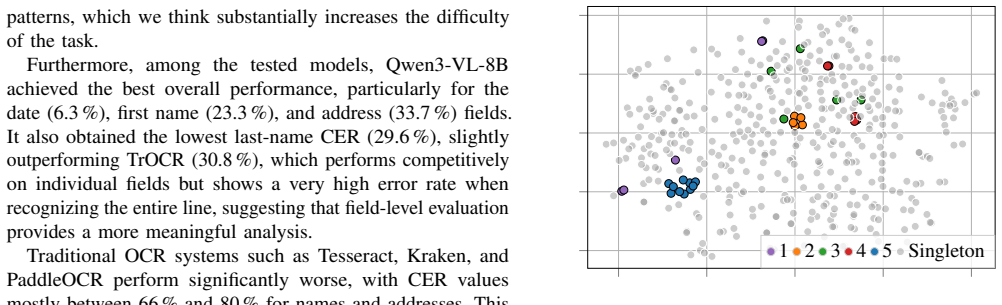
A pipeline of template-based line segmentation, OCR, and writer retrieval was tested on 443 handwritten entries from 418 writers. OCR reaches a character error rate of 29.6 percent on first names and struggles with out-of-vocabulary terms, while writer retrieval achieves 50.6 percent mAP and more reliably identifies visually similar entries across lists to support duplicate detection.
What carries the argument
Writer retrieval techniques that match entries by handwriting similarity across signature lists.
If this is right
- Writer retrieval can flag potential duplicate submissions for manual review.
- Off-the-shelf OCR systems remain unreliable for transcribing short handwritten names and addresses.
- The segmentation-plus-retrieval pipeline offers a concrete way to assist labor-intensive list validation.
- Performance metrics are measured on a dataset built from real signature entries.
Where Pith is reading between the lines
- Such methods could be integrated into existing validation workflows to reduce the volume of entries requiring full manual inspection.
- Collecting additional Swiss handwriting samples might raise the mAP beyond the reported 50.6 percent.
- The same retrieval approach could extend to other administrative tasks that require spotting repeated handwritten content.
Load-bearing premise
The 443-entry dataset collected from 418 writers represents the handwriting variability, formats, and duplicate patterns found in real Swiss signature lists.
What would settle it
Apply the writer retrieval method to a new collection of actual submitted signature lists from multiple initiatives and check whether the top-ranked similar pairs are genuine duplicates or forgeries.
Figures


read the original abstract
Popular initiatives and referendums are central to Swiss democracy, yet the validation of handwritten signature lists remains a labor-intensive manual process. This paper investigates the potential of automated document analysis methods, including OCR and AI-based handwriting analysis, to support this task. We propose a pipeline combining template-based line segmentation with text recognition and writer retrieval techniques, evaluated on a dataset of 443 handwritten entries from 418 writers. Results show that OCR struggles with out-of-vocabulary handwriting, with a CER of 29.6% for first names. In contrast, writer retrieval performs more robustly, reaching an mAP of 50.6%. Furthermore, our experiments indicate that off-the-shelf OCR systems are not sufficiently reliable for transcription of handwritten signature data, particularly for short, out-of-vocabulary entries such as names or addresses. However, writer retrieval methods can effectively identify visually similar entries across signature lists, making them a suitable tool for supporting the detection of potential duplicate submissions based on handwriting similarity.
Editorial analysis
A structured set of objections, weighed in public.
Referee Report
Summary. The paper proposes a pipeline combining template-based line segmentation, OCR-based text recognition, and writer retrieval to support validation of handwritten signature lists for Swiss popular initiatives. It evaluates the approach on an internal dataset of 443 entries from 418 writers, reporting a CER of 29.6% for first-name transcription and an mAP of 50.6% for writer retrieval. The central claim is that while off-the-shelf OCR is unreliable for short out-of-vocabulary entries, writer retrieval methods can effectively identify visually similar entries and are thus suitable for supporting detection of potential duplicate submissions based on handwriting similarity.
Significance. If the reported mAP generalizes, the work provides a concrete baseline (CER 29.6%, mAP 50.6%) for applying document analysis techniques to a real civic process, potentially reducing manual validation effort. The explicit reporting of these metrics on a non-trivial collection of signature data is a strength that future studies can build upon.
major comments (2)
- [Dataset] Dataset section: The collection comprises 443 entries from 418 writers (implying ~25 repeated writers). The evaluation therefore rests on a small number of near-duplicates whose similarity patterns may not reflect operational cases such as forgeries, aging signatures, or cross-list variations. This directly limits the strength of the claim that the 50.6% mAP demonstrates suitability for supporting duplicate detection in practice.
- [Experiments] Experiments / Evaluation protocol: No external validation set drawn from official Swiss submissions is described, nor is the precise construction of queries versus gallery (or definition of a positive duplicate match) detailed. Without these, it is unclear whether the mAP measures the operational task the authors conclude it supports.
minor comments (1)
- [Abstract] Abstract: The evaluation protocol, baselines, and error analysis are not summarized, making the reported numbers difficult to interpret at first reading.
Simulated Author's Rebuttal
We thank the referee for the constructive feedback on our dataset and evaluation protocol. The comments correctly identify limitations in scale and external validation that affect the strength of our claims. We address each point below and will revise the manuscript accordingly.
read point-by-point responses
-
Referee: [Dataset] Dataset section: The collection comprises 443 entries from 418 writers (implying ~25 repeated writers). The evaluation therefore rests on a small number of near-duplicates whose similarity patterns may not reflect operational cases such as forgeries, aging signatures, or cross-list variations. This directly limits the strength of the claim that the 50.6% mAP demonstrates suitability for supporting duplicate detection in practice.
Authors: We agree that the limited number of repeated writers (~25) restricts evaluation on challenging variations such as forgeries or aging. Our internal collection was assembled to mirror the low duplicate rate typical of real signature lists. The mAP of 50.6% shows the retrieval method can surface the existing duplicates present in this data. In revision we will add explicit discussion of these constraints in the limitations section and moderate the language on operational suitability. revision: partial
-
Referee: [Experiments] Experiments / Evaluation protocol: No external validation set drawn from official Swiss submissions is described, nor is the precise construction of queries versus gallery (or definition of a positive duplicate match) detailed. Without these, it is unclear whether the mAP measures the operational task the authors conclude it supports.
Authors: Official Swiss submission data cannot be used due to privacy restrictions; the reported results are therefore based on our internal collection. We will revise the Experiments section to specify the query-gallery split, the exact definition of a positive match (entries from the same writer), and how mAP is computed. This will clarify the relation between the reported metric and the duplicate-flagging use case. revision: yes
Circularity Check
No circularity: purely empirical evaluation with no derivations or self-referential reductions
full rationale
The paper collects a dataset of 443 entries, applies existing OCR and writer retrieval methods, and reports direct performance metrics (CER 29.6%, mAP 50.6%). No equations, fitted parameters, predictions, or derivations are present that could reduce to inputs by construction. No self-citations are invoked as load-bearing uniqueness theorems or ansatzes. The central claim is an empirical observation about method suitability on the internal data, which does not involve any circular reduction.
Axiom & Free-Parameter Ledger
Reference graph
Works this paper leans on
-
[1]
Trocr: Transformer-based optical character recognition with pre-trained models,
M. Li, T. Lv, J. Chen, L. Cui, Y . Lu, D. A. F. Flor ˆencio, C. Zhang, Z. Li, and F. Wei, “Trocr: Transformer-based optical character recognition with pre-trained models,” inThirty-Seventh AAAI Conference on Artificial Intelligence, AAAI 2023, 2023, pp. 13 094–13 102
2023
-
[2]
Writer retrieval for historical documents,
M. Peer, “Writer retrieval for historical documents,” Ph.D. dissertation, 2025
2025
-
[3]
Handwriting Analysis with Focus on Writer Identification and Writer Retrieval,
V . Christlein, “Handwriting Analysis with Focus on Writer Identification and Writer Retrieval,” Ph.D. dissertation, 2018
2018
-
[4]
Layoutlmv3: Pre-training for document AI with unified text and image masking,
Y . Huang, T. Lv, L. Cui, Y . Lu, and F. Wei, “Layoutlmv3: Pre-training for document AI with unified text and image masking,” inMM ’22: The 30th ACM International Conference on Multimedia 2022, 2022, pp. 4083–4091
2022
-
[5]
Ocr-free document understanding transformer,
G. Kim, T. Hong, M. Yim, J. Nam, J. Park, J. Yim, W. Hwang, S. Yun, D. Han, and S. Park, “Ocr-free document understanding transformer,” in Computer Vision - ECCV 2022 - 17th European Conference, 2022, pp. 498–517
2022
-
[6]
A novel connectionist system for unconstrained handwriting recognition,
A. Graves, M. Liwicki, S. Fern ´andez, R. Bertolami, H. Bunke, and J. Schmidhuber, “A novel connectionist system for unconstrained handwriting recognition,”IEEE Trans. Pattern Anal. Mach. Intell., vol. 31, no. 5, pp. 855–868, 2009. TABLE III: Results of different writer retrieval methods and datasets showing that a supervised use of additional training da...
2009
-
[7]
Handwritten text recognition: A survey,
C. Garrido-Munoz, A. Rios-Vila, and J. Calvo-Zaragoza, “Handwritten text recognition: A survey,”IEEE Transactions on Pattern Analysis and Machine Intelligence, vol. 48, no. 4, p. 4367–4387, Apr. 2026
2026
-
[8]
Qwen2.5-Coder Technical Report
Qwen Team, “Qwen3 technical report,”arXiv preprint, 2024, arXiv:2409.12186
work page internal anchor Pith review Pith/arXiv arXiv 2024
-
[9]
Benchmarking large language models for handwritten text recognition,
G. Crosilla, L. Klic, and G. Colavizza, “Benchmarking large language models for handwritten text recognition,”Journal of Documentation, vol. 81, no. 7, pp. 334–354, 2025
2025
-
[10]
Writer identification using vlad encoded contour-zernike moments,
V . Christlein, D. Bernecker, and E. Angelopoulou, “Writer identification using vlad encoded contour-zernike moments,” in2015 13th International Conference on Document Analysis and Recognition (ICDAR), 2015, pp. 906–910
2015
-
[11]
Writer retrieval using compact con- volutional transformers and netmvlad,
M. Peer, F. Kleber, and R. Sablatnig, “Writer retrieval using compact con- volutional transformers and netmvlad,” in26th International Conference on Pattern Recognition, ICPR 2022, 2022, pp. 1571–1578
2022
-
[12]
Learning features for writer retrieval and identification using triplet cnns,
M. Keglevic, S. Fiel, and R. Sablatnig, “Learning features for writer retrieval and identification using triplet cnns,” in16th International Conference on Frontiers in Handwriting Recognition, ICFHR 2018, 2018, pp. 211–216
2018
-
[13]
SAGHOG: Self-Supervised Autoencoder for Generating HOG Features for Writer Retrieval,
M. Peer, F. Kleber, and R. Sablatnig, “SAGHOG: Self-Supervised Autoencoder for Generating HOG Features for Writer Retrieval,” in Document Analysis and Recognition - ICDAR 2024, 2024, pp. 121–138
2024
-
[14]
Self-supervised vision transformers for writer retrieval,
T. Raven, A. Matei, and G. A. Fink, “Self-supervised vision transformers for writer retrieval,” inDocument Analysis and Recognition - ICDAR 2024, E. H. Barney Smith, M. Liwicki, and L. Peng, Eds. Cham: Springer Nature Switzerland, 2024, pp. 380–396
2024
-
[15]
Unsupervised feature learning for writer identification and writer retrieval,
V . Christlein, M. Gropp, S. Fiel, and A. K. Maier, “Unsupervised feature learning for writer identification and writer retrieval,” in14th IAPR International Conference on Document Analysis and Recognition, ICDAR 2017,, 2017, pp. 991–997
2017
-
[16]
Questioned document examination using cedar-fox,
S. N. Srihari, B. Srinivasan, and K. Desai, “Questioned document examination using cedar-fox,”Journal of Forensic Document Examination, vol. 28, p. 15–26, Dec. 2018
2018
-
[17]
Histograms of oriented gradients for human detection,
N. Dalal and B. Triggs, “Histograms of oriented gradients for human detection,” inProceedings of the IEEE Computer Society Conference on Computer Vision and Pattern Recognition (CVPR), 2005, pp. 886–893
2005
-
[18]
UMAP: Uniform Manifold Approximation and Projection for Dimension Reduction
L. McInnes, J. Healy, and J. Melville, “Umap: Uniform manifold approximation and projection for dimension reduction,”arXiv preprint arXiv:1802.03426, 2018
work page internal anchor Pith review Pith/arXiv arXiv 2018
-
[19]
Hdbscan: Hierarchical density based clustering,
L. McInnes, J. Healy, and S. Astels, “Hdbscan: Hierarchical density based clustering,”Journal of Open Source Software, vol. 2, no. 11, p. 205, 2017
2017
-
[20]
Distinctive image features from scale-invariant keypoints,
D. G. Lowe, “Distinctive image features from scale-invariant keypoints,” International Journal of Computer Vision, vol. 60, no. 2, pp. 91–110, 2004
2004
-
[21]
Random sample consensus: A paradigm for model fitting with applications to image analysis and automated cartography,
M. A. Fischler and R. C. Bolles, “Random sample consensus: A paradigm for model fitting with applications to image analysis and automated cartography,”Communications of the ACM, vol. 24, no. 6, pp. 381–395, 1981
1981
-
[22]
Parametric image alignment using enhanced correlation coefficient maximization,
G. D. Evangelidis and E. Z. Psarakis, “Parametric image alignment using enhanced correlation coefficient maximization,”IEEE Transactions on Pattern Analysis and Machine Intelligence, vol. 30, no. 10, pp. 1858–1865, 2008
2008
-
[23]
A computational approach to edge detection,
J. Canny, “A computational approach to edge detection,”IEEE Transac- tions on Pattern Analysis and Machine Intelligence, vol. PAMI-8, no. 6, pp. 679–698, 1986
1986
-
[24]
Method and means for recognizing complex patterns,
P. V . C. Hough, “Method and means for recognizing complex patterns,” U.S. Patent, no. 3,069,654, 1962
1962
-
[25]
The iam-database: An english sentence database for offline handwriting recognition,
U.-V . Marti and H. Bunke, “The iam-database: An english sentence database for offline handwriting recognition,”International Journal on Document Analysis and Recognition, vol. 5, no. 1, pp. 39–46, 2002
2002
-
[26]
CVL-DataBase: An off- line database for writer retrieval, writer identification and word spotting,
F. Kleber, S. Fiel, M. Diem, and R. Sablatnig, “CVL-DataBase: An off- line database for writer retrieval, writer identification and word spotting,” in12th International Conference on Document Analysis and Recognition, ICDAR 2013, 2013, pp. 560–564
2013
-
[27]
Hybrid page layout analysis via tab-stop detection,
R. Smith, “Hybrid page layout analysis via tab-stop detection,”Proceed- ings of the Tenth International Conference on Document Analysis and Recognition (ICDAR), pp. 241–245, 2009
2009
-
[28]
Kraken: An universal text recognizer for the humanities,
B. Kiessling, C. Reul, M. Wehner, and U. Springmann, “Kraken: An universal text recognizer for the humanities,”Proceedings of the Digital Humanities Conference, 2019
2019
-
[29]
arXiv preprint arXiv:2009.09941 (2020)
Y . Du, C. Li, R. Guo, X. Yin, W. Liu, J. Zhouet al., “Pp-ocr: A practical ultra lightweight ocr system,”arXiv preprint, 2020, arXiv:2009.09941
-
[30]
Towards the influence of text quantity on writer retrieval,
M. Peer, R. Sablatnig, and F. Kleber, “Towards the influence of text quantity on writer retrieval,” inDocument Analysis and Recognition – ICDAR 2025, 2026, pp. 129–145
2025
-
[31]
All About VLAD,
R. Arandjelovic and A. Zisserman, “All About VLAD,” in2013 IEEE Conference on Computer Vision and Pattern Recognition, 2013, pp. 1578–1585
2013
-
[32]
Deep Residual Learning for Image Recognition,
K. He, X. Zhang, S. Ren, and J. Sun, “Deep Residual Learning for Image Recognition,” in2016 IEEE Conference on Computer Vision and Pattern Recognition (CVPR). IEEE, 2016, pp. 770–778
2016
-
[33]
Towards writer retrieval for historical datasets,
M. Peer, F. Kleber, and R. Sablatnig, “Towards writer retrieval for historical datasets,” inDocument Analysis and Recognition - ICDAR 2023, 2023, pp. 411–427
2023
-
[34]
Netvlad: CNN architecture for weakly supervised place recognition,
R. Arandjelovic, P. Gronat, A. Torii, T. Pajdla, and J. Sivic, “Netvlad: CNN architecture for weakly supervised place recognition,” in2016 IEEE Conference on Computer Vision and Pattern Recognition, CVPR 2016, 2016, pp. 5297–5307
2016
discussion (0)
Sign in with ORCID, Apple, or X to comment. Anyone can read and Pith papers without signing in.