REVIEW 3 major objections 7 minor 28 references
Identification for Molecular Communication Based on Diffusion Channel with Poisson Reception Process
T0 review · 3 major / 7 minor · reviewed 2026-08-07 · deepseek-v4-flash
Pith's one-line read The paper proves that deterministic identification over a diffusion-based Poisson molecular channel has capacity at least 1/4, so the number of identifiable messages grows like $2^{n\log n/4}$.
desk verdict A reasonable model and honest simulations, but the main capacity proof has a fatal radius error that invalidates Theorem 2.2 as written. read the letter →
The pith
A machine-rendered reading of the paper's core claim, the machinery that carries it, and where it could break.
The reading
What carries the argument
The carrying object is the sphere-packing construction for codebooks: codewords are centers of disjoint hyperspheres packed inside the input cube, the packing density is bounded below, and the number of codewords is the ratio of the cube volume to the sphere volume. The decoder is a distance test on the statistic $d(y^n,u)=\frac{1}{n}\sum_{t=1}^n[(y_t-\lambda_t)^2-y_t]$, with decoding regions as balls of radius $\delta_n$ around each codeword. Type I and Type II errors are controlled through fourth moments and Chebyshev's inequality, giving errors that vanish for large block lengths. The absorption probability $\tilde{\lambda}_t=\operatorname{erfc}(L_R/\sqrt{4Dt})$ enters every mean and variance, connecting the diffusion physics to the Poisson statistics.
What would settle it
Recompute the bound on $\log N$ in Section 3 with the radius exactly as defined, $r_0=\sqrt{a n^{1+b}/4}$: if the $n\log n$ coefficient of $\log N$ is not positive for the claimed range of $b$, the packing argument cannot yield $C^d_{\mathrm{ID}}(P)\ge 1/4$. A numerical check for $n=10,\dots,100$ of whether the codeword count grows or shrinks would settle the point.
Extended reading notes
Core claim
The central claim is Theorem 2.2: for the diffusion-based discrete-time Poisson channel with peak constraint $0\le x_t\le A$, the deterministic identification capacity satisfies $C^d_{\mathrm{ID}}(P)\ge 1/4$. The channel is built from Fick's law in one dimension, an absorbing receiver at distance $L_R$, and a Poisson reception process whose mean is the released molecule count times the complementary-error-function absorption probability. Achievability is shown by packing non-overlapping $n$-dimensional spheres of radius $r_0$ inside the cube $[0,A]^n$, decoding by a distance threshold, and bounding both identification error probabilities with Chebyshev's inequality so that they vanish as $n$ grows. If the theorem is correct, deterministic identification over molecular diffusion channels achieves the super-exponential growth rate previously known for simpler Poisson models.
Load-bearing premise
The theorem stands on the packing step: the chosen sphere radius $r_0$ must make the number of non-overlapping code spheres inside $[0,A]^n$ grow super-exponentially with $n$, and if the volume ratio actually shrinks, the lower-bound proof collapses.
Editorial extensions
If this is right
- If the bound holds, identification-based molecular communication can distinguish a number of events growing like $2^{n\log n/4}$, so even short blocks carry astronomically many event identities.
- Receivers can be simpler in principle: they only need to test for the presence of one target message rather than decode the transmitted word.
- The sphere-packing codebook construction gives an explicit achievability route for diffusion-based Poisson channels, extending the technique used for the simpler discrete-time Poisson channel.
- The error analysis shows both Type I and Type II error probabilities can be made arbitrarily small by increasing block length, with short-block simulations following the predicted trend.
- The lower bound supplies a concrete design target for molecular communication testbeds and for future constructive code designs.
Reading between the lines
- Beyond the paper: the packing-count step is sensitive to the sphere radius; verifying that $r_0$ scales like $n^{3/4}$ would convert the estimate into a robust construction recipe.
- Beyond the paper: the same sphere-packing identification approach could be tried for two- and three-dimensional diffusion channels, where Green's functions exist but the volume ratios change.
- Beyond the paper: in event-driven drug-delivery or sensing protocols, the natural figure of merit would shift from decoded throughput to the number of distinguishable events, a metric this paper implicitly puts forward.
Editorial analysis
A structured set of objections, weighed in public.
Referee Report
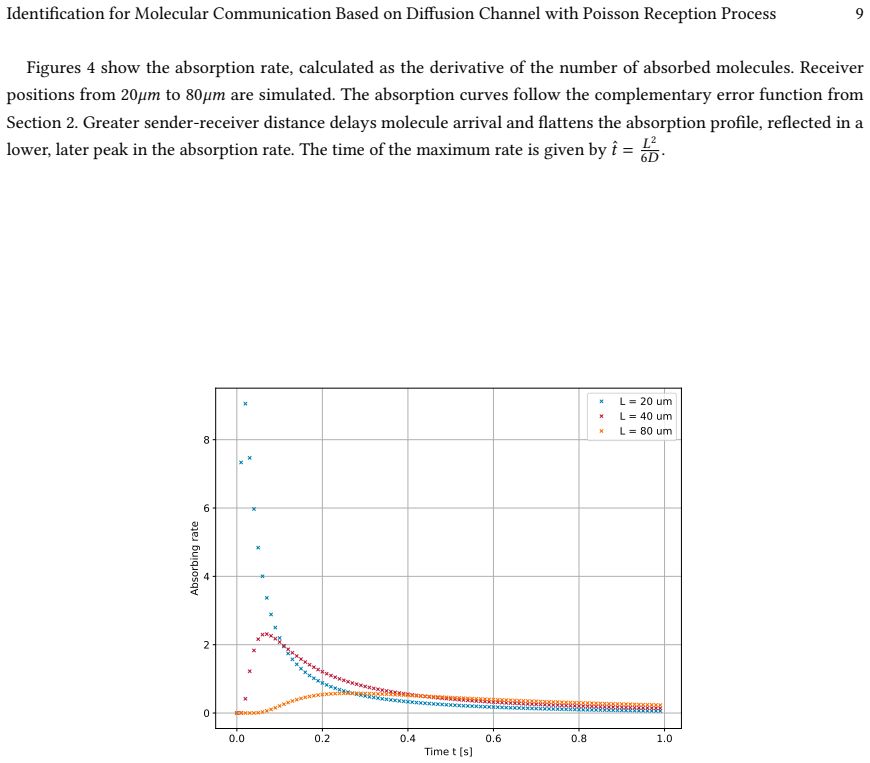
Summary. The paper combines deterministic identification (DI) with one-dimensional diffusion-based molecular communication. The channel model is y_t ~ Poisson(erfc(L_R/sqrt(4Dt)) * x_t) under a peak constraint 0 <= x_t <= A, derived from a 1D diffusion equation with the sender at the origin and the receiver at L_R. After defining (n, N, lambda_1, lambda_2) DI codes and the super-exponential capacity in Eq. (1), the authors state Theorem 2.2 claiming C^d_ID(P) >= 1/4, which would mean the number of identifiable messages scales like 2^{n log n / 4}. The proof in Section 3 adapts the sphere-packing argument of [23]: saturated packings of spheres of radius r_0 = sqrt(a n^{1+b}/4) in [0,A]^n, with Type I/II error bounds derived via Chebyshev inequalities and a final limit b -> 0. Section 4 validates the diffusion channel impulse response with a finite-element macroscopic simulation and reports error probabilities for short randomized binary codes, using the parameters listed in Tables 1 and 2.
Significance. If Theorem 2.2 were correct, the paper would deliver a concrete super-exponential identification guarantee (2^{n log n / 4}) for an event-driven molecular communication system with a physically motivated 1D diffusion channel and Poisson reception, extending the DTPC result of [23] to include the erfc absorption factor through D, L_R, and t. The macroscopic finite-element simulation of the channel impulse response is a solid empirical component, and the paper is transparent about reusing the published sphere-packing technique. On the other hand, the mathematical contribution is an adaptation of an existing proof rather than a new method, the numerical section validates error probabilities of particular codes rather than the capacity claim, and there is no machine-checked proof or released code. These points matter, but the decisive question is whether the proof of Theorem 2.2 is sound; on that point the manuscript currently fails, as detailed below.
major comments (3)
- [Section 3 (sphere-packing count, before 'Take the logarithm')] The packing-count step is load-bearing and algebraically incoherent as printed. From r_0 = sqrt(a n^{1+b}/4) one obtains n log r_0 = ((1+b)/2) n log n + O(n), and log Vol(S_{r_0}) = n log r_0 - (n/2) log n + O(n); substituting into N >= 2^{-n} Vol(Q_0)/Vol(S_{r_0}) gives log N >= (1/2 - (1+b)/2) n log n + O(n) = -(b/2) n log n + O(n). For every b in (0,1] the coefficient is non-positive, and even the limit b = 0 gives only log N = O(n), so the displayed conclusion log N >= n log n [(1-b)/4 + o(n)] cannot follow from the printed radius. The asserted rate (1-b)/4 would require r_0 ~ n^{(1+b)/4}, i.e., r_0 = (a n^{1+b})^{1/4} (a fourth root). Because the same r_0 fixes the Euclidean separation 2r_0 used in the Type II error bound, every subsequent inequality inherits the problem, and Theorem 2.2 is unproven as written.
- [Section 3 (Type I and Type II error chains)] The error-probability chains in Section 3 contain substitutions that do not close. With delta_n = ac(min_t lambda_tilde_t)^2 n^{(b-1)/2} and r_0^2 = a n^{1+b}/4, the Type II threshold (min_t lambda_tilde_t)^2 (2r_0)^2/n - 2 delta_n equals a(min_t lambda_tilde_t)^2 n^b (1 - 2c n^{-(1+b)/2}), not the final display's denominator ac(min_t lambda_tilde_t)^2 n^{b+1} and factor (2 - c n^{(b-1)/2}); the first Chebyshev term evaluates to 8A^3(max_t lambda_tilde_t)^3/(a^2 c^2 (min_t lambda_tilde_t)^4 n^b), not the printed 8A^3(max_t lambda_tilde_t)^3/(ac(min_t lambda_tilde_t)^2 n^{b+1}). The Type I variance identity (1/n^2) sum {E[(Y_t - lambda_tilde_t u_{i,t})^4] - lambda_tilde_t u_{i,t}} is also only an upper bound rather than an equality. All of these displays must be re-derived consistently, and in particular the positivity of the Type II threshold must be rechecked after the radius of the previous comment is corrected.
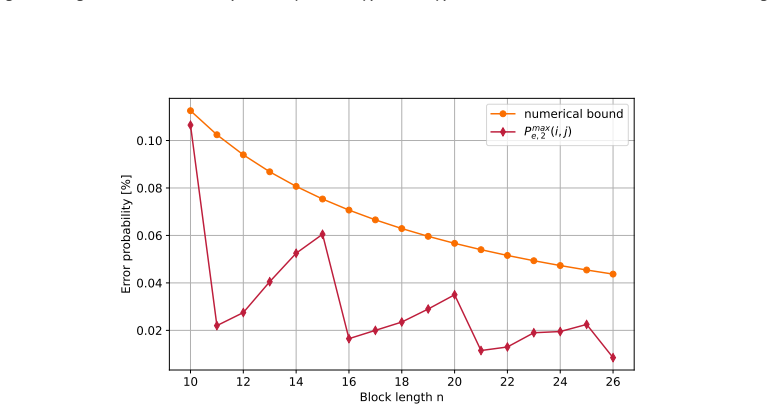
- [Section 4.2 (Identification Code, Tables 1 and 2)] The numerical validation as described is not feasible. With a = 500 and b = 0.99 (Table 2), r_0 = sqrt(500 n^{1.99}/4) approx 11.2 n^{0.995}, so the required separation 2r_0 exceeds 100 for all n >= 5; for n = 26, 2r_0 approx 575 requires pairwise Hamming distance at least 34 among binary {0,100} strings of length 26, which is impossible, so the stated rule that each codeword must be at least 2r_0 from all previously accepted codewords cannot produce the claimed N = 2^{n log_2 n * 0.1} approx 4800. In addition, the simulated rate R = 0.1 is 40 times the rate (1-0.99)/4 = 0.0025 that Theorem 2.2 would prove for the displayed value of b, so the experiment does not validate the capacity lower bound. The section must state the feasible codebook construction actually used and clarify which claim (error bounds versus packing size) the experiments test.
minor comments (7)
- [Theorem 2.2] The statement that the capacity 'is upper-bounded by C^d_ID(P) >= 1/4' should read 'lower-bounded', and the connection to the infimum over error probabilities in Eq. (1) should be made explicit.
- [Section 3] 'low of total probability' should be 'law of total probability', and 'Chebyshev's inequity' should be 'Chebyshev's inequality'.
- [Section 3 (packing display)] The Stirling-type bound for Gamma(n/2+1) is written with floor(n/2) in a way that garbles the volume expression, and for odd n the substitution Gamma(n/2+1) = (n/2)! is not exact; this display should be cleaned up.
- [Section 3 (error bounds and b -> 0)] The Type I and Type II bounds are O(n^{-b}) and should be reported as tending to zero (o(1)); writing '= o(n)' is vacuous, and the 'Choose b -> 0' step should argue that for each fixed error threshold (lambda_1, lambda_2) and each fixed b > 0 the bounds eventually fall below the threshold at rate (1-b)/4.
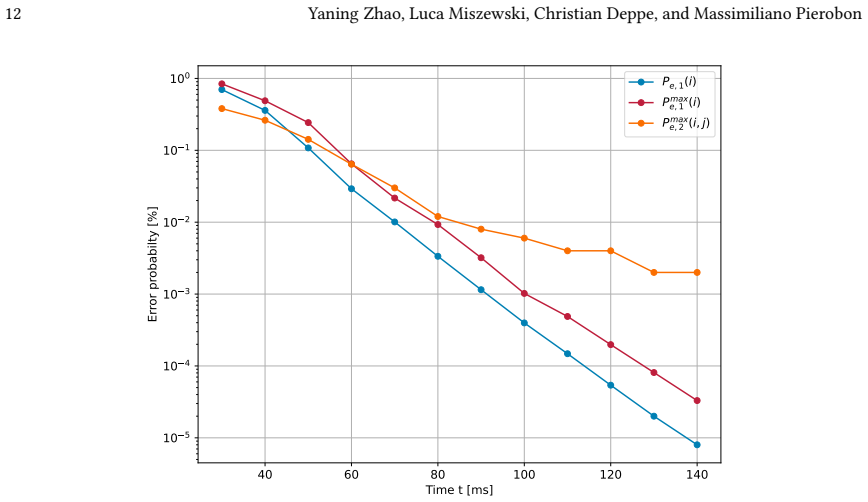
- [Figures 6 and 7] Figure 6's caption mentions Type I and Type II error, but the plotted quantities are P_{e,1} only; Type II appears in Figure 7.
- [Section 1] 'highlighting the for a more practical' contains a missing word, making the sentence ungrammatical.
- [Section 2 (channel model)] The erfc absorption formula should be derived or precisely referenced; the boundary condition partial rho / partial l = 0 at l = L_R together with absorption at the receiver is ambiguous as stated.
Circularity Check
No significant circularity: the capacity lower bound is derived from an independent sphere-packing lemma and self-derived probability bounds; the reuse of the technique from [23] is a minor, non-load-bearing self-citation.
full rationale
The claimed DI capacity lower bound is not obtained by fitting or by defining the channel in terms of the result. The proof constructs a sphere packing in the input cube, lower-bounds the number of codewords via the external saturated-packing lemma [7], and then bounds the Type I and Type II error probabilities by explicit Chebyshev inequalities for the Poisson reception process. The final rate 1/4 is independent of the diffusion parameters D and L_R and of the constants a, b, c, so the result is not an input to itself. The citation to [23], which shares one co-author, is used only as a technique reference ('extending the sphere packing technique used for the achievability proof in [23]'); the present proof re-derives the steps rather than importing a black-box theorem. The numerical section compares Monte Carlo error rates with the paper's own analytical bound, so it is a consistency check rather than an independent external validation, but this does not make the derivation circular. Separately, the printed radius r0 = sqrt(a n^{1+b}/4) appears to give an n log n coefficient of -b/2 rather than (1-b)/4, which if literal would invalidate the displayed asymptotic rate; that is an internal mathematical/correctness issue, not a circularity of the type this pass targets.
Assumptions & free parameters
free parameters (3)
- a =
arbitrary positive constant (500 in simulation)
- b =
b in [0,1], taken to 0 for the final bound; 0.99 in simulation
- c =
1.5 in simulation
assumptions (6)
- standard math Volume of an n-dimensional Euclidean ball of radius r is V = pi^(n/2) r^n / Gamma(n/2+1), or its asymptotic approximation.
- standard math Chebyshev's inequality bounds the probability of deviation by variance over threshold squared.
- standard math Saturated packing density is at least 2^(-n), as cited from [7] in Lemma 3.1.
- domain assumption The channel output is Poisson with mean lambda_t = x_t * erfc(L_R/sqrt(4Dt)), and the absorbing probability is erfc(L_R/sqrt(4Dt)).
- domain assumption Maximum release constraint 0 <= x_t <= A with A a fixed constant.
- ad hoc to paper The sphere radius is chosen as r_0 = sqrt(a n^(1+b)/4) with a>0 and b in [0,1].
Cite this review
Pith. "Pith review of Identification for Molecular Communication Based on Diffusion Channel with Poisson Reception Process." pith.science (2026). https://pith.science/paper/2KG5AOFZ
@misc{pith2026250614360,
  author       = {Pith},
  title        = {Pith review of: Identification for Molecular Communication Based on Diffusion Channel with Poisson Reception Process},
  year         = {2026},
  howpublished = {\url{https://pith.science/paper/2KG5AOFZ}},
  note         = {Machine review of arXiv:2506.14360}
}
read the original abstract
Molecular communication (MC) enables information exchange at the nano- and microscale, with applications in areas like drug delivery and health monitoring. These event-driven scenarios often require alternatives to traditional transmission. Identification communication, introduced by Ahlswede and Dueck, offers such an approach, in which the receiver only determines whether a specific message was sent, suiting resource-limited and event-triggered systems. This paper combines MC with identification and proposes a one-dimensional (1D) diffusion-based model. Diffusion noise is modeled as a Poisson process, and a lower bound on channel capacity is derived. Simulations, microscopic, and with short-length deterministic codes, validate theoretical results, including the channel impulse response and error bounds. The findings support the design of practical MC systems, with potential use in testbed development.
Figures


Figures from the paper (5 more)


Reference graph
Works this paper leans on
-
[23]
Mohammad Javad Salariseddigh, Vahid Jamali, Uzi Pereg, Holger Boche, Christian Deppe, and Robert Schober. 2023. Deterministic identification for molecular communications over the Poisson channel. IEEE Transactions on Molecular, Biological and Multi-Scale Communications (2023)
work page 2023
-
[1]
2024. Fick’s Law of Diffusion . Springer Nature Singapore, Singapore, 376–376
work page 2024
-
[2]
R. Ahlswede and G. Dueck. 1989. Identification via channels. IEEE Transactions on Information Theory 35, 1 (1989), 15–29
work page 1989
-
[3]
Theresa M. Allen and Pieter R. Cullis. 2004. Drug delivery systems: entering the mainstream. Science (New York, N.Y.) 303, 5665 (2004), 1818–1822
work page 2004
-
[4]
Robert Byrne and Dermot Diamond. 2006. Chemo/bio-sensor networks. Nature materials 5, 6 (2006), 421–424
work page 2006
-
[5]
Juan A Cabrera, Holger Boche, Christian Deppe, Rafael F Schaefer, Christian Scheunert, and Frank HP Fitzek. 2021. 6G and the Post-Shannon Theory. Shaping Future 6G Networks: Needs, Impacts, and Technologies (2021), 271–294
work page 2021
-
[6]
Jens Clausen. 2009. Man, machine and in between. Nature 457, 7233 (2009), 1080–1081. Manuscript submitted to ACM Identification for Molecular Communication Based on Diffusion Channel with Poisson Reception Process 13
work page 2009
-
[7]
Henry Cohn. 2010. Order and disorder in energy minimization. In Proceedings of the International Congress of Mathematicians 2010 (ICM 2010) (In 4 Volumes) Vol. I: Plenary Lectures and Ceremonies Vols. II–IV: Invited Lectures . World Scientific, 2416–2443
work page 2010
Show all 28 references
-
[8]
Pau Colomer, Christian Deppe, Holger Boche, and Andreas Winter. 2025. Deterministic identification over channels with finite output: a dimensional perspective on superlinear rates. IEEE Transactions on Information Theory (2025)
2025
-
[9]
Pau Colomer, Christian Deppe, Holger Boche, and Andreas Winter. 2025. Rate-reliability functions for deterministic identification. arXiv:2502.02389 [cs.IT] https://arxiv.org/abs/2502.02389
2025 arXiv
-
[10]
Farokhzad and Robert Langer
Omid C. Farokhzad and Robert Langer. 2009. Impact of nanotechnology on drug delivery. ACS nano 3, 1 (2009), 16–20
2009
-
[11]
Birkan Yilmaz, Andrew Eckford, Chan-Byoung Chae, and Weisi Guo
Nariman Farsad, H. Birkan Yilmaz, Andrew Eckford, Chan-Byoung Chae, and Weisi Guo. 2016. A Comprehensive Survey of Recent Advancements in Molecular Communication. IEEE Communications Surveys & Tutorials 18, 3 (2016), 1887–1919
2016
-
[12]
Amin Gohari, Mahtab Mirmohseni, and Masoumeh Nasiri-Kenari. 2016. Information theory of molecular communication: directions and challenges. IEEE Transactions on Molecular, Biological and Multi-Scale Communications 2, 2 (2016), 120–142
2016
-
[13]
Griffith and Gail Naughton
Linda G. Griffith and Gail Naughton. 2002. Tissue engineering–current challenges and expanding opportunities. Science (New York, N.Y.) 295, 5557 (2002), 1009–1014
2002
-
[14]
Weisi Guo, Christos Mias, Nariman Farsad, and Jiang-Lun Wu. 2015. Molecular Versus Electromagnetic Wave Propagation Loss in Macro-Scale Environments. IEEE Transactions on Molecular, Biological and Multi-Scale Communications 1, 1 (2015), 18–25
2015
-
[15]
Ya-Ping Hsieh and Ping-Cheng Yeh. 2013. Mathematical Foundations for Information Theory in Diffusion-Based Molecular Communications. http://arxiv.org/pdf/1311.4431v1
2013 arXiv
-
[16]
Wafa Labidi, Christian Deppe, and Holger Boche. 2024. Information-Theoretical Analysis of Event-Triggered Molecular Communication. InEuropean Wireless 2024; 29th European Wireless Conference . 35–40
2024
-
[17]
Derya Malak and Ozgur B. Akan. 2012. Molecular communication nanonetworks inside human body. Nano Communication Networks 3, 1 (2012), 19–35
2012
-
[18]
Moritani, S
Y. Moritani, S. Hiyama, and T. Suda. 2006. Molecular communication for health care applications. In Fourth Annual IEEE International Conference on Pervasive Computing and Communications Workshops (PERCOMW’06) . 5 pp–553
2006
-
[19]
Muthu and Sanjay Singh
Madaswamy S. Muthu and Sanjay Singh. 2009. Targeted nanomedicines: effective treatment modalities for cancer, AIDS and brain disorders. Nanomedicine (London, England) 4, 1 (2009), 105–118
2009
-
[20]
Tadashi Nakano. 2013. Molecular communication. Cambridge University Press, Cambridge
2013
-
[21]
Akyildiz
Massimiliano Pierobon and Ian F. Akyildiz. 2013. Capacity of a Diffusion-Based Molecular Communication System With Channel Memory and Molecular Noise. IEEE Transactions on Information Theory 59, 2 (2013), 942–954
2013
-
[22]
Mohammad Javad Salariseddigh, Vahid Jamali, Holger Boche, Christian Deppe, and Robert Schober. 2023. Deterministic identification for MC binomial channel. In 2023 IEEE International Symposium on Information Theory (ISIT) . IEEE, 448–453
2023
-
[24]
Mohammad J Salariseddigh, Uzi Pereg, Holger Boche, and Christian Deppe. 2021. Deterministic identification over channels with power constraints. IEEE Transactions on Information Theory 68, 1 (2021), 1–24
2021
-
[25]
Rajesh Singh and James W. Lillard. 2009. Nanoparticle-based targeted drug delivery. Experimental and molecular pathology 86, 3 (2009), 215–223
2009
-
[26]
Prakriti Tayalia and David J. Mooney. 2009. Controlled growth factor delivery for tissue engineering. Advanced materials (Deerfield Beach, Fla.) 21, 32-33 (2009), 3269–3285
2009
-
[27]
Stefan Wilhelm, Anthony J Tavares, Qin Dai, Seiichi Ohta, Julie Audet, Harold F Dvorak, and Warren CW Chan. 2016. Analysis of nanoparticle delivery to tumours. Nature reviews materials 1, 5 (2016), 1–12
2016
-
[28]
Irvine, Dennis E
Jin-Wook Yoo, Darrell J. Irvine, Dennis E. Discher, and Samir Mitragotri. 2011. Bio-inspired, bioengineered and biomimetic drug delivery carriers. Nature reviews. Drug discovery 10, 7 (2011), 521–535. Manuscript submitted to ACM
2011
Reviewed August 7, 2026 · model on record in the stance chip above.
Discussion (0). Sign in to comment.