REVIEW 5 major objections 5 minor 31 references
An Adaptive Supervision Framework for Active Learning in Object Detection
T0 review · 5 major / 5 minor · reviewed 2026-08-14 · deepseek-v4-flash
Pith's one-line read Active learning that asks for center clicks before full boxes reaches target accuracy with roughly 15–30% less annotation time.
desk verdict A simple and sensible way to interleave weak and strong labels in active detection, with consistent but not rigorously quantified savings. read the letter →
The pith
A machine-rendered reading of the paper's core claim, the machinery that carries it, and where it could break.
The reading
What carries the argument
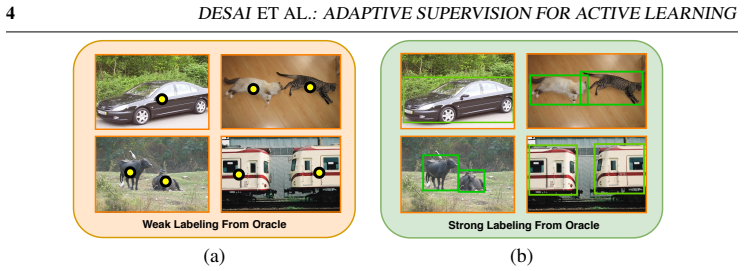
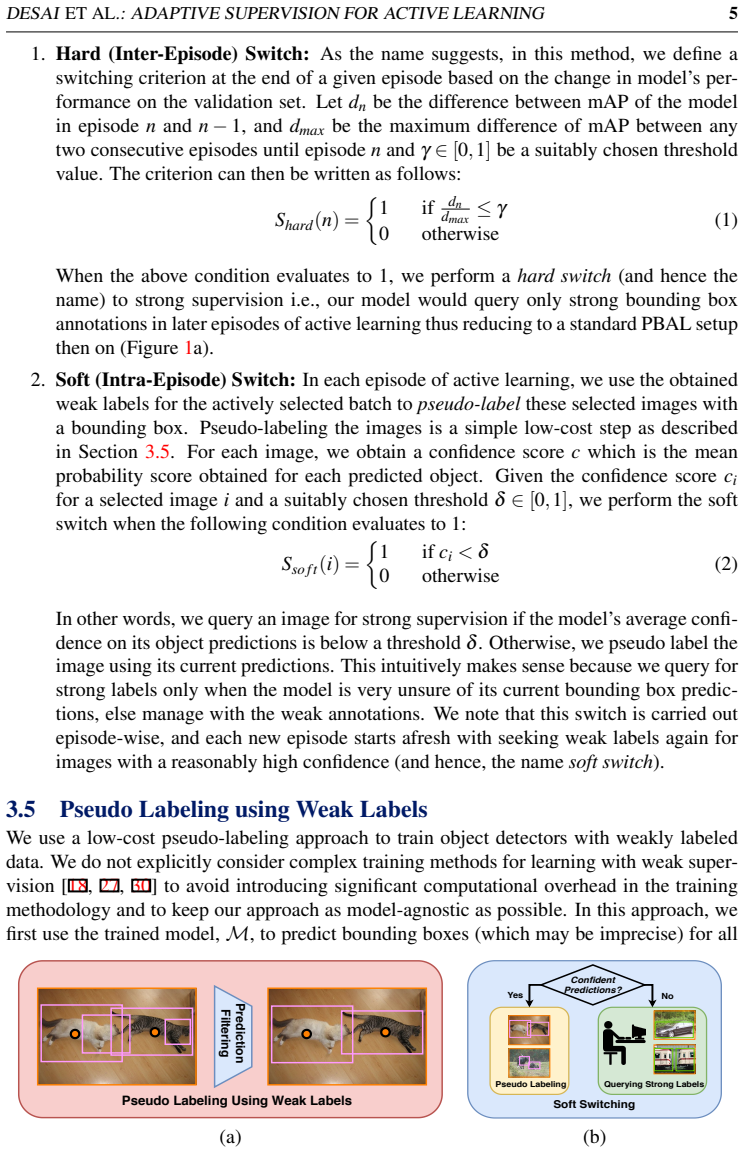
The load-bearing object is the adaptive supervision module, a small decision layer on top of an off-the-shelf detector. It has two named variants: a hard (inter-episode) switch, which checks whether the latest mAP improvement has dropped to at most gamma times the best improvement so far, and a soft (intra-episode) switch, which checks each image's average prediction confidence against a threshold delta and routes low-confidence images to strong annotations. The other half of the machinery is pseudo-labeling from center clicks: given click locations, the model keeps, for each click, the predicted box whose center is closest and tags it with the highest-probability class; this converts weak labels into training boxes in one forward pass, with no architectural change.
What would settle it
Measure actual annotation times for full boxes versus center clicks on PASCAL VOC 2007 with the same annotator pool, then re-plot the curves using real times; if center clicking costs more than roughly a small fraction of a full box, for instance 10 seconds per click rather than 3 seconds, the reported 30% savings at mAP around 0.55 will largely or entirely disappear.
Extended reading notes
Core claim
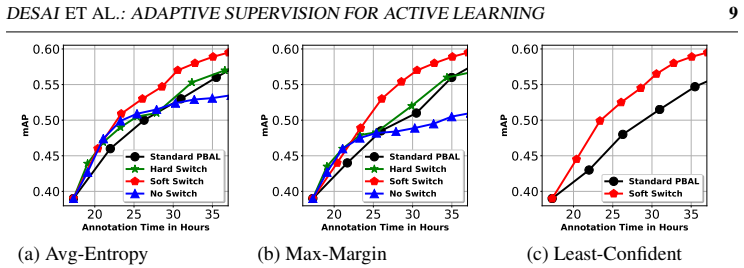
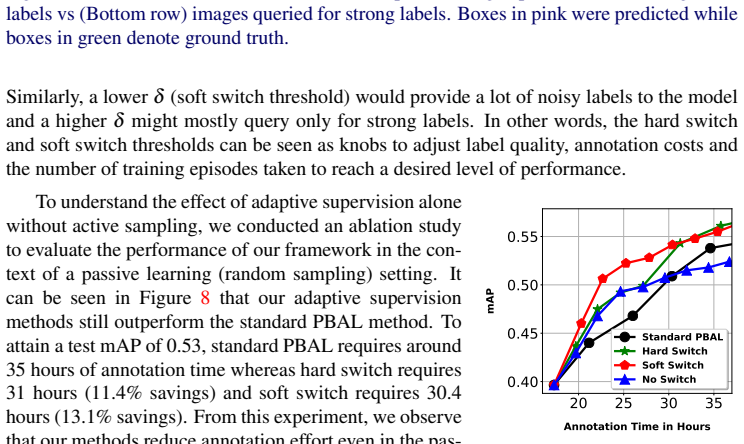
The central discovery is that interleaving weak supervision into active learning is not just a cost-saving add-on: it is a way to spend the annotation budget better, because weakly supervised pseudo-labels let the detector train on more images per hour and strong labels are reserved for exactly the images where the model is least confident. Concretely, with the soft-switch variant, each actively sampled image gets pseudo-labels from its center clicks unless the model's average prediction confidence falls below a threshold, in which case the image is sent for full bounding-box annotation. The paper reports that this soft switch beats both standard active learning and the hard-switch variant across three active query metrics and three datasets, e.g. reaching mAP around 0.55 on VOC 2007 in about 24.6 hours instead of around 35 hours.
Load-bearing premise
The reported percentage savings rest on the assumption that the ImageNet timing ratios, 34.5 seconds per bounding box, 3 seconds per center click, and 7.8 seconds per image, are realistic for PASCAL VOC and Wheat; if clicks are relatively slower on those images, the headline savings shrink.
Editorial extensions
If this is right
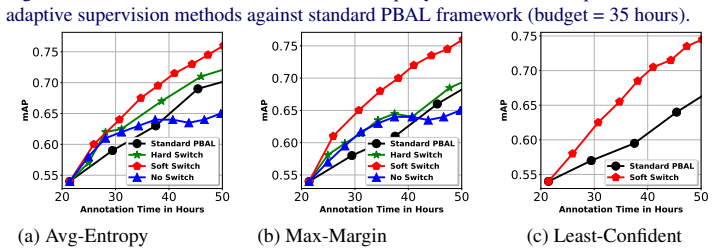
- Soft-switch adaptive supervision reaches a fixed mAP with less annotation time than standard pool-based active learning for all three active query methods tested (avg-entropy, max-margin, least-confident) on all three datasets.
- Hard switching gives smaller but consistent savings, roughly 7–15%, and remains useful when weak and strong annotation cannot be requested in the same round.
- The savings persist in passive learning with random sampling, with soft switch saving about 13% of annotation time to reach mAP 0.53 on VOC 2007, so the gain is not purely an artifact of active query selection.
- Because the framework uses only detector outputs and requires no change to the model architecture, the same adaptive module transfers across query methods and datasets.
Reading between the lines
- If the claim holds, a natural extension is to tune the switching thresholds online as a function of remaining budget rather than fixing them before training; a budget-aware scheduler could make the trade-off between label cost and model confidence a design choice rather than a constant.
- The method's reliance on the detector's own predicted boxes for pseudo-labels suggests that early episodes may be fragile if the initial model is very weak; a testable extension is to measure how the annotation-time savings vary with the size of the initial labeled seed.
- The same confidence-based routing idea could transfer to other expensive annotation tasks such as instance segmentation or keypoint labeling, where the decision to ask for a strong label might be made per object or per structure instead of per image.
Signed reviews
Editorial analysis
A structured set of objections, weighed in public.
Referee Report
Summary. The paper proposes an adaptive supervision framework for active learning in object detection. Instead of always querying bounding-box annotations, the framework first queries weak labels (center clicks) for actively selected images, generates pseudo-labels by matching predicted boxes to click locations, and uses a switching rule to request strong labels when the model is uncertain (soft switch) or when the mAP improvement has saturated (hard switch). The authors evaluate two switching variants on PASCAL VOC 2007, VOC 2012, and a wheat head counting dataset, using three query functions, and report 15-30% savings in annotation time to reach a given mAP compared with a standard pool-based active learning baseline. The main conclusion is that adaptive supervision reduces annotation cost.
Significance. If the reported savings are reliable, the paper introduces a simple and model-agnostic way to reduce annotation cost in detection, and it provides a useful comparison of weak-versus-strong supervision in an active learning loop. The soft-switch mechanism is particularly appealing because it requires no extra architecture and no access to a validation set. The authors also include a passive-learning ablation that isolates the effect of adaptive supervision. However, the quantitative claims rest on unvalidated annotation-time constants and single-run experiments, and the hard-switch variant appears to use test-set information; these issues must be addressed before the savings can be trusted. The comparison to 'state of the art' active learning methods is not supported by the experiments, which only compare to generic query baselines.
major comments (5)
- [Section 4.2 / Algorithm 1] The hard-switch condition is defined on validation mAP in Section 3.4, but Section 4.2 states 'we switch to strong supervision when the test mAP increase in the last episode is less than 30%...'. If test mAP is used, the annotation budget is being allocated using test-set information, which is unavailable in real applications and inflates the reported hard-switch savings; if a validation set is used, it is not described in the setup. Please clarify and, if the test set was used, re-run the hard-switch experiments with a held-out validation split and report only test mAP at the end.
- [Section 3.3, Eq. (3)] The annotation-time conversion is the basis for the headline savings, but the constants (34.5 s/box, 3.0 s/click, 7.8 s/image overhead) are taken from ImageNet and applied without change to PASCAL VOC and Wheat, with no sensitivity analysis. The text acknowledges that VOC/Wheat annotation times were unavailable, yet the reported percentages (e.g., 30% savings in Figure 4a) are computed directly from the ratio of these constants. Please provide a sensitivity analysis over the click-to-box cost ratio (e.g., 3.0s to 10s, per-image overhead 0-15s) and, ideally, a small-scale annotation timing study on VOC/Wheat to confirm the ratio.
- [Sections 4.2-4.4] All results appear to be from a single run per condition. Given the stochastic nature of active learning (initial pool, sampling, training), differences of a few hours of annotation time (e.g., Figure 5a showing a 2.5-hour gap between hard and soft switch) may be within run-to-run variance. Please report mean and standard deviation over at least 3-5 independent runs and state whether the observed savings are statistically significant.
- [Section 4.1] Weak labels are simulated by adding 'small zero mean Gaussian random noise' to ground-truth center positions, but the noise scale is not reported, making the experiments irreproducible. More importantly, simulated clicks do not model real annotator behavior such as systematic bias or occasional errors. Please report the noise standard deviation and include either a sensitivity analysis or a small real-annotator validation of center clicks on one of the datasets.
- [Abstract / Section 4] The abstract claims the framework trains detectors with 'much lesser annotation costs than the state of the art active learning approaches for object detection', but the experiments compare only against a standard PBAL baseline with three generic query functions (max-margin, avg-entropy, least-confident) implemented by the authors. No comparison to previously published active learning methods for object detection (e.g., localization-aware active learning, Kao et al. 2018) is provided. Please either include such comparison or temper the 'state of the art' claim to 'standard pool-based active learning'.
minor comments (5)
- [Eq. (3)] The per-image overhead of 7.8 s is added for both strong and weak annotation; please clarify whether this overhead applies to click annotations or adjust the formula.
- [Section 3.4] The hard-switch ratio dn/dmax requires division by dmax; please specify the behavior when dmax=0, for example in the first episode or if mAP does not improve between consecutive episodes.
- [Section 4.2] The threshold values γ=0.3 and δ=0.75/0.85 are reported without a sensitivity analysis; a short study on how the savings vary with these thresholds would increase confidence in their generality.
- [References] References [4] and [5] are duplicate citations (Brust et al., Active learning for deep object detection); please deduplicate.
- [Section 4.4] The text contains a typo: 'highnumber' should be 'high number'.
Circularity Check
No circularity: the adaptive-supervision savings are empirical, and the annotation-time constants are external and not fitted to the paper's own results.
full rationale
The paper's central claim is that interleaving weak (center-click) labels with strong (bounding-box) labels in an active-learning loop reduces annotation time to reach a given mAP. The claimed savings are not forced by construction: the same ImageNet-derived annotation-time constants from Su et al. [26] and Papadopoulos et al. [18] are applied equally to standard PBAL, hard-switch, soft-switch, and no-switch methods via Eq. (3). The result depends on empirically measured mAP-vs-time curves, which are not fitted parameters renamed as predictions. The weak labels are simulated by perturbing ground-truth centers, and pseudo-labels are produced by the detector, but this is an experimental protocol rather than a definitional recycling of the headlined result. The switching thresholds γ and δ are manually chosen and are not optimized to manufacture savings. There are no load-bearing self-citations: the cited works on center-clicking and annotation-time statistics are external, and the paper does not invoke any uniqueness theorem or prior result by the same authors to foreclose alternatives. The transferability of ImageNet median annotation times to PASCAL VOC and Wheat is a legitimate validity concern, since different datasets could have different click-to-box cost ratios, but that is a correctness/robustness issue, not circularity. No step in the derivation reduces, by the paper's own equations or by self-citation, to its own inputs.
Assumptions & free parameters
free parameters (5)
- gamma =
0.3
- delta =
0.75 on VOC, 0.85 on Wheat
- click noise amplitude =
unspecified
- initial labeled pool size =
500 (VOC), 450 (Wheat)
- episode batch sizes =
250 strong, 500 weak
assumptions (4)
- domain assumption ImageNet median annotation times (25.5s to draw a box, 9.0s to verify, 7.8s to scan for remaining objects, 3.0s per click) transfer to PASCAL VOC and Wheat datasets.
- domain assumption Center clicks simulated by perturbing ground-truth box centers with 'small zero mean Gaussian random noise' are a faithful proxy for real human center-click annotations.
- ad hoc to paper The detector's mean confidence on predicted boxes is a reliable indicator of whether weak labels suffice for an image, so a single global threshold delta (0.75 or 0.85) can route images to weak or strong supervision.
- ad hoc to paper The ratio of consecutive mAP changes (dn/dmax) compared with gamma identifies when weak supervision has saturated, justifying a permanent switch to strong labels.
Cite this review
Pith. "Pith review of An Adaptive Supervision Framework for Active Learning in Object Detection." pith.science (2026). https://pith.science/paper/2KGRI7QE
@misc{pith2026190802454,
  author       = {Pith},
  title        = {Pith review of: An Adaptive Supervision Framework for Active Learning in Object Detection},
  year         = {2026},
  howpublished = {\url{https://pith.science/paper/2KGRI7QE}},
  note         = {Machine review of arXiv:1908.02454}
}
read the original abstract
Active learning approaches in computer vision generally involve querying strong labels for data. However, previous works have shown that weak supervision can be effective in training models for vision tasks while greatly reducing annotation costs. Using this knowledge, we propose an adaptive supervision framework for active learning and demonstrate its effectiveness on the task of object detection. Instead of directly querying bounding box annotations (strong labels) for the most informative samples, we first query weak labels and optimize the model. Using a switching condition, the required supervision level can be increased. Our framework requires little to no change in model architecture. Our extensive experiments show that the proposed framework can be used to train good generalizable models with much lesser annotation costs than the state of the art active learning approaches for object detection.
Figures

Figures from the paper (5 more)

Reference graph
Works this paper leans on
- [1]
-
[2]
Weakly supervised deep detection networks
Hakan Bilen and Andrea Vedaldi. Weakly supervised deep detection networks. 2016 IEEE Conference on Computer Vision and Pattern Recognition (CVPR) , pages 2846– 2854, 2016
work page 2016
-
[3]
Weakly supervised object detec- tion with posterior regularization
Hakan Bilen, Marco Pedersoli, and Tinne Tuytelaars. Weakly supervised object detec- tion with posterior regularization. 2014
work page 2014
-
[5]
Active learning for deep object detection
Clemens-Alexander Brust, Christoph Käding, and Joachim Denzler. Active learning for deep object detection. CoRR, abs/1809.09875, 2018. URL http://arxiv. org/abs/1809.09875
arXiv 2018
-
[6]
Liang-Chieh Chen, George Papandreou, Iasonas Kokkinos, Kevin Murphy, and Alan L. Yuille. DeepLab: Semantic image segmentation with deep convolutional nets, atrous convolution, and fully connected CRFs. IEEE Transactions on Pattern Analysis and Machine Intelligence , 40(4):834–848, apr 2018. doi: 10.1109/tpami.2017.2699184. URL https://doi.org/10.1109%2Ftp...
arXiv 2018
-
[7]
M. Everingham, L. Van Gool, C. K. I. Williams, J. Winn, and A. Zisserman. The PAS- CAL Visual Object Classes Challenge 2007 (VOC2007) Results. http://www.pascal- network.org/challenges/VOC/voc2007/workshop/index.html,
work page 2007
-
[8]
M. Everingham, L. Van Gool, C. K. I. Williams, J. Winn, and A. Zisserman. The PAS- CAL Visual Object Classes Challenge 2012 (VOC2012) Results. http://www.pascal- network.org/challenges/VOC/voc2012/workshop/index.html,
work page 2012
-
[9]
Deep bayesian active learning with image data
Yarin Gal, Riashat Islam, and Zoubin Ghahramani. Deep bayesian active learning with image data. In ICML, 2017
2017
Show all 31 references
-
[10]
K. He, G. Gkioxari, P. Dollà ˛ ar, and R. Girshick. Mask r-cnn. In 2017 IEEE Inter- national Conference on Computer Vision (ICCV) , pages 2980–2988, Oct 2017. doi: 10.1109/ICCV .2017.322
2017 doi
-
[11]
Deep residual learning for image recognition
Kaiming He, Xiangyu Zhang, Shaoqing Ren, and Jian Sun. Deep residual learning for image recognition. CoRR, abs/1512.03385, 2015. URL http://arxiv.org/ abs/1512.03385
2015 arXiv
-
[12]
Contextlocnet: Context-aware deep network models for weakly supervised localization
Vadim Kantorov, Maxime Oquab, Minsu Cho, and Ivan Laptev. Contextlocnet: Context-aware deep network models for weakly supervised localization. 09 2016
2016
-
[13]
Localization-aware active learning for object detection
Chieh-Chi Kao, Teng-Yok Lee, Pradeep Sen, and Ming-Yu Liu. Localization-aware active learning for object detection. CoRR, abs/1801.05124, 2018. 12 DESAI ET AL.: ADAPTIVE SUPERVISION FOR ACTIVE LEARNING
2018 arXiv
-
[14]
Kapoor, K
A. Kapoor, K. Grauman, R. Urtasun, and T. Darrell. Active learning with gaussian processes for object categorization. In 2007 IEEE 11th International Conference on Computer Vision, pages 1–8, Oct 2007. doi: 10.1109/ICCV .2007.4408844
2007
-
[15]
Learning in- telligent dialogs for bounding-box annotation
Ksenia Konyushkova, Jasper Uijlings, Chris Lampert, and Vittorio Ferrari. Learning in- telligent dialogs for bounding-box annotation. 2018. URL https://arxiv.org/ abs/1712.08087
2018 arXiv
-
[16]
Li and Y
X. Li and Y . Guo. Adaptive active learning for image classification. In 2013 IEEE Conference on Computer Vision and Pattern Recognition , pages 859–866, June 2013. doi: 10.1109/CVPR.2013.116
2013 doi
-
[17]
Ear density estimation from high resolution rgb imagery using deep learning technique
Simon Madec, Xiuliang Jin, Hao Lu, Benoit de Solan, Shouyang Liu, Florent Duyme, Emmanuelle Heritier, and Baret Frederic. Ear density estimation from high resolution rgb imagery using deep learning technique. Agricultural and F orest Meteorology, 264: 225–234, 01 2019. doi: 10...
2019 doi
-
[18]
Training object class detectors with click supervision
Dim Papadopoulos, Jasper Uijlings, Frank Keller, and Vittorio Ferrari. Training object class detectors with click supervision. In CVPR, 2017. URL https://arxiv. org/abs/1704.06189
2017 arXiv
-
[19]
Extreme click- ing for efficient object annotation
Dim Papadopoulos, Jasper Uijlings, Frank Keller, and Vittorio Ferrari. Extreme click- ing for efficient object annotation. In ICCV, 2017. URL https://arxiv.org/ abs/1708.02750
2017 arXiv
-
[20]
Papadopoulos, Jasper R
Dim P. Papadopoulos, Jasper R. R. Uijlings, Frank Keller, and Vittorio Ferrari. We donâ ˘A ´Zt need no bounding-boxes: Training object class detectors using only human verification. 2016 IEEE Conference on Computer Vision and Pattern Recognition (CVPR), pages 854–863, 2016
2016
-
[21]
Faster r-cnn: To- wards real-time object detection with region proposal networks
Shaoqing Ren, Kaiming He, Ross Girshick, and Jian Sun. Faster r-cnn: To- wards real-time object detection with region proposal networks. In C. Cortes, N. D. Lawrence, D. D. Lee, M. Sugiyama, and R. Garnett, editors, Ad- vances in Neural Information Processing Systems 28 , page...
2015
-
[22]
Namboodiri
Soumya Roy, Asim Unmesh, and Vinay P. Namboodiri. Deep active learning for object detection. In BMVC, 2018
2018
-
[23]
Active learning for convolutional neural networks: A core-set approach
Ozan Sener and Silvio Savarese. Active learning for convolutional neural networks: A core-set approach. In ICLR 2018, 2018
2018
-
[24]
Active learning literature survey
Burr Settles. Active learning literature survey. Technical report, 2010
2010
-
[25]
On learning to localize objects with minimal supervision
Hyun Oh Song, Ross Girshick, Stefanie Jegelka, Julien Mairal, Zaid Harchaoui, and Trevor Darrell. On learning to localize objects with minimal supervision. In Pro- ceedings of the 31st International Conference on International Conference on Ma- chine Learning - V olume 32, ICM...
2014
-
[26]
Crowdsourcing annotations for visual object detec- tion
Hao Su, Jia Deng, and Li Fei-Fei. Crowdsourcing annotations for visual object detec- tion. In HCOMP@AAAI, 2012
2012
-
[27]
Weakly supervised object localization with latent category learning
Chong Wang, Weiqiang Ren, Kaiqi Huang, and Tieniu Tan. Weakly supervised object localization with latent category learning. In David Fleet, Tomas Pajdla, Bernt Schiele, and Tinne Tuytelaars, editors, Computer Vision – ECCV 2014 , pages 431–445, Cham,
2014
-
[28]
Cost-effective active learning for deep image classification
Keze Wang, Dongyu Zhang, Ya Li, Ruimao Zhang, and Liang Lin. Cost-effective active learning for deep image classification. IEEE Trans. Cir . and Sys. for Video Technol. , 27(12):2591–2600, December 2017. ISSN 1051-8215. doi: 10.1109/TCSVT.2016. 2589879. URL https://doi.org/10.1...
2017
-
[29]
A faster pytorch implementa- tion of faster r-cnn
Jianwei Yang, Jiasen Lu, Dhruv Batra, and Devi Parikh. A faster pytorch implementa- tion of faster r-cnn. https://github.com/jwyang/faster-rcnn.pytorch, 2017
2017
-
[30]
Zhang, D
D. Zhang, D. Meng, C. Li, L. Jiang, Q. Zhao, and J. Han. A self-paced multiple- instance learning framework for co-saliency detection. In 2015 IEEE International Conference on Computer Vision (ICCV) , pages 594–602, Dec 2015. doi: 10.1109/ ICCV .2015.75
2015
-
[31]
Soft proposal net- works for weakly supervised object localization
Yi Zhu, Yanzhao Zhou, Qixiang Ye, Qiang Qiu, and Jianbin Jiao. Soft proposal net- works for weakly supervised object localization. CoRR, abs/1709.01829, 2017. URL http://arxiv.org/abs/1709.01829
2017 arXiv
-
[2014]
ISBN 978-3-319-10599-4
Springer International Publishing. ISBN 978-3-319-10599-4
Reviewed August 14, 2026 · model on record in the stance chip above.
Discussion (0). Continue with ORCID to comment.