REVIEW 3 major objections 4 minor 42 references
First Principles calculations of the EFG tensors of Ba$_2$NaOsO$_6$, a Mott insulator with strong spin orbit coupling
T0 review · 3 major / 4 minor · reviewed 2026-08-14 · deepseek-v4-flash
Pith's one-line read The paper claims that the electric field gradient seen in Na NMR of Ba2NaOsO6 is caused by a static orthorhombic Q2 distortion of the Na-O octahedra, not by the magnetic order, and that this distortion lifts the j=3/2 quartet into two…
desk verdict A careful DFT+U study that tentatively validates the Q2 distortion in Ba2NaOsO6, but the central claim is overstrong because the distortion amplitude is fitted and the relaxed structure would not reproduce the NMR data. read the letter →
The pith
A machine-rendered reading of the paper's core claim, the machinery that carries it, and where it could break.
The reading
What carries the argument
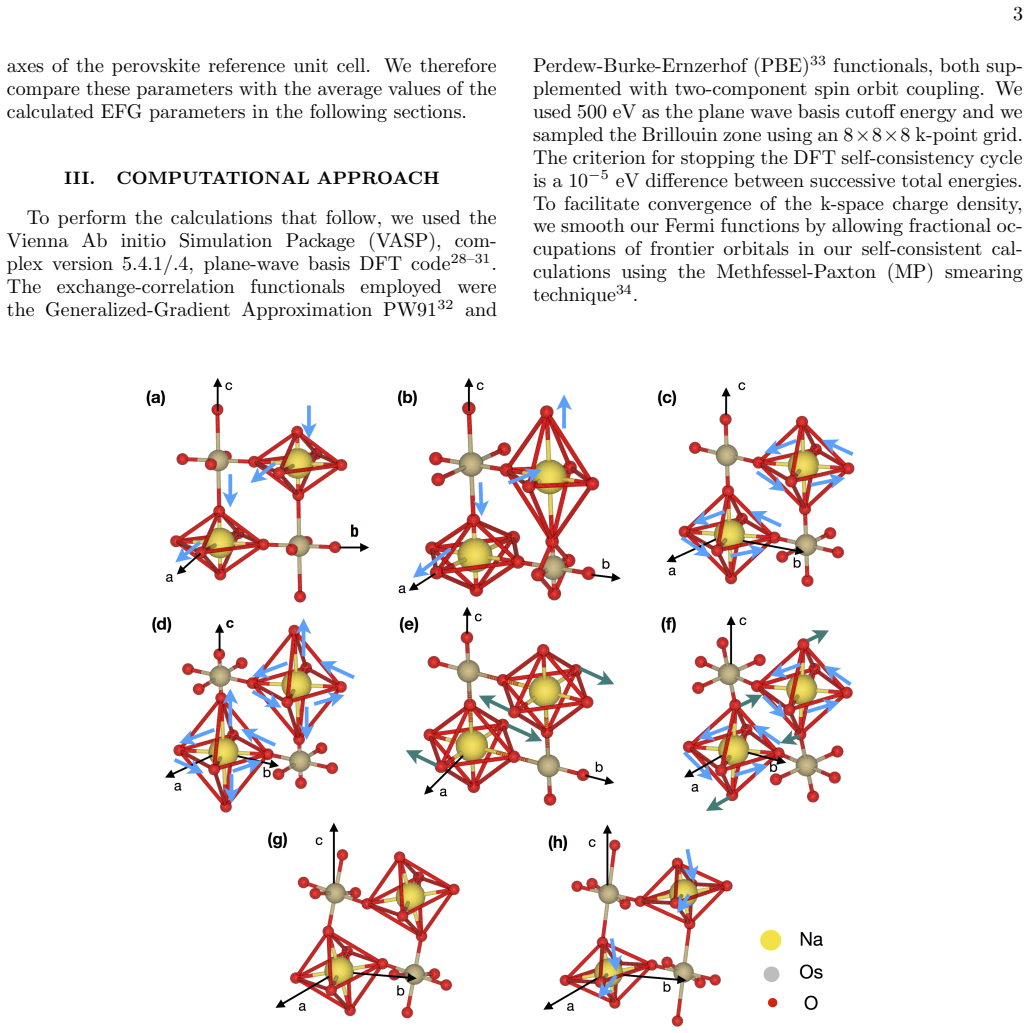
The central object is the electric field gradient tensor at the 23Na nucleus, computed from the DFT+U charge density; its largest eigenvalue $V_{zz}$ and asymmetry parameter $\eta$ are the direct theoretical counterparts of the NMR observables $\nu_Q$ and $\eta$. The comparison is carried across the six distortion models proposed in an earlier point-charge study, and the argument hinges on which model, at what distortion amplitude, reproduces both the observed splitting and the cubic alignment of the principal axes. The winning structure is Model A, a static Q2 distortion mode of the Na-O octahedra — the Jahn-Teller-active displacement that elongates one octahedral axis, compresses another, and leaves the third unchanged, giving orthorhombic local symmetry. That mode is what converts a charge redistribution into a finite, experimentally visible EFG, and it is also the symmetry lowering that the paper connects to splitting the $j = 3/2$ quartet into two Kramers doublets.
What would settle it
A direct structural measurement of the local Na-O bond lengths in the BLPS phase (for example, EXAFS or X-ray pair distribution function analysis) that does not find the about 0.52% Q2 pattern would falsify the claim; so would a fully relaxed DFT structure, which has lower energy, that still fails to reproduce the observed $\nu_Q \approx 190$–200 kHz splitting.
Extended reading notes
Core claim
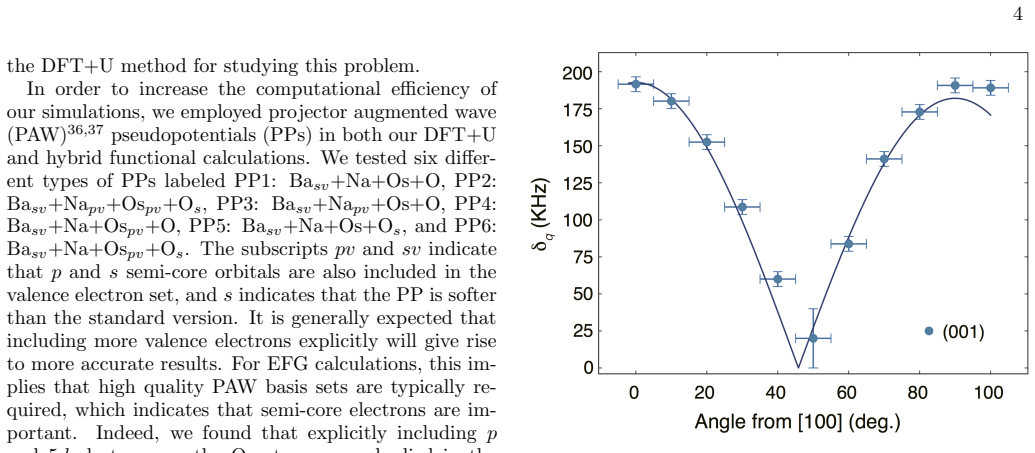
On the paper's own terms, the central discovery is that a specific local orthorhombic distortion of the Na-O octahedra reproduces the experimentally observed EFG parameters at the 23Na site: a Q2 mode with Na-O bonds elongated along the $a$ axis and compressed along the $c$ axis by roughly 0.52%, giving $\nu_Q \approx 190$–200 kHz, $\eta \approx 0.8$–1, and the principal EFG axis aligned with a cubic axis. The EFG is nearly identical whether the underlying magnetic order is canted ferromagnetic, FM[110], or absent altogether, so the distortion alone sets the quadrupole splitting; magnetic order and spin-orbit coupling only broaden the NMR lines. Rotational, tilt, and GdFeO3-type distortions are ruled out because their principal axes point along diagonal directions and their splittings disagree with experiment. The paper therefore claims that the broken local point symmetry phase in BNOO is a static Q2 Jahn-Teller-like distortion that lifts the $j = 3/2$ quartet into two Kramers doublets before long-range magnetic order sets in.
Load-bearing premise
Everything rests on the assumption that the real BLPS structure is a static Q2 distortion of about 0.52%, even though fully relaxing the structure in DFT lowers the energy by 0.3 eV and reduces the computed EFG to roughly half the measured value.
Editorial extensions
If this is right
- The broken local point symmetry phase in BNOO is a static Q2 orthorhombic distortion with Na-O bond changes of about 0.52%, not a rotation, tilt, or charge-only effect.
- The quadrupole splitting seen in 23Na NMR can be read as a direct measure of the local Q2 distortion amplitude, essentially independent of the magnetic order present.
- The rotated and tilted distortions favored by the earlier point-charge analysis are ruled out, since their principal axes do not align with the cubic axes.
- The same DFT+NMR comparison can be applied to sister compounds such as Ba2LiOsO6 to test whether their different magnetic ground states reflect different local distortions.
- The Q2 distortion provides the symmetry lowering that lifts the $j = 3/2$ moment into two Kramers doublets before canted ferromagnetic order appears.
Reading between the lines
- If the static Q2 distortion is the true order parameter of the BLPS transition, the transition itself is a local structural (Jahn-Teller-type) event that can occur independently of magnetism; the canted ferromagnetic easy axis may then be set by the coupling of this strain to spin-orbit-coupled moments rather than by exchange alone.
- Since full DFT relaxation lowers the energy by 0.3 eV and halves the computed EFG, the fitted 0.52% distortion is not a DFT equilibrium structure; the real BLPS phase may involve a dynamic or partially averaged distortion, or the functionals may underestimate the Jahn-Teller coupling, so mapping the potential-energy surface along the Q2 coordinate would be a direct test.
- Carrying the same EFG-based structure identification to other $5d^1$ double perovskites could reveal whether a Q2 distortion generally precedes magnetic order in this family, turning NMR quadrupole parameters into a routine structural probe of octahedral deformations.
Signed reviews
Editorial analysis
A structured set of objections, weighed in public.
Referee Report
Summary. The paper reports DFT+U and hybrid DFT calculations of the electric field gradient (EFG) tensor at the 23Na sites in the double perovskite Ba2NaOsO6, a 5d1 Mott insulator with strong spin-orbit coupling. The authors construct several model distortions (Models A, B, C, C2, D, E, F, F2) based on earlier point-charge work, compute νQ and η for each, and compare with NMR values of νQ ≈ 190–200 kHz and η ≈ 0.88. They find that a uniform orthorhombic distortion of the Na-O octahedra, with Na-O bonds elongated/compressed by about 0.52% along crystalline axes (Model A.3), best reproduces the NMR EFG parameters, and they identify this as a Q2 distortion mode. They also report that the EFG is insensitive to the type of magnetic ordering and only weakly dependent on U and J over the ranges tested. The conclusion asserts that this Q2 distortion is the main source of the EFG and that it lifts the j = 3/2 quartet into two Kramers doublets before the onset of canted ferromagnetic order.
Significance. If the central claim were fully supported, the paper would provide a valuable first-principles-based identification of the local structural distortion in the broken local point symmetry (BLPS) phase of a strongly spin-orbit-coupled Mott insulator, complementing NMR data and testing a Jahn-Teller-type mechanism in a 5d^1 system. The work has clear strengths: it goes beyond the earlier point-charge approximation by computing EFG from the self-consistent DFT charge density; it systematically tests six families of distortion models, including negative results for Models C, D, and E; it checks PAW pseudopotential convergence, k-point and cutoff convergence, and U/J sensitivity (Table XI); and it openly reports functional dependence and the results of structure relaxation in Appendix E. These sensitivity studies and the qualitative symmetry argument based on η ≈ 1 with principal axes along crystalline axes give nontrivial support to the Q2-mode assignment.
major comments (3)
- [Section IV A, Table II, and Appendix E] The amplitude of the Model A distortion is a fitted, hand-imposed parameter rather than a first-principles output. The text states that distortions of 0.53–0.55% are chosen because they "can produce the desired EFG parameters," and Appendix E reports that full relaxation of Model A.3 lowers the total energy by 0.3 eV and reduces the EFG parameters to roughly half of their unrelaxed values. Consequently, the structure that matches the NMR data is not a stationary point of the same DFT+U functional, and the quantitative agreement (νQ ≈ 183–203 kHz, η ≈ 0.79–0.99 in Table II) is obtained by construction. The conclusion in Section V that the calculations "explicitly show" the Q2 distortion to be the main source of the EFG therefore overstates what is demonstrated. The revision should either provide an independent determination of the distortion amplitude (for example, a relaxed low-temperature structure in which the Q2 mode is a genuine local minimum) or explicitly reframe the result as a consistency/fitting study and identify what additional evidence would make the assignment predictive.
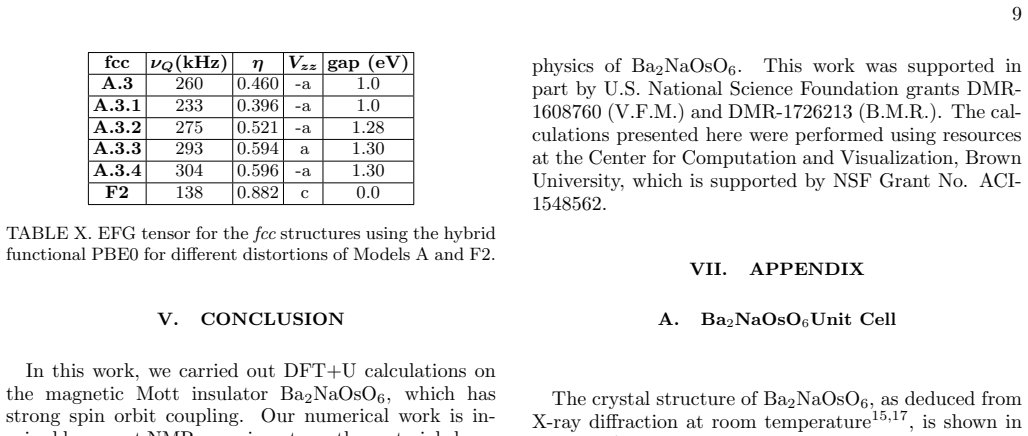
- [Section IV C, Table X, and Appendix D] The quantitative EFG prediction is strongly functional-dependent. For the same Model A.3 distortion, PBE0 gives η = 0.46 and νQ = 260 kHz (Table X), PBE+SOC+U gives νQ = 128 kHz with η = 0.803 (Table XII in Appendix D), while the GGA+SOC+U calculation gives νQ in the 183–203 kHz range with η ≈ 0.79–0.99. The match to experiment is thus achieved only with one exchange-correlation functional at a fitted distortion amplitude. The paper should quantify this functional uncertainty and justify why GGA+SOC+U is the appropriate level for EFG prediction in this strongly correlated system, or temper the claim that the Q2 assignment is robustly established.
- [Section IV A (Q2 discussion) and Section V] The claim that the Q2 distortion "lifts the j = 3/2 quartet to two Kramer doublets" is not derived from the EFG calculations. The authors explicitly acknowledge on page 8 that "we cannot provide proof of this hypothesis since a systematic theoretical framework for the description of the spin orbit channels in the strong SOC case is lacking." The conclusion section should clearly separate the supported statement (the experimental EFG is consistent with a static Q2-type local distortion) from the speculative electronic-level mechanism, and should not present the level-splitting scenario as a demonstrated result of the calculations.
minor comments (4)
- [Section IV A and Table II caption] The sign convention for the distortion is contradictory: the text defines elongation as positive and compression as negative, while the Table II caption states "Positive distortions indicate compression and negative distortions indicate elongation." Please make the convention consistent throughout.
- [Appendix D, Table XIII] The table is titled "Model B.3" while the surrounding text refers to Model B.2; please correct the label so the table matches the text.
- [Appendix E] The summary of the relaxation calculations is too brief to be useful. Please report the relaxed lattice parameters, the residual distortion amplitudes, and the resulting EFG tensor components rather than only stating that the values are "roughly half" of the unrelaxed values.
- [Introduction, page 2] The word "orthohombic" should be "orthorhombic".
Circularity Check
Quantitative EFG agreement is achieved by hand-tuning the 0.52% distortion amplitude to the NMR value, making the νQ match partly by construction; the Q2 mode selection and magnetic-order insensitivity retain independent content.
-
fitted input called prediction
[Section IV A, Model A paragraph; Section V Conclusion; Appendix E]
"In these calculations, the magnitude of the distortion is varied by hand. ... We found that orthorhombic distortions elongated along the a axis by 0.53% to 0.55% and compressed along the c axis by the same percentage while leaving the b axis untouched can produce the desired EFG parameters, as shown for Models A.2 and A.3 (where the 2 and 3 denote models with different A-type distortion percentages) in Table II and Figure 2."
The 0.52% Na-O distortion amplitude is not a predicted equilibrium quantity: it was scanned by hand until the computed νQ landed in the experimental 190-200 kHz range, and Model A.3 was then reported as the best match. Therefore the quantitative agreement in νQ and η is imposed by the fit rather than independently predicted, and the conclusion that this distortion is 'the main source' of the observed EFG parameters is partly circular. Appendix E confirms that the fitted geometry is not a DFT minimum: relaxation lowers the energy by 0.3 eV and reduces the EFG parameters to roughly half. The mode identification (Vzz aligned with cubic axes, η≈1) and the insensitivity to magnetic order are independent checks, so the circularity is partial rather than total.
full rationale
The paper computes EFG tensors with DFT+U for six candidate distortions and compares them with NMR-derived EFG parameters. The central numerical match is obtained by hand-adjusting the distortion amplitude to about 0.52%, so the νQ agreement is partly by construction, and Appendix E shows the same functional does not stabilize that amplitude at equilibrium. However, the paper is not entirely circular: the selection of Model A over the other candidates rests on principal-axis alignment and η≈1 constraints that are not fitting parameters, and the comparison between FM110 and cFM magnetic orders is a genuine prediction. The self-citations to Refs. 18 and 20 supply the experimental NMR input and the menu of candidate models; they are not used to prove the DFT result itself. A score of 4 reflects the partial circularity in the quantitative claim without treating the structural mode identification as forced.
Assumptions & free parameters
free parameters (3)
- U (Hubbard on-site Coulomb repulsion) =
3.3 eV (tested 3.3-5.0 eV)
- J (Hund's coupling) =
0.5 eV (tested 0.5-1.0 eV)
- Model A.3 distortion amplitudes =
delta_a = -0.525%, delta_b = 0%, delta_c = 0.52% of Na-O bond
assumptions (3)
- domain assumption DFT+U with GGA+SOC+U accurately computes EFG tensors in this strongly correlated 5d1 Mott insulator
- domain assumption Static unrelaxed structures with imposed distortions are representative of the BLPS phase
- domain assumption The NMR-deduced cFM magnetic order and the two possible EFG axis assignments (Vzz||a or Vzz||c) are correct
Cite this review
Pith. "Pith review of First Principles calculations of the EFG tensors of Ba$_2$NaOsO$_6$, a Mott insulator with strong spin orbit coupling." pith.science (2026). https://pith.science/paper/2KOSSTLS
@misc{pith2026190809014,
  author       = {Pith},
  title        = {Pith review of: First Principles calculations of the EFG tensors of Ba$_2$NaOsO$_6$, a Mott insulator with strong spin orbit coupling},
  year         = {2026},
  howpublished = {\url{https://pith.science/paper/2KOSSTLS}},
  note         = {Machine review of arXiv:1908.09014}
}
abstract
We present first principles calculations of the electrostatic properties of Ba$_2$NaOsO$_6$ (BNOO), a 5$d^1$ Mott insulator with strong spin orbit coupling (SOC) in its low temperature quantum phases. In light of recent NMR experiments showing that BNOO develops a local octahedral distortion that is accompanied by the emergence of an electric field gradient (EFG) and precedes the formation of long range magnetic order [Lu et al., Nature Comm. 8, 14407 (2017), Liu et al., Phys. Rev. B. 97, 224103 (2018), Liu et al., Physica B. 536, 863 (2018)], we calculated BNOO's EFG tensor for several different model distortions. The local orthorhombic distortion that we identified as mostly strongly agreeing with experiment corresponds to a Q2 distortion mode of the Na-O octahedra, in agreement with conclusions given in [Liu et al., Phys. Rev. B. 97, 224103 (2018)]. Furthermore, we found that the EFG is insensitive to the type of underlying magnetic order. By combining NMR results with first principles modeling, we have thus forged a more complete understanding of BNOO's structural and magnetic properties, which could not be achieved based upon experiment or theory alone.
Figures
Reference graph
Works this paper leans on
-
[1]
author author B. J. \ Kim , author H. Jin , author S. J. \ Moon , author J.-Y. \ Kim , author B.-G. \ Park , author C. S. \ Leem , author J. Yu , author T. W. \ Noh , author C. Kim , author S.-J. \ Oh , author J.-H. \ Park , author V. Durairaj , author G. Cao , \ and\ author E. Rotenberg ,\ 10.1103/PhysRevLett.101.076402 journal journal Phys. Rev. Lett. \...
-
[2]
author author B. J. \ Kim , author H. Ohsumi , author T. Komesu , author S. Sakai , author T. Morita , author H. Takagi , \ and\ author T. Arima ,\ 10.1126/science.1167106 journal journal Science \ volume 323 ,\ pages 1329 ( year 2009 ) NoStop
-
[3]
author author H. Zhang , author K. Haule , \ and\ author D. Vanderbilt ,\ 10.1103/PhysRevLett.111.246402 journal journal Phys. Rev. Lett. \ volume 111 ,\ pages 246402 ( year 2013 ) NoStop
-
[4]
author author S. J. \ Moon , author H. Jin , author K. W. \ Kim , author W. S. \ Choi , author Y. S. \ Lee , author J. Yu , author G. Cao , author A. Sumi , author H. Funakubo , author C. Bernhard , \ and\ author T. W. \ Noh ,\ 10.1103/PhysRevLett.101.226402 journal journal Phys. Rev. Lett. \ volume 101 ,\ pages 226402 ( year 2008 ) NoStop
-
[5]
author author X. Wan , author A. M. \ Turner , author A. Vishwanath , \ and\ author S. Y. \ Savrasov ,\ 10.1103/PhysRevB.83.205101 journal journal Phys. Rev. B \ volume 83 ,\ pages 205101 ( year 2011 ) NoStop
-
[6]
author author M. Imada , author A. Fujimori , \ and\ author Y. Tokura ,\ 10.1103/RevModPhys.70.1039 journal journal Rev. Mod. Phys. \ volume 70 ,\ pages 1039 ( year 1998 ) NoStop
-
[7]
author author G. Chen , author R. Pereira , \ and\ author L. Balents ,\ 10.1103/PhysRevB.82.174440 journal journal Phys. Rev. B \ volume 82 ,\ pages 174440 ( year 2010 ) NoStop
-
[8]
author author M. R. \ Christopher Svoboda \ and\ author N. Trivedi ,\ @noop journal journal arXiv:1702.03199v1 [cond-mat.str-el] \ ( year 2017 ) NoStop
work page Pith review arXiv 2017
Show all 42 references
-
[9]
author author J. G. \ Rau , author E. K.-H. \ Lee , \ and\ author H.-Y. \ Kee ,\ 10.1146/annurev-conmatphys-031115-011319 journal journal Annual Review of Condensed Matter Physics \ volume 7 ,\ pages 195 ( year 2016 ) NoStop
2016 doi
-
[10]
Witczak-Krempa , author G
author author W. Witczak-Krempa , author G. Chen , author Y. B. \ Kim , \ and\ author L. Balents ,\ 10.1146/annurev-conmatphys-020911-125138 journal journal Annual Review of Condensed Matter Physics \ volume 5 ,\ pages 57 ( year 2014 ) NoStop
-
[11]
author author M. Z. \ Hasan \ and\ author C. L. \ Kane ,\ 10.1103/RevModPhys.82.3045 journal journal Rev. Mod. Phys. \ volume 82 ,\ pages 3045 ( year 2010 ) NoStop
2010 doi
-
[12]
author author J. B. \ Goodenough ,\ @noop journal journal Physical Review \ volume 171 ,\ pages 466 ( year 1968 ) NoStop
1968
-
[13]
Romh\'anyi , author L
author author J. Romh\'anyi , author L. Balents , \ and\ author G. Jackeli ,\ 10.1103/PhysRevLett.118.217202 journal journal Phys. Rev. Lett. \ volume 118 ,\ pages 217202 ( year 2017 ) NoStop
2017 doi
-
[14]
author author A. J. \ Steele , author P. J. \ Baker , author T. Lancaster , author F. L. \ Pratt , author I. Franke , author S. Ghannadzadeh , author P. A. \ Goddard , author W. Hayes , author D. Prabhakaran , \ and\ author S. J. \ Blundell ,\ @noop journal journal Physical Re...
2011
-
[15]
Erickson , author S
author author A. Erickson , author S. Misra , author G. J. \ Miller , author R. Gupta , author Z. Schlesinger , author W. Harrison , author J. Kim , \ and\ author I. Fisher ,\ @noop journal journal Physical review letters \ volume 99 ,\ pages 016404 ( year 2007 ) NoStop
2007
-
[16]
Xu , author N
author author L. Xu , author N. A. \ Bogdanov , author A. Princep , author P. Fulde , author J. van den Brink , \ and\ author L. Hozoi ,\ https://doi.org/10.1038/npjquantmats.2016.29 journal journal NPJ Quantum Materials \ volume 1 ,\ pages 16029 ( year 2016 ) NoStop
2016 doi
-
[17]
author author K. E. \ Stitzer , author M. D. \ Smith , \ and\ author H.-C. \ zur Loye ,\ @noop journal journal Solid State Sciences \ volume 4 ,\ pages 311 ( year 2002 ) NoStop
2002
-
[18]
Lu , author M
author author L. Lu , author M. Song , author W. Liu , author A. P. \ Reyes , author P. Kuhns , author H. O. \ Lee , author I. R. \ Fisher , \ and\ author V. F. \ Mitrovi \'c ,\ @noop journal journal Nature Communications \ volume 8 ,\ pages 14407 EP ( year 2017 ) NoStop
2017
-
[19]
Liu , author R
author author W. Liu , author R. Cong , author E. Garcia , author A. P. \ Reyes , author H. O. \ Lee , author I. R. \ Fisher , \ and\ author V. F. \ Mitrovi \'c ,\ doi.org/10.1016/j.physb.2017.08.062 journal journal Physica B: Condensed Matter \ volume 536 ,\ pages 863 ( year ...
2017 doi
-
[20]
Liu , author R
author author W. Liu , author R. Cong , author A. P. \ Reyes , author I. R. \ Fisher , \ and\ author V. F. \ Mitrovi c \' c ,\ 10.1103/PhysRevB.97.224103 journal journal Phys. Rev. B \ volume 97 ,\ pages 224103 ( year 2018 b ) NoStop
2018 doi
-
[21]
author author K. I. \ Kugel \ and\ author D. I. \ Khomski ,\ http://stacks.iop.org/0038-5670/25/i=4/a=R03 journal journal Soviet Physics Uspekhi \ volume 25 ,\ pages 231 ( year 1982 ) NoStop
1982
-
[22]
author author D. I. \ Khomskii ,\ http://stacks.iop.org/1402-4896/72/i=5/a=N02 journal journal Physica Scripta \ volume 72 ,\ pages CC8 ( year 2005 ) NoStop
2005
-
[23]
author author J. N. \ Gon c c alves , author A. Stroppa , author J. G. \ Correia , author T. Butz , author S. Picozzi , author A. S. \ Fenta , \ and\ author V. S. \ Amaral ,\ 10.1103/PhysRevB.86.035145 journal journal Phys. Rev. B \ volume 86 ,\ pages 035145 ( year 2012 ) NoStop
-
[24]
\ Lee \ and\ author W
author author K.-W. \ Lee \ and\ author W. E. \ Pickett ,\ http://stacks.iop.org/0295-5075/80/i=3/a=37008 journal journal EPL (Europhysics Letters) \ volume 80 ,\ pages 37008 ( year 2007 ) NoStop
2007
-
[25]
Gangopadhyay \ and\ author W
author author S. Gangopadhyay \ and\ author W. E. \ Pickett ,\ 10.1103/PhysRevB.91.045133 journal journal Phys. Rev. B \ volume 91 ,\ pages 045133 ( year 2015 ) NoStop
2015 doi
-
[26]
Gangopadhyay \ and\ author W
author author S. Gangopadhyay \ and\ author W. E. \ Pickett ,\ @noop journal journal Phys. Rev. B \ volume 93 ,\ pages 155126 ( year 2016 ) NoStop
2016
-
[27]
Volkoff , author H
author author G. Volkoff , author H. Petch , \ and\ author D. Smellie ,\ @noop journal journal Canadian Journal of Physics \ volume 30 ,\ pages 270 ( year 1952 ) NoStop
1952
-
[28]
Kresse \ and\ author J
author author G. Kresse \ and\ author J. Hafner ,\ @noop journal journal Phys. Rev. B \ volume 47 ,\ pages 558 ( year 1993 ) NoStop
1993
-
[29]
Kresse \ and\ author J
author author G. Kresse \ and\ author J. Hafner ,\ @noop journal journal Phys. Rev. B \ volume 49 ,\ pages 251 ( year 1994 ) NoStop
1994
-
[30]
Kresse \ and\ author J
author author G. Kresse \ and\ author J. Furthmuller ,\ @noop journal journal Comput. Mat. Sci. \ volume 6 ,\ pages 15 ( year 1996 a ) NoStop
1996
-
[31]
Kresse \ and\ author J
author author G. Kresse \ and\ author J. Furthmuller ,\ @noop journal journal Phys. Rev. B \ volume 54 ,\ pages 11169 ( year 1996 b ) NoStop
1996
-
[32]
author author J. P. \ Perdew \ and\ author Y. Wang ,\ 10.1103/PhysRevB.45.13244 journal journal Phys. Rev. B \ volume 45 ,\ pages 13244 ( year 1992 ) NoStop
1992 doi
-
[33]
author author J. P. \ Perdew , author K. Burke , \ and\ author M. Ernzerhof ,\ 10.1103/PhysRevLett.77.3865 journal journal Phys. Rev. Lett. \ volume 77 ,\ pages 3865 ( year 1996 ) NoStop
1996 doi
-
[34]
Methfessel \ and\ author A
author author M. Methfessel \ and\ author A. T. \ Paxton ,\ 10.1103/PhysRevB.40.3616 journal journal Phys. Rev. B \ volume 40 ,\ pages 3616 ( year 1989 ) NoStop
1989 doi
-
[35]
author author F. Z. \ Hund ,\ https://doi.org/10.1007/BF01328319 journal journal Zeitschrift f \"u r Physik \ volume 33 ,\ pages 345 ( year 1925 ) NoStop
1925 doi
-
[36]
Bl \"o chl ,\ @noop journal journal Phys
author author P. Bl \"o chl ,\ @noop journal journal Phys. Rev. B \ volume 50 ,\ pages 17953 ( year 1994 ) NoStop
1994
-
[37]
Kresse \ and\ author J
author author G. Kresse \ and\ author J. Joubert ,\ @noop journal journal Phys. Rev. B \ volume 59 ,\ pages 1758 ( year 1999 ) NoStop
1999
-
[38]
Adamo , author G
author author C. Adamo , author G. E. \ Scuseria , \ and\ author V. Barone ,\ 10.1063/1.479571 journal journal The Journal of Chemical Physics \ volume 111 ,\ pages 2889 ( year 1999 ) NoStop
1999 doi
-
[39]
Glazer ,\ @noop journal journal Acta Crystallographica Section B: Structural Crystallography and Crystal Chemistry \ volume 28 ,\ pages 3384 ( year 1972 ) NoStop
author author A. Glazer ,\ @noop journal journal Acta Crystallographica Section B: Structural Crystallography and Crystal Chemistry \ volume 28 ,\ pages 3384 ( year 1972 ) NoStop
1972
-
[40]
Khomskii ,\ @noop title Transition metal compounds \ ( publisher Cambridge University Press ,\ year 2014 ) NoStop
author author D. Khomskii ,\ @noop title Transition metal compounds \ ( publisher Cambridge University Press ,\ year 2014 ) NoStop
2014
-
[41]
author author V. I. \ Anisimov , author J. Zaanen , \ and\ author O. K. \ Andersen ,\ 10.1103/PhysRevB.44.943 journal journal Phys. Rev. B \ volume 44 ,\ pages 943 ( year 1991 ) NoStop
1991 doi
-
[42]
author author A. I. \ Liechtenstein , author V. I. \ Anisimov , \ and\ author J. Zaanen ,\ 10.1103/PhysRevB.52.R5467 journal journal Phys. Rev. B \ volume 52 ,\ pages R5467 ( year 1995 ) NoStop
1995 doi
Reviewed August 14, 2026 · model on record in the stance chip above.
Discussion (0). Continue with ORCID to comment.