Resonant cooling of nuclear spins by optically-oriented holes in MAPbI₃ perovskite crystals
Pith reviewed 2026-07-03 18:30 UTC · model grok-4.3
The pith
Spin-oriented holes in MAPbI3 cool nuclear spins when light helicity is modulated at resonant frequencies.
A machine-rendered reading of the paper's core claim, the machinery that carries it, and where it could break.
Core claim
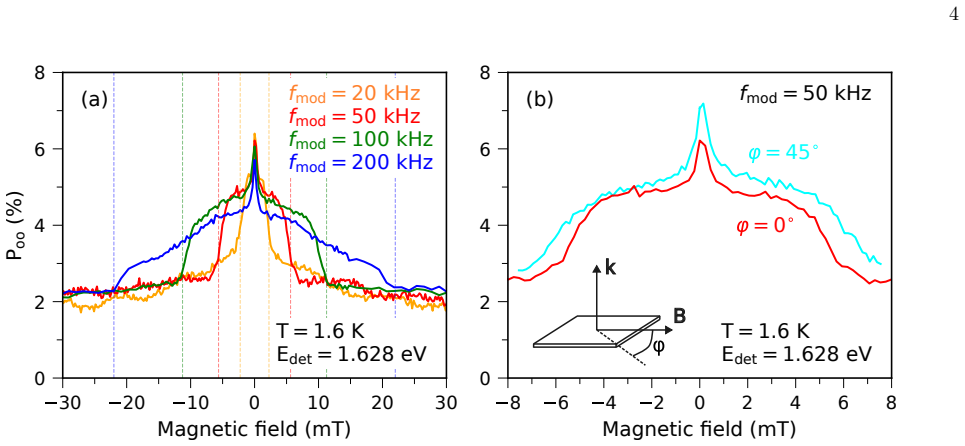
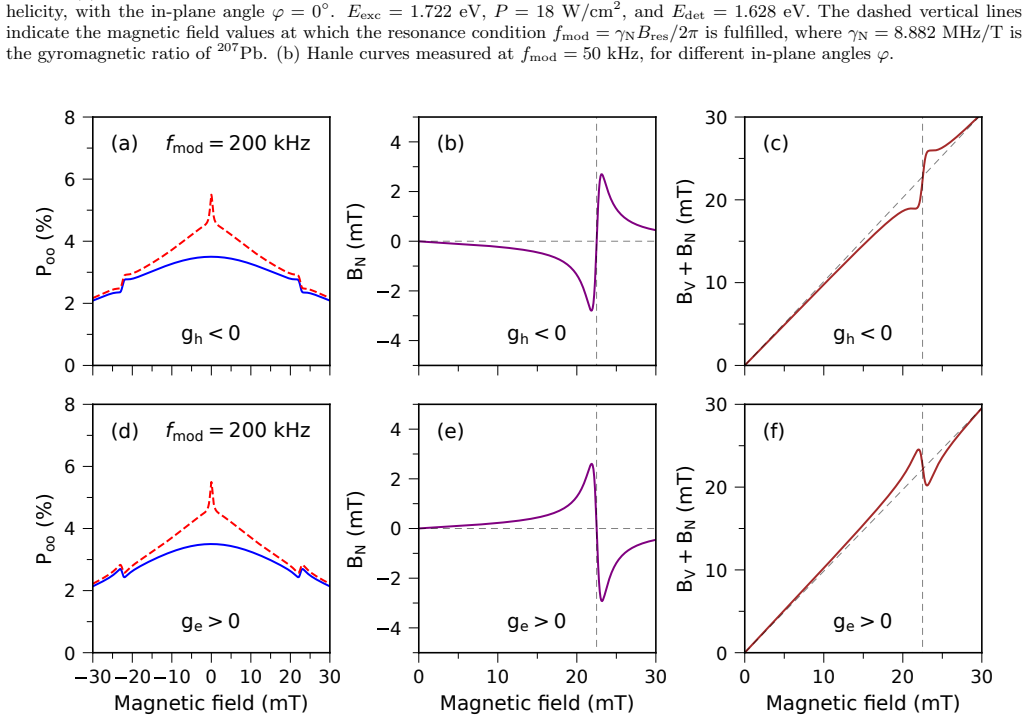
Resonant cooling of nuclear spins by photogenerated spin-oriented holes is demonstrated for MAPbI₃ perovskite crystals. It is evidenced by Hanle-effect measurements under helicity-modulated excitation with variable frequency. The resonance position in magnetic field shifts toward higher fields with increasing modulation frequency. The invariance of the Hanle curve upon in-plane sample rotation is consistent with the involvement of ²⁰⁷Pb nuclei with spin I = 1/2, which do not exhibit quadrupolar splitting. The shape of the resonance feature reveals that the nuclear spins are cooled by carriers with a negative g-factor consistent with holes, and the resonance fields exceed the half-width of th
What carries the argument
Hanle-effect resonance under helicity-modulated excitation, where resonance fields exceed the half-width associated with weakly localized holes.
If this is right
- Resonance position increases linearly with modulation frequency.
- In-plane rotation leaves the Hanle curve unchanged, consistent with I = 1/2 nuclei lacking quadrupolar moments.
- Negative g-factor of the cooling carriers identifies them as holes.
- Strongly localized holes dominate nuclear-spin cooling over weakly localized holes.
Where Pith is reading between the lines
- The same modulation technique could be used to measure hyperfine coupling strengths in other lead-halide perovskites.
- Selective cooling of specific nuclear isotopes might become possible by tuning modulation frequency to their Larmor precession.
- Carrier localization depth could be quantified by comparing resonance positions to the known Hanle widths of different hole populations.
Load-bearing premise
The observed resonance features arise specifically from cooling of 207Pb nuclear spins by strongly localized holes rather than from other spin-dependent relaxation channels.
What would settle it
A Hanle curve recorded under the same modulated excitation that shows resonance positions remaining inside the weakly localized hole half-width, or no shift of resonance field with modulation frequency, would falsify the claim.
Figures
read the original abstract
Resonant cooling of nuclear spins by photogenerated spin-oriented holes is demonstrated for MAPbI$_3$ perovskite crystals. It is evidenced by Hanle-effect measurements under helicity-modulated excitation with variable frequency. The resonance position in magnetic field shifts toward higher fields with increasing modulation frequency. The invariance of the Hanle curve upon in-plane sample rotation is consistent with the involvement of $^{207}$Pb nuclei with spin $I = 1/2$, which do not exhibit quadrupolar splitting. The shape of the resonance feature in the Hanle curve reveals that the nuclear spins are cooled by carriers with a negative $g$-factor, consistent with holes. The resonance fields associated with the modulation frequencies exceed the half-width of the weakly localized hole contribution to the Hanle curve, indicating that strongly localized holes are the primary carriers responsible for the nuclear spin cooling.
Editorial analysis
A structured set of objections, weighed in public.
Referee Report
Summary. The manuscript claims to demonstrate resonant cooling of nuclear spins by photogenerated spin-oriented holes in MAPbI₃ perovskite crystals. This is shown via Hanle-effect measurements under helicity-modulated excitation with variable frequency, where the resonance position shifts to higher fields with increasing modulation frequency. Invariance of the Hanle curve under in-plane rotation is taken as evidence for involvement of ²⁰⁷Pb nuclei (I=1/2) without quadrupolar splitting. The shape of the resonance feature indicates cooling by carriers with negative g-factor, consistent with holes. The key inference is that strongly localized holes are the primary agents, because the resonance fields exceed the half-width of the weakly localized hole contribution to the Hanle curve.
Significance. If substantiated, the result establishes a frequency-tunable resonant mechanism for dynamic nuclear polarization in lead-halide perovskites mediated by localized holes. The approach of using helicity modulation to separate localization-dependent contributions offers a concrete experimental handle on hyperfine interactions in these materials, which could inform spintronic or quantum-information applications. The work supplies falsifiable predictions (resonance shift with frequency, negative-g signature) and relies on standard spin-physics models without introducing free parameters or ad-hoc entities.
major comments (1)
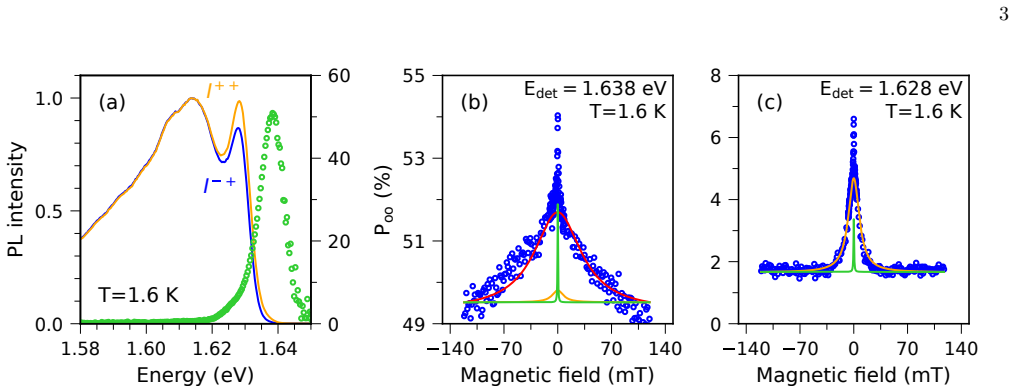
- [Results / Hanle-curve analysis] The central assignment of nuclear-spin cooling to strongly localized holes rests on the statement that resonance fields exceed the half-width of the weakly localized contribution (abstract and results/discussion of Hanle curves). This comparison presupposes a clean, unambiguous decomposition of the observed Hanle signal into distinct weakly- and strongly-localized Lorentzian components whose half-widths can be extracted with quantified uncertainty. If the decomposition involves overlapping contributions, background choices, or fitting ambiguities, the 'exceed' threshold may lose statistical significance; the manuscript must therefore supply the explicit fitting procedure, covariance matrices, and alternative-model tests for the Hanle curves.
minor comments (2)
- [Abstract] The abstract states that the resonance feature shape reveals a negative g-factor but does not specify the quantitative criterion (e.g., sign of the dispersive component or zero-crossing shift) used to reach this conclusion; a brief sentence linking the observed lineshape to the sign of g would improve clarity.
- [Figure captions] Figure captions for the frequency-dependent Hanle data should explicitly state the modulation frequencies, the magnetic-field sweep range, and the number of averaged traces to allow readers to assess signal-to-noise and resonance-position precision.
Simulated Author's Rebuttal
We thank the referee for the constructive comment and positive overall assessment. The request for explicit details on the Hanle-curve decomposition is reasonable and will be addressed by expanding the methods and results sections.
read point-by-point responses
-
Referee: [Results / Hanle-curve analysis] The central assignment of nuclear-spin cooling to strongly localized holes rests on the statement that resonance fields exceed the half-width of the weakly localized contribution (abstract and results/discussion of Hanle curves). This comparison presupposes a clean, unambiguous decomposition of the observed Hanle signal into distinct weakly- and strongly-localized Lorentzian components whose half-widths can be extracted with quantified uncertainty. If the decomposition involves overlapping contributions, background choices, or fitting ambiguities, the 'exceed' threshold may lose statistical significance; the manuscript must therefore supply the explicit fitting procedure, covariance matrices, and alternative-model tests for the Hanle curves.
Authors: We agree that the statistical robustness of the decomposition should be documented more explicitly. The observed Hanle curves were fitted as a sum of two Lorentzians (one narrow component for weakly localized holes and one broad component for strongly localized holes) plus a linear background, with the resonance positions extracted from the frequency-dependent shift of the broad component. In the revised manuscript we will add: (i) the full functional form and fitting constraints, (ii) the covariance matrices obtained from the least-squares fits for representative curves, and (iii) a comparison with single-Lorentzian and three-component alternative models together with the associated reduced-χ^{2} values. These additions will allow readers to assess the significance of the statement that resonance fields exceed the half-width of the weakly localized contribution. revision: yes
Circularity Check
No circularity: experimental Hanle resonances compared to measured half-widths using standard spin physics
full rationale
The paper reports Hanle-effect data under helicity modulation, with resonance positions shifting with frequency and exceeding the weakly-localized half-width to assign strongly-localized holes. No equations, fitted parameters, or self-citations are presented that define a quantity in terms of itself or rename a fit as a prediction. The comparison relies on direct measurement of the Hanle curve shape and resonance fields; the decomposition into localization components is an interpretive step but does not reduce the central claim to a tautology by construction. The invariance under rotation and negative g-factor inference are likewise data-driven and consistent with standard models for I=1/2 nuclei. This is a standard experimental interpretation without load-bearing self-referential steps.
Axiom & Free-Parameter Ledger
axioms (1)
- domain assumption Hanle-effect curves under helicity modulation can be interpreted in terms of resonant nuclear spin cooling by carriers with defined g-factors.
Reference graph
Works this paper leans on
-
[1]
G. Lampel, Nuclear dynamic polarization by optical elec- tronic saturation and optical pumping in semiconductors, Phys. Rev. Lett.20, 491 (1968)
work page 1968
- [2]
-
[3]
D. Kudlacik, N. E. Kopteva, M. Kotur, D. R. Yakovlev, K. V. Kavokin, C. Harkort, M. Karzel, E. A. Zhukov, E. Evers, V. V. Belykh, and M. Bayer, Optical spin ori- entation of localized electrons and holes interacting with nuclei in a FA0.9Cs0.1PbI2.8Br0.2 perovskite crystal, ACS Photonics11, 2757 (2024)
work page 2024
- [4]
- [5]
-
[6]
I. A. Merkulov, Cooling of a system of nuclear spins in a semiconductor upon polarization of the electron polar- ization, Zh. Eksp. Teor. Fiz.79, 1036 (1980) [Sov. Phys. JETP52, 526 (1980)]
work page 1980
-
[7]
W. Hanle, ¨Uber magnetische beeinflussung der polarisa- tion der resonanzfluoreszenz, Zeitschrift f¨ ur Physik30, 93 (1924)
work page 1924
-
[8]
V. K. Kalevich, V. D. Kul’kov, and V. G. Fleisher, Op- tical cooling of the spin system of nuclei in a semicon- 7 ductor lattice in a rotating system of coordinates, Fiz. Tverd. Tela22, 1208 (1980) [Sov. Phys. Solid State22, 703 (1980)]
work page 1980
-
[9]
V. K. Kalevich, V. D. Kul’kov, and V. G. Fleisher, Mani- festation of the sign of the g factor of conduction electrons in resonant cooling of the nuclear spin system of a semi- conductor, Fiz. Tverd. Tela23, 1524 (1981) [Sov. Phys. Solid State23, 892 (1981)]
work page 1981
-
[10]
E. A. Zhukov, A. Greilich, D. R. Yakovlev, K. V. Ka- vokin, I. A. Yugova, O. A. Yugov, D. Suter, G. Kar- czewski, T. Wojtowicz, J. Kossut, V. V. Petrov, Yu. K. Dolgikh, A. Pawlis and M. Bayer, All-optical NMR in semiconductors provided by resonant cooling of nuclear spins interacting with electrons in the reso- nant spin amplification regime, Phys. Rev. B...
work page 2014
-
[11]
A. D. Wright, R. L. Milot, G. E. Eperon, H. J. Snaith, M. B. Johnston, and L. M. Herz, Band-tail recombination in hybrid lead iodide perovskite, Adv. Funct. Mater.27, 1700860 (2017)
work page 2017
-
[12]
D. W. DeQuilettes, K. Frohna, D. Emin, T. Kirchartz, V. Bulovic, D. S. Ginger, and S. D. Stranks, Charge- carrier recombination in halide perovskites: Focus re- view, Chem. Rev.119, 11007 (2019)
work page 2019
-
[13]
E. Kirstein, D. R. Yakovlev, E. A. Zhukov, J. H¨ ocker, V. Dyakonov, and M. Bayer, Spin dynamics of electrons and holes interacting with nuclei in MAPbI 3 perovskite single crystals, ACS Photonics9, 1375 (2022)
work page 2022
-
[14]
N. E. Kopteva, D. R. Yakovlev, E. Yalcin, I. A. Akimov, M. Kotur, B. Turedi, D. N. Dirin, M. V. Kovalenko, and M. Bayer, Optical orientation of excitons and charge car- riers in methylammonium lead iodide perovskite single crystals in the orthorhombic phase, Phys. Rev. B111, 195201 (2025)
work page 2025
-
[15]
K. V. Kavokin, Resonant optical cooling of nuclear spins in case of strong Knight field of photoexcited electrons, arXiv:2605.14934 (2026)
work page internal anchor Pith review Pith/arXiv arXiv 2026
-
[16]
Z. Chen, B. Turedi, A. Y. Alsalloum, C. Yang, X. Zheng, I. Gereige, A. AlSaggaf, O. F. Mohammed, and O. M. Bakr, Single-crystal MAPbI 3 perovskite so- lar cells exceeding 21% power conversion efficiency, ACS Energy Lett.4, 1258 (2019)
work page 2019
-
[17]
A. Y. Alsalloum, B. Turedi, X. Zheng, S. Mitra, A. A. Zhumekenov, K. J. Lee, P. Maity, I. Gereige, A. AlSaggaf, I. S. Roqan, O. F. Mohammed, and O. M. Bakr, Low-temperature crystallization enables 21.9% ef- ficient single-crystal MAPbI 3 inverted perovskite solar cells, ACS Energy Lett.5, 657 (2020)
work page 2020
discussion (0)
Sign in with ORCID, Apple, or X to comment. Anyone can read and Pith papers without signing in.