REVIEW 2 major objections 5 minor 1 cited by
Geometric percolation of spins and spin-dipoles in Ashkin-Teller model
T0 review · 2 major / 5 minor · reviewed 2026-08-12 · deepseek-v4-flash
Pith's one-line read Spin and spin-dipole percolation in the Ashkin-Teller model happens on the Baxter line, with fractal dimensions fixed by a single universal ratio $w = 5/12$.
desk verdict A solid Monte Carlo study of percolation in the Ashkin-Teller model with a plausible but under-tested conjecture that w=5/12 is constant along the Baxter line—worth refereeing, but the claim needs to be narrowed to the tested interval and the Z4 endpoint handled explicitly. read the letter →
The pith
A machine-rendered reading of the paper's core claim, the machinery that carries it, and where it could break.
The reading
What carries the argument
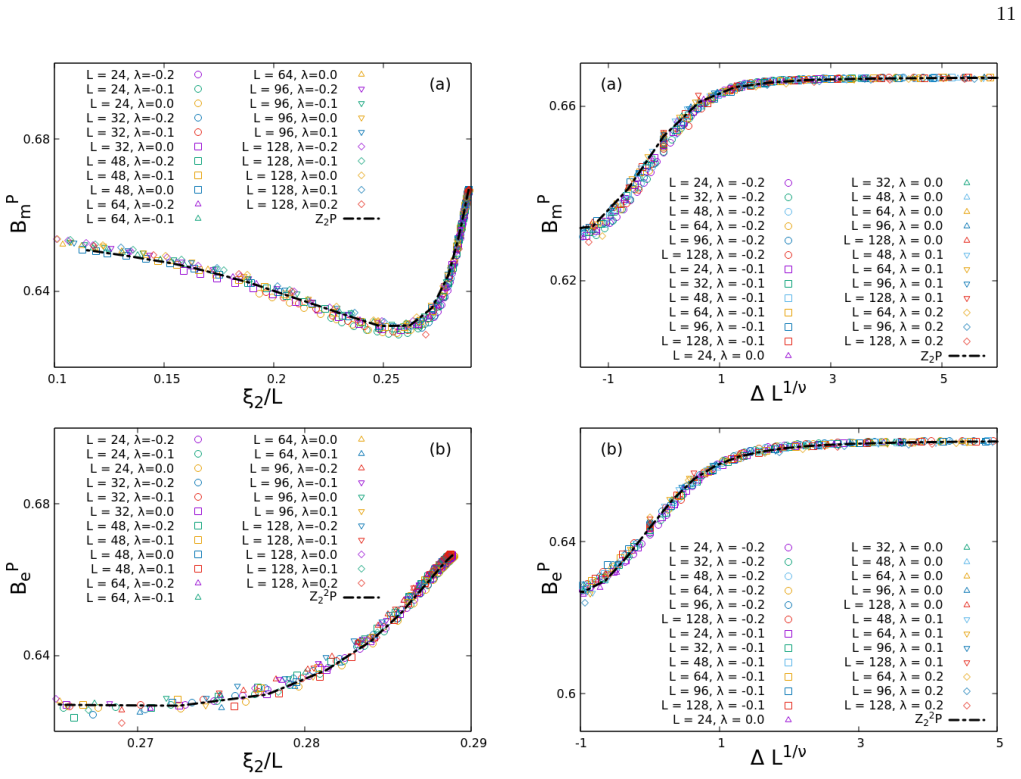
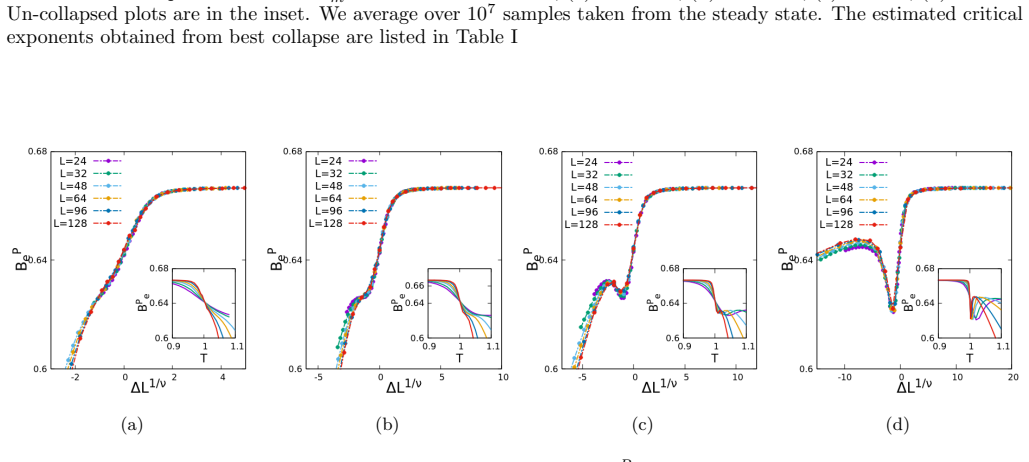
The load-bearing object is the identity $D_{m,e}=d-w\,\beta_{m,e}/\nu$ with the universal constant $w=\beta^P/\beta=5/12$, carried over from Ising geometric percolation, where it arises from the tricritical $q=1$ Potts connection. This identity is the bridge between the exactly known order-parameter exponents on the Baxter line and the geometric exponents of percolating clusters; together with the standard scaling relations $D=d-\beta^P/\nu$, $2\beta^P+\gamma^P=d\nu$, $\tau=2+\beta^P/(\beta^P+\gamma^P)$, and $\sigma^{-1}=\beta^P+\gamma^P$, it fixes every percolation exponent. The second key probe is the Binder cumulant as a function of the second-moment correlation length ratio $\xi_2/L$, which the paper uses as an RG-invariant fingerprint to identify superuniversality classes.
What would settle it
Measure the fractal dimension $D_e$ of the largest electric cluster directly at a Baxter-line point outside the tested window, for example $\lambda=0.3$, and compare the slope with $2-(5/12)\beta_e/\nu$ evaluated with the exact $\beta_e/\nu$ from Eq. (11); a statistically significant deviation would falsify the universal-$w$ conjecture, and the approach to $\lambda=\ln 3/4$ is especially decisive because the paper predicts a different $w$ exactly at that point.
Extended reading notes
Core claim
The central claim is Eq. (23): along the Baxter line the fractal dimension $D_{m,e}$ of the largest critical cluster of spins (magnetic percolation) or of spin-dipoles (electric percolation) is $D_{m,e}=d-w\,\beta_{m,e}/\nu$ with $w=5/12$, the same constant that governs geometric percolation in the ordinary Ising model. Combined with the exact Baxter-line exponents $\nu=2(\mu-\pi)/(4\mu-3\pi)$, $\cos\mu=e^{2\lambda}\sinh(2\lambda)$, $\beta_m=\nu/8$, and $\beta_e=(2\nu-1)/4$, the identity yields $\beta^P_m=5\nu/96$, $\beta^P_e=5(2\nu-1)/48$, and the corresponding $\gamma^P$ from the scaling relations, so every percolation exponent varies with $\lambda$ in a definite predicted way. Monte Carlo finite-size scaling along the Baxter line for $\lambda=-0.2,\dots,0.2$ confirms that $\nu$ is unchanged, that the measured $\beta^P/\nu$ and $\gamma^P/\nu$ match the prediction, and that the fractal dimensions are $D_m\simeq 1.948$ for all $\lambda$ and $D_e$ between about $1.87$ and $1.926$, consistent with the formula. The paper further claims that the percolation Binder cumulant plotted against $\xi_2/L$ is a superuniversal function: identical to the Ising spin-percolation function for magnetic percolation (the $Z_2^P$ class) and a new function for electric percolation (the $Z_2^{2P}$ class), with the $Z_4$-symmetric endpoint $\lambda=\ln 3/4$ forming a separate $Z_4^P$ class where $w=1$.
Load-bearing premise
The whole set of predictions rests on the assumption that the factor $w=5/12$ stays exactly the same at every point of the Baxter line, a value taken from the decoupled Ising limit with no analytic derivation; the paper checks it numerically for $\lambda$ between $-0.2$ and $0.2$, but if $w$ drifts outside that range or at the $Z_4$ endpoint, the predicted exponents would fail.
Editorial extensions
If this is right
- Because $w=5/12$ is unchanged along the Baxter line, the percolation order-parameter exponents are always $\beta^P_{m,e}=(5/12)\beta_{m,e}$, so geometric percolation directly reports the underlying magnetic or electric $\beta$ through a fixed proportionality factor.
- Magnetic percolation obeys weak universality: $\beta_m/\nu=1/8$ is fixed, so the fractal dimension $D_m=187/96\simeq 1.948$ is the same for every $\lambda$ on the Baxter line, exactly as in Ising spin percolation.
- Electric percolation is genuinely non-universal: $\beta_e/\nu$ varies with $\lambda$, making $D_e$ vary from about $1.87$ at $\lambda=-0.2$ to about $1.93$ at $\lambda=0.2$, yet its Binder-cumulant scaling function is invariant along the line, defining the new $Z_2^{2P}$ superuniversality class.
- At the $Z_4$ point $\lambda=\ln 3/4$, spin and dipole clusters coincide and percolation belongs to the four-state Potts percolation class with $w=1$, so the endpoint prediction differs from the rest of the line.
- The correlation-length exponent $\nu$ of percolation equals the thermal $\nu$ of the underlying transition, so percolation introduces no new diverging length scale along the Baxter line.
Reading between the lines
- If the equality $w=\beta^P/\beta=5/12$ is exact, the same prediction should hold at Baxter-line points outside the simulated window; measuring $D_e$ at, say, $\lambda=0.3$ would separate a genuine universal constant from a numerical coincidence within $[-0.2,0.2]$.
- The paper's picture implies that superuniversality of a scaling function and non-universality of fractal dimensions can coexist: the electric percolation Binder function is invariant while $D_e$ varies, a split that may also appear in other models with marginal lines, such as disordered or multi-layer Ising systems.
- Treating the $Z_4$ endpoint as a separate class with $w=1$ suggests a discontinuity as $\lambda\to\ln 3/4$: extrapolating the $w=5/12$ electric formula gives $D_e\to 379/192\simeq 1.974$, whereas the $Z_4$ value is $31/16=1.9375$, so how the two regimes connect is a sharp test of the decomposition.
Editorial analysis
A structured set of objections, weighed in public.
Referee Report
Summary. This paper studies geometric percolation of spin clusters and spin-dipole clusters in the isotropic two-dimensional Ashkin-Teller model. It reports Monte Carlo evidence that both percolation transitions occur along the Baxter line, with critical exponents that vary with the interlayer coupling λ. The central conjecture is Eq. (23): D_{m,e}=d-(5/12)β_{m,e}/ν, with w=5/12 inherited from the known Ising geometric-percolation result. Using finite-size scaling of Binder cumulants, order parameters, susceptibilities, and cluster-size distributions for λ∈{-0.2,-0.1,0,0.1,0.2}, the authors estimate percolation exponents, verify scaling relations, and report D_m≈1.948 for all λ and D_e varying from about 1.87 to 1.926, consistent with the conjecture. They also find that Binder cumulants as functions of ξ2/L collapse onto superuniversal curves, identifying Z2P and Z2^2P superuniversality classes, with the Z4 endpoint treated as a separate Z4P class.
Significance. If correct, Eq. (23) is a nontrivial extension of the Stella-Vanderzande relation to a critical line with continuously varying exponents, and it would determine all percolation exponents exactly from the known eight-vertex-model thermal exponents. The paper's strengths are its extensive Monte Carlo sampling, the multiple independent routes to the exponents (static FSS, dynamic scaling, cluster-size distributions), and the consistency checks against exact 8V predictions. The main caveat is that the constant w is conjectural, and the paper itself shows in Section III that w changes at the Z4 endpoint; therefore the central claim needs a clear scope restriction or an additional argument. The superuniversality observation is interesting and would be a useful addition to the correlated-percolation literature if the collapse quality is quantified.
major comments (2)
- [Sec. II F, Eq. (23); Sec. III, Eq. (28)] Equation (23) is stated for the Baxter line without qualification, but Section III, Eq. (28) and the surrounding discussion assert that at the Z4 point, λ=ln3/4, the percolation fractal dimension is D4=d−β4/ν4, i.e. w=1, not 5/12. This point lies on the Baxter line, so the invariance w=5/12 cannot hold on the full line; it can hold at most on the open interval λ<λ*. The numerical evidence in Tables I and II covers only [-0.2,0.2] and excludes the endpoint. The authors should explicitly restrict the conjecture and Eq. (26) to the open interval λ<λ*, or provide an RG/continuity argument explaining why the Z4 endpoint is a separate enhanced-symmetry point whose different w does not invalidate the open-interval claim.
- [Tables I-II and Fig. 7] The direct measurements that test Eq. (23) are the fractal dimensions D_m and D_e from Fig. 7, but D_e (and D_m) are reported without error bars in Tables I and II, and the w column is not an independent check: w=βP/β uses the same FSS estimates of βP whose agreement with Eq. (26) is the point at issue. With the stated uncertainties of order 0.05–0.06 on βP, the w values 0.412–0.422 are all compatible with 5/12≈0.4167, but they also do not exclude a slow drift; λ=0.2 is only about 0.075 below λ*, so a crossover toward the Z4 value remains numerically possible. Please give error bars for D_e (and preferably D_m), and either add data closer to λ* (for example λ=0.25 or 0.27) or state explicitly that the verification is limited to the interval studied.
minor comments (5)
- [Sec. II B and II C] In the last paragraph of Sec. II B, ϕP_e is described as the order parameter for the 'magnetic' percolation transition; this should be 'electric'. In Sec. II C, the text mentions the 'largest eclectic cluster s^τ_max'; this should be 'electric cluster s^α_max'.
- [Eq. (14) vs Eq. (28)] Equation (14) lists ν4=4/3 for the Z4 (four-state Potts) point, but Eq. (28) uses ν=2/3, and the hyperscaling relation 2β4+γ4=dν4 gives ν4=2/3. This internal inconsistency should be corrected; the value 2/3 is the one used later.
- [Supplemental Material, Eq. (4)] The Supplemental Material writes D_{m,e}=d−wβ_{m,e}/γ_{m,e}; this should be β_{m,e}/ν as in the main text, Eq. (23). The expression for γP_e also needs explicit parentheses to show that it is (5+38ν)/24.
- [Sec. II F, Fig. 7 caption and text] The text says 'In Fig. 7 (a), (b) we plot ϕm and ϕm as a function of L'; the second symbol should be ϕe. The figure itself is informative, but the notation errors make it harder to read.
- [Sec. IV, Figs. 10 and 11] The superuniversal collapses are presented only visually. Adding a quantitative collapse criterion, or representative error bars on the Binder cumulants, would make the claim of a λ-independent scaling function more robust.
Circularity Check
No circular reduction: the central D = d - (5/12)β/ν relation is an explicit conjecture tested against independent Monte Carlo estimates; the self-citations are non-load-bearing.
full rationale
The paper's central claim is an explicit conjecture, not a derived first-principles result. Section II-F states: 'We conjecture that w remains invariant along the Baxter line and it must be w = 5/12 (which is the value for λ = 0)', and Eq. (23) is introduced with 'We conjecture that the same holds for magnetic and electric percolation, D_{m,e} = d - w β_{m,e}/ν; w = 5/12'. The percolation exponents in Eq. (26) follow from this conjecture combined with the exact eight-vertex exponents in Eq. (11). They are then compared with, not fitted to, the Monte Carlo FSS estimates in Tables I and II. The measured ratios w = β^P/β (0.415-0.422 for magnetic and 0.412-0.422 for electric) are outputs of independent measurements of β^P and exact β, not parameters used to generate the prediction. The fractal dimension D is measured directly from s_max ~ L^D, and the identity D = d - β^P/ν (Eq. (25)) is a standard scaling relation, so the comparison to D = d - (5/12)β/ν is substantive. The paper explicitly flags the conjectural status: 'These results are based on the conjecture that the fractal dimension of spanning clusters at criticality is given by Eq. (23) and ν remains invariant.' It also discloses the exception at the Z4 endpoint (w = 1, Eq. (28)), which is a scope/correctness concern rather than circularity. The self-citations — Ref. [15] (Mukherjee and Mohanty) for the superuniversality hypothesis and Ref. [41] for an application — provide background; the percolation-specific Binder-cumulant collapses in Figs. 10-12 are computed in this paper and do not reduce to those works. No fitted input is renamed as a prediction, and no load-bearing argument is justified solely by a self-citation. Overall, the paper is self-contained against the exact Baxter-line exponents and its measured percolation quantities; only a minor, non-load-bearing self-citation prevents a fully clean bill.
Assumptions & free parameters
free parameters (1)
- w =
5/12 (assumed invariant; not fitted to AT data in this paper)
assumptions (4)
- domain assumption AT model maps exactly to the eight-vertex model, giving critical exponents nu, beta_m, beta_e, gamma_m, gamma_e (Eq. 11)
- domain assumption The correlation length exponent nu is unchanged for percolation observables; the percolation transition occurs at the same Tc as the magnetic/electric transition
- domain assumption Stella-Vanderzande conjecture for Ising geometric percolation: fractal dimension D = d - (5/12) beta/nu with w = 5/12
- standard math Standard scaling relations (hyper-scaling, cluster scaling relations)
Cite this review
Pith. "Pith review of Geometric percolation of spins and spin-dipoles in Ashkin-Teller model." pith.science (2026). https://pith.science/paper/2KRTWA23
@misc{pith2026241111644,
  author       = {Pith},
  title        = {Pith review of: Geometric percolation of spins and spin-dipoles in Ashkin-Teller model},
  year         = {2026},
  howpublished = {\url{https://pith.science/paper/2KRTWA23}},
  note         = {Machine review of arXiv:2411.11644}
}
abstract
Ashkin-Teller model is a two-layer lattice model where spins in each layer interact ferromagnetically with strength $J$, and the spin-dipoles (product of spins) interact with neighbors with strength $\lambda.$ The model exhibits simultaneous magnetic and electric transitions along a self-dual line on the $\lambda$-$J$ plane with continuously varying critical exponents. In this article, we investigate the percolation of geometric clusters of spins and spin-dipoles denoted respectively as magnetic and electric clusters. We find that the largest cluster in both cases becomes macroscopic in size and spans the lattice when interaction exceeds a critical threshold given by the same self-dual line where magnetic and electric transitions occur. The fractal dimension of the critical spanning clusters is related to order parameter exponent $\beta_{m,e}$ as $D_{m,e}=d-\frac{5}{12}\frac{\beta_{m,e}}\nu,$ where $d=2$ is the spatial dimension and $\nu$ is the correlation length exponent. This relation determines all other percolation exponents and their variation wrt $\lambda.$ We show that for magnetic Percolation, the Binder cumulant, as a function of $\xi_2/L$ with $\xi_2$ being the second-moment correlation length, remains invariant all along the critical line and matches with that of the spin-percolation in the usual Ising model. The function also remains invariant for the electric percolation, forming a new superuniversality class of percolation transition.
Figures


Figures from the paper (19 more)






Forward citations
Cited by 1 Pith paper
-
Non-reciprocal interactions preserve the universality class of Potts model
Directed, non-reciprocal couplings in the q-state Potts model are claimed to leave equilibrium critical exponents unchanged, while selfish non-equilibrium dynamics yield varying exponents yet a super-universal Binder ...
Reference graph
Works this paper leans on
- [1]
-
[2]
Clusters are formed by joining the neighboring sites with parallel spins
is the critical temperature as- sociated with the ferromagnet-to-paramagnet transition in the Ising model. Clusters are formed by joining the neighboring sites with parallel spins. Using standard per- colation techniques, one can, in practice, estimate the critical exponents. The critical behavior in the FK clus- ters belongs to the Ising universality cla...
-
[3]
D. Stauffer and A. Aharony, Introduction to Percolation 13 Theory, 2nd ed. (Taylor & Francis, 1992)
work page 1992
-
[4]
Sahimi, Applications Of Percolation Theory , 1st ed
M. Sahimi, Applications Of Percolation Theory , 1st ed. (CRC Press, 1994)
work page 1994
-
[5]
S. R. Broadbent and J. M. Hammersley, Proceedings of the Cambridge Philosophical Society 53, 629 (1957)
work page 1957
-
[6]
J. W. Essam, Reports on Progress in Physics 43, 833 (1980)
work page 1980
-
[7]
A. A. Saberi, Physics Reports 578, 1 (2015)
work page 2015
-
[8]
Kesten, Percolation Theory for Mathematicians , 2nd ed
H. Kesten, Percolation Theory for Mathematicians , 2nd ed. (Birkh¨ auser Boston, MA,USA, 1982)
work page 1982
Show all 45 references
-
[9]
Grimmett, Percolation, 2nd ed
G. Grimmett, Percolation, 2nd ed. (Springer Berlin, Hei- delberg,Germany, 2013)
2013
-
[10]
M. F. Thorpe and J. C. Phillips, eds., Phase Transitions and Self-Organization in Electronic and Molecular Net- works, 1st ed. (Springer, New York, USA, 2006)
2006
-
[11]
Zierenberg, N
J. Zierenberg, N. Fricke, M. Marenz, F. P. Spitzner, V. Blavatska, and W. Janke, Phys. Rev. E 96, 062125 (2017)
2017
-
[12]
Fortunato, Phys
S. Fortunato, Phys. Rev. B 66, 054107 (2002)
2002
-
[13]
A. A. Saberi and H. Dashti-Naserabadi, Europhysics Let- ters 92, 67005 (2011)
2011
-
[14]
M. E. J. Newman and R. M. Ziff, Phys. Rev. Lett. 85, 4104 (2000)
2000
-
[15]
Mukherjee and P
I. Mukherjee and P. K. Mohanty, Phys. Rev. B 108, 174417 (2023)
2023
-
[16]
H. E. Stanley, Introduction to Phase Transition and Crit- ical Phenomena (Oxford University Press, New York, 1971)
1971
-
[17]
Grassberger, Journal of Physics A: Mathematical and General 19, 1681 (1986)
P. Grassberger, Journal of Physics A: Mathematical and General 19, 1681 (1986)
1986
-
[18]
(1) by the following scaling re- lations [1, 16]
(2) These exponents are not independent; they relate to the cluster-exponents in Eq. (1) by the following scaling re- lations [1, 16]. τ = 2 + β β +γ ; σ = 1 β +γ ; D =d− β ν, (3) where d = 2 is the dimension of the system. The two sets of exponents reflect distinct aspects of...
-
[19]
Ashkin and E
J. Ashkin and E. Teller, Phys. Rev. 64, 178 (1943)
1943
-
[20]
Onsager, Physical Review 65, 117 (1944)
L. Onsager, Physical Review 65, 117 (1944)
1944
-
[21]
that fractal dimension DP of the geometric clusters of Ising model can not be determined solely in terms 9 FIG. 8. Critical exponents estimated from simulations (points) along with functions (line) predicted in Eq. (26). of the Ising exponents (4), there is an additional fac- ...
-
[22]
Weinrib, Phys
A. Weinrib, Phys. Rev. B 29, 387 (1984)
1984
-
[23]
C. M. Fortuin and P. W. Kasteleyn, Physica 57, 536 (1972)
1972
-
[24]
F. Y. Wu and K. Y. Lin, Journal of Physics C: Solid State Physics 7, L181 (1974)
1974
-
[25]
A. L. Stella and C. Vanderzande, Phys. Rev. Lett. 62, 1067 (1989)
1989
-
[26]
Coniglio and W
A. Coniglio and W. Klein, Journal of Physics A: Mathe- matical and General 13, 2775 (1980)
1980
-
[27]
Coniglio, Journal of Physics: Condensed Matter 13, 9039–9053 (2001)
A. Coniglio, Journal of Physics: Condensed Matter 13, 9039–9053 (2001)
2001
-
[28]
Suzuki, Progress of Theoretical Physics 51, 1992 (1974), https://academic.oup.com/ptp/article- pdf/51/6/1992/5276871/51-6-1992.pdf
M. Suzuki, Progress of Theoretical Physics 51, 1992 (1974), https://academic.oup.com/ptp/article- pdf/51/6/1992/5276871/51-6-1992.pdf
1974
-
[29]
R. J. Baxter, Annals of Physics 70, 323 (1972)
1972
-
[30]
L. P. Kadanoff and A. C. Brown, Annals of Physics 121, 318 (1979)
1979
-
[31]
Bonati, A
C. Bonati, A. Pelissetto, and E. Vicari, Phys. Rev. Lett. 123, 232002 (2019)
2019
-
[32]
I. G. Enting, Journal of Physics A: Mathematical and General 8, L35 (1975)
1975
-
[33]
Fan and F
C. Fan and F. Y. Wu, Phys. Rev. B 2, 723 (1970)
1970
-
[34]
L. P. Kadanoff and F. J. Wegner, Phys. Rev. B 4, 3989 (1971)
1971
-
[35]
Domany and E
E. Domany and E. K. Riedel, Phys. Rev. B 19, 5817 (1979)
1979
-
[36]
Hoshen and R
J. Hoshen and R. Kopelman, Phys. Rev. B 14, 3438 (1976)
1976
-
[37]
F. Y. Wu, Rev. Mod. Phys. 54, 235 (1982)
1982
-
[38]
Krˇ cm´ ar and L.ˇSamaj, Phys
R. Krˇ cm´ ar and L.ˇSamaj, Phys. Rev. E 97, 012108 (2018)
2018
-
[39]
Binder, Zeitschrift f¨ ur Physik B Condensed Matter 43, 119 (1981)
K. Binder, Zeitschrift f¨ ur Physik B Condensed Matter 43, 119 (1981)
1981
-
[40]
Janke and A
W. Janke and A. M. J. Schakel, Nuclear Physics B 700, 385 (1995)
1995
-
[41]
Cardy, Scaling and Renormalization in Statistical Physics (Cambridge University Press, Cambridge, 1996)
J. Cardy, Scaling and Renormalization in Statistical Physics (Cambridge University Press, Cambridge, 1996)
1996
-
[42]
Binder, Phys
K. Binder, Phys. Rev. Lett. 47, 693 (1981)
1981
-
[43]
Supplemental Materaial (Here we report on estimation of percolation critical exponents for different points on Baxter line in Ashkin teller model)
-
[45]
S. K. Saha, A. Banerjee, and P. K. Mohanty, Soft Matter xx, xx (2024). Supplemental Material: Geometric percolation of spins and spin-dipoles in Ashkin Teller model Aikya Banerjee, Priyajit Jana and P. K. Mohanty ∗ Department of Physical Sciences, Indian Institute of Science E...
2024 arXiv
-
[48]
(6) Here, the superscript P stands for exponents related to the percolation transition, and in the last step, we use the scaling relation, γP =dνP−βP. Indeed, geometric percolation transition of spins in the Ising model forms a new universality class where ϕ =⟨smax⟩/L2 plays t...
Reviewed August 12, 2026 · model on record in the stance chip above.
Discussion (0). Continue with ORCID to comment.