REVIEW 4 major objections 4 minor 1 cited by
HOLODECK 2.0: Vision-Language-Guided 3D World Generation with Editing
T0 review · 4 major / 4 minor · reviewed 2026-08-05 · deepseek-v4-flash
Pith's one-line read HOLODECK 2.0 claims that generating 3D assets on demand, guided by a vision-language model, produces more faithful, more stylistically coherent, and more editable scenes than retrieving them from a fixed asset library.
desk verdict Solid system paper with a real evaluation confound: the CLIP scores bake in the text-to-image reference, so the headline advantage over HOLODECK isn't cleanly attributable to the 3D pipeline. read the letter →
The pith
A machine-rendered reading of the paper's core claim, the machinery that carries it, and where it could break.
The reading
What carries the argument
The load-bearing mechanism is an iterative loop between a vision-language model and a depth-first-search (DFS) layout solver operating on ten spatial-relation primitives (left/right/in front/behind/side, near/far, on/above, face to) with hand-set thresholds such as near at most 2 m, far beyond 8 m, on with clearance under 2 mm, and face to within 10 degrees. The VLM proposes an object inventory, initial positions, and constraints; the solver places objects one by one in topological order, sampling candidates around the VLM's initial poses while checking mesh collisions and constraint satisfaction; when constraints conflict, the solver reports the failure back to the VLM, which regenerates co
What would settle it
Give both pipelines 30 descriptions whose objects already exist in Objaverse with high CLIP matches. If HOLODECK 2.0's advantage collapses on those cases, the reported gain comes from asset generation rather than from VLM parsing or layout solving. Separately, feed the DFS solver constraint sets with known valid layouts: repeatedly returning partial or out-of-threshold arrangements would refute the physical-plausibility claim.
Extended reading notes
Core claim
HOLODECK 2.0 claims that a 3D scene faithful to a detailed text description can be built by replacing retrieval-based object assembly with a fully generative, vision-language-guided pipeline. A VLM generates a reference scene image and an object inventory with transparent frontal images; an image-to-3D model turns these into style-consistent mesh assets; a depth-first-search solver arranges them under ten spatial-relation primitives, re-prompting the VLM when constraints conflict. The paper reports that this beats the retrieval-based HOLODECK baseline in indoor and open-domain settings: human asset- and scene-level scores roughly double (8.00 vs 4.28 and 7.71 vs 3.67 indoors; 7.58 vs 3.77 an
Load-bearing premise
The load-bearing premise is that the ten hand-coded spatial rules with their fixed thresholds, plus the search the solver does around the VLM's own initial positions, are enough to capture physically plausible layouts — so when the solver finds a valid arrangement, the arrangement is actually a good one.
Editorial extensions
If this is right
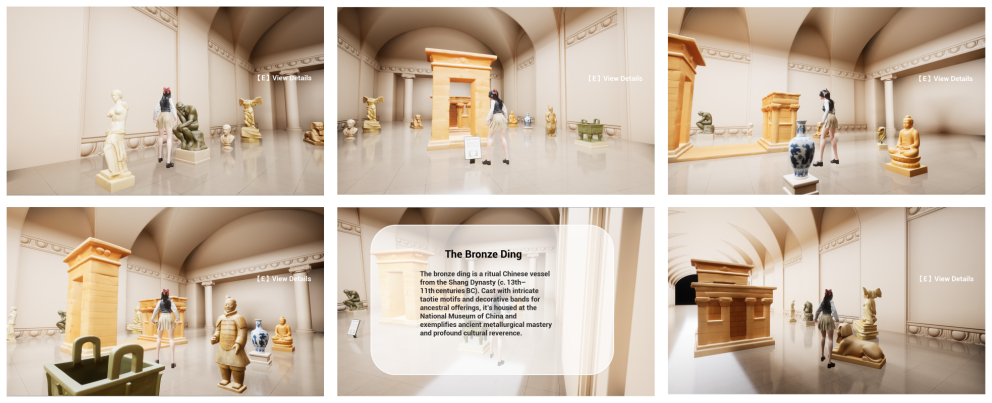
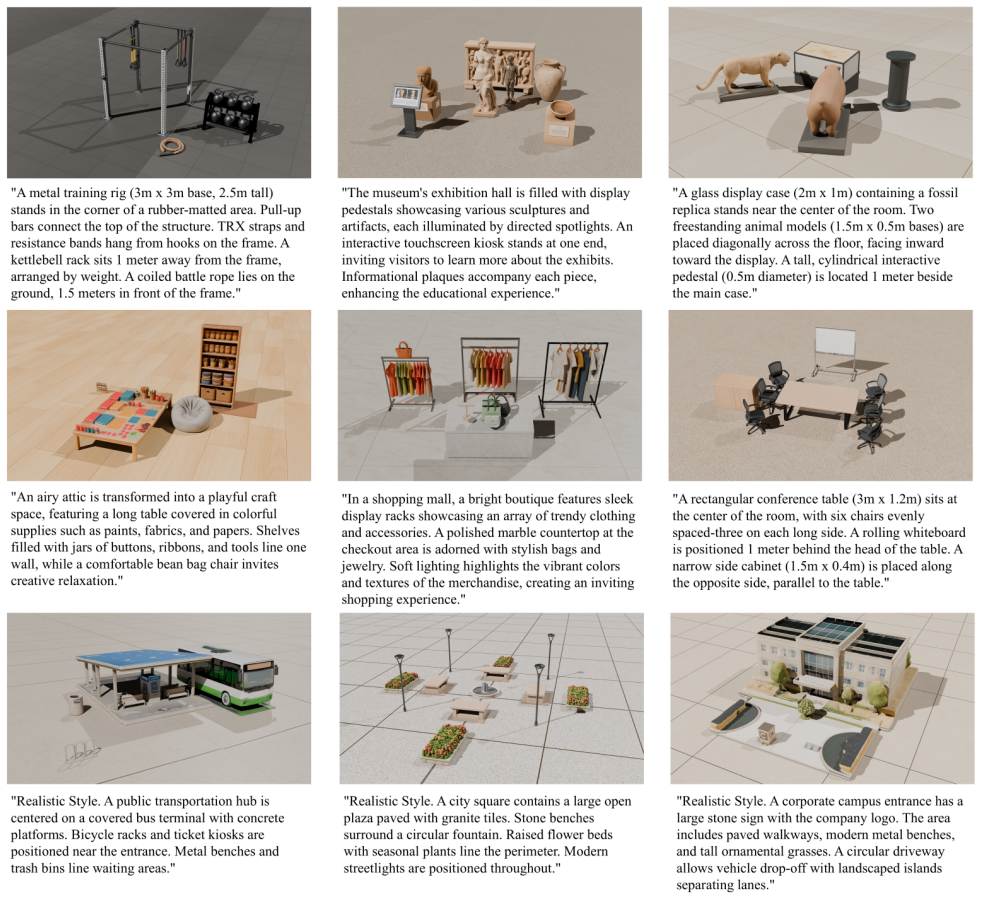
- Open-domain environments — airship docks, rural roadsides, museum halls, cyberpunk streets — become reachable from text alone, because assets are generated rather than selected from indoor-biased libraries.
- Style consistency across a scene becomes achievable at the asset level: the same reference image conditions every object, so a scene can be uniformly realistic, cartoon, anime, or cyberpunk.
- Because scenes remain assemblies of separate mesh assets, users can add, delete, replace, or reposition a single object in natural language without regenerating the whole world.
- The layout ablation implies the spatial-constraint solver, not the raw VLM, is what makes arrangements physically plausible: the full module was preferred over VLM-only initial layouts in 67.93% of comparisons.
- The Unreal Engine integration shows a direct path from text prompt to interactive game environment, potentially reducing the modeling effort in procedural game production.
Reading between the lines
- Beyond the paper: because the only ablation isolates the layout solver, the reported gain over HOLODECK is not decomposed between generated assets and VLM parsing; a controlled swap of retrieval assets into the new pipeline would tell which component deserves the credit.
- Beyond the paper: if the VLM's spatial reasoning improves, this architecture should scale to much larger environments without redesign, since the DFS solver and constraint language remain the same.
- Beyond the paper: the hand-set thresholds (e.g., far beyond 8 m, face to within 10 degrees) may need per-domain calibration; for city-scale or tabletop scenes the same text could yield implausible layouts unless thresholds are made scale-aware.
- Beyond the paper: style consistency across dozens of objects may degrade as scene size grows, because each object image is generated independently while tied to the same reference; measuring per-object style variance would quantify this.
Editorial analysis
A structured set of objections, weighed in public.
Referee Report
Summary. The paper presents HOLODECK 2.0, a text/image-guided 3D scene generation and editing system. The pipeline uses a VLM to generate a reference image from the text, parses object properties from the image and text, generates 3D assets with Hunyuan3D, and arranges them via a DFS solver that applies VLM-generated spatial constraints. The system also supports language-based editing of layouts and assets, and the authors demonstrate integration with Unreal Engine. Comparative evaluations against the original HOLODECK, plus ablations and an editing comparison with BlenderAlchemy, are reported. The central claim is that HOLODECK 2.0 consistently outperforms the baseline in both human and CLIP-based evaluations, especially for open-domain scenes.
Significance. If the reported results hold, the paper makes a useful systems contribution: it combines VLM-based scene decomposition, generative 3D assets, and iterative constraint solving into one editable pipeline, addressing known limitations of retrieval-based assembly. Strengths include a detailed appendix with prompts and solver pseudocode, a large human evaluation, an ablation isolating the DFS layout module, and a publicly announced code release. The application to Unreal Engine illustrates practical value. However, the quantitative evidence for the central comparative claim is weakened by a confounded automated metric and by human evaluations that conflate asset-source quality with the proposed framework. The contribution is nonetheless plausible and the issues are addressable with additional experiments and analysis.
major comments (4)
- [Evaluation, Tables 1-2; Appendix Listings 1 and 4] The CLIP score is not an independent measure of 3D scene quality in this comparison. The pipeline's first step generates a reference image directly from the input text; object images, asset generation, and layout are all conditioned on that image. The reported CLIP(render, text) therefore inherits the text-image alignment of GPT-Image-1's 2D output, while the HOLODECK baseline has no such reference-image step. The claimed CLIP advantage (0.299 vs 0.253 indoor; 0.307 vs 0.256 open) could be largely explained by 2D generation quality rather than by the proposed 3D layout or editing contributions. Please report the CLIP score of the reference image itself, and ideally add an ablation in which the reference image is removed or held fixed across methods.
- [Evaluation, Tables 1-2] The human 'asset-level' scores compare assets generated by Hunyuan3D against assets retrieved from Objaverse. Since the asset source is different between the two systems, the reported asset-level advantage (8.00 vs 4.28 indoor; 7.58 vs 3.77 open) isolates the benefit of generative assets, not the framework's VLM-guided object parsing or constraint generation. The DFS ablation in Figure 9 is informative, but it only varies the layout within HOLODECK 2.0. To support the central claim that the full HOLODECK 2.0 framework outperforms HOLODECK, the authors should provide a controlled comparison that varies one component at a time, e.g., using the same generated assets in both layout methods, or evaluating scene-level quality while factoring out asset quality.
- [Evaluation, Figure 8] No uncertainty quantification is provided for the main comparative results. The paper reports mean CLIP scores and mean human ratings over 30 scenes, but the kernel density plots in Figure 8 suggest considerable overlap between the baseline and HOLODECK 2.0 distributions. Without confidence intervals, paired significance tests, or per-scene error bars, the claim that HOLODECK 2.0 'consistently outperforms' is not statistically supported. This is load-bearing for the headline conclusion.
- [Appendix, Spatial Constraints Definition; Listing 8] The 'acyclic dependency' rule, which prevents an object from appearing as a source after it has been a target, restricts the space of representable spatial constraint graphs. It is unclear whether this rule preserves all physically plausible layouts. For instance, two objects facing each other would naturally require both 'face to' constraints, which the rule forbids. The paper should either justify that the rule is complete for the supported relation set or demonstrate empirically that it does not cause layout failures or degraded results in scenes requiring symmetric or cyclic relations.
minor comments (4)
- [Evaluation, Setup] The evaluation uses a single baseline, HOLODECK, which is from the same research group. Comparisons to SceneCraft, LayoutVLM, or other recent text-to-3D scene methods would strengthen the external validity, even if only qualitatively.
- [Evaluation, Scene Editing] The editing comparison is based on only 10 tasks. This small sample, combined with a forced-choice preference, would benefit from a per-task breakdown or confidence intervals.
- [Figure 8] The CLIP score distributions are presented with kernel density estimates but no raw data points, making it hard to assess per-scene variability. Consider showing scatter plots or box plots with paired data.
- [Abstract/Introduction] The claimed improvements of '110% for indoor scenes and 139% for open-domain scenes' are not clearly tied to which metric or table; please specify that these refer to asset-level human scores and add the corresponding baseline values.
Circularity Check
No significant circularity: the claimed contributions are evaluated against external baselines and no fitted parameter is relabeled as a prediction.
full rationale
Walking the derivation chain, text input -> GPT-Image-1 reference image -> GPT-o3 object-property JSON -> GPT-Image-1 object images -> Hunyuan3D assets -> GPT-o3 spatial constraints -> DFS layout solver -> optional editing, each stage consumes the previous stage's output, but no stage is defined in terms of the evaluation metric. The CLIP score is computed on the final rendered scene against the input text; although the reference image is text-conditioned and object images are made 'similar to the reference scene', the final render is a distinct 3D output, so the CLIP number is not equal by construction to the reference image's text alignment nor to any fitted parameter. The spatial-relation thresholds in Table 3 (2 m, 8 m, 2 mm, 10 degrees) are hand-specified constants, not tuned on the 60 test cases, so there is no fitting-to-prediction cycle. The ablation study isolates the DFS layout from the VLM initial layout, and the editing comparison uses an external baseline (BlenderAlchemy). The only self-referential element is using the authors' own HOLODECK as the baseline system; this is a normal empirical comparison, not an appeal to authority, and does not force the outcome. Accordingly, the paper's central claims do not reduce to their inputs by construction.
Assumptions & free parameters
free parameters (6)
- near distance threshold =
2 m
- far distance threshold =
8 m
- on clearance threshold =
2 mm
- face-to angle tolerance =
10 degrees
- layout buffer =
0.1 m
- object size range =
[0.1, 5] m
assumptions (5)
- domain assumption GPT-o3 and GPT-Image-1 reliably parse scenes and generate accurate object images
- domain assumption Hunyuan3D 2.1 generates faithful, adjustable 3D meshes from object images
- ad hoc to paper The ten spatial relations and their thresholds capture physical plausibility
- ad hoc to paper The acyclic dependency rule (a target cannot later be a source) preserves all valid layouts
- domain assumption The DFS solver with local candidate generation will find a valid layout if one exists
Cite this review
Pith. "Pith review of HOLODECK 2.0: Vision-Language-Guided 3D World Generation with Editing." pith.science (2026). https://pith.science/paper/2KWMSI2H
@misc{pith2026250805899,
  author       = {Pith},
  title        = {Pith review of: HOLODECK 2.0: Vision-Language-Guided 3D World Generation with Editing},
  year         = {2026},
  howpublished = {\url{https://pith.science/paper/2KWMSI2H}},
  note         = {Machine review of arXiv:2508.05899}
}
read the original abstract
3D scene generation plays a crucial role in gaming, artistic creation, virtual reality, and many other domains. However, current 3D scene design still relies heavily on extensive manual effort from creators, and existing automated methods struggle to generate open-domain scenes or support flexible editing. To address those challenges, we introduce HOLODECK 2.0, an advanced vision-language-guided framework for 3D world generation with support for interactive scene editing based on human feedback. HOLODECK 2.0 can generate diverse and stylistically rich 3D scenes (e.g., realistic, cartoon, anime, and cyberpunk styles) that exhibit high semantic fidelity to fine-grained input descriptions, suitable for both indoor and open-domain environments. HOLODECK 2.0 leverages vision-language models (VLMs) to identify and parse the objects required in a scene and generates corresponding high-quality assets via state-of-the-art 3D generative models. Then, HOLODECK 2.0 iteratively applies spatial constraints derived from the VLMs to achieve semantically coherent and physically plausible layouts. Both human and model evaluations demonstrate that HOLODECK 2.0 effectively generates high-quality scenes closely aligned with detailed textual descriptions, consistently outperforming baselines across indoor and open-domain scenarios. Additionally, HOLODECK 2.0 provides editing capabilities that flexibly adapt to human feedback, supporting layout refinement and style-consistent object edits. Finally, we present a practical application of HOLODECK 2.0 in procedural game modeling to generate visually rich and immersive environments that can boost efficiency in game design Code is available at https://github.com/bzx20/Holodeck2.0.
Figures


Figures from the paper (10 more)




Forward citations
Cited by 1 Pith paper
-
SceneCritic: A Symbolic Evaluator for 3D Indoor Scene Synthesis
SceneCritic is a symbolic, ontology-grounded evaluator for floor-plan layouts that identifies specific semantic, orientation, and geometric violations and aligns better with human judgments than VLM-based scorers.
Reference graph
Works this paper leans on
-
[1]
, " * write output.state after.block = add.period write newline
ENTRY address archivePrefix author booktitle chapter edition editor eid eprint howpublished institution isbn journal key month note number organization pages publisher school series title type volume year label extra.label sort.label short.list INTEGERS output.state before.all mid.sentence after.sentence after.block FUNCTION init.state.consts #0 'before.a...
-
[2]
write newline
" write newline "" before.all 'output.state := FUNCTION n.dashify 't := "" t empty not t #1 #1 substring "-" = t #1 #2 substring "--" = not "--" * t #2 global.max substring 't := t #1 #1 substring "-" = "-" * t #2 global.max substring 't := while if t #1 #1 substring * t #2 global.max substring 't := if while FUNCTION word.in bbl.in capitalize " " * FUNCT...
-
[3]
Aguina-Kang, R.; Gumin, M.; Han, D. H.; Morris, S.; Yoo, S. J.; Ganeshan, A.; Jones, R. K.; Wei, Q. A.; Fu, K.; and Ritchie, D. 2024. Open-universe indoor scene generation using llm program synthesis and uncurated object databases. arXiv preprint arXiv:2403.09675
arXiv 2024
-
[4]
BlenderGPT . 2023. BlenderGPT . Available at: https://github.com/gd3kr/BlenderGPT, Accessed: 2025-07-22
work page 2023
-
[5]
Chang, A.; Savva, M.; and Manning, C. D. 2014. Learning spatial knowledge for text to 3D scene generation. In Proceedings of the 2014 conference on empirical methods in natural language processing (EMNLP), 2028--2038
work page 2014
-
[6]
Chung, J.; Lee, S.; Nam, H.; Lee, J.; and Lee, K. M. 2023. Luciddreamer: Domain-free generation of 3d gaussian splatting scenes. arXiv preprint arXiv:2311.13384
arXiv 2023
-
[7]
Coyne, B.; and Sproat, R. 2001. WordsEye: An automatic text-to-scene conversion system. In Proceedings of the 28th annual conference on Computer graphics and interactive techniques, 487--496
work page 2001
- [8]
Show all 35 references
-
[9]
Deitke, M.; Schwenk, D.; Salvador, J.; Weihs, L.; Michel, O.; VanderBilt, E.; Schmidt, L.; Ehsani, K.; Kembhavi, A.; and Farhadi, A. 2023 b . Objaverse: A universe of annotated 3d objects. In Proceedings of the IEEE/CVF conference on computer vision and pattern recognition, 13...
2023
-
[10]
E.; and Wang, W
Feng, W.; Zhu, W.; Fu, T.-j.; Jampani, V.; Akula, A.; He, X.; Basu, S.; Wang, X. E.; and Wang, W. Y. 2023. Layoutgpt: Compositional visual planning and generation with large language models. Advances in Neural Information Processing Systems, 36: 18225--18250
2023
-
[11]
Ho, J.; Jain, A.; and Abbeel, P. 2020. Denoising diffusion probabilistic models. Advances in neural information processing systems, 33: 6840--6851
2020
-
[12]
A.; Schmid, C.; and Fathi, A
Hu, Z.; Iscen, A.; Jain, A.; Kipf, T.; Yue, Y.; Ross, D. A.; Schmid, C.; and Fathi, A. 2024. Scenecraft: An llm agent for synthesizing 3d scenes as blender code. In Forty-first International Conference on Machine Learning
2024
-
[13]
Huang, I.; Yang, G.; and Guibas, L. 2024. Blenderalchemy: Editing 3d graphics with vision-language models. In European Conference on Computer Vision, 297--314. Springer
2024
-
[14]
Hunyuan3D, T.; Yang, S.; Yang, M.; Feng, Y.; Huang, X.; Zhang, S.; He, Z.; Luo, D.; Liu, H.; Zhao, Y.; et al. 2025. Hunyuan3D 2.1: From Images to High-Fidelity 3D Assets with Production-Ready PBR Material. arXiv preprint arXiv:2506.15442
2025 arXiv
-
[15]
C.; Lo, W.-Y.; et al
Kirillov, A.; Mintun, E.; Ravi, N.; Mao, H.; Rolland, C.; Gustafson, L.; Xiao, T.; Whitehead, S.; Berg, A. C.; Lo, W.-Y.; et al. 2023. Segment anything. In Proceedings of the IEEE/CVF international conference on computer vision, 4015--4026
2023
-
[16]
Lai, Z.; Zhao, Y.; Liu, H.; Zhao, Z.; Lin, Q.; Shi, H.; Yang, X.; Yang, M.; Yang, S.; Feng, Y.; et al. 2025. Hunyuan3D 2.5: Towards High-Fidelity 3D Assets Generation with Ultimate Details. arXiv preprint arXiv:2506.16504
2025 arXiv
-
[17]
Li, W.; Liu, J.; Yan, H.; Chen, R.; Liang, Y.; Chen, X.; Tan, P.; and Long, X. 2024. Craftsman3d: High-fidelity mesh generation with 3d native generation and interactive geometry refiner. arXiv preprint arXiv:2405.14979
2024 arXiv
-
[18]
Lin, C.; Liu, H.; Lin, Q.; Bright, Z.; Tang, S.; He, Y.; Liu, M.; Zhu, L.; and Le, C. 2025. Objaverse++: Curated 3D Object Dataset with Quality Annotations. arXiv preprint arXiv:2504.07334
2025 arXiv
-
[19]
Lin, C.-H.; Gao, J.; Tang, L.; Takikawa, T.; Zeng, X.; Huang, X.; Kreis, K.; Fidler, S.; Liu, M.-Y.; and Lin, T.-Y. 2023. Magic3d: High-resolution text-to-3d content creation. In Proceedings of the IEEE/CVF conference on computer vision and pattern recognition, 300--309
2023
-
[20]
G.; Fisher, M.; Li, M.; Pirk, S.; Hua, B.-S.; Yeung, S.-K.; Tong, X.; Guibas, L.; and Zhang, H
Ma, R.; Patil, A. G.; Fisher, M.; Li, M.; Pirk, S.; Hua, B.-S.; Yeung, S.-K.; Tong, X.; Guibas, L.; and Zhang, H. 2018. Language-driven synthesis of 3D scenes from scene databases. ACM Transactions on Graphics (TOG), 37(6): 1--16
2018
-
[21]
OpenAI . 2025. GPT o3 . Available at: https://openai.com/index/introducing-o3-and-o4-mini/, Accessed: 2025-07-22
2025
-
[22]
Paschalidou, D.; Kar, A.; Shugrina, M.; Kreis, K.; Geiger, A.; and Fidler, S. 2021. Atiss: Autoregressive transformers for indoor scene synthesis. Advances in Neural Information Processing Systems, 34: 12013--12026
2021
-
[23]
Peebles, W.; and Xie, S. 2023. Scalable diffusion models with transformers. In Proceedings of the IEEE/CVF international conference on computer vision, 4195--4205
2023
-
[24]
T.; and Mildenhall, B
Poole, B.; Jain, A.; Barron, J. T.; and Mildenhall, B. 2022. Dreamfusion: Text-to-3d using 2d diffusion. arXiv preprint arXiv:2209.14988
2022 arXiv
-
[25]
W.; Hallacy, C.; Ramesh, A.; Goh, G.; Agarwal, S.; Sastry, G.; Askell, A.; Mishkin, P.; Clark, J.; et al
Radford, A.; Kim, J. W.; Hallacy, C.; Ramesh, A.; Goh, G.; Agarwal, S.; Sastry, G.; Askell, A.; Mishkin, P.; Clark, J.; et al. 2021. Learning transferable visual models from natural language supervision. In International conference on machine learning, 8748--8763. PmLR
2021
-
[26]
Ren, T.; Liu, S.; Zeng, A.; Lin, J.; Li, K.; Cao, H.; Chen, J.; Huang, X.; Chen, Y.; Yan, F.; et al. 2024. Grounded sam: Assembling open-world models for diverse visual tasks. arXiv preprint arXiv:2401.14159
2024 arXiv
-
[27]
Rombach, R.; Blattmann, A.; Lorenz, D.; Esser, P.; and Ommer, B. 2022. High-resolution image synthesis with latent diffusion models. In Proceedings of the IEEE/CVF conference on computer vision and pattern recognition, 10684--10695
2022
-
[28]
Sohl-Dickstein, J.; Weiss, E.; Maheswaranathan, N.; and Ganguli, S. 2015. Deep unsupervised learning using nonequilibrium thermodynamics. In International conference on machine learning, 2256--2265. pmlr
2015
-
[29]
Sun, F.-Y.; Liu, W.; Gu, S.; Lim, D.; Bhat, G.; Tombari, F.; Li, M.; Haber, N.; and Wu, J. 2025. Layoutvlm: Differentiable optimization of 3d layout via vision-language models. In Proceedings of the Computer Vision and Pattern Recognition Conference, 29469--29478
2025
-
[30]
TurboSquid . 2024. TurboSquid . Available at: https://www.turbosquid.com/, Accessed: 2025-07-31
2024
-
[31]
Xiang, J.; Lv, Z.; Xu, S.; Deng, Y.; Wang, R.; Zhang, B.; Chen, D.; Tong, X.; and Yang, J. 2025. Structured 3d latents for scalable and versatile 3d generation. In Proceedings of the Computer Vision and Pattern Recognition Conference, 21469--21480
2025
-
[32]
Yang, Y.; Sun, F.-Y.; Weihs, L.; VanderBilt, E.; Herrasti, A.; Han, W.; Wu, J.; Haber, N.; Krishna, R.; Liu, L.; et al. 2024. Holodeck: Language guided generation of 3d embodied ai environments. In Proceedings of the IEEE/CVF Conference on Computer Vision and Pattern Recogniti...
2024
-
[33]
Zhang, B.; Tang, J.; Niessner, M.; and Wonka, P. 2023. 3dshape2vecset: A 3d shape representation for neural fields and generative diffusion models. ACM Transactions On Graphics (TOG), 42(4): 1--16
2023
-
[34]
Zhang, L.; Wang, Z.; Zhang, Q.; Qiu, Q.; Pang, A.; Jiang, H.; Yang, W.; Xu, L.; and Yu, J. 2024. Clay: A controllable large-scale generative model for creating high-quality 3d assets. ACM Transactions on Graphics (TOG), 43(4): 1--20
2024
-
[35]
Zhao, Z.; Liu, W.; Chen, X.; Zeng, X.; Wang, R.; Cheng, P.; Fu, B.; Chen, T.; Yu, G.; and Gao, S. 2023. Michelangelo: Conditional 3d shape generation based on shape-image-text aligned latent representation. Advances in neural information processing systems, 36: 73969--73982
2023
Reviewed August 5, 2026 · model on record in the stance chip above.
Discussion (0). Sign in to comment.