Topological Quantum Interferometry
Pith reviewed 2026-06-26 17:41 UTC · model grok-4.3
The pith
The exchange Berry phase decomposes two-photon spatial patterns into geometry-dictated modes, revealing invariants that witness state dimensionality without tomography.
A machine-rendered reading of the paper's core claim, the machinery that carries it, and where it could break.
Core claim
The exchange Berry phase (BPX) serves as a geometric marker that governs spatial interference, acting as a deterministic control parameter which decomposes two-photon spatial patterns into geometry-dictated fundamental modes; this decomposition reveals topological invariants and phase singularities that function as a non-tomographic witness for state dimensionality estimation.
What carries the argument
The exchange Berry phase (BPX), generalized across arbitrary topological charges and detuning conditions in q-plate systems, which directly dictates the decomposition of two-photon interference patterns into fundamental spatial modes.
If this is right
- BPX enables generalization of q-plate state generation and characterization beyond perfectly tuned conditions.
- Topological invariants extracted from the spatial patterns provide a witness for dimensionality that avoids full-state reconstruction.
- The method supports scalable, device-independent characterization suitable for high-dimensional quantum networks.
- Phase singularities identified in the patterns allow topologically protected state selection.
Where Pith is reading between the lines
- The same geometric decomposition principle may apply to other structured-light platforms that generate high-dimensional states.
- Avoiding tomography could lower resource costs in quantum metrology tasks that rely on dimensionality estimation.
- The invariants might serve as error indicators in networks where dynamic phases fluctuate.
Load-bearing premise
The exchange Berry phase generalizes to arbitrary topological charges and detuning conditions in q-plate systems and directly governs the observed spatial interference patterns without other phases dominating.
What would settle it
Measurement of two-photon coincidence patterns under varied q-plate charges that fail to match the predicted decomposition into geometry-dictated modes, showing instead patterns dominated by dynamic phases unrelated to the exchange Berry phase.
Figures
read the original abstract
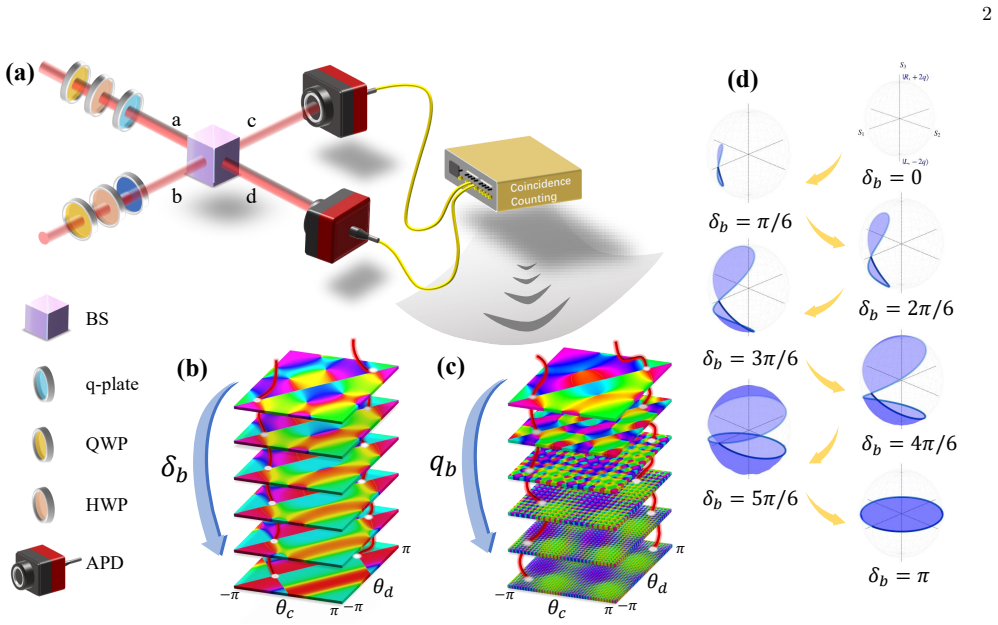
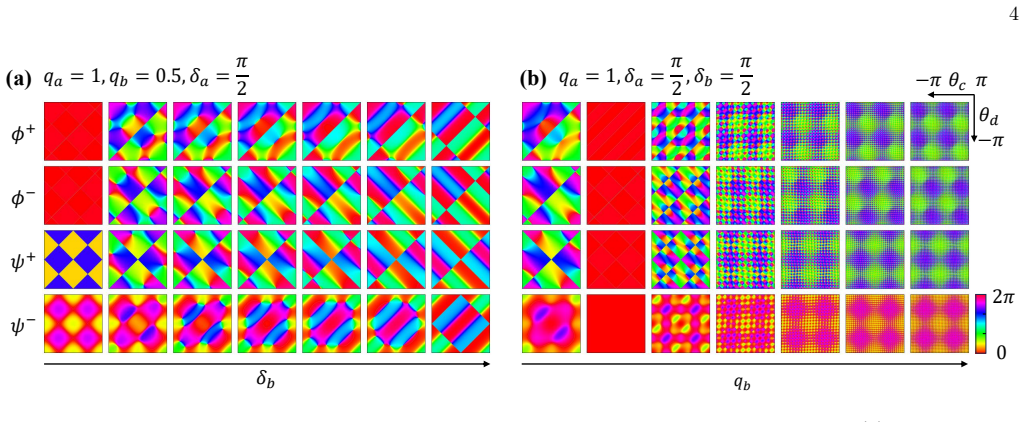
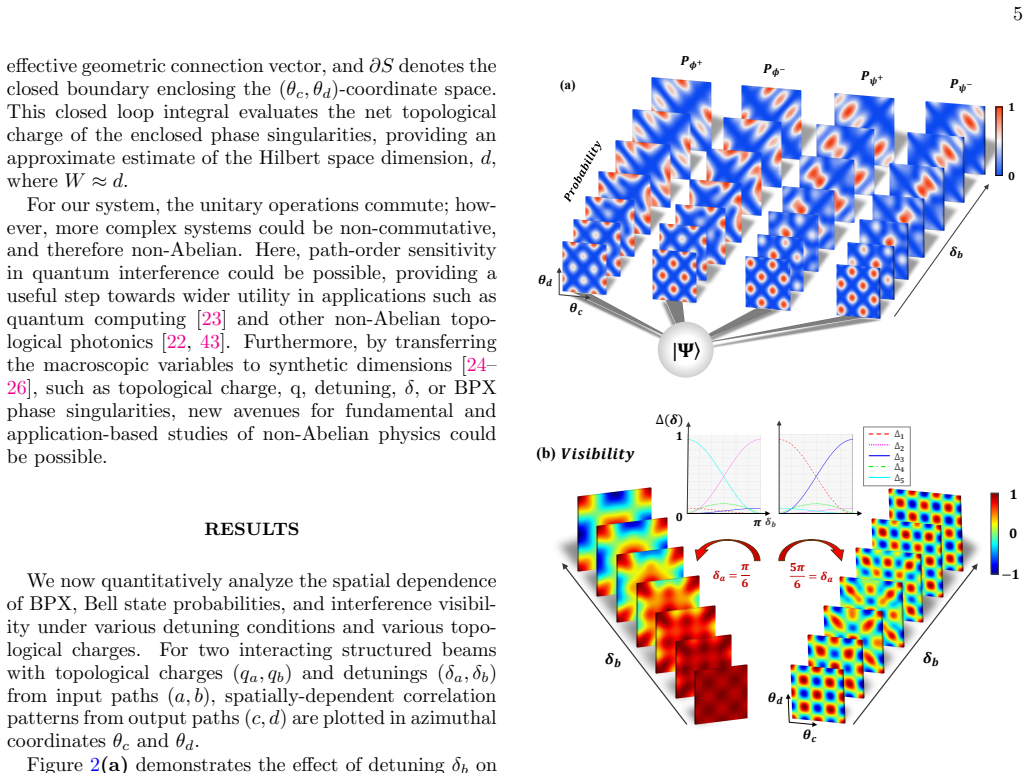
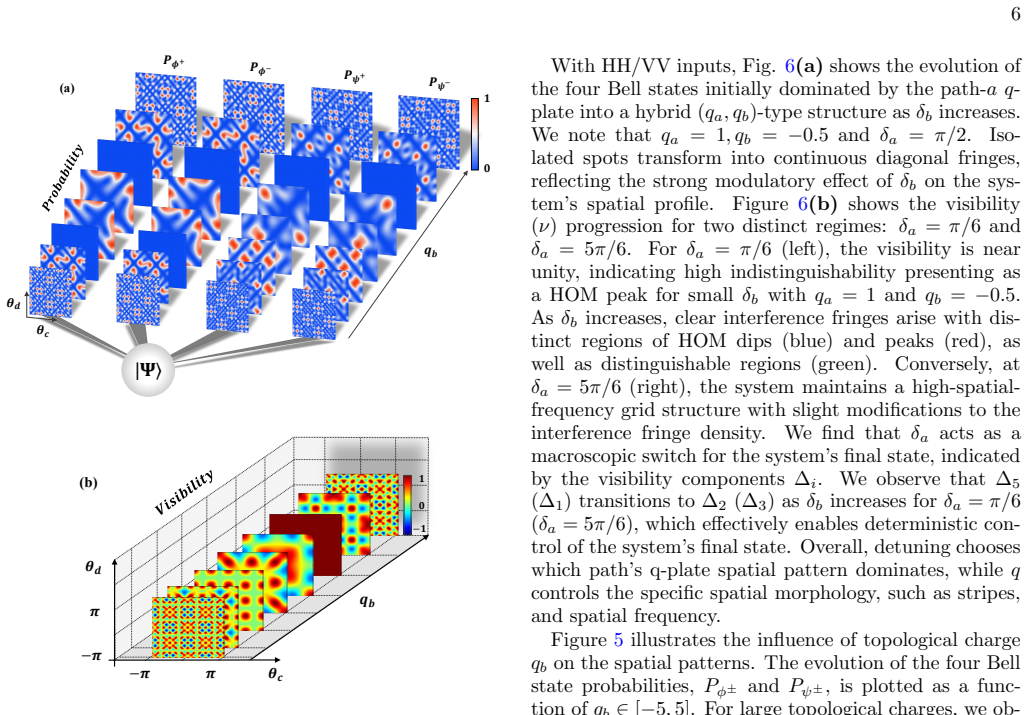
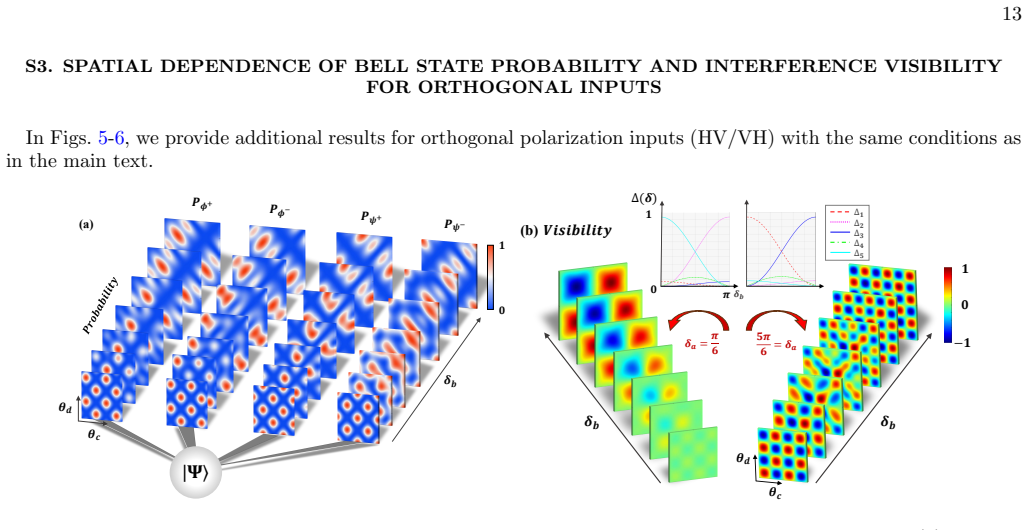
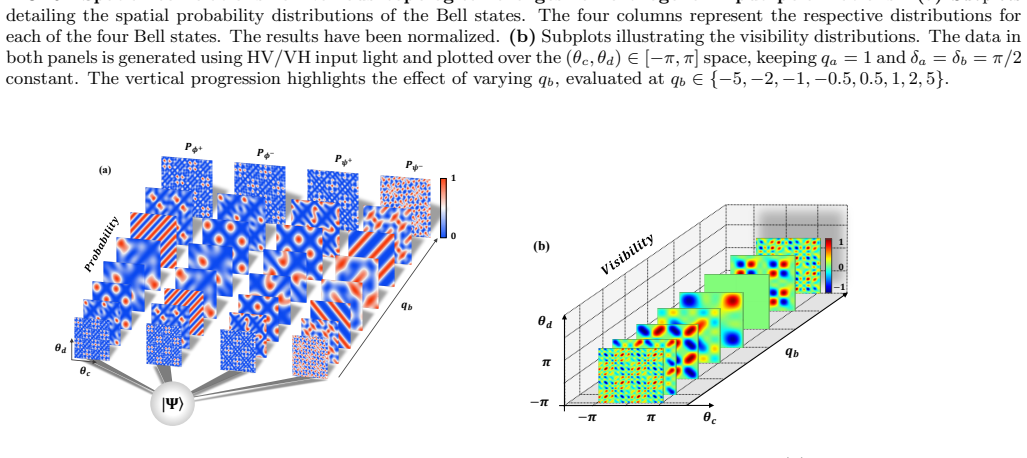
Structured light provides high-dimensional Hilbert spaces holding tremendous potential for fundamental quantum optics and quantum technologies. However, existing characterization methods, like Hong-Ou-Mandel (HOM) interference, typically assume perfectly tuned conditions, overlooking the geometric physics governing spatial mode evolution. Here, we establish topological quantum interferometry driven by an interaction-based geometric phase, the exchange Berry phase (BPX). Our formalism generalizes $q$-plate state generation and characterization to arbitrary topological charges and (de)tuning conditions, demonstrating that BPX acts as a geometric marker governing spatial interference. We show BPX serves as a deterministic control parameter, decomposing two-photon spatial patterns into geometry-dictated fundamental modes. This mapping reveals topological invariants and phase singularities that function as a non-tomographic witness for state dimensionality estimation, circumventing full-state reconstruction. Being device-independent and highly scalable, this approach enables scalable high-dimensional characterization and topologically protected state selection, with direct applicability to quantum metrology and high-capacity quantum networks.
Editorial analysis
A structured set of objections, weighed in public.
Referee Report
Summary. The manuscript introduces topological quantum interferometry driven by the exchange Berry phase (BPX) in q-plate systems. It claims to generalize q-plate state generation and characterization to arbitrary topological charges and (de)tuning conditions, demonstrating that BPX acts as a geometric marker and deterministic control parameter that decomposes two-photon spatial patterns into geometry-dictated fundamental modes. This mapping is asserted to reveal topological invariants and phase singularities that serve as a non-tomographic witness for state dimensionality estimation, circumventing full-state reconstruction, with claimed applicability to scalable high-dimensional characterization and topologically protected state selection.
Significance. If the central mapping holds with BPX isolated as the dominant control parameter, the work would offer a scalable, device-independent route to high-dimensional quantum state characterization without tomography, with potential impact on quantum metrology and networks. The emphasis on geometric phases governing interference patterns is a conceptual strength if supported by explicit derivations and bounds.
major comments (2)
- [Formalism and generalization (likely §2–3)] The central claim that BPX serves as the sole deterministic control parameter for decomposing patterns and yielding a unique dimensionality witness requires that dynamic phases remain negligible relative to geometric contributions for arbitrary charges and detuning. No explicit bound, ratio calculation, or error propagation is provided showing that propagation-induced dynamic phases or q-plate detuning corrections do not shift singularity locations or mode weights by amounts comparable to the BPX effect; this assumption is load-bearing for the non-tomographic witness claim.
- [Results on dimensionality witness and phase singularities] The non-tomographic witness via topological invariants and phase singularities is presented as circumventing full reconstruction, but without quantitative comparison to standard methods (e.g., HOM interference under detuning) or demonstration that the mapping remains invertible when dynamic phases are included, the uniqueness of the BPX-to-dimensionality relation is not established.
minor comments (2)
- [Introduction and formalism] Clarify the precise definition of BPX at first introduction and distinguish it explicitly from dynamic phases in the q-plate Hamiltonian.
- [Abstract] The abstract states the approach is 'device-independent,' but the formalism is tied to q-plate geometry; specify what aspects are independent of the specific device implementation.
Simulated Author's Rebuttal
We thank the referee for the constructive and detailed comments. We address the two major points below and will incorporate revisions to provide the requested bounds, comparisons, and invertibility analysis.
read point-by-point responses
-
Referee: The central claim that BPX serves as the sole deterministic control parameter for decomposing patterns and yielding a unique dimensionality witness requires that dynamic phases remain negligible relative to geometric contributions for arbitrary charges and detuning. No explicit bound, ratio calculation, or error propagation is provided showing that propagation-induced dynamic phases or q-plate detuning corrections do not shift singularity locations or mode weights by amounts comparable to the BPX effect; this assumption is load-bearing for the non-tomographic witness claim.
Authors: We agree that the manuscript would benefit from explicit bounds. In the revised version we will add a dedicated subsection deriving the ratio of dynamic phase accumulation to BPX for arbitrary topological charge q and detuning δ, together with an error-propagation analysis that quantifies the resulting shift in singularity locations and mode weights. This will delineate the parameter regime in which BPX remains the dominant control parameter. revision: yes
-
Referee: The non-tomographic witness via topological invariants and phase singularities is presented as circumventing full reconstruction, but without quantitative comparison to standard methods (e.g., HOM interference under detuning) or demonstration that the mapping remains invertible when dynamic phases are included, the uniqueness of the BPX-to-dimensionality relation is not established.
Authors: We will expand the results section with a direct quantitative comparison of the BPX witness against HOM visibility under controlled detuning. We will also augment the theoretical model to retain dynamic phases explicitly and demonstrate, both analytically and numerically, that the observed singularity pattern still maps invertibly onto dimensionality within the bounds established by the new ratio analysis, thereby confirming uniqueness of the witness. revision: yes
Circularity Check
No significant circularity detected
full rationale
The abstract and description present a new formalism establishing topological quantum interferometry via the exchange Berry phase (BPX) as a geometric marker, generalizing q-plate methods to arbitrary charges and detuning. No equations, self-citations, or derivations are quoted that reduce claims (such as BPX as deterministic control parameter or non-tomographic witness) to inputs by construction, fitted parameters renamed as predictions, or load-bearing self-referential assumptions. The central mapping from BPX to spatial patterns and invariants is framed as derived from geometric physics rather than tautological redefinition, making the chain self-contained against external benchmarks.
Axiom & Free-Parameter Ledger
axioms (1)
- domain assumption Exchange Berry phase governs spatial mode evolution and interference in the generalized q-plate system under arbitrary charges and detuning
invented entities (1)
-
exchange Berry phase (BPX)
no independent evidence
Reference graph
Works this paper leans on
-
[1]
Measurement of subpicosecond time intervals between two photons by interference,
C. K. Hong, Z. Y. Ou, and L. Mandel, “Measurement of subpicosecond time intervals between two photons by interference,” Physical Review Letters59, 2044–2046 (1987)
2044
-
[2]
Two-photon interference: the hong–ou–mandel effect,
Fr´ ed´ eric Bouchard, Alicia Sit, Yingwen Zhang, Robert Fickler, Filippo M Miatto, Yuan Yao, Fabio Sciarrino, and Ebrahim Karimi, “Two-photon interference: the hong–ou–mandel effect,” Reports on Progress in Physics 84, 012402 (2020), arXiv:2006.09335
arXiv 2020
-
[3]
Robert J Chapman, Tristan Kuttner, Jost Kellner, Alessandra Sabatti, Andreas Maeder, Giovanni Finco, Fabian Kaufmann, and Rachel Grange, “On-chip quan- tum interference between independent lithium niobate- on-insulator photon-pair sources,” Physical Review Let- ters134, 223602 (2025), arXiv:2404.08378
arXiv 2025
-
[4]
Demonstration of an all-optical quan- tum controlled-not gate,
J. L. O’Brien, G. J. Pryde, A. G. White, T. C. Ralph, and D. Branning, “Demonstration of an all-optical quan- tum controlled-not gate,” Nature426, 264–267 (2003), arXiv:quant-ph/0403062
Pith/arXiv arXiv 2003
-
[5]
Linear opti- cal quantum computing with photonic qubits,
Pieter Kok, W. J. Munro, Kae Nemoto, T. C. Ralph, Jonathan P. Dowling, and G. J. Milburn, “Linear opti- cal quantum computing with photonic qubits,” Reviews of Modern Physics79, 135–174 (2007), arXiv:quant- ph/0512071
arXiv 2007
-
[6]
Phase-programmable gaussian boson sampling us- ing stimulated squeezed light,
Han-Sen Zhong, Yu-Hao Deng, Jian Qin, Hui Wang, Ming-Cheng Chen, Li-Chao Peng, Yi-Han Luo, Dian Wu, Si-Qiu Gong, Hao Su, Yi Hu, Peng Hu, Xiao-Yan Yang, Wei-Jun Zhang, Hao Li, Yuxuan Li, Xiao Jiang, Lin Gan, Guangwen Yang, Lixing You, Zhen Wang, Li Li, Nai-Le Liu, Jelmer J. Renema, Chao-Yang Lu, and Jian-Wei Pan, “Phase-programmable gaussian boson sampling...
arXiv 2022
-
[7]
Quantum computa- tional advantage using photons,
Han-Sen Zhong, Hui Wang, Yu-Hao Deng, Ming-Cheng Chen, Li-Chao Peng, Yi-Han Luo, Jian Qin, Dian Wu, Xing Ding, Yi Hu, Peng Hu, Xiao-Yan Yang, Wei-Jun Zhang, Hao Li, Yuxuan Li, Xiao Jiang, Lin Gan, Guang- wen Yang, Lixing You, Zhen Wang, Li Li, Nai-Le Liu, Chao-Yang Lu, and Jian-Wei Pan, “Quantum computa- tional advantage using photons,” Science370, 1460–1...
arXiv 2020
-
[8]
Eleonora Nagali, Linda Sansoni, Fabio Sciarrino, Francesco De Martini, Lorenzo Marrucci, Bruno Piccir- illo, Ebrahim Karimi, and Enrico Santamato, “Opti- mal quantum cloning of orbital angular momentum pho- ton qubits through hong–ou–mandel coalescence,” Na- ture Photonics3, 720–723 (2009), arXiv:1010.5214
Pith/arXiv arXiv 2009
-
[9]
Optimal quantum cloning on a beam splitter,
William T. M. Irvine, Ant´ ıa Lamas Linares, Michiel J. A. de Dood, and Dirk Bouwmeester, “Optimal quantum cloning on a beam splitter,” Physical Review Letters92, 047902 (2004)
2004
-
[10]
High-dimensional quantum cloning and applications to quantum hacking,
Fr´ ed´ eric Bouchard, Robert Fickler, Robert W. Boyd, and Ebrahim Karimi, “High-dimensional quantum cloning and applications to quantum hacking,” Science Advances3, e1601915 (2017), arXiv:1608.04396
Pith/arXiv arXiv 2017
-
[11]
Measurement-device-independent quantum key distri- bution,
Hoi-Kwong Lo, Marcos Curty, and Bing Qi, “Measurement-device-independent quantum key distri- bution,” Physical Review Letters108, 130503 (2012), arXiv:1109.1473
Pith/arXiv arXiv 2012
-
[12]
Attosecond-resolution hong-ou-mandel inter- ferometry,
Ashley Lyons, George C Knee, Eliot Bolduc, Thomas Roger, Jonathan Leach, Erik M Gauger, and Daniele Faccio, “Attosecond-resolution hong-ou-mandel inter- ferometry,” Science Advances4, eaap9416 (2018), arXiv:1708.08351
Pith/arXiv arXiv 2018
-
[13]
Tracking the polari- sation state of light via hong-ou-mandel interferometry,
Natapon Harnchaiwat, Feng Zhu, Niclas Westerberg, Erik Gauger, and Jonathan Leach, “Tracking the polari- sation state of light via hong-ou-mandel interferometry,” Optics Express28, 2210 (2020), arXiv:1912.12087
arXiv 2020
-
[14]
Optical spin-to- orbital angular momentum conversion in inhomogeneous anisotropic media,
L. Marrucci, C. Manzo, and D. Paparo, “Optical spin-to- orbital angular momentum conversion in inhomogeneous anisotropic media,” Physical Review Letters96, 163905 (2006), arXiv:0712.0099
Pith/arXiv arXiv 2006
-
[15]
Filippo Cardano, Ebrahim Karimi, Sergei Slussarenko, Lorenzo Marrucci, Corrado de Lisio, and Enrico Santam- ato, “Polarization pattern of vector vortex beams gener- ated by q-plates with different topological charges,” Ap- plied Optics51, C1 (2012), arXiv:1201.2646. 8
Pith/arXiv arXiv 2012
-
[16]
Tunable liquid crystal q-plates with arbitrary topologi- cal charge,
Sergei Slussarenko, Anatoli Murauski, Tao Du, Vladimir Chigrinov, Lorenzo Marrucci, and Enrico Santamato, “Tunable liquid crystal q-plates with arbitrary topologi- cal charge,” Optics Express19, 4085 (2011)
2011
-
[17]
Ar- bitrary, direct and deterministic manipulation of vector beams via electrically-tuned q-plates,
Vincenzo D’Ambrosio, Flavio Baccari, Sergei Slus- sarenko, Lorenzo Marrucci, and Fabio Sciarrino, “Ar- bitrary, direct and deterministic manipulation of vector beams via electrically-tuned q-plates,” Scientific Reports 5, 7840 (2015)
2015
-
[18]
The adiabatic phase and pancharat- nam’s phase for polarized light,
Michael V Berry, “The adiabatic phase and pancharat- nam’s phase for polarized light,” Journal of Modern Op- tics34, 1401–1407 (1987)
1987
-
[19]
Geometric nature of the environment- induced berry phase and geometric dephasing,
Robert S Whitney, Yuriy Makhlin, Alexander Shnirman, and Yuval Gefen, “Geometric nature of the environment- induced berry phase and geometric dephasing,” Phys- ical Review Letters94, 070407 (2005), arXiv:cond- mat/0405267
arXiv 2005
-
[20]
Higher order pancharatnam-berry phase and the angu- lar momentum of light,
Giovanni Milione, S Evans, DA Nolan, and RR Alfano, “Higher order pancharatnam-berry phase and the angu- lar momentum of light,” Physical Review Letters108, 190401 (2012)
2012
-
[21]
Noncyclic continuous pancharat- nam—berry phase in dual-beam interference,
Aleksi Leinonen, Antti Hannonen, Henri Partanen, Janne Heikkinen, Tero Set¨ al¨ a, Ari T Friberg, and Tommi K Hakala, “Noncyclic continuous pancharat- nam—berry phase in dual-beam interference,” Commu- nications Physics6, 132 (2023)
2023
-
[22]
Non-abelian lattice gauge fields in photonic syn- thetic frequency dimensions,
Dali Cheng, Kai Wang, Charles Roques-Carmes, Eran Lustig, Olivia Y Long, Heming Wang, and Shanhui Fan, “Non-abelian lattice gauge fields in photonic syn- thetic frequency dimensions,” Nature637, 52–56 (2025), arXiv:2406.00321
arXiv 2025
-
[23]
Non- abelian berry connections for quantum computation,
Jiannis Pachos, Paolo Zanardi, and Mario Rasetti, “Non- abelian berry connections for quantum computation,” Physical Review A61, 010305 (1999), arXiv:quant- ph/9907103
arXiv 1999
-
[24]
Non-abelian physics in light and sound,
Yi Yang, Biao Yang, Guancong Ma, Jensen Li, Shuang Zhang, and CT Chan, “Non-abelian physics in light and sound,” Science383, eadf9621 (2024), arXiv:2305.12206
arXiv 2024
-
[25]
Topological photon- ics in synthetic dimensions,
Eran Lustig and Mordechai Segev, “Topological photon- ics in synthetic dimensions,” Advances in Optics and Photonics13, 426–461 (2021)
2021
-
[26]
A perspective on synthetic dimensions in photonics,
Max Ehrhardt, Sebastian Weidemann, Lukas J Maczewsky, Matthias Heinrich, and Alexander Szameit, “A perspective on synthetic dimensions in photonics,” Laser & Photonics Reviews17, 2200518 (2023)
2023
-
[27]
Free-space quantum key dis- tribution by rotation-invariant twisted photons,
Giuseppe Vallone, Vincenzo D’Ambrosio, Anna Spon- selli, Sergei Slussarenko, Lorenzo Marrucci, Fabio Sciar- rino, and Paolo Villoresi, “Free-space quantum key dis- tribution by rotation-invariant twisted photons,” Physi- cal Review Letters113, 060503 (2014), arXiv:1402.2932
Pith/arXiv arXiv 2014
-
[28]
Quantum key distribution without a shared reference frame,
C. E. R. Souza, C. V. S. Borges, A. Z. Khoury, J. A. O. Huguenin, L. Aolita, and S. P. Walborn, “Quantum key distribution without a shared reference frame,” Physical Review A77, 032345 (2008)
2008
-
[29]
Terabit-scale orbital angular momentum mode division multiplexing in fibers,
Nenad Bozinovic, Yang Yue, Yongxiong Ren, Moshe Tur, Poul Kristensen, Hao Huang, Alan E. Willner, and Siddharth Ramachandran, “Terabit-scale orbital angular momentum mode division multiplexing in fibers,” Science 340, 1545–1548 (2013)
2013
-
[30]
Complete experimental tool- box for alignment-free quantum communication,
Vincenzo D’Ambrosio, Eleonora Nagali, Stephen P. Wal- born, Leandro Aolita, Sergei Slussarenko, Lorenzo Mar- rucci, and Fabio Sciarrino, “Complete experimental tool- box for alignment-free quantum communication,” Nature Communications3, 961 (2012), arXiv:1203.6417
Pith/arXiv arXiv 2012
-
[31]
Resilience of hybrid optical angular mo- mentum qubits to turbulence,
Osvaldo Jim´ enez Far´ ıas, Vincenzo D’Ambrosio, Caterina Taballione, Fabrizio Bisesto, Sergei Slussarenko, Lean- dro Aolita, Lorenzo Marrucci, Stephen P. Walborn, and Fabio Sciarrino, “Resilience of hybrid optical angular mo- mentum qubits to turbulence,” Scientific Reports5, 8424 (2015), arXiv:1502.06433
Pith/arXiv arXiv 2015
-
[32]
High- dimensional encoding based on classical nonseparability,
Pengyun Li, Bo Wang, and Xiangdong Zhang, “High- dimensional encoding based on classical nonseparability,” Optics Express24, 15143 (2016)
2016
-
[33]
Cre- ation and detection of vector vortex modes for classi- cal and quantum communication,
Bienvenu Ndagano, Isaac Nape, Mitchell A. Cox, Carmelo Rosales-Guzman, and Andrew Forbes, “Cre- ation and detection of vector vortex modes for classi- cal and quantum communication,” Journal of Lightwave Technology36, 292–301 (2017), arXiv:1709.00736
Pith/arXiv arXiv 2017
-
[34]
Q-plate enabled spec- trally diverse orbital-angular-momentum conversion for stimulated emission depletion microscopy,
L. Yan, P. Gregg, E. Karimi, A. Rubano, L. Marrucci, R. Boyd, and S. Ramachandran, “Q-plate enabled spec- trally diverse orbital-angular-momentum conversion for stimulated emission depletion microscopy,” Optica2, 900 (2015)
2015
-
[35]
Numerical study of an apertureless near field scanning optical microscope probe under radial polarization illumination,
Weibin Chen and Qiwen Zhan, “Numerical study of an apertureless near field scanning optical microscope probe under radial polarization illumination,” Optics Express 15, 4106 (2007)
2007
-
[36]
Hardy’s paradox tested in the spin- orbit hilbert space of single photons,
Ebrahim Karimi, Filippo Cardano, Maria Maffei, Cor- rado de Lisio, Lorenzo Marrucci, Robert W. Boyd, and Enrico Santamato, “Hardy’s paradox tested in the spin- orbit hilbert space of single photons,” Physical Review A 89, 032122 (2014), arXiv:1403.5681
Pith/arXiv arXiv 2014
-
[37]
Violation of leggett-type inequalities in the spin-orbit degrees of free- dom of a single photon,
Filippo Cardano, Ebrahim Karimi, Lorenzo Marrucci, Corrado de Lisio, and Enrico Santamato, “Violation of leggett-type inequalities in the spin-orbit degrees of free- dom of a single photon,” Physical Review A88, 032101 (2013), arXiv:1304.1738
Pith/arXiv arXiv 2013
-
[38]
Entangled vector vor- tex beams,
Vincenzo D’Ambrosio, Gonzalo Carvacho, Francesco Graffitti, Chiara Vitelli, Bruno Piccirillo, Lorenzo Mar- rucci, and Fabio Sciarrino, “Entangled vector vor- tex beams,” Physical Review A94, 030304 (2016), arXiv:1507.08887
Pith/arXiv arXiv 2016
-
[39]
Generation of the complete bell basis via hong-ou-mandel interference of vector modes,
Xiaoqin Gao, Dilip Paneru, Francesco Di Colandrea, Yingwen Zhang, and Ebrahim Karimi, “Generation of the complete bell basis via hong-ou-mandel interference of vector modes,” Physical Review A112, 012215 (2025), arXiv:2412.14274
arXiv 2025
-
[40]
Full spatial characterization of entangled structured pho- tons,
Xiaoqin Gao, Yingwen Zhang, Alessio D’Errico, Ali- cia Sit, Khabat Heshami, and Ebrahim Karimi, “Full spatial characterization of entangled structured pho- tons,” Physical Review Letters132, 063802 (2024), arXiv:2304.14280
arXiv 2024
-
[41]
Tailoring spatial correlations with quan- tum interference,
Carlo Schiano, Bereneice Sephton, Elnaz Darsheshdar, Lorenzo Marrucci, Corrado de Lisio, and Vincenzo D’Ambrosio, “Tailoring spatial correlations with quan- tum interference,” Laser & Photonics Reviews , e02895 (2026), arXiv:2509.04725
arXiv 2026
-
[42]
Orbital angular momentum of light and the transformation of laguerre-gaussian laser modes,
L. Allen, M. W. Beijersbergen, R. J. C. Spreeuw, and J. P. Woerdman, “Orbital angular momentum of light and the transformation of laguerre-gaussian laser modes,” Physical Review A45, 8185–8189 (1992)
1992
-
[43]
Non- abelian braiding on photonic chips,
Xu-Lin Zhang, Feng Yu, Ze-Guo Chen, Zhen-Nan Tian, Qi-Dai Chen, Hong-Bo Sun, and Guancong Ma, “Non- abelian braiding on photonic chips,” Nature Photonics 16, 390–395 (2022), arXiv:2112.01776
arXiv 2022
-
[44]
Observa- 9 tion of optical polarization m¨ obius strips,
Thomas Bauer, Peter Banzer, Ebrahim Karimi, Sergej Orlov, Andrea Rubano, Lorenzo Marrucci, Enrico San- tamato, Robert W. Boyd, and Gerd Leuchs, “Observa- 9 tion of optical polarization m¨ obius strips,” Science347, 964–966 (2015)
2015
-
[45]
High- dimensional intracity quantum cryptography with struc- tured photons,
Alicia Sit, Fr´ ed´ eric Bouchard, Robert Fickler, J´ er´ emie Gagnon-Bischoff, Hugo Larocque, Khabat Heshami, Do- minique Elser, Christian Peuntinger, Kevin G¨ unthner, Bettina Heim, Christoph Marquardt, Gerd Leuchs, Robert W. Boyd, and Ebrahim Karimi, “High- dimensional intracity quantum cryptography with struc- tured photons,” Optica4, 1006 (2017), arX...
Pith/arXiv arXiv 2017
-
[46]
Tunable high-resolution macro- scopic self-engineered geometric phase optical ele- ments,
Etienne Brasselet, “Tunable high-resolution macro- scopic self-engineered geometric phase optical ele- ments,” Physical Review Letters121, 033901 (2018), arXiv:1803.05973
Pith/arXiv arXiv 2018
-
[47]
Hypergeometric-gaussian modes,
Ebrahim Karimi, Gianluigi Zito, Bruno Piccir- illo, Lorenzo Marrucci, and Enrico Santamato, “Hypergeometric-gaussian modes,” Optics Letters32, 3053 (2007), arXiv:0712.0782. 10 SUPPLEMENT AR Y MA TERIAL FOR: TOPOLOGICAL QUANTUM INTERFEROMETR Y S1. THEORETICAL DERIV A TION The effect of the q-plate acting on the polarization basis{|H⟩,|V⟩}, where|L⟩=|H⟩ −i|...
Pith/arXiv arXiv 2007
discussion (0)
Sign in with ORCID, Apple, or X to comment. Anyone can read and Pith papers without signing in.